0022-538X/06/$08.00⫹0 doi:10.1128/JVI.80.7.3332–3340.2006
Copyright © 2006, American Society for Microbiology. All Rights Reserved.
Effect of Hepatitis C Virus (HCV) NS5B-Nucleolin Interaction on
HCV Replication with HCV Subgenomic Replicon
Tetsuro Shimakami,
1Masao Honda,
1Takashi Kusakawa,
2Takayuki Murata,
3Kunitada Shimotohno,
3Shuichi Kaneko,
1and Seishi Murakami
2*
Department of Gastroenterology, Kanazawa University Graduate School of Medicine,1and Department of Molecular Oncology,
Cancer Research Institute, Kanazawa University,2Takara-Machi, Kanazawa, Ishikawa 920-0934, and Department of
Viral Oncology, Institute for Virus Research, Kyoto University, Kawara-Cho, Sakyo-Ku, Kyoto 606-8507,3Japan
Received 25 September 2005/Accepted 5 January 2006
We previously reported that nucleolin, a representative nucleolar marker, interacts with nonstructural protein 5B (NS5B) of hepatitis C virus (HCV) through two independent regions of NS5B, amino acids 208 to 214 and 500 to 506. We also showed that truncated nucleolin that harbors the NS5B-binding region inhibited the RNA-dependent RNA polymerase activity of NS5B in vitro, suggesting that nucleolin may be involved in HCV replication. To address this question, we focused on NS5B amino acids 208 to 214. We constructed one alanine-substituted clustered mutant (CM) replicon, in which all the amino acids in this region were changed to alanine, as well as seven different point mutant (PM) replicons, each of which harbored an alanine substitution at one of the amino acids in the region. After transfection into Huh7 cells, the CM replicon and the PM replicon containing NS5B W208A could not replicate, whereas the remaining PM replicons were able to replicate. In vivo immunoprecipitation also showed that the W208 residue of NS5B was essential for its interaction with nucleolin, strongly suggesting that this interaction is essential for HCV replication. To gain further insight into the role of nucleolin in HCV replication, we utilized the small interfering RNA (siRNA) technique to investigate the knockdown effect of nucleolin on HCV replication. Cotransfection of replicon RNA and nucleolin siRNA into Huh7 cells moderately inhibited HCV replication, although suppression of nucleolin did not affect cell proliferation. Taken together, our findings strongly suggest that nucleolin is a host compo-nent that interacts with HCV NS5B and is indispensable for HCV replication.
Hepatitis C virus (HCV) is a major cause of chronic hepatitis around the world (1, 7). Chronic infection with HCV results in liver cirrhosis and may lead to hepatocellular carcinoma (53, 54). HCV is an enveloped positive-strand RNA virus belonging to the genusHepacivirusin the familyFlaviviridae. The HCV RNA ge-nome is ⬃9.6 kb in length and consists of a 5⬘ nontranslated region (NTR), a large open reading frame, and a 3⬘NTR. The 5⬘ NTR contains an internal ribosome entry site, which mediates the translation of a single polyprotein of ⬃3,000 amino acid (aa) residues (61, 64). This polyprotein is cleaved by host and viral proteases into at least 10 different products (33). At the amino terminus of the polyprotein are the core protein, E1, and E2, followed by p7, a hydrophobic peptide with unknown function, and the nonstructural (NS) proteins NS2, NS3, NS4A, NS4B, NS5A, and NS5B. The 3⬘NTR consists of a short variable se-quence, a poly(U)-poly(UC) tract, and a highly conserved X re-gion and is critical for HCV RNA replication and HCV infection (13, 29, 69, 71).
HCV is unique among positive-strand RNA viruses in that it causes persistent and chronic infections. In addition, the high mutation rate of the gene encoding the E2 protein allows it to escape host immune surveillance, which is strongly associated with chronic inflammation of the liver (19, 23, 66, 67). As a result, HCV replication has become a target for the treatment of chronically infected individuals. The RNA-dependent RNA
polymerase (RdRp) NS5B is the central catalytic enzyme in HCV RNA replication. Several recombinant and catalytically active forms of NS5B have been expressed and purified from insect cells andEscherichia coli, and these proteins have pro-vided insights into the biochemical and catalytic properties of NS5B (2, 12, 34, 68). Studies of HCV replication in vitro have to overcome several difficulties, since replication requires all or most NS proteins and/or host proteins and occurs at the mem-brane. An understanding of the biology of HCV replication has been facilitated by the development of subgenomic and full-length HCV replicons, which express HCV proteins and rep-licate their RNA when transfected into human hepatoma-cell-derived Huh7 cells and other cell lines (22, 24, 35).
Nucleolin is a major nucleolar phosphoprotein, and nucleo-lin-specific antibodies have been used to identify nucleoli (14, 59). Nucleolin has been shown to be an RNA chaperone and/or shuttling protein for various host and viral components in nucleoli, nucleoplasm, cytoplasm, and the plasma mem-brane (18, 37, 41). We previously reported that the transient expression of NS5B causes the redistribution of endogenous nucleolin from the nucleus to the cytoplasm and that nucleolin and NS5B interact, in vitro and in vivo, through two indepen-dent regions of NS5B, aa 208 to 214 and 500 to 506. We also showed that the C-terminal region of nucleolin inhibited NS5B RdRp activity through this interaction in vitro (20). Because full-length nucleolin was not available in that experimental condition (70), we could not determine the exact role of this interaction in vivo.
To further investigate the interaction between nucleolin and NS5B, we focused on NS5B aa 208 to 214. We prepared a
* Corresponding author. Mailing address: Department of Molecular Oncology, Cancer Research Institute, Kanazawa University, 13-1 Takara-Machi, Kanazawa, Ishikawa, Japan. Phone: 81-76-265-2731. Fax: 81-76-234-4501. E-mail: [email protected].
3332
on November 8, 2019 by guest
http://jvi.asm.org/
1b isolate, M1LE [GenBank accession no. AB080299]) and contains wild-type M1LE replicon (M1LE/wild) cDNA, was digested with MluI and BglII, and the obtained fragment was inserted into the MluI and BglII sites of the vector pGL3Basic (Promega) to create pGL3-MluI-BglII. The intermediate vector pGL3-MluI-BglII-S232I was constructed by introducing the point mutation S232I of NS5A into the MluI and SacI sites of pGL3-MluI-BglII by site-directed mutagenesis using primers carrying the necessary nucleotide changes. Subse-quently, mutations were introduced into pGL3-MluI-BglII-S232I, which was di-gested with MluI and BglII. The resulting DNA fragments were subsequently ligated into the MluI and BglII sites of pNNRZ2RU. Plasmids containing the individual NS5B substitutions W208A, K209A, S210A, K211A, K212A, C213A, and P214A and the 7-amino-acid alanine substitution, cm211, were constructed by introducing each mutation into the Eco81I and NdeI sites of pGL3-MluI-BglII-S232I by site-directed mutagenesis using primers carrying the necessary nucleotide changes.
The vector pNKFLAG (49) was used to express amino-terminally FLAG-tagged proteins. The plasmid pNNRZ2RU was subcloned by PCR using the primers 5⬘-TATCGAGCTCGATGTCAATGTCCTACTCATGGACAGGT-3⬘ (NS5B For), which contains an artificial initiation codon downstream of the SacI site, and 5⬘-ATGGATGGATCCGCGGGGTCGGGCGCGAGACAGGCT-3⬘
(NS5Bt Rev), which contains a BamHI site. NS5Bt, containing full-length NS5B truncated by 21 aa at the C terminus, was subcloned into the SacI and BamHI sites of pNKFLAG to create pNKFLAGNS5Bt.
The plasmid pNKGST/Nucleolin (20) was used for the expression of glutathione-S-transferase (GST)-fused nucleolin proteins. FLAG-labeled plasmids containing the individual NS5B substitutions W208A, K209A, S210A, K211A, K212A, C213A, and P214A and the 7-amino-acid alanine substitution cm211 were constructed by introducing fragments of pGL3-MluI-BglII-S232I containing each mutation into the EcoRI and SmaI sites of pNKFLAGNS5Bt.
The sequences of all the constructs were confirmed using the dideoxy sequence method. The plasmids pLMH14 and pLMH14/GHD (40) were used as templates for replicon RNA LMH14 and LMH14/GHD, respectively.
Cell culture.We used two kinds of Huh7 cells, one derived from our own laboratory’s original Huh7 cells, designated Huh7-DMB (56), and the other cured of MH14 gamma interferon, designated cured MH14 (40). Huh7-DMB cells were used for colony-forming assays, and cured MH14 cells were used for luciferase assays. Both types of Huh7 cells were grown in Dulbecco’s modified Eagle’s medium (Gibco-BRL, Invitrogen Life Technologies) supplemented with 10% fetal bovine serum, 2 mML-glutamine, nonessential amino acids, 100 U of penicillin, and 100g of streptomycin.
In vitro transcription and purification of RNA.All plasmids harboring repli-con RNA were linearized with XbaI and column purified (PCR purification kit; Promega). RNA was synthesized and purified as described previously (56).
RNA transfection and selection of G418-resistant cells.Subconfluent Huh7 cells were trypsinized, washed once with phosphate-buffered saline (PBS) that does not contain Ca and Mg [PBS(⫺)], and resuspended at 107cells/ml in
OPTI-MEM (Gibco-BRL, Invitrogen Life Technologies). One hundred nano-grams ofneoreplicon RNA, with or without 1M of each siRNA, was added to 400l of each cell suspension in a cuvette with a gap width of 0.4 cm (Bio-Rad). The mixture was immediately transfected into Huh7 cells by electroporation with a GenePulser II system (Bio-Rad) set to 270 V and 975F. Following a 10-min incubation at room temperature, the cells were transferred into 10 ml of growth medium and seeded into a 10-cm-diameter cell culture dish. To select G418-resistant cells, the medium was replaced with fresh medium containing 1 mg/ml of G418 (GENETICIN; Gibco-BRL, Invitrogen Life Technologies) 24 h after transfection. After changing the medium twice per week for 4 weeks, the colonies
structions. Cell proteins were extracted in a lysis buffer supplied in the Dual-Luciferase Reporter Assay system (Promega), and their luciferase activity was measured. Each assay was performed at least in triplicate, and means and standard deviations were determined.
Preparation of cell extracts, coprecipitation with glutathione resin, and West-ern blot analysis.COS1 cells were transiently transfected using the calcium-phosphate method. The cells were harvested, washed with PBS(⫺), and soni-cated in PBS lysis buffer [PBS(⫺) containing 150 mM NaCl, 1.0% Triton X-100, 1 mM EDTA, and 1 mM dithiothreitol] containing 10g each of aprotinin and leupeptin per ml. Total cell lysates were diluted 10-fold with PBS lysis buffer, mixed with 20l of glutathione-Sepharose 4B beads (glutathione resin) (Amer-sham Biosciences), and incubated for 3 h on a rotator in a cold room. After extensive washing with PBS(⫺) containing 1.0% Triton X-100, the bound pro-teins were eluted, fractionated by sodium dodecyl sulfate (SDS)–10% polyacryl-amide gel electrophoresis (PAGE), transferred onto nitrocellulose membranes, and subjected to Western blot analysis with anti-FLAG M2 monoclonal antibody (Sigma). The proteins were visualized using enhanced chemiluminescence ac-cording to the manufacturer’s instructions (Amersham Biosciences). As a load-ing control, the nitrocellulose membranes used for Western blot analysis with anti-FLAG M2 monoclonal antibody were reprobed with anti-GST monoclonal antibody (Santa Cruz Biotechnology, Inc.) according to the manufacturer’s in-structions (Amersham Biosciences).
siRNA.We purchased siRNA for luciferase GL3 duplex (si-Luc), siRNA for nonspecific control RNA duplex (si-Mix), siRNA for nucleolin (si-Nuc) (GGA AGACGGUGAAAUUGAU-deoxyribosylthymine [dT]dT), and siRNA for HCV (CCUCAAAGAAAAACCAAAC-dTdT) from B-Bridge International, Inc., and we purchased siRNA for GFP from QIAGEN.
Western blot analysis for endogenous nucleolin.Using the electroporation protocol described above, 1M of each siRNA was transfected into Huh7-DMB cells. After 48 h, the cells were harvested, washed with PBS(⫺), and sonicated in PBS lysis buffer. Total cell lysates were fractionated by SDS–10% PAGE, trans-ferred onto nitrocellulose membranes, and subjected to Western blot analysis with rabbit polyclonal anti-nucleolin antibody (103C) (20), mouse monoclonal anti-nucleolin antibody (C23, sc-8031; Santa Cruz Biotechnology, Inc.), and mouse monoclonal anti--actin antibody (Sigma). The proteins were visualized by enhanced chemiluminescence according to the manufacturer’s instructions (Amersham Biosciences).
RESULTS
We previously reported that NS5B from HCV subtype 1b isolate JK-1 and nucleolin interact in vitro and in vivo and that two regions of NS5B, amino acids 208 to 214 and 500 to 506, are both indispensable for binding to nucleolin. We also re-ported that the C-terminal region of nucleolin inhibited the RdRp activity of NS5B in a dose-dependent manner (20). Although the effect of full-length nucleolin could not be de-termined, because we could not obtain recombinant full-length nucleolin, these results strongly suggested that nucleolin may be a component of the HCV replication complex and, through its interaction with NS5B, may modulate HCV replication. To further investigate this question, we determined the biological effect of the interaction between NS5B from HCV subtype 1b
on November 8, 2019 by guest
isolate M1LE and nucleolin on HCV replication using an HCV subgenomic replicon system.
Scanning of aa 208 to 214 in an HCV subgenomic replicon.
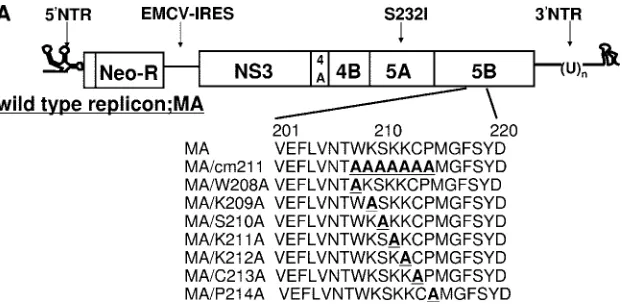
First, we tested the importance of NS5B aa 208 to 214, a region essential for nucleolin binding, in HCV RNA replication. For this purpose, we prepared eight mutant replicons (Fig. 1A). The wild-type replicon was represented by MA, in which S232 of NS5A was altered to I, because this mutant replicon can efficiently replicate in Huh7 cells (36, 56). In the replicon MA/cm211, each of the amino acids at positions 208 to 214 of NS5B was changed to alanine, whereas in the replicons MA/ W208A, K209A, S210A, K211A, K212A, C213A, and P214A, each individual amino acid residue was changed to alanine. All of these mutant replicons were transfected into Huh7-DMB cells, which were selected with G418, and the number of G418-resistant colonies was used as an indication of HCV RNA replication. In cells transfected with MA/cm211 and MA/ W208A, we observed no G418-resistant colonies, whereas in cells transfected with the six other point mutant replicons, as well as in cells transfected with MA/K211, we detected G418-resistant col-onies, but they were fewer than those detected with wild-type replicon MA (Fig. 1B). Our negative control, the mutant replicon M1LE/5B-VDD, in which the GDD motif of NS5B was mutated to VDD, yielded no G418-resistant colonies (data not shown). The results of this experiment indicated that the region of NS5B at aa 208 to 214, especially W208, is essential for HCV RNA replication.
Interaction between nucleolin and NS5B.Although we have shown that NS5B from isolate JK-1 binds to nucleolin, it was
necessary to show this in isolate M1LE. Due to the poor recovery of soluble full-length NS5B, we utilized NS5Bt (68), a soluble form of NS5B in which the C-terminal 21 aa were truncated, to dissect the interaction between NS5B and nucleo-lin. Previously, we confirmed that these 21 deleted amino acids were not essential for this interaction (20). FLAG-NS5Bt and GST-nucleolin were transiently coexpressed in COS1 cells, af-ter which the lysates were subjected to a GST pull-down assay and the bound proteins were immunologically detected with anti-FLAG M2 and anti-GST antibodies. We found that GST-nucleolin could bind FLAG-NS5Bt from the M1LE isolate, whereas GST could not, indicating that nucleolin interacts with NS5B in both JK-1 and M1LE isolates (Fig. 2). To determine the essential region/residues of NS5B required for its bind-ing to nucleolin, we again focused on aa 208 to 214 usbind-ing the alanine scanning method (3). We prepared FLAG-NS5Bt/ cm211, in which aa 208 to 214 were all replaced by alanine residues, and showed that it could not bind to GST-nucleo-lin in an in vivo immunoprecipitation assay (Fig. 2), indicat-ing that aa 208 to 214 of NS5B in both M1LE and JK-1 isolates constitute a critical region for the binding of nucleo-lin. To identify the exact residue(s) within aa 208 to 214 critical for binding to nucleolin, we prepared seven alanine-substituted point mutants in which each amino acid was replaced by alanine, and we tested the ability of each point mutant to bind to GST-nucleolin. Using an in vivo imnoprecipitation assay, we found that of the seven point mu-tants, only FLAG-NS5Bt/W208A could not bind to GST-nucleolin (Fig. 2), indicating that W208 of NS5B is essential for this binding and may be essential for HCV replication.
Suppression of endogenous nucleolin by siRNA.To identify the siRNA sequence that knocks down the expression of endogenous nucleolin, we used the prediction services of
FIG. 1. (A) Schematic representation of the mutant replicons used in this study. MA is a replicon carrying the point mutation S232I in NS5A and was used as the wild-type replicon. The mutant replicons MA/cm211, MA/W208A, MA/209A, MA/S210A, MA/211A, MA/212A, MA/213A, and MA/214A carry NS5B mutations in MA, as shown. Numbering starts from the beginning of NS5B. EMCV, encephalomyocarditis virus; IRES, internal ribosome entry site. (B) Effect of each mutation on HCV RNA replication. Huh7-DMB cells were electroporated with 1g of each rep-licon RNA, and G418-resistant cells were selected with 1 mg/ml G418 and stained 4 weeks later. This figure shows the mean number of G418-resistant cell colonies per 10-cm-diameter cell culture dish per 1g rep-licon RNA.
on November 8, 2019 by guest
http://jvi.asm.org/
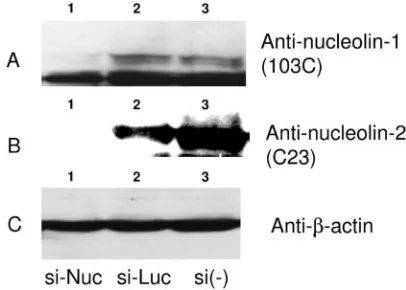
[image:3.585.138.449.68.220.2]iGENE (Tsukuba, Japan). We selected one sequence, si-Nuc, and, as a control for siRNA transfection, we utilized siRNA for luciferase (si-Luc) (GL3 luciferase duplex). Forty-eight hours after electroporation of each siRNA, at a concentra-tion of 1M, into Huh7-DMB, the lysates were analyzed by Western blotting analysis with two kinds of antibody to nucleolin. We found that both anti-nucleolin antibodies de-tected the expression of endogenous nucleolin. Although si-Nuc efficiently knocked down the expression of endoge-nous nucleolin, si-Luc did not (Fig. 3), showing the speci-ficity of the former. In addition, real-time PCR showed that si-Nuc decreased nucleolin mRNA by about one-third com-pared with si-Luc (data not shown).
Effect of nucleolin suppression on HCV replication.To test the effect of nucleolin knockdown on HCV RNA replica-tion, we transfected 1M of si-Nuc or si-Luc along with 100 ng of replicon MA RNA into Huh7-DMB cells and selected the cells with G418. As shown in Fig. 4, we found that cotransfection of si-Nuc reduced the number of G418-resis-tant colonies, whereas cotransfection of si-Luc did not (Fig. 4). As a control for the efficient transfection of siRNA, we used si-HCV, which targets the HCV internal ribosome entry site and can efficiently suppress HCV replication, as described pre-viously (51). Using this siRNA, we observed no G418-resistant colonies, indicating that siRNA was efficiently transfected un-der these experimental conditions. To rule out the possibility that suppression of nucleolin may have a detrimental effect on cells and may inhibit HCV RNA replication, we transfected pCI-Neo, which encodes a neomycin resistance gene under the control of a CMV promoter/enhancer, into Huh7-DMB cells,
[image:4.585.318.521.514.659.2]with or without si-Nuc and si-Luc, and selected the cells with 0.5 mg/dl G418. We found that the suppression of nucleolin expression did not significantly reduce the number of G418-resistant colonies (data not shown). In addition, massive cell death was not observed after the transfection of any siRNA (data not shown). These results indicate that the transient suppression of nucleolin may not affect cell proliferation but that nucleolin may affect the HCV replication complex itself.
FIG. 2. Interaction between nucleolin and NS5B of HCV isolate M1LE and an essential residue for this interaction. COS1 cells were transiently cotransfected with mammalian expression vectors expressing FLAG-NS5Bt proteins (lanes: 1 and 2, wild type; 3, cm211; 4, W208A; 5, K209A; 6, S210A; 7, K211A; 8, K212A; 9, C213A; 10, P214A) and GST protein alone (lane 1) or GST-nucleolin protein (lanes 2 to 10). (A) Input of FLAG-NS5Bt proteins. Total lysates were fractionated by SDS–10% PAGE and subjected to Western blot analysis with anti-FLAG M2 monoclonal antibody. (B) Output of FLAG-NS5Bt proteins. Coprecipitants by glutathione resin were washed with PBS(⫺) containing 1.0% Triton X-100, fractionated by SDS–10% PAGE, and subjected to Western blot analysis with anti-FLAG M2 monoclonal antibody. (C) Recovery of GST or GST-nucleolin proteins. The nitrocellulose membrane used for Western blot analysis of coprecipitants with anti-FLAG M2 antibody was reprobed with anti-GST antibody. Molecular masses (kilodaltons) are indicated to the right of the panel.
FIG. 3. Knockdown of endogenous nucleolin by siRNA. Huh7-DMB cells were electroporated with 1M si-Nuc and si-Luc. After 48 h, total cell lysates were fractionated by SDS–10% PAGE and subjected to Western blot analysis with the anti-nucleolin antibodies nucleolin-1 (103C) in A and nucleolin-2 (C23) in B and
anti--actin antibody in C. Lanes: 1, cells transfected with si-Nuc; 2, cells transfected with si-Luc; 3, no siRNA [si(⫺)].
on November 8, 2019 by guest
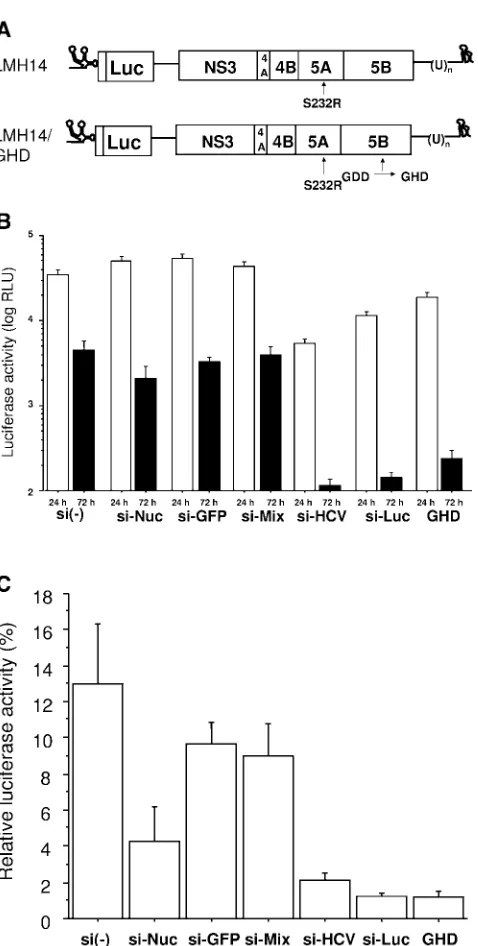
Because the knockdown effect of siRNA does not continue for more than 3 weeks after transient transfection, the number of G418-resistant colonies may not be a good indicator of HCV RNA replication. We therefore performed a transient replica-tion assay using a replicon in which the neomycin resistance gene was replaced by a luciferase gene, and luciferase activity was used as a marker of HCV RNA replication. Transfection of MH14 RNA, which was used as the wild-type replicon, into a subline of Huh7 cells resulted in highly efficient luciferase activity, whereas a polymerase-defective RNA replicon of MH14, MH4GHD, in which the catalytic GDD motif of NS5B polymerase was replaced by an inactive GHD motif, was used
as a negative control (Fig. 5A). si-HCV and si-Luc suppressed the luciferase activity even at 24 h after transfection, but other siRNAs did not affect the luciferase activity, and luciferase activities in these siRNAs were similar to that of the control (no siRNA) at this point (Fig. 5B). We found that cotransfec-tion of si-Nuc moderately suppressed both luciferase activity at 72 h after transfection and relative luciferase activity, whereas cotransfection of si-GFP and si-Mix did not (Fig. 5B and C). Cotransfection of si-HCV and si-Luc almost completely sup-pressed luciferase activity at 72 h after transfection. In a tran-sient replication assay, the suppression of endogenous nucleo-lin also inhibited HCV replication.
FIG. 4. Effect of suppression of endogenous nucleolin on HCV replication in the MA replicon. Huh7-DMB cells were electroporated with 1
g of in vitro-transcribed MA RNA plus si-Nuc, si-Luc, si-HCV, or no siRNA [si(⫺)], and G418-resistant cells were selected with 1 mg/ml G418 and were stained 4 weeks later. (A) Mean number of G418-resistant colonies per 10-cm-diameter cell culture dish per 1g replicon RNA. Error bars indicate the standard deviations of the results from at least three independent experiments. (B) Visualization of G418-resistant colonies, as described in Materials and Methods.
on November 8, 2019 by guest
http://jvi.asm.org/
expressed in stable cell lines harboring replicons, they colocalize to these membrane structures, indicating that they might form a complex (16, 39, 47). These nonstructural proteins, together with host factors, form the viral replicase, the complex in which viral replication is thought to take place. The in vitro level of the RdRp activity of NS5B is low (12), indicating that cofac-tors, whether viral and/or host proteins and/or the appropriate cellular environment, are necessary for optimal activity of HCV RdRp. HCV NS5B has been reported to interact with NS3, NS4A, NS4B, NS5A, and NS5B itself (9, 48, 57, 65). Using an HCV subgenomic replicon, we previously reported the critical role of the interaction between NS5A and NS5B and the oligomerization of NS5B itself in HCV replication (36, 56). NS3 and NS4B have been shown to be positive and neg-ative regulators, respectively, of NS5B in the replication com-plex (46).
In addition to interacting with HCV nonstructural proteins, NS5B has been reported to interact with many host proteins, including a SNARE-like protein (62); eIF4AII, an RNA-de-pendent ATPase/helicase; a component of the translation ini-tiation complex (30), protein kinase C-related kinase 2, which specifically phosphorylates NS5B (27); and p68, a human RNA helicase I (15). The suppression of protein kinase C-related kinase 2 has been reported to reduce the phosphorylation of NS5B and to inhibit HCV RNA replication (27), and the suppression of p68 has been reported to inhibit the synthesis of negative-strand HCV RNA from the positive strand (15).
Several host proteins have been shown to interact with RdRp of other RNA viruses. For example, in poliovirus, an RdRp and an RdRp precursor interact with human Sam68 (38) and heterogeneous nuclear ribonucleoprotein C1/C2 (5), respectively, and modulate RdRp activity directly or indirectly. Bromo mosaic virus RdRp and tobacco mosaic virus RdRp interact with eukaryotic initiation factor 3 and eukaryotic initiation factor 3-related factor, altering RdRp activity (45, 50).
[image:6.585.46.285.82.555.2]Here and in a previous report, we identified and character-ized the interaction between nucleolin and HCV NS5B (20). Nucleolin was originally identified as a common phosphopro-tein of growing eukaryotic cells, although its function is not completely understood. Nucleolin is a multifunctional protein that shuttles between the nucleus and cytoplasm. In addition, it is expressed on the surface of various cells, acting as a receptor for various ligands, including lipoproteins (55), cytokines, growth factors (6, 52, 60), the extracellular matrix (10, 18, 25), bacteria (58), and viruses (4, 8, 21, 41–44).
FIG. 5. Effect of suppression of endogenous nucleolin on HCV replication in the LMH14 replicon. (A) Schematic representation of the luciferase replicon. In the LMH14 replicon, the neomycin resis-tance gene was replaced by a luciferase gene, and S232 of NS5A was replaced by R. In the LMH14/GHD replicon, the NS5B GDD motif in LMH14 was changed to GHD and used as a negative control. (B) Cells were transfected with in vitro-transcribed LHH14 or LMH14/GHD RNA along with 2M of si-Mix, si-GFP, si-Nuc, si-Luc, si-HCV, or no siRNA [si(⫺)] using the DMRIE-C reagent, and luciferase activity (relative light units [RLU]) was measured 24 and 72 h after transfec-tion. Shown are the activities at 24 and 72 h. Error bars indicate the standard deviations of the results from at least three independent experiments. (C) Activity at 24 h was used as an indication of each transfection. Shown are the ratios of activity (percent) at 72 h relative to that at 24 h. Error bars indicate the standard deviations of the results from at least three independent experiments.
on November 8, 2019 by guest
We found that recombinant C-terminal nucleolin proteins can bind NS5B and inhibit its RdRp activity in a dose-depen-dent manner (20), suggesting that nucleolin may affect HCV replication by interacting with NS5B. The direct interaction of nucleolin with HCV NS5B in vivo and in vitro was shown to require two critical stretches of NS5B. Here, we showed that within one of these regions, aa 208 to 214, the W208 residue was critical for both binding of nucleolin and HCV replication. Transient down-regulation of endogenous nucleolin by siRNA considerably inhibited HCV replication in Huh7 cells. These results strongly indicate that nucleolin has an important role in HCV replication through its direct interaction with NS5B.
Our finding of an important positive role for nucleolin in HCV replication is apparently inconsistent with previous find-ings of an inhibitory role for nucleolin. It was previously re-ported that purified C-terminal nucleolin proteins inhibited the RdRp activity of NS5B in vitro. The latter result, however, may have been due to the use of recombinant truncated nucleolin proteins, because recombinant full-length nucleolin was not avail-able (70). Taken together, however, these results indicate that N-terminal nucleolin may be important for the positive function of nucleolin in HCV replication, although the NS5B-binding re-gion is within the RGG domain and RNA-binding domain 4 is at the C terminus.
Transfection of the mutant replicon containing NS5B W208A, which could not bind nucleolin, led to almost no HCV replication. By contrast, the suppression of nucleolin by siRNA moderately inhibited HCV replication, a result also observed with the
tran-sient assay using luciferase reporter replicon and G418-resistant colony formation. While HCV replication was completely inhib-ited by MA/W208A, replication was only partially inhibinhib-ited by si-Nuc, indicating that si-Nuc can transiently suppress, but cannot eliminate, expression of endogenous nucleolin. Recently, nucleo-lin was reported to inhibit cell cycle progression after heat shock and genotoxic stress by increasing complex formation with human replication protein A (26). When pGL3 control or pCI-Neo was cotransfected with si-Nuc, the luciferase activity or the number of G418-resistant colonies was not reduced, strongly suggesting that the moderate inhibition of nucleolin expression did not have severe cytotoxic effects on siRNA-transfected cells. More efficient suppression of nucleolin may result in more severe inhibition of HCV RNA replication. It is therefore important to determine whether nucleolin is dispens-able in mammalian cells as it is inSaccharomyces pombe(17)
andSaccharomyces cerevisiae(31), since nucleolin may
consti-tute a putative therapeutic target to inhibit HCV replication. Using a clustered alanine substitution mutant library (CM) of NS5B, we previously showed that two stretches of NS5B amino acids, aa 208 to 214 and 500 to 506, were critical for nucleolin binding. According to the crystal models of NS5B, the former stretch is in the palm and the latter stretch is in the bottom of the thumb domain. We focused on identifying res-idues in aa 208 to 214 that are essential for nucleolin binding and HCV replication, as the CM mutant of aa 500 to 506 was defective in RdRp activity in vitro and HCV replication in vivo (36, 48, 49). We found that the W208 residue was critical for
FIG. 6. Effect of suppression of endogenous nucleolin on cell proliferation. The plasmid pGL3 control, encoding the luciferase gene under the control of the CMV promoter/enhancer, was cotransfected with 2M of si-Mix, si-GFP, si-Nuc, si-HCV, or no siRNA [si(⫺)] using DMRIE-C reagent, and luciferase activity was measured 48 and 72 h after transfection. The error bars indicate the standard deviations of the results from at least three independent experiments.
on November 8, 2019 by guest
http://jvi.asm.org/
pocket of catalytic activity and did not affect binding to nucleo-lin, K211 may contribute to the structural integrity of the pocket or the heat-stable property of RdRp as reported pre-viously (36).
Efficient HCV replication and infection in tissue-cultured cells by using full-length HCV RNA replicons have been re-ported previously (32, 63, 72). HCV replication occurs in dif-ferentiated subcellular fractions and involves dynamic com-plexes of structural proteins, nonstructural proteins, and HCV RNA demarcated by membrane structures. It is therefore of great interest to determine whether nucleolin is involved in such HCV-replicating intermediates in compartmented subcel-lular structures.
REFERENCES
1.Alter, H. J., R. H. Purcell, J. W. Shih, J. C. Melpolder, M. Houghton, Q. L. Choo, and G. Kuo.1989. Detection of antibody to hepatitis C virus in prospectively followed transfusion recipients with acute and chronic non-A, non-B hepatitis. N. Engl. J. Med.321:1494–1500.
2.Behrens, S. E., L. Tomei, and R. De Francesco.1996. Identification and properties of the RNA-dependent RNA polymerase of hepatitis C virus. EMBO J.15:12–22.
3.Bordo, D., and P. Argos.1991. Suggestions for “safe” residue substitutions in site-directed mutagenesis. J. Mol. Biol.217:721–729.
4.Bose, S., M. Basu, and A. K. Banerjee.2004. Role of nucleolin in human parainfluenza virus type 3 infection of human lung epithelial cells. J. Virol. 78:8146–8158.
5.Brunner, J. E., J. H. Nguyen, H. H. Roehl, T. V. Ho, K. M. Swiderek, and B. L. Semler.2005. Functional interaction of heterogeneous nuclear ribo-nucleoprotein C with poliovirus RNA synthesis initiation complexes. J. Virol. 79:3254–3266.
6.Callebaut, C., S. Nisole, J. P. Briand, B. Krust, and A. G. Hovanessian.2001. Inhibition of HIV infection by the cytokine midkine. Virology281:248–264. 7.Choo, Q. L., G. Kuo, A. J. Weiner, L. R. Overby, D. W. Bradley, and M. Houghton.1989. Isolation of a cDNA clone derived from a blood-borne non-A, non-B viral hepatitis genome. Science244:359–362.
8.de Verdugo, U. R., H. C. Selinka, M. Huber, B. Kramer, J. Kellermann, P. H. Hofschneider, and R. Kandolf.1995. Characterization of a 100-kilodalton binding protein for the six serotypes of coxsackie B viruses. J. Virol.69:6751– 6757.
9.Dimitrova, M., I. Imbert, M. P. Kieny, and C. Schuster.2003. Protein-protein interactions between hepatitis C virus nonstructural Protein-proteins. J. Vi-rol.77:5401–5414.
10.Dumler, I., V. Stepanova, U. Jerke, O. A. Mayboroda, F. Vogel, P. Bouvet, V. Tkachuk, H. Haller, and D. C. Gulba.1999. Urokinase-induced mitogenesis is mediated by casein kinase 2 and nucleolin. Curr. Biol.9:1468–1476. 11.Egger, D., B. Wolk, R. Gosert, L. Bianchi, H. E. Blum, D. Moradpour, and
K. Bienz.2002. Expression of hepatitis C virus proteins induces distinct membrane alterations including a candidate viral replication complex. J. Vi-rol.76:5974–5984.
12.Ferrari, E., J. Wright-Minogue, J. W. Fang, B. M. Baroudy, J. Y. Lau, and Z. Hong.1999. Characterization of soluble hepatitis C virus RNA-dependent RNA polymerase expressed inEscherichia coli. J. Virol.73:1649–1654. 13.Friebe, P., and R. Bartenschlager.2002. Genetic analysis of sequences in the
3⬘ nontranslated region of hepatitis C virus that are important for RNA replication. J. Virol.76:5326–5338.
14.Ginisty, H., H. Sicard, B. Roger, and P. Bouvet.1999. Structure and func-tions of nucleolin. J. Cell Sci.112:761–772.
Nomura, K. Kobayashi, and S. Murakami.2003. Direct interaction between nucleolin and hepatitis C virus NS5B. J. Biol. Chem.278:5109–5115. 21.Hovanessian, A. G., F. Puvion-Dutilleul, S. Nisole, J. Svab, E. Perret, J. S.
Deng, and B. Krust.2000. The cell-surface-expressed nucleolin is associated with the actin cytoskeleton. Exp. Cell Res.261:312–328.
22.Ikeda, M., M. Yi, K. Li, and S. M. Lemon.2002. Selectable subgenomic and genome-length dicistronic RNAs derived from an infectious molecular clone of the HCV-N strain of hepatitis C virus replicate efficiently in cultured Huh7 cells. J. Virol.76:2997–3006.
23.Kato, N., Y. Ootsuyama, H. Sekiya, S. Ohkoshi, T. Nakazawa, M. Hijikata, and K. Shimotohno.1994. Genetic drift in hypervariable region 1 of the viral genome in persistent hepatitis C virus infection. J. Virol.68:4776–4784. 24.Kato, T., T. Date, M. Miyamoto, Z. Zhao, M. Mizokami, and T. Wakita.
2005. Nonhepatic cell lines HeLa and 293 support efficient replication of the hepatitis C virus genotype 2a subgenomic replicon. J. Virol.79:592–596. 25.Kibbey, M. C., B. Johnson, R. Petryshyn, M. Jucker, and H. K. Kleinman.
1995. A 110-kD nuclear shuttling protein, nucleolin, binds to the neurite-promoting IKVAV site of laminin-1. J. Neurosci. Res.42:314–322. 26.Kim, K., D. D. Dimitrova, K. M. Carta, A. Saxena, M. Daras, and J. A.
Borowiec.2005. Novel checkpoint response to genotoxic stress mediated by nucleolin-replication protein A complex formation. Mol. Cell. Biol.25:2463– 2474.
27.Kim, S. J., J. H. Kim, Y. G. Kim, H. S. Lim, and J. W. Oh.2004. Protein kinase C-related kinase 2 regulates hepatitis C virus RNA polymerase func-tion by phosphorylafunc-tion. J. Biol. Chem.279:50031–50041.
28.Kishine, H., K. Sugiyama, M. Hijikata, N. Kato, H. Takahashi, T. Noshi, Y. Nio, M. Hosaka, Y. Miyanari, and K. Shimotohno.2002. Subgenomic rep-licon derived from a cell line infected with the hepatitis C virus. Biochem. Biophys. Res. Commun.293:993–999.
29.Kolykhalov, A. A., K. Mihalik, S. M. Feinstone, and C. M. Rice.2000. Hepatitis C virus-encoded enzymatic activities and conserved RNA elements in the 3⬘ nontranslated region are essential for virus replication in vivo. J. Virol.74:2046–2051.
30.Kyono, K., M. Miyashiro, and I. Taguchi.2002. Human eukaryotic initiation factor 4AII associates with hepatitis C virus NS5B proteinin vitro. Biochem. Biophys. Res. Commun.292:659–666.
31.Lee, W. C., D. Zabetakis, and T. Melese.1992. NSR1 is required for pre-rRNA processing and for the proper maintenance of steady-state levels of ribosomal subunits. Mol. Cell. Biol.12:3865–3871.
32.Lindenbach, B. D., M. J. Evans, A. J. Syder, B. Wolk, T. L. Tellinghuisen, C. C. Liu, T. Maruyama, R. O. Hynes, D. R. Burton, J. A. McKeating, and C. M. Rice.2005. Complete replication of hepatitis C virus in cell culture. Science309:623–626.
33.Lindenbach, B. D., and C. M. Rice.2005. Unravelling hepatitis C virus replication from genome to function. Nature436:933–938.
34.Lohmann, V., F. Korner, U. Herian, and R. Bartenschlager.1997. Biochem-ical properties of hepatitis C virus NS5B RNA-dependent RNA polymerase and identification of amino acid sequence motifs essential for enzymatic activity. J. Virol.71:8416–8428.
35.Lohmann, V., F. Korner, J. Koch, U. Herian, L. Theilmann, and R. Barten-schlager. 1999. Replication of subgenomic hepatitis C virus RNAs in a hepatoma cell line. Science285:110–113.
36.Ma, Y., T. Shimakami, H. Luo, N. Hayashi, and S. Murakami.2004. Muta-tional analysis of hepatitis C virus NS5B in the subgenomic replicon cell culture. J. Biol. Chem.279:25474–25482.
37.Matthews, D. A.2001. Adenovirus protein V induces redistribution of nucleolin and B23 from nucleolus to cytoplasm. J. Virol.75:1031–1038.
38.McBride, A. E., A. Schlegel, and K. Kirkegaard.1996. Human protein Sam68 relocalization and interaction with poliovirus RNA polymerase in infected cells. Proc. Natl. Acad. Sci. USA93:2296–2301.
39.Mottola, G., G. Cardinali, A. Ceccacci, C. Trozzi, L. Bartholomew, M. R. Torrisi, E. Pedrazzini, S. Bonatti, and G. Migliaccio.2002. Hepatitis C virus
on November 8, 2019 by guest
nonstructural proteins are localized in a modified endoplasmic reticulum of cells expressing viral subgenomic replicons. Virology293:31–43.
40.Murata, T., T. Ohshima, M. Yamaji, M. Hosaka, Y. Miyanari, M. Hijikata, and K. Shimotohno. 2005. Suppression of hepatitis C virus replicon by TGF-beta. Virology331:407–417.
41.Nisole, S., B. Krust, C. Callebaut, G. Guichard, S. Muller, J. P. Briand, and A. G. Hovanessian.1999. The anti-HIV pseudopeptide HB-19 forms a com-plex with the cell-surface-expressed nucleolin independent of heparan sul-fate proteoglycans. J. Biol. Chem.274:27875–27884.
42.Nisole, S., B. Krust, E. Dam, A. Bianco, N. Seddiki, S. Loaec, C. Callebaut, G. Guichard, S. Muller, J. P. Briand, and A. G. Hovanessian.2000. The HB-19 pseudopeptide 5[Kpsi(CH2N)PR]-TASP inhibits attachment of T lymphocyte- and macrophage-tropic HIV to permissive cells. AIDS Res. Hum. Retrovir.16:237–249.
43.Nisole, S., B. Krust, and A. G. Hovanessian.2002. Anchorage of HIV on permissive cells leads to coaggregation of viral particles with surface nucleo-lin at membrane raft microdomains. Exp. Cell Res.276:155–173. 44.Nisole, S., E. A. Said, C. Mische, M. C. Prevost, B. Krust, P. Bouvet, A.
Bianco, J. P. Briand, and A. G. Hovanessian.2002. The anti-HIV pentameric pseudopeptide HB-19 binds the C-terminal end of nucleolin and prevents anchorage of virus particles in the plasma membrane of target cells. J. Biol. Chem.277:20877–20886.
45.Osman, T. A., and K. W. Buck. 1997. The tobacco mosaic virus RNA polymerase complex contains a plant protein related to the RNA-binding subunit of yeast eIF-3. J. Virol.71:6075–6082.
46.Piccininni, S., A. Varaklioti, M. Nardelli, B. Dave, K. D. Raney, and J. E. McCarthy.2002. Modulation of the hepatitis C virus RNA-dependent RNA polymerase activity by the non-structural (NS) 3 helicase and the NS4B membrane protein. J. Biol. Chem.277:45670–45679.
47.Pietschmann, T., V. Lohmann, G. Rutter, K. Kurpanek, and R. Barten-schlager.2001. Characterization of cell lines carrying self-replicating hepa-titis C virus RNAs. J. Virol.75:1252–1264.
48.Qin, W., H. Luo, T. Nomura, N. Hayashi, T. Yamashita, and S. Murakami. 2002. Oligomeric interaction of hepatitis C virus NS5B is critical for catalytic activity of RNA-dependent RNA polymerase. J. Biol. Chem.277:2132–2137. 49.Qin, W., T. Yamashita, Y. Shirota, Y. Lin, W. Wei, and S. Murakami.2001. Mutational analysis of the structure and functions of hepatitis C virus RNA-dependent RNA polymerase. Hepatology33:728–737.
50.Quadt, R., C. C. Kao, K. S. Browning, R. P. Hershberger, and P. Ahlquist. 1993. Characterization of a host protein associated with brome mosaic virus RNA-dependent RNA polymerase. Proc. Natl. Acad. Sci. USA90:1498– 1502.
51.Randall, G., A. Grakoui, and C. M. Rice.2003. Clearance of replicating hepatitis C virus replicon RNAs in cell culture by small interfering RNAs. Proc. Natl. Acad. Sci. USA100:235–240.
52.Said, E. A., B. Krust, S. Nisole, J. Svab, J. P. Briand, and A. G. Hovanessian. 2002. The anti-HIV cytokine midkine binds the cell surface-expressed nucleolin as a low affinity receptor. J. Biol. Chem.277:37492–37502. 53.Saito, I., T. Miyamura, A. Ohbayashi, H. Harada, T. Katayama, S. Kikuchi,
Y. Watanabe, S. Koi, M. Onji, Y. Ohta, et al.1990. Hepatitis C virus infection is associated with the development of hepatocellular carcinoma. Proc. Natl. Acad. Sci. USA87:6547–6549.
54.Seeff, L. B.1997. Natural history of hepatitis C. Hepatology26:21S–28S. 55.Semenkovich, C. F., R. E. Ostlund, Jr., M. O. Olson, and J. W. Yang.1990.
A protein partially expressed on the surface of HepG2 cells that binds lipoproteins specifically is nucleolin. Biochemistry29:9708–9713. 56.Shimakami, T., M. Hijikata, H. Luo, Y. Y. Ma, S. Kaneko, K. Shimotohno,
and S. Murakami. 2004. Effect of interaction between hepatitis C virus
NS5A and NS5B on hepatitis C virus RNA replication with the hepatitis C virus replicon. J. Virol.78:2738–2748.
57.Shirota, Y., H. Luo, W. Qin, S. Kaneko, T. Yamashita, K. Kobayashi, and S. Murakami.2002. Hepatitis C virus (HCV) NS5A binds RNA-dependent RNA polymerase (RdRP) NS5B and modulates RNA-dependent RNA poly-merase activity. J. Biol. Chem.277:11149–11155.
58.Sinclair, J. F., and A. D. O’Brien.2002. Cell surface-localized nucleolin is a eukaryotic receptor for the adhesin intimin-gamma of enterohemorrhagic Escherichia coli O157:H7. J. Biol. Chem.277:2876–2885.
59.Srivastava, M., and H. B. Pollard.1999. Molecular dissection of nucleolin’s role in growth and cell proliferation: new insights. FASEB J.13:1911–1922. 60.Take, M., J. Tsutsui, H. Obama, M. Ozawa, T. Nakayama, I. Maruyama, T. Arima, and T. Muramatsu.1994. Identification of nucleolin as a binding protein for midkine (MK) and heparin-binding growth associated molecule (HB-GAM). J. Biochem. (Tokyo)116:1063–1068.
61.Tsukiyama-Kohara, K., N. Iizuka, M. Kohara, and A. Nomoto.1992. Inter-nal ribosome entry site within hepatitis C virus RNA. J. Virol.66:1476–1483. 62.Tu, H., L. Gao, S. T. Shi, D. R. Taylor, T. Yang, A. K. Mircheff, Y. Wen, A. E. Gorbalenya, S. B. Hwang, and M. M. Lai.1999. Hepatitis C virus RNA polymerase and NS5A complex with a SNARE-like protein. Virology263: 30–41.
63.Wakita, T., T. Pietschmann, T. Kato, T. Date, M. Miyamoto, Z. Zhao, K. Murthy, A. Habermann, H. G. Krausslich, M. Mizokami, R. Bartenschlager, and T. J. Liang.2005. Production of infectious hepatitis C virus in tissue culture from a cloned viral genome. Nat. Med.11:791–796.
64.Wang, C., P. Sarnow, and A. Siddiqui.1993. Translation of human hepatitis C virus RNA in cultured cells is mediated by an internal ribosome-binding mechanism. J. Virol.67:3338–3344.
65.Wang, Q. M., M. A. Hockman, K. Staschke, R. B. Johnson, K. A. Case, J. Lu, S. Parsons, F. Zhang, R. Rathnachalam, K. Kirkegaard, and J. M. Colacino. 2002. Oligomerization and cooperative RNA synthesis activity of hepatitis C virus RNA-dependent RNA polymerase. J. Virol.76:3865–3872. 66.Weiner, A. J., M. J. Brauer, J. Rosenblatt, K. H. Richman, J. Tung, K.
Crawford, F. Bonino, G. Saracco, Q. L. Choo, M. Houghton, et al.1991. Variable and hypervariable domains are found in the regions of HCV cor-responding to the flavivirus envelope and NS1 proteins and the pestivirus envelope glycoproteins. Virology180:842–848.
67.Weiner, A. J., H. M. Geysen, C. Christopherson, J. E. Hall, T. J. Mason, G. Saracco, F. Bonino, K. Crawford, C. D. Marion, K. A. Crawford, et al.1992. Evidence for immune selection of hepatitis C virus (HCV) putative envelope glycoprotein variants: potential role in chronic HCV infections. Proc. Natl. Acad. Sci. USA89:3468–3472.
68.Yamashita, T., S. Kaneko, Y. Shirota, W. Qin, T. Nomura, K. Kobayashi, and S. Murakami.1998. RNA-dependent RNA polymerase activity of the soluble recombinant hepatitis C virus NS5B protein truncated at the C-terminal region. J. Biol. Chem.273:15479–15486.
69.Yanagi, M., M. St. Claire, S. U. Emerson, R. H. Purcell, and J. Bukh.1999. In vivoanalysis of the 3⬘untranslated region of the hepatitis C virus afterin vitromutagenesis of an infectious cDNA clone. Proc. Natl. Acad. Sci. USA 96:2291–2295.
70.Yang, T. H., W. H. Tsai, Y. M. Lee, H. Y. Lei, M. Y. Lai, D. S. Chen, N. H. Yeh, and S. C. Lee.1994. Purification and characterization of nucleolin and its identification as a transcription repressor. Mol. Cell. Biol.14:6068–6074. 71.Yi, M., and S. M. Lemon.2003. 3⬘nontranslated RNA signals required for
replication of hepatitis C virus RNA. J. Virol.77:3557–3568.
72.Zhong, J., P. Gastaminza, G. Cheng, S. Kapadia, T. Kato, D. R. Burton, S. F. Wieland, S. L. Uprichard, T. Wakita, and F. V. Chisari. 2005. Robust hepatitis C virus infectionin vitro. Proc. Natl. Acad. Sci. USA102:9294–9299.