C
2011. The American Astronomical Society. All rights reserved. Printed in the U.S.A.
CHARACTERISTICS OF
KEPLER
PLANETARY CANDIDATES BASED ON THE FIRST DATA SET
William J. Borucki1, David G. Koch1, Gibor Basri2, Natalie Batalha3, Alan Boss4, Timothy M. Brown5,
Douglas Caldwell6, Jørgen Christensen-Dalsgaard7, William D. Cochran8, Edna DeVore6, Edward W. Dunham9,
Andrea K. Dupree10, Thomas N. Gautier III11, John C. Geary10, Ronald Gilliland12, Alan Gould13, Steve B. Howell14,
Jon M. Jenkins6, Hans Kjeldsen7, David W. Latham10, Jack J. Lissauer1, Geoffrey W. Marcy2, David G. Monet15,
Dimitar Sasselov10, Jill Tarter6, David Charbonneau10, Laurance Doyle6, Eric B. Ford16, Jonathan Fortney17,
Matthew J. Holman10, Sara Seager18, Jason H. Steffen19, William F. Welsh20, Christopher Allen21, Stephen
T. Bryson1, Lars Buchhave10, Hema Chandrasekaran6, Jessie L. Christiansen6, David Ciardi22, Bruce D. Clarke6,
Jessie L. Dotson1, Michael Endl8, Debra Fischer23, Francois Fressin10, Michael Haas1, Elliott Horch24,
Andrew Howard2, Howard Isaacson2, Jeffery Kolodziejczak25, Jie Li6, Phillip MacQueen8, Søren Meibom10,
Andrej Prsa26, Elisa V. Quintana6, Jason Rowe1, William Sherry14, Peter Tenenbaum6, Guillermo Torres10,
Joseph D. Twicken6, Jeffrey Van Cleve6, Lucianne Walkowicz2, and Hayley Wu6
1NASA Ames Research Center, Moffett Field, CA 94035, USA;[email protected] 2University of California, Berkeley, CA 94720, USA
3San Jose State University, San Jose, CA 95192, USA 4Carnegie Institute of Washington, Washington, DC 20015, USA 5Las Cumbres Observatory Global Telescope, Goleta, CA 93117, USA
6SETI Institute, Mountain View, CA 94043, USA 7Aarhus University, Aarhus, Denmark
8McDonald Observatory, University of Texas at Austin, Austin, TX 78712, USA 9Lowell Observatory, Flagstaff, AZ 86001, USA
10Harvard-Smithsonian Center for Astrophysics, Cambridge, MA 02138, USA 11Jet Propulsion Laboratory, California Institute of Technology, Pasadena, CA 91109, USA
12Space Telescope Science Institute, Baltimore, MD 21218, USA 13Lawrence Hall of Science, Berkeley, CA 94720, USA
14NOAO, Tucson, AZ 85719, USA
15United States Naval Observatory, Flagstaff, AZ 86001, USA 16University of Florida, Gainesville, FL 32611, USA 17University of California, Santa Cruz, CA 95064, USA
18MIT, Cambridge, MA 02139, USA 19Fermilab, Batavia, IL 60510, USA
20San Diego State University, San Diego, CA 92182, USA 21Orbital Sciences Corp., Mountain View, CA 94043, USA 22Exoplanet Science Institute/Caltech, Pasadena, CA 91125, USA
23Yale University, New Haven, CT 06520, USA
24Southern Connecticut State University, New Haven, CT 06515, USA 25MSFC, Huntsville, AL 35805, USA
26Villanova University, Villanova, PA 19085, USA
Received 2010 July 21; accepted 2010 December 13; published 2011 January 28
ABSTRACT
In the spring of 2009, the Kepler Mission commenced high-precision photometry on nearly 156,000 stars to determine the frequency and characteristics of small exoplanets, conduct a guest observer program, and obtain asteroseismic data on a wide variety of stars. On 2010 June 15, theKeplerMission released most of the data from the first quarter of observations. At the time of this data release, 705 stars from this first data set have exoplanet candidates with sizes from as small as that of Earth to larger than that of Jupiter. Here we give the identity and characteristics of 305 released stars with planetary candidates. Data for the remaining 400 stars with planetary candidates will be released in 2011 February. More than half the candidates on the released list have radii less than half that of Jupiter. Five candidates are present in and near the habitable zone; two near super-Earth size, and three bracketing the size of Jupiter. The released stars also include five possible multi-planet systems. One of these has two Neptune-size (2.3 and 2.5 Earth radius) candidates with near-resonant periods.
Key words: planets and satellites: detection – surveys
Online-only material:color figures
1. INTRODUCTION
Kepleris a Discovery-class mission designed to determine
the frequency of Earth-size planets in and near the habitable zone (HZ) of solar-type stars. The instrument consists of a 0.95 m aperture telescope/photometer designed to obtain high-precision photometric measurements of>100,000 stars to search for patterns of transits. The focal plane of the Schmidt-type telescope contains 42 CCDs with a total of 95 megapixels
that cover 115 deg2 of sky. Kepler was launched into an Earth-trailing heliocentric orbit on 2009 March 6, finished its commissioning on 2009 May 12, and is now in science operations mode. Further details of the Kepler Mission and instrument can be found in Koch et al. (2010b), Jenkins et al. (2010c), and Caldwell et al. (2010).
operation, 156,097 stars were similarly observed. Five new exo-planets with sizes between 0.37 and 1.6 Jupiter radii and orbital periods from 3.2 to 4.9 days were confirmed by radial veloc-ity (RV) observations (Borucki et al.2010; Koch et al.2010a; Dunham et al.2010; Jenkins et al.2010a; Latham et al.2010).
The results discussed in this paper are based on the first data segment taken at the beginning of science operations on 2009 May 13 UT and finished on 2009 15 June 15 UT; a 33.5-day segment (labeled Q1).
The observations usedKepler’s normal list of 156,097 exo-planet target stars. TheKepler Kp bandpass covers both theV andRphotometric passbands. These stars are primarily main-sequence dwarfs chosen from theKeplerInput Catalog (KIC). Stars were chosen to maximize the number of stars that were both bright and small enough to show detectable transit signals for small planets in and near the HZ (Batalha et al.2010). Most stars were in the magnitude range 9<Kp<16.
Data for all stars are recorded at a cadence of one per 29.4 minutes (hereafter, long cadence, or LC). Data for a subset of 512 stars are also recorded at a cadence of one per 58.5 s (hereafter, short cadence or SC), sufficient to conduct asteroseismic observations needed for measurements of the stars’ size, mass, and age. The results presented here are based only on LC data. For a full discussion of the LC data and their reduction, see Jenkins et al. (2010b,2010c); see Gilliland et al. (2010) for a discussion of the SC data.
At the one-year anniversary of the receipt of the first set of data from the beginning of science operations, the data for 156,097 stars covering these two periods are now available to the public, apart from two exceptions: 400 stars held back to allow completion of one season of observations by theKepler
team, and 2778 stars held back for the Guest Observers and Asteroseismic Science Consortium (KASC). These data will be released on 2011 February 1, and in 2010 November when the proprietary period is complete, respectively. A total of 152,919 stars are now available at several levels of processing at the Multi-Mission Archive at the Space Telescope Science Institute (MAST27) for analysis by the community.
2. DESCRIPTION OF THE DATA
Because of great improvements to the data-processing pipeline, many more candidates are readily visible than in the data used for the papers published in early 2010. During the early phase of operations, many of the candidates were found by vi-sual inspection, but with recent improvements to the analysis pipeline, most are now being detected in an automated fash-ion. Over 855 stars with transiting exoplanet signatures have been identified. Of those, approximately 150 have been identi-fied as likely false positives and, consequently, removed from consideration as viable exoplanet candidates.
A separate paper that identifies false positive events found in the released data will be submitted. In the interim, see the list at the MAST. False positive events are patterns of dimming that appear to be the result of planetary transits, but are actually caused by other astrophysical processes or by instrumental fluctuations in the brightness values that mimic planetary transits. The identification of the false positives should help the community avoid wasting observation resources.
Data and search techniques capable of finding planetary transits are also very sensitive to eclipsing binary (EB) stars, and indeed the number of EBs discovered withKepler vastly
27 http://archive.stsci.edu/kepler/kepler_fov/search.php
exceeds the number of planetary candidates. With more study, some of the current planetary candidates might also be shown to be EBs. Prsa et al. (2010) present a list of EBs with their basic system parameters that have been detected in these early data.
The discussion in this paper covers the 305 stars with candidates that the Kepler team does not plan to give high priority for follow-up confirmation. These are generally faint stars and were not observed for the first 9.7-day time interval. Thus, only 33.5 days of data are available for most candidates discussed herein. AnAppendixidentifying these candidates and providing their characteristics is attached.
2.1. Selecting the Candidates to Release
The candidates discussed here do not include 400 stars selected as high-priority targets. These are primarily those amenable to ground-based follow-up observations and those with the smallest candidates. In particular, these stars include (1) those showing two or more sets of transit events at distinctly different periods, (2) those showing any indication of transit-timing variations that could lead to detection of additional planets, (3) stars cooler than 4000 K, (4) stars brighter than
Kp = 13.9, (5) candidates with a likelihood of showing a secondary occultation event, and (6) stars with candidates smaller than 1.5R⊕. The likelihood of an occultation event is determined by computing the ratio of the stellar luminosity to the thermal emission of the planet assuming an even distribution of energy over the day and night side of the planet, an albedo of 0.1, and a circular orbit at a distance given by the stellar properties in the KIC and the period provided by the transit photometry. This ratio is then compared to the expected photometric noise given the apparent brightness of the star in question. Targets are flagged if the occultation depth is expected to be larger than 2σ. Collectively, these criteria yielded 400 stars, though the large majority of candidates were selected simply based on the brightness cutoff (e.g., amenability to ground-based follow-up observations). These targets will be released to the public in 2011 February, giving the team a full observing season to collect follow-up observations that will help to weed out astrophysical false positives. The remaining 305 stars comprise the sample described herein.
2.2. Noise Sources in the Data
TheKeplerphotometric data contain a wide variety of both
These sources and others are treated in Jenkins et al. (2010b) and Caldwell et al. (2010). Work is underway to improve the mitigation and flagging of the affected data. Additional noise sources are seen in the short cadence data (Gilliland et al.2010). In particular, a frequency analysis of these data often shows spurious regularly spaced peaks at 48.9388 day−1 and their harmonics. Additionally, there appears to be a noise source that causes additive offsets in the time domain inversely proportional to stellar brightness.
Because of the complexity of the various small effects that are important to the quality of theKeplerdata, prospective users ofKeplerdata are strongly urged to study the data release notes (hosted at the MAST) for the data sets they intend to use. Note that theKeplerdata analysis pipeline was designed to perform differential photometry to detect planetary transits so other uses of the data products require caution.
2.3. Distinguishing Planetary Candidates from False Positive Events
Stars that show a pattern consistent with those from a planet transiting its host star are labeled “planetary candidates.” Those that were at one time considered to be planetary candidates, but subsequently failed some consistency test, are labeled “false positives.” Thus, the search for planets starts with a search of the time series of each star for a pattern that exceeds a detection threshold commensurate with a non-random event. After passing all consistency tests described below, and only after a review of all the evidence by the entireKeplerScience Team, does the candidate become a validated exoplanet. It is then submitted to a peer-reviewed journal for publication.
There are two general types of processes associated with false positive events in theKepler data that must be evaluated and eliminated before a candidate planet can be considered a valid discovery: (1) statistical fluctuations or systematic variations in the time series, and (2) astrophysical phenomena that produce similar signals. A sufficiently high threshold has been used that statistical fluctuations should not contribute to the candidates proposed here. Similarly, systematic variations in the data have been interpreted in a conservative manner and only rarely should result in false positives. However, astrophysical phenomena that produce transit-like signals will be much more common.
2.4. Search for False Positives in the Output of the Data Pipeline
The Transiting Planet Search (TPS) pipeline searches through each systematic error-corrected flux time series for periodic sequences of negative pulses corresponding to transit signa-tures. The approach is a wavelet-based, adaptive matched fil-ter that characfil-terizes the power spectral density (PSD) of the background process yielding the observed light curve and uses this time-variable PSD estimate to realize a pre-whitening filter and whiten the light curve (Jenkins2002; Jenkins et al.2010c, 2010d). Transiting Planet Search then convolves a transit wave-form, whitened by the same pre-whitening filter as the data, with the whitened data to obtain a time series of single event statistics. These represent the likelihood that a transit of that du-ration is present at each time step. The single event statistics are combined into multiple event statistics by folding them at trial orbital periods ranging from 0.5 days to as long as one quarter (∼90 days). The step sizes in period and epoch are chosen to control the minimum correlation coefficient between neighbor-ing transit models used in the search so as to maintain a high
sensitivity to transit sequences in the data. The transit durations used for TPS through 2010 June were 3, 6, and 12 hr. These transit durations will be augmented to include 1.5, 2.0, 2.5, 3.0, 4.0, 5.0, 6.0, 7.5, 9.5, 12.0, and 15.0 hr in order to maintain a similar degree of sensitivity as that achieved for epoch and period. This modification should increase the sensitivity to low signal-to-noise ratio (S/N) signals. Transiting Planet Search is also being modified to conduct searches across the entire mis-sion duration by “stitching” quarterly segments together so that we can identify periods longer than one quarter in the data.
The maximum multiple event statistics is collected for each star and those with maximum multiple event statistics greater than 7.1σ are flagged as threshold crossing events (TCEs). The Data Validation (DV) pipeline fits limb-darkened transit models to each TCE and performs a suite of diagnostic tests to build or break confidence in each TCE as a planetary signature as opposed to an EB or noise fluctuation (Wu et al. 2010; Tenenbaum et al. 2010). Data Validation removes the transit signature from the light curve and searches for additional transiting planets using a call to TPS. Threshold crossing events with transit depths more than 15% are not processed by DV since they are most likely to be EBs. Also, currently light curves whose maximum multiple event statistics are less than 1.25 times the maximum single event statistic are not processed by DV since these are likely due to one large single event, and most of these cases are due to radiation-induced step discontinuities introduced at the pixel level.
Using these estimates and information about the star from the KIC, tests are performed to search for a difference in even- and odd-numbered event depths. If a significant difference exists, this would suggest that a comparable-brightness EB has been found for which the true period is twice that determined due to the presence of primary and secondary eclipses. Similarly, a search is conducted for evidence of a secondary eclipse or a possible planetary occultation roughly half-way between the potential transits. If a secondary eclipse is seen, then this could indicate that the system is an EB with the period assumed. However, the possibility of a self-luminous planet (as with HAT-P-7; Borucki et al. 2009) must be considered before dismissing a candidate as a false positive.
The shift in the centroid position of the target star measured in and out of the transits must be consistent with that predicted from the fluxes and locations of the target and nearby stars.
After passing these tests, the candidate is elevated to
“Kepler Object of Interest” (KOI) status and is forwarded to
the Threshold Crossing Event Review Team. They examine the information associated with each KOI, add any that they have found by visual inspection, judge the priority of each KOI, and then send the highest priority candidates to the Follow-up Ob-servation Program (FOP) for various types of obOb-servations and additional analysis. These observations include the following.
1. High-resolution imaging with adaptive optics or speckle interferometry to evaluate the contribution of other stars to the photometric signal and to evaluate the shift of the photocenter when a transit occurs.
2. Medium-precision RV measurements are made to rule out stellar or brown dwarf mass companions and to better characterize the host star.
3. A stellar blend model (Torres et al.2004) is used to check that the photometry is consistent with a planet orbiting a star rather than the signature of a multi-star system. 4. High-precision RV measurements may be made, as
candidates and ultimately to determine the mass and eccen-tricity of the companion and to identify other non-transiting planets. For low-mass planets where the RV precision is not sufficiently high to detect the stellar RV variations, RV ob-servations are conducted to produce an upper limit for the planet mass and assure that there is no other body that could cause confusion.
5. When the observations indicate that the Rossiter– McLaughlin effect (Winn2007) will be large enough to be measured in the confirmation process, such measurements may be scheduled, typically at the Keck Observatory. 6. When the data indicate the possibility of transit-timing
vari-ations large enough to assist in the confirmation process, the multiple-planet and transit-timing working groups per-form additional analysis of the light curve and possible dynamical explanations (Steffen et al.2010).
2.5. Estimate of the False Positive Rate
This paper discusses the characteristics for the 311 candidates (associated with 305 stars) in the released list. These candidates have not been fully vetted through the steps described above, so a substantial fraction of the candidates could be false positives. The process of determining the residual false positive fraction forKeplercandidates at various stages in the validation process has not proceeded far enough to make good quantitative statements about the expected true planet fraction, or purity, of the released list but a modest improvement can be made over the broad estimate of 24%–60% good planets given in Gautier et al. (2010).
The candidates come from about 425 TCEs using the first three, pre-FOP, validation steps; i.e., check that the odd- and even-numbered transit depths have the amplitude, search for a secondary eclipse, and check that any centroid shift during the transits is consistent with a transit of the target star. Essentially no analysis of ground-based follow-up observations was applied to the released list. About 29% of the 425 TCEs were removed as false positives, mainly EB target stars and background eclipsing binaries (BGEBs) whose images were confused with those of the target stars. The false positives remaining in the 312 candidates should consist of BGEBs closer to the target star than the preliminary vetting could detect, EBs missed in the preliminary light curve analysis, and triple systems harboring an EB.
The analysis used to identify false positives in the 425 TCEs is not considered thorough. For instance, the centroid motion analysis to detect BGEBs in the released list is not particularly sensitive because only the KIC stars in the aperture used for the KOIs were used. A higher sensitivity to BGEBs is obtained when follow-up imaging of star fields around the KOIs is made using high spatial resolution imaging techniques. A rough estimate is that 70%–90% of the EBs and BGEBs were detected, leaving 14–53 EBs and BGEBs in the list. Analysis of medium-precision RV measurements of 268 of the 400 candidates sequestered by theKepler team shows clear signs of 16 EBs that were not found in a relatively thorough light curve analysis. This fraction implies that 14–22 of these EBs are left in the released list. Brown & Latham (2008) estimate that the number of hierarchical triple systems expected to be seen by the proposed Transiting Exoplanet Survey Satellite (TESS) will be about equal to the number of planets. Almenara et al. (2009) find 6 hierarchical blends and 6 planets in a sample of
49CoRoTcandidates that were completely “solved.” Combining
these estimates yields an expectation of 52 ± 20 EBs and
BGEBs in the 312 candidates leaving 249± 20 true planets plus hierarchical blends. Assuming a 1:1 ratio of planets to hierarchical blends, the fraction of planets in the released sample is estimated to be 41%±7%. This estimate might become as poor as 41%±17% if the uncertainty on the 1:1 ratio is as large as 40%, derived from the small number statistics used in the Almenara paper.
It is difficult to compare our estimated purity of 41% to purity estimates of other expolanet surveys at the same stage of candidate vetting. The sample of 49 CoRoT candidates in Almenara et al. (2009) is at roughly the same stage of vetting as our sample and yielded 6 planets for a purity of 12%. However,
theKepleranalysis has been able to take advantage of centroid
motion analysis in our vetting while the CoRoT sample had essentially no vetting for BGEBs. Reducing the 19 BGEBs in
the CoRoT sample by 80% to make it similar to our sample
produces a purity of 18%. The difference appears to come from the larger fraction of EBs in theCoRoTsample than we expect in ours. Estimates for TESS from Brown & Latham (2008) predict 28% purity, near the lower end of estimates for our list at a vetting stage similar to ours.
3. RESULTS
For the released candidates, the KOI number, the KIC number, the stellar magnitude, effective temperature, and surface gravity of the star taken from the KIC are listed in the Appendix. Also listed are the orbital period, epoch, and an estimate of the size of the candidate. When only one transit is seen in the Q1 data, the epoch and period are calculated using data obtained subsequently. More information on the characteristics of each star can be obtained from the KIC. Several of the target stars show more than one series of planetary transit-like events and therefore have more than one planetary candidate. These candidate multi-planet systems are of particular interest to investigations of planetary dynamics. The candidate multiple-planet systems (i.e., KOI 152, 191, 209, 877, and 896) are discussed in a later section.
3.1. Naming Convention
It is expected that many of the candidates listed in the Ap-pendixwill be followed up by members of the science commu-nity and that many will be confirmed as planets. To avoid confu-sion in naming them, it is suggested that the community refers
toKeplerstars as KIC NNNNNNN (with a space between the
“KIC” and the number), where the integer refers to the ID in the KIC archived at MAST. For planet identifications, a letter des-ignating the first, second, etc., confirmed planet as “b,” “c,” etc. should follow the KIC ID number. At regular intervals, the litera-ture will be combed for planets found in theKeplerstar field, se-quential numbers assigned, the IAU-approved prefix (“Kepler”) added, and the information on the planet with its reference will be placed in theKeplerResults Catalog. Preliminary versions of this catalog will be available at the MAST and revised on a yearly basis.
3.2. Statistical Properties of Planet Candidates
4000 5000 6000 7000 8000 9000 10000 0.5
1 1.5 2 2.5 3 3.5 4 4.5 5
Effective Temperature (K)
logarithm(# of Stars)
13.50 14 14.5 15 15.5 16 16.5
2000 4000 6000 8000 10000 12000 14000 16000
Kp
[image:5.612.92.517.57.291.2]# of Stars
Figure 1.Distributions of effective temperature and magnitude for the stars considered in this study. (A color version of this figure is available in the online journal.)
the analysis because they were at least twice the size of Jupiter and are likely to be M dwarf stars.
The readers are cautioned that the sample considered here contains many poorly quantified biases. Some of the released candidates could be false positives. Further, those candidates orbiting stars brighter than 13.9 mag and the small-size can-didates (i.e., those with radii less than 1.5R⊕) are not among the released stars. Nevertheless, the large number of candidates provides interesting, albeit tentative, associations with stellar characteristics. Comparisons are limited to orbital periods of <33.5 days. For candidates with periods greater than 16.75 days and that have only a single transit during Q1, data obtained at a later date were used to compute the orbital period to provide necessary information for observers.
In the figures below, the distributions of various parameters are plotted and compared with values in the literature and those derived from the Extrasolar Planets Encyclopedia28(EPE; as of 2010 December 7).
The results discussed here for the 306 candidates are primarily based on the observations of 87,615 stars withKp>13.9 with effective temperature above 4000 K, and with size less than 10 times the size of the Sun. The latter condition is imposed because the photometric precision is insufficient to find Jupiter-size and smaller planets orbiting stars with 100 times area of the Sun. Stellar parameters are based on KIC data. The function of the KIC was to provide a target sample with a low fraction of evolved stars that would be unsuitable for transit work, and to provide a first estimate of stellar parameters that is intended to be refined spectroscopically for KOI at a later time. Spectroscopic observations have not been made for the released stars, so it is important to recognize that some of the characteristics listed for the stars are uncertain, especially surface gravity (i.e., logg) and metallicity ([M/H]). The errors in the star diameters can reach 25%, with proportional changes to the estimated diameter of the candidates.
28 Extrasolar Planets Encyclopedia:http://exoplanet.eu/.
In Figure1, the stellar distributions of magnitude and effec-tive temperature are given for reference. In later figures, the association of the candidates with these properties is examined. It is clear from Figure1that most of the stars monitored by
Keplerhave temperatures between 4000 and 6500 K; they are
mostly late F, G, and K spectral types. This is because these types are the most frequent for a magnitude-limited survey of dwarfs and because the selection of target stars was purposefully skewed to enhance the detectability of Earth-size planets by choosing those with an effective temperature and magnitude that maximized the transit S/N (Batalha et al. 2010). Thus, the decrease in the number of monitored stars for magnitudes greater than 15.5 is due to the selection of only those stars in the field of view (FOV) that are likely to be small enough to show planets. In particular, A, F, and G stars were selected at magnitudes where they are sufficiently bright for their low shot noise to overcome the lower S/N for a given planet size due to their large stellar radii. After all available bright dwarf stars are chosen for the target list, many target slots remain, but only dimmer stars are available (Batalha et al.2010). From the dimmest stars, the smallest stars are given preference. In the following figures, when appropriate, the results will be based on the ratio of the number of candidates to the number of stars in each category.
A comparison of the distributions shown in Figure2indicates that the majority of the candidates discovered by Kepler are Neptune-size (i.e., 3.8R⊕) and smaller; in contrast, the planets discovered by the transit method and listed in the EPE are typically Jupiter-size (i.e., 11.2R⊕) and larger. This difference is understandable because of the difficulty in detecting small planets when observing through Earth’s atmosphere.
The Kepler results shown in Figure 2 imply that small
0 20 40 60 80 100 120
Number of Candidates
Analytic curve−1/R2
0 5 10 15 20
0 5 10 15
Planet radius (Re)
[image:6.612.321.565.54.246.2]Number of Planets
Figure 2. Size distribution. Upper panel: Keplercandidates. Lower panel: planets discovered by the transit method and listed in the EPE as of 2010 December 7 (withoutKeplerplanets).
(A color version of this figure is available in the online journal.)
0 0.05 0.1 0.15 0.2
0 20 40 60 80
Semi−Major Axis, a (AU)
Number of Candidates
Line shows the relative effect of the probability of geometrical alignment
−1.60 −1.5 −1.4 −1.3 −1.2 −1.1 −1 −0.9 −0.8 −0.7 10
20 30 40 50
logarithm Semi−Major Axis, a (AU)
[image:6.612.47.293.56.235.2]Number of Candidates
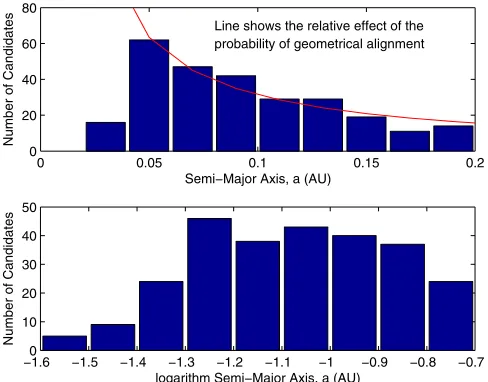
Figure 3.Semi-major axis distribution of candidates. Upper panel: in linear intervals. Lower panel: in logarithmic intervals.
(A color version of this figure is available in the online journal.)
curve fits the Kepler data well. Because it is much easier to detect larger candidates than smaller ones, this result implies that the frequency of planets decreases with the area of the planet, assuming that the false positive rate and other biases are independent of planet size for planets larger than 2 Earth radii.
In Figure 3, the dependence of the number of candidates on the semimajor axis is examined. In the upper panel, an analytic curve has been fitted to show the expected reduction in the integrated number in each interval due to the decreasing geometrical probability that orbits are correctly aligned with the line of sight. It has been fitted over the range of semimajor axis from 0.04 to 0.2 AU corresponding to orbital periods from 3 days to∼33 days for a solar-mass star.
Although the corrections necessary to normalize the observed distribution to an unbiased one are too lengthy to consider here, we performed a statistical analysis that corrected for the probability of orbital alignment. Although the sample sizes are small and thus the results are uncertain, it is interesting to
0 2 4 6 8 10 12
# of Candidates
Super−Earth−size 0 20 40 60 80 Neptune−size
0 .04 .08 .12 .16 .2
0 10 20 30
Semi−major Axis (AU)
Number of Candidates
Jupiter−size
0 .04 .08 .12 .16 .2
0 1 2 3
[image:6.612.319.566.297.483.2]Semi−major Axis (AU) Very−Large− size
Figure 4.Semi-major axis distribution of candidates grouped into four candidate sizes.
(A color version of this figure is available in the online journal.)
0 5 10 15 20 25 30
0 20 40 60
Number of Candidates
0 5 10 15 20 25 30
0 5 10 15 20 25
Orbital Period (d)
Number of Planets
Figure 5. Upper panel: period distribution of Kepler candidate planets. Lower panel: period distribution of exoplanets listed in the EPE (as of 2010 December 7) determined from RV measurements.
(A color version of this figure is available in the online journal.)
correct the observations to get a lower limit to the occurrence frequencies.
The corrected number of candidates (Nc) in each 0.01 AU interval of the semimajor axis is estimated from
N c=Average(ai/Ri)Nobs, (1)
where ai is the semimajor axis of candidate “i,” Ri is the stellar radius of the host star,Nobs is the number of detected candidates in the interval of the semimajor axis, and the index “i” counts only those candidates in each increment of the semimajor axis.
Considering only this correction and only for the range of the semimajor axis from 0.04 to 0.2 AU, the fraction of stars detected with candidates is nearly constant with the semimajor axis and equal to 6.8×10⁻².
[image:6.612.47.291.301.492.2]0 10 20 30 0 10 20 30 40 50 60
Number of Candidates
All Sizes
0 10 20 30
0 1 2 3 4 5 6 Super−Earth−size
0 10 20 30
0 10 20 30 40
Orbital Period (d)
Neptune−size
0 10 20 30
0 2 4 6 8 10 12 14
Orbital Period (d)
Number of Candidates
Jupiter−size
0 10 20 30
0 0.5 1 1.5 2
Orbital Period (d)
[image:7.612.47.291.54.258.2]Very−Large− size
Figure 6.Orbital period distribution for several choices of candidate size. (A color version of this figure is available in the online journal.)
showed a large increase in the number per logarithmic interval as expected from an examination of the upper panel. Thus, these observations are not consistent with a logarithmic distribution of candidates with semimajor axis.
A breakout of the number of candidates versus semimajor axis is shown in Figure 4. “Super-Earth-size” candidates are those with sizes from 1.25R⊕to 2.0R⊕. These are expected to be rocky-type planets without a hydrogen–helium atmosphere. “Neptune-size” candidates are those with sizes from 2.0R⊕ to 6 R⊕, and are expected to be similar to Neptune and the ice giants in composition. Candidates with sizes between 6 and 15
R⊕and between 15 and 22R⊕are labeled Jupiter-size and very large candidates, respectively. The nature of the larger category of objects is unclear. No mass measurements are available. It is possible that they are small stars transiting large stars. It is
also possible that these are ordinary Jovian planets whose stars have incorrectly assigned radii or that they are the tail of the distribution of large planets.
A correction of these results for the probability of a geomet-rical alignment shows that the adjusted occurrence frequencies of candidate planets are 8×10⁻³, 4.6×10⁻², 1.2×10⁻², and 2×10⁻³ for super-Earth-size, Neptune-size, Jupiter-size, and the very large candidates, respectively. Substantial increases in the values for the smaller candidates are expected when more comprehensive corrections are made for low-level signals that are currently too noisy to produce detectable transits and when a larger range of semimajor axis is considered.
There are several references in the literature to the pile-up of giant planet orbital periods near 3 days (Santos & Mayor2003) and a “desert” for orbital periods in excess of 5 days. Figure5is a comparison of distributions of frequency with orbital period for theKeplerresults with that derived from the planets listed in the EPE. In this instance, the much larger number of planets listed in the EPE under RV discoveries was used in the comparison. The very compact distribution of frequency with orbital periods between 3 and 7 days seen in the EPE results is also seen in theKeplerresults. However, there is little sign of the “desert” that has been discussed in the literature with respect to the RV results for giant planets. We note that theKeplersample contains a much larger fraction of super-Earth-size candidates than does the EPE sample.
In Figure 6, the dependences of the number of candidates with the size groups and orbital period are shown.
The first four panels indicate that the observed number of candidates is decreasing with orbital period regardless of size and that there is a peak in concentration for orbital periods between 2 and 5 days for all sizes.
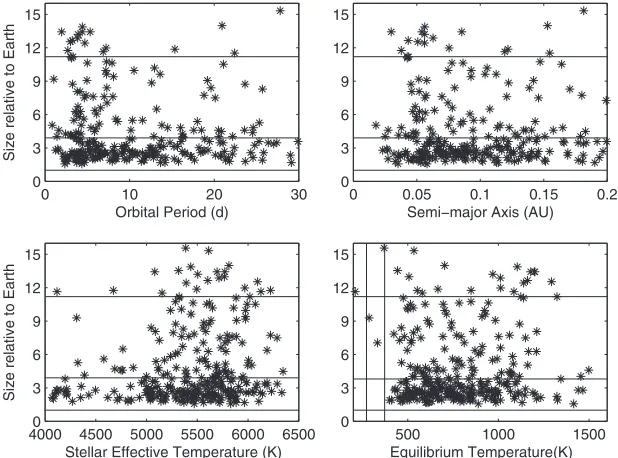
All panels in Figure7show a lack of candidates with radius less than 1.5R⊕. This result is mostly due to the sequestration of small candidates for follow-up observations during the summer of 2010. In the upper left panel, the decrease in the number of candidates with increasing orbital period and with decreasing size is evident. In contrast to the strong correlation of decreasing
0 10 20 30
0 3 6 9 12 15
Orbital Period (d)
Size relative to Earth
0 0.05 0.1 0.15 0.2
0 3 6 9 12 15
Semi−major Axis (AU)
40000 4500 5000 5500 6000 6500 3
6 9 12 15
Stellar Effective Temperature (K)
Size relative to Earth
500 1000 1500
0 3 6 9 12 15 Equilibrium Temperature(K)
[image:7.612.151.460.497.726.2]0 0.0002 0.0004
0.0006 Super−Earth−size
Frequency
0 0.001 0.002 0.003 0.004
Neptune−size
14 14.5 15 15.5 16
0 0.0003 0.0006 0.0009 0.0012 0.0015
Frequency
Kepler Magnitude Jupiter−size
14 14.5 15 15.5 16
0 0.00005 0.0001 0.00015 0.0002 0.00025 0.0003
[image:8.612.150.462.58.288.2]Kepler Magnitude Very−Large−size
Figure 8.Measured frequencies of candidates for four size ranges as a function ofKeplermagnitude. (A color version of this figure is available in the online journal.)
0 2 4 6 8 10 12
Number of Candidates
Super−Earth−size
0 20 40 60
80 Neptune−size
40000 5000 6000 7000 8000
10 20 30 40
Stellar effective temperature (K)
Number of Candidates
Jupiter−size
40000 5000 6000 7000 8000
1 2 3 4 5
[image:8.612.151.458.339.557.2]Stellar effective temperature(K) Very−Large−size
Figure 9.Number of candidates for various candidate sizes vs. stellar effective temperature. (A color version of this figure is available in the online journal.)
Table 1
Properties of Five Candidates In or Near the HZ
Candidate Properties Stellar Properties
KOI No. Candidate Size (R⊕) Period (days) Teq(K) Epocha KIC No. Teffb(K) Kp
494.01 1.9 25.698 400 121.780 3966801 4854 14.9
504.01 1.9 40.588 411 132.291 5461440 5403 14.6
819.01 15.6 38.037 370 129.933 4932348 5386 15.5
865.01 7.0 119.021 333 155.237 6862328 5560 15.1
902.01 9.3 83.904 287 169.808 8018547 4312 15.8
Notes.
aEpochs are BJD-2454900.
[image:8.612.96.517.625.708.2]0 0.001 0.002 0.003 0.004
Frequency
0 0.0001 0.0002 0.0003 0.0004 0.0005
40000 5000 6000 7000
0.001 0.002 0.003 0.004
Stellar temperature
Frequency
40000 5000 6000 7000
0.0002 0.0004 0.0006 0.0008 0.0010 0.0012
[image:9.612.150.460.57.280.2]Stellar temperature
Figure 10.Measured frequency of stars with candidates vs. stellar temperature. From upper left (clockwise): all released candidates, super-Earth-size candidates, Neptune-size candidates, and Jupiter-size candidates.
[image:9.612.90.529.348.494.2](A color version of this figure is available in the online journal.)
Table 2
Properties of Five Multi-candidate Systems
Candidate Properties Stellar Properties
KOI No, Candidate Size Period (days) Epocha KIC No. Teffb(K) Kp R.A. (2000) Decl.
152.01 0.58RJ >27 91.747 8394721 6500 13.9 20 02 04.1 44 22 53.7
152.02 0.31RJ 27.41 66.630
152.03 0.30RJ 13.48 69.622
191.01 1.06RJ 15.36 65.385 5972334 5500 15.0 19 41 08.9 41 13 19.1
191.02 2.04R⊕ 2.42 65.50
209.01 1.05RJ >29 68.635 10723750 6100 14.2 19 15 10.3 48 02 24.8
209.02 0.68RJ 18.80 78.822
877.01 2.53R⊕ 5.95 103.956 7287995 4500 15.0 19 34 32.9 42 49 29.9
877.02 2.34R⊕ 12.04 114.227
896.01 0.38RJ 16.24 108.568 7825899 5000 15.3 19 32 14.9 43 34 52.9
896.02 0.28RJ 6.31 107.051
Notes.
aEpochs are BJD-2454900.
bThe effective temperatures were derived from spectroscopic observations as described in Steffen et al. (2010).
planet mass with orbital period found by Torres et al. (2008), no analogous dependence of candidate size with orbital period is evident.
The vertical lines in the bottom right panel mark the edges of the HZ; i.e., temperatures of 273 and 373 K. The equilibrium temperatures for the candidates were computed for a Bond albedo of 0.3 and a uniform surface temperature. However, the computed temperatures have an uncertainty of approximately
±50 K, because of the uncertainties in the stellar size, mass, and temperature as well as the effect of any atmosphere. Over this wider temperature range, five candidates are present; two near super-Earth size, and three bracketing the size of Jupiter; see Table1.
In Figure8, the frequency of candidates in each magnitude bin has been calculated from the number of candidates in each bin divided by the total number of stars monitored in each bin. The number of stars brighter than 14.0 mag and fainter than 16.0 in the current list is so small that the count is not shown.
The panel for super-Earth-size candidates shows a substantial decrease in frequency for magnitudes larger than 15.0 and is indicative of difficulty in detecting small candidates around dim stars.
Figure9shows that the number of candidates is a maximum for stars with temperatures between 5000 and 6000 K, i.e., G-type dwarfs. This result should be expected because a large number of G -type stars are chosen as target stars. The relatively large number of super-Earth- and Neptune-size candidates orbiting K stars (4000 K stellar temperature 5000 K) is likely the result of small planets being easier to detect around small stars than around large stars and the relatively large number of such stars chosen. Similarly, the paucity of candidates associated with stars at temperatures above 6000 K is likely to be due to the relatively small number of such stars in the survey.
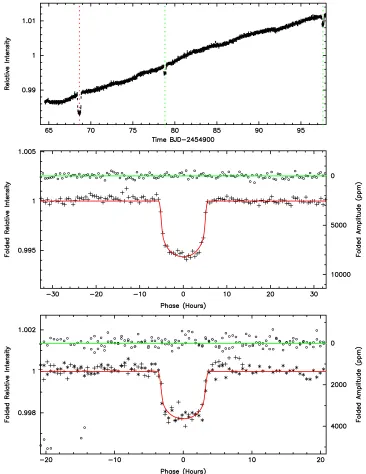
Figure 11.Three candidate planets associated with KIC 8394721. The position of the vertical dotted lines shows the position of the transits observed for each of the candidates.
Figure 12.Two candidate planets associated with KIC 5972334. The clear detection of two candidates (1.06RJ and 2.0R⊕) demonstrates thatKeplercan detect
super-Earth-size candidates even for stars as dim as 15th magnitude. (A color version of this figure is available in the online journal.)
computing the frequencies of the candidates as a fraction of the number of stars monitored.
Note that the frequency for the total of all candidate sizes is nearly constant with increasing stellar temperature. However, for super-Earth candidates, the decrease with temperature is quite marked, as might be expected when considering the substantially lower S/N due to the increase of stellar size of main-sequence stars with temperature. It is unclear whether the decrease in occurrence frequency is real or a measurement bias. The observed increase in the frequency with stellar temperature for Jupiter-size candidates should not be biased because the signal level for such large candidates is many times the noise level associated with the instrument and shot noise. Thus, this increase could indicate a real, positive correlation of giant candidates with stellar mass (Johnson et al.2010).
A study of the dependence of the frequency of the planet candidates on the stellar metallicity was not considered, because
the metallicities in the KIC are not considered sufficiently reliable. In particular, the D51 filter used in the estimation of metallicity is sensitive to a combination of the effects of surface gravity and metallicity, especially within the temperature range from roughly late K to late F stars. However, the information generated by this filter was used to develop the association with logg, thereby making any estimate of metallicity highly uncertain.
4. EXAMPLES OF CANDIDATE MULTI-PLANET SYSTEMS
Figure 13.KIC 10723750. The two sets of transits correspond to two different Jupiter-size (1.05 and 0.68RJ) candidates with long periods.
(A color version of this figure is available in the online journal.)
with orbital periods exceeding the 33.5 days of observations. For other candidate systems, several transits of multiple-planet candidates have been observed.
In two cases, the ratio of putative orbital periods is near 2. For such a system there is a high (60%) conditional probability that both planets transit, provided that the inner planet transits and the system is planar. For systems with planet candidates having a large ratio of orbital periods (e.g., KOI 191), the probability that the outer planet will transit, given that the inner one does, is small. While an exhaustive study remains to be done, the implication is that many planetary systems have multiple planets or that nearly coplanar planetary systems might be common.
Any of these multiple-planet candidate systems, as well as the single-planet candidate systems, could harbor additional planets
that do not transit and therefore are not seen in these data. Such planets might be detectable via transit-timing variations of the transiting planets after several years ofKeplerphotometry (Agol et al.2005; Holman & Murray2005). Based on the data presented here, we do not find any statistically significant transit-timing variations for the five candidate multiple-planet systems or for the single-planet candidates listed in theAppendix.
Figure 14.KIC 7287995. A cool, spotted star with two super-Earth candidates (2.7 and 2.3R⊕) with near-resonant periods of 5.96 and 12.04 days. (A color version of this figure is available in the online journal.)
5. ECLIPSING BINARY DATA
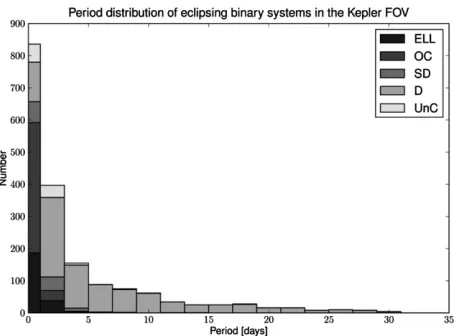
More than 1.2% ofKeplerstars are EB stars. Statistical results derived from 1832 EBs are presented by Prsa et al. (2010). Figure16depicts a distribution of EB periods. The stacked gray-scaled bars correspond to different morphologic types. This distribution can be readily compared to that for transiting planets shown in Figure5for the planetary candidates. The distribution of observed EB stars is more heavily weighted toward short periods than is the distribution of planet candidates. This is due to over-contact binaries and ellipsoidal variables, for which there is no counterpart among planets. For a comprehensive discussion of EB stars seen in theKeplerdata, see Prsa et al. (2010).
6. SUMMARY AND CONCLUSIONS
The following conclusions must be tempered by recognizing that many sources of bias exist in the results and that the results apply only to the released candidates.
Most candidate planets are less than half the radius of Jupiter. Five candidates are present in and near the HZ; two near super-Earth size, and three bracketing the size of Jupiter.
There is a narrow maximum in the frequency of candidates with orbital period in the range from 2 to 5 days. This peak is more prominent for large candidate planets than for small candidates.
The adjusted occurrence frequencies of super-Earth-, Neptune-, Jupiter-, and very large size candidates in short-period orbits are approximately 8×10⁻³, 4.6×10⁻², 1.2×10⁻², and 2×10⁻³, respectively. These values are expected to be lower than unbiased values because no corrections have been made for factors such as stellar magnitude and variability which have substantial effects on the detectability.
Figure 15.KIC 7825899. A K-type star with two Neptune-size candidates in 6.3-day and 16.2-day orbits. (A color version of this figure is available in the online journal.)
Figure 16.Distribution of EB stellar periods. Objects are classified into five groups based on their morphologic type: ellipsoidal variables (ELL), overcontact binaries (OC), semi-detached binaries (SD), detached binaries (D), and uncertain (UnC).
One of the five candidate multi-planet systems has two super-Earth-size candidates (2.5 and 2.3R⊕) with near-resonant periods of 5.96 and 12.04 days.
Kepler was competitively selected as the 10th Discovery
mission. Funding for this mission is provided by NASA’s Science Mission Directorate. Some of the data presented herein were obtained at the W. M. Keck Observatory, which is operated as a scientific partnership among the California Institute of Technology, the University of California, and the National Aeronautics and Space Administration. The Observatory was made possible by the generous financial support of the W. M. Keck Foundation. The authors thank the many people who gave so generously of their time to make this mission a success.
APPENDIX
[image:14.612.56.286.530.698.2]Table A1 List of Planetary Candidates
KOI KIC Number Kp Planet Radius Epoch Period Teff log(g) R∗
RJ BJD-2454900 (days) (K) (cgs) (Sun)
152.01 8394721 13.9 0.57 91.750 52.088 6187 4.536 0.936
152.02 8394721 13.9 0.31 66.634 27.401 6187 4.536 0.936
152.03 8394721 13.9 0.29 69.622 13.484 6187 4.536 0.936
191.01 5972334 15.0 1.06 65.385 15.359 5495 4.519 0.921
191.02 5972334 15.0 0.19 65.492 2.419 5495 4.519 0.921
209.01 10723750 14.3 1.05 68.635 50.789 6221 4.478 1.418
209.02 10723750 14.3 0.69 78.821 18.796 6221 4.478 1.418
184.01 7972785 14.9 1.59 66.566 7.301 6134 4.431 1.534
187.01 7023960 14.9 1.16 84.529 30.883 5768 4.703 0.829
188.01 5357901 14.7 0.72 66.508 3.797 5087 4.730 0.681
193.01 10799735 14.9 1.46 90.349 37.590 5883 4.465 1.008
194.01 10904857 14.8 0.99 72.466 3.121 5883 4.633 0.820
195.01 11502867 14.8 1.13 66.630 3.218 5604 4.498 0.955
198.01 10666242 14.3 3.43 86.369 87.233 5538 4.629 0.806
200.01 6046540 14.4 0.63 67.344 7.341 5774 4.690 0.759
204.01 9305831 14.7 0.78 66.379 3.247 5287 4.476 1.043
206.01 5728139 14.5 1.20 64.982 5.334 5771 4.345 1.904
208.01 3762468 15.0 1.12 67.710 3.004 6094 4.585 1.176
210.01 10602291 14.9 1.25 72.326 20.927 5812 4.352 1.154
211.01 10656508 15.0 0.94 69.014 35.875 6072 4.407 1.091
212.01 6300348 14.9 0.68 72.231 5.696 5843 4.538 1.056
214.01 11046458 14.3 1.00 64.741 3.312 5322 4.442 0.999
215.01 12508335 14.7 2.70 88.206 42.944 5535 4.395 1.078
217.01 9595827 15.1 1.18 66.414 3.905 5504 4.724 0.896
219.01 6305192 14.2 0.68 65.470 8.025 5347 4.727 1.372
220.01 7132798 14.2 0.38 65.939 2.422 5388 4.867 0.989
221.01 3937519 14.6 0.49 65.441 3.413 5176 4.686 0.898
223.01 4545187 14.7 0.24 67.478 3.177 5128 4.657 0.744
224.01 5547480 14.8 0.32 65.073 3.980 5740 4.507 0.951
225.01 5801571 14.8 0.45 74.537 0.839 6037 4.546 0.919
226.01 5959753 14.8 0.22 71.116 8.309 5043 4.892 0.869
229.01 3847907 14.7 0.56 67.934 3.573 5608 4.370 1.119
234.01 8491277 14.3 0.29 65.187 9.614 5735 4.356 1.205
235.01 8107225 14.4 0.18 66.818 5.632 5041 4.654 0.740
237.01 8041216 14.2 0.20 67.788 8.508 5679 4.533 0.919
239.01 6383785 14.8 0.31 71.556 5.641 5983 4.539 0.924
240.01 8026752 15.0 0.45 71.615 4.287 5996 4.602 1.446
241.01 11288051 14.1 0.19 64.796 13.821 5055 4.854 0.689
242.01 3642741 14.7 0.86 71.343 7.259 5437 4.507 1.556
403.01 4247092 14.2 1.58 104.132 21.057 5565 4.440 1.022
409.01 5444548 14.2 0.21 112.522 13.249 5709 5.008 0.993
410.01 5449777 14.5 1.07 109.286 7.217 5968 4.384 1.117
412.01 5683743 14.3 0.72 103.325 4.147 5584 4.275 1.256
413.01 5791986 14.8 0.28 109.558 15.229 5236 4.557 8.560
416.01 6508221 14.3 0.27 118.841 18.208 5083 4.647 0.750
417.01 6879865 14.8 0.81 109.965 19.193 5635 4.594 0.851
418.01 7975727 14.5 1.03 105.796 22.418 5153 4.422 1.010
419.01 8219673 14.5 0.67 122.391 20.131 5723 4.695 0.752
420.01 8352537 14.2 0.42 107.084 6.010 4687 4.513 0.831
421.01 9115800 15.0 1.60 105.819 4.454 5181 4.317 1.158
423.01 9478990 14.3 0.94 135.857 21.087 5992 4.448 1.138
425.01 9967884 14.7 0.43 102.753 5.428 5689 4.544 0.438
426.01 10016874 14.7 0.36 105.152 16.301 5796 4.328 1.188
427.01 10189546 14.6 0.43 124.737 24.615 5293 4.496 0.930
428.01 10418224 14.6 1.04 105.518 6.873 6127 4.549 1.927
429.01 10616679 14.5 0.48 105.527 8.600 5093 4.485 1.024
430.01 10717241 14.9 0.25 112.402 12.377 4124 4.584 0.640
431.01 10843590 14.3 0.34 111.712 18.870 5249 4.433 1.004
432.01 10858832 14.3 0.32 107.350 5.263 5830 4.457 1.015
433.01 10937029 14.9 0.52 104.095 4.030 5237 4.372 1.084
434.01 11656302 14.6 1.69 106.103 22.265 5172 4.564 1.350
435.01 11709124 14.5 0.36 111.951 20.548 5709 4.663 1.039
438.01 12302530 14.3 0.19 107.796 5.931 4351 4.595 0.679
441.01 3340312 14.5 0.24 106.917 30.544 6231 4.628 0.838
Table A1 (Continued)
KOI KIC Number Kp Planet Radius Epoch Period Teff log(g) R∗
RJ BJD-2454900 (days) (K) (cgs) (Sun)
450.01 6042214 14.2 0.30 104.953 27.047 6089 4.561 0.904
451.01 6200715 14.9 0.23 105.178 3.724 6333 4.648 1.012
452.01 6291033 14.6 0.34 102.939 3.706 5935 4.409 1.771
454.01 7098355 14.8 0.21 103.557 29.007 5138 4.569 0.835
456.01 7269974 14.6 0.27 104.476 13.700 5644 4.515 0.950
457.01 7440748 14.2 0.19 107.295 4.921 4931 4.650 0.729
458.01 7504328 14.7 0.94 141.081 53.717 5593 4.280 1.248
459.01 7977197 14.2 0.32 103.102 19.447 5601 4.428 1.040
460.01 8043638 14.7 0.41 109.077 17.587 5387 4.334 1.150
466.01 9008220 14.7 0.28 103.538 9.391 5907 4.896 0.590
467.01 9583881 14.8 0.48 115.442 18.009 5583 4.539 0.979
468.01 9589524 14.8 0.36 107.596 22.184 4999 4.499 0.900
469.01 9703198 14.7 0.49 107.607 10.329 6005 4.631 0.827
470.01 9844088 14.7 0.35 104.150 3.751 5542 4.653 0.782
471.01 10019643 14.4 0.17 104.730 21.348 5548 4.670 0.766
472.01 10123064 15.0 0.38 106.565 4.244 5682 4.580 1.149
473.01 10155434 14.7 0.22 113.637 12.705 5379 4.686 0.737
474.01 10460984 14.3 0.22 109.721 10.946 6143 4.468 1.015
476.01 10599206 15.0 0.23 111.437 18.428 4993 4.514 0.881
477.01 10934674 14.7 0.23 102.646 16.542 5039 4.513 0.889
480.01 11134879 14.3 0.24 105.308 4.302 5324 4.511 0.915
482.01 11255761 14.9 0.30 102.552 4.993 5526 4.426 1.036
483.01 11497977 14.7 0.23 106.257 4.799 5410 4.703 0.938
484.01 12061222 14.5 0.20 108.064 17.204 5065 4.759 0.745
486.01 12404305 14.1 0.22 102.492 22.184 5625 5.000 0.969
487.01 12834874 14.5 0.17 106.036 7.659 5463 4.510 0.977
488.01 2557816 14.7 0.18 109.444 9.380 5488 4.490 0.955
491.01 3541800 14.4 0.15 102.670 4.662 5965 4.684 0.798
492.01 3559935 14.4 0.32 127.712 29.910 5373 4.263 1.258
493.01 3834360 14.7 0.21 103.125 2.908 5583 4.571 0.871
494.01 3966801 14.9 0.17 121.780 25.698 4854 4.904 0.620
497.01 4757437 14.6 0.24 108.609 13.193 6045 4.495 1.163
499.01 4847534 14.3 0.17 107.535 9.669 5362 4.531 0.896
501.01 4951877 14.6 0.29 103.340 24.793 5556 4.501 1.502
502.01 5282051 14.3 0.18 104.159 5.910 5288 4.339 1.134
503.01 5340644 15.0 0.23 105.958 8.222 4110 4.550 0.673
504.01 5461440 14.6 0.17 132.291 40.588 5403 4.754 0.678
505.01 5689351 14.2 0.33 107.812 13.767 4985 4.242 1.259
506.01 5780715 14.7 0.25 102.966 1.583 5777 4.557 0.896
507.01 5812960 14.9 0.41 106.494 18.495 5117 4.408 1.024
509.01 6381846 14.9 0.23 102.712 4.167 5437 4.565 0.900
511.01 6451936 14.2 0.25 103.504 8.006 5802 4.404 1.083
512.01 6838050 14.8 0.25 105.919 6.510 5406 4.316 1.178
513.01 6937692 14.9 0.30 103.098 35.181 6288 4.577 1.204
514.01 7602070 14.4 0.17 109.061 11.757 5446 4.916 0.841
519.01 8022244 14.9 0.21 111.337 11.904 5807 4.523 0.991
520.01 8037145 14.6 0.26 103.304 12.760 5048 4.465 0.946
521.01 8162789 14.6 0.41 105.003 10.161 5767 4.394 1.094
522.01 8265218 14.4 0.19 102.940 12.831 5663 4.910 0.631
523.01 8806123 15.0 0.63 131.230 49.413 5942 4.421 1.066
524.01 8934495 14.9 0.20 104.997 4.593 5187 4.698 0.720
525.01 9119458 14.5 0.49 106.678 11.532 5524 4.281 1.241
526.01 9157634 14.4 0.22 104.044 2.105 5467 4.633 0.796
528.01 9941859 14.6 0.29 109.674 9.577 5448 4.346 1.138
532.01 10454313 14.7 0.23 106.689 4.222 5874 4.540 1.033
533.01 10513530 14.7 0.22 104.698 16.550 5198 4.444 0.985
535.01 10873260 14.4 0.40 104.182 5.853 5782 4.450 1.358
537.01 11073351 14.7 0.18 103.785 2.820 5889 4.906 0.949
538.01 11090765 14.6 0.24 104.657 21.214 5923 4.427 1.061
539.01 11246364 14.1 0.15 104.196 29.122 5722 4.361 1.137
540.01 11521048 14.9 0.74 127.824 25.703 5361 4.498 0.934
541.01 11656721 14.7 0.15 113.347 13.647 5369 4.712 0.741
542.01 11669239 14.3 0.24 111.682 41.889 5509 4.357 1.128
543.01 11823054 14.7 0.17 106.438 4.302 5166 4.724 0.686
Table A1 (Continued)
KOI KIC Number Kp Planet Radius Epoch Period Teff log(g) R∗
RJ BJD-2454900 (days) (K) (cgs) (Sun)
546.01 12058931 14.9 0.31 103.186 20.686 5989 4.487 1.244
547.01 12116489 14.8 0.32 121.061 25.302 5086 4.619 0.788
549.01 3437776 14.6 0.44 126.512 42.895 5609 4.414 1.059
551.01 4270253 14.9 0.17 111.850 11.636 5627 4.667 0.775
552.01 5122112 14.7 1.00 104.099 3.055 6018 4.431 1.057
553.01 5303551 14.9 0.20 104.453 2.399 5404 4.394 1.140
554.01 5443837 14.5 0.39 103.544 3.658 5835 4.641 0.809
557.01 5774349 15.0 0.28 103.785 15.656 5002 4.415 1.005
558.01 5978361 14.9 0.22 106.084 9.179 5281 4.580 0.835
559.01 6422367 14.8 0.17 106.712 4.330 5187 4.467 0.955
560.01 6501635 14.7 0.16 112.266 23.678 5142 4.834 0.750
563.01 6707833 14.5 0.18 108.632 15.284 5879 4.477 1.173
564.01 6786037 14.9 0.31 104.887 21.060 5686 4.525 1.453
565.01 7025846 14.3 0.14 103.202 2.340 5829 4.409 1.068
569.01 8008206 14.5 0.21 118.442 20.725 5039 4.546 0.851
570.01 8106610 14.8 0.27 105.782 12.399 6079 4.452 1.033
572.01 8193178 14.2 0.23 112.777 10.640 5666 4.310 1.325
573.01 8344004 14.7 0.28 105.505 5.997 5729 4.352 1.149
574.01 8355239 14.9 0.21 104.362 20.136 5047 4.669 0.727
575.01 8367113 14.7 0.23 116.405 24.321 5979 4.480 0.994
578.01 8565266 14.7 0.46 102.879 6.413 5777 4.362 1.528
580.01 8625925 14.9 0.19 108.711 6.521 5603 4.920 0.806
581.01 8822216 14.8 0.23 108.914 6.997 5514 4.856 0.761
582.01 9020160 14.8 0.20 103.467 5.945 5103 4.650 0.750
583.01 9076513 14.6 0.17 103.740 2.437 5735 4.550 1.197
585.01 9279669 14.9 0.18 104.558 3.722 5437 4.737 0.695
586.01 9570741 14.6 0.16 108.979 15.779 5707 4.669 0.802
587.01 9607164 14.6 0.28 104.606 14.034 5112 4.423 1.005
588.01 9631762 14.3 0.21 108.672 10.356 4431 4.459 0.852
590.01 9782691 14.6 0.16 107.545 11.389 6106 4.546 0.922
592.01 9957627 14.3 0.24 108.475 39.759 5810 4.408 1.077
593.01 9958962 15.0 0.19 104.792 9.997 5737 4.617 0.889
597.01 10600261 14.9 0.20 109.942 17.308 5833 4.416 1.046
598.01 10656823 14.8 0.18 104.152 8.309 5171 4.811 0.749
599.01 10676824 14.9 0.20 106.212 6.455 5820 4.540 0.916
600.01 10718726 14.8 0.18 103.367 3.596 5869 4.445 1.032
602.01 12459913 14.6 0.23 110.276 12.914 6007 4.405 1.282
605.01 4832837 14.9 0.16 102.718 2.628 4270 4.757 0.581
607.01 5441980 14.4 0.57 106.492 5.894 5497 4.608 0.825
608.01 5562784 14.7 0.47 125.921 25.333 4324 4.551 1.326
609.01 5608566 14.5 1.20 105.027 4.397 5696 4.295 1.231
610.01 5686174 14.7 0.19 113.850 14.281 4072 4.529 0.687
614.01 7368664 14.5 0.36 103.023 12.875 5675 4.887 0.589
617.01 9846086 14.6 2.06 131.599 37.865 5594 4.530 0.917
618.01 10353968 15.0 0.28 111.347 9.071 5471 4.516 0.922
620.01 11773022 14.7 0.65 92.107 45.154 5803 4.544 1.384
725.01 10068383 15.8 0.75 102.644 7.305 5046 4.652 0.882
726.01 10157573 15.1 0.30 106.266 5.116 6164 4.508 0.969
728.01 10221013 15.4 0.89 103.121 7.189 5976 4.544 0.918
729.01 10225800 15.6 0.36 102.674 1.424 5707 4.608 0.838
730.01 10227020 15.3 0.31 109.793 14.785 5599 4.386 1.287
732.01 10265898 15.3 0.25 103.407 1.260 5360 4.588 0.860
733.01 10271806 15.6 0.24 102.725 5.925 5038 4.846 0.730
734.01 10272442 15.3 0.39 120.924 24.542 5719 4.700 1.329
736.01 10340423 16.0 0.25 110.789 18.796 4157 4.552 0.681
737.01 10345478 15.7 0.43 115.678 14.499 5117 4.602 0.798
740.01 10395381 15.6 0.17 119.368 17.672 4711 4.640 0.703
743.01 10464078 15.5 1.65 105.491 19.402 4877 4.304 1.904
746.01 10526549 15.3 0.24 106.246 9.274 4681 4.551 0.788
747.01 10583066 15.8 0.28 104.602 6.029 4357 4.680 0.608
749.01 10601284 15.4 0.23 104.806 5.350 5374 4.780 0.915
750.01 10662202 15.4 0.19 104.535 21.679 4619 4.624 0.703
752.01 10797460 15.3 0.26 103.533 9.489 5584 4.406 1.067
753.01 10811496 15.4 2.11 108.840 19.904 5648 4.843 0.621
Table A1 (Continued)
KOI KIC Number Kp Planet Radius Epoch Period Teff log(g) R∗
RJ BJD-2454900 (days) (K) (cgs) (Sun)
759.01 11018648 15.1 0.32 127.134 32.629 5401 4.563 0.864
760.01 11138155 15.3 0.81 105.257 4.959 5887 4.622 0.830
762.01 11153539 15.4 0.24 104.356 4.498 5779 4.596 1.172
764.01 11304958 15.4 0.71 141.932 41.441 5263 4.367 1.582
765.01 11391957 15.3 0.20 104.629 8.354 5345 4.700 0.722
769.01 11460018 15.4 0.21 104.903 4.281 5461 4.643 0.942
770.01 11463211 15.5 0.26 103.998 1.506 5502 4.927 0.590
772.01 11493732 15.2 0.68 106.831 61.263 5885 4.409 1.079
773.01 11507101 15.2 0.21 105.837 38.374 5667 4.624 0.820
776.01 11812062 15.5 0.55 104.792 3.729 5309 4.829 0.843
777.01 11818800 15.5 2.00 106.564 40.420 5256 4.479 0.948
778.01 11853255 15.1 0.18 103.681 2.243 4082 4.605 0.611
782.01 11960862 15.3 0.59 106.634 6.575 5733 4.411 1.248
783.01 12020329 15.1 0.96 102.991 7.275 5284 4.762 1.953
784.01 12066335 15.4 0.25 119.798 19.266 4112 4.569 0.653
785.01 12070811 15.5 0.21 111.749 12.393 5380 4.725 0.741
786.01 12110942 15.2 0.17 103.366 3.690 5638 4.715 0.876
787.01 12366084 15.4 0.30 104.017 4.431 5615 4.534 1.037
788.01 12404086 15.2 0.31 109.049 26.396 4950 4.634 0.747
789.01 12459725 15.7 0.15 104.505 14.180 5563 4.765 0.683
790.01 12470844 15.3 0.18 107.168 8.472 5176 5.058 0.612
791.01 12644822 15.1 0.79 113.890 12.612 5564 4.528 1.117
793.01 2445129 15.1 0.34 106.313 10.319 5655 4.409 1.069
795.01 3114167 15.6 0.22 103.575 6.770 5455 4.804 0.640
799.01 3246984 15.3 0.41 102.817 1.627 5491 4.412 1.051
802.01 3453214 15.6 0.75 114.881 19.620 5556 5.009 0.498
804.01 3641726 15.4 0.23 110.194 9.030 5136 4.533 0.874
808.01 3838486 15.8 0.37 104.985 2.990 4389 4.582 0.701
810.01 3940418 15.1 0.23 103.507 4.783 4997 4.571 0.820
811.01 4049131 15.4 0.41 114.427 20.507 4764 4.432 0.944
812.01 4139816 16.0 0.22 104.978 3.340 4097 4.661 0.571
813.01 4275191 15.7 0.60 103.528 3.896 5357 4.726 0.725
814.01 4476123 15.6 0.27 108.450 22.368 5236 4.855 0.984
815.01 4544670 15.7 0.90 105.628 34.845 5344 4.485 0.948
819.01 4932348 15.5 1.39 129.933 38.037 5386 4.963 0.518
820.01 4936180 15.3 0.67 106.720 4.641 6287 4.511 0.970
822.01 5077629 15.8 0.95 105.179 7.919 5458 4.605 0.824
823.01 5115978 15.2 0.82 103.228 1.028 5976 4.427 4.223
825.01 5252423 15.3 0.19 109.957 8.103 4735 4.581 0.764
826.01 5272878 15.1 0.21 104.135 6.366 5557 4.843 0.854
827.01 5283542 15.5 0.25 107.779 5.975 5837 4.539 0.918
829.01 5358241 15.4 0.24 107.778 18.649 5858 4.567 0.888
833.01 5376067 15.4 0.39 106.275 3.951 5781 4.660 0.788
834.01 5436502 15.1 0.78 104.372 23.655 5614 4.598 1.496
835.01 5456651 15.2 0.17 113.936 11.763 4817 4.952 0.635
837.01 5531576 15.7 0.16 107.659 7.954 4817 4.751 0.623
838.01 5534814 15.3 0.69 106.011 4.859 5794 4.475 0.991
842.01 5794379 15.4 0.25 108.349 12.719 4497 4.524 0.787
843.01 5881688 15.3 0.56 104.440 4.190 5784 4.396 1.092
845.01 6032497 15.4 0.35 110.290 16.330 5646 4.444 1.224
846.01 6061119 15.5 1.37 119.713 27.807 5612 4.597 0.846
847.01 6191521 15.2 0.70 136.898 80.868 5469 4.559 1.894
849.01 6276477 15.0 0.24 103.936 10.355 5303 4.475 0.956
850.01 6291653 15.3 0.89 109.522 10.526 5236 4.549 0.865
851.01 6392727 15.3 0.50 102.975 4.583 5570 4.551 0.892
852.01 6422070 15.3 0.20 104.904 3.762 5448 4.466 0.980
853.01 6428700 15.4 0.28 102.690 8.204 4842 4.472 0.906
855.01 6522242 15.2 1.21 128.787 41.408 5316 4.586 0.832
856.01 6526710 15.3 0.91 105.855 39.749 5858 4.592 0.861
857.01 6587280 15.1 0.19 107.884 5.715 5033 4.629 0.764
858.01 6599919 15.1 0.86 106.989 13.610 5440 4.450 0.999
863.01 6784235 15.5 0.22 105.152 3.168 5651 4.593 0.851
865.01 6862328 15.1 0.63 155.237 119.021 5560 4.704 1.232
867.01 6863998 15.2 0.32 113.274 16.086 5059 4.521 0.881
Table A1 (Continued)
KOI KIC Number Kp Planet Radius Epoch Period Teff log(g) R∗
RJ BJD-2454900 (days) (K) (cgs) (Sun)
871.01 7031517 15.2 0.91 112.422 12.941 5650 5.051 0.477
872.01 7109675 15.3 0.65 119.684 33.593 5127 4.592 0.810
873.01 7118364 15.0 0.14 105.226 4.348 5470 4.784 0.789
874.01 7134976 15.0 0.17 102.977 4.602 5037 4.561 0.706
875.01 7135852 15.7 0.34 103.624 4.221 4198 4.865 0.780
876.01 7270230 15.9 0.68 104.898 6.998 5417 4.865 0.589
877.01 7287995 15.0 0.24 103.952 5.955 4211 4.566 0.678
877.02 7287995 15.0 0.21 114.227 12.038 4211 4.566 0.678
878.01 7303253 15.3 0.41 106.808 23.591 4749 4.281 1.160
882.01 7377033 15.5 1.20 103.694 1.957 5081 4.572 0.826
883.01 7380537 15.8 1.05 103.101 2.689 4674 4.821 0.642
887.01 7458762 15.0 0.22 108.345 7.411 5601 4.525 0.923
889.01 757450 15.3 1.52 102.992 8.885 5101 4.480 0.933
890.01 7585481 15.3 0.84 109.623 8.099 5976 4.561 1.104
891.01 7663691 15.1 0.34 109.969 10.006 5851 4.593 1.244
892.01 7678434 15.2 0.23 105.617 10.372 5010 4.604 0.788
895.01 7767559 15.4 1.24 104.894 4.409 5436 4.372 1.195
896.01 7825899 15.3 0.38 108.568 16.240 5206 4.629 0.821
896.02 7825899 15.3 0.28 107.051 6.308 5206 4.629 0.821
900.01 7938496 15.4 0.45 105.339 13.810 5692 4.335 1.172
901.01 8013419 15.8 0.26 109.938 12.733 4213 4.716 0.359
902.01 8018547 15.8 0.83 169.808 83.904 4312 4.616 0.940
903.01 8039892 15.8 0.95 106.433 5.007 5620 4.776 1.256
906.01 8226994 15.5 0.23 107.135 7.157 5017 4.558 0.836
908.01 8255887 15.1 1.11 104.446 4.708 5391 4.245 1.288
910.01 8414716 15.7 0.26 104.720 5.392 5017 4.863 0.876
911.01 8490993 15.4 0.18 104.006 4.094 5820 4.783 0.758
912.01 8505670 15.1 0.22 104.804 10.849 4214 4.608 0.637
914.01 8552202 15.4 0.23 102.731 3.887 5479 4.965 1.126
916.01 8628973 15.1 0.36 104.312 3.315 5401 4.480 0.959
917.01 8655354 15.2 0.29 106.356 6.720 5681 4.478 0.982
918.01 8672910 15.0 0.99 139.583 39.648 5321 4.544 1.038
920.01 8689031 15.1 0.16 123.502 21.802 5330 4.859 0.608
922.01 8826878 15.4 0.24 104.624 5.155 5253 4.456 0.976
923.01 8883593 15.5 0.32 107.901 5.743 5669 4.596 1.024
924.01 8951215 15.2 0.36 106.306 39.478 5951 4.529 0.935
927.01 9097120 15.5 1.46 121.982 23.900 5957 4.557 0.903
931.01 9166862 15.3 1.15 103.679 3.856 5714 4.776 1.011
934.01 9334289 15.8 0.32 106.008 5.827 5733 4.655 0.861
935.01 9347899 15.2 0.40 113.013 20.859 6345 4.696 1.018
937.01 9406990 15.4 0.20 109.572 20.835 5349 4.685 0.725
938.01 9415172 15.6 0.24 104.701 9.946 5342 4.582 0.838
940.01 9479273 15.0 0.54 102.571 6.105 5284 4.629 1.337
942.01 9512687 15.4 0.23 107.857 11.515 4997 4.734 0.663
944.01 9595686 15.4 0.37 103.244 3.108 5166 4.495 0.921
945.01 9605514 15.1 0.23 121.860 25.852 6059 4.594 1.072
948.01 9761882 15.6 0.19 106.717 24.582 5298 4.946 0.706
949.01 9766437 15.5 0.27 103.766 12.533 5733 4.703 0.909
951.01 9775938 15.2 0.58 104.546 13.197 4767 4.255 1.205
955.01 9825625 15.1 0.23 108.731 7.039 6121 4.510 1.141
956.01 9875711 15.2 0.50 108.645 8.361 4580 4.334 1.051
Note.To provide accurate estimates of the epoch and period for observers, data taken after Q1 were used when available.
are the orbital period, epoch, and an estimate of the size of the candidate.
REFERENCES
Agol, E., Steffen, J., Sari, R., & Clarkson, W. 2005,MNRAS,359, 567
Almenara, J. M., et al. 2009,A&A,506, 337
Batalha, N. M., et al. 2010,ApJ,713, L103
Borucki, W. J., et al. 2009,Science,325, 709
Borucki, W. J., et al. 2010,ApJ,713, L126
Brown, T. M. 2003,ApJ,593, L125
Brown, T. M., & Latham, D. W. 2008, arXiv:0812.1305
Caldwell, D. A., et al. 2010,ApJ,713, L92
Dunham, E. W., et al. 2010,ApJ,713, L136
Gaudi, B. S. 2005,ApJ,628, L73
Gautier, T. N., III. 2010, arXiv:1001.0352
Gilliland, R. L., et al. 2010,ApJ,713, L160
Holman, M. J., & Murray, N. W. 2005,Science,307, 1288