UNIVERSITI TEKNIKAL MALAYSIA MELAKA
FIVE-AXIS TOOL PATH PROGRAMMING UTILIZING CATIA V5
FOR TURBINE BLADE: ALUMINIUM 6063
This report submitted in accordance with requirement of the Universiti Teknikal Malaysia Melaka (UTeM) for the Bachelor’s Degree in Manufacturing Engineering
Technology (Process and Technology) (Hons.)
by
LIM RU PEI
B071310514
930722-07-5356
i
DECLARATION
I hereby, declared this report entitled “FIVE-AXIS TOOL PATH PROGRAMMING UTILIZING CATIA V5 FOR TURBINE BLADE: ALUMINIUM 6063” is the results of
my own research except as cited in references.
Signature : ………
Name : LIM RU PEI
ii
APPROVAL
This report is submitted to the Faculty of Engineering Technology of UTeM as a partial fulfilment of the requirements for the degree of Bachelor of Manufacturing Engineering Technology (Process and Technology) with Honours. The member of the supervisory is as follow:
……….
(SYAHRUL AZWAN BIN SUNDI @ SUANDI)
iii
ABSTRAK
Melalui kajian ini, semua maklumat, jurnal, artikel yang berkaitan dengan CAD/CAM, turbine blade dan five-axis machining pergerakan mata alat bagi peningkatan pengetahuan tentang projek ini. Pada masa kini, sesetengah masalah telah dihadapi berdasarkan turbine blade seperti kecacatan atas sebab manufacturing process. Objektive bagi projek ini ialah mengeluarkan give-axis machining pergerakan mata alat yang sesuai serta ketepatan bagi machined part. CAD model telah didapati dari GrabCAD. Perubahan telah dijalankan berdasarkan peralatan dan bahan mentah yang sedia ada. Aluminium 6063 telah digunakan sebagai bahan mentah bagi turbine blade. Five-axis machine yang code DMU 60 monoBLOCK telah digunakan bagi menghasilkan turbine blade serta strategi pemesinan telah disediakan melalui CATIA V5. Dalam CADCAM software, ,beberapa strategi telah digunakan seperti roughing process, multi-axis flank contouring, multi-axis sweeping dan isoparametric. Selepas proses pemesinan fizikal, penilaian telah dijalankan 3D Scanner serta its methodology. Keputusan yang didapati dari 3D Scanner telah dinyatakan perbezaan CAD model dengan bahagian dimesin fizikal melalui warna yang berbeza. Warna biru mewakili kelebihan pemotongan serta warna hijau mewakili kelebihan bahan.
iv
ABSTRACT
In this research, information’s, journals and articles regarding CAD/CAM turbine blade and five-axis machining tool path have been searched for better acknowledgement and understanding. Currently, some problem has been occurred in turbine blade such as premature failure of blade caused by serious manufacturing defects. Objectives of this research are producing suitable machining cutting tool path utilizing CATIA V5 and accuracy is investigated. Turbine Blade CAD model has been selected from GrabCAD. Modification has been done based on limitation of equipment and raw material. Aluminium 6063 is used as raw material to machine turbine blade. DMU 60 monoBLOCK is used in machining turbine blade and machining program has been done by CATIA V5. In CADCAM software, machining strategies have been used to machine turbine blade are roughing process, multi-axis flank contouring, multi-axis sweeping and isoparametric. After physical machining process, analysis has been done through 3D Scanner and its methodology. Result from 3D Scanner show comparison between CAD model and physical machined part by different type of colour. Blue colour shows overcut while green colour shows undercut. Some recommendations such as smaller and tapered cutting tool has been suggested in part of future work.
v
DEDICATIONS
To my beloved family
vi
ACKNOWLEDGMENTS
Firstly, I would like to thanks to my beloved university, Universiti Teknikal Malaysia Melaka (UTeM) giving me this opportunity to explore myself in new thing. I would like to thanks God for blessings to allow me complete my Final Year Project smoothly although there are some problems faced in Final Year Project.
I wish to express my fully thanks to my Supervisor, Mr. SYAHRUL AZWAN BIN SUNDI @ SUANDI and co-supervisor Mr. MUHAMMAD SYAFIK BIN JUMALI for the motivation, enormous amount of knowledge and patience. Both of supervisor have guide me and give useful information in all the time of research study.
Besides, I like to take this opportunity to express my gratitude to all assistance engineers in UTeM which given fully assistance to me for this research study.
vii
TABLE OF CONTENT
DECLARATION ... i
APPROVAL ... ii
ABSTRAK ...iii
ABSTRACT ... iv
DEDICATIONS ... v
ACKNOWLEDGMENTS ... vi
TABLE OF CONTENT ………...vii
LIST OF FIGURE ………ix
LIST OF TABLE ………xiii
LIST OF ABBREVIATIONS, SYMBOLS AND NOMENCLATURE ……….xiv
CHAPTER 1 INTRODUCTION 1 1.1 Background ... 1
1.2 Problem statement ... 4
1.3 Objectives ... 5
1.4 Scope ... 5
CHAPTER 2 LITERATURE REVIEW ... 6
2.1 Five-Axis Machining ... 6
2.2 Ball-end Milling process ... 17
2.3 Five-axis Flank Milling ... 21
2.4 Turbine blade ... 26
2.5 Accuracy of Five-axis machining... 27
2.6 Aluminum ... 28
CHAPTER 3METHODOLOGY ... 32
3.1 Project planning ... 32
3.2 Phase I ... 35
3.2.1 Problem Simulation………...35
3.2.2 Literature Review to Understand Better The Topic………...35
3.2.3 Searching Suitable CAD Model Verification………36
viii
3.3 Phase II ... 39
3.3.1 Material and Suitable Cutting Tool………39
3.3.2 Preparation of CAM Program………42
3.3.2.1 Process Roughing………..45
3.3.2.2 Process Multi-axis Sweeping……….47
3.3.2.3 Process Isoparametric………51
3.3.2.4 Process Multi-axis Flank Contouring………55
3.3.3 Jig and Fixture Preparation………58
3.3.4 Post Processing………..60
3.3.5 Physical Machining………...61
3.3.6 Dimensional Analysis………....63
CHAPTER 4 RESULT AND DISCUSSION ... 67
4.1 Result ... 67
4.2 Comparison between Finished Part and CAD Model in CAM Program ... 70
4.3 Problem Preparation of Jig ... 72
4.4 Machined Part Problem ... 75
4.5 Accuracy of Turbine Blade... 76
CHAPTER 5 CONCLUSION AND FUTURE WORK ... 80
5.1 Conclusion ... 80
5.2 Future Work ... 81
ix
LIST OF FIGURE
Figure 2.1: The Pressure Surface after Removing Tool Marks. 8 Figure 2.2: Impeller that been machined.
8 Figure 2.3: Types of general ball end mills.
11 Figure 2.4: Comparison of machining strategies.
11 Figure 2.5: A View of Model Gampad machined is zoom in by ISFC (Improved Space Filling Curve) and traditional SFC (Space Filling Curve). 12 Figure 2.6: The surface partitioning and model for a blade of a blisk.
14 Figure 2.7: Tool Paths have been shown for two sub surfaces.
15 Figure 2.8: Flank Milling Operation in Case Study.
16 Figure 2.9: Resulting Surfaces after The Tests
18 Figure 2.10: In Test 1, Tool Tip Mark has been Observed while Test Two does not Exist Tool Tip Mark on the surface. 19 Figure 2.11: Lead and Tilt Angles Will Affected on Case 1 -Maximum Fxy Force, Figure B Represents Case 2 while Figure C which Related with Tool Deflection for case3.
19
Figure 2.12: The Geometry Applied for Purpose of Simulation and Validation. 20 Figure 2.13: Geometry Output of Five-axis Machining of An Impeller has been Shown by Developed through Developed Model 20 Fig. 2.14: Process of End Milling, Flank Milling and Sweeping.
Red colour shows contact locations of cutter with surface. 22 Figure 2.15: References of Main Generation of Flank Milling Toolpath.
x
Fig. 2.16: Fig. 2.16: Surface A Error-measuring Result.
25 Figure 2.17: Finished Part
26 Figure 2.18: (a)Cone defining the boundary of meshed blade1; (b)generated
toolpath.
27 Figure 2.19: (a) Cones defining the machining region for meshed blade2; (b)the generated toolpath for the given region 27 Figure 2.20: Figure 2.20: Designation System of Wrought Aluminium Alloy
31 Figure 2.21: Different Advantage of Aluminium With Different Combination
of Material. 31
Figure 3.1: Flow Chart of Methodology 33 Figure 3.2: Selected CAD Model -Turbine Blade 36 Figure 3.3: CAD Model (Turbine Blade) with Stock and Plane System 38 Figure 3.4: Plane System 38 Figure 3.5: Assembly Part (CAD Model with Plane System) 39 Figure 3.6: Detail Regarding Cutting Tool 41 Figure 3.7: List of Cutting Tool Used 42 Figure 3.8: Setting of Part Operation 42 Figure 3.9: Flow Chart of CAM Machining Process 44 Figure 3.10: First Roughing 46 Figure 3.11: Second Roughing 47 Figure 3.12: Labelling Number on Space between Blades based on Labelling of Multi-axis sweeping
xi
Figure 3.13: Tool Path for Front of Blade 58 Figure 3.14: Tool Path for Back of Blade 58 Figure 3.15: Drawing of Jig 59 Figure 3.16: Jig for CNC Five-axis Machining 60 Figure 3.17: Example of G-Code and M-Code in H. file Format 61 Figure 3.18: Technical Data of DMU 60 monoBLOCK Machine 62 Figure 3.19: DMU 60 monoBLOCK Machine 62 Figure 3.20: Program Simulation for Validation Test Cut 63 Figure 3.21: Physical Machining of First Blade 63 Figure 3.22: Function of 3D Scanner 64 Figure 3.23: Example Flow Chart of 3D Scanner 65 Figure 3.24: 3D Scanner Model 65 Figure 3.25: a) Before Applying Spraying Substances on Turbine Blade.
xii
xiii
LIST OF TABLE
Table 3.1: Scale Ratio of CAD Model 37 Table 3.2: Detail
Dimension of Selected Cutting Tool
41
xiv
LIST OF ABBREVIATIONS, SYMBOLS AND
NOMENCLATURE
CAM = Computer Aided Manufacturing CAD = Computer Aided Design
CATIA = Computer aided three-dimensional interactive application
NC = Numerical Control
CNC = Computer Numerical Control Ksi = Kilopound per square inch
IGES = Initial Graphic Exchange Specification STEP = Standard Exchange of the Product Model STL = Standard Triangle Language
1
CHAPTER 1
INTRODUCTION
1.1 Background
In current condition, there is a great importance in productive activity which is machining process for both indirectly for the manufacture of auxiliary elements and directly in the manufacture of components. Multiple fields related to the machining technology has evolved much in recent years such as the means of production, machining technology, tools for cutting, CAD/CAM or the sensors. Technique that applied in five-axis machining have been evolved rapidly with many CAD/CAM software developers. CAD/CAM software have addition function such as collision-avoidance capabilities and advanced simulation for five-axis program. CAD/CAM software is designed to cut the complex parts used in many areas such as die-mold, aerospace and medical machining applications. (Patrick Waurzyniak, 2007).
CNC machining means the physical machining process which is controlled under a NC program. A programmer must specify machine activity in NC program and cutting tool movement based on the sequence of the machining process. NC program execute instructions and interpret it through the machine control unit (MCU) of the NC machine. There are three types of NC programming which are manual programming, CAD- assisted programming and computer-assisted programming which based on the level of automation.
2
generate instructions of NC machining which based on the definition of geometry for a cutter and workpiece, such as CADCAM, CATIA and Computer vision.
Delcam plc (Birmingham, UK) has been develop CAM software and also made moves on the acquisition front, purchasing IMCS Inc. PartMaker (Fort Washington, PA) after their company buys Engineering Geometry Systems (Salt Lake City), developers of FeatureCAM. (Patrick Waurzyniak, 2007)
Recently, five-axis and multi-axis machining methods have been looked by CAM software suppliers to solidify their offerings for users trying to stay competitive by using more complex manufacturing techniques. In getting keen interest in multi-axis and five-axis machining, there are manufacturers who play important role such as Eastern European and Asian manufacturers. Aim of those manufacturers are getting lower cost for tools used in five-axis machine tools and intense competition from low-cost. To reduce setups on machining complex parts, new five-axis offerings add the ability.
Infinite probability things such as to shapes and the part sizes which can manufactured effectively by five-axis machining. The cutting tool on a center of five-axis machining moves across the linear axes which are X, Y and Z axes together with rotates on the B and A axes to machine the workpiece/ part from any direction. On the other hand, five-axis machining can manufacture five sides of a single part in single settings. (Mazak) Based on explanation of Gibbs (Rolls-Royce), Five-axis technology provides the user with the ultimate amount of control when applying tooling to a part. Because of this, collision avoidance, improved surface finish, and reduced tool wear are some of the benefits realized. (Stuart Nathan, 2015)
3
jewelry to an airplane. Product engineering in a fully-integrated manner with functional range and power is provided by CATIA to obtain the complete product development process. CATIA helps to increase response of enterprises to market needs shorten development cycles and facilitates reuse of product design knowledge.
An old method to create turbine blade was metalworking. To create turbine blades used for jet engines, the most basic and ancient methods of metalworking are casting process. If a fire can be heated until temperature which can melt a metal, a crucible is created to melt metal together with a mold (can withstand the heat) and cast complex forms of metal. “The blades operate in an environment several hundreds of degrees hotter than the melting point of the nickel alloy, but because of the cooling mechanisms, the metal is never above its melting point, even though the environment is.” (Neil Glover, Rolls-Royce). Not all material in making turbine blades is nickel alloy; family of alloys and ceramic materials also used in making turbine blades. A significant differentiation between temperature of external flow and surface temperature. Material with a high melting point is used in solving the problem and reduces the effective temperature over the surface of the used metal. (Stuart Nathan, 2015)
4
center). One of aluminium alloys is 6xxx series are combination aluminium with silicon and magnesium. 6xxx series aluminium alloys are moderate in strength which is 200 to 350 MPa. Though the heat treatment processing or forming process, the strength of aluminium 6xxx series are achieved. (sapa:)
1.2 Problem statement
At present, one of causes failure of blade is manufacturing defects. Defects often occur as design specification of blades which based on CAD models or drawings are not follow during manufacturing process. One of the common defects is premature failure of blade as it is weakening the point that normal loads by serious manufacturing defects.
Turbine blades are designed for mass center location and optimum aerodynamics, resist extreme temperature, and avoid corrosion, and constitute of advanced metal alloy castings and composites to increase strength. Tight tolerances apply to both the geometry and alignment of turbine blades to guarantee optimum blade position and aerodynamic operation. (Nikon)
Currently, process of manufacturing turbine blades are castings, forgings, solid billets of titanium and stainless steel or bar stock. (Mark Albert ,2012) Many factors are important such as total cut time, depth of cut, spindle speed, an investment in the machine itself and tool life in determining material of manufacturing process. These factors contribute to cost of manufacturing and in turn the ability to efficiently and profitably machine selected material.
5 1.3 Objectives
The objectives of this project are stated as below:
a) To determine the suitable machining tool path in preparing the CAM program for a turbine blade utilizing CATIA V5 by validating the tool path in the real machining which is 5-axis machine.
b) To investigate the effect of dimensional accuracy of a machined part in transferring the CADCAM data to the actual machined part.
1.4 Scope
6
CHAPTER 2
LITERATURE REVIEW
2.1 Five-Axis Machining
A study which related with a new method for five-axis tool path optimization has conducted by Pascal Ray (2008) found that there is remaining some kinematic performance issues that have been introduced by tool path computation which can generate slowdown although scientific community has been study the main problems of five-axis. The goal of this study is to improve machine tool behavior without deterioration of milled part quality. The kinematic behaviour of the machine tool and the five-axis machining geometric method is necessary be confronted. There are a lot of researched in five-axis machining are focusing on methods to figure out tool axis orientation in order to improve or optimize such as:
The control of interference between part and tool
The quality of the milled surfaces is evaluated.
The interpolation format of the tool path
Free collision positioning of the tool under its environment
7
rotation axis.
8
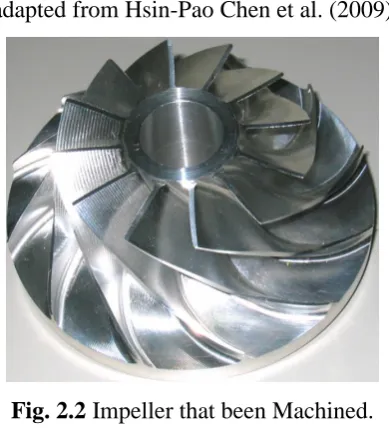
been done to verification of the algorithms and implementation of the procedure. The time of machining can be saved up to 23.57% with the spline tool paths. The proposed procedure can simply be modified to fit them for others five-axis machines with two rotational axes and three orthogonal translating axes. Thus, the future topic which can be discussed is the effect of machined impeller blade surfaces through reverse axes movements of five-axis machine tools. Figure 2.1 shows the pressure surface after removing tool marks in this finding while figure 2.2 shows model that has been used in this finding which is impeller.
[image:23.612.192.468.236.386.2].
Fig. 2.1 The Pressure Surface after Removing Tool Marks (adapted from Hsin-Pao Chen et al. (2009))
Fig. 2.2 Impeller that been Machined. (adapted from Hsin-Pao Chen et.al (2009))
[image:23.612.231.426.417.632.2]9
requirements in the certain environments, different machine tools are chosen. In selection of tool, some parameters such as cutting parameter that related to blade and tool, machine power, the speed of milling material of blade and head are needed to be calculated. In addition, arbor, blade, cutter head and milling head need to be simulated and have interference checking depending on posterior simulation processing. Processing method and Cutter scheme needed modification while cutter interference exists. Finally, it must be ascertained that cutter has no problem in interference examination and simulation. In a follow-up study, Linjian Yang and Jinchun Feng (2011) also found that, in the machine power, machine tool stiffness and speed range of milling head must be sufficient during simulation. Different diameter cutters are utilized with these conditions to improve the efficiency of machining by calculating suitable diameter. At the same time protection of machine tool is paid attention.
Besides, selection of the parametric curve of tool trajectories as the machining direction of milling when machining blade profile is one of study done by Linjian Yang and Jinchun Feng (2011). This step helps to improve capability of cutting technology. Different knife-axial controlling methods and cutters are applied in different areas to improve efficiency of as possible. Based on simulating machining techniques, key techniques are proceeded with the development of computers. On the other hand, there are more preface needed to be consider regarding automatic programming when five-axis CNC machine is used to machine large blade. Verification of the simulation on computer is important step before machining. This step can be repeated modification and optimize processing scheme by machining simulation. Assembling precision in making uniform welding amount can be greatly improved through the CNC processing way of groove.