Introduction
Many medications have been developed for one purpose but then are found to have other clinical activities. For example, minoxidil was originally developed as an anti-hypertensive but then was found to cause excessive hair
growth. Because of the multiple potential pathways that can be involved with cancer growth and metastases, tremendous interest remains in whether currently used non-cancer medications may potentially have anti-cancer eff ects. In this review article, we will present and evaluate the evidence for several commonly used over-the-counter and prescription medications that have been evaluated among breast cancer survivors in prospective studies. Please note that we have not included a discussion of selective serotonin reuptake inhibitors and tamoxifen, since this appears to be more of a pharma co-logic interaction rather than a true anti-cancer eff ect. We have focused our discussion on drugs that may infl uence cancer recurrence rather than primary incidence.
Methods
For this review article, we will focus on cohort studies, prospective nested case control studies, and randomized controlled trials that presented breast cancer-specifi c survival or recurrence data. We have omitted case control studies because these can be subject to bias. For our search strategy, we searched PubMed through July 2012 for relevant English language studies. Th e major search terms used were breast neoplasms and (mortality or survival or survival analysis or survivors or recurrence). For the individual drug search terms, we used (aspirin or anti-infl ammatory agents, non-steroidal), adrenergic beta-antagonists, (angiotensin-converting enzyme inhibitors or angiotensin receptor antagonists), (insulin or hypo gly-cemic or metformin), (statin or lovastatin or simvastatin or fl uvastatin or atorvastatin or pravastatin or rosuva-statin), and (digoxin or digitalis). We also reviewed the references lists of all relevant papers for any additional studies. We did not include studies that were presented only in abstract form at a meeting or were published only as editorial letters.
Aspirin and other non-steroidal anti-infl ammatory drugs
Biological rationale/preclinical data
Aspirin and non-steroidal anti-infl ammatory drugs (NSAIDs) may infl uence breast cancer recurrence through
a number of mechanisms. Th ey inhibit production of
Abstract
Many medications have been developed for one purpose but then are found to have other clinical activities. There is tremendous interest in whether non-cancer medications may potentially have eff ects on breast cancer survival. In this review article, we have presented and evaluated the evidence for several commonly used over-the-counter and prescription medications – including aspirin (and other non-steroidal anti-infl ammatory drugs), beta-blockers, angiotensin-converting enzyme inhibitors, statins, digoxin, and metformin – that have been evaluated among breast cancer survivors in prospective studies. Substantial scientifi c evidence supports the hypothesis that some of these common and relatively safe drugs may reduce breast cancer mortality among those with the disease by an amount that rivals the mortality reduction gained by currently used therapies. In particular, the evidence is strongest for aspirin (approximately 50% reduction), statins (approximately 25% reduction), and metformin (approximately 50% reduction). As these drugs are generic and inexpensive, there is little incentive for the pharmaceutical industry to fund the randomized trials that would show their eff ectiveness defi nitively. We advocate that confi rmation of these fi ndings in randomized trials be considered a high research priority, as the potential impact on human lives saved could be immense.
© 2010 BioMed Central Ltd
Hiding in plain view: the potential for commonly
used drugs to reduce breast cancer mortality
Michelle D Holmes*
1,2and Wendy Y Chen
1,3R E V I E W
*Correspondence: [email protected]
1The Channing Division of Network Medicine, Department of Medicine, Brigham
and Women’s Hospital and Harvard Medical School, 181 Longwood Avenue, Boston, MA 02115, USA
Full list of author information is available at the end of the article
prostaglandins and cyclo-oxygenase (COX), which comes in two isoforms: COX-1 and COX-2 [1]. It has been known for over 20 years that elevated tissue levels of prostaglandins have been seen in breast tissue, especially hormone receptor-negative tumors [2]. Prostaglandins can stimulate angiogenesis [3] and inhibit apoptosis [4]. In addition, prostaglandins stimulate aromatase activity and thus may aff ect estrogen production [5]. Aromatase is an enzyme that catalyzes the conversion of androgen precursors to estrogen, the main source of estrogen production in post-menopausal women. Aromatase inhi-bitors are widely used for breast cancer treatment and lower estrogen levels. Aspirin and NSAIDs could im-prove survival if they acted as aromatase inhibitors. Cross-sectional studies provide suggestive evidence that aspirin can infl uence estrogen levels, since estrogen levels are lower among women using aspirin [6]. However, prostaglandin eff ects may not be limited to hormone receptor-positive tumors.
Th ere is also strong evidence that aspirin and NSAIDs may prevent early metastasis but not advanced disease. COX-2 overexpression has been associated with human breast cancer that has metastasized [7]. Th is may explain why early trials of NSAIDs to treat advanced or meta-static breast cancer showed little eff ect [8]. A recent publication reviewed the extensive experimental evi-dence showing that platelets promote adhesion of circulating tumor cells to the endothelium and protect them from immune elimination within the circulatory system, thus enabling future establishment of metastases. Aspirin, but not NSAIDs, inhibits platelet function [9].
Epidemiologic data
Th ree out of four large prospective observational studies have shown a potential survival benefi t among women with breast cancer who use aspirin or NSAIDs. Kwan and colleagues [10] reported from the Life After Cancer Epidemiology (LACE) study, a prospective cohort of 2,292 survivors whose stage I to III breast cancer was diagnosed between 1997 and 2000 and who were drawn primarily from Kaiser Permanente Northern California.
Th e authors found a reduced risk of recurrence for
current regular (>3 days per week) use of ibuprofen (relative risk (RR) = 0.56, 95% confi dence interval (CI) = 0.32 to 0.98) but not aspirin (RR = 1.09, 95% CI = 0.74 to 1.61). However, short follow-up (mean of 2.5 years) may have precluded the detection of an association. Blair and colleagues [11] reported a borderline reduced risk of breast cancer death (RR = 0.64, 95% CI = 0.39 to 1.05) for any use of NSAIDs (aspirin and non-aspirin NSAIDs combined) after diagnosis among 591 post-menopausal women with breast cancer and a reduced risk of breast cancer death for aspirin use alone (RR = 0.53, 95% CI = 0.30 to 0.93). In the combined group of any NSAID use,
use of aspirin only (43%) was considerably more common than use of non-aspirin NSAIDs only (10%) or use of both (27%). In the Nurses’ Health Study [12], we reported on 4,164 women with early-stage breast cancer and found a reduced risk of breast cancer death for aspirin use after diagnosis (RR = 0.51, 95% CI = 0.41 to 0.65). Th e survival benefi t was similar for estrogen receptor (ER)-positive
and -negative tumors. Th ere was a suggestion of a
protective association with NSAID intake as well, but power was limited. Intriguingly, among a subset of 2,001 subjects for whom we had tumor samples to perform
COX-2 immunohisto chemistry, we found a similar
association for aspirin use among those with COX-2-positive tumors (RR = 0.64, 95% CI = 0.43 to 0.96) and COX-2-negative tumors (RR = 0.57, 95% CI = 0.44 to 0.74), suggesting that the aspirin mechanism for breast cancer may be independent of COX-2 [7]. Aspirin binds covalently to and inhibits both COX-1 and COX-2. In breast carcinogenesis, in contrast to colon cancer, COX-1 activity may be relatively more important [13].
Among 1,024 breast cancer cases from a population-based case control study followed as a cohort for an average of 7 years, Li and colleagues [14] reported a non-statistically signifi cant reduced risk of overall mortality among those using aspirin (RR = 0.82, 95% CI = 0.54 to 1.24) and a similar risk for breast cancer mortality (RR = 0.89, 95% CI = 0.53 to 1.52).
In addition to the prospective studies, randomized trial data have demonstrated an eff ect of aspirin on cancer recurrence. In the UK, Rothwell and colleagues [15] pooled data from fi ve large randomized trials of aspirin to prevent vascular disease. Th e purpose of the pooled analysis was to examine the eff ect of aspirin on cancer metastases presenting during or after the trials’ follow-up. In the pooled data, those subjects allocated to aspirin had a reduced risk of cancer with distant metastasis, mainly due to a reduced risk of metastatic adeno-carcinoma (RR = 0.52, 95% CI = 0.35 to 0.75). In addition, patients with adenocarcinoma who did not have metastasis at initial diagnosis and who remained on aspirin up to or after diagnosis had a markedly reduced risk of metastasis during follow-up (RR = 0.31, 95% CI = 0.15 to 0.76). Examination of case fatality by individual cancers was hampered by small numbers, but there was a suggestion of reduced case fatality for breast cancer (RR = 0.16, 95% CI = 0.02 to 1.19). Because these dramatic pooled fi ndings were similar in the one trial which used a low-dose (75 mg) slow-release formulation of aspirin designed to inhibit platelet function only in the portal circulation and not to have systemic eff ects, the authors speculate that aspirin’s eff ect on platelet-medi ated formation of metastases is the likely mechanism [15].
from the randomized trials. Th e risk of breast cancer with distant metastases pooled from observational studies (RR = 0.58, 95% CI = 0.20 to 1.71) was similar to that found in randomized trials but, owing to small numbers, did not reach statistical signifi cance [16].
In conclusion, abundant preclinical and epidemiologic data support a protective role for aspirin and NSAIDs in breast cancer survival [10-12,16]. In addition, pooled data from fi ve large randomized trials of aspirin used to prevent vascular disease have demonstrated a reduced risk of metastatic and fatal adenocarcinoma, including breast cancer, among those allocated to aspirin. Results from the randomized trials hint that low-dose (75 mg) aspirin may be eff ective, suggesting that inhibition of platelet function may be the key mechanism in preventing metastases [15]. However, as we reported in a
previous review, several other mecha nisms may be
involved for breast cancer [6]. Although COX-2 expression is stronglylinked to the cancer process, for breast cancer these benefi cial eff ects are not solely or primarily caused by inhibiting COX-2 [7]. Although non-aspirin NSAIDs may also improve breast cancer survival, evidence is currently strongest for aspirin [13,15].
Beta-blockers
Biological rationale/preclinical data
Patients and clinicians have shown great interest in the possible link between stress and cancer initiation and progression. In a 2006 review, Antoni and colleagues [17] elucidated how bio-behavioral infl uences (for example, life stress, psychological processes, and health behaviors) could plausibly aff ect cancer processes through neuro-endocrine pathways. In fact, evidence is stronger for an eff ect on cancer progression than on cancer initiation [17].
Th e major neuroendocrine transmitters of the stress response are catecholamines, and beta-adrenergic recep-tors mediate most of the eff ects of catecholamines. Preclinical studies in several types of cancer (ovarian, nasopharyngeal, prostate, and pancreatic) have shown catecholamine stimulation to increase angiogenesis, tumor invasion, metastasis, and inhibit apoptosis; many of these eff ects could be inhibited by the use of beta-adrendergic blocker drugs such as propranolol [18].
In a recently published study, mice with mammary cancer subjected to chronic stress had neuroendocrine activation that did not aff ect growth of the primary tumors but increased distant metastases 30-fold. Th is tumor spread could be inhibited by treatment with propranolol [19]. Beta-adrenergic receptors have been found in human breast cancer cells [20].
Epidemiologic data
Four observational studies among women with breast cancer (three cohorts and one prospective nested case
control) have examined the association between intake of beta-blockers and risk of either breast cancer mortality or recurrence. In 2010, Powe and colleagues [21] reported on 466 stage I to III UK breast cancer patients with more than 10 years of follow-up; 92 (20%) had pre-existing hypertension and 43 of these (9%) were treated with beta-blockers. In multivariate models controlling for age and tumor characteristics, women using beta-blockers had marked decreases in breast cancer mortality (RR = 0.29, 95% CI = 0.12 to 0.72) and distant recurrence (RR = 0.43, 95% CI = 0.20 to 0.93) [21]. Th is initial small study was rapidly followed by three larger ones published in 2011. Melhem-Bertrandt and colleagues [22] reported on 1,413 patients with stage I to III breast cancer at the MD Anderson Cancer Center; 102 (7%) used beta-blockers. Th e authors hypothesized that the higher prevalence of abdominal obesity and metabolic syndrome among women with triple-negative breast cancer and its link to adrenergic dysregulation and also high expression of beta-adrenergic receptors in triple-negative breast cancer cell lines could make these patients particularly sensitive
to beta-blocker treatment. Th e authors reported a
moved from the non-selective to the cardioselective
(beta-1) blockers. Th e authors present preclinical
evidence that beta-2 signaling may be more important for cancer metastasis, and their results would seem to bolster this hypothesis [24].
In conclusion, tantalizing evidence from preclinical studies supports a role for beta-blockers to inhibit breast cancer metastasis and potentially improve survival. Observational studies are hampered by a relatively low prevalence (approximately 10% to 15%) of beta-blocker use and the fact that only a subset of non-selective beta-blockers may be eff ective, and these have been used less over time. Additionally, the beta-blocker eff ect may diff er by tumor subtype, with a stronger eff ect seen among triple-negative tumors.
Angiotensin-converting enzyme inhibitors and angiotension type I receptor blockers
Biological rationale/preclinical data
Th e renin-angiotensin-aldosterone system (RAAS) has a potential role in breast cancer control. Angiotensin I is cleaved into angiotensin II by angiotensin-converting enzyme (ACE). Angiotensin II interacts with angiotensin type I receptors to promote aldosterone secretion and vasoconstriction. ACE inhibitors (ACEIs) and angio ten-sin type I receptor blockers (ARBs) are commonly used to treat hypertension, congestive heart failure, and chronic kidney disease [18].
Polymorphisms of the RAAS genes leading to increased activity of the system have been associated with increased risk of breast cancer [25,26]. Breast cancer cells have been found to express components of the RAAS [27]. RAAS stimulation of breast cancer cells can increase cell proliferation via protein kinase C activation and epider-mal growth factor receptor transactivation as well as activating the P13K-kinase B (AKT) pathway [28,29]. RAAS stimulation of hormone receptor-negative breast cancer cells has been shown to increase expression of angiogenesis-related genes [27].
Epidemiologic data
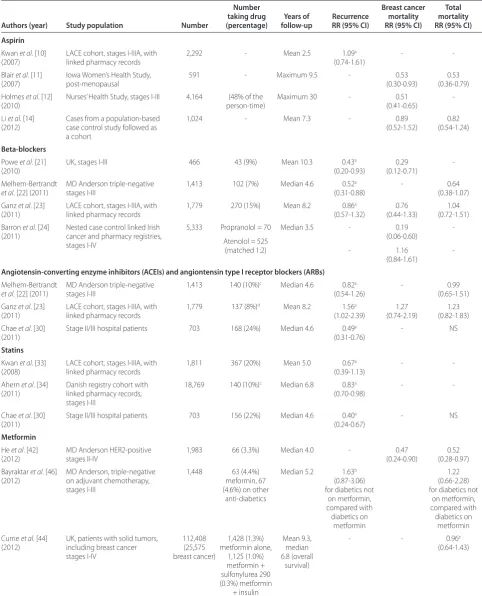
Two observational studies that previously reported on use of beta-blockers and breast cancer survival also reported on ACEI/ARB use. Contrary to the hypotheses generated by the preclinical evidence, neither the MD Anderson cohort of 1,413 patients reported by Melhem-Bertrandt and colleagues [22] nor the LACE cohort (n = 1,779) reported by Ganz and colleagues [23] found any evidence of decreased recurrence, breast cancer mortality, or total mortality among women with breast cancer using ACEIs or ARBs (Table 1) [22,23]. In fact, an elevated risk of recurrence was found among the LACE cohort (RR = 1.56, 95% CI = 1.02 to 2.39) [23]. In a smaller cohort of 703 stage II/III breast cancer patients
from Albert Einstein Medical Center, Chae and colleagues [30] reported a reduced risk of breast cancer recurrence among those using ACEI/ARB (RR = 0.49, 95% CI = 0.31 to 0.76), but total mortality was not reduced. Th erefore, despite promising preclinical evi dence for ACEIs/ARBs, substantial evidence for a protective eff ect among women with breast cancer is currently lacking.
Statins
Biological rationale/preclinical data
Statins – HMG-CoA (3-hydroxy-3-methyl-glutaryl-CoA) reductase inhibitors – are widely used lipid-lowering drugs. Interestingly, lipophilic statins (for example, simvi-statin, lovasimvi-statin, and fl uvastatin) have been shown in vitro to inhibit breast cancer cell growth and proliferation with a variety of hypothesized mechanisms. In multiple cell lines, statins can inhibit prenylation (post-trans-lational modifi cation) of multiple proteins, including those in the Ras family, which is involved in signal trans-duction and presumed to be important in carcinogenesis [31]. Statins may also inhibit histone deacetylase activity [32]. Drugs targeting histone deacetylation are already approved for lymphoma and have activity in other cancers as well. Several clinical trials in cancers other than breast cancer have suggested that statins used in
conjunction with chemotherapy may improve effi cacy
[18]. In terms of breast cancer incidence, studies on the eff ects of statins are mixed. However, the only published, cohort studies on the association between statins and breast cancer recurrence have consistently shown a decreased risk of recurrence.
Epidemiologic data
Table 1. Cohort studies of aspirin, beta-blockers, angiontensin-converting enzyme inhibitors, statins, and metformin and breast cancer survival
Number Breast cancer Total
taking drug Years of Recurrence mortality mortality Authors (year) Study population Number (percentage) follow-up RR (95% CI) RR (95% CI) RR (95% CI) Aspirin
Kwan et al. [10] (2007)
LACE cohort, stages I-IIIA, with linked pharmacy records
2,292 - Mean 2.5 1.09a
(0.74-1.61)
-
-Blair et al. [11] (2007)
Iowa Women’s Health Study, post-menopausal
591 - Maximum 9.5 - 0.53
(0.30-0.93)
0.53 (0.36-0.79) Holmes et al. [12]
(2010)
Nurses’ Health Study, stages I-III 4,164 (48% of the person-time)
Maximum 30 - 0.51
(0.41-0.65)
-Li et al. [14] (2012)
Cases from a population-based case control study followed as a cohort
1,024 - Mean 7.3 - 0.89
(0.52-1.52)
0.82 (0.54-1.24)
Beta-blockers
Powe et al. [21] (2010)
UK, stages I-III 466 43 (9%) Mean 10.3 0.43b (0.20-0.93)
0.29 (0.12-0.71)
-Melhem-Bertrandt
et al. [22] (2011)
MD Anderson triple-negative stages I-III
1,413 102 (7%) Median 4.6 0.52a (0.31-0.88)
- 0.64
(0.38-1.07) Ganz et al. [23]
(2011)
LACE cohort, stages I-IIIA, with linked pharmacy records
1,779 270 (15%) Mean 8.2 0.86a (0.57-1.32)
0.76 (0.44-1.33)
1.04 (0.72-1.51) Barron et al. [24]
(2011)
Nested case control linked Irish cancer and pharmacy registries, stages I-IV
5,333 Propranolol = 70
Atenolol = 525 (matched 1:2)
Median 3.5
-0.19 (0.06-0.60) 1.16 (0.84-1.61)
-Angiotensin-converting enzyme inhibitors (ACEIs) and angiontensin type I receptor blockers (ARBs)
Melhem-Bertrandt
et al. [22] (2011)
MD Anderson triple-negative stages I-III
1,413 140 (10%)c Median 4.6 0.82a (0.54-1.26)
- 0.99
(0.65-1.51) Ganz et al. [23]
(2011)
LACE cohort, stages I-IIIA, with linked pharmacy records
1,779 137 (8%)d Mean 8.2 1.56a (1.02-2.39)
1.27 (0.74-2.19)
1.23 (0.82-1.83) Chae et al. [30]
(2011)
Stage II/III hospital patients 703 168 (24%) Median 4.6 0.49a (0.31-0.76)
- NS
Statins
Kwan et al. [33] (2008)
LACE cohort, stages I-IIIA, with linked pharmacy records
1,811 367 (20%) Mean 5.0 0.67a (0.39-1.13)
-
-Ahern et al. [34] (2011)
Danish registry cohort with linked pharmacy records, stages I-III
18,769 140 (10%)c Median 6.8 0.83a (0.70-0.98)
-
-Chae et al. [30] (2011)
Stage II/III hospital patients 703 156 (22%) Median 4.6 0.40a (0.24-0.67)
- NS
Metformin
He et al. [42] (2012)
MD Anderson HER2-positive stages II-IV
1,983 66 (3.3%) Median 4.0 - 0.47 (0.24-0.90)
0.52 (0.28-0.97) Bayraktar et al. [46]
(2012)
MD Anderson, triple-negative on adjuvant chemotherapy, stages I-III
1,448 63 (4.4%) meformin, 67 (4.6%) on other
anti-diabetics
Median 5.2 1.63b (0.87-3.06) for diabetics not
on metformin, compared with diabetics on metformin 1.22 (0.66-2.28) for diabetics not
on metformin, compared with diabetics on
metformin Currie et al. [44]
(2012)
UK, patients with solid tumors, including breast cancer stages I-IV 112,408 (25,575 breast cancer) 1,428 (1.3%) metformin alone, 1,125 (1.0%) metformin + sulfonylurea 290 (0.3%) metformin + insulin Mean 9.3, median 6.8 (overall survival)
- - 0.96e
(0.64-1.43)
aAny recurrence; bdistant recurrence; cACEI or ARB use; dACEI only; ebreast cancer survivors only; see [44] for all cancer survivor numbers. CI, confi dence interval; LACE,
impact on overall survival. Power was also limited in this study, as there were only 19 recurrences among those who used statins at least 6 months [30].
Th e largest study to date was a population-based
Danish cohort of 18,769 survivors of stage I to III breast cancer diagnosed between 1996 and 2003. Statin use was assessed via linkage to the National Registry of Medicinal Products, which tracks all prescriptions since 1995. Breast cancer recurrence was confi rmed via cancer registry data. Women who used primarily lipophilic statins had a lower risk of recurrence compared with non-users (10-year HR = 0.73, 95% CI = 0.60 to 0.89) after adjustment for age at diagnosis, menopausal status, cancer stage, ER status, cancer treatment, and use of other relevant non-prescription medications. In contrast, women who used primarily hydrophilic statins (for example, atorvastatin, pravastatin, or rosuvastatin) had the same risk of breast cancer recurrence as non-users (10-year adjusted HR = 1.2, 95% CI = 0.79 to 1.70). It should be noted that the analyses with hydrophilic statins were limited for power; there were only 39 recurrences at 10 years compared with 182 recurrences among users of lipophilic statins. Th e primary statin used in the Danish cohort was simvastatin (accounting for 72% of prescrip-tions among statin users), which is the most lipophilic statin. Stratifi ed models showed no diff erence by grade, ER status, or type of treatment [34]. In the US, prior to the introduction of the generic statins in 2006, Lipitor (atorvastatin; Pfi zer Inc, New York, NY, USA) had the largest market share [35].
Although the pharmacologic diff erences between lipo-philic and hydrolipo-philic statins in terms of their cholesterol-lowering eff ects have been well characterized, less is known about statins’ pleiotropic eff ects. Hydrophilic, but not lipophilic, statins may increase mevalonate synthesis in extra-hepatic tissues and this may result in diff erential eff ects on cancer development. Lipophilic statins also tend to accumulate more in fat and have higher plasma protein binding than hydrophilic statins, and this could result in more extra-hepatic activity and systemic eff ects [36].
In summary, the observational data on statins infl u-encing breast cancer recurrence risk are compelling and provide a strong justifi cation for a randomized trial. Furthermore, similar to the aspirin data, data from the multiple randomized trials of statins for cardiovascular disease prevention/treatment should be pooled to evaluate for possible eff ects on cancer recurrence and mortality.
Digoxin
Biological rationale/preclinical data
Cardiac glycosides (the most widely used of which is digoxin) have also demonstrated anti-tumor eff ects in
vitro, presumably through inhibition of Na+K+-ATPase. A variety of anti-tumor eff ects, including induction of apoptosis and inhibition of DNA topoisomerase II, have been observed in cell lines [18,37,38].
Epidemiologic data
Only one study (which has been published several times at varying times of follow-up) has evaluated the asso cia-tion between breast cancer recurrence and digoxin use. With 22 years of follow-up, breast cancer survivors who used digoxin had a lower rate of death (6%, n = 32) from breast cancer than non-users (34%, n = 143) [39]. To date, no other study on this topic has been published.
Anti-diabetic medications
Biological rationale/preclinical data
Although insulin, sulfonylureas, thiazolidinediones, and metformin all lower glucose levels and have been used successfully for diabetes treatment, they have diff erent mechanisms of action and diff erent associations with breast cancer survival. In terms of its anti-diabetic eff ect, metformin inhibits hepatic gluconeogenesis and improves insulin sensitivity in peripheral tissue [40]. Th e mecha-nism of action for thiazolidinediones (for example, rosiglitazone) is not completely understood, but they increase glucose utilization in adipose, muscle, and hepatic tissue, most likely by activating peroxisome proliferator-active receptors (PPARs). Both metformin and thiazolidinediones are associated with lower fasting insulin and C-peptide levels. Importantly, insulin is a known mitogen and can activate insulin-like growth factor 1 (IGF-1) receptors. Sulfonylureas stimulate the release of insulin from pancreatic beta cells. Higher circu lating insulin has been associated with worse breast cancer mortality [41]. Since most of the studies that have evaluated the eff ect of anti-diabetic medications on cancer survival have compared recurrence risks across categories of drugs, all classes will be discussed concurrently[42].
Epidemiologic data
less aggressive cancer screen ing or treatment and may have a higher risk of adverse events from treatments [43]. In addition, the use of certain anti-diabetic drugs may be associated with certain prognostic factors. For example, metformin users tend to be younger than subjects who use other anti-diabetic medications. Analyses are further complicated by the fact that diabetic patients switch back and forth over time between mono-therapy and combined therapy.
Th e study with the largest number of breast cancer cases was a retrospective study of 112,408 subjects from the UK with a diagnosed solid tumor; 8,392 of the subjects had type II diabetes. Medication use was con-fi rmed with pharmacy records. Among 25,575 breast cancer survivors (1,182 with type II diabetes), there was an increased risk of breast cancer mortality associated with having type II diabetes (unadjusted HR = 1.32, 95% CI = 1.17 to 1.49). However, metformin use among cancer survivors was associated with a decreased risk of overall mortality (adjusted HR = 0.85, 95% CI = 0.78 to 0.93) compared with non-diabetics. In contrast, diabetics who used sulfonylureas (HR = 1.13, 95% CI = 1.05 to 1.21) or insulin (HR = 1.13, 95% CI = 1.01 to 1.27) had an increased risk of mortality. Th ese diff erences were not signifi cant in analyses limited to breast cancer survivors [44]. In two companion studies, investigators from MD Anderson focused on outcomes among specifi c breast cancer subgroups. In the fi rst study, they retrospectively reviewed 1,983 consecutive patients with stage II to IV HER2-positive breast cancer (154 diabetics) and found again that diabetes was associated with worse overall survival (adjusted HR = 1.42, 95% CI = 1.04 to 1.94). However, in multivariate analyses, survival diff ered by anti-diabetic therapy, and insulin users had a shorter survival than diabetics who did not use insulin and non-diabetics. In contrast, diabetics who used metformin had signifi cantly longer survival compared with diabetics who did not use metformin or non-diabetics. In multivariate analyses, both metformin use and thiazolidinedione use were associated with improved survival after adjustment for age, BMI, ER status, and use of insulin or insulin secretagogue therapy. In an analysis of competing risks among diabetic patients, metformin and thiazolidino-diones were associated with decreased breast cancer-specifi c mortality [42]. Th e second study focused on triple-negative breast cancer and included 1,448 women (including 63 diabetics on metformin and 67 diabetics not on metformin) with stage I to III triple-negative
breast cancer treated with adjuvant chemo therapy
between 1995 and 2007. In multivariate analyses, both diabetics not on metfomin and diabetics had a non-signifi cant increased risk of distant metastases (HR = 1.63, 95% CI = 0.87 to 3.06 and HR = 1.62, 95% CI = 0.97 to 2.71, respectively) compared with diabetics on
metformin. Th e study was limited by the small number of distant recurrences among the diabetics (18 among metformin users and 26 among non-metformin users) and limited data on metformin use, which were available for the adjuvant chemotherapy period only [46].
Among 2,529 breast cancer patients who received neo-adjuvant chemotherapy for breast cancer at MD Ander-son, the rate of pathologic complete response was higher in the metformin group (24%, n = 68) compared with diabetics who did not take metformin (8%, n = 87) and non-diabetics (16%, n = 2,374) (overall P for diff erence = 0.02). Metformin was also independently predictive of the chances of pathologic complete response (adjusted odds ratio = 2.95, 95% CI = 1.07 to 8.17) after adjustment for age, diabetes, BMI, stage, grade, ER status, and treat-ment) [45].
Th e molecular basis for metformin’s inhibition of cancer cell growth is not known but is hypothesized to be its ability to inhibit PI3-kinase/AKT/mammalian target to rapamycin (mTOR) signaling via activation of the LKB1/AMP-activated protein kinase (AMPK) pathway. Of all the medications presented in this review article, metformin is the only one that will have randomized trial data evaluating its eff ect on breast cancer recurrence within the near future. Th e National Cancer Institutes of Canada and US are enrolling subjects for a phase III study to evaluate the eff ect of metformin compared with placebo among women with higher-risk stage I and stage II or III breast cancer (NCIC MA32). Th e accrual of this study, which opened in April 2010 and is expected to close in 2016, is estimated to be 3,852, and the results are eagerly awaited. Because of their eff ects on the PPAR pathway, ongoing phase I clinical trials are using a variety of thiazolidnediones in combination with chemotherapy for advanced solid tumors.
Conclusions
Substantial scientifi c evidence supports the hypothesis that several common and relatively safe drugs may reduce breast cancer mortality among breast cancer survivors by an amount that rivals the benefi t of currently used therapies. In particular, the evidence is strongest for aspirin (approximately 50% reduction), statins (approxi-mately 25% reduction), and metformin (approxi(approxi-mately 50% reduction).
We believe that randomized trials of aspirin, met-formin, and statins are essential to move the fi eld forward. Despite the compelling evidence presented in this review, it is based primarily on observational studies,
which are subject to confounding. Th ese drugs are
example, aspirin has a measurable risk of gastrointestinal [47] and central nervous system [48] bleeding, and there is a suggestion of hepatoxicity with metformin [49]. In
addition, aspirin is not taken in a fi xed dose; a
randomized trial could help to establish the lowest eff ective dose.
If these fi ndings are confi rmed in randomized trials among breast cancer survivors, the public health impact would be immense. We estimate that, if aspirin is eff ective, using it to treat all patients with breast cancer in the US could potentially save 10,000 lives per year. In addition, if one considers the possible benefi t in the developing world of an inexpensive, widely available medicine, the impact is truly staggering; an estimated 75,000 lives would potentially be saved each year.
In an era in which we struggle to contain health-care costs, the extra costs for patients with breast cancer in the US would be minimal. For developing countries, it could mean the diff erence between some adjuvant treat-ment and none. Whereas new cancer treattreat-ments typically benefi t only patients in wealthy countries because of the costs, these drugs would be a breast cancer treatment available to every part of the world. Th e results of these trials could be truly transformative and change the treatment of breast cancer across the globe with what millions of people already have in their medicine cabinet.
Given the overwhelming weight of the biologic and observational data, randomized trials are the defi nitive way to assess the risk-benefi t balance for breast cancer survivors. One such trial is under way for metformin. A similar trial for aspirin is defi nitely warranted, and possibly one for statins. We estimate that a trial of aspirin would require approximately 3,000 women with stage II or III breast cancer randomly assigned 1:1 and followed for 5 years and cost approximately $15 million USD. However, because these drugs are generic and widely available, there is little industry incentive to support such studies. We propose that the cost is small given the potential benefi t. Who will fi ll this need?
Abbreviations
ACE, angiotensin-converting enzyme; ACEI, angiotensin-converting enzyme inhibitor; ARB, angiotensin type I receptor blocker; BMI, body mass index; CI, confi dence interval; COX, cyclo-oxygenase; ER, estrogen receptor; HR, hazard ratio; LACE, Life After Cancer Epidemiology; NSAID, non-steroidal anti-infl ammatory drug; PPAR, peroxisome proliferator-active receptor; RAAS, renin-angiotensin-aldosterone system; RR, relative risk.
Competing interests
The authors declare that they have no competing interests.
Author details
1The Channing Division of Network Medicine, Department of Medicine,
Brigham and Women’s Hospital and Harvard Medical School, 181 Longwood Avenue, Boston, MA 02115, USA. 2Department of Epidemiology, Harvard
School of Public Health, 677 Huntington Avenue, Boston, MA 02115, USA.
3Department of Medical Oncology, Dana Farber Cancer Institute, 450 Brookline
Avenue, Boston, MA 02215, USA.
Published: 10 December 2012
References
1. Pereg D, Lishner M: Non-steroidal anti-infl ammatory drugs for the prevention and treatment of cancer.J Intern Med 2005, 258:115-123. 2. Karmali RA, Welt S, Thaler HT, Lefevre F: Prostaglandins in breast cancer:
relationship to disease stage and hormone status.Br J Cancer 1983, 48:689-696.
3. Leahy KM, Ornberg RL, Wang Y, Zweifel BS, Koki AT, Masferrer JL: Cyclooxygenase-2 inhibition by celecoxib reduces proliferation and induces apoptosis in angiogenic endothelial cells in vivo.Cancer Res 2002, 62:625-631.
4. Tsujii M, DuBois RN: Alterations in cellular adhesion and apoptosis in epithelial cells overexpressing prostaglandin endoperoxide synthase 2.
Cell 1995, 83:493-501.
5. Terry MB, Gammon MD, Zhang FF, Tawfi k H, Teitelbaum SL, Britton JA, Subbaramaiah K, Dannenberg AJ, Neugut AI: Association of frequency and duration of aspirin use and hormone receptor status with breast cancer risk.JAMA 2004, 291:2433-2440.
6. Gates MA, Tworoger SS, Eliassen AH, Missmer SA, Hankinson SE: Analgesic use and sex steroid hormone concentrations in postmenopausal women.
Cancer Epidemiol Biomarkers Prev 2010, 19:1033-1041.
7. Holmes MD, Chen WY, Schnitt SJ, Collins L, Colditz GA, Hankinson SE, Tamimi RM: COX-2 expression predicts worse breast cancer prognosis and does not modify the association with aspirin.Breast Cancer Res Treat 2011, 130:657-662.
8. Dang CT, Dannenberg AJ, Subbaramaiah K, Dickler MN, Moasser MM, Seidman AD, D’Andrea GM, Theodoulou M, Panageas KS, Norton L, Hudis CA: Phase II study of celecoxib and trastuzumab in metastatic breast cancer patients who have progressed after prior trastuzumab-based treatments.
Clin Cancer Res 2004, 10:4062-4067.
9. Gay LJ, Felding-Habermann B: Contribution of platelets to tumour metastasis.Nat Rev Cancer 2011, 11:123-134.
10. Kwan ML, Habel LA, Slattery ML, Caan B: NSAIDs and breast cancer recurrence in a prospective cohort study.Cancer Causes Control 2007, 18:613-620.
11. Blair CK, Sweeney C, Anderson KE, Folsom AR: NSAID use and survival after breast cancer diagnosis in post-menopausal women.Breast Cancer Res Treat
2007, 101:191-197.
12. Holmes MD, Chen WY, Li L, Hertzmark E, Spiegelman D, Hankinson SE: Aspirin intake and survival after breast cancer.J Clin Oncol 2010, 28:1467-1472. 13. Howe LR, Lippman SM: Modulation of breast cancer risk by nonsteroidal
anti-infl ammatory drugs.J Natl Cancer Inst 2008, 100:1420-1423.
14. Li Y, Brasky TM, Nie J, Ambrosone CB, McCann SE, Shields PG, Trevisan M, Edge SB, Freudenheim JL: Use of nonsteroidal anti-infl ammatory drugs and survival following breast cancer diagnosis.Cancer Epidemiol Biomarkers Prev
2012, 21:239-242.
15. Rothwell PM, Wilson M, Price JF, Belch JF, Meade TW, Mehta Z: Eff ect of daily aspirin on risk of cancer metastasis: a study of incident cancers during randomised controlled trials.Lancet 2012, 379:1591-1601.
16. Algra AM, Rothwell PM: Eff ects of regular aspirin on long-term cancer incidence and metastasis: a systematic comparison of evidence from observational studies versus randomised trials.Lancet Oncol 2012, 13:518-527.
17. Antoni MH, Lutgendorf SK, Cole SW, Dhabhar FS, Sephton SE, McDonald PG, Stefanek M, Sood AK: The infl uence of bio-behavioural factors on tumour biology: pathways and mechanisms.Nat Rev Cancer 2006, 6:240-248. 18. Vaklavas C, Chatzizisis YS, Tsimberidou AM: Common cardiovascular
medications in cancer therapeutics.Pharmacol Ther 2011, 130:177-190. 19. Sloan EK, Priceman SJ, Cox BF, Yu S, Pimentel MA, Tangkanangnukul V, Arevalo
JM, Morizono K, Karanikolas BD, Wu L, Sood AK, Cole SW: The sympathetic nervous system induces a metastatic switch in primary breast cancer.
Cancer Res 2010, 70:7042-7052.
20. Vandewalle B, Revillion F, Lefebvre J: Functional beta-adrenergic receptors in breast cancer cells.J Cancer Res Clin Oncol 1990, 116:303-306.
21. Powe DG, Voss MJ, Zanker KS, Habashy HO, Green AR, Ellis IO, Entschladen F: Beta-blocker drug therapy reduces secondary cancer formation in breast cancer and improves cancer specifi c survival.Oncotarget 2010, 1:628-638. 22. Melhem-Bertrandt A, Chavez-Macgregor M, Lei X, Brown EN, Lee RT,
patients with triple-negative breast cancer.J Clin Oncol 2011, 29:2645-2652. 23. Ganz PA, Habel LA, Weltzien EK, Caan BJ, Cole SW: Examining the infl uence
of beta blockers and ACE inhibitors on the risk for breast cancer recurrence: results from the LACE cohort.Breast Cancer Res Treat 2011, 129:549-556.
24. Barron TI, Connolly RM, Sharp L, Bennett K, Visvanathan K: Beta blockers and breast cancer mortality: a population- based study.J Clin Oncol 2011, 29:2635-2644.
25. Koh WP, Yuan JM, Sun CL, van den Berg D, Seow A, Lee HP, Yu MC: Angiotensin I-converting enzyme (ACE) gene polymorphism and breast cancer risk among Chinese women in Singapore.Cancer Res 2003, 63:573-578.
26. Koh WP, Yuan JM, Van Den Berg D, Lee HP, Yu MC: Polymorphisms in angiotensin II type 1 receptor and angiotensin I-converting enzyme genes and breast cancer risk among Chinese women in Singapore.Carcinogenesis
2005, 26:459-464.
27. Herr D, Rodewald M, Fraser HM, Hack G, Konrad R, Kreienberg R, Wulff C: Potential role of Renin-Angiotensin-system for tumor angiogenesis in receptor negative breast cancer.Gynecol Oncol 2008, 109:418-425. 28. Greco S, Muscella A, Elia MG, Salvatore P, Storelli C, Mazzotta A, Manca C,
Marsigliante S: Angiotensin II activates extracellular signal regulated kinases via protein kinase C and epidermal growth factor receptor in breast cancer cells.J Cell Physiol 2003, 196:370-377.
29. Zhao Y, Chen X, Cai L, Yang Y, Sui G, Fu S: Angiotensin II/angiotensin II type I receptor (AT1R) signaling promotes MCF-7 breast cancer cells survival via PI3-kinase/Akt pathway.J Cell Physiol 2010, 225:168-173.
30. Chae YK, Valsecchi ME, Kim J, Bianchi AL, Khemasuwan D, Desai A, Tester W: Reduced risk of breast cancer recurrence in patients using ACE inhibitors, ARBs, and/or statins.Cancer Invest 2011, 29:585-593.
31. Khanzada UK, Pardo OE, Meier C, Downward J, Seckl MJ, Arcaro A: Potent inhibition of small-cell lung cancer cell growth by simvastatin reveals selective functions of Ras isoforms in growth factor signalling.Oncogene
2006, 25:877-887.
32. Lin YC, Lin JH, Chou CW, Chang YF, Yeh SH, Chen CC: Statins increase p21 through inhibition of histone deacetylase activity and release of promoter-associated HDAC1/2.Cancer Res 2008, 68:2375-2383. 33. Kwan ML, Habel LA, Flick ED, Quesenberry CP, Caan B: Post-diagnosis statin
use and breast cancer recurrence in a prospective cohort study of early stage breast cancer survivors.Breast Cancer Res Treat 2008, 109:573-579. 34. Ahern TP, Pedersen L, Tarp M, Cronin-Fenton DP, Garne JP, Silliman RA,
Sorensen HT, Lash TL: Statin prescriptions and breast cancer recurrence risk: a Danish nationwide prospective cohort study.J Natl Cancer Inst 2011, 103:1461-1468.
35. Jackevicius CA, Chou MM, Ross JS, Shah ND, Krumholz HM: Generic atorvastatin and health care costs.N Engl J Med 2012, 366:201-204. 36. Duncan RE, El-Sohemy A, Archer MC: Statins and cancer development.
Cancer Epidemiol Biomarkers Prev 2005, 14:1897-1898.
37. Frese S, Frese-Schaper M, Andres AC, Miescher D, Zumkehr B, Schmid RA: Cardiac glycosides initiate Apo2L/TRAIL-induced apoptosis in non-small cell lung cancer cells by up-regulation of death receptors 4 and 5.Cancer Res 2006, 66:5867-5874.
38. Bielawski K, Winnicka K, Bielawska A: Inhibition of DNA topoisomerases I and II, and growth inhibition of breast cancer MCF-7 cells by ouabain, digoxin and proscillaridin A.Biol Pharm Bull 2006, 29:1493-1497. 39. Stenkvist B: Is digitalis a therapy for breast carcinoma?Oncol Rep 1999,
6:493-496.
40. Decensi A, Puntoni M, Goodwin P, Cazzaniga M, Gennari A, Bonanni B, Gandini S: Metformin and cancer risk in diabetic patients: a systematic review and meta-analysis.Cancer Prev Res (Phila Pa) 2010, 3:1451-1461. 41. Goodwin PJ, Ennis M, Pritchard KI, Trudeau ME, Koo J, Madarnas Y, Hartwick W,
Hoff man B, Hood N: Fasting insulin and outcome in early-stage breast cancer: results of a prospective cohort study.J Clin Oncol 2002, 20:42-51. 42. He X, Esteva FJ, Ensor J, Hortobagyi GN, Lee MH, Yeung SC: Metformin and
thiazolidinediones are associated with improved breast cancer-specifi c survival of diabetic women with HER2+ breast cancer.Ann Oncol 2012, 23:1771-1780.
43. Peairs KS, Barone BB, Snyder CF, Yeh HC, Stein KB, Derr RL, Brancati FL, Wolff AC: Diabetes mellitus and breast cancer outcomes: a systematic review and meta-analysis.J Clin Oncol 2011, 29:40-46.
44. Currie CJ, Poole CD, Jenkins-Jones S, Gale EA, Johnson JA, Morgan CL: Mortality after incident cancer in people with and without type 2 diabetes: impact of metformin on survival.Diabetes Care 2012, 35:299-304. 45. Jiralerspong S, Palla SL, Giordano SH, Meric-Bernstam F, Liedtke C, Barnett CM,
Hsu L, Hung MC, Hortobagyi GN, Gonzalez-Angulo AM: Metformin and pathologic complete responses to neoadjuvant chemotherapy in diabetic patients with breast cancer.J Clin Oncol 2009, 27:3297-3302.
46. Bayraktar S, Hernadez-Aya LF, Lei X, Meric-Bernstam F, Litton JK, Hsu L, Hortobagyi GN, Gonzalez-Angulo AM: Eff ect of metformin on survival outcomes in diabetic patients with triple receptor-negative breast cancer.
Cancer 2012, 118:1202-1211.
47. Hernandez-Diaz S, Garcia Rodriguez LA: Cardioprotective aspirin users and their excess risk of upper gastrointestinal complications.BMC Med 2006, 4:22.
48. He J, Whelton PK, Vu B, Klag MJ: Aspirin and risk of hemorrhagic stroke: a meta-analysis of randomized controlled trials.JAMA 1998, 280:1930-1935. 49. Hashmi T: Probable hepatotoxicity associated with the use of metformin in
type 2 diabetes.BMJ Case Rep 2011, 2011.
doi:10.1186/bcr3336