i
SIMULATION FOR HELICOPTER CONTROL SYSTEM USING LQR CONTROLLER
AHMAD ZUL FADZLI BIN MANSOR TARIDI
This report is submitted in partial fulfillment of the requirements for the award of Bachelor of Electronic Engineering
(Industrial Electronics) With Honours
Faculty of Electronic and Computer Engineering Universiti Teknikal Malaysia Melaka
ii
UNIVERSTI TEKNIKAL MALAYSIA MELAKA
FAKULTI KEJURUTERAAN ELEKTRONIK DAN KEJURUTERAAN KOMPUTER
BORANG PENGESAHAN STATUS LAPORAN PROJEK SARJANA MUDA II
Tajuk Projek : Simulation For Helicopter Control System Using LQR Controller Sesi
Pengajian : 2008/2009
Saya AHMAD ZUL FADZLI BIN MANSOR TARIDI (HURUF BESAR)
mengaku membenarkan Laporan Projek Sarjana Muda ini disimpan di Perpustakaan dengan syarat-syarat kegunaan seperti berikut:
1. Laporan adalah hak milik Universiti Teknikal Malaysia Melaka.
2. Perpustakaan dibenarkan membuat salinan untuk tujuan pengajian sahaja.
3. Perpustakaan dibenarkan membuat salinan laporan ini sebagai bahan pertukaran antara institusi pengajian tinggi.
4. Sila tandakan ( √ ) :
SULIT*
(Mengandungi maklumat yang berdarjah keselamatan atau kepentingan Malaysia seperti yang termaktub di dalam AKTA RAHSIA RASMI 1972)
TERHAD* (Mengandungi maklumat terhad yang telah ditentukan oleh
organisasi/badan di mana penyelidikan dijalankan)
TIDAK TERHAD
Disahkan oleh:
__________________________ ___________________________________
(TANDATANGAN PENULIS) (COP DAN TANDATANGAN PENYELIA)
Alamat Tetap: No 26, Jln Assamara,
Taman Assamara,
34000, Taiping
Tarikh 30/04/09 Tarikh: ………..
iii
“I hereby declare that this report is the result of my own work except for quotes as cited in the references.”
Signatures : _____________________
iv
“I hereby declare that I have read this report and in my opinion this report is sufficient in terms of the scope and quality for the award of Bachelor of Electronic
Engineering (Industrial Electronic Engineering) With Honours.”
v
For you, my mom and dad
For your truly support and undivided love For making me the person
vi
ACKNOWLEDGEMENT
vii
ABSTRACT
viii
ABSTRAK
ix
LIST OF CONTENTS
CHAPTER CONTENT PAGE
TITLE OF PROJECT i
DECLARATION ii
DEDICATION v
ACKNOWLEDGEMENT vi
ABSTRACT vii
ABSTRAK viii
LIST OF CONTENT ix
LIST OF TABLES xiii
LIST OF FIGURES xiv
LIST OF ABBREVIATION xvii
LIST OF APPENDIXES xviii
I INTRODUCTION
1.1 OBJECTIVES 2
1.2 PROBLEM STATEMENT 2
1.3 SCOPE OF PROJECT 3
1.4 PROJECT METHODOLOGY 4
x
II LITERATURE REVIEW
2.1 BASIC HELICOPTER CONTROLLING SYSTEM 8
2.1.1 The Basic of Pitch 9
2.1.1.1 Collective Control 9
2.1.1.2 Cyclic Control 11
2.1.1.3 Rotational (yaw) Control 13
2.1.1.4 Throttle Control 14
2.1.2 How Blade Generate Lift 15
2.1.3 FP (Fixed Pitch) vs. CP (Collective Pitch) 17
2.2 RC HELICOPTER CONTROL CHANNEL 19
2.3 HELICOPTER SENSORS 20
2.3.1 The Gyro 21
2.3.2 RC Helicopter Mixer Boards 22 2.4 THE ATMOSPHERE AND AIR DATA
MEASUREMENT 23
2.4.1 The Characteristic of the Atmosphere. 23
2.4.2 Winds and Turbulence 24
III PROJECT METHODOLOGY
3.1 GENERAL CONCEPT 26
3.2 PROJECT FLOW CHART 28
IV MATHEMATICAL MODEL
4.1 MODEL STRUCTURE 30
xi
4.3 TRANSLATIONAL EQUATION 36
4.4 ROTATATIONAL EQUATION 38
4.5 EULER’S ANGLE 42
4.6 PARAMETER 43
V LQR CONTROLLER
5.1 EQUATION OF LQR 46
5.2 STABILITY 49
VI VIRTUAL REALITY TOOLBOX
6.1 VRML VIEWERS 51
6.2 VRML EDITOR 51
6.3 VRML COORDINATE SYSTEM 52
6.4 APPLICATION VIRTUAL REALITY IN
HELICOPTER SYSTEM 54
VII RESULT AND DISCUSSION
7.1 RESULT FROM M-FILES FOR OPEN-LOOP 60
7.1.1 The State-Space 60
7.1.2 The Transfer Function 61
7.1.3 The Eigenvalue 62
7.1.4 Poles-Zero Map 63
7.2 RESULT FROM M-FILES FOR CLOSED-LOOP 64 7.2.1 The Matrix Value of State-Space in Simulation 64
7.2.2 LQR in MATLAB 65
7.2.3 The Transfer Function 66
xii
7.2.5 Poles-Zero Map 67
7.3 SIMULINK FOR OPEN-LOOP SYSTEM 68
7.3.1 Input System 69
7.3.2 Output System 70
7.4 SIMULINK FOR CLOSED-LOOP SYSTEM 74
7.4.1 Output System 75
7.5 SIMULINK FOR UAV SYSTEM 79
7.5.1 UAV INPUT 79
7.5.2 UAV OUTPUT 80
7.6 DISCUSSION 82
VI CONCLUSION
5.1 CONCLUSION 84
5.2 FUTURE RECOMENDATION 85
REFERENCES 86
xiii
LIST OF TABLE
NUM TITLE PAGE
2.1 RC Channel Mode 19
4.1 Moments and Product of Inertia 40
4.2 DRA Puma Parameters 43
xiv
LIST OF FIGURES
NUM TITLE PAGE
1.1 Project Workflow 4
2.1 Swash Plate 8
2.2 Rotational Movement 8
2.3 Translational Movement 8
2.4 Airfoil System 9
2.5 Collective and Rotor Blade Angle of Attack 9
2.6 Collective Control 10
2.7 Cyclic and Rotor Blade Angle of Attack 11
2.8 Cyclic Control 12
2.9 Helicopter Controls in Relation to the Pilot's Seat 12
2.10 Tail Blade 13
2.11 Tail Control 13
2.12 Blade Operation 15
2.13 Movement of Air Over an Airfoil 16
2.14 Pitch Angle of Attack 17
2.15 Rotor Head Assembly of a ‘FP’ RC Helicopter 17 2.16 FP Rotor Head Compared to The More Complex CP (right) 18
2.17 The Gyro 21
2.18 RC Mixer Boards 22
3.1 Helicopter System 26
3.2 Project Methodology 28
4.1 Typical Model Organization 31
xv
4.3 Inertial (E), Local (L), And Body (B) Axes 33
4.4 Aircraft Orientation Using Euler Angles 34
4.5 Euler Angle 42
4.6 DRA Research Puma 44
6.1 V-Realm Builder software 51
6.2 MATLAB graphics 52
6.3 VRML coordinate system 52
6.4 Rotation Angles 52
6.5 Helicopter System 54
6.6 Virtual Reality Block Model 54
6.7 Inside Subsystem Block Model 55
6.8 Red Block (Color Block 55
6.9 Helicopter Trajectory 55
6.10 Helicopter Trajectory Color 56
6.11 Visual of Virtual Reality 56
6.12 Parameter VR Sink 57
6.13 V-Realm Builder World Animation Design 58
6.14 Object Library 58
7.1 Eigenvalues 62
7.2 Poles-Zero Map 63
7.3 Feedback Block Model 65
7.4 Feedback Block Model 66
7.5 Poles-Zero Map 67
7.6 Simulink Block for Open-Loop System 68
7.7 Upward and Forward Mode Adjustment 69
7.8 Upward Input 69
7.9 Forward Input 69
7.10 Upward Translational Output 70
7.11 Upward Translational Output 3-D 70
7.12 Upward Distance Output 3-D 71
7.13 Upward Rotational Output 3-D 71
7.14 Forward Translational Output 72
xvi
7.16 Forward Distance Output 3-D 73
7.17 Forward Rotational Output 3-D 73
7.18 Simulink Block for Closed-Loop System 74
7.19 Upward Translational Output 75
7.20 Upward Translational Output 3-D 75
7.21 Upward Distance Output 3-D 76
7.22 Upward Rotational Output 3-D 76
7.23 Forward Ttranslational Output 77
7.24 Forward Ttranslational Output 3-D 77
7.25 Forward Distance Output 3-D 78
7.26 Forward Rotational Output 3-D 78
7.27 Simulink Block for UAV System 79
7.28 UAV Input Data 79
7.29 UAV Translational Output 80
7.30 UAV Translational Output 3-D 80
7.31 UAV Distance Output 3-D 81
7.32 UAV Rotational Output 3-D 81
8.1 UAV Interfacing using RTWT 85
8.2 Stability Derivatives Longitudinal Parameter 90
8.3 Stability Derivatives Lateral Parameter 91
xvii
LIST OF ABBREVIATION
SISO - Single Input Single Output MIMO - Multi Input Multi Output
PID - Proportional-Integral-Derivative PD - Proportional-Derivative
LQR - Linear Quadratic Regulator DOF - Degree of Freedom
a
M - Mass of helicopter (kg)
X,Y,Z - External aerodynamic forces in x,y,z body axes (N) P,Q,R - Angular velocity around x,y,z body axes (rad) L,M,N - External aerodynamic moment in x,y,z axes (Nm)
0
θ
- Main rotor collective pitch angle (rad)T 0
θ
- Tail rotor collective pitch angle (rad)LS
θ
- Longitudinal cyclic pitch (rad)LC
θ
- Lateral cyclic pitch (rad)u,v,w - Translational velocity component of helicopter along fuselage (m/s)
p,q,r - Angular velocity component of helicopter (rad/s)
ψ φ
θ, , - Euler angles defining the orientation of the aircraft relative to the Earth (rad)
a
Ω - Mass rotor angular velocity (rad/s) UAV - Unmanned Aerial Vehicle
xviii
LIST OF APPENDIXES
NO TITLE PAGE
A M-FILES CODING 87
1
CHAPTER 1
ITRODUCTIO
The first successful flight of an airplane on December 17, 1903 by the Wright
brothers and the advent of the helicopter on November 13, 1907 by Paul Cornu
(Helicopter History Site), man began exploring the skies. Both of these craft offer
extraordinary ways to soar through the skies, yet each has its own limitations. While,
the airplane can fly up to 120,000 feet and can do so flying three times faster than the
speed of sound. It needs a runway about a mile long to take off and land and must
maintain a forward velocity to produce lift. While the helicopter can take off without
and runway and can remain stationary in a hover, it cannot fly much faster than 400
miles per hour and cannot fly much higher than 30,000 feet but can reach to the
difficult area that airplane can reach. The helicopter was known to be inherently
unstable, complicated and nonlinear dynamics under the significant influence of
disturbances and parameter perturbations. The system has to be stabilized by using a
feedback controller. The stabilizing controller may be designed by the model-based
mathematical approach or by heuristic control algorithms. Due to the complexity of
the helicopter dynamics, there have been efforts to apply non-model-based
approaches such as fuzzy-logic control, neural network control, or linear quadratic
2
1.1 OBJECTIVES
The objectives for this project are:
i. To develop the mathematical model of this system.
ii. To understand each of DRA Puma helicopter parameter that can be implant to
helicopter model.
iii. To understand and calculate the EoM (equation of movement) in helicopter
model and apply the EoM in state-space representation.
iv. To design the upward flight and forward flight control then design the stable
control system for this model using LQR.
v. To demonstrate design and analysis techniques by using MATLAB software
through graph and animation of the system.
1.2 PROBLEM STATEMET
The control for a small scale helicopter has been designed using various
methods. During the period of 1990s, the classical control systems such as
single-input-single-output SISO proportional-derivative (PD) feedback control systems
have been used extensively. Their controller parameters were usually tuned
empirically [4]. This trial-and error approach to design an ''acceptable'' control
system however is not agreeable with complex multi-input multi-output MIMO
systems with sophisticated performance criteria. For more advanced multivariable
controller synthesis approaches, an accurate model of the dynamics is required. To
control a model helicopter as a complex MIMO system, an approach that can
synthesize a control algorithm to make the helicopter meet performance criteria
while satisfying some physical constraints is required. More recent development in
this area include the use of optimal control (Linear Quadratic Regulator)
3
1.3 SCOPE OF PROJECT
The scope of this project involve of:
i. Develop the mathematical model of hybrid control system.
ii. Design upward flight and forward flight control system in simulation.
iii. Apply the LQR controller to stabilize the system.
4
1.4 PROJECT METHODOLOGY
Methodology is important part of the whole project because it shows out how the
project’s activity develops. For this project, there are some procedures and methods
which be used to produce a set of simulation system of linear helicopter. The detail
explanations about the methodology are discussed in Chapter III. The project
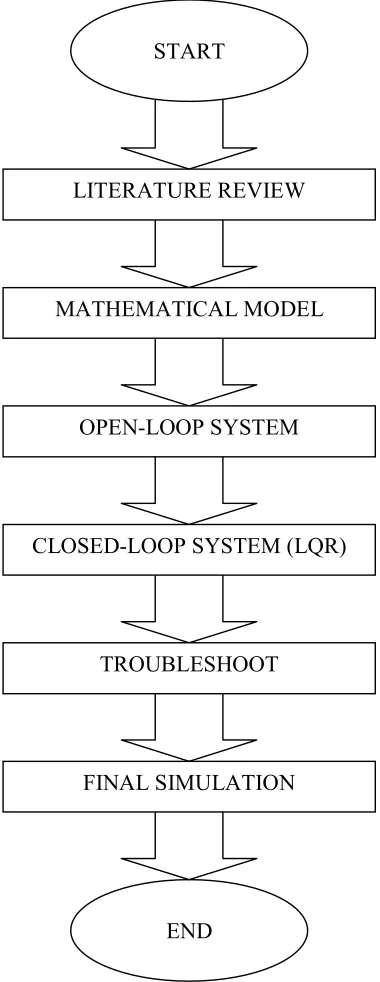
workflow is shown in Figure 1.1
END START
MATHEMATICAL MODEL LITERATURE REVIEW
OPEN-LOOP SYSTEM
CLOSED-LOOP SYSTEM (LQR)
TROUBLESHOOT
[image:22.612.241.431.202.693.2]FINAL SIMULATION
5
1.6 REPORT ORGAIZATIO
This report contains eight chapters that will be explaining the detail of this
project. First six chapters are introduction, literature review, project methodology,
mathematical model, LQR controller and virtual reality toolbox will briefly cover the
main operation and understanding of the project. Seventh and the eighth chapter are
on result and discussion that show finalize result that been achieved by the
simulation in MATLAB. The observation and analysis will be describe detail to
show the capability of the system performance.
The first chapter is about the introduction of the project. This chapter covers
about the overview of this project, project objective, project problem statement,
project scope and the project methodology.
The second chapter is about the literature review of the project. The literature
reviews includes some research about the theory of controlling the real helicopter
and remote control helicopter (RC). This chapter also explains about the sensors that
use in the helicopter. Plus this chapter give information about atmosphere and
standard air data measurement.
The third chapter is about the project methodology. In this chapter the
explanation of the step of the project will be clarify. The general concepts will be
shown and explain in detail. The process of the project is drawn in the flowchart of
the project. All the process is elaborate completely in this chapter.
The fourth chapter mainly focuses on the mathematical model. Based on the
three main axis than get the orientation of the helicopter. Using the basic equation
from Newton’s Law and Euler’s Equation in term of coordinate system and derive to
get 9 Equation of Motion (EoM) to use in the control system. This chapter also
include the parameter used for the helicopter control system. The DRA Research
6
The fifth chapter will show the derivation of the mathematical of LQR system
based on Riccarti equation to stabilize the helicopter control system. The important
variable needed to manipulate the system and give the optimize value for the
controller.
The sixth chapter briefly show how to use the Virtual Reality Toolbox in
MATLAB. Start from the introduction of VRML than to V-Realm Builder software
and finally how to create the animation and communicate with the control system.
The seventh chapter contains the preliminary result of the project. In this
chapter, the simulation for open-loop and closed-loop will be design. The output
graph of open-loop system will show either the system is stable or unstable. The
output graph of closed-loop system will show the difference performance compared
to open-loop system. This chapter also show the UAV helicopter design through the