Bringing Active Learning to Life
Ines Rehbein
Computational Linguistics Saarland University
Josef Ruppenhofer
Computational Linguistics Saarland University
{rehbein|josefr|apalmer}@coli.uni-sb.de
Alexis Palmer
Computational Linguistics Saarland University
Abstract
Active learning has been applied to dif-ferent NLP tasks, with the aim of limit-ing the amount of time and cost for human annotation. Most studies on active learn-ing have only simulated the annotation scenario, using prelabelled gold standard data. We present the first active learning experiment for Word Sense Disambigua-tion with human annotators in a realistic environment, using fine-grained sense dis-tinctions, and investigate whether AL can reduce annotation cost and boost classifier performance when applied to a real-world task.
1 Introduction
Active learning has recently attracted attention as having the potential to overcome the knowledge acquisition bottleneck by limiting the amount of human annotation needed to create training data for statistical classifiers. Active learning has been shown, for a number of different NLP tasks, to re-duce the number of manually annotated instances needed for obtaining a consistent classifier perfor-mance (Hwa, 2004; Chen et al., 2006; Tomanek et al., 2007; Reichart et al., 2008).
The majority of such results have been achieved by simulating the annotation scenario using prela-belled gold standard annotations as a stand-in for real-time human annotation. Simulating annota-tion allows one to test different parameter set-tings without incurring the cost of human anno-tation. There is, however, a major drawback: we
do not know whether the results of experiments performed using hand-corrected data carry over to real-world scenarios in which individual human annotators produce noisy annotations. In addi-tion, we do not know to what extent error-prone annotations mislead the learning process. A sys-tematic study of the impact of erroneous annota-tion on classifier performance in an active learn-ing (AL) settlearn-ing is overdue. We need to know a) whether the AL approach can really improve clas-sifier performance and save annotation time when applied in a real-world scenario with noisy data, and b) whether AL works for classification tasks with fine-grained or complex annotation schemes and a low inter-annotator agreement.
deci-sions on particular instances may diverge, raising the question of which annotations should be used to guide the AL process. This paper thus investi-gates whether active learning can be successfully applied in a real-world scenario with the particular challenges described above.
Section 2 of the paper gives a short overview of the AL paradigm and some related work, and Section 3 discusses the multi-annotator scenario. In Section 4 we present our experimental design and describe the data we use. Section 5 presents results, and Section 6 concludes.
2 Active Learning
The active learning approach aims to reduce the amount of manual annotation needed to create training data sufficient for developing a classifier with a given performance. At each iteration of the AL cycle, the actual knowledge state of the learner guides the learning process by determin-ing which instances are chosen next for annota-tion. The main goal is to advance the learning process by selecting instances which provide im-portant information for the machine learner.
In a typical active learning scenario, a small set of manually labelled seed data serves as the ini-tial training set for the classifier (learner). Based on the predictions of the classifier, a large pool of unannotated instances is queried for the next instance (or batch of instances) to be presented to the human annotator (sometimes called the or-acle). The underlying active learning algorithm controlling the learning process tries to select the most informative instances in order to get a strong boost in classifier performance. Different meth-ods can be used for determining informativity of instances. We use uncertainty sampling (Cohn et al., 1995) in which “most informative” instances are those for which the classifier has the lowest confidence in its label predictions. The rough in-tuition behind this selection method is that it iden-tifies instance types which have yet to be encoun-tered by the classifier. The learning process pro-ceeds by presenting the selected instances to the human annotator, who assigns the correct label. The newly-annotated instances are added to the seed data and the classifier is re-trained on the new data set. The newly trained classifier now picks
the next instances, based on its updated knowl-edge, and the process repeats. If the learning pro-cess can provide precisely that information which the classifier still needs to learn, a smaller number of instances should suffice to achieve the same ac-curacy as on a larger training set of randomly se-lected training examples.
Active learning has been applied to a num-ber of natural language processing tasks like POS tagging (Ringger et al., 2007), NER (Laws and Sch¨utze, 2008; Tomanek and Hahn, 2009), syntactic parsing (Osborne and Baldridge, 2004; Hwa, 2004), Word Sense Disambiguation (Chen et al., 2006; Chan and Ng, 2007; Zhu and Hovy, 2007; Zhu et al., 2008) and morpheme gloss-ing for language documentation (Baldridge and Palmer, 2009). While most of these studies suc-cessfully show that the same classification accu-racy can be achieved with a substantially smaller data set, these findings are mostly based on simu-lations using gold standard data.
For our task of Word Sense Disambiguation (WSD), mixed results have been achieved. AL seems to improve results in a WSD task with coarse-grained sense distinctions (Chan and Ng, 2007), but the results of (Dang, 2004) raise doubts as to whether AL can successfully be applied to a fine-grained annotation scheme, where Inter-Annotator Agreement (IAA) is low and thus the consistency of the human annotations decreases. In general, AL has been shown to reduce the cost of annotation when applied to classification tasks where a single human annotator predicts labels for new data points with a reasonable consistency and accuracy. It is not clear whether the same settings can be applied to a multi-annotator environment where IAA is low.
3 Active Learning in a realistic task
including multiple annotators
high level of ambiguity, and it necessitates that all annotators work on the same data set.
Replicating an active learning simulation on hand-corrected data, starting with a fixed set of seed data and fixed parameter settings, using the same algorithm, will always result in the same training set selected from the pool. Human anno-tators, however, will assign different labels to the same instances, thus influencing the selection of the next instance from the pool. This means that individual annotators might end up with very dif-ferent sets of annotated data, depending on factors like their interpretation of the annotation guide-lines, an implicit bias towards a particular label, or simply errors made during annotation.
There is not much work addressing this prob-lem. (Donmez and Carbonell, 2008) consider modifications of active learning to accommodate variability of annotators. (Baldridge and Palmer, 2009) present a real-world study with human an-notators in the context of language documenta-tion. The task consists of producing interlin-ear glossed text, including morphological and grammatical analysis, and can be described as a sequence labelling task. Annotation cost is measured as the actual time needed for annota-tion. Among other settings, the authors compare the performance of two annotators with different grades of expertise. The classifier trained on the data set created by the expert annotator in an ac-tive learning setting does obtain a higher accuracy on the gold standard. For the non-expert annota-tor, however, the active learning setting resulted in a lower accuracy than for a classifier trained on a randomly selected data set. This finding sug-gests that the quality of annotation needs to be high enough for active learning to actually work, and that annotation noise is a problem for AL.
There are two problems arising from this:
1. It is not clear whether active learning will work when applied to noisy data
2. It is not straightforward to apply active learn-ing to a real-world scenario, where low IAA asks for multiple annotators
In our experiment we address these questions by systematically investigating the impact of an-notation noise on classifier performance and on
the composition of the training set. The next sec-tion presents the experimental design and the data used in our experiment.
4 Experimental Design
In the experiment we annotated 8 German cau-sation nouns, namely Ausgang, Anlass,
Ergeb-nis, Resultat, Grund, Konsequenz, Motiv, Quelle
(outcome, occasion, effect, result, reason, con-sequence, motive, source of experience). These nouns were chosen because they exhibit a range of difficulty in terms of the number of senses they have in our annotation scheme. They all encode subtle distinctions between different word senses, but some of them are clearly easier to disam-biguate than others. For instance, although
Aus-gang has 9 senses, they are easier to distinguish
for humans than the 4 senses of Konsequenz. Six annotators participated in the experiment. While all annotators were trained, having at least one year experience in frame-semantic annota-tion, one of the annotators is an expert with several years of training and working experience in the Berkeley FrameNet Project. This annotator also defined the frames (word senses) used in our ex-periment.
Prior to the experiment, all annotators were given 100 randomly chosen sentences. After annotating the training data, problematic cases were discussed to make sure that the annotators were familiar with the fine-grained distinctions between word senses in the annotation scheme. The data sets used for training were adjudicated by two of the annotators (one of them being the expert) and then used as a gold standard to test classifier performance in the active learning pro-cess.
4.1 Data and Setup
For each lemma we extracted sentences from the Wahrig corpus1 containing this particular lemma. The annotators had to assign word senses to 300 instances for each target word, split into 6 pack-ages of 50 sentences each. This resulted in 2,400 annotated instances per annotator (14,400 anno-tated instances in total). The annotation was done
1
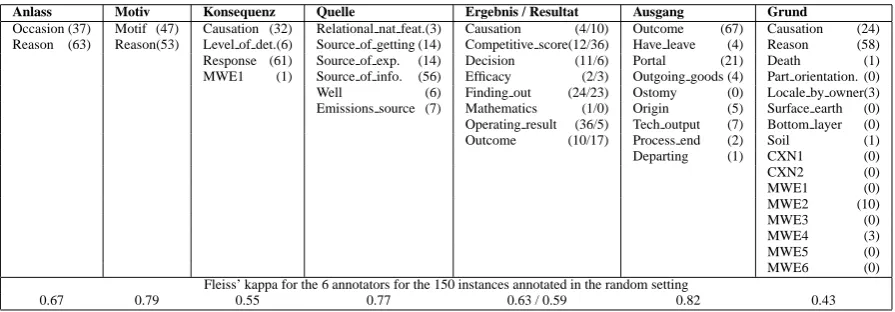
Anlass Motiv Konsequenz Quelle Ergebnis / Resultat Ausgang Grund
Occasion (37) Motif (47) Causation (32) Relational nat feat.(3) Causation (4/10) Outcome (67) Causation (24) Reason (63) Reason(53) Level of det.(6) Source of getting (14) Competitive score(12/36) Have leave (4) Reason (58) Response (61) Source of exp. (14) Decision (11/6) Portal (21) Death (1) MWE1 (1) Source of info. (56) Efficacy (2/3) Outgoing goods (4) Part orientation. (0) Well (6) Finding out (24/23) Ostomy (0) Locale by owner(3) Emissions source (7) Mathematics (1/0) Origin (5) Surface earth (0) Operating result (36/5) Tech output (7) Bottom layer (0) Outcome (10/17) Process end (2) Soil (1) Departing (1) CXN1 (0)
CXN2 (0)
MWE1 (0)
MWE2 (10)
MWE3 (0)
MWE4 (3)
MWE5 (0)
MWE6 (0)
Fleiss’ kappa for the 6 annotators for the 150 instances annotated in the random setting
0.67 0.79 0.55 0.77 0.63 / 0.59 0.82 0.43
Table 1: 8 causation nouns and their word senses (numbers in brackets give the distribution of word senses in the gold standard (100 sentences); CXN: constructions, MWE: multi-word expressions; note that Ergebnis and Resultat are synonyms and therefore share the same set of frames.)
using a Graphical User Interface where the sen-tence was presented to the annotator, who could choose between all possible word senses listed in the GUI. The annotators could either select the frame by mouse click or use keyboard shortcuts. For each instance we recorded the time it took the annotator to assign an appropriate label. To ease the reading process the target word was high-lighted.
As we want to compare time requirements needed for annotating random samples and sen-tences selected by active learning, we had to con-trol for training effects which might speed up the annotation. Therefore we changed the annotation setting after each package, meaning that the first annotator started with 50 sentences randomly se-lected from the pool, then annotated 50 sentences selected by AL, followed by another 50 randomly chosen sentences, and so on. We divided the an-notators into two groups of three anan-notators each. The first group started annotating in the random setting, the second group in the AL setting. The composition of the groups was changed for each lemma, so that each annotator experienced all dif-ferent settings during the annotation process. The annotators were not aware of which setting they were in.
Pool data For the random setting we randomly
selected three sets of sentences from the Wahrig corpus which were presented for annotation to all six annotators. This allows us to compare annota-tion time and inter-annotator agreement between
the annotators. For the active learning setting we randomly selected three sets of 2000 sentences each, from which the classifier could pick new in-stances during the annotation process. This means that for each trial the algorithm could select 50 in-stances out of a pool of 2000 sentences. On any given AL trial each annotator uses the same pool as all the other annotators. In an AL simulation with fixed settings and gold standard labels this would result in the same subset of sentences se-lected by the classifier. For our human annotators, however, due to different annotation decisions the resulting set of sentences is expected to differ.
Sampling method Uncertainty sampling is a standard sampling method for AL where new in-stances are selected based on the confidence of the classifier for predicting the appropriate label. Dur-ing early stages of the learnDur-ing process when the classifier is trained on a very small seed data set, it is not beneficial to add the instances with the lowest classifier confidence. Instead, we use a dy-namic version of uncertainty sampling (Rehbein and Ruppenhofer, 2010), based on the confidence of a maximum entropy classifier2, taking into ac-count how much the classifier has learned so far. In each iteration one new instance is selected from the pool and presented to the oracle. After anno-tation the classifier is retrained on the new data set. The modified uncertainty sampling results in a more robust classifier performance during early stages of the learning process.
Anlass Motiv Konsequenz Quelle Ergebnis Resultat Ausgang Grund
R U R U R U R U R U R U R U R U
A1 8.6 9.6 5.9 6.6 10.7 10.5 6.0 4.8 10.5 7.4 10.1 9.6 6.4 10.0 10.2 11.1
A2 4.4 5.7 4.8 5.9 8.2 9.2 4.9 4.9 6.4 4.4 11.7 8.5 5.1 7.7 9.0 9.3
A3 9.9 9.2 6.8 6.7 6.8 8.3 7.4 6.1 9.4 7.6 9.0 12.3 7.5 8.5 11.7 10.2
A4 5.8 4.9 3.6 3.6 9.9 11.3 4.8 3.5 7.9 7.1 9.7 11.1 3.6 4.1 9.9 9.4
A5 3.0 3.5 3.0 2.6 4.8 4.9 3.8 3.0 6.8 4.8 6.7 6.1 3.1 3.5 6.3 6.0
A6 5.4 6.3 5.3 4.7 6.7 8.6 5.4 4.6 7.8 6.1 8.7 9.0 6.9 6.6 9.3 8.5
ø 6.2 6.5 4.9 5.0 7.8 8.8 5.4 4.5 8.1 6.2 9.3 9.4 5.4 6.7 9.4 9.1
sl 25.8 27.8 27.8 26.0 24.2 25.8 24.9 26.5 25.7 25.2 29.0 35.9 25.5 27.9 26.8 29.7
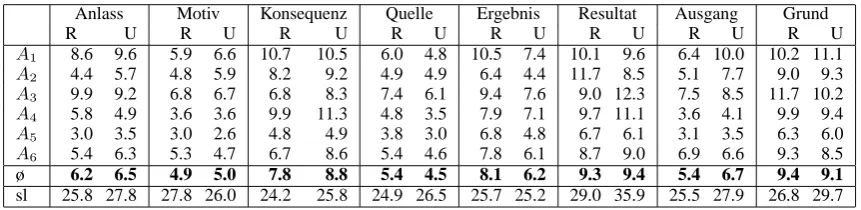
Table 2: Annotation time (sec/instance) per target/annotator/setting and average sentence length (sl)
5 Results
The basic idea behind active learning is to se-lect the most informative instances for annotation. The intuition behind “more informative” is that these instances support the learning process, so we might need fewer annotated instances to achieve a comparable classifier performance, which could decrease the cost of annotation. On the other hand, “more informative” also means that these instances might be more difficult to annotate, so it is only fair to assume that they might need more time for annotation, which increases annotation cost. To answer the question of whether AL re-duces annotation cost or not we have to check a) how long it took the annotators to assign labels to the AL samples compared to the randomly se-lected instances, and b) how many instances we need to achieve the best (or a sufficient) perfor-mance in each setting. Furthermore, we want to investigate the impact of active learning on the distribution of the resulting training sets and study the correlation between the performance of the classifier trained on the annotated data and these factors: the difficulty of the annotation task (as-sessed by IAA), expertise and individual proper-ties of the annotators.
5.1 Does AL speed up the annotation process when working with noisy data?
Table 2 reports annotation times for each annota-tor and target for random sampling (R) and uncer-tainty sampling (U). For 5 out of 8 targets the time needed for annotating in the AL setting (averaged over all annotators) was higher than for annotat-ing the random samples. To investigate whether this might be due to the length of the sentences in the samples, Table 2 shows the average sen-tence length for random samples and AL samples
for each target lemma. Overall, the sentences se-lected by the classifier during AL are longer (26.2 vs. 28.1 token per sentence), and thus may take the annotators more time to read.3 However, we could not find a significant correlation (Spearman rank correlation test) between sentence length and annotation time, nor between sentence length and classifier confidence.
The three target lemmas which took longer to annotate in the random setting are Ergebnis (re-sult), Grund (reason) and Quelle (source of expe-rience). This observation cannot be explained by sentence length. While sentence length for
Ergeb-nis is nearly the same in both settings, for Grund
and Quelle the sentences picked by the classi-fier in the AL setting are significantly longer and therefore should have taken more time to anno-tate. To understand the underlying reason for this we have to take a closer look at the distribution of word senses in the data.
5.2 Distribution of word senses in the data
In the literature it has been stated that AL implic-itly alleviates the class imbalance problem by ex-tracting more balanced data sets, while random sampling tends to preserve the sense distribution present in the data (Ertekin et al., 2007). We could not replicate this finding when using noisy data to guide the learning process. Table 3 shows the distribution of word senses for the target lemma
Ergebnis a) in the gold standard, b) in the random
samples, and c) in the AL samples.
The variance in the distribution of word senses in the random samples and the gold standard can
3
Ergebnis
Frame gold (%) R (%) U (%)
Causation 4.0 4.8 3.7
Outcome 10.0 17.8 10.5
Finding out 24.0 26.2 8.2
Efficacy 2.0 0.8 0.1
Decision 11.0 5.1 3.2
Mathematics 1.0 1.6 0.4
Operating result 36.0 24.5 66.7
Competitive score 12.0 19.2 7.2
Table 3: Distribution of frames (word senses) for the lemma Ergebnis in the gold standard (100 sen-tences), in the random samples (R) and AL sam-ples (U) (150 sentences each)
be explained by low inter-annotator agreement caused by the high level of ambiguity for the tar-get lemmas. The frame distribution in the data selected by uncertainty sampling, however, cru-cially deviates from those of the gold standard and the random samples. A disproportionately high 66% of the instances selected by the classi-fier have been assigned the label Operating result by the human annotators. This is the more sur-prising as this frame is fairly easy for humans to distinguish.
The classifier, however, proved to have seri-ous problems learning this particular word sense and thus repeatedly selected more instances of this frame for annotation. As a result, the distribution of word senses in the training set for the uncer-tainty samples is highly skewed, having a nega-tive effect on the overall classifier performance. The high percentage of instances of the “easy-to-decide” frame Operating result explains why the instances for Ergebnis took less time to annotate in the AL setting. Thus we can conclude that an-notating the same number of instances on average takes more time in the AL setting, and that this effect is not due to sentence length.
5.3 What works, what doesn’t, and why
For half of the target lemmas (Motiv, Konsequenz,
Quelle, Ausgang), we did obtain best results in
the AL setting (Table 4). For Ausgang and
Mo-tiv AL gives a substantial boost in classifier
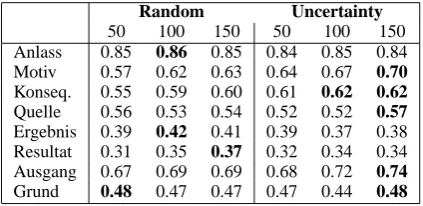
per-formance of 5% and 7% accuracy, while the gains for Konsequenz and Quelle are somewhat smaller with 2% and 1%, and for Grund the highest accu-racy was reached on both the AL and the random
Random Uncertainty
50 100 150 50 100 150
Anlass 0.85 0.86 0.85 0.84 0.85 0.84 Motiv 0.57 0.62 0.63 0.64 0.67 0.70
Konseq. 0.55 0.59 0.60 0.61 0.62 0.62
Quelle 0.56 0.53 0.54 0.52 0.52 0.57
Ergebnis 0.39 0.42 0.41 0.39 0.37 0.38 Resultat 0.31 0.35 0.37 0.32 0.34 0.34 Ausgang 0.67 0.69 0.69 0.68 0.72 0.74
Grund 0.48 0.47 0.47 0.47 0.44 0.48
Table 4: Avg. classifier performance (acc.) over all annotators for the 8 target lemmas when train-ing on 50, 100 and 150 annotated instances for random samples and uncertainty samples
sample.
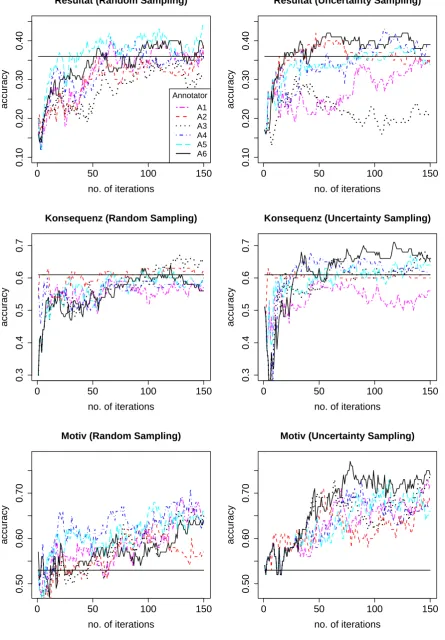
Figure 1 (top row) shows the learning curves for Resultat, our worst-performing lemma, for the classifier trained on the manually annotated sam-ples for each individual annotator. The solid black line represents the majority baseline, obtained by assigning the most frequent word sense in the gold standard to all instances. For both random and AL settings, results are only slightly above the base-line. The curves for the AL setting show how erro-neous decisions can mislead the classifier, result-ing in classifier accuracy below the baseline for two of the annotators, while the learning curves for these two annotators on the random samples show the same trend as for the other 4 annotators. For Konsequenz (Figure 1, middle), the classi-fier trained on the AL samples yields results over the baseline after around 25 iterations, while in the random sampling setting it takes at least 100 iterations to beat the baseline. For Motiv (Figure 1, bottom row), again we observe far higher re-sults in the AL setting. A possible explanation for why AL seems to work for Ausgang, Motiv and
Quelle might be the higher IAA4(κ0.825, 0.789, 0.768) as compared to the other target lemmas. This, however, does not explain the good results achieved on the AL samples for Konsequenz, for which IAA was quite low withκ0.554.
Also startling is the fact that AL seems to work particularly well for one of the annotators (A6, Figure 1) but not for others. Different possible ex-planations come to mind: (a) the accuracy of the annotations for this particular annotator, (b) the
4
0 50 100 150
0.10
0.20
0.30
0.40
Resultat (Random Sampling)
no. of iterations
accuracy
Annotator A1 A2 A3 A4 A5 A6
0 50 100 150
0.10
0.20
0.30
0.40
Resultat (Uncertainty Sampling)
no. of iterations
accuracy
0 50 100 150
0.3
0.4
0.5
0.6
0.7
Konsequenz (Random Sampling)
no. of iterations
accuracy
0 50 100 150
0.3
0.4
0.5
0.6
0.7
Konsequenz (Uncertainty Sampling)
no. of iterations
accuracy
0 50 100 150
0.50
0.60
0.70
Motiv (Random Sampling)
no. of iterations
accuracy
0 50 100 150
0.50
0.60
0.70
Motiv (Uncertainty Sampling)
no. of iterations
Konsequenz A1 A2 A3 A4 A5 A6
human 0.80 0.72 0.89 0.73 0.89 0.76
maxent 0.60 0.63 0.67 0.60 0.63 0.64
Table 5: Acc. for human annotators against the adjudicated random samples and for the classifier
instances selected by the classifier based on the annotation decisions of the individual annotators, and (c) the distribution of frames in the annotated training sets for the different annotators.
To test (a) we evaluated the annotated ran-dom samples for Konsequenz for each annotator against the adjudicated gold standard. Results showed that there is no strong correlation between the accuracy of the human annotations and the performance of the classifier trained on these an-notations. The annotator for whom AL worked best had a medium score of 0.76 only, while the annotator whose annotations were least helpful for the classifier showed a good accuracy of 0.80 against the gold standard.
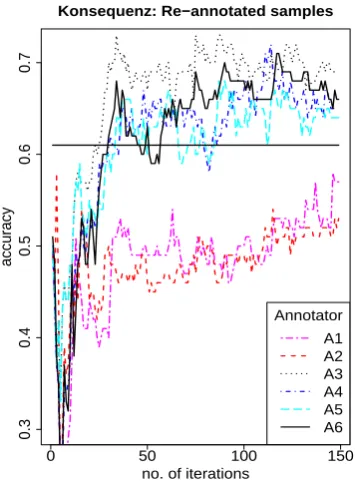
Next we tested (b) the impact of the particu-lar instances in the AL samples for the individ-ual annotators on classifier performance. We took all instances in the AL data set from A6, whose annotations gave the greatest boost to the clas-sifier, removed the frame labels and gave them to the remaining annotators for re-annotation. Then we trained the classifier on each of the re-annotated samples and compared classifier perfor-mance. Results for 3 of the remaining annotators were in the same range or even higher than the ones forA6(Figure 2). For 2 annotators, however, results remained far below the baseline.
This again shows that the AL effect is not di-rectly dependent on the accuracy of the individual annotators, but that particular instances are more informative for the classifier than others. Another crucial point is (c) the distribution of frames in the samples. In the annotated samples forA1 and
A2 the majority frame for Konsequenz is Causa-tion, while in the samples for the other annotators Response was more frequent. In our test set Re-sponse also is the most frequent frame, therefore it is not surprising that the classifiers trained on the samples ofA3 toA6 show a higher performance. This means that high-quality annotations (identi-fied by IAA) do not necessarily provide the
in-0 50 100 150
0.3
0.4
0.5
0.6
0.7
Konsequenz: Re−annotated samples
no. of iterations
accuracy
Annotator
A1 A2 A3 A4 A5 A6
Figure 2: Re-annotated instances for Konsequenz (AL samples from annotatorA6)
formation from which the classifier benefits most, and that in a realistic annotation task address-ing the class imbalance problem (Zhu and Hovy, 2007) is crucial.
6 Conclusions
Acknowledgments
This work was funded by the German Research Foundation DFG (grant PI 154/9-3 and the MMCI Cluster of Excellence).
References
Baldridge, Jason and Alexis Palmer. 2009. How well does active learning actually work?: Time-based evaluation of cost-reduction strategies for language documentation. In Proceedings of EMNLP 2009.
Burchardt, Aljoscha, Katrin Erk, Anette Frank, An-drea Kowalski, Sebastian Pad ´o, and Manfred Pinkal. 2006. The salsa corpus: a german corpus resource for lexical semantics. In Proceedings of
LREC-2006.
Chan, Yee Seng and Hwee Tou Ng. 2007. Domain adaptation with active learning for word sense dis-ambiguation. In Proceedings of ACL-2007.
Chen, Jinying, Andrew Schein, Lyle Ungar, and Martha Palmer. 2006. An empirical study of the behavior of active learning for word sense disam-biguation. In Proceedings of NAACL-2006, New York, NY.
Cohn, David A., Zoubin Ghahramani, and Michael I. Jordan. 1995. Active learning with statistical mod-els. In Tesauro, G., D. Touretzky, and T. Leen, ed-itors, Advances in Neural Information Processing
Systems, volume 7, pages 705–712. The MIT Press.
Dang, Hoa Trang. 2004. Investigations into the role
of lexical semantics in word sense disambiguation.
PhD dissertation, University of Pennsylvania, Penn-sylvania, PA.
Donmez, Pinar and Jaime G. Carbonell. 2008. Proac-tive learning: Cost-sensiProac-tive acProac-tive learning with multiple imperfect oracles. In Proceedings of
CIKM08.
Erk, Katrin. 2005. Frame assignment as word sense disambiguation. In Proceedings of the IWCS-6.
Ertekin, S¸eyda, Jian Huang, L’eon Bottou, and Lee Giles. 2007. Learning on the border: active learn-ing in imbalanced data classification. In
Proceed-ings of CIKM ’07.
Hwa, Rebecca. 2004. Sample selection for statisti-cal parsing. Computational Linguistics, 30(3):253– 276.
Laws, Florian and Heinrich Sch ¨utze. 2008. Stopping criteria for active learning of named entity recogni-tion. In Proceedings of Coling 2008.
Osborne, Miles and Jason Baldridge. 2004. Ensemble-based active learning for parse selection. In Proceedings of HLT-NAACL 2004.
Rehbein, Ines and Josef Ruppenhofer. 2010. Theres no data like more data? revisiting the impact of data size on a classification task. In Proceedings
of LREC-07, 2010.
Reichart, Roi, Katrin Tomanek, Udo Hahn, and Ari Rappoport. 2008. Multi-task active learning for linguistic annotations. In Proceedings of ACL-08:
HLT.
Ringger, Eric, Peter Mcclanahan, Robbie Haertel, George Busby, Marc Carmen, James Carroll, and Deryle Lonsdale. 2007. Active learning for part-of-speech tagging: Accelerating corpus annotation. In Proceedings of ACL Linguistic Annotation
Work-shop.
Tomanek, Katrin and Udo Hahn. 2009. Reducing class imbalance during active learning for named entity annotation. In Proceedings of the 5th
Interna-tional Conference on Knowledge Capture, Redondo
Beach, CA.
Tomanek, Katrin, Joachim Wermter, and Udo Hahn. 2007. An approach to text corpus construction which cuts annotation costs and maintains corpus reusability of annotated data. In Proceedings of
EMNLP-CoNLL 2007.
Zhu, Jingbo and Ed Hovy. 2007. Active learning for word sense disambiguation with methods for ad-dressing the class imbalance problem. In
Proceed-ings of EMNLP-CoNLL 2007.
Zhu, Jingbo, Huizhen Wang, Tianshun Yao, and Ben-jamin K. Tsou. 2008. Active learning with sam-pling by uncertainty and density for word sense dis-ambiguation and text classification. In Proceedings