Rochester Institute of Technology
RIT Scholar Works
Theses
Thesis/Dissertation Collections
3-1-1989
Comparison of four digital halftone screen (dither)
patterns using quantitative analysis of the binary
image microstructure
Jacquelyn S. Ellinwood
Follow this and additional works at:
http://scholarworks.rit.edu/theses
This Thesis is brought to you for free and open access by the Thesis/Dissertation Collections at RIT Scholar Works. It has been accepted for inclusion in Theses by an authorized administrator of RIT Scholar Works. For more information, please [email protected].
Recommended Citation
COMPARISON OF FOUR DIGITAL HALFTONE SCREEN (DITHER) PATIERNS USING QUANTITATIVE ANALYSES OF THE
BINARY IMAGE MICROSTRUCTURE
by
Jacquelyn S. Ellinwood
A thesis submitted in partial fulfillment of the requirements for the degree of
Master of Science in the Center for Imaging Science in the College of Graphic Arts and Photography of the
Rochester Institute of Technology
March 1989
Signature of Author J_a_c--=qu=----e_l..=y_n_S_._E_l_l_~_·n_w_o_o_d _
Accepted by N_arn_e_ _I_l_l_e..=g_i_b_l_e _
COli.EGE OF GRAPHIC ARTS AND PHOTOGRAPHY ROCHESTER INSTITUTE OF TECHNOLOGY
ROCHESTER, NEW YORK
CERTIFICATE OF APPROVAL
M.S. DEGREE THESIS
The M.S. Degree Thesis of Jacquelyn S. Ellinwood has been examined and approved
by the thesis committee as satisfactory for the thesis requirement for the
Master of Science degree
Mr. Peter Engeldrum, Thesis Advisor
Dr. Roger Easton
Dr. Rodney Shaw
htvr.t
jJ
ry;(
j
7
If
THESIS RELEASE PERMISSION FORM
ROCHESTER INSTITUTE OFTECHNOLOGY COLl.EGE OF GRAPHIC ARTS ANDPHOTOGRAPHY
Title of Thesis: Comparison of Four Digital HalftoneScreen<Dither) Patterns Using Quantitative AnalYsis of the Binary Image Microstructure
I, Jacquelyn Ellinwood, hereby grant permission to the Wallace Memorial Ubrary of R.I.T. to reproduce my thesis in whole or in part. Any reproduction will not be for commercial use or profit.
Signature: _ _..;;;,J.=a..;;;,c....:ilquo..=e..;;;;l.-.y...n:...=E..;;;;l..;;;;l..;;;;i...n ...w...:.o...:.o...:.d;..._ _
COMPARISON O F FOUR DIGITAL HALFTONE S C R E E N (DITHER) PATTERNS USING QUANTITATIVE ANALYSES OF THE
BINARY IMAGE MICROSTRUCTURE
by
Jacquelyn S . Ellinwood
Submitted to the Center for Imaging Science in partial fulfillment of the requirements
for the Master of Science Degree at the Rochester Institute of Technology
ABSTRACT
The ordered-dither halftoning technique which reproduces continuous tones with spatially encoded binary imaging elements uses the digital halftone screen. The effect at the microstructural level of four screens on tone reproduction, spatial signal reproduction, and quantization noise is evaluated by measuring the tone reproduction curve (TRC), the two-dimensional Fourier transform of a constant density patch, the degree of harmonic distortion (THD), the system Modulation Transfer Function (MTF), and the Wiener Spectrum (WS) produced by each screen. The applicablity of these five conventional image evaluation metrics on binary output is also evaluated. Spatial averaging is done to convert the binary output to a more linear form.
The T R C s were found to be identical with a full output average reflectance range and a contrast of 1.0/255.0. The curves were step-wise linear, displaying 65 reproducible average reflectance levels. Fourier analysis of the binary structure showed that aliasing was likely to occur with the
Diamond Dot and Bryngdahl screens, while aliasing from the Bayer and Allebach screens was unlikely. The THD plots showed that the Diamond Dot screen produced the highest degree of non-linearity, followed by Bryngdahl. The Bayer and Allebach screens produced the lowest THD. The line edge derivative approach to determining MTF did not yield useful MTF results for the halftoned forms. The Weiner spectrum for the Diamond Dot and
ACKNOWLEDGEMENTS
Successful completion of this thesis owes recognition to support from many sources. Valuable and timely assitance and advice was particularly appreciated from the following:
Peter Engeldrum, currently of Imcotek Inc., who has acted as thesis advisor as well as mentor. His help in planning, organizing, and understanding the work has been invaluable. Pete's knowledge of the subject, enthusiasm, and willingness to help has been unrivaled.
Rodney Shaw and Roger Easton of the Center for Imaging Science (CIS) at RIT who have acted on the thesis committee. A special thanks is given for
Rodney's technical insights and for Roger's assistance in the writing of a clear and concise thesis.
Robert Fiete and Jennifer Wideman, two Eastman Kodak colleagues who offered invaluable peer-level input on the depth and clarity of the work and presentation. Their excitement about the results was contagious.
Paul Flavin and Chia-Chin Liu, RIT colleagues who provided digital imagery used for realizations, and supplied and supported computer programs that generated the halftone realizations. Their cooperation saved numerous hours of work.
Thomas Ellinwood, my husband, and Bernard and Carol Whaley, my parents, who have provided continued support throughout my education. Tom has been very supportive of my academic decisions and has never asked that boundaries be set on the time and energy that I spent in pursuit of my degrees. Mom and Dad offered financial support for over half of my education, supplied a
I. Introduction 1
1.0 Traditional Halftoning vs. Digital Halftoning 1
1.1 Traditional Halftoning 3
1.2 Digital Halftoning • 7
2.0 Digital Halftone Screen Patterns 11
2.1 Diamond Dot Screen 12
2.2 Bryngdahl-type Screen 13
2.3 Bayer-type Screen 15
2.4 Allebach-type Screen . - . 1 6
3.0 Objective •• •• 19
II. Evaluation Methods • 20
1.0 Tone Reproduction Analysis • 22
2.0 Tone Uniformity Analysis (Aliasing) 26
3.0 Harmonic Distortion Analysis 27
3.1 Total Harmonic Distortion 28
3.2 Fisher's Test of Harmonic Significance 30
4.0 System Modulation Transfer Function Analysis 31
III. Experimental Parameters 37
1.0 Halftone Screens 39
1.1 Halftone Cell Size 39
1.2 Halftone Cell Scale 41
2.0 Halftone Threshold Values 41
3.0 Test Patterns 42
IV. Results 50
1.0 Tone Reproduction Analysis 56
2.0 Tone Uniformity Analysis (Aliasing) 58
3.0 Harmonic Distortion Analysis 60
4.0 System Modulation Transfer Function Analysis ..62
5.0 Quantization Noise Analysis 66
V. Discussion 69
1.0 Tone Reproduction Analysis • 69
2.0 Tone Uniformity Analysis (Aliasing) 70
3.0 Harmonic Distortion Analysis • 73
4.0 System Modulation Transfer Function Analysis 75
5.0 Quantization Noise Analysis 77
1.0 Traditional Halftoning vs. Digital Halftoning
A halftone is a reproduction of a continuous-tone image that uses binary output
to create the perception of intermediate tones. The illusion of different density levels in
a halftone is due to the observer's vision; the imaging elements are made so small that
the eye is unable to resolve each individual element. An intermediate density level is
perceived when the visual system, acting as a spatial integrator, averages the imaging
elements and substrate density together over some area. The area covered by the imaging
element relative to the aperture area defines fractional area coverage (equation 1).
Average reflectance and average density are functions of fractional area coverage
(equations 2 and 3).
^ aperture area = A
area covered by imaging element = a
f = a/A (1)
f = fractional area covered by dark imaging element A = aperture area
a = area within A covered by imaging element
R = [R(p)x(1-f)] + [R(i)xf] (2)
R = average reflectance
R(p) = reflectance of paper or substrate R(i) = reflectance of imaging element
D = -log [R]
= -log([R(p)x(1-f)] + [R(i)xf]) (3)
D = average density
Henry Fox Talbot, a British pioneer in photography, made use of the visual
perception of changing fractional area coverage when he invented the traditional halftone
process in 18521. By the late 1800s halftoning had become a popular method of
reproduction in the printing industry2. When computers became popular in the 1970s
and 1980s, digital image reproduction methods replaced a large part of the traditional
halftoning processes. Numerous digital halftoning algorithms were developed to
maximize aesthetic qualities such as tone, dynamic range, and resolution of the output
image. One of the most popular methods is the ordered-dither. With this method a set of
non-image-related values contained in a halftone screen is added to a digitized scene. The
sum is thresholded and assigned an 'on' or 'off value at each location. The screen cell
Lippel and Kurland5, and o t h e r s6'7-8-9'1 0'1 1 have published articles on particular
halftone screen patterns and their effects, while Stoeffel and M o r e l a n d1 2, and Jarvice,
et. a / .1 3 have published comprehensive surveys on the subject. In addition, A l l e b a c h1 4,
Floyd and S t e i n b e r g1 5, and others16,17,18,19,20,21 n a ve reported algorithms other
than ordered-dither.
While the literature contains both subjective and objective analyses on effects of various digital halftone screens, a quantitative analysis using the methods outlined in
Section II does not exist. Since the halftone screen pattern strongly influences final image characteristics, it is important to understand the effects of a given pattern on an image. First, though, an understanding of the digital halftoning process and how it relates to traditional halftoning is important.
1.1 Traditional Halftoning
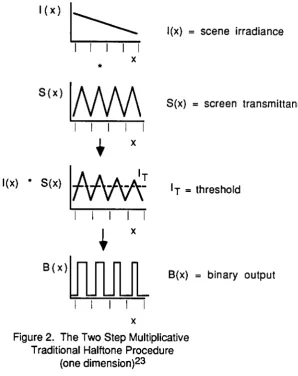
B r y n g d a h l2 2 describes the traditional halftoning process in mathematical terms
l ( x )
I I
l(x) = scene irradiance
S ( x )
MM
l(x) * S(x)
I I I I I
A A M
1i i i
B ( x )
I I I
S(x) = screen transmittance
I j = threshold
[image:12.534.168.467.58.435.2]B(x) = binary output
Figure 2. The Two Step Multiplicative Traditional Halftone Procedure
(one dimension)2 3
Because transmittances multiply the traditional photographic process is
considered multiplicative. For the case above, the original scene with irradiance l(x) is
photographed through a halftone screen with transmittance S(x). The screen function
S(x) introduces a non-image related light distribution to the exposed image. In
traditional contact screen halftoning, a physical halftone screen is placed in contact with
the film, between the original scene and the film. The older cross-line screen used in a
The lines are etched or scratched into clear plastic or glass. This screen is placed at a
distance from the film, thus casting a defocussed image on the film. An example of a
traditional cross line halftone screen that is commonly used in a graphic arts camera is
shown in figure 3.
^ 1 m m w
Figure 3. Example of a Traditional Cross Line Halftone Screen
The product of the scene irradiance and the screen transmittance is subjected to
an irradiance threshold, \j, by projecting the scene onto a high-contrast recording film.
Density
Irradiance
[image:14.534.145.339.107.220.2]T
Figure 4. Thresholding Effect
Characteristic Curve of High Contrast Recording Film
After processing, dark elements occur in the final image, B(x), when
l(x) x S(x) > lT
The final image, B(x), is a matrix of imaging elements of varying size placed on paper
or some other receiver substrate. In figure 5, the traditional halftone binary structure
is shown.
[image:14.534.149.392.462.527.2]These imaging elements vary the fractional area coverage by a change in size.
Since the fractional area coverage can assume any value between 0.0 and 1.0, an infinite
number of density levels in the final image between minimum and maximum density is
possible.
1.2 Digital Halftoning
As in traditional multiplicative halftoning, digital halftoning converts a
"continuous tone" input image into binary output. The input image is quantized to digital
values, called pixels or pels, that represent the gray level in the original image.
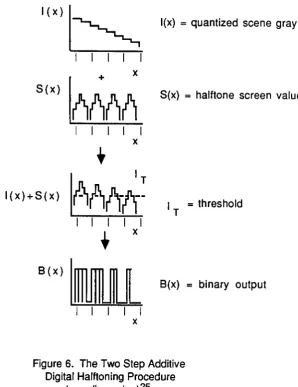
B r y n g d a h l2 4 describes the digital halftoning process as additive (figure 6). A computer
is capable of using the multiplicative or the additive approach. In digital halftoning,
though, the additive scheme is usually used because add instructions are faster than
l ( x )
l(x) = quantized scene gray level
S ( x )
I I I I
S(x) = halftone screen value
I I I
l ( x ) + S ( x )
I I I I I
I
xB ( x )
= threshold
[image:16.534.159.458.55.443.2]B(x) = binary output
Figure 6. The Two Step Additive Digital Halftoning Procedure
(one dimension)2 5
For the case in Figure 6, the quantized scene gray level l(x) is added to the halftone
screen value, S(x). The halftone screen is known under many names including:2 6
screen function = ordered dither pattern dither pattern
grating dot screen
The halftone screen function in the digital process plays the same role as that of the
halftone screen in the traditional process; it adds non-image-related values to the
original quantized scene. The screen function may be random, but is more often periodic.
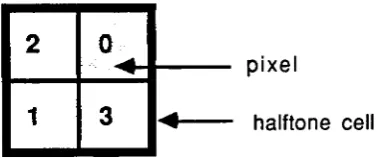
A periodic screen consists of a pattern (the halftone cell, figure 7) which is repeated in
orthogonal directions. The screen's fundamental period (the halftone cell size) is
substantially larger than the pixel interval. This results in many pixels per halftone
c e l l2 7.
p i x e l
[image:17.534.234.424.269.348.2]halftone cell
Figure 7. Example of a Halftone Cell Pattern
Thresholding is performed by numerical comparison in analogous fashion to the
traditional thresholding step using high-contrast film. Dark elements occur when
l(x) + S(x) > lT. (5)
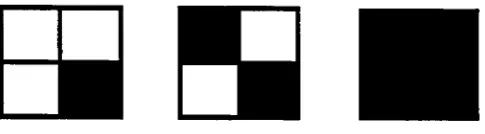
The resultant binary image, B(x), consists of a matrix of black imaging elements of one
size, and white substrate. In figure 8, the digital halftone binary structure is
• %
Figure 8. Digital Halftone Binary Structure with .25, .50, and 1.00 Fractional Area CoverageThe fractional area coverage is altered by changing the number of imaging elements per
area A. Whereas the traditional halftone binary structure may take on any one of an
infinite number offractional areas, the digital fractional area coverage may take on only
discrete values. Hence, the average reflectance and average density of the output will be
discrete as well.
The digital-halftone process has been described for a print-black (i.e. negative)
system. Typically, the imaging element is a black dot which creates a high average
density for a high fractional area coverage. Due to the initial approach taken by the
author, the results in this paper are from a print-white system {i.e. a low average
density for a high fractional area coverage. This is evident in the results, especially in
the tone reproduction analysis. Both approaches are valid (print-black and
2.0 Digital Halftone Screen Patterns
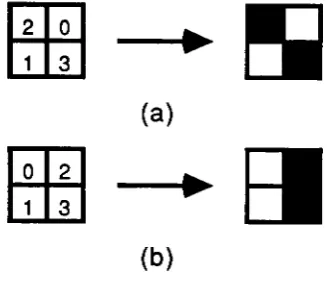
Digital halftone screens, and in particular the halftone cell pattern of the
screens, define the halftone binary structure. In figure 9, two different cell patterns
and their corresponding binary structures are illustrated for 50% fractional area
coverage. Notice the difference in placement of the two 'on' pixels.
2 0
1 3
0 2
1 3
( a )
a
[image:19.534.195.359.224.366.2](b)
Figure 9. Two Halftone Cell Patterns and Corresponding Binary Structure for 50% Fractional Area Coverage
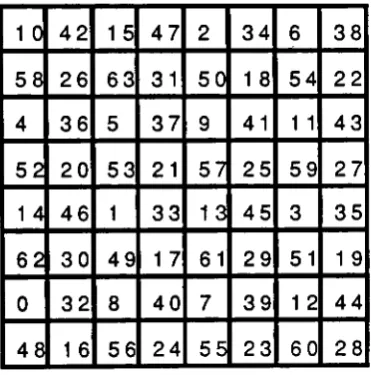
Many cell patterns have been developed with the intent to optimize certain final
image characteristics. Following is a discussion of four screen patterns and the
characteristics they were designed to optimize. The set yields a range of binary
structures: the diamond dot s c r e e n2 8 produces a clustered-type structure which closely
resembles that of traditional halftone, the screen developed by B r y n g d a h l2 9 creates a
ringed binary structure; and the Bayer s c r e e n3 0 simulates a dispersed structure.
2.1 Diamond Dot Screen
In general, screens that produce binary structures with dispersed imaging
elements are preferred over those producing binary structures where the image
elements are clustered together. Dispersed patterns tend to be less visible3 2- There are
devices, though, which cannot properly print isolated pixels. In offset printing, for
example, a halftone screen yielding a cluster-type binary structure is used since the
clustered structure represents the minimum area that is reliably reproduced and
maintained as the press runs. Plate wear is an issue, along with the size of the imaging
element on the plate. The cluster-type structure is used even though the cell pattern is
highly visible. The diamond dot screen is an example of a clustered-dot-producing
screen.
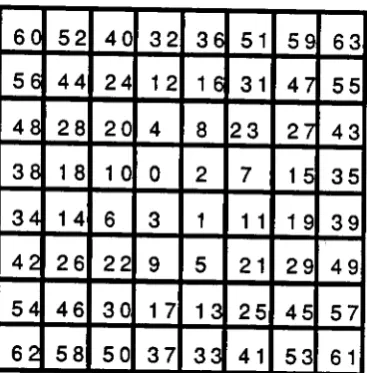
The printing industry is the largest user of the clustered-type s c r e e n3 3. The
diamond dot s c r e e n3 4 depicted in figure 10 creates a clustered binary structure. The
structure is centered about the middle of the halftone cell and the fractional area
6 0 5 2 4 0 3 2 3 6 51 5 9 6 3
5 6 4 4 2 4 1 2 1 6 31 4 7 5 5
4 8 2 8 2 0 4 8 2 3 2 7 4 3
3 8 1 8 1 0 0 2 7 1 5 3 5
3 4 1 4 6 3 1 1 1 1 9 3 9
4 2 2 6 2 2 9 5 21 2 9 4 9
5 4 4 6 3 0 1 7 1 3 2 5 4 5 5 7
[image:21.534.158.342.54.241.2]6 2 5 8 5 0 3 7 3 3 41 5 3 61
Figure 10. Halftone Cell Pattern for Diamond Dot Screen
Figure 11 illustrates the binary structure produced by the diamond dot screen for 10%
through 100% fractional area coverage.
i i
[image:21.534.43.499.382.451.2]10% 20% 30% 40% 50% 60% 70% 80% 90% 100%
Figure 11. Binary Structure for 10 %-100% (10%) Fractional Area Coverage Produced from One 8 by 8
Diamond Dot Halftone Screen Cell
2.2 Brvnadahl-tvpe Screen
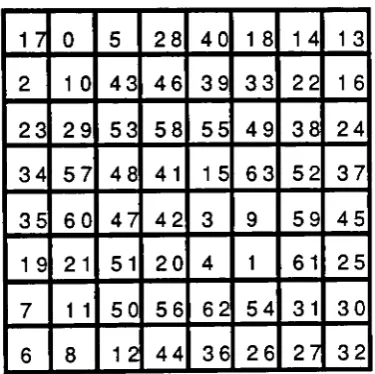
B r y n g d a h l3 5 developed a halftone screen with a ringed binary structure. Since
final image areas, Bryngdahl argues that the halftone screen cell should maximize the
length of the boundary between these areas to optimize reproduction of detail. Also, the
locations of this boundary should be distributed as uniformly as possible. To this end, he
proposes that the halftone screen cell pattern build the binary structure in the form of
rings. With a ringed shape geometry, a change in scene gray level is reflected in a
variation of the width of an annular area instead of a change in the radius of a circular
structure as in the traditional halftone case. An example of a screen based on his scheme
is shown in figure 12.
1 7 0 5 2 8 4 0 1 8 1 4 1 3
2 1 0 4 3 4 6 3 9 3 3 2 2 1 6
2 3 2 9 5 3 5 8 5 5 4 9 3 8 2 4
3 4 5 7 4 8 41 1 5 6 3 5 2 3 7
3 5 6 0 4 7 4 2 3 9 5 9 4 5
1 9 21 51 2 0 4 1 61 2 5
7 1 1 5 0 5 6 6 2 5 4 31 3 0
[image:22.534.163.351.294.481.2]6 8 1 2 4 4 3 6 2 6 2 7 3 2
Figure 12. Halftone Cell Pattern for Bryngdahl Screen
The binary structure produced by a Bryngdahl halftone cell for different percentages of
B B B H K M W £.
•
80% 90% 100%
Figure 13. Binary Structure for 10%-100% (10%) Fractional Area Coverage Produced from One. 8 by 8
Bryngdahl Halftone Screen Cell
2.3 Baver-tvoe Screens
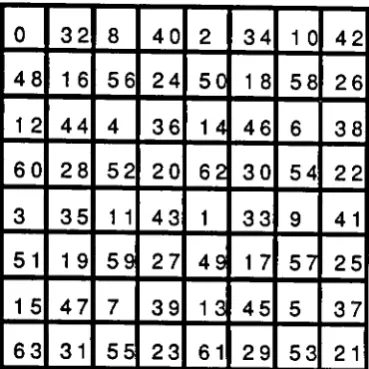
When creating his halftone screen, B a y e r3 6 attempted to minimize the
amplitude of the lowest spatial frequency of the non-zero Fourier components of the
binary structure. This minimizes halftone pattern visibility and maximizes resolution
of detail in the output image. This result is accomplished by creating the halftone image
using a dispersed filling pattern. The screen also required a square halftone-cell of size
2n (n=1,2 N). Using his optimization criteria, Bayer determined that the previous
halftone cell patterns designed by L i m b3 7 and Lippel and Kurland 3 8 were also optimal.
Judice, et. a / .3 9 developed a recurrence relationship to generate Bayer-type matrices.
Although this approach minimizes the halftone cell visibility, it has been reported to
0 3 2 8 4 0 2 3 4 1 0 4 2
4 8 1 6 5 6 2 4 5 0 1 8 5 8 2 6
1 2 4 4 4 3 6 1 4 4 6 6 3 8
6 0 2 8 5 2 2 0 6 2 3 0 5 4 2 2
3 3 5 1 1 4 3 1 3 3 9 41
5 1 1 9 5 9 2 7 4 9 1 7 5 7 2 5
1 5 4 7 7 3 9 1 3 4 5 5 3 7
[image:24.534.156.341.60.245.2]6 3 31 5 5 2 3 61 2 9 5 3 21
Figure 14. Halftone Cell Pattern for Bayer Screen
In figure 15, the binary structure for various fractional area coverages created by one
Bayer halftone cell is illustrated.
B S B 3 9
P ^ O rT T Tl
10% 20% 30% 40% 50% 60% 70% 80% 90% 100%
Figure 15. Binary Structure for 10%-100% (10%) Fractional Area Coverage Produced from One 8 by 8
Bayer Halftone Screen Cell
2.4 Allebach-type Screens
Allebach and Stradling4 2 developed a screen which was designed to meet Bayer's
referred to as the Allebach screen. The method for determining an optimum screen
pattern was based on Fourier analysis of the binary structure. Allebach found that the
visibility of the binary structure and poor resolution of details were due to a l i a s i n g4 3.
Through an iterative pairwise exchange algorithm, he developed the halftone cell pattern
shown in figure 16.
1 0 4 2 1 5 4 7 2 3 4 6 3 8
5 8 2 6 6 3 31 5 0 1 8 5 4 2 2
4 3 6 5 3 7 9 41 1 1 4 3
5 2 2 0 5 3 21 5 7 2 5 5 9 2 7
1 4 4 6 1 3 3 1 3 4 5 3 3 5
6 2 3 0 4 9 1 7 61 2 9 51 1 9
0 3 2 8 4 0 7 3 9 1 2 4 4
[image:25.534.174.360.218.406.2]4 8 1 6 5 6 2 4 5 5 2 3 6 0 2 8
Figure 16. Halftone Cell Pattern for Allebach Screen
The binary structure from the Allebach halftone cell pattern is pictured below for
nS no
lH
X X [image:26.534.43.503.120.183.2]10%
20% 30% 40% 50% 60% 70% 80% 90% 100%Figure 17. Binary Structure for 10%-100% (10%) Fractional Area Coverage Produced from One 8 by 8
Allebach Halftone Screen Cell
3.0 Objective
The objective of this experiment is to assess and compare four halftone screens
by objectively evaluating the screens' effect at the microstructural level on tone
reproduction, spatial signal reproduction, and quantization noise in the final binary
image. This is done by measuring the tone reproduction curve, the two-dimensional
Fourier Transform of a constant density patch, the degree of harmonic distortion, the
system Modulation Transfer Function (MTF), and the Wiener Spectrum (WS) produced
by each screen. The results will indicate the ability to evaluate binary output using
conventional evaluation metrics.
The comprehensive evaluation methods listed above are commonly used in
conventional reproduction analysis and are described in detail in the Section II. 1) The
level. The plot yields the contrast and reflectance range of the reproduction system. 2)
The two-dimensional Fourier Transform of a digitally halftoned uniform gray patch
yields the degree of uniformity with which the patch was reproduced, i.e. the spectral
components introduced by halftoning. 3) Total Harmonic Distortion (THD) is a sum of
the multiple frequency Fourier components created when halftoning a sinusoid. It is a
measure of the degree of non-linearity present in a system. 4) The system Modulation
Transfer Function (MTF) is derived to measure the ability of the halftoning procedure to
accurately reproduce all frequencies. An edge input is halftoned and the line spread
function is obtained by taking the derivative of the halftoned edge. In a linear system,
the modulus of the Fourier Transform of the line spread function yields the MTF of the
halftoning system. 5) Finally, noise introduced by quantization is measured by
evaluating the Wiener Spectrum (WS). The Wiener Spectrum is obtained through an
autocorrelation of the noise and a subsequent Fourier Transform.
A variety of evaluation methods for measuring final binary image
characteristics have been designed and i n v e s t i g a t e d ,4 4-4 5-4 6'4 7'4 8'4 9-5 0'5 1 -5 2 but no
where in the literature is a complete objective analysis using the methods described
Since the output from the digital halftone process is binary and highly
non-linear, it would seem that the linear evaluation tools described in the following
section, e.g. harmonic analysis, would not be applicable to digital halftoning output. However, if the output undergoes spatial averaging (similar to the action of the human
visual system or a microdensitometer scanning slit), the output may be considered
continuous and these evaluations are applicable. According to equation 1, the
two-dimensional binary output can be reduced to one dimension by spatial averaging, i.e. determining fractional area coverage. This transformation is accomplished through
halftone-cell or column averaging. In halftone-cell averaging it is assumed that the
aperture area A is equal to one halftone cell, i.e. A equals the number of pixels in a halftone cell. Therefore,
fc en = number of 'on' pixels in one halftone cell (6)
number of pixels in a halftone cell
In column averaging, it is assumed that the aperture area A is equal to one column, i.e. A equals the number of pixels in a column. Hence,
fcolumn = number of 'on' pixels in one column (7)
number of pixels in a column
Once f(x) is defined through halftone cell or column averaging, another basic
evaluation tool, the discrete Fourier transform (DFT), is utilized. The transform
decomposes f(x) into a linear combination of complex-valued coefficients which
represents the frequency make-up of f(x). f(x) and F(u) are Fourier transform pairs.
The DFT is used to compute the Fourier series coefficients, each of which is
characterized by a particular frequency. If f(x) is a sinusoid with a spatial frequency of
u0, its Fourier transform will consist of one component at the fundamental frequency. If
f(x) is the sum of two sinusoids of different spatial frequencies, the Fourier series will
contain two components, one at each of the two fundamental frequencies. Any function
can be considered as the sum of a number of sinusoids with varying frequencies and
amplitudes. The DFT is used to define the sinusoidal components present in f(x). Figure
18 illustrates the relationship between f(x) and its Fourier spectrum, F ( u ) .5 3
f(x) - l / N ^ F ( u ) e A u
a) f(x) = A
f ( x ) F ( u )
b)f(x) = Acos(2rcu X)
f ( x )
A
-A / 2 |
-u
F ( u )
| A / 2
c) f(x) = ACOS(2TC(5U 0 )X)
f ( x ) F ( u )
A / 2 1 -5u
A A / 2
[image:30.534.60.477.67.445.2]5u 11
Figure 18. Relationship Between the Frequency of a Cosine Function and its Fourier Spectrum
1.0 Tone Reproduction Analysis
In traditional photography, the tone reproduction curve (TRC) is a density vs. log
(input) will produce. This concept can be used with digital halftoning as well. Instead of
log exposure, gray level is the input. After halftoning, the output image is composed of a
two-dimensional binary structure. According to equation 6, the two-dimensional binary
output can be reduced to one dimension through halftone cell averaging. Average
reflectance and average density are determined from fce||.
R = fcell
D = -log(fc en) (9)
assuming R(i) = 1.0 and R(p) = 0.0.
The T R C for digital halftoning is used to show two specific ways the halftone
screen affects tone reproduction: 1) the halftone screen cell size determines the number
of reproducible reflectance or density levels, while 2) the threshold values within the
halftone cell determine the overall contrast of the final image. In an n by m halftone cell
there are (n x m) + 1 possible gray levels, i.e. (n x m)+1 possible average reflectance or average density levels. Figure 19 illustrates the effect of halftone cell size on the
T R C . Due to the limited number of reproducible reflectance levels, the T R C is a series of
a) 2 by 2 halftone cell, 5 gray levels b) 4 by 4 halftone cell, 17 gray levels
Tone Reproduction Curve
S I 5 T
71 1C: 125 150 175 203 225 2SC Inpul gray level
[image:32.534.277.477.99.241.2]c) 5 by 5 halftone cell, 26 gray levels
Figure 19. Effect on the Tone Reproduction Curve of Increasing the Halftone Cell Size
In addition to determining the number of reproducible gray levels, the halftone
screen cell alters the shape of the tone reproduction curve when a constant is added to the
4 1 61 1 5 3 9 2 1 0
8 2 1 7 3 2 4 5 2 0 4 1 1 2
1 4 3 2 1 4 2 5 5 2 2 4 1 3 3
1 2 2 1 9 4 2 3 5 1 8 4 71
2 0 1 0 2 1 6 3 51 31
a) 5 by 5 halftone screen cell pattern, threshold = 256
T o n e R e p r o d u c t i o n C u r v e T o n e R e p r o d u c t i o n C u r v e
Additive C o n s t a n t s : -60. 0, +60 Multiplicative Constants .2. .6. 1.0, 1 4 . i s
input gray level input gray level
[image:33.534.158.305.58.212.2]b) add constant to screen c) multiply screen by constant
Figure 20. Effects on T R C of Adding or Multiplying a Constant to the Screen Cells' Values
The shape of the T R C remains unchanged but is shifted along the x axis (figure 20b)
when the halftone screen cell pattern is changed by adding a constant. The contrast or
slope {(y2-y-|V(x2-Xi)} ° ft n e curve changes (figure 20c) when the halftone screen
2.0 Tone Uniformity Analysis fAliasing)
Whereas the T R C yields results about contouring and contrast, it shows nothing
about the uniformity of a constant gray level area. Fourier analysis of the binary
structure is one method of e v a l u a t i o n5 4'5 5-5 6-5 7-5 8. Figure 21 illustrates the
degradation in the Fourier domain that occurs when a 50% gray-level continuous image
is halftoned. Degradation, in this example, is defined as the addition of spatial
frequencies due to halftoning.
2D F F y
a) digitized image
[image:34.534.134.411.320.556.2]b) quantized form
When the digitized form of a continuous tone image of one gray level (figure 21a) is
Fourier transformed, the resulting function contains one zero-order term and no
frequency components. If that image is halftoned, the Fourier transform of the binary
structure indicates that frequency components have been introduced. The zeroth-order
spectrum of the binary structure is that of the quantized original image while the other
spectra correspond to distortions5 9- These distortions are due to an interaction between
the original scene and thresholding steps that give rise to new frequencies. If low
enough, these lower frequencies will be perceived as a l i a s i n g6 0. Aliasing describes the
low frequency components of the Fourier transform not present in the digitized or
continuous image but that appear in the halftone image. The visibility of these artifacts
may be reduced by choosing a spatial arrangement within the halftone cell which
minimizes all non-zeroth-order terms and places them at less-visible higher
frequencies6 1. By analyzing the spectrum created by halftoning, the degree of aliasing
produced by different screen thresholding patterns may be compared.
3.0 Harmonic Distortion Analysis
Signal-reproduction characteristics are determined by the ability of the digital
halftone screen to accurately reproduce an input signal of a particular spatial
configuration. Harmonic analysis can be used to measure and compare the amount of
3.1 Total Harmonic Distortion
If a system has two one-dimensional inputs, f^x) and f2(x), and uses an
operator, B , such that
In digital halftoning, f1 (x) can be assigned the input image value, f2(x) can be
assigned the screen value, and B is the thresholding operator. If the system is linear,
the 1 or 0 resulting from thresholding the image value, plus the 1 or 0 resulting from
thresholding the screen value will equal the 1 or 0 resulting from thresholding the sum.
A metric suitable for evaluating linearity is THD. B { fi(x) } -f l l( x )
B {f2(x) } = g2(x) (10)
it is considered linear if
B { WxJ + f g M } = B { M x ) } + B { f2(x) }
= 9l(x) + g2(x) (11)
THD is the square root of the ratio of the sum of the squares of the harmonic amplitudes
for all non-zero frequencies except the fundamental frequency, divided by the square of
the amplitude at the fundamental frequency.
The input form of interest is the sinusoid. After halftoning, the sinusoid has two
dimensions. A s already discussed, this two-dimensional image can be converted to one
dimension, f(x), through column averaging, fC 0|u m n (equation 7), which is analogous to
scanning with a slit on a microdensitometer. The discrete Fourier transform (DFT) is
then used to compute the Fourier Series coefficients of f(x). THD is determined from the
DFT results.
If f(x) is linear and has been reproduced as a perfect sinusoid, F(u) will have
one non-zero harmonic component associated with its fundamental frequency. If
distortions are introduced through processing, f(x) will not be a perfect sinusoid and
F(u) will contain non-zero components at frequencies other than the fundamental. THD
analysis (equation 11) uses this result to measure the degree of process linearity. If
THD equals zero, there are no harmonic amplitudes beyond the fundamental frequency
and the system is linear. A s the process becomes non-linear, THD will increase.
In this experiment, the processing referred to in the above discussion is
halftoning. Non-linearities in f(x) are introduced in the screening and thresholding
steps. THD is a metric for comparing the ability of the four screens to linearly
3.2 Fisher's Test of Harmonic Significance
In digital halftoning, noise is introduced by quantizing a continuous-tone image to
a one-bit image. This noise may be sufficient to render the results of the THD analysis
uncertain. Even if there are no periodic components in a random series of points, some
of the amplitudes obtained by harmonic analysis would be greater than others, simply
due to random fluctuations of the Fourier components.6 2 Since the output of digital
halftoning will contain noise and signal, a method is needed that will detect signal apart
from noise.
Fisher's test of significance in harmonic analysis is designed to measure just
that.6 3 It is used to determine the plausibility that a certain amplitude represents a
real periodicity.6 4 The test was developed by F i s h e r6 5 and generalized by Grenander and
Rosenblatt6 6. The test method determines the probability that the largest of the
harmonic amplitudes, given in a normalized form with respect to the data, is the result
of randomness of the d a t a .6 7 If the normalized amplitudes of the harmonics g|<,
k=1,2 m, is arranged in decreasing order, and gr is the rth largest term of this
m-1 P ( gr> 9 ) = ml y ( i )J ~r (1-jg r)
= amplitude of the harmonic component for k = 1,2, ... m
gk = normalized ck, ck 2
gr = ordered g.
m
I Cj2
J = 1 J
L = largest-integer, | 1/g r | for 1 / g p
= m for 1/g r > m
(13)
S h i m s h o n i6 9 calculated a table of critical values for various parameters.
Fisher's test is designed to be used based on certain assumptions that noise is
random. Since quantization noise may not meet these requirements, a test must be
performed on Fisher's method to determine its robustness.
4.0 System Modulation Transfer Function Analysis
The second input signal of interest is the edge. Column averaging of the processed
image, B(x,y) will yield the equivalent of an edge trace, e(x). For a linear system, e(x)
is actually the result of a perfect edge (l0(x)) convolved with a point spread function
(h(x)) of the processing system. Convolution will be discussed in the sub-section 5.0.
A one-dimensional system convolution is illustrated in figure 22 (* indicates
= =>
[image:40.534.80.415.78.249.2]h ( x ) e ( x )
Figure 22. Effect on l0(x) of the System
Point Spread Function, h(x)
The derivative of an edge trace is the line spread function (l(x)) and the Fourier
transform of the line spread function is the optical transfer function, L(u).
d ( e ( x ) )
dx
FFT l(x)
L(u) is complex-valued and is of the form
L ( u )
(14)
L(u) = R(u) + il(u)
R = real portion of L(u) I = imaginary portion of L(u)
(15)
The Modulation Transfer Function (MTF) is the modulus of L(u), and is always positive;
MTF(u) = V (L(u))2
= V R2 + |2 (16)
L(u) is equivalent to H ( u )7 0, the system MTF. This approach to finding the system MTF
is valid for a linear, shift-invariant (LSI) s y s t e m7 1.
If an edge (l0(x)) is perfectly reproduced to e(x), then imaging is perfect and the point
spread function (psf) is a delta function. The resultant MTF will contain constant
amplitudes over all frequencies. Any degradation in l0 (x,y) caused by the psf of the
system will cause the system MTF to deviate from a constant value. Variations between a
perfectly and imperfectly reproduced edge are pictured in figure 23.
a) perfectly reproduced edge
— A s l o p e = 0
derivative FFT
e ( x ) l(x) = psf L(u) = |H(u)|
[image:42.534.43.466.62.280.2]b) imperfectly reproduced edge 0 derivative FFT
Figure 23. MTF Difference Between a Perfectly and Imperfectly Reproduced Edge
A is commonly normalized to 1.0 at u = 0. If H(u) is less than 1.0, the system is unable
to completely reproduce the Fourier component at frequency u. A value greater than 1.0
indicates that the system amplifies components with that frequency.
5.0 Quantization Noise Analysis
An error is introduced when the infinite number of input gray levels are forced into a
finite number of integral halftoned output gray levels. If the normalized original
continuous-tone image is considered the actual image gray level, and the normalized
column average of the quantized form is considered the processed gray level, then the
Grayprocessed = G r a ya c t u a| + noise
noise = G r a ya c t u a| - G r a yp r o c e s s e d (18)
An example of the effect of processing parameters on noise is seen in the influence of the
size of the halftone-screen cell. A s shown in section I, the tone-reproduction curve
becomes smoother and more continuous as the screen-cell size increases, i.e. there is less error due to quantizing. Hence, larger matrices result in less noise.
An estimate of the amount and type of noise is needed to evaluate the effect of the
screen function on noise. Useful evaluation tools are the autocorrelation, Cx x, function
and its Fourier transform, the Wiener spectrum, WS(u). The autocorrelation function
measures the correlation between two points in the image. For a discrete random
process, the autocorrelation function estimate is defined as:
N
(19)
t=1
N = number of data points
f(xt), f ( xt + k) = value of f(x) at x=t or x=(t+k)
The autocorrelation at any value of the shift, k, is just the average of the product of the
random process with a copy of itself shifted by k. The units of Cx x( k ) are the squared
As already stated, the autocorrelation function and the one-dimensional power
spectrum are Fourier transform pairs.
I - I2T C U X ,
WS(u) =J C (x)e dx
_ X X
C (x) =1 W S ( u ) e '2 7 l u xd u xx
(20)
The Wiener spectrum is a power spectrum of noise and has units of area multiplied by
the squared units of f(x).7 2 If no noise were added to an image, the autocorrelation
( Cx x) and the Wiener spectrum (WS) of the noise would not exist. If periodic noise
were added, the W S would contain a set of components which described the spectral
distribution of noise power. By evaluating the Wiener spectrum, the type and frequency
Figure 24 summarizes the halftone procedure and evaluations used in this
experiment. I0(x,y) is the original continuous tone image that is digitized to l(x,y), an
eight-bit image of 256 levels. I0(x,y) is one of three inputs: 1) a large constant gray
level patch, 2) a sinusoid, or 3) an edge.
1) constant gray l0(x.y) = gray level
2) sinusoid l0(x.y) = a+Acos(2nx/p)
a=constant A=amplitude x=distance p=period
3) edge l0(x,y) = Step(x)73 (21)
Quantization proceeds as follows:
l(x,y) = nint( l0(x,y)) (22)
where nint indicates the nearest integer. Once the digital image is formed, the halftone
screen is added and the sum is thresholded to produce a bitmap. This section describes
1.0 Halftone Screens
The halftone cell size and the halftone cell scale are two variables of the screen
that are fixed prior to halftoning. Following is a discussion on the levels that were
chosen for each.
1.1 Halftone Cell Size
The screens are made from four different halftone cell patterns described in
Section I: Diamond Dot, Bryngdahl, Bayer, and Allebach. The size of the halftone cell
determines the number of reproducible gray levels; an n by m cell yields (n x m)+1
levels. The smaller halftone cells tend to exhibit false contouring due to the limited
number of gray levels available. A s was shown in figure 19a, the quantized values in a 2
by 2 cell have only five output gray levels in which to fall. This causes the output image
to make large jumps in output gray level, while there may only be small jumps in input
gray level. As the size of the halftone cell increases (figures 19b, 19c), the possible
number of gray levels increases and subsequently the tone reproduction curve becomes
smoother and more continuous.
At first, it might seem that a large halftone cell would produce the best result.
This is not necessarily so because there is a tradeoff between the level of reproducible
detail and the size of the halftone cell. When the halftone cell size is increased, the
amount of detail decreases because there are less halftone cells per image of a given size.
J a r v i s7 4 investigated the subjective effects of the halftone screen cell size and
found that a 16 by 16 matrix does not produce a noticeably different output from the 8
by 8 matrix. He concluded that the image data noise is usually greater than four
intensity units, the additional fineness in the thresholds of the 16 by 16 matrix does not
significantly affect the output images. He finds that digital halftone screens made with
an 8 by 8 halftone cell (65 gray level capability) is the optimum halftone screen to use
as it balances the false contouring created by 'small' cell sizes with the loss of detail
created by 'large' cell sizes.
An additional argument for an 8 by 8 halftone cell is found in the properties of
the human visual system. A typical maximum achievable reflectance in a reproduction
is 9.5 in the Munsell Lightness S c a l e7 5. The minimum is approximately 1.5-2.0. This
gives a reproducible range of approximately 8 M u n s e l l7 6 values. Since a
just-noticeable difference Qnd) in lightness has a Munsell value of .1, the number of
perceptible gray levels in a reproduction is about 8/.1, or 80. It has already been
discussed that there are (n x m) + 1 gray levels in an n by m halftone cell. An 8 by 8
cell yields (8 x 8)+1, or 65 gray levels. This approaches the 80 gray levels
perceivable by the eye. The next size, a 16 by 16 matrix, yields 257 gray levels which
is over three times the number of perceivable levels. This requirement and a limit of a
2n square cell size required by Bayer's criterion resulted in an 8 by 8 halftone cell in
1.2 Halftone Cell Scale
Once l(x,y) is formed, it is added to the properly scaled screen pattern, S(x,y).
The effect of altering the values within a halftone screen by addition or multiplication is
considered in the discussion of evaluation methods. The 8 by 8 halftone cells described
in section I have 65 values ranging from 0 through 64. This range must be expanded to
cover the range of l(x,y). The expansion is done by simply determining the desired
range (0 through 255), the current range (0 through 63), and the ratio between them
(255/63=4.05). If this cell range expansion step is not performed, many pixels will
be set to zero in the thresholding step instead of being set to one, i.e. I(x,y) + S(x,y) will be too small. Each threshold value within the halftone cell is multiplied by 4.05 to
obtain a range of screen values from 0 to 255.
The halftone cell is then repeated as many times as necessary to create a screen
the size of l(x,y). For the constant gray level patch the screen is the size of the cell, for
the sinusoid it is repeated 16 times for a 128 by 8 pixel screen, and for the edge it is
repeated four times for a 32 by 8 pixel screen.
2.0 Halftone Threshold Value
The range of the image is set at 8-bits (0 through 255), and the range of the
screen is equivalent (0 through 255). When the screen is added to the image, the
resultant sum has a possible range of 0 through 510. Figure 25 illustrates the result of
A 5 1 0
2 5 5 threshold value
t o
[image:50.534.124.406.67.176.2]image + screen range
Figure 25. Determining the Threshold Value
A threshold value should be chosen such that an image value at 50% of the image
range (127) will reproduce with .5 fractional area coverage. This occurs when the
threshold is chosen at the half-way point of the image + screen range, or at 255.
3.0 Test Patterns
Three test patterns are used in this study. The first of interest is the constant
gray level patch. For the patch, an 8 by 8 matrix of one gray level is formed. This form
is useful for two analyses. For the tone-reproduction curve (TRC), 256 of these
patches are produced, with each having a constant value between 0 and 255.
For the tone uniformity analysis ten matrices are formed. The ten patches
contain a constant gray value that when processed yields ten different fractional area
coverages (,..10 through 1.00 in ...10 increments).
The sinusoidal input form l(x,y) is a 128 sample (x) by 8 line (y) matrix
variables used to describe the sinusoid. Figure 26 illustrates how one line of the
sinusoidal input is created.
[image:51.534.52.475.143.317.2]1 2 3 4 / 63 64 65 66 6 7 ' 126 127 128 pixel (x)
Figure 26. Components of One Line of a Quantized Sinusoid, l(x) = a + Acos(2rcx/p)
The line y=1 is then repeated eight times to produce a 128 by 8 matrix. The period of
the sinusoid is described in halftone cells per cycle. For example, if the halftone cell is
eight pixels long, and a sinusoid is 64 pixels long, the sinusoid is described as (64
pixels per cycle) / (8 pixels per halftone cell), or a period of 8 halftone cells per cycle.
Each of the sinusoids was created as a cosine with an average gray level (a) of 128. The
peak gray level is placed at x=1 for position 1 (see figure 26) and the period is 2, 4, 8,
or 16 halftone cells per cycle. The sinusoidal period is limited to these values due to the
In addition to period and amplitude, another variable in the halftone process is
the phase of the sinusoid, i.e. the position of the first sinusoidal gray level peak with respect to the position of the first halftone cell. Position 1 indicates that the first
halftone screen cell position is placed at the peak cosine level, at x=1. Position 2
indicates that the first cell position is placed at the position following the peak cosine
level, x=2, and so on. The effects of a sinusoid at position 9 is the same as position 1
because the halftone cell is periodic within the screen and repeats every 8 pixels in the
x direction. It is therefore necessary to investigate only the effects of setting the
sinusoid at positions 1 through 8. In figure 27. the difference between a sinusoid at
position 1 and position 2 is illustrated for one dimension. Pixels one through ten are
Screen at position one - sinusoid
2 3 4 5 6 8 7 9 1 0
l ( x ) 2 5 5 2 5 4 2 5 3 2 5 2 2 5 1 2 4 9 2 4 7 2 4 4 2 4 0 2 3 5
+
1 • •
S ( x ) 2 5 5 0 1 6 1 2 8 3 2 1 4 8 2 0 9 2 | 2 5 5 0
halftone
c e l l . . | position I 1
one halftone cell
3 4 5 6 7 8 I 1
I
Screen at position two sinusoid
3 4 5 6 8 7 9 1 0
l ( x ) 2 5 5 2 5 4 2 5 3 2 5 2 2 5 1 2 4 9 2 4 7 2 4 4 2 4 0 2 3 5
+
• • S ( x )
9 2
1 I
2 5 5 0 1 6 1 2 8 3 2 1 4 8 2 0 9 21 1
2 5 5halftone c e l l
position 8
I
I
h
2 3one halftone cell
[image:53.534.51.428.72.535.2]4 5 6 7 3
1
1
iFigure 27. Effect of Changing Sinusoidal Peak Gray Level Position, One Dimension
Shifting the sinusoid produces the same effect as keeping the peak gray level of the
The levels chosen for the three sinusoidal variables are as follows: period (p) at
2 , 4 , 8, or 16 halftone cells per cycle, amplitude A at 10 through 120 in increments of
5, and position at one through eight. This covers the range of possible settings.
The third input form, an edge, is created in a similar fashion to the sinusoid. It
is a matrix of 32 samples (x) by 8 lines (y) and l(x,y) reflecting the gray level for
each side of the edge. Figure 28 illustrates how one line of the edge input is created.
y = 1 1
255
255
i
255 255 255gray level
^ I I ^ 1
' 1 5 16 17 1
[image:54.534.48.447.275.492.2]1 2 3 4 ' 1 5 16 17 18 1 9 ' 30 31 32 pixel (x)
Figure 28. Components of One Line of a Quantized Edge, l(x) = Step(x)
This 32 sample line is repeated to create a 32 by 8 matrix. The lower gray value, or
x=17. Average gray is kept constant at 128 throughout the experiment, while contrast
ratio and halftone cell position are altered.
Again, the first cell position of the edge is defined with respect to the position of
the halftone cell. The edge is placed somewhere between x=17 and x=24 which is in the
center of the image and covers the range of one halftone cell. For position 1, the edge is
placed at x=17, the first position within a halftone cell. Position 2 indicates that the
edge is placed at the second halftone cell position, x=18, and so on. Position 9 is a repeat
of position 1, therefore only positions 1 through 8 are investigated. A one-dimensional
example is shown in figure 29 which illustrates the difference between an edge at
position 1 and position 2.
Average gray = ( g r a ym a x + g r a ym i n) / 2 (23)
1 7
Screen at position one - edge
1 8 1 9 2 0 21 2 2 2 3 2 4 2 5 2 6
l ( x ) 1 2 5 5 2 5 5 2 5 5 2 5 5 2 5 5 2 5 5 2 5 5 2 5 5 2 5 5
+
1
S ( x ) I 2 5 5 0 1 6 1 2 8 3 2 1 4 8 2 0 9 2 2 5 5 0
[image:56.534.44.425.77.520.2]_ one halftone cell halftone
c e l l . |
position | 1 2 3 4 5 6 7 8 | 1
I
1 7
Screen at position two - edge
1 9 2 0 21 2 2 2 3 2 4 2 5 2 6
l ( x ) 1 2 5 5 2 5 5 2 5 5 2 5 5 2 5 5 2 5 5 2 5 5 2 5 5 2 5 5
+
•
S ( x ) 9 2 | | 2 5 5 0 1 6 1 2 8 3 2 1 4 8 2 0
9 2
I
I 2 5 5I
halftone c e l l
position 3
I
1
h
2 3one halftone cell
4 5 6 7 B
I
1
1
iFigure 29. Effect of Changing Edge Position One-dimension
Shifting the edge position produces the same results as keeping the edge position constant
The levels chosen for the two variables are as follows: contrast ratio at 255
(255/1), 125 (254/2), 80 (253/3), 50(250/5), 30 (248/8), and 10 (230/23),
and positions at one through eight. The contrast ratios are approximate; they were
chosen to keep the average gray level at 128 and still produce a representative contrast
IV. RESULTS
Typical test results are shown in this section. A complete set is found in the
appendices and a discussion on these results is found in Section V. Four sets of images
are included in this paper to aid the reader in understanding the visual effects of the
screens on a scene. The first consists of an image of a person and is found on the next
four pages. The other two sets, 'kid' and 'tree', are found in Appendix V. The original
images are 512 pixels by 512 pixels, quantized to 256 gray levels. After halftoning,
they are printed with a laser binary-output device. Each halftone pixel is made of 16 by
16 laser-sized pixels. The images are included only for reference and are not used in
the evaluation process.
Following these images is an illustration of the binary structure each screen
produces at different percent coverages. Note that the percentages are approximate and
D i a m o n d Dot
• • • • • » # « . • • • . * - - • • • • • • • • • • • » » » • - » •
••••**»*•». • -• -• -• » -• * * . . * - . , . .
« » »
-• » . * * » -• -• -• -•
B r y n g d a h l
i>t>t>f>t>t>«>«>o<><»t>ec>o t>6t>t>t>t>t>c>t>p<»t>«>t>«>
t> t> t» «• e> t> t> t> t> t> tv&« o o
O *S <> O <• «• O t> «> t>
c-e>tx>f>»>f>t>p<vt>e»«>t>o. t> f> «• t> V P €• O f> o t> O t> t> t» t» <**t»op«>t>a cit-s'<»•>«••> <-t>ot>o<>t>ot!o
e>e»e><»t>t>o <>*>«> o c * o (><»<»yt>c»o c o o^ e o
p06t>C>t>t>Ot> o t) o o
P<» C» t>t? O O O O O O T.
oooooot>&C'vfrfrC*5555s
f>c • oooooOC,€*ft555555
f>o o o o o o ^ t>c»55*^*55S
ooo'>oopc^555 555s OP c> '-• •:• o ">*5555555S
>••.> • ''°^S^£JSSS
',>•>o?<>222^^M
" ^ * ^ ^ 5 ^ ^ ^ q <>o-. --:>r->*555££x£2255
Binary Structure
10% 100% fractional area coverage
Diamond Dot
H
O
i i i r10% 20% 3fj% 40o/o 50o/o 60o/o 70o/o 80o/o 9 0 % 100o/o
B r y n g d a h l
B B B H H H H
F-10% 20% 30% 40% 50%
1
—i *
60% 70% 80% 90% 100%
no
B a y e r
X X
10% 20% 30% 40% 50% 60% 70% 80% 90% 100%
A l l e b a c h
1.0 Tone Reproduction Analysis
Following are tone reproduction curves (average output reflectance as a function
2.0 Tone Uniformity Analysis (Aliasing)
A complete set of plots for this part of the experiment are found in Appendix I.
The following page illustrates the Fourier transforms for 40% fractional area coverage.
For these plots and those found in the appendix, the binary structure with a certain
fractional area coverage and its corresponding two-dimensional Fourier transform plot
is illustrated for four screens. The plots for 10 fractional area coverages from 100% to
10% in 10% increments are included. Since the digital representation of the binary
structure is a real function with no symmetry, its Fourier transform is hermitian (real
part is even, imaginary part is odd). Since a hermitian function is conjugate
symmetric, F(5) = F*(-5), only two quadrants of the two-dimensional Fourier
3.0 Harmonic Distortion Analysis
A complete set of THD plots are found in Appendix II. The following page
illustrates the plots for position 1. For these plots and those found in the appendix, the
two-dimensional plot of THD as a function of frequency and amplitude of the input
sinusoid at a certain position is illustrated. The results of four screens for positions 1
through 8 are. included. The n axis corresponds to frequency, 1/2n cycles per halftone
cell. n=1 is the highest spatial frequency (1/2 cycles/halftone cell), andn=4isthe
lowest spatial frequency (1/16 cycles/halftone cell). The uniform n-intervals do not
correspond to a uniform spacing in spatial frequencies. All data points are placed on a
THD scale of 0 to 15 to show their relative values across the screens. This analysis did
not include Fisher's test of Harmonic Significance as it was not found to be robust under
the conditions of this study. A detailed discussion of the robustness test is found in
4.0 System Modulation Transfer Function Analysis
The plots of both the derivative and modulus of the edge traces are found in
Appendix III. The following three pages illustrate the derivative and modulus for input
sinusoids at position 1. For these plots and those found in the appendix, all four screens
are plotted on the same set of axes with each screen offset on the y axis. This was done to
facilitate comparison of the effects of the screens on MTF for a given set of parameters.
The offset changes with contrast. The lowest plot (diamond dot) is always placed at the
correct level. Plots for the other screens are offset from each other by constant values.
For example, the derivative for Bayer at contrast=125 is offset from diamond dot by .5,
Allebach is offset from Bayer by .5, and Bryngdahl is offset from Allebach by .5. The
modulus is offset by the same amount at contrasts 25. At contrast=80, though, the
modulus for each screen is offset by 1.0. The amount of offset for each case is obvious
from the plot. Included in the appendix are six sets of plots corresponding to positions
1, 2, 4, 6, and 8. FLED is an abbreviation for 'Fourier transfer of a line edge
LT)
in
CM
O l —
LJ _j!
in
i °
CO
lb
^ c _)! o3 U
o
CD < CD Q
1 1
T LT)
i
J
i
o rsj
o f
-_ j ; m
n- E L !0 0
I i I 1 .2 0 Frequenc y iLu s o f contrast" ] j 1 1 1
1 1 I
a ~> •
4i
0 —>
1
1 1
1 — L _
o w
0
a.
• O
- °
S'Z S'Z Z S'l
s n - | n p o n
S'D o c m rx L
m < ffi o
y \ [
v \ ! \ ! /!> y
<i vr'
i — , •
V E 2
U c o m CM o SI
0 g
D C
0 —
'r
*- — CO Q
CD < CD Q
S ' l I S'O x p / f ( X ) e 6 p e j p
I I
^ " CO Q
L" (U Q
DQ < CQ Q C Q < C Q O
5.0 Quantization Noise Analysis
The autocorrelation and Wiener Spectrum of the sinusoidal input are found in
Appendix IV. The following two pages contain results for an input sinusoid of 1/16
cycles per halftone cell frequency and 100 count amplitude. For these plots and those
found in the appendix, the autocorrelation function and Wiener Spectrum were
determined for four frequencies and three amplitudes at position one. This yielded
2 plots x 4 screens x 4 frequencies x 3 amplitudes = 96 plots. The same Wiener
spectrum distributions were found for different input sinusoidal frequencies and
amplitudes for a given screen. For brevity, just one set of plots is included for a
sinusoidal input (frequency = 1/16 cycles/halftone cell, amplitudes 00, 50,10
pixels), with the other frequencies described in the next section. The plots for an edge
1.0 Tone Reproduction Analysis
The tone reproduction curve (TRC) is a plot of average reflectance obtained by
halftoning a constant input gray level. It is used to illustrate the effects of the halftone
screen on final image tonal characteristics, namely 1) the number of available average
reflectance levels, and 2) the overall contrast of the final image.
The properties of the halftone screen that were expected to influence tonal
characteristics were the halftone cell size, and the actual values within the halftone cell.
As the cell is 8 pixels by 8 pixels in size, (8 x 8)+1 = 65 reflectance levels were
expected in the T R C . Since there are fewer output levels (65) than input levels (256),
more than one input gray level will produce the same average output reflectance. This is
expected to create a curve increasing in a step-wise fashion.
The four halftone screens were designed to produce a 0.0 to 1.0 average output
reflectance range through cell value scaling described in Section III. This means that the
T R C s are linear in a step-wise fashion. The uniform difference in consecutive cell
values produces the same increase in output values for a given increase in input values
(eg. when discounting the step characteristic, a 10 count change in input gray level will
always yield a .04 change in average output reflectance). Since the properties that
define final image tonal characteristics (halftone cell size and values) are the same in
As was expected, the curves are identical. The tonal reproduction capabilities of
the halftoning process are maximized by the screens' design as a full output reflectance
range, 0.0 through 1.0, is created by a full input gray level range, 0 through 255. The
T R C is step-wise linear, producing a contrast of 1.0/255.0. There are 65 average
reflectance levels.
2.0 Tone Uniformity Analysis {Aliasing)
Since the four tone reproduction curves are identical, a given input gray level
will produce the corresponding average reflectance independent of which screen was
used. From this result, one might think that all four screens produce the same image
tonal characteristics. While this is true for average reflectance and overall contrast, it
is not true for tone uniformity. The binary structure produced by each of the four
halftone cells for an equivalent fractional area coverage (Section IV) illustrates this
point.
Fourier analysis of the binary structure is used to evaluate uniformity. The
frequency components introduced to a continuous-tone image through halftoning are seen
in the modulus of the Fourier transform of the digital binary structure. The
zeroth-order term of the transform corresponds to the average tonal value of the
quantized original tone. Any other spectral components indicate that unwanted frequency
components were added by processing. The components present near the zeroth-order
term in the transform indicate that low frequencies are present in the halftoned patch
at higher frequencies, the halftoned patch is less likely to exhibit aliasing and the
'constant tone' area will appear more uniform.
Predictions about the amount of aliasing introduced by each screen can be made
by examining the placement of the cell values within each halftone screen. This indicates
the type of binary structure created by each screen. As fractional area coverage
increases, the binary structure created by the Diamond Dot screen increases in a
clustered pattern. This low frequency pattern is believed to be an alias candidate.
Although it differs from that created with the Diamond Dot screen, the binary pattern
from the Bryngdahl screen is believed to also cause aliasing. It's concentric ring pattern
has a low-frequency cluster in the center, although its outside ring may also add some
higher frequency components. Both the Bayer and Allebach screen create a dispersed,
high frequency binary structure. It is expected that these two screens will produce less
aliasing than the Diamond Dot and Bryngdahl screens, although no prediction is made
about which screen produces the le