Abstract: A service enterprise is considered to be a complex set of material and technical, information, labor, financial and human resources, whose diversity involves the search for ways of rational combination and use them to ensure the achievement of the set goals of the enterprise. Service quality management is one of the types of management activities that arose as a result of the labor division and specialization of enterprise management functions. The aim of the study is to identify the possibilities of designing a Service Quality Management System at the enterprises of the restaurant industry meeting the requirements of ISO 9001.The article shows the relevance of solving the problem of modeling the customer service quality management system based on ISO standards in the enterprise of the restaurant business, as well as analyzes various theoretical approaches to understanding the essence of the service quality management system.To achieve the set goal, a structural and functional model of the customer service quality management system was developed, as well as a model of the staff quality management system.
Index Terms: quality management, quality management system, customer service quality management system, staff quality management system, restaurant business.
I. INTRODUCTION
Not always the owner of a service enterprise has the opportunity to check how conscientiously his employees work that is one of the fundamental reasons for the deterioration of the enterprise reputation and reduction of its competitive factor among other enterprises in the occupied niche.
According to R.P. Valevich, to improve the above-mentioned situation, it is necessary to implement a service quality management system (SQMS), whose purpose is improving the performance of each enterprise, namely, increasing its effectiveness and efficiency by enhancement the functioning of structural units, enterprise officials, as well as improving the quality of services provided to consumers [1].
According to the definition offered by S.L. Ahire, quality management system (QMS) is a set of interrelated or interacting elements, which makes it possible to set policies and goals as well as achieve these goals, and which directs and controls the activities of the organization in terms of
Revised Manuscript Received on August 05, 2019.
Mikhail Yu. Dyakonov, Russian State Social University, Moscow, Russian Federation.
Aleksey Valeryevich Novikov, “Research Institute of the Federal Penitentiary Service of Russia”, Moscow, Russia; Criminal Law Department of Astrakhan state University, Astrakhan, Russia; Civil Law Department Russian Customs Academy, Lyubercy, Moscow region, Russia.
Diana N. Slabkaya, Research Institute of the Federal Penitentiary Service of Russia, Moscow, Russia.
Suzana L. Balova, Financial University under the Government of the Russian Federation, Moscow, Russian Federation.
Vladimir Dmitriyevich Sekerin, V.A. Trapeznikov Institute of Control Sciences of Russian Academy of Sciences, Moscow.
Anna Evgenievna Gorokhova, V.A. Trapeznikov Institute of Control Sciences of Russian Academy of Sciences, Moscow, Russia.
quality [2]. On the practical side, as believed by V.K. Chong and M.J. Rundus, QMS is a tool, through which the local government can improve its activities and the quality of services rendered to citizens. In a broad sense, it consists of an organizational structure together with the planning system, activity processes, resources and documentation, which are needed to achieve quality objectives [3].
According to M. Zineldin, the main advantage of the implementation of QMS in services is that it creates an opportunity to increase the level of control over the company's employees to achieve transparency and publicity in the activities [4].
In order to improve service quality, the enterprise can apply various corporate management technologies, including the Lean production system, re-engineering, Total Productive Maintenance (TRM), the 5S workplace organization and rationalization system, the Six Sigma approach, the Balanced Scorecard (BSC), systems of continuous improvement (KAIZEN), and drastic improvement of quality (KAIRYO), as well as the self-assessment method [5].
The purpose of the present study is to identify the possibilities of designing a customer service quality management system (CSQMS) at the enterprises of the restaurant industry meeting the requirements of ISO 9001. Based on the obtained research results, it can be concluded that the goal set in the study was achieved.
II. METHODS A. General Description
The methodological basis of this study includes a set of scientific methods, such as, in particular, generalization, analysis and synthesis, systematization, and comparison, which are used to reveal the development and implementation issues of the quality management system model in the restaurant business based on ISO standards, as well as information about modern quality management systems, to systematize their capabilities and differences, to outline the main advantages of quality management services in restaurant business, etc.
The information base of the conducted research includes the scientific developments of domestic and foreign scientists dealing with the development and implementation of quality management systems, statistical materials, and Internet sources.
In modern quality management [6-9], universal models are formed that define the basic elements of the CSQMS, which can be adapted to the specific features of the restaurant industry. Among them, the most
common are F. Kotler’s Five
M’s and E. Deming’s
Customer Service Quality Management System
Mikhail Yu. Dyakonov
,
Aleksey Valeryevich Novikov, Diana N. Slabkaya
,
Suzana L. Balova
,
Closed-loop quality models. B. Algorithm
The Five M’s management model assumes that the quality of services is achieved through the effective management of all components of the restaurant service, namely, staff (MEM), equipment (MACHINE), materials (MATERIAL), methods (METHOD), and the environment or micro-climate (MILIEU) [10].
Closed-loop quality is adopted as a basis in the international standards ISO 9000-9004 and describes the stages of the service life cycle, including marketing, service design, logistics, preparation and development of the technological process of service, provision of restaurant product, quality control, reconstruction and operation of the restaurant, restaurant infrastructure, technical assistance in service, and staff training [11].
The success of the modern restaurant business is based on the competitiveness of its services, that is, the quality-to-price ratio. Certainly, the level of services competitiveness is influenced by other factors, including advertising, PR-activities, restaurant brand, direct marketing, and the like. However, competitiveness is already formed at the stage of services development and provision, and is implemented in the course of customer service.
According to the authors of the article, the main objectives of the CSQMS for the restaurant business enterprises can be identified as follows: improving the economic condition of the enterprise, expanding markets for services, achieving the international level of service provision, focus on meeting the requirements of market segments, developing new services, providing compliance and improvement of service quality indicators, ensuring service development, monitoring, and
preventing poor quality services.
The subjects and objects of the CSQMS in the hotel enterprise should be allocated on the basis of the developed Five M’s model, according to which the main objects and subjects include staff (men); equipment (machine); materials (material); methods (method), environment, and microclimate (milieu). Each of these subjects and objects consists of a set of elements, namely:
1. Staff (men) includes staff composition, experience, professional skills, qualifications, training, and organizational culture.
2. Equipment (machine): equipment, devices, apparatus, and engineering system.
3. Material: products for restaurants (furniture, tableware, cutlery, interior, etc.).
4. Method: system, organization, technology, management style, and service quality standards.
5. Environment, microclimate (milieu): image, economic success, competitiveness, environmental protection, and working conditions.
General management functions consist of planning, organization, motivation, control, and regulation. The exercise of functions should cover certain control timeframes, namely, the strategic, tactical, and operational periods. C. Flow Chart
Based on the above, a structural and functional model of the CSQMS was developed (Fig. 1).
The goal of CSQMS
Achieving long-term success by improving the quality of customer service, reducing transaction costs, obtaining benefits for all employees of the restaurant and society, taking into account the profitability criterion
The objective of CSQMS Improving the
economic condition of the restaurant
Expansion
of the
sales market
Achievement
of the
international level of service provision
Focus on
meeting the requirements of market
segments
Development
of new
services
Adherence to and
improvement of services quality
Service development
Monitoring and prevention of poor quality services
CSQMS objects and subjects Staff
(MEM)
Equipment (MACHINE)
Materials (MATERIAL)
Methods (METHOD)
Environment and micro-climate (MILIEU)
CSQMS elements Recruitment Experience Professional skills Qualification Training
Furniture Crockery Interior, etc.
Equipment Engineering and technical system
Organization Technology Leadership style
Service quality standards
Image
Economic success Competitiveness
Environmental protection Labor conditions
CSQMS functions
Planning Organization Motivation Monitoring Regulation
CSQMS timeframes
Strategic Tactic Operational
Availability, communication, competence, courtesy, reliability, trust, responsibility, security, product tangibility, understanding of the client
Fig. 1: Structural-functional model of the CSQMS of the restaurant business enterprise
According to S.S. Andaleeb and C. Conway, the basis for the effective functioning of the CSQMS, in general, is the structuring of the management goals by the individual employees, taking into account the specifics of their types of work and the specifics of the particular enterprise of the restaurant business [12].
In this connection, to build the CSQMS at the enterprises of the restaurant business, the authors offer an additional model of the stuff quality management system (SQMS) as the CSQMS component in the context of the "Staff (men)" element, which is based on a meaningful approach (aspect) of quality management service.
Effective SQMS at the enterprises of the restaurant business can exist only provided the corresponding advance in the growth of staff quality comparing to expenses necessary for such growth, as well as consideration of enterprise profitability from this standpoint.
[image:3.595.47.292.351.429.2]Based on the fulfillment of these conditions, the structural and functional model of the staff quality management system (SQMS) is additionally developed (Fig. 2).
Fig. 2: Segmentation of a CSQMS at the restaurant business enterprises
Designing a CSQMS at the enterprises of the restaurant business should be based on the enterprise operation conditions and in accordance with the recommendations of ISO 9001 standards [13].
First, the enterprise needs to define its goals and objectives that are set for the staff, and then coordinate them with the staff policy of the enterprise. Based on the current organizational structure of the enterprise, it is necessary to choose the appropriate structural units that will be responsible for the functions of the built staff quality system in the enterprise, as well as to develop new regulations required to perform these functions. It is also necessary to determine the use of internal documentation that supports the staff quality system and its control.
Staff quality control as an individual element of the quality system includes input checks, in-process inspection, final inspection, as well as inspection documents, although the requirements of ISO 9001 are mainly general in nature and do not provide for a single QMS structure, as well as the similar forms of documentation [14].
Controlled staff quality indicators are also set depending on the specifics of the work of individual staff jobs, such as waiter, barman, sommelier, barista, distributor, bartender, cloakroom attendant, and doorman.
The distribution of individual positions of staff in certain segments allows developing a balanced system of service quality management indicators, aimed at improving productivity in the restaurant business.
It is necessary to distinguish the staff composition by positions in the quality management segments. The authors distinguish three segments in the structure of the SQMS: – a segment of staff motivation for quality improvement; – learning segment
– a segment of the enterprise's resource productivity, aimed at improving the quality of staff.
The purpose of segmentation is to simplify the analysis of the staff quality system of the restaurant business.
The motivation segment contains a set of economic motivators and demotivators aimed at improving staff quality and increasing the level of expertise.
The training segment provides for the training and internship procedure in order to improve the quality of staff and the services provided by the enterprise of the restaurant business. The segment of effective use of enterprise's resources pursues minimization of expenses on the professional development of the staff at maximization of service staff performance efficiency indicators and increase of its quality.
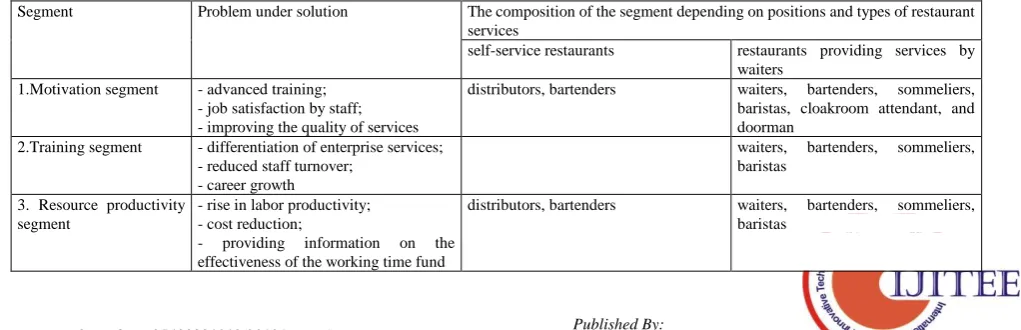
The objectives of SQMS contained in noted segments require a comprehensive solution and the appointment of coordinators for certain groups of employees holding different positions. The official composition of the staff is determined according to the operation method of the enterprise. The main features of the SQMS depending on the positions in the segments are given in Table 1.
Table 1: Content and problems solved by segments of the SQMS
Segment Problem under solution The composition of the segment depending on positions and types of restaurant services
self-service restaurants restaurants providing services by waiters
1.Motivation segment - advanced training; - job satisfaction by staff; - improving the quality of services
distributors, bartenders waiters, bartenders, sommeliers, baristas, cloakroom attendant, and doorman
2.Training segment - differentiation of enterprise services; - reduced staff turnover;
- career growth
waiters, bartenders, sommeliers, baristas
3. Resource productivity segment
- rise in labor productivity; - cost reduction;
- providing information on the effectiveness of the working time fund
distributors, bartenders waiters, bartenders, sommeliers, baristas
Motivation segment
Study segment Resource productivity
[image:3.595.41.552.648.813.2]Training methods for employees holding different positions are different. While for bartenders, sommeliers, and baristas, training and master classes, which are held outside the restaurant business, are quite typical, for the waiters, refresher courses organized directly at the enterprise are more suitable. This is so-called internal training, as well as the dissemination of the approved experience of individual employees of the enterprise among the staff.
Resource productivity segment affects the training segment. If the company does not have enough funds to train the staff, then the training of staff is carried out using inexpensive forms, such as instructional training or in-process training in the workplace by an attached mentor.
Motivation is also associated with the resource productivity segment because improving the quality of the staff of the restaurant business is accompanied by an increase in wages and material incentives for staff. The motivation methods should include not only economic but also non-economic approaches, such as moral encouragement, awarding the title of "Best in the profession", etc.
The objects of the SQMS include staff quality indicators, factors, and conditions that determine their level, as well as the staff quality formation processes [15].
The methods of SQMS include techniques, rules, and actions in relation to management objects, aimed at achieving the necessary quality of staff. They include the following: - managerial methods (orders, disciplinary penalties); - normative methods (norms, standards, regulations); - social and psychological methods (trust, progressive experience, respect in the team);
- economic methods (material stimulation taking into account quality level, financing of enterprise activity in the quality sphere).
These methods need comprehensive use in the enterprises of the restaurant business.
III. RESULTS
Most restaurant business enterprises define customer service quality as its compliance with standards and regulations that is appropriate at the operational level of management and one of the conditions of high-quality service. The highest level of management should be directed to the future quality service that requires the development of a flexible proposal, which is modified according to the requirements of customers. The quality of restaurant service is characterized by two aspects [16]: technical and functional. The first aspect involves getting by the customer what in his opinion is the most important, and what can be measured. The functional aspect means both the interaction of staff and customers and the structure of the customer service process.
It is believed that if the company has received a certificate of conformity of the QMS to international standards ISO 9000, it is able to consistently provide quality services, which can be competitive. Most companies around the world offer tangible and intangible services, using in their activities the ISO 9000 international standards, as well as QS 9000, ISO 14000, and the like, derived from them [17].
At that, an important tool for effective CSQMS is business
automation through the use of automated control system (ACS), which makes it possible to reduce customer service time, minimize routine time-consuming operations of employees, and reduce costs.
For restaurants, there are several products available on the market, but in the authors’ opinion, two of them are the main ones: R-keeper and Iiko. They are quite similar, though each has its own advantages. In the restaurant business, any automation program is called by employees R-Keeper. The name of R-Keeper has long been a generic term. In fact, R-Keeper is a trademark of UCS company and the cognominal name of the software for the organization of the front office operation.
The main disadvantage of this system is its cost. To sum up, one can note that R-keeper is the flagship software for automating the restaurant business, and thus it should be used by large enterprises that have sufficient financial resources. At the same time, Ilko is a very high-quality analog, which is cheaper. However, it has almost the same capabilities and should be used at the opening stage of the enterprise, especially seasonal restaurant enterprises.
According to E.A Wall and L.L. Berry, the level of QMS efficiency of the restaurant business enterprise is directly proportional to the level of competitiveness of services and the enterprise in general. Consequently, the QMS can become the main tool for winning the competition, given the fact that the competitiveness of the enterprise is its level of competence relative to competitors in the accumulation and use of production potential in a certain area that is reflected in indicators such as the quality of services, the scope of their provision, profit, and the like [18].
According to C.H-J. Wu and R-D. Liang, not only qualified and interested employees, and the appropriate material base, but also a well-established quality management system are necessary to achieve 100% quality service. This is what leads the most restaurant businesses to success in the future. However, only the desire to provide high-quality services to customers is not enough, because there is a need for a competent approach to the QMS, because this affects the customer impression from the enterprise and its activities. This is incredibly important to improve the enterprise’s image, and to attract new customers in the future. That is why at the enterprises of restaurant business important is the quality of the service, service quality management, as well as quality management [19].
However, as believed by M. Haghighi, for the effective functioning of the QMS and the effective provision of quality services, the restaurant business enterprise should identify in its operation numerous interrelated activities (processes) and manage them, as well as carry out monitoring, measurement, and analysis of these processes [20].
At that, like in any process of implementing something new, there may be certain problems and risks that need to be taken into account. The main such problems in the course of implementing QMS at the enterprises of the restaurant business, in the authors’ opinion, are the following:
implementation of the QMS;
• the mentality of management and officials, who do not accept new solutions and feel dislike for any new initiatives; • too detailed regulation of activities and processes that can lead to the development and implementation of a large number of documents that in turn can create difficulties in the work, rather than help;
• lack of methodical support of QMS implementation process.
IV. CONCLUSION
The proposed model of CSQMS represents a combination of objects, elements, functions, and timeframes of quality management of restaurant services, which corresponds to a systematic, integrated approach, and is recommended for use in domestic hospitality enterprises. The simultaneous implementation of the staff quality management system in the context of certain segments will allow focusing the attention of responsible professionals on the main objectives of the QMS implementation. At the same time, the current QMS should be objective and consistent with the requirements of the ISO 9001 international quality standard.
REFERENCES
1. R.P. Valevich, “Upravlenie kachestvom tovarov i uslug” [Quality management of goods and services], Minsk, Publishing House of the Belarusian State Economic University, 2008, pp. 304.
2. S.L. Ahire, “Total quality management interfaces: An integrative framework”, Management Science, 27(6), 1997, pp. 91-105.
3. V.K. Chong, M.J. Rundus, “Total quality management, market competition, and organizational performance”, British Accounting Review, 36, 2004, pp. 155-172.
4. M. Zineldin, “Total relationship management (TRM) and total quality management (TQM)”, Managerial Auditing Journal, 15(1/2), 2000, pp. 20-28.
5. A. Ghobadian, S. Speller, M. Jones, “Service quality: Concepts and models”, International Journal of Quality and Reliability Management, 11(9), 1994, pp. 43-66.
6. G.S. Sureshchandar, C. Rajendran, R.N. Anantharaman, “A conceptual model for total quality management in service organizations”, Total Quality Management, 12(3), 2001, pp. 343-363.
7. H. Kaynak, “The relationship between total quality management practices and their effects on firm performance”, Journal of Operations Management, 21, 2003, pp. 405- 435.
8. J. Dulen, “Quality control”, Restaurant and Institutions, 109(5), 1999, pp. 38-52.
9. S-K. Rheea, J.Y. Rhab, “Public service quality and customer satisfaction: Exploring the attributes of service quality in the public sector”, The Service Industries Journal, 29(11), 2009, pp. 1491-1512. 10. N. Chowdhary, M. Prakash, “Prioritizing service quality dimensions”,
Managing Service Quality, 17(5), 2007, pp. 493-509.
11. I. Gil, G. Berenguer, A. Cervera, “The roles of service encounters, service value, and job satisfaction in achieving customer satisfaction in business relationships”, Industrial Marketing Management, 37(8), 2008, pp. 921-939.
12. S.S. Andaleeb, C. Conway, “Customer satisfaction in the restaurant industry: An examination of the transaction-specific model”, Journal of Services Marketing, 20(1), 2006, pp. 3-11.
13. Quality management principles. International Organization for Standardization. ISO Central Secretariat. Geneva, Switzerland Retrieved from
https://www.iso.org/files/live/sites/isoorg/files/archive/pdf/en/pub1000 80.pdf
14. Y. Namkung, S. Jang, “Are highly satisfied restaurant customers really different? A quality perception perspective”, International Journal of Contemporary Hospitality Management, 20(2), 2008, pp. 142-155. 15. S. Marković, S. Raspor, K. Šegarić, “Does restaurant performance meet
customers’ expectations? An assessment of restaurant service quality
using a modified DINESERV approach”, Tourism and Hospitality Management, 16(2), 2010, pp. 181-195.
16. N. Barber, R.J. Goodman, B.K. Goh, “Restaurant consumers repeat patronage: A service quality concern”, International Journal of Hospitality Management, 30(2), 2011, pp. 329-336.
17. J. Ha, S.C. Jang, “Effects of service quality and food quality: The moderating role of atmospherics in an ethnic restaurant segment”,
International Journal of Hospitality Management, 29(3), 2010, pp. 520-529.
18. E.A. Wall, L.L. Berry, “The combined effects of the physical environment and employee behavior on customer perception of restaurant service quality”, Cornell Hotel and Restaurant Administration Quarterly, 48(1), 2007, pp. 59-69.
19. C.H.J. Wu, R.D. Liang, “Effect of experiential value on customer satisfaction with service encounters in luxury-hotel restaurants”,
International Journal of Hospitality Management, 28(4), 2009, pp. 586-593.