Abstract: Sequential pattern mining is one of the important functionalities of data mining. It is used for analyzing sequential database and discovers sequential patterns. It is focused for extracting interesting subsequences from a set of sequences. Various factors such as rate of occurrence, length, and profit are used to define the interestingness of subsequence derived from the sequence database. Sequential pattern mining has abundant real-life applications since sequential data is logically programmed as sequences of cipher in many fields such as bioinformatics, e-learning, market basket analysis, texts, and webpage click-stream analysis. A large diversity of competent algorithms such as Prefixspan, GSP and Freespan have been proposed during the past few years. In this paper we propose a data model for organizing the sequential database, which consists of a directed graphDGS (cycles and several edges are allowed) and an organization of directed paths in DGS to represent a sequential data for discovering sequential pattern3 from a sequence database. Competent algorithms for constructing the digraph model (DGS) for extracting all sequential patterns and mining association rules are proposed. A number of theoretical parameters of digraph model are also introduced, which lead to more understanding of the problem.
Keywords: sequential pattern, data mining, directed graph, directed path, frequent item, association rule, minimum support.
I. DIGRAPH MODEL FOR SEQUENCE DATABASE
Consider a set of items, I = {1,2,…,n}. “A sequence, s is any nonempty subset of items in I. A sequence database S is a set of sequences in I. A subsequence x
s
S may take place more than once in DGS. We assume that for eachi
I
, there is at least one sequences
S
withS
i
. In other wordss
I
S s
. A sequences
S
is said to support a subsequence x,x
s
ifs
S
. The support of x is defined byS
s
x
S
s
x
)
:
sup(
. Thus)
sup(
x
is the percentage of sequences contains x. If a threshold min_supp is fix, then any subsequence x of s withRevised Manuscript Received on September 10, 2019.
Dr. Sabeen S, Department of Computer Science, SRM Institute of Sceince and Technology, Kattankulathur, Tamilnadu, India. Email: [email protected]
Dr. R. Arunadevi, Department of Computer Science, Vidhya Sagar Women's College, Chengalpettu,Tamilnadu, India. .Email: [email protected]
Dr. B. Kanisha, Department of Information Technology, Veltech Multitech Dr.RR & Dr.SR Engineering College, Chennai, India. Email:[email protected]
Dr. R. Kesavan, Department of Information Technology, Jaya Engineering College, Thiruninravur, Chennai, Tamilnadu, India. Email: [email protected]
)
sup(
x
min_supp is called a sequential pattern”. “An association rule is an implication of the formx
y
where
x
,
y
S
andx
y
. The support of ruley
x
is defined to besup(
x
y
)
. The confidence of the rule is defined as)
sup(
)
sup(
)
(
x
y
x
y
x
conf
.The support and confidence values are usually normalized so that these values occur between 0 and 100 instead of 0 and 1.0”. Association rules can be generated from the extracted sequential patterns[1][4][8][13]. The sequential pattern mining problem was first proposed by Agrawal[1]. Consider a set of sequences, where every sequence contains a set of subsequence and each subsequence consists of a list of items. For a given user-defined minimum support, the problem of sequential pattern can be defined as the extraction of all the frequent subsequences.
II. DEVELOPMENT OF DIGRAPH MODEL FOR
THE SEQUENCE DATABASE, DGS A method to construct the data model, DGS for a sequence database, S is proposed in this section. This method dynamically constructs the data model DGS by scanning the database only once and at the same time extract a number of factors such as incidence frequency of each node, how many loops are there in each node?, occurrence frequency of each edge, how many edges in DGS?, the highest length of a sequence, and each node’s in-degree and out-degree.
The algorithm for constructing data model, DGS of a sequence database, initially constructs separate nodes for each item with occurrence frequency 0. Then scanning the
sequence database one time and read each sequence
S
j and construct the directed route or path representing the sequence in DGS. Let
e1, e2, . . . , ek
be a sequence, with k elements e1, e2, . . ., and ek . Each element ej is an itemset denoted as(i1, i2, . . . , ik) where ij is an item, ij
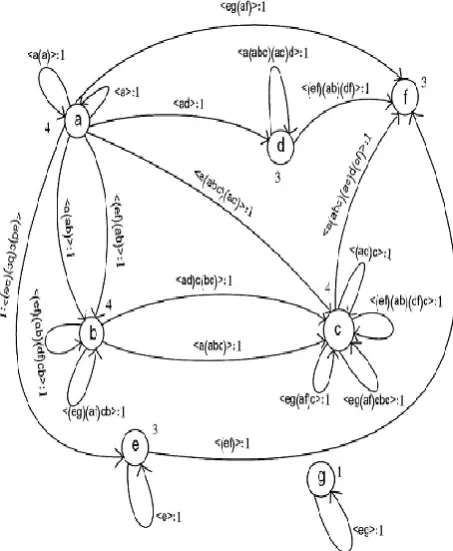
I. An edge (ij, ij+1) is implemented by linked list. Each node in the linked list has two fields for storing prefix patterns (i1, i2, . . . , ij), which is name of the edge(i, j) and occurrence frequency of the edge(i, j). For instance the data model given in Figure 2, the edge (a, b) occurs with label
a
(
ab
)
and also with values
ef
(
ab
)
indicating that it occurs once as part of the sequencesS
10 andS
30.Mining of Sequential Patterns using Directed
Graphs
These values are stored in memory dynamically. The algorithm for developing the data model DGS is given in Figure1.
A. Algorithm for Directed graph of Sequence Database, DGS
The pseudo code for constructing a directed graph for a sequence database is follows:
Algorithm: DGS, Directed graph of Sequence database Input:S, Sequence database,
I, set of items
n, items count
m, total sequences Output:
f(i): frequency of each item
K: Highest Length of a sequence
N(E): Total edges in DGS id(i): in-degree of a node i. od(i): out-degree of a node i.
Lc(i): Number of loops at node i.
InEdge (i): Number of distinct edges to node i. OutEdge (i): Number of distinct edges from node i. Label (
e
c,i): Label assigned to the edgee
cwith head i, f (e
c ,i): frequency of edgee
c with head i and Label (e
c,i) l(S
j ): length of sequenceS
j (i.e.,count of items inS
j) E(S
j):set of all subsequence inS
jN(
S
j):count of subsequences inS
jK: Highest Length of sequence
N
(
S
cj)
: Number of items in instances ofS
j; DGS: The directed graph of the sequence database.Method:
for each item
i
I
,
1
i
n
, doCreateNode(i); f (i) = 0;
od (i) = 0; id (i) = 0; InEdge (i) = 0; OutEdge (i) = 0;
L
c(i) = 0; //1
i
n
K = 0end for
K = 0;
foreach sequence
S
j
S
,
1
j
m
doE (
S
j)= GetElements(S
j); // assigning all elements ofS
j to E (S
j);
N
(
S
j)
E
(
S
j)
;item =
; prefix =
;N
(
S
cj)
=0;for each element in
j
S
,E
k(
S
j)
E
(
S
j),
1
k
N
(
S
j)
do
predecesso
r
;
X
;
foreach item
i
E
k(
S
j)
N
(
S
cj)
++;if
(
i
item
)
thenf (i)++; item =
{
i
}
;X =
{
i
}
;else X =
{
i
}
;end if
if (
E
k(
S
j)
= 1) thenL
c(i)++;if(
L
c(i)= 1) thenCreateEdge(i,i); N(E)++; f(
e
c ,i) = 1;Label(
e
c,i) =
prefix
X
:
f
(
e
c,
i
)
; Prefix =
{
i
}
;end if
if (
L
c(i) > 1) thenf (
e
c ,i)++; end ifod (i) + +;
id (i) + +;
InEdge (i) + +;
OutEdge (i) + +;
end if
if (predecessor
) then if (X
any Label(e
c,i))thenCreateEdge (predecessor, i); N (E) + +;
f (
e
c ,i) = 1;Label (
e
c,i) =
prefix
X
:
f
(
e
c,
i
)
; prefix =
{
i
}
;od (predecessor) + +; id (i) + +;
InEdge (i) + +;
OutEdge (predecessor) + +;
end if
if (X
any Label(e
c,i)) then f (e
c ,i)++;od (predecessor) + +; id (i) + +;
end if
prefix =
{
i
}
; predecessor = i ;end for end for
I (
S
j) = item; L (S
j) =N
(
S
cj)
end if end for
return DGS
Figure 1 Pseudo code for constructing directed graph of a sequence database, DGS
[image:3.595.73.264.189.280.2]For example, let the running example adopted in Pei, Han, Behzad Mortazavi, Pinto(2004) database9 be a sequence database S17, shown in Table1 and minimum support count = 2. The list of items in the sequence database is, I={a, b, c, d, e, f, g}.
Table 1 A sequence database18 Sid Sequence
S10
a
(
abc
)(
ac
)
d
(
cf
)
S20
(
ad
)
c
(
bc
)(
ae
)
S30
(
ef
)(
ab
)(
df
)
cb
S40
eg
(
af
)
cbc
Consider the sequence
a
(
abc
)(
ac
)
d
(
cf
)
has 5 sub sequence: (a), (abc), (ac), (d) and (cf ) where item a and cshow more than once in distinct subsequences. It is a
9-sequence since total 9 instances appearing in that sequence. Support count of a sequence can be calculated as follows: Item a occur 3 times in this sequence so it contributes 3 to the length of the sequence but the whole sequence
a
(
abc
)(
ac
)
d
(
cf
)
contributes only one to the support of that sequence16. Also, sequence
a
(
bc
)
df
is a subsequence of
a
(
abc
)(
ac
)
d
(
cf
)
. Since both sequences S10 and S30 contain sub sequencex
(
ab
)
c
, [image:3.595.55.282.465.741.2]x is a sequential pattern of length 3, that is, 3-pattern.
Figure 2 DGS of a sequence database in Table 1
III. MINING OF SEQUENTIAL PATTERNS FROM DGS
In this section, a method for mining all sequential
patterns[12],
S
Lfrom DGS is presented. For each node i, the method finds all sequential patterns ends with i. Suppose the number of edges ends on a node i is 0 i.e., InEdge (i)=0, i} is the only pattern ends with i. Otherwise for each edge ec with i as head, all subsets, X of Label(ec, i) suchthatX
2
andX
i
are considered. Then the support count of X is the total support counts of all the edges ec with distinct prefix andi as head for which
X
Label
(
e
c,
i
)
. If this support count is greater than or equal to the minimum support s, thenX is included in the list of all sequential patterns. The pseudo code for extracting frequent patterns from a DGS is XoSP is shown in Figure 3.
A. Agorithm for Extracting Sequential Patterns, XoSP The algorithm for extracting sequential patterns form the directed graph of the sequence database is presented as follows.
Algorithm: XoSP, Extraction of Sequential Patterns from DGS
Input: s: Minimum support threshold.
DGS: a model of sequence database S.
Output:
S
L: List of sequential patterns extracted fromDGS.
m: Number of sequential patterns. Method:
;
0
,
m
L
foreach node12i, i
DGS
do if(f (i) ≥ s) then
S
L=
i
:
f
(
i
)
; m++;end if
if (
Edge
(
i
)
)>0thenf = 0;
for each Label(ec ,i), as i in last elementof edge labeldo f = f (ec ,i);
W = Label(ec ,i);
if
(
W
S
L)
then //S
Lis the set of patterns already extractedfor eachsubsequence, x ends with
i,
x
W
&
&
x
S
L dofor each Label(
e
y,
i
)
do // other than Label (ec ,i)if
((
x
Label
(
e
y,
i
))
&&))
))
,
(
(
))
,
(
(
(
prefix
Label
e
yi
prefix
Label
e
ci
f = + f(ey,i);
end if end for end for
if
(
f
s
)
thenS
L =
x
:
f
m++;
end if end for end if end for return
S
L;Figure 3 Pseudo code of XoSP for extracting sequential patterns from DGS
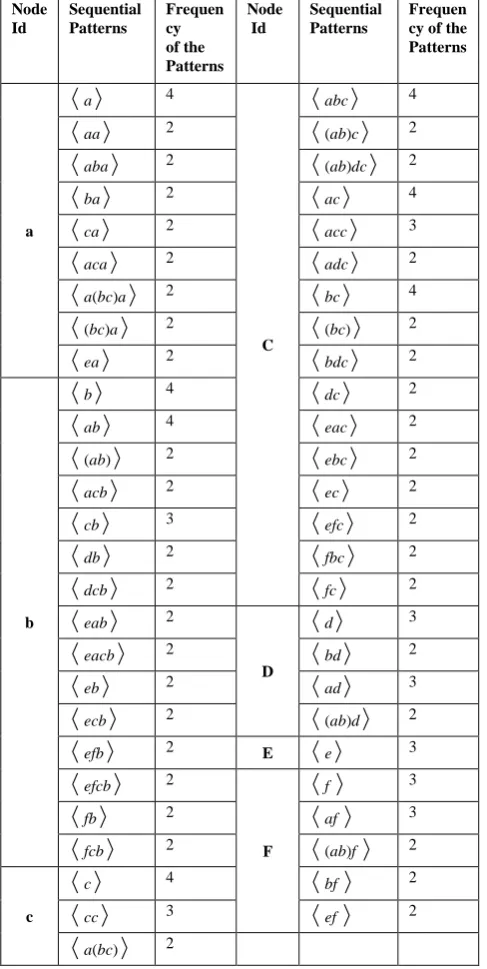
The algorithm DGS is illustrated with a sequence database consisting of 4 sequences and 7 items shown in Table 1; by applying XoSP to the DGS shown in Figure 2 all sequential patterns from the nodes of DGS have been extracted. The
process of extracting sequential patterns using XoSP from a
DGS is given below:
XoSP algorithm starts from the first node, that is, the node representing the first item in the list of items.19 For the directed graph DGS in Figure 3.13, XoSP starts from the node
a. Frequency of node a,
f
(
a
)
4
which is more than the minimum support, s. So
a
is a sequential pattern and isincluded in the set of allf sequential patterns, SL. The number of edges of the node a can be calculated using the formulae
)
(
i
Edge
= InEdge(i) + OutEdge(i) - Lc(i), whereInEdge(i) is the number in-edges of the node a and OutEdge(i) is the number of out-edges of the node a , and Lc(i) is the number of loops at a. Thus
Edge
(
a
)
= 2 + 8 - 2 = 8. The Edge (a) with edge label,
a(a)
S
L has frequency 1 and not yet been extracted as a sequential pattern. Let W=
a(a)
. The subsequencex
W
, which ends with item a are
a
and
a(a)
. The subsequence
a
is already extracted and is contained in SL. The sequence
a(a)
S
L. To get the net frequency of
a (a)
we have to consider total support count of the edges with different prefix in the edge label and contain
a (a)
as the subsequence. One out-edge of a with frequency 1, contains
a (a)
in its label as a subsequence with different prefix. Hence f (
a (a)
) =1 + 1 = 2, satisfying minimum support s, so
a (a) is a sequential pattern that can be added to SL. For out-edge of node a with label
eg
(
af
)
and its prefix is
ega
S
L and f (ega) = 1. Let W =
ega
. The subsequences,x
W
that ends with a are x= {
ea
,
ga
,
ega
}. The subsequence x1 =
ea
S
L. Wecan find net frequency of the sub sequence x1 =
ea
by considering total support count of edges of a which contain
ea
as a subsequence in its label with different prefix. One out-edge of node a has
ea
as a subsequence in its label with frequency of the edge as 1. Hence the net frequency f(
ea
) = 1 + 1 = 2
s. So the subsequence
ea
is a sequential pattern with frequency 2 and can be added to SL. For the next subsequence x2 =
ea
S
L, and cannot be asequential pattern since the net frequency of
ea
is f(
ea
) = 1 only. In this manner all the sequential patterns can be extracted from each node in the DGS. The set of all sequential patterns along with the respective frequencies mined from all the nodes of DGS is given in Table 2.IV. EXPERIMENT RESULTS
The experimental results on the performance of
DGS andcomparisons with Prefixspan, GSP and Freespan
[2][3][6][12]are discussed in this section. It shows that DGS
producing better results than other previously proposed methods. This approach of mining sequential pattern is efficient and scalable in large databases. It is efficient and scalable for mining sequential patterns in large databases. In this paper, performance of our approach on a sample data set C10T8S8I8[5][7][10]is provided. In this data set the number of items is set to 1000 and there are 10,000 sequences in the data set. The number of items and sequences taken for this data set is 1000 and 10,000 respectively.
Node Id
Sequential Patterns
Frequen cy of the Patterns
Node Id
Sequential Patterns
Frequen cy of the Patterns
a
a
4C
abc
4
aa
2
(ab)c
2
aba
2
(ab)dc
2
ba
2
ac
4
ca
2
acc
3
aca
2
adc
2
a(bc)a
2
bc
4
(bc)a
2
(bc)
2
ea
2
bdc
2b
b
4
dc
2
ab
4
eac
2
(ab)
2
ebc
2
acb
2
ec
2
cb
3
efc
2
db
2
fbc
2
dcb
2
fc
2
eab
2D
d
3
eacb
2
bd
2
eb
2
ad
3
ecb
2
(ab)d
2
efb
2 E
e
3
efcb
2F
f
3
fb
2
af
3
fcb
2
(ab)f
2c
c
4
bf
2
cc
3
ef
2The average number of items and subsequences with in elements and sequence are set to 8 and is denoted as T8 and S8. We can increase the number of long sequential patterns when minimum support count is set at low level. The result of our experiment on given data set on scalability with different support count is shown in Figure 3.
0
50
100
150
200
250
300
350
400
450
0.25
0.5
0.75
1
2
3
R
u
n
tim
e
(s
econ
d
s)
Support Threshold in %
Freespan
GSP
Prefixspan
DGS
Figure 3 Runtime comparisons among DGS, Prefixspan, GSP and Freespan
When we increase the minimum support count the number of sequential patterns generated is less. As the support threshold decreases the gaps between the runtime of four methods becomes clear. Both Freespan and Prefixspan
are faster than GSP. But DGS method is more efficient and faster than and more scalable than Freespan and Prefixspan
techniques9,11,14,15.
V.CONCLUSION
The algorithms for mining sequential patterns from big databases are studied and developed by using a new digraph model DGS. In this approach no candidates are generated and test approach such as GSP and Prefixspan are performed. This approach generates a directed graph DGS for sequence database and grows sequential patterns through the nodes of the DGS. The size of the DGS is always less than that of S, sequence database. This approach constructs a digraph model, DGS while scanning the sequence database S
first time. No further scanning the sequence database S is necessary for extracting sequential patterns. In summary,
DGS is more efficient and scalable than, GSP, Freespan and
Prefixspan.
REFERENCES
1. Agrawal R and Srikant R., Mining Sequential Patterns. In Proc. 1995 Int.Conf. Data Engineering (ICDE’95), pages 3–14, Taipei, Taiwan, Mar. 1995.
2. Agrawal R, Mannila H., Srikant R., Toivonen H., and Verkamo A.I., “Fast Discovery Of Association Rules” In U.M. Fayyad, G. Piatetsky - Shapiro, P. Smyth, and R. Uthurusamy, editors, Advances in Knowledge Discovery and Data Mining, pp. 307–328. MIT Press, 1996
3. Bettini. C, Sean Wang X., and Jajodia S., Mining Temporal Relationships with Multiple Granularities In Time Sequences, Data Engineering Bulletin, 21:32–38, 1998.
4. Garofalakis M, Rastogi R., and Shim K. Spirit: Sequential pattern mining with regular expression constraints. In Proc. Int. Conf. Very
Large Data Bases (VLDB’99), pages 223–234, Edinburgh, UK, Sept. 1999.
5. Han J, G. Dong, and Y. Yin. Efficient mining of partial periodic patterns in time series database. In Proc. Int. Conf. Data Engineering (ICDE’99), pages 106–115, Sydney, Australia, April 1999.
6. Lu. H, Han J., and Feng L. Stock movement and n-dimensional intertransaction association rules. In Proc. 1998 SIGMOD Workshop Research Issues on Data Mining and Knowledge Discovery (DMKD’98), pages 12:1– 12:7, Seattle, WA, June 1998.
7. Mannila. H, H Toivonen, and Verkamo A. I. Discovery of frequent episodes in event sequences. Data Mining and Knowledge Discovery, 1:259–289, 1997.
8. Ozden. B, Ramaswamy S., and Silberschatz A. Cyclic association rules. In Proc. 1998 Int. Conf. Data Engineering (ICDE’98), pages 412–421, Orlando, FL, Feb. 1998.
9. Pei, J., Han, J., Mortazavi-Asl, B., Wang, J., Pinto, H., Chen, Q., ... Hsu, M. C. (2004). Mining sequential patterns by pattern-growth: The prefixspan approach. IEEE Transactions on Knowledge and Data Engineering, 16(11), 1424-1440. https://doi.org/10.1109/TKDE.2004. 10. Ramaswamy S., Mahajan S., and Silberschatz A. On the discovery of interesting patterns in association rules. In Proc. Int. Conf. Very Large Data Bases (VLDB’98), pages 368–379, New York, NY, Aug. 1998. 11. Sabeen. S., “Classification of Message in Dynamic Notice Board using
Android”, European Journal of Scientific Research, Vol. 92, No. 4, December 2012.
12. Arumugam, S., Sabeen, S. “Association Rule Mining using Path Systems in Directed Graphs”, INT J COMPUT COMMUN, ISSN 1841-9836, 8(6):791-799, December, 2013.
13. Srikant. R and Agrawal R. Mining sequential patterns: Generalizations and performance improvements. In Proc. 5th Int. Conf. Extending Database Technology (EDBT’96), pages 3–17, Avignon, France, Mar. 1996.
14. Wang. J, Chirn G., Marr T., B. Shapiro, Shasha D., and K. Zhang. Combinatiorial pattern discovery for scientific data: Some preliminary results. In Proc. 1994 ACM-SIGMOD Int. Conf. Management of Data (SIGMOD’94), pages 115–125, Minneapolis, MN, May, 1994. 15. Zaki M. J. Efficient enumeration of frequent sequences. In Proc. 7th
Int. Conf. Information and Knowledge Management (CIKM’98), pages 68–75, Washington DC, Nov. 1998.
16. Jun Ai, Linzhi Huang, Fei Wang, Jiaming Wang. "Research on Relations between Software Network Structure and Fault Propagation", 2016 International Conference on Software Analysis, Testing and Evolution (SATE), 2016.
17. dblab.cs.nccu.edu.tw
18. Jia-Wei Han, Jian Pei, Xi-Feng Yan. "From sequential pattern mining to structured pattern mining: A pattern-growth approach", Journal of Computer Science and Technology, 2004
19. "RESEARCH ON THE PROJECTION POSITIONBASED SEQUENTIAL PATTERN MINING ALGORITHM", Control and Intelligent Systems, 2014.
AUTHORSPROFILE
Dr. R. ArunadeviSecond is presently working in the Department of Computer Science, Vidhyasagar Women’s College. She has completed MCA in 1996, M.Phil in 2005 and received her Ph.D. in 2017 from Manonmaniam Sundaranar University. She has got more than 23 years of teaching experience in Computer science. Her area of research includes Data Mining, Cloud computing and Network Security. She has guided many M.Phil. Scholars and provided project guidance to post graduate students and published many research articles.
Dr.B. Kanisha received her Ph.D. from Anna University, Chennai, India. She is working as an Associate Professor in the Department of Information Technology in Veltech Multitech Dr.RR &Dr.SR Engineering College, Chennai, India. She has 15 years of academic experience. She has published many papers in reputed journals and international conference proceedings. She has guided more than many undergraduate and post graduate students in their project works. Her research and teaching interests include human computer interaction, speech recognition, neural networks and data mining