ISSN: 2278-3075, Volume-8 Issue-9S3, July 2019
Differential Algorithm Based Intelligent Protection
Scheme for Microgrid
Pooja Khandare, S.A.Deokar, A.M.Dixit
Abstract: Proposed scheme presents intelligent technique in protection of microgrid. This paper gives new approach in feature extraction of faulted current signal using Discrete Wavelet Transform. Furthermore different parameters like TMS(Time Measurment setting),PSM (Plug setting Multiple ) and CTD (coordination time Duration) are computed from featured faulty current. This course of action used to build genetic differential algorithm for deciding best suitable pair of relay with concept of “survival of fittest”. IEEE 9 bus system is considered for studding different types of faults for utility-connected and islanded mode. Initially primary pair of relay is activated and secondary protection operates on failure of primary. This study gives effective solution for fast operation of pair of relay in optimized time.
Keywords: Protection; Relay coordination; Micro grid; fault detection; DiscreteWavelet Transform (DWT)
I.
INTRODUCTION
Fossils fuels are vanishing day by day hence need of micro
grid is increasing. Penetration of renewable energy sources
and Distributed generators (DGs) in grid reduces greenhouse
effect and give solution to high energy demand and
depletion of artificial sources[1-4]. Micro grid gives quality
of supply to all types of load commercial as well as
household in rural and urban areas [4].In remote areas where
electricity is not reached because of natural calamities and
atmosphere micro grid is best solution. Micro grid System
works for both mode of operation grid connected as well as
islanded mode [5].[6] gives digital protection scheme for
micro grid using wavelet transform which does not consider
Grid connected and islanded mode of operation. Author in
[8] gives Time-frequency transform-based differential
schemefor micro grid protectionstudied both modes and HIF
but feature extraction take place with help of differential
energy and Threshold which results in increase in tripping
time of relay. [10]
Revised Manuscript Received on July 25, 2019.
Pooja Khandare,Dr.S.A.Deokar,Dr.A.M.Dixit
[email protected],[email protected], [email protected]
Ph.D student,Department of Technolgy,Pune Campus Director,ZES’S ZCOER,Pune ,India
B201,Veerodaya society, new grant road Kharadi,Pune 411041
An adaptive overcurrent protection scheme based on the
synchronous phase measurement is proposed for different
operation modes in microgrid but not studied for moth
operating modes. [14]fuzzy and neuro based optimization
techniques used to create problem for relay coordination
predefined for various issued therefore if new issue obtained
with system ,coordination fails[3]-[4]
microgrid provides feasible solution for forthcoming
problems like greenhouseeffect , growing energy demand,
and the depletion of conventional fossil fuel energy
sources.Many researchers give different techniques in
feature extraction of fault current in microgrid.Author [1]
suggest protection scheme which utilizes the principles of
synchronized phasor measurements and microprocessor
relays to detect all types of fault conditions in case of both
modes of operation but as communication is included which
results in increases in cost. [2] Gives sequence component
based feature extraction protection but the robustness and
reliability of the proposed schemes need to improve.Curve
fitting is one method in which inverse time operating
relation are obtained on graph for many faults. Linear and
nonlinear characteristics are tested for relay coordination
with different operating curves [5]but accuracy of this
method is very poor. Non Linear optimization techniques
[16][17] in which problem is formulated using nonlinear
programming. Both TDS and PSM are selected efficiently;
minima trap can be obtained in this method. Hybrid
optimization method which is combination of Analytical and
optimization method capable of solving relay coordination
problem for big interconnected system but worked with
fixed topology[15]-[18].There is need to discover intelligent
scheme for microgrid protection with optimization
techniques.
II.
SYSTEM DESCRIPTION
IEEE-9 bus system is converted to hybrid microgrid by
connecting two solar one wind and one diesel generator set.
Normal grid is fed with two feeder 115kV, X/R
ratio=6,MVA=500MVA.The
line
impedance
is
0.1529+j0.1406 Ω/km ,all lines are 500m long. Transformer
connected to point of coupling is with rating 20 MVA,
115kV/12.47kV.Ratings of DG are 480V, 20 MVA,
xd’=0.11
with
transformer
rating
20
MVA,
Differential Algorithm Based Intelligent Protection Scheme for Microgrid
[image:2.595.51.287.168.304.2]129
When renewable sources are not connected to system single
overcurrent relay are sufficient to protect system from faults.
But with penetration of DGs it becomes complex network as
flow of current is bidirectional. Hence primary and
secondary
protection
is
necessary.
Comprehensive
simulation studies are conducted to verify the efficiency of
the proposed protection strategy in the MATLAB
environment in different fault scenarios.
Fig 1:- IEEE 9 bus system with integrated source
Comprehensive simulation studies are carried out to verify the effectiveness of the proposed protection strategy under different fault scenarios, in the MATLAB environment. Fig-2 shows different fault currents at 5 buses in different operating modes for LG fault. It is noticed that fault current in utility connected mode is higher than islanded mode .As fault current is proportional to
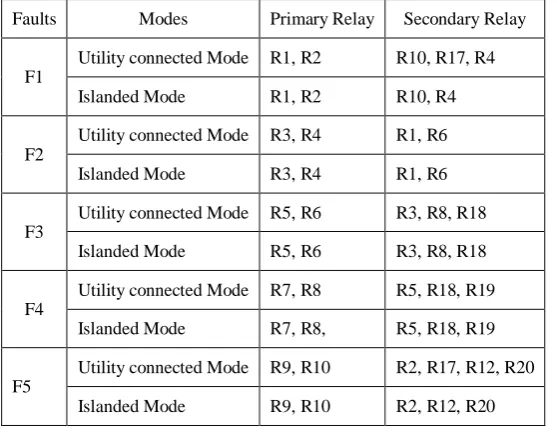
short-circuit power of the grid and inverse to short-short-circuit impedance seen by the fault. Overall there is noteworthy difference in two operating modes. As fault current contributed by utility is more than islanded mode. Table-I shows pair of primary and Secondary relay in utility connected and islanded mode.Microgrid Protection strategy must respond positively and offer safe and reliable operation against fault .Considering these all challenges this paper offer new approach of integrated DWT and differential algorithm technique for secured and safe operation of micro grid. The proposed scheme considers L-G shunt fault at various locations in grid connected and islanded mode at various location of distribution line. Fault current is processed through DWT feature extraction to extract delicate features and remove noise content from both ends of distribution line. These extracted features from DWT are used to build model with differential algorithm techniques and tripping command is issue to circuit breaker by choosing pair of primary and secondary relay.
[image:2.595.314.538.263.386.2]Fig 2:-current distribution in grid connected and Islanded mode
Table-I
Primary and backup relays for 5 bus in Utility connected and islanded mode
Faults Modes Primary Relay Secondary Relay
F1
Utility connected Mode R1, R2 R10, R17, R4
Islanded Mode R1, R2 R10, R4
F2
Utility connected Mode R3, R4 R1, R6
Islanded Mode R3, R4 R1, R6
F3
Utility connected Mode R5, R6 R3, R8, R18
Islanded Mode R5, R6 R3, R8, R18
F4
Utility connected Mode R7, R8 R5, R18, R19
Islanded Mode R7, R8, R5, R18, R19
F5
Utility connected Mode R9, R10 R2, R17, R12, R20
Islanded Mode R9, R10 R2, R12, R20
III.
IMPLEMENTATION OF INTEGRATED
DWT DIFFERENTIAL ALGORITHM
A. Optimization Problem
Transfer coordination improvement issue can be planned as nonlinear programming issue whose principal point is to limit add up relay working time,(i,e total of the primary and secondary relay)Adaptive assurance methodology is utilized. Overcurrent relay which fill in as essential relay in its zone same relay is function as secondary relay when blame is in neighboring zone.
(1)
Where is relay function which has to be minimize
i is faulty line or location identifier ,n is total no of relay
j is primary relay each fault have 2 primary relay.
0
1
2
3
4
F1
F2
F3
F4
F5
Utility
Connected
[image:2.595.161.440.446.663.2]ISSN: 2278-3075, Volume-8 Issue-9S3, July 2019
(2)
Where a and b overcurrent relay parameters that are depend on relay characteristics. Here value of a and b are set to 0.1401 and 0.0201, respectively.
Fault current and Ip is relay pick up current.
TMS (Time Measurement setting) of relay
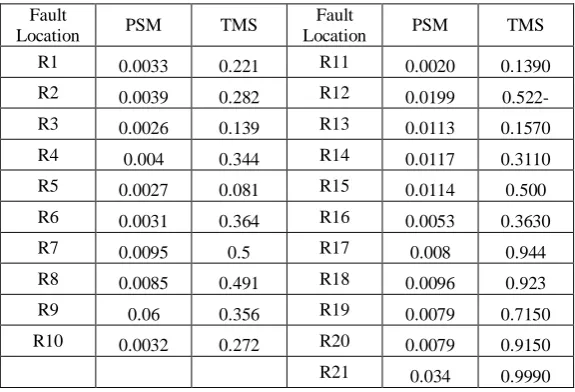
TMS and pick up current of relay are two parameter from which operating time of relay is optimized. Pick up current is defined as minimum value of short circuit current above which relay continues to operate. Value of optimized PSM and TMS is given below in fig-1. Coordinated relay settings result in operating time of relays which are satisfying all the necessary constraints applied to the relay coordination problem
B. Constraint
For proper coordination of relay some constraint should be applied on objective function if any criteria is not fulfilled then penalty is applied .To ensure reliable operation of microgrid primary protection must provide with secondary protection which will operate only when primary protection disappointed. However secondary protection sends tripping signal after 0.201 sec delay called as CTD (coordination time duration).
Backup - Primary ≥ CTD (3)
TMS Imin ≤ TMS ≤ TMS Imax (4)
(5)
[image:3.595.154.442.326.522.2]TMS and pick up current of relay are two parameter from which operating time of relay is optimized. is calculated from minimum value of fault current above which relay starts to operate. Value of optimized PSM and TMS is given below in table –II. Coordinated relay settings result in operating time of relays which are satisfying all the necessary constraints applied to the relay coordination problem
Table II
Relay settings given in terms of PSM and TMS
Fault
Location PSM TMS
Fault
Location PSM TMS
R1 0.0033 0.221 R11 0.0020 0.1390
R2 0.0039 0.282 R12 0.0199 0.522-
R3 0.0026 0.139 R13 0.0113 0.1570
R4 0.004 0.344 R14 0.0117 0.3110
R5 0.0027 0.081 R15 0.0114 0.500
R6 0.0031 0.364 R16 0.0053 0.3630
R7 0.0095 0.5 R17 0.008 0.944
R8 0.0085 0.491 R18 0.0096 0.923
R9 0.06 0.356 R19 0.0079 0.7150
R10 0.0032 0.272 R20 0.0079 0.9150
R21 0.034 0.9990
C. Feature Extraction
DWT is used to estimate fundamental features from short circuit
current by using db4 mother wavelet [13].Feature extraction for
LG fault with 4 level coefficient decomposition is shown in
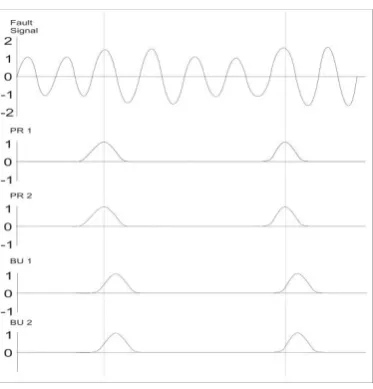
fig-3.After extraction of feature with DWT from faulty signal,
primary protection starts operating as shown in fig 4 .PR1 and
PR2 are primary relay for LG fault. If primary protection fails
Differential Algorithm Based Intelligent Protection Scheme for Microgrid
[image:4.595.71.258.213.408.2]131
[image:4.595.320.542.298.485.2]Fig 3:-feature extraction with DWT
Fig 4:-Operation of primary and backup relay
D. Differential Algorithm
“
survival of fittest “is one of the evolutionary approach for optimization method.it start with search of random set of populations ,and solution with better fitness are selected as parent to produce next generation.The software is implemented according to
the following steps:
I) Step 1.Intialization of all parameters, like population
size, no of generation, cross over probability, scaling factor
II) Step 2.Generate first Iteration
III) Step 3. Generate different target vector set randomly
for size S corresponding to the variables such as (PSM, TMS) which has to be optimized. Target vector set: Vi,P; i=1,2,3,…,S
IV) Step 4. With the help of vector set calculate objective
function given with reference to eq-(1)
V) Step 5.Mutation :For a given set of vector Vi,P ,
generate 3 random definite vectors (Vr1,P,
Vr2,P,Vr3,P and Vr4,P Generate mutant vector for target vector.
VI)
Vr4i,P (6)
VII) Step 6.Crossover: on the basis of crossover
probability Obtain trial set of vector by replacing some of the mutant vectors obtain with step 5 by target vector
VIII) Step 7.Selection: Merge vector which we assume
initially with target set of vector.Compare merged vector set and sort the vector set in ascending order (in accordance to the minimum objective function value). Sorted vector set is of doubled population size Select vector set of P-size (optimum values) and remove the rest values
IX) Step 8.In sorted vector set of S size if maximum
generation is reached then Select Vector (variable value) which results in the minimum value of objective function. Obtain Vbest individual and stop the process and if maximum generation is not reached then sorted vector set-Target vector for next generation and increment generation by 1 and directly jump to step 3 and repeat the algorithm. Relay use wavelet technique in detection of fault. Different conditions like healthy and faulty are checked within microgrid.Short circuit signal from faulty line are input to the intelligent relay.
Fig 4:-Survival of Fittest technique for selection of pair of relay
IV.
RESULT AND ANALYSIS
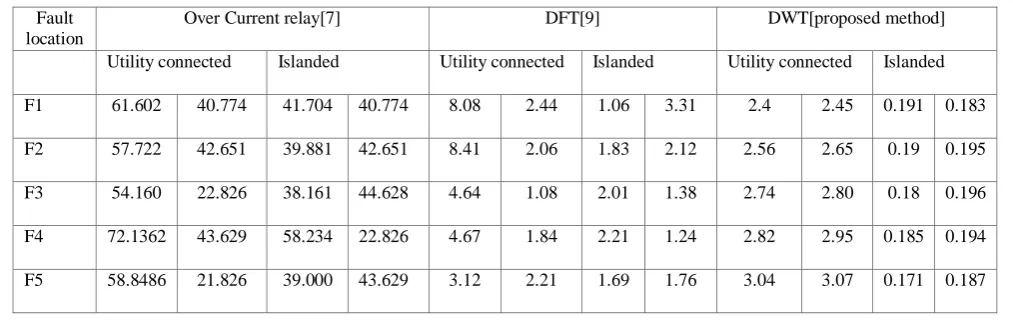
Execution examination between overcurrent Relay strategy [7] and ref [9] which utilized DFT system for highlight extraction is contrasted with proposed technique. Table III gives correlation for short out current of over three techniques. Correlation Results demonstrates that in ref [7] no component extraction will complete straightforwardly hamper use for hereditary calculation. What's more, in ref [9] DFT is utilized for highlight extraction; information mining enhancement system is utilized for further figuring. Table IV gives operating time required for all three methods. Which lessoned proposed technique is more efficient than compared methods.
Some
statistical definitions are present from which
performance based result can be compared. Reliability is
one of them which is defined as Total number of fault
cases assumed/Total number of real fault cases happen.
Performance comparison
in
Overcurrent Relay withDifferential Algorithm,DFT
ISSN: 2278-3075, Volume-8 Issue-9S3, July 2019
Techniques and DWT with Differential Algorithm in terms of reliability for both modes of operation is given in Table V.
Table III
Comparison of Short circuit current with Different Feature Extraction Technique
Table IV
Comparison of operating time
Fault
Operating Time
Overcurrent Relay with Differential Algorithm
DFT with Data mining Techniques
DWT with Differential Algorithm
[image:5.595.45.552.132.292.2]LG fault 0.35 Cycle 0.2 Cycle 0.1 Cycle
Table V
Performance Comparison in terms of Reliability
Techniques Grid Connected Islanded
Overcurrent Relay with Differential Algorithm 79% 63%
DFT with Data mining Techniques 97.6% 98%
DWT with Differential Algorithm 98% 99%
V.
CONCLUSION
This research proposes a genetic algorithm model-based differential intelligent protection scheme for microgrid protection. The given scheme develops protection optimization function for the microgrid operating at utility connected and Islanded mode. The differential features extraction at respective buses with DWT is used to build the Survival of fittest models, which are used for a final relaying decision. The proposed DWT differential algorithm is extensively tested on the standard IEEE 9 bus microgrid model. Comparison result show that in overcurrent and DFT method proposed method takes less operating time. The performance comparison with existing relays indicates that the proposed scheme can provide a highly reliable and effective protection measure for the microgrid.
REFERENCES
1. Eric Sortomme, S. S. Venkata, and Joydeep Mitra,” Microgrid Protection Using Communication-Assisted Digital Relays ”IEEE TRANSACTIONS ON POWER DELIVERY, VOL. 25, NO. 4, OCTOBER 2010
2. Sachit Gopalan, Victor Sreeram, Herbert Iu Yateendra Mishra “An Improved Protection Strategy for Microgrids” 2013 4th IEEE PES Innovative Smart Grid Technologies Europe (ISGT Europe), October 6-9, Copenhagen
3. M. Stadler, A. Siddiqui, C. Marnay, H. Aki, and J. Lai, “Control of greenhouse gas emissions by optimal DER technology investment
and energy management in zero-net-energy buildings,” Eur. Trans. Electr. Power, vol. 21, no. 2, pp. 1291–1309, Mar. 2011.
4. G. Venkataramanan and C. Marnay, “A larger role for microgrids,” IEEE Power Energy Mag., vol. 6, no. 3, pp. 78–82, May/Jun. 2008. 5. Bramha S.M and Girgis A”development of adaptive protection
scheme for distribution system with high penetration of distributed denerations”IEEE Trans,power Del 2004,19(1)pp,56-63
6. P.kanakasabapathy,Meenakshi Mohan ,Digital protection Sceheme for microgrid Protection 978-1-4799-8364-3/15/$31.00_c 2015 IEEE
7. Ankita Sharma and B. K. Panigrahi,“optimal Relay Coordination suitable for Grid-Connected and Islanded operational modes of Microgrid” Senior Member, IEEE IEEE INDICON 2015 1570185643
8. Susmita Kar, Subhransu Rajan Samantaray Time-frequency transform-based differential scheme for microgrid protection IET Gener. Transm. Distrib., 2014, Vol. 8, Iss. 2, pp. 310–320
9. Susmita Kar, S. R. Samantaray, and M. Dadash Zadeh Data-Mining Model Based Intelligent Differential Microgrid Protection Scheme IEEE SYSTEMS JOURNAL1932-8184 © 2015 IEEE.
10. Lin, Hengwei; Guerrero, Josep M.; Jia, Chenxi; Tan, Zheng-Hua; Quintero, Juan CarlosVasquez; Liu, Chengxi “Adaptive Overcurrent Protection for Microgrids in Extensive Distribution Systems” Proceedings of IECON 2016:
11. E. Casagrande and L. N. Woon, “A differential sequence component protection scheme for
Fault location
Over Current relay[7] DFT[9] DWT[proposed method]
Utility connected Islanded Utility connected Islanded Utility connected Islanded
F1 61.602 40.774 41.704 40.774 8.08 2.44 1.06 3.31 2.4 2.45 0.191 0.183
F2 57.722 42.651 39.881 42.651 8.41 2.06 1.83 2.12 2.56 2.65 0.19 0.195
F3 54.160 22.826 38.161 44.628 4.64 1.08 2.01 1.38 2.74 2.80 0.18 0.196
F4 72.1362 43.629 58.234 22.826 4.67 1.84 2.21 1.24 2.82 2.95 0.185 0.194
Differential Algorithm Based Intelligent Protection Scheme for Microgrid
133
micro-grids with inverter based distributed generators,” IEEE Trans. Smart Grid., vol. 5, no. 1, pp. 29–37, Jan. 2014.12. P. Mahat, Z. Chen, B. Bak-Jensen, and C. L. Bak, “A simple adaptive over current protection of distributed systems with distributed generations,” IEEE Trans. Smart Grid, vol. 2, no. 3, pp. 428–437, Sep. 2011.
13. Debi Prasad Mishra, Subhransu Ranjan Samantaray “A Combined Wavelet and Data-Mining BasedIntelligent Protection Scheme for Microgrid”IEEE TRANSACTIONS ON SMART GRID, VOL. 7, NO. 5, SEPTEMBER 2016
14. Q. H. Wu, J. F. Zhang, and D. J. Zhang, “Ultra-high-speed directional protection of transmission lines using mathematical morphology,” IEEE Trans. Power Del., vol. 18, no. 4, pp. 1127– 1133, Oct. 2003.
15. Keng-Yu Lien Shi-Lin Chen, Duong Minh Bui, Wei-Xiang Zhao “Fast Computing Algorithm for Microgrid Fault Protection System Using Communication-Assisted Digital Relays and Initially Experimental Results”
16. Mehdi monadi and catalin gavriluta “A communication assisted protection for MVDC distribution systems with distributed generation” IEEE transaction
17. Subhashree chaudhary ,Leesa mohapatra”A comprehensive review on modelling,control,protection and future prospectus of microgrid””, Ed. 3, Electrical Distribution-System Protection, Cooper Industries, 1990.