Abstract: Nowadays for Personal Identification Numbers (PIN) and passwords an efficient and secure alternative has been used which is called e-security. Due to the various computer frauds like identity theft and computer hacking there is a rapid increase in the financial losses of payment. In present day, the banking sector is accepting the payments through credit cards for every on-line as well as offline transaction which actually encourages the cashless payments. It will be the foremost convenient because of do on-line looking out, bills payments etc. Therefore, there is also increase in the fraud risks that area associated with the misuse of the credit cards as a result of technology development. So we go for biometric security to resolve this problem. The aim of our study is to given security through biometric technology of fingerprint recognition. Minutiae extraction and minutiae matching technique of AKAZE to boost the accuracy and high speed computation.
Keywords : AKAZE, : Biometric, Crossing Number, Fingerprint Matching, Fingerprint Extraction, SIFT
I. INTRODUCTION
Fingerprints are gaining popularity due to the truth it's far outstanding for every body and one need no longer to remember them as the password. Fingerprints are commonly with a person and one want no longer to maintain like cards (credit/debit) [1]. Biometric recognition refers physiological (face, iris, palm print, fingerprint) as well as behavioral (signature, gait) features that are known as biometric identifiers. Due to increasing fraud the banking and also the business institutions have significantly increased fingerprints recognition systems in various applications like e-commerce, banking, ATM transactions, government concerns as well as forensic department Fingerprint recognition is one of the automated method that is used for confirming or identifying the individual’s identity by comparing the two fingerprints. Also, among the various biometric methods one of the best method is fingerprint recognition and also for computerized system’s authentication it is the mostly used biometric solution.
Revised Manuscript Received on August 05, 2019.
First Author Name*, Department of computer Applications ,Bharathiar University, Coimbatore, India. Email: [email protected]
Second Author Name, Department of computer Applications, Bharathiar university, Email: [email protected]
In comparison to the behavioral and physiological features like palm vein, hearing, gait, voice, iris and face features the most leading biometric feature that is being used is the fingerprint. A fingerprint recognition system contains two stages that are verification and identification. In the first stage, an entry fingerprint is compared with the enrollment fingerprint of one to many matching verify whether the same person fingerprint or different fingerprint. In the identification stage an entry fingerprint is compared with the database fingerprint of many to many matching if the fingerprint is genuine person or fraud person.
Fig.1 Fingerprint Ridges and Valleys
A fingerprint contains many dark patterns, valleys and ridges within the fingerprint is termed streak and therefore the light-weight region between the ranges is said because the furrow [2] in figure 1. There are some distinctive purposes of the fingerprint that are referred to as because the minutiae point.
Minutiae points of fingerprint patterns are bifurcation and termination, the bifurcation point contains the branches of ridges called (bifurcation) and termination point is a ridge end (termination) [3]. Though many sorts of minutiae will be typically classify the partial fingerprint problem and to improve with high accuracy. The most significant thing for fingerprint recognition are the smallest details within the partial fingerprint that contains minutiae check with specific points.
II. FINGER PRINT RECOGNITION A. Matching Techniques
Minutiae-based total fingerprint matching stores an image in fixed points and a template is used that consist of the matching set of points and hence minutiae is entered.
Partial Fingerprint Recognition of Feature
Extraction and Improving Accelerated KAZE
Feature Matching Algorithm
In a correlation-based totally overall matching of fingerprints, snapshots of fingerprints are overlaid and then correlation is calculated among equal pixels.
Ridge characteristic dependent fingerprint matching method is an associate degree revolutionary technique through which ridges are captured as a minutiae-based fingerprint capturing of an image of fingerprint in noise level is sufficient minutiae points.
B. Minutiae Features
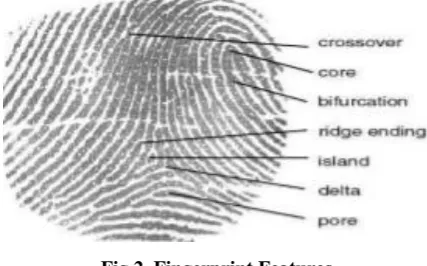
Minutiae features as represented by figure 2, there are generally three levels of features that are extracted from a fingerprint image, that are:
In level one option macro details such as singular points, pattern sort, and friction ridge flow are captured.
In level two options ridge bifurcations and endings are referred.
In level three options edge contour, pores, shape, width, ridge path deviation, and different details, together with inchoate scars, creases, and ridges are captured.
[image:2.595.60.274.360.493.2]The level one option the fingerprint are categorized into key pattern sorts such as whorl, loop, or arch; whereas the level two as well as three options will be accustomed in establishing the singularity or individuality of fingerprint. If the resolution of fingerprint image is high, in that case it is easy to extract the high-level options.
Fig 2. Fingerprint Features
The partial fingerprint is the incomplete or the minor fingerprint part that contains only 25-30 minutiae points in fingerprint image. Generally the small scanners captures the partial fingerprint match among the images of two fingerprints. The small areas ranging from 1 "x1" to 0.42 "x0.42" can be detected by the miniaturized fingerprint sensors. However, only the partial fingerprints is captured by the fingerprint scanners that are having a detection area less than 0.5 " x 0.7" that is actually the fingerprint’s average size.
The small number of minutiae in partial fingerprints remains a challenge for fingerprint matching.
C. Fingerprint Identification Applications:
For detecting the criminals in criminality acts. It is among the main reasons that FBI in USA has developed this technology.
It helps to improve the security for only authenticated person nor unauthenticated person.
For automatically recognizing as well as billing from the debit card or credit card of registered user in the grocery store.
Current methods of partial fingerprint algorithms facing the following problems are:
(i) Partial fingerprint trivia extraction algorithm necessary to decrease performance accuracy
(ii) The correspondence of the minutiae deteriorates considerably with a number of minutiae also insufficient.
(iii) Due to the inefficient and complex calculation time, the previous partial print work was unsuccessful. To overcome these existing problem we have to improve the partial fingerprint through the feature extraction thinning method and Accelerated KAZE using hamming distance classifier is efficient way to improve the accuracy and the less computation time.
III. LITERATURE REVIEW
Ru Zhou [10] proposed Fingerprint identification the use of SIFT-based Minutiae Descriptors and the minutiae based fingerprint matching algorithms’ overall performance degrades the accuracy compared with the existing algorithms Scale Invariant characteristic Transformation descriptors using SMD given high performance accuracy.
Helala AlShehri [7] proposes a singular fingerprint verification technique to resolve the trouble of move-matching. Fingerprints are captured from the equal finger using different sensors they range in scales and determination. To those troubles, the alternatives of a
fingerprint are regionally
extracted from it by usingdecomposing the fingerprint into overlapping home windows. Binary patterns and Scale Invariant Feature Transformation Descriptors using local ridge patterns. Descriptors can produce every rotation-invariant and scale-invariant LBP represent the vital systems of the fingerprints like edges SIFT has moreover been verified the descriptor due to the fact it is scale-invariant and rotation invariant.
Chikkerur [23] proposed novel graph based fingerprint matching algorithm. An invariant representation under rotation and translation called K-plet is used to define the local neighborhood for every minutiae. Every neighboring minutiae was represented using direct graph and every minutiae using a vertex which accumulated to encode a structurally local relationship for K-plet. A dynamic algorithm for programming was formed for local neighborhood matching. For consolidating every local match in fingerprints of two or more types, the algorithm used was “Coupled Breadth First Search Algorithm”. A database of eight hundred images was used to evaluate the performance and analysis of matching algorithm.
Zhang Jie [12] presented pattern entropy based similarity measure for incomplete fingerprint recognition. The global orientation as well as local minutiae features are obtained and merged for constructing a unique rotation and scale invariant feature. The pattern entropy for similarity measure that eliminates most of the false matches and performs time complexity
Kai Cao [11] proposed a novel fingerprint classification algorithm orientation model is to improve the fingerprint extraction using Complex filter fingerprint ridge and singularities. A heuristic classifier that's powerful to intra-classification variability's and inter-category variability's to gain a higher
Tsai-Yang [22] represented a new minutiae-based partial fingerprint matching that uses Support Vector Machine (SVM). They have designed an SVM to classify the partial fingerprint with the input (query) and (registered) fingerprints square measure at the beginning matched per their minutiae point’s challenges of minutiae-based partial fingerprint matching square measure
• The problem is poor quality fingerprints.
• They need for additional features (than minutiae) to improve the accuracy.
• Global minutiae matching square measure neither robust nor efficient to handling distortion.
Wonjune [3] developed the Partial Fingerprint Matching process from ridge shape points (RSFs) in small ridge segments. In the matching degree of minutiae the appropriate minutia pair was decided by evaluating the nearest RSF and side by side with each minutia. During the next stage of matching the ridge operation, RSF increases matching accuracy.
Paul W.H [8] Proposed form context descriptors for dot pattern matching. The modified form matching context using certain contextual information can provide a boost for fingerprint matching when compared to the original image. To minimize calculations at the pre-processing step, what is called elliptical region filtering is turning off fake little things before matching.
Milstein [25] proposed an algorithm of fingerprint attention for partial and overall fingerprints. The Space Frequency Transformation Algorithm and Line Scanning Algorithm were developed to check partial fingerprints and reduce the time needed to assess full fingerprints. Basically, most of the advantages of the core factor of the algorithm are given excessive accuracy in partial fingerprints. At the moment the important weakness of the algorithm being developed is the lack of an initial form of small things that is validated.
IV. STATEMENT OF THE PROBLEM
Partial fingerprints for technology development of e-commerce transactions and banking sector have problems in identifying the real user. The efficient partial fingerprints use makes it all possible for using the technology like USB drives, Digital security credit cards and many others. On the other hand they should be used through a ways that can progressively authenticate them
.
V. METHODOLOGY
A. Data collection
[image:3.595.55.283.717.749.2]As there the partial fingerprint database is not available publically, therefore, proposed matching algorithm datasets performance of partial fingerprints is evaluated through the FVC2000 DB1 images simulation from optical sensor contains 800 images in 388 dpi.
Fig. 3: Architecture diagram
B. Minutiae Extraction
In feature extraction minutia point can be of either type be a termination type or bifurcation type. For the representation of fingerprints, this technology is being used world widely and also it is having very distinctive configuration. And also this technique is having a small template size. Furthermore, if the minutiae points of two fingerprints have matched then only system confirms that there is a match. Presently, among the various available products that uses fingerprint recognition the minutiae based fingerprint methods proved to be act as their backbone. The complex issues regarding the fingerprint recognition extraction and algorithm matching has been reduced through the minutiae feature fingerprint representation techniques [6]. The crossing number method of ridge pixel equation:
Pi represents pixel value in the neighborhood of P it encloses eight neighboring pixels in an anti-clockwise direction as in table 1
.
Table 1 crossing number
P
4P
3P
2P
5P
P
1P
6P
7P
8Crossing Number Algorithm Step 1: Find CN = 1 and CN = 3 Step 2: X and Y of minutia points Step 3: direction θ of minutia Step 4: detect the false minutia IF feature = core point THEN Set CN = 5
END IF
IF feature = delta point THEN Set CN = 7
END IF
Step 5: Store information, Minutia = [X, Y, CN, θ]
Crossing number computed with ridge pixel properties shown in table 2 specified Crossing number of 1 is ridge ending and crossing number of 3 specifies bifurcation. Parameter of x and y segmented the minutiae points in edge direction.
Table 2: Properties of the Crossing Number CN Property
4 Crossing Point
3 Bifurcation Point
2 Continuing Ridge Ending Point
1 Ridge Ending Point
0 Isolated Point
Furthermore, the ridge details are categorized as non-minutiae, bifurcation or ridge finishing. For instance, a ridge detail with a CN of one corresponds to a ridge completing and a CN of three corresponds to a bifurcation [7] [8].Their technique includes using a 3×3 window to test the nearby neighborhood of every ridge in the image.
(a) CN=1 Ridge Pixel (b) CN=3 Bifurcation Pixel
1 0 0 0 0 1 0 0 0 0
p 1 0 0 0 0 1 0 0 0
0 0 1 0 0 0 0 1 0 0
0 0 0 0 0 0 1 0 1 0
0 0 0 0 0 0 1 0 1 0
(c) Ridge Pixel (d) Bifurcation Pixel
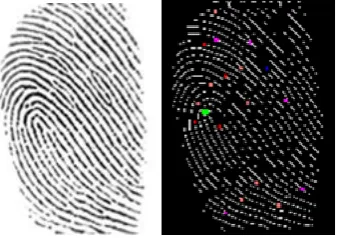
A detail is then categorized as a ridge finishing if it’s far simply one near ridge element inside the window, and classified as a bifurcation if its far 3 near ridge pixels. Generally, a minutiae point which exists at the end of a ridge is known as termination minutia and the minutia points which exists at the cutting point or joining point of two ridges is known as bifurcation type of minutiae [5]. These minutiae points are the basis of the analysis in which are performed. In fig 3 terminations and bifurcations are shown with different colors. For termination type minutiae, red color is used while for bifurcation type minutiae point, pink color is used for indication and core point specified in green color. The issue regarding the point pattern matching to the complex issue of fingerprint identification is reduced by use of minutiae feature for fingerprint representation [4].
C. POST-PROCESSING
A Fingerprint image is the place to begin of minutiae extraction (Lu et al 2002). Though its miles a miles described image, it's going to have deformations and cast minutiae that required to be filtered out. Since trivia are very not often adjacent, a set of rules might also abolish one in all adjoining minutiae. Scars, sweat or dirt may additionally motive abnormal minutiae that appear as false minutiae when obtaining thefingerprint image. Algorithms ought to hint any factors or styles that do not produce experience, which includes a spur on an island which maybe a false minutia
.
For
numerous examples of fake minutia. In clockwise order, interrupted ridges, forks, spurs, shape ladders, triangles and bridges are portrayed. Two very near strains with the same path create the interrupted ridges are removed.D. AKAZE
An increased version of KAZE has also been created known as AKAZE which the creators claim has similar accuracy to KAZE while being extensively quicker. AKAZE function extractor and detector which gives a superb compromise among pace of calculation. A-KAZE became firstly proposed for object popularity as well as picture matching [12]. The key points of A-KAZE are extraordinarily one of a kind as well as are repeatable. For the descriptor generation and detection of A-KAZE key points following points are followed:
E. AKAZE Matching
To check whether the image match with the pair of enrollment image Le [j] and template image in Lt[i]. If the matching between two pairs then points is calculated by hamming distance. This hamming calculates the distance threshold value in the following approaches.
Compare the template image function vector of enrollment image.
Calculate the hamming distances for each template function vector in equation
[image:4.595.92.243.242.321.2] [image:4.595.89.263.654.773.2]Fig 4 Matching point between two images Algorithm 2 Matching key point pairs
1: Input: LT [1,2,...n] , LE[1,2,...n] 2: Output: Matched _Image [1, 2,...n]
3: Conversion of Gray scale Image to Binary Image 4. Initialize
E[i] 0 ; i=1……n M[i] 1; i=1…..n 5. For i=1 to n-1 do For j=i+1 to m do
6. Hamming distance calculate the matching keypoints
if( Threshold<=0.5) Print(“matching”) Else
Print(“non matching”) End
End End
VI. EXPERIMENTAL RESULTS
[image:5.595.313.541.50.129.2]A. A-KAZE using Hamming distance calculate the partial fingerprint match between the template and enrollment image pairs figure 5 shows the hamming distance performance accuracy is 98.5% of threshold value 0.5.Percentage of accreditation will be higher if considered as a complete data base. Experimental results shows in fingerprint recognition accuracy in FVC2002 dataset and for the separation point of 0.5 a false non-matching rate as well as a false matching rate of 0.095 and 0.075 respectively is obtained.
Figure 5 Matchng Points between two images
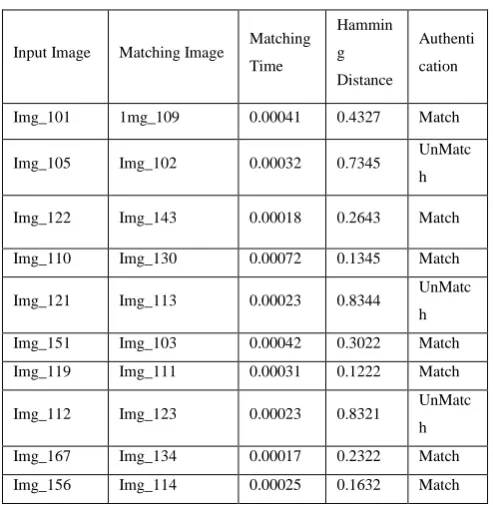
Fig 6 Matching Time comparison of AKAZE and SIFT Figure 6 represents the improvement of of proposed algorithm and existing algorithm Matching time and give the result interms of matching time accuracy.table shown matching time ,hamming distance between images and class labels of authorized person fingerprint should be matched or not.
Table 2 shows mathcing tie and distance of akaze
Input Image Matching Image Matching Time
Hammin g
Distance
Authenti
cation
Img_101 1mg_109 0.00041 0.4327 Match
Img_105 Img_102 0.00032 0.7345 UnMatc h
Img_122 Img_143 0.00018 0.2643 Match
Img_110 Img_130 0.00072 0.1345 Match
Img_121 Img_113 0.00023 0.8344 UnMatc h
Img_151 Img_103 0.00042 0.3022 Match
Img_119 Img_111 0.00031 0.1222 Match
Img_112 Img_123 0.00023 0.8321 UnMatc h
Img_167 Img_134 0.00017 0.2322 Match
Img_156 Img_114 0.00025 0.1632 Match
VII. CONCLUSION
Overall the analysis of experiment partial fingerprint are degraded the performance accuracy in previous methods compared to existing method the proposed method feature extraction and minutiae matching AKAZE for faster and efficient partial fingerprint method.it has to perform higher accuracy using feature extraction thinnin
g algorithm
eliminate noise in fingerprint image and matching method of Accelerated AKAZE using hamming distance classifier improve the performance accuracy and less computation timeREFERENCES
1. Danny Thakka "Biometric Fingerprint Readers in Banks and Financial Organizations",www.bayometric.com and www.touchngoid.com. 2. 2 .Shaharyar Ahmed Khan Tareen " A Comparative Analysis of SIFT,
[image:5.595.304.551.239.492.2] [image:5.595.54.282.531.705.2]3. Wonjune Lee, SungchulChoa Proposed Partial Fingerprint Matching Using Minutiae and Ridge Shape Features for Small Fingerprint Scanners, Expert Systems With Applications 31 January 2017 1 June 2017 .
4. 4.K. Virdaus, A. Mallak,"Fingerprint Verification with Crossing Number Extraction and Orientation-Based Matching",publication at: https://www.researchgate.net/publication/329191381 2017
5. 5.Mouad .M.H.Ali ,Vivek H. Mahale " Overview of Fingerprint Recognition System",International Conference on Electrical, Electronics, and Optimization Techniques (ICEEOT) - 2016 6. 6.Costas, Andrea, Boult, 2016 the partial fingerprint matching using
the SIFT features FINAL, AUGUST 2016
7. 7.M. Hassaballah et al., “Image features detection, description and matching,” in Image Feature Detectors and Descriptors, Springer International Publishing, 2016, ch. 1, pp. 11-45
8. 8.Paul W.H. Kwan1, Junbin Gao2 2015 proposed Shape context, a robust descriptor for point pattern matching, Pattern Recognition Volume 47 Issue 3, March 2014 Pages 1469-1484.
9. 9.P. F. Alcantarilla et al., “Fast explicit diffusion for accelerated features in nonlinear scale spaces,” in British Machine Vision Conference, Bristol, BMVC, 2013.
10. 10 R. Zhou, D. Zhong, and J. Han, Fingerprint Identification Using SIFT-Based Minutia Descriptors and Improved All Descriptor-Pair Matching, Sensors (Basel), vol. 13, no. 3, Mar. 2013.
11. Kai Cao a, Liaojun Panga, Jimin Liang2013 a proposed Fingerprint classification by a hierarchical classifier pattern Recognition Volume 46 Issue 12. December 2013 Pages 3186-3197.
12. 12.ZHANG Jie, JING Xiao “Incomplete fingerprint recognition based on feature fusion and pattern entropy”, Journl of Electronics and Information ,2013
13. R. Ortiz, and P. Vandergheynst, Freak: Fast retina keypoint, in Computer vision and pattern recognition (CVPR), 2012 IEEE conference on, 2012
14. X. Cao, Y. Wei, F. Wen, and J. Sun. Face alignment by explicit shape regression. In IEEE Conf. on Computer Vision and Pattern Recognition (CVPR), pages 2887–2894, 2012.
15. J. Heinly, E. Dunn, and J. M. Frahm. Comparative evaluation of binary features. In Eur. Conf. on Computer Vision (ECCV), pages 759–773, 2012.
16. 16.R. Mishra and R. Mishra, Fingerprint recognition using robust local features, International Journal of Advanced Research in Computer Science and Software Engineering, vol. 2, no. 6, 2012.
17. 17.M. Calonder, V. Lepetit, M. Özuysal, T. Trzinski, C. Strecha, and P. Fua. BRIEF: Computing a local binary descriptor very fast. IEEE Trans. Pattern Anal. Machine Intell., 34(7):1281–1298, 2011. 18. 18.E. Rublee et al., “ORB: An efficient alternative to SIFT or SURF,”
in IEEE International Conference on Computer Vision, Barcelona, ICCV, 2011, pp. 2564-2571.
19. S. Leutenegger et al., “BRISK: Binary robust invariant scalable keypoints,” in IEEE International Conference on Computer Vision, Barcelona, ICCV, 2011, pp. 2548-2555.
20. 20 A. K. Jain, J. Feng, and K. Nandakumar, ”Fingerprint Matching,” Computer, vol. 43, no. 2, 2010.
21. 21.Bhupesh Gour, T. K. Bandopadhyaya and Sudhir Sharma, “Fingerprint Feature Extraction using Midpoint Ridge Contour Method and Neural Network”, International Journal of Computer Science and Network Security, vol. 8, no, 7, pp. 99-109, (2008).
22. 22.Tsai-Yang Jea, VenuGovindaraju presented a new minutiae-based partial fingerprint matching using Support Vector Machine (SVM) Pattern Recognition Volume 38 Issue 10, October 2005 Pages 1672-1684
23. 23.Sharat Chikkerur, Venu Govindaraju and Alexander N. Cartwright, (2005), “K-plet and Coupled BFS: A Graph Based Fingerprint Representation and Matching Algorithm”, Advances in Biometrics Lecture Notes in Computer Science, Vol. 3832, pp 309-315. 24. 24 .D. Maltoni, D. Maio, A.K. Jain and S. Prabhakar, “Handbook of
Fingerprint Recognition,” Springer, 2003 .
25. BOLLE R., HONG L., JAIN A., On-line fignerprint verification, IEEE Trans. Pattern Anal. Machine. Intell, Vol. 19, No. 4, pp. 302-314, USA, 1997.
AUTHOR PROFILE
Author 1 :P.Gayathiri is pursuing as an Ph.D in the Department of Computer Applications at Bharathiar University, Coimbatore. She pursued her Bachelor of Computer Science at Madras University, Master of Computer Science at Krishna college of arts and science, under Madras University and. Her area of specialization is Data mining and Image processing