X-RAY DIFFRACTION STUDIES OF SOME GROUP VIA
COMPOUNDS
WILLIAM FRANCIS DONOVAN
Being a reading thesis submitted as part fulfilment of the prerequisites for the
degree of Doctor of Philosophy in the University of Tasmania
Department of Chemistry
University of Tasmania June 1964
r,‘
INDEX
PAGE
Abbreviations 2
Introduction,
3
Chromium, molybdenum, tungsten:
Oxidation state zero 14
Oxidation state one 16
Oxidation state two 17
Oxidation state three 23
Oxidation state four
33
Oxidation state five 36
Oxidation state six 45
ABBREVIATIONS
X.S.C. single crystal X-ray diffraction X.P. powder X-ray diffraction
number of molecules per unit cell cp cyclopentadienyl
- 3
-INTRODUCTION
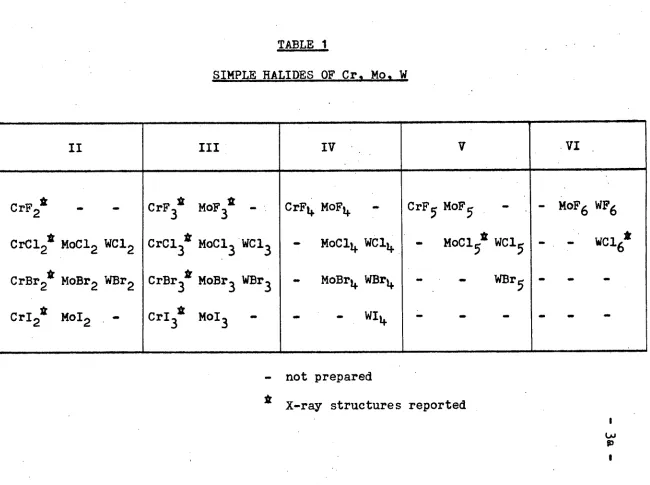
Of the known halides of chromium, molybdenum and tungsten only about one-third have been studied by X-ray structural techniques (see Table 1). The structures
reported for these halides can be divided into three categories.
1. The two or three-dimensional lattice type is the most common. The lattice usually contains MX6 octahedra
(M = Cr, Mo, W I X = halogen), the overall packing of
which gives the appropriate polymeric form of the halide. Examples of this type are the di- and tri-halides of
chromium.
2, Molecular crystals are formed by some halides. Amongst known structures this is confined at present to the
hexahalides, e.g., WC16.
TABLE I
SIMPLE HALIDES OF Cr, Mo. W
II III IV V VI
CrF2* - - CrF 3
* MoF
32 CrF4 MoFti. - CrF 5 MoF 5 - - MoF6 WF6
CrC12* MoC12 WC1 2 CrC1 3* MoC1 3 WC13 - MoClif W 14 - M0C15
*
WCle 2 - WC16* C.1„,nr mnriv, limy,... ... 2* ...a., 0.... a. 2 ... 2
CrI 22 MoI -
(...,m, , Ir %trim,. um.
... J. Li 3 &WW1 3 ... 3
CrI 3
* mo1
3 -
- moBrIf wBr1+
- - ii•
- - WBr 5
- - -
- - -
MO am •••
- not prepared
- 4
-The complex halides, pseudo halides and coordination compounds of chromium, molybdenum and tungsten have a variety of structures including some which have become classical, e.g., the binuclear (W2C1 9 )34. complex ion,and the polynuclear
(Mo6C18)4+ group.
As will be seen later, further structural studies are needed in this field of chromium, molybdenum and
tungsten chemistry. This is particularly so
(a)to fill the gaps in our knowledge of the simple halide structures
(b) to solve bonding problems, e.g., metal-metal bonding in polynuclear complexes, and to elucidate those structural features which are at present subject to some controversy, e.g., whether the metal atom bonds to the N or S of the NCS' group In thiocyanate complexes.
X-ray Diffraction
Single Crystal Method
A crystal acts as a three-dimensional diffraction grating for X-rays, and the resulting reflection of X-rays by the crystal planes is governed by the geometry of the crystal lattice. The intensity of a reflection from a
2
plane is proportional to Fhkr (F is a structure
factor, and is a function of the positions and scattering power of the various atoms in the unit cell of a crystal. h,k,l are the Miller indices of a plane). The structure factors (Fm ) have amplitude and phase. The amplitudes can be directly obtained from the measured intensities, but these do not enable the phases of the structure factors to be calculated. To overcome this difficulty:
(i) A trial structure is postulated, and the
atomic coordinates from this structure are refined by the least-squares method to give agreement with the observed structure factors.
. 6 -
synthesis can be used to give electron density maps. Atomic positions obtained from these maps are refined by further Fourier synthesis, until
calculated and observed data show good agreement. The advantage of single crystal work lies in its unambiguity, both in the initial assignment of the space group and in the final determination of the
structure.
Powder Method
The diffraetion of X-rays from the random array
of crystallites in a powder gives rise to cones of reflected
radiation, and portions of these cones can be recorded photographically. Such a "powder photograph" can be used
(a) for identification of compounds (b) for the determination of unit cell
dimensions of a compound
- 7-.
Such structural determinations from powder data are subject to the following limitations:-
1. Intensity data obtainable is confined to about
ten to forty values and this is insufficient for a
reliable structure determination. In many instances, it has been shown that, while correlation between observed
and calculated data may have been reasonably good, single
crystal measurements have exposed differences which are not evident from powder work.
2. Because of the lack of sufficient experimental
data it is extremely difficult to establish systematic
absences of crystal planes and hence the space group and symmetry. This often leads to such errors as, for example, assigning rhombohedral instead of hexagonal symmetry to a compound:
Limitations of X-ray Methods
. 8 -
1. Very light atoms are difficult to locate because of their very small contribution to diffracted beams.
2. Equally difficult to distinguish are atoms which have about the same atomic number and hence are very similar in scattering power,
3. Ionization states of atoms in a compound cannot be calculated.
'TABLE '2
• STRUCTURAL DATA REPORTED FROM X-RAY STUDIES Cr. Mo. W : OXIDATION STATES AND Compound Symmetry Unit Cell
,
Z Bond Distances A
0 - Experi-mental Method
Ref: Remarks
Cr(C06)2
-- -
,
C-C 1.386-1.407 X.S.C.
3
Chromium atom sandwiched between two benzene rings Mo 2cp 2(CO), o___ __
-
Mo-No 3.222 Mo-C (1.946 (carbonyl)(1.965 (1.969 Mo-C 2.3-2.4
rint
X.S.C.
6
Non-linear arrangement with No-Mo bondand terminal CO groups
W
2cp2 (C0)6 __ _ X.P.
7
with IsomorphousIn ur, NO, w : UAIUAT1UN OTATL 11
Compound Symmetry
-
Unit Cell Z
•
0
Bond Distances A
Experi-mental Method Ref. 1 Remarks CrF2 .
Monoclinic a=4.732 o ' o c=3.5053
,
2 Cr-F 2.43 2.01 1.98
.
X.S.C.
-
8 Distorted rutile type
three-dimensional layer lattice; two short Cr-F distances
CrC1 2 Orthorhombic a=6.64 o o b=5.98A o c=3.48A
2 Cr-C1 2.40 2.91 Cr-Cr 4.806
X.S.C. 9 Distorted rutile type
three-dimensional layer lattice CrBr2 Monoclinic a=7.11A o
o =.A b364
o c=6.21A
dig =23o521
2 Cr-Br 2.998
2.545 X.S.C.
.
10 Distorted rutile type
three-dimensional 11 sandwich" layer lattice CrI
2 Monoclinic
o a=7.545A o b3 929A o c=7.505A 19=115°1it
2 Cr-1 2.74 X.S.C. 11 Distorted rutile type
two-dimensional "sandwich" layer lattice
Cr, Mo. W : OXIDATION STATE 11
Compound Symmetry Unit Cell Z Bond Distances A o
Experi-mental Method _
Ref. Remarks
(M0
6
cl
8
)(013)4(H20) 12H 0 2 . • Hexagonal Rhombohedral o =15.1 a 5A0 c=11.02A o a=9.49A - =105.96°
6
Io- 2.6 MMo
Mo-Cl 2.5 (in Mo6C18)
X.S.C.
•
12 Octahedra of six Mo atoms approximately face-centring a cube of Cl atoms surrounded by an octahedral
(01-04(H20)2 group
•
((Mo6C18)C 42H20) H20 Tetragonal
0
a=906A c28 o'
4
•
X.S.C.
13 Similar to ' Mo6C18 complex above(NH)2(Mo6Cl)C1.H20 Monoclinic •
• o a19.33 0 b=14.9e c=9.16A =115.2° • 4110-Mo Mo-C1
(in Mo Cl )
—
- 6 8
Mo-C1(outside Mo6C18) L 2.63 2.56 2.43 Radial Distri- bution X.P.
Cr. MO, : OXIDATION STATE III. Compound Symmetry Unit Cell Z
0
Bond Distances A
Experi-mental Method
Ref. Remarks CrF
3 Rhombohedral
o a=5.2643A =56.56o
Cr-F 1.90
X.S.C.
,
16 CrF6 octahedra sharing corners,, with F in ' intermediate type packing CrC1
3 Hexagonal
o a=6.02A o
c=17.3A -
. . S.
X C 18 CrC16 octahedra! sharing corners,1 with Cl in cubicl close sackin .
CrBr
3 Hexagonal
o a=6.26A o
C-- - X•S.C.
19 CrBr6 octahedra sharing corners, with
with Br in
hexagonal close
•
ackinCrI
3 Hexagonal
o a=6.86A o =12.88A
__ X.P. 20 Isomorphous with CrC1 1 CrErC12 CrIC12 CrIBr2 . _ _
X.P. 2
Cr, Mo, W OXIDATION STATE III Compound Symmetry Unit Cell Z Bond Distances A o
Experi-mental Method
Ref. Remarks MoF
3
, 1. Dark pink
. tan )
black) crystals red )
Cubic
Rhombohedral
0
a=3.8985A 1
-- X.P.
X.P.
21
22
Re01 type strdcture VF1 type
structure Cs3Cr2CI9 Hexagonal a=7.222,
o =A c17.97
.2Cr-Cr 3.12 tr-Cl
(brid ging) 2.52 Cr-C1 2.34
(terminal)
X.S.C. 29 Similar to K3
w2
C19 but no
Cr-Cr bonding KiW2C1 9 Hexagonal a7.17R
o
-
16 2A2 W-W 2.409 , -Cl 2.48
(bridging)
-,C1 2.40 (terminal)
X.S.C. 27 W2C193- is
dimeric, formed by sharing a face of two distorted octa-hedra. W-W distance
suggests bondin between tungste.
atoms 1
Cr, Mo, W : OXIDATION STATE III
Compound - Symmetry Unit Cell Z Bond Distances A 0
Experi-mental Method
Ref. Remarks CrOC1 Orthorhombic a=3.88A o
. o b=3.20A c=7.72R
2 Cr-Cr 3.04
Cr-C1 2.32 X.S.C. 33 Cr-O-Cr layers separated by double halogen
sheets K
3Cr(NCS)6.4H20 Trigonal
o a=14.18A Or 0 28.36A o c=9. 69A 3. 02) •
Cr-S 2.45 X.S.C. 34 Layer structure of Cr(NCS)63- o/tahedra and K' ions and H20' molecules
C5H5NH(Cr(NCS)4(NH ) ) Monoclinic
1. o a=15.52A ,o b=7.64A o c=14.64A =102.4°
-4 Reineckate
Cr-N 1.95 N-C • 1.15 C-S 1.76
FYridinium
C-C
C-N 1.35
X.S.C. 35 Cr bonded to N of SC1r group. Cr-N-C angle
1800
(NHOr(NCS) (NH3)2)- 2 '
/3H20
- - -
Reineckate
Cr-N 1.97 N-C 1.14 C-S 1.80
X.S.C. 36 Octahedra of (Cr(NCS)4(NH3)2T with random
arrpgement of NH4 ions and water molecules Cr-N-C angle
Cr, Mo, W : OXIDATION STATE III
Compound Symmetry Unit Cell Z
0 Bond Distances A
Experi-mental Method
Ref. Remarks Choline Reineckate
- - -
Reineckate Cr-N
N-C . C-S •
1.94 1.27 1.64
X.S.C. 36 Cr bonded to N of SCN'
group. C-N-C , angle 155.5° Cr(acac)
3 Monoclinic
1
• ,
, o a=14.2A b=7.62A o c=16.5A A =99o81 . - ,
X.S.C.
37
Distorted octa-hedral arrange-ment of oxygen atoms around Crcr(F3(acac))3 _ ,
_ __ X.P.
37
Isostructuralwith Cr(acac)
Cr(F6(acac))3 _
.
-
. _ X.P.
37
with Cr(acac) Isostructural Mo(acac)3 _ _
i
,
_ _ X.P.
.
76 Suggested
structure I similar to
Cr(acac)3
Cr, MO, : OXIDATION STATE IV Compound Symmetry Unit Cell Z
0 Bond Distances A
, ,Method Experi-
mental Ref:
, , Remarks
K2MoC16 Cs2M0C16 Cs2WC16
Cubic Cubic Cubic
o a9.860
' o a=10.264A o a=10.209A - — X P: X.P. X.P.
3 3
3
Preliminary measurements only , K4Mo(CN) 8 .2H20 Orthorhombic• o a=16.55A o c=8.68% 4
b =11.70A
Mo-C 2.04-2.24 C-N 1.07-1.27 Mo-N 3.29
X.S.C. 41 Aggrega;te of le; i, 4-
Mo(CN)8 ions and H20
Cr, Mo, W : OXIDATION STATE V
Compound
, Symmetry /Unit Cell Z
0 Bond Distances A
Experi-mental Method
Ref. Remarks
Cric.
2 Orthorhombic a=5.52
b=7.4X o
n
c=16. A
- _ X.P. 43 Preliminary measurements
only
MoClr.
2 Monoclinic.
o a=17.71A o b=17.81A o c=6.09A =9 5 .40,
12
!(terminal) Mo-Cl 2.53
(bridging) Mo-Cl 2.24 j*lo-MO
X.S.C.
46
Dimeric with jtwo chlorinebridges
i.e., Mo 2C1 10
L1M0F6
L1WF6
o Rhombohedral.a=5.43A 1 R1 b<=57.1° o Rhombohedral a=5.45A ex=qq.lip
R1 '
41 — X.P. X.P.
7
47 Distorted NaC1 type lattice of- 'Li"
,
(Mo and (wF6
,ions NaM0F6
NaWF6
,
_o Cubic ,a=8.194A C
1
.o Cubic ;a=8.18A
C l
Mo-F 1.74 2.46
X.P.
X.P.
51 Distorted NaCl '
Itype lattice of (Mo ` 47 Na and (w
F6
Cr, Mo. : OXIDATION STATE V
Compound Symmetry Unit Cell Z Bond Distances A 0 Experi-mental
Method Ref. Remarks
KN0F6 INF6 Tetragonal T Tetragonal T o a=5.88A o c=9.98A o a=5.85A o c=10.08A
- k -
X.P. X.P. 47 47 Caesium chloride type lattice RbM0F6 RbWF6 o Rhombohedral a=5.11A
R2 °(
=96.5° o
Rhombohedral a=5.14A
R2 0(=97.60
X.P. X.P. 47 47 Caesium chloride type lattice CsM0F6 CsWF6 o Rhombohedral a=5.29A R2
',4=96.0° Rhombohedral a=5.31A X.P. X.P. 47 47 Caesium chloride type lattice T1M0F6 Rhombohedral a= 5.135A o
R2 (=-'916.13° _ X.P. 47 •Caesium chloride type
Cr, Mo, W : OXIDATION STATE VI
Compound Symmetry Unit Cell Z
0 Bond Distances A
Experi-mental
Method Ref.
Remarks .WC1 6 i Rhombohedral Hexagonal , a=6.581 o a=6.008A o c=16.68A 1
W-Cl 2.24 Cl-C1 3.14
X.S.C.
59
59
Molecular crystal - slightlydeformed WC16 octahedra
.
Cubic a=10.27 o
_
X.P.
62 8 x 6
octa- hedral sets of F atoms with statistical 'distribution ofK/W at:kris suggested RbWF
7 Cubic
o
a=10.03 - _ X.P. 62
•iic
Similar to WF
2
8
CsWF
7 Cubic
o
a5.49A X.P. 62 Cs and W in
caesium chloride 'type lattice
suagested
•
ur,•nu, w : VAIVATIVB bINWE, VI
Compound Symmetry Unit Cell Z
0
Bond Distances A
Experi-mental Method
Ref. Remarks
Cr0F4 Monoclinic á=12.A o
b=5.4A c=7.3R , - , X.P. I. . ,
65 Preliminary measurements only
KCrO
3F Tetragonal
o a=5.46A c=12.89R
4 Cr 0 1.58 X.S.C. 70 Distorted scheelite structure KCrO
3C1 Monoclinic , i
P21/c o a=7.79A o b=7.50A o c=7.80A 4?=91°204 .
4 Cr-C1 2.16
K-Cl 3.29 3.42
• 3.48
01-01
4.22 Cr 0 1.
X.S.C.
1
f
70 Distorted scheelite structure
/04 ) 3Mo0 F 3
•
Cubic ,
•
.
o =9.10A
•
14 Mo-F 1.9 -
F-F
5.3
•
Face centred X.S.C.
. '
2
Cr Mo, W : OXIDATION STATE VI
•
Compound Symmetry Unit Cell Z
0
Bond Distances A
Experi-mental
Method Ref.! Remarks Na )
Ke )11,,n w
R
3 ).3,3
Cs3 )Cubic — --
.
X.P. 74 All isomorphous with (NH4)3- Mo0 F
3 3
•
NaW0F e2 Cubic a=8.173. 75 Preliminary measurements
CsW0Fr.
7 Rhombohedral
o
a=5.31A — X P. 75 Preliminary
OXIDATION STATE ZERO
The structure of the rather unusual compound dibenzene chromium (Cr(C06) 2 ) has been the subject of controversy between several workers. On the basis of
X-ray diffraction powder studies Fischer and Weiss (1956) 1
suggested that (Cr(C06)2) has three-fold symmetry.
Jellinek (1960) 2 from single crystal X-ray diffraction data reported carbon atom positions and supported the
previously reported D3d symmetry for the molecule, with planar rings having alternating C-C bond distances of
I.439R and 1.353.
Doubt was cast on this structural determination
by Cotton et al. (1963)3 for two reasons,
(i) the lack of published data, making it
impossible to check the veracity of the reported
structure;
(ii) the fact that molecular orbital theory
predicts six-fold symmetry of the benzene rings.
A carefully repeated X-ray single crystal
of a chromium atom at the centre of the mean plane of the carbon atoms with only very slight degradation of six-fold symmetry, such as could be readily attributed to the crystalline environment and not to any inherent
tendency of the molecule to have different C-C bond lengths. The bond lengths are on the contrary very much the same
(C -C 1.386% and 1.407R).
Data published by these authors show good correlation between observed and calculated structure factors.
By contrast octahedral structures for Cr(C0)6, MO(C0)6 and W(C0)61 have been reported by Brockway et al.
(1938)4. These structures are based on electron diffraction
- 1
6 -
OXIDATION STATE ONE
Several univalent complexes of chromium, molybdenum and tungsten have been
isolated, e.g.
(K3Cr(CM) 5N0).H20r but as yet very little structural
study of these compounds has been reported. Wilkinson
(195) 5 has proposed a structure for Mo
2
cp
2
(C0)6 and
W
2
cp
2
(C0)6 in which the metal atoms and ring centres in
the sequence cp-M-(C0)6
4
-M-cp lie on a straight line normalto the plane of a ring of six CO groups. Wilson and
Shoemaker
(1956)
6
, however, have questioned this structure,and on the basis of a three dimensional X-ray
diffraction
study of Mo 2cp2 (C0)6, havereported it to consist of a
linear arrangement with a Mo-Mo bond and withnon-bridging independently coordinated CO groups (see diagram 1). Details of this work are at present unavailable. From the
DIAGRAM 1
0 C
0°
Molecular Structure of
0 M°
17
-OXIDATION STATE TWO. HALIDES
Prior to a discussion of the structural
relationship between the dihalides of chromium, a brief outline of each of the four structures will be given. Chromium difluoride (Cr7 21
Jack and Maitland (1957)8 reported that CrF2 crystallizes as a distorted rutile structure, with CrF6
octahedra sharing corners 01r-F distances 2.43, 2.01, 1.98A). Chromiumftichloride (CrC1 21
According to Tracy et al. (1960)9 CrC12
crystallizes with a distorted rutile structure in which slightly distorted CrC16 octahedra share their shortest edge and form a densely packed linear ribbon parallel to the c-axis of the unit cell (Cr-C1 distances 2.40, 2.912), The longer bonds link each ribbon to its four nearest
18
Chromium dibromide (CrBr 21
Tracy et al. (1962) 10 reported CrBr2 to have elongated CrBr6 octahedra which share their shortest edge to form infinite planar chains and share their longer edges to form a "sandwich" type layer structure.
Chromium diiodide (CrI 2,1
Tracy et al. (1962)11 have also reported CrI 2
to be made up of distorted Cr16 octahedra, which share their shortest edge to give densely packed linear ribbons parallel to the b-axis of the unit cell, and share their longer edge to form an infinite two-dimensional "sandwich" layer
structure.
All four halides exhibit the basic distorted CrX6 (X = halogen) octahedral configuration but have different packing arrangements in the crystal lattice. Chromium difluoride differs from CrC1 2 in that
(i) CrF 2 has two different bond lengths for the short Cr-X distances, whereas CrC1 2 has only one (see table 2);
-(ii) in CrF2 the CrF 6 octahedra which share edges are not those which give maximum density to the ribbon whereas in CrC1
- 19 -
Chromium dibromide differs from CrI 2 only in the manner in which the sandwich layers are packed, CrBr2 in three-dimensional and CrI 2 in two dimensional. The diiodide likewise differs from CrC1
2 in that CrC12 has a three-dimensional lattice structure (see diagram 2).
All four structure determinations were carried
out using single crystal X-ray diffraction techniques with good correlation being reported, in each case, between observed and calculated structure factors.
Up to date there have been no X-ray structural
studies reported for the simple dihalides of Mo and W. This is probably due to their instability and to the difficulty of crystal preparation. These compounds are of interest
(i) because their structures probably are built
4+
up from the polynuclear (Mo6C18) group known for some complex halides;
(ii)the Cr dihalides are paramagnetic whereas the Mo dihalides are diamagnetic;
- 19A-
0 t bt
—111. a
--0.
CrF2 CrCli
a --to a —1I.
CrBr2 C,I2
[Small Circles C
DIAGRAM 2. Large Circles
X1
THE STRUCTURES OF
- 20 -
In an attempt to establish whether Moll formed a postulated trinuclear, group (Mo 3X4) 2" as the basis for complex formation, the crystal structure of the compound formulated as (MO 3C14.2R20)(0/0 2 .61120 was studied by Brosset 12 . On the basis of this X-ray study he concluded that the compound was instead (Mo6C18)(OH)4.-
(H20) 2 .12H20 which he named chloromolybdenUm hydroxide. The complex consists of eight Cl atoms lying at the corners of a cube, face -centred with six Mo atoms, with the
remaining four Cl atoms lying at the corners, of a square and surrounding the (Mo6C18) group (see diagram 3).
The structural study was carried out using Laue, powder and Weissenberg X-ray techniques to obtain diffraction data which were processed by Patterson and Fourier methods, good correlation being reported between observed and
calculated structure factors.
- 20A -
DIAGRAM 3
THE STRUCTURE OF
THE ( Mo
6 CI8 )
-21 -
chloromolybdenum chloride - its structure again being based
4+
on the (Mo6C18) group (see above). Again good correlation was reported between observed and calculated structure
factors.
Sheldon14 reported that he had confirmed that the chloromolybdenum group normally requires octahedral
coordination to give M06C18X6 (K = Cl, Br, 1) complexes or polymeric Mo6C18X4 compounds. He suggested that in
these "novel type of coordination complexes" the (Mo 6C18 )4+ group acts as a centre for octahedral complexes analogously to a single-atom ion.. The same worker reports several
similar complexes which presumably have the same basic
structure as the two compounds discussed but no experimental evidence is cited to support these suggestions.
15
Vaughan reported that (NH)) 2Mo6C1 1 4.H20
4+
- 22 --
Several features of these Mo complexes require explanation
(i) the formation of these unique structures by molybdenum and not by other elements;
(ii)the nature of the bonding of the MO and Cl atoms in the complex group (Mo6C18) 4+;
(iii)the outer chlorines are labile whereas
4+
those in the (Mo6C18) group are very stable, whereas the Mo-Cl distances are longer in the
4+
- 23 -
OXIDATION STATE THREE HALIDES
Chromium Trifluoride (CrF 31
According to Knox (1960) 16 CrF
3 consists of symmetric CrF6 octahedra which share corners only to give a three-dimensional lattice.
Chromium Trichloride
wrial31
Early work by Natta (1927) 17 , who claimed CrC1 3 to be rhombohedral and belonging to the hohohedric class, was discounted by Wooster (1930) 18 who reported that CrC1 3 was hexagonal, and consisted of chlorines in positions of cubic close packing with chromiums occupying one-third of the octahedral holes formed by the chloride layers.
Chromium Tribromide (CrBr 31
-• 21+ -
Chromium Triiodide (CrI 3).
Handy and Gregory (1952)20 on the basis of
X-ray powder studies reported that CrI 3 was isostructural with CrC13 .
Discussion
These four trihalides of chromium are all layer structures and are built up of CrX6 (X = halogen) octahedra which by sharing corners or edges give a polymeric lattice. In CrC1
3 and CrI3 the halogens are in positions of cubic close packing while CrBr 3 has bromines in hexagonal close packing. Chromium fluoride, on the contrary, has fluorines In an intermediate type of packing and with one-quarter of the fluorine positions vacant.
As far as the experimental structure studies are concerned, both CrF 3 and CrBr 3 have been studied using
1".. 2
5
lestructural determination of CrC1
3 and considering the doubt which arises out of this conflict, it may be
necessary for a repeat single crystal X-ray diffraction study to be carried out.
Molybdenum trifluoride (MoF 3 ) has been studied by Gutmann and Jack (1950)21 who proposed a cubic
rhenium oxide (Re0
3) type structure, in which the
fluorines are in positions of cubic close packing with molybdenum atoms filling one-quarter of the octahedral holes between the layers, and in which one-quarter of the fluorine sites remain vacant, i.e., the structure consists of MoF6 octahedra which share corners. This structural study was based on X-ray diffraction powder data with excellent agreement being reported between observed and calculated intensities,
La Valle et al. (1959)22 in trying to repeat the preparation of the dark pink MoF321 were, however, unsuccessful, their method yielding tan, black, or red crystals of M0F3 depending on the temperature used.
These, when studied by X-ray powder techniques, were shown to have a rhombohedral VF
the previously reported cubic Re03 type, i.e., intermediate
between cubic and hexagonal close packing.
The explanations suggested for the results obtained by Gutmann and Jack23 were,
(a) that more than one structural form of MoF3 may exist or,
(b) that the structure of MoF3 may be
sensitive to slight changes in stoichiometry or impurity content.
COMPLEX
mutiops
There are several complex halides of Mo and W which are unusual in their internal bonding. Trivalent tungsten forms some binuclear complexes, and as we have seen above divalent molybdenum exhibits a tendency to form polynuclear complexes. This phenomenon appears to be in some way connected with unusual oxidation states of the metal atoms, but as yet very little is known about the bonding within these compounds.
- 2
7 -
the complex halide K 3W2C1 9. This W 2C1 93°. group he reports as taking the form of two slightly distorted octahedra of chlorine atoms which share one face, and in which the tungsten atoms are located centrally but closer to the plane of the shared face (1.205R), than to the planes of the outer faces (1.35)
(see
diagram 4).In a later paper Brosset (1945) 25 postulated on the basis of his reported W-W bond length (2.46A) that there is some kind of attractive force between the tungsten atoms. Pauling (1914.7)26 in discussing this K 3W2C1 9 complex
suggested that the W-W distance was consistent with a W=W double bond. The refined W-W distance (2.409A) reported by Watson and Weser (1958) 27 is even more closely in accord with strong W-W bonding and confirmation for this
W-W interaction is given by the magnetic moment ' , = 0.55 B 14 ' 28 The three chlorines shared by the W atoms exhibit
unexpectedly longer W-Cl distances (2.48A) than the W-Cl distances (2.408A) to the terminal chlorines. There does not appear as yet to be an explanation of this difference.
- 27A -
DI AGRAM 4 .
THE STRUCTURE OF
3 -
- 28 -
were used in this refined study and there is reasonable correlation reported between observed and calculated
structure factors.
A similar complex of CrIII, viz. Cs3Cr2C1 929 has a magnetic moment corresponding to three unpaired electrons per chromium atom, indicative of a lack of
interaction between the chromiums. Wessel and Ijdo (1957) 29 reported the crystal structure of Cs 3Cr 2C1 9 to be basically similar to that of K3W2C19 but with the chromium atoms
shifted from the plane of the shared octahedral face
towards the outer layers of chlorine atoms in the Cr 2C1 93' group.
Of interest because of the possibility of
trinuclear complexes of tungsten is the reported compound ly3C1 1 4 for which X-ray powder data obtained by Laudise
and Young (1955)30 show at least ten unique line spacings. There is, however, no data given and suitable corroborative
- 29 -
there are no suitable means by which WC16 octahedra can share either faces, edges or corners to give the proposed
(W3C1 1 4) 3- group.
Recent X-ray powder measurements made by KOnig (1963)31 supports this and KOnig reports that there is no such compound as K 5W3C1 1 4 but that it is really a mixture of K3W2C1 9 and K2 (W(OH)C1 5 ).
MIXED HALIDES
Handy and Gregory32 have reported some mixed halides of the form CrXY 2 (X,Y = halogen). Because of the similarity of the X-ray powder patterns of these
compounds to those of the parent halides, they are regarded as structurally equivalent, to the resultant expected from an ideal solution of CrX
3 and CrY3 with the possible exception that the halide layers may not be as closely packed.
The stoichiometric formulae for these compounds
were based on the chromium content only, and then with an
-30
OX-HALIDES
The oxychloride (GrOC1) has been reported by Forsberg (1962) 33 to form Cr-O-Cr layers which are
separated by double halogen sheets. This report gives a brief outline of the X-ray techniques used without reporting any experimental evidence.
PSEUDO-HALIDES
A thiocyanate complex of chromium K 3Cr(NCS)6.4H 20
has been reported by Zhdanov et al.
(1953) 34 as beingcomposed of Cr(NCS)6
3
' octahedra, with the Cr atom being
bonded to the $ atom of the NCS
.
" group (Cr-S distance 2.45A).
The authors quote projection methods as their means of fixing
atomic positions, and postulate a
layer structure of Cr(NCS)6 3"octahedra with
le ions and water molecules (see diagram 5).Some experimental intensity data have been given
but no calculated values were published. There is a lack
of information about the experimental methods used and
the length of the a-axis has been reported to be
either
14.18A or 28,36. The Cr bonding to the S of the NCS— 30A -
CroSCN)6
DIAGRAM 5
PROJECTION OF Wr(S
- 3
1 -discovered for bonding through the N of the SCN- group (see notes on the reineckate complexes).
Structural studies reported by Takeuchi and
Pepinsky35 on the pyridinium complex C 5H 5NH(Cr(NCS))4 (NH3 ) 2 ) show the Cr atom of the reineckate radical to be at the centre of symmetry of the molecule and bonded to the N of the SCN- group. The pyridinium ion lies on a two-fold axis and is surrounded by twelve S atoms, four of which are coordinated to the pyridinium N with two S-N distances
(3.362, 3.60%). This single crystal X-ray structural study made use of Patterson and Fourier projections for determining atom positions, with good correlation being reported between observed and calculated structure factors. Both the
reineckate salt and choline reineckate complex exhibit
similar Cr-N bonding. Based on evidence from X-ray studies Takeuchi and Saito (1957)36 have reported the reineckate salt (NH4Cr(NC5))(NH 3 ) 2 )2/3H20 as being composed of
32 **
COORDINATION COMPOUNDF
The acetylacetonate complexes of CrIII and MoIII are structurally interesting in that it has been reported that Cr(acac)
3 has a symmetric octahedral arrangement of
the three oxygen atoms around the central chromium
(Astbury (1926) 37 see diagram 6). This structural work, making use of rotating crystal and Laue techniques,
together with the theory of space groups to extract atomic positions, was carried out in 1926. Like Paulingis earlier work72 this determination could be refined by modern X-ray methods.
Chromium trifluoroacetylacetonate (Cr(F 3acac) 3 ) and chromium hexafluoracetylacetonate (Cr(Fecac) 3 ) have been reported, on the basis of X-ray powder studies, to be
isostructural with Cr(acac) 3, with fluorines replacing three and six respectively of the hydrogen atoms on the acetylacetonate groups (see diagram 7).
Jarrett 38 has also reported some preliminary X-ray powder diffraction measurements on Mo(acac) 3 and from them suggested that this complex has a similar
- 32A -
DIAGRAM 6
THE STRUCTURE OF
Cr(F3 acac)3
Cr(F" acad
-- 6 3
C 0 0 0 Cr
-33-
OXIDATION STATE FOUR HALIDES
On the basis of the structural knowledge of other Cr, Mo and W halides 2 it is suggested that the simple tetrahalides may be composed of
(i) a tetrahedral configuration of halogen atoms around a central metal atom existing, as do the hexahalides s as molecular crystals with the tetrahedra joined together by weak forces;
(ii) a lattice type make up of MX6 (M = metal s X = halogen) octahedra joined by sharing edges or faces to give an effective OiXid n formula.
Problems involved in such studies are:- (a) Preparation of the crystalline compounds is difficult because they are often found mixed with halides of other metal oxidation states.
(b) The halides are unstable in air.
- 34 .
but as yet no structural studies have been carried out.
On the basis of preliminary X-ray powder measurements, McCarley and Brown report that WBrii. is isomorphous with MoBr4.
COMPLEX HALIDES
Complex halides of the type have been isolated for Cr Mo and W. diffraction powder measurements on a have been made41 .
MIIMX6 and M2 MX6 Preliminary X-ray few of these compounds
It is probable that the structure of these complexes comprises MX6 octahedra in a caesium chloride or sodium chloride lattice arrangement with either M 2+ or M+ ions.
PSEUDO-HALIDES
Perhaps one of the most interesting compounds of MoIV is the complex cyanide K4Mo(CN)8.2H20. Hoard and . Nordsieck (1939)42 described the structure as:
- 35 4.
the same way as the positive and negative tetrahedra of a cube; as compared with these regular tetrahedra, one bisphenoid is
considerably elongated, and the other is much flattened along the unique axis."
The crystal structure itself comprises an aggregate of X+ and Mo(CM)8 4— ions and water molecules with the Mo(CN)8 4— group occurring as a dodecahedron
(see diagram 8).
Earlier theories on the structure of
Vo(CN) 8 .2H20 suggested the cube or square prism as possible geometric shapes for the Mo(CN) 84- group but the authors42 have shown the dodecahedron to be correct. Single crystal X-ray photographs in conjunction with Patterson and Fourier projections were used in the
structure determination. There is no published intensity or structure factor data, although the authors claim good correlation between observed and calculated intensities.
- 35A -
0 M o
DIAGRAM 8 0 CN -
THE STRUCTURE OF THE
IDEALIZED Mo(C1\1)8 GROUP.
- 36 -
OXIDATION STATE
Fimg
BALIDESEdwards (1963)43 in 4 preliminary report based on X-ray powder data has determined the unit cell
dimensions of chromium pentafluoride (CrF 5 ). It will probably be found that the crystalline structure of
chromium pentafluoride consists of CrF6 octahedra packed in such a way as to share edges or faces to give a polymeric
(CrF5) n formula. The proposed structural work on CrF 5 by Edwards44 will no doubt shed further light on this matter.
On the basis of electron diffraction measurements, Ewens and Lister (1938)45 suggested a trigonal bipyramid
structure for molybdenum pentachloride in the vapour state. Early electron diffraction data were subject to a basic
error of theory and need to be considered with reservations. Sands and Zalkin in working on various pentachlorides had
established much the same structure for niobium pentachloride by electron diffraction techniques. X-ray diffraction
- 37
-Similarities observed between the X-ray powder photographs of the pentachlorides of Nb and Mo suggested that
molybdenum pentachloride might itself be a dimer.
Accordingly these authors46 carried out a single crystal X-ray diffraction study of molybdenum pentachloride and verified that it does exist as MO2C110 dimers. Each dimer consists of chlorine atoms forming two octahedra which share a common edge, with two Mo atoms occupying the centres of these octahedra and being held together by two bridging chlorine atoms (see diagram 9). Support for these chlorine bridges is given by the Mo-Cl bond
distances (eight of 2.53A and two of 2.24A), the two
shorter bonds being due to bridging chlorines. Excellent agreement was reported between observed and calculated structure factors, and this, together with the use of single crystal X-ray diffraction work and refinement of atom positions by Fourier analysis, satisfies the
criteria (see Introduction) laid down for a complete structure determination.
- 37A -
DIAGRAM 9
THE STRUCTURE OF THE
0 a
greenish-black colour of molybdenum pentachloride. Because of the close structural relationship which exists between corresponding Mo and W compounds it is probable that the tungsten and molybdenum pentachlorides will be isostructural. A.comparison of the X-ray powder photographs of the two compounds would be sufficient to establish a structural relationship between them.
HALIDE COMPLEXES
The structural chemistry of the complex
fluorides of MoV and WV as reported by Kemmitt, Russel and Sharp (1963)47 follows on and incorporates the work of several other workers in this field 48 /49 50
The complex fluorides of general formula AIB 1F6 (A = Li, Na, K I RI), Cs, Te l B = Mo, W) fall
into five proposed structural types. The particular type adopted depending on the size of the ions A and B. The following is a brief summary of each of these five structural types.
- 39 -
ion is a regular octahedron and each A is octahedrally coordinated by fluorines from six BF6 groups. This type of structure occurs when ions A and B are both small and comparable in size.
C i and C 2 : Both of these structure types are cubic, having a similar sodium chloride lattice to R 1 . It is difficult to find any difference between C 1 and C 2 as given by these authors and further structure study would be required to separate them.
I: This occurs as a tetragonal caesium chloride lattice structure made up of A+ and BFC ions. Each A+ ion has eight fluorines as nearest neighbours with another four fluorines as next nearest neighbours.
R is rhombohedral and related to the caesium chloride structure with the A+ ion surrounded by twelve close packed fluorines.
- -
crystal techniques. There are, however, no data given for the powder lines obtained, only unit cell dimensions
being published. Granted that these show very close analogy between the postulated members of a particular structural type, more evidence both of powder and single crystal X-ray data is still required for a complete
cataloguing of these compounds.
-
of the corresponding ionic distances52 and this is reported without comment by the authors.
OX-HALIDES
The analogy observed between NbV and NOV
chlorides (see above) may be extended to their oxyhalides. Edwards (1963) 53 suggests that the structure of Mo0C1 3 will be similar to that of niobium oxytrichloride Nb0C1 3 . If this were the case, M00C1
3 would consist of trans octahedral M0O 2C14 groups linked in double chains by
sharing two chlorines at an edge and sharing oxygen atoms at two opposite vertices. This has, however, not been proved by X-ray methods.
The corresponding bromide Mo0Br 3 has been prepared but as in the case of M00C1
3 no X-ray structure measurements have been attempted.
Chromium oxytrichloride (CrOC1 3 ) may be expected to differ somewhat from Mo0C1
.42.
On-HALIDE COMPLEXES
As shown by Allen et al. (1963) 54 MoV and WV form two types of oxyhalide complex MI(M V0X5 ) and
MI(MVOX)4 ) (MI = univalent cation, My = Ma, Ws
X = Cl or Br). Preliminary structural studies, both spectral and magnetic, have been carried out on some of these compounds and discussed in the light of
molecular orbital theory, but X-ray studies have still to be undertaken. The structure of the M I (MOX ) type 2
5
of oxyhalide may be made up of octahedral MOXe2. ions2
combined with M+ ions in a distorted sodium chloride or caesium chloride type lattice. Once again X-ray diffraction studies would be necessary to clarify these structures.
Priest et al. (1948) 55 claimed on the basis of
X-ray powder photographs that both W 20 5.HF.H20 and W205.2HF existed as cubic perovskite type crystals.
pursue further studies into the structures of these unusual compounds.
In a paper by Mitchell and Williams (1962) 56 mention is made of some unpublished work of Mitchell and
Ph
Prout on MoC12 (Opy) 3 . It is claimed that the structure of this complex is similar to that of dimeric copper acetate monohydrate in that it occurs as dimers by utilizing two chlorine bridges and direct Mo-Mo interaction. Evidence for this interaction lies in
(i) their reported Mo-No bond distance of 2.82 (cf. Mo-Mo 2.73A in metallic molybdenum) 57 ; ' (ii) the magnetic moment? = 0.42 B.M. which
is very low and suggests metal-metal interaction. An evaluation of this proposed structure is impossible at the moment because no data is available.
58
Mitchell and Williams also suggest on the basis of a low magnetic moment that (pyH) 2Mo02 (NCS) 3
(
rzs)
THE Mo0 (NCS) 2 3 2 4- ON. - 43A
(SCN) (NCS)
DIAGRAM
Ph
OXIDATION STATE SIX
HALIDES
Ketelaar and van Oosterhout (1942)59 examined WC16 using single crystal techniques and reported that
the structure comprised a slightly distorted hexagonally close-packed arrangement of chlorine atoms with tungstens occupying one-sixth of the octahedral holes. Accordingly tungsten hexachloride is an example of a molecular crystal, i.e., it exists as discrete molecules in the solid state.
These authors give no intensity data or
comparative tables of observed and calculated structure factors. This structure cannot, therefore, be accepted as completely established until such data could be studied.
Electron diffraction measurements by Glauber and Schomaker61 have also supported the octahedral configuration for M0F6 in the vapour state.
COMPLEX HALIDES
Few halide complexes of Cr, MO and W VIhave been prepared and structural information is very limited. The symmetry and unit cell dimensions of some of these compounds have been reported but complete X-ray structural work is lacking. It has been suggested by Hargreaves and Peacock62 that RbWF7 and K2WF8, which have very similar unit cell dimensions, exist in sets of octahedrally arranged fluorine atoms with a statistical distribution of W I and K or Rb atoms between them. In the case of CsWF
7 it has been
further suggested by the same authors63 that the Cs and W atoms have the same relative arrangement as in the CsC1
0XX-HALIDES
Edwards (1963)65 in a preliminary X-ray study of Cr0F4 has reported unit cell dimensions and symmetry as a prelude to publishing a complete structure
determination.
Molecular oxy-halides of the formulae CrO 2C12 and Mo02C12 have been studied in the vapour state by
electron diffraction by Palmer. (1938)66 and Skinner (1941)67
respectively. Data obtained by them suggest a distorted tetrahedral arrangement. As has been seen earlier,
electron diffraction measurements made about that time were subject to error68. Because of this single crystal X-ray studies would be of interest. *
COMPLEX OXY-HALIDES
Following on optical crystallographic work by Groth (1908)69, Helmholz and Foster (1950)70 reported that the complex oxy-halide KCrO 3C1 can be considered as derived from the scheelite structure (see diagram) and that it consisted of a random arrangement of CrO 3C1'
Cr02CI 2 is a liquid at room temperature, hence X-ray diffraction studies would have to be carried out at a low
tetrahedra, with some deformation arising from the substitution of chlorine for oxygen. In this single crystal study both Laue and oscillation X-ray techniques were employed and although intensity data were not listed, Patterson and Fourier projections were given. The authors, however, claimed good correlation between observed and calculated structure factors.
Ketelaar and Wegerif (1938) 71 demonstrated that KCr0
3F and CsCr03F are isomorphous, and have similar
structures to that of KCrO
3C1. Both are derived from
the scheelite structure but there is less distortion
caused by the presence of the smaller fluorines rather than chlorine atoms as in KCr0
3C1. Single crystal X-ray methods
used in the study of KCrO3F fulfil the requirements for a structure determination, and although there is a lack of data in relation to intensity measurements the authors claim good correlation between observed and calculated
intensities. On the basis of the similarity of their X-ray powder patterns KCr0
- 49 -
Pauling (1924)72 in a classic paper on the structures of ammonium fluoro salts outlined the
structure of ammonium oxyfluoromolybdate (N114) 3M0O 3F 3 . This is based on a unit of four molecules in a face centred lattice with an octahedral arrangement of three oxygen and three fluorine atoms around each molybdenum with ammonium ions around them (see diagram . 11). This arrangement is paralleled by that of sodium chloride where the octahedral (M0O 3F3 )3- ions replace Cl- ions and NH4+ replace Na+ ions, with the exception that there are two extra NH4+ ions at one-third and two-thirds of each of the four body diagonals of the unit cell. Pauling's structural determination was based on data obtained
from Laue and powder X-ray photographs. Despite the lack of knowledge at that period about X-ray structure methods, this work appears to be extremely well executed.
- 49A -
ON
DIAGRAM 12.
THE UNIT CELL
OF ( NH4 )3 M003 F3 .
H
- 50 -
isotropic octahedra to (NH4) 3MoO3F3 . On the basis of this it may be assumed that the structure of (NH4) 3W03F3 is similar to that of (NH4) 3MoO3F3 . Of course, to verify this, X-ray powder photographs of the two compounds would need to be taken and the similarity between the two
patterns established.
Schmitz-Dumont and Heckman (1952) 74 showed by the correlation between their X-ray powder patterns that the sodium, potassium, rubidium and caesium salts of the oxyfluoromolybdate complex are isomorphous with
(NH4) 3M0O 3F3 .
Hargreaves and Peacock (1958) 75 have, by the use of Debye X-ray photographs, reported NaW0F 5 and CsW0F 5 as to their symmetry and unit cell dimensions (see table 2). For these compounds it would perhaps be expected that
there would be an octahedral configuration of an oxygen and five fluorine atoms around the central atom. The structure could then be built up in a sodium chloride or caesium chloride type structure of Na+ or Cs+ ions and WOF,,
- 50a-
ACKNOWLEDGMENTS
The author wishes to express his thanks to Dr. P. W. Smith, Chemistry Department, University of Tasmania, and Dr. A. D. Wadsley, Division of Mineral Chemistry, C.S.I.R.O., for valuable assistance in
- 51 -
LITERATURE REFERENCES
1. Fischer, E., and Weiss, E., Z. Anorg. Allgem. Chem., 286, 142 (1956)
2. Jellinek, F., Nature, JAZ 871 (1960)
3. Cotton, F., Dollase, W., and Wood, 3., J. Am. Chem. Soc. 8.5i, 1543 (1963)
Brockway, L., Ewens, R., and Lister, M., Trans. Far. Soc. 311, 1350 (1938)
5.
Wilkinson, G., J. Am. Chem. Soc.mk,
209 (1954) Wilson, F., and Shoemaker, D., Naturwissenschaften9 57
(1956)7. Wilson, F., and Shoemaker, D., 3. Chem. Phy . 809 (1957)
8. Jack, K., and Maitland, Proc. Chem. Soc. 232 (1957) 9. Tracy, 3. et al., Acta Cryst.li, 927 (1961)
10. Tracy, J., Gregory, N., and Lingafelter, E., Acta Cryst. j, 672 (1962)
11. Tracy, 3. 1 et al., Acta Cryst.
11,
46o (1962)- 52 -
13. Brosset„ C., Arkiv. Kemi. Min. 0. Geol.
haa,
No. 11 (1946)14. Sheldon, J., J.C.S. 410 (1962)
15. Vaughan, P., Proc. Nat. Acad. of Sci. 36, No.
9,
2074 (1950)
16. Knox, K., Acta Cryst. la, 507 (1960)
17. Natta, G., Atti Acad. Linceil, 592 (1927) 18. Wooster, N., Z. Krist.
2L+
363 (1930)19. Braekken, H., Kgl. Norski Videnskal Selstat. Fohr No. 11 (1932)
20. Handy, L., and Gregory, No, J. Am. Chem. Soc.
891
(1952)21. Gutmann, V., and Jack, K., Acta Cryst. 4, 244 (1957)
• 22. La Valle, D., et al., J. Am. Chem. Soc. 82, 2433 (1960)
23. Gutmann, V., and Jack, K., Acta Cryst.
4,
245 (1957) 24. Brosset, C., Arkiv. Kemi Min. 0. Geol.AIL
No.if
(1935)
25. Brosset, C., Arkiv. Kemi Min. 0. Geol.
Lail,
No. 4, (1945)26, Pauling, L., Chem. Eng. News iLL 291
-. 53 .
28. Watson, W., and Waser, J., Acta Cryst. 11, 689-(1958) 29. Wessel, G., and Ijdo, D., Acta Cryst. 10,
466 (1957)
30. Laudise, R., and Young, R., J. Am. Chem. Soc.22,
5288 (1955)
31. Konig, G., Inorg. Chem. No. 6, 1238'(1963) 32. Handy, L., and Gregory, N., J. Am. Chem. Soc.
891
(1952)
33. Forsberg, H., Acta Chem. Scand. 16, No.
3 (1962)
•
34.
Zhdanov, G., Zvonkova, Z., and Glushkova, V.,Zhurnal Fizichiskoi Khimii, 27(1), 106
(1953)
35. Takeuchi, Y., and Pepinsky, R., Z. Mr Krist.1229 29 (1957)
36. Takeuchi, Y., and Salta, Bull. Chem. Soc. Japan
321 319 (1957)
37. Astbury, W., Proc. Roy. Soc. 112A,
448 (1926)
38. Jarrett, H., J. Chem. Phys.22,
1299
39. McCarley, 11.2 and Brown, T., J. Am. Chem. Soc. 84, 3216 (1962)
40. McCarley, 11.9 and Brown T. J. Am. Chem. Soc. 84,
3217 (1962)
42. Hoard, J., and Nordsieck, H:, J. Am. Chem. Soc. 61.i
2853 (1939)
43. Edwards, A., Proc. Chem. Soc. 205
(1963)
44. Edwards, A:, Proc: Chem. Soc. 206(1963)
45. Ewens„ R., and Lister M., Trans. Far: Soc.316 1 358 (1938)
46. Sands,
D., and
Zalkin, A., Acta Cryst: 12,723 (1959)
47. Kemmitt, R.; Russel D.i and Sharp, D:, J.C.S.,4408 (1963)
48. Cox, B.1 . J.C.S.
876 (1956)
49. Peacock, R., J.C.S.
1855 (1957)
50. Hargreaves, G., and Peacock, R., J.C.S.
4212 (1957)
51. Edwards, A. and Peacock, Re, J.C.S.4253
(1961) 52. Interatomic Distances (Chem. Soc.) p. 148153. Edwards, A., J. Inorg. and Nuc. Chem.
21,
1198 (1963)
54. Allen, F., et al., J.C.S.4649 (1963)
55. Priest, Horner and Schumb.„ J. Am Chem. Soc.
21:1,
3378 (1948)
-; 55
-58; Mitchell and Williams, J.C.S. 4572 - (1962)
59. Ketelaai, J., and'Van Oosterhout; G.; Rec. Tray. Chem; 62,197'(1947)
6o; Burke, T., Smith, D., and Nielsen, 4. Chem. Phys. 20 0 447 (1952)
61. Glauber, A., and SChomaker, V. Phys. Rev.
§2,
667 (1953)
62. Hargreaves, Go, and Peacock, R., J.C.S. 2174 (1958) 63. Hargreaves, G., and Peacock, R., J.C.S. 2175 (1958) 64. Hargreaves, GO; and Peacock, R., J.C.S. 2172 (1958) 65. Edwards, A., Proc. Chem. Soc. 205 (1963)
66. Palmer, K. t J. Am. Chem. Soc. 60, 2360 (1938) 67. Skinner, H., Thesis, Oxford, 1941 • .
.68. Wells, A., "Structural Inorganic Chemistry", Clarendon Press, Oxford, 1962, p. 215
69. Groth, Chethische Krystallographie 2, (1908) 70. Helmholz, L., and Foster, W., J. Am. Chem. Soc.
-a,
4971 (1950)
- 56 .
73. Groth, Chemische Krystallographie 1, 416 (1906) 74. Schmitz-Dumont, 0., and Heckmann, J., Z. Anorg.
Chem.