Performance and diarrhoea in piglets following weaning at seven weeks of
age: Challenge with
E. coli
O 149 and effect of dietary factors
M.T. Sørensen
⁎
, E.M. Vestergaard
1, S.K. Jensen, C. Lauridsen, S. Højsgaard
Aarhus University, Faculty of Agricultural Sciences, Research Centre Foulum, P.O. Box 50, DK-8830 Tjele, Denmark
a r t i c l e i n f o
a b s t r a c t
Article history: Received 28 August 2007
Received in revised form 4 December 2008 Accepted 5 December 2008
Four dietary factors (ad libitumversus feed restriction, control versus protein restriction atad libitumfeeding, control versus inclusion of lupin as a protein source atad libitumfeeding, and control versus extra vitamin E atad libitumfeeding) were tested in four separate experiments for the effect on diarrhoea. To introduce a diarrhoea-like condition, half of the piglets were challenged with anE. coliO 149 dose of 1 × 10⁸colony forming units on days one and two after weaning (day of
weaning= day zero). All piglets were susceptible since the dams were tested mono-zygotic susceptible to the attachment site ofE. coliO 149 in the intestines. Each of the four experiments included 32 piglets from 4 sows. The design was a 2 × 2 factorial with dietary factor andE. coliO 149 challenge as the two factors, each at two levels. The piglets were housed individually during the experiment which lasted for 10 days from weaning at 7 weeks of age. The daily recordings included feed intake, weight and faecal score (from 1 = solid and cloddy to 6 = watery and yellow). Faeces from days 1 to 4 were tested forE. colistrains. In addition, blood was sampled and serum was analysed for antibodies toE. coli, IgG and IgM. Generally theE. colichallenge had no effect on growth and feed intake whereas faecal score and number of faecal haemolytic bacteria increased and faecal dry matter decreased. Feed restriction decreased the weight gain while faecal characteristics were unaffected. An analysis including all four experiments revealed that a feed intake of less than 200 g during thefirst day after weaning seems to be associated with a relatively high incidence of a post-weaning diarrhoea-like condition. Protein restriction decreased faecal score and increased faecal dry matter while weight gain tended to decrease. Inclusion of lupin affected neither weight gain nor faecal characteristics. Extra vitamin E did not affect weight gain while faecal dry matter decreased, and faecal score and number of faecal haemolytic bacteria increased. The dietary treatments had no effect on the measured immunoglobulins. In conclusion, the studied dietary factors could not alleviate a diarrhoea-like condition and at the same time maintain the growth rate. Furthermore, the results indicate that performance can be improved if piglets achieve a daily feed intake of at least 200 g during thefirst day after weaning.
© 2009 Elsevier B.V. All rights reserved. Keywords:
Piglets Late-weaning Feeding Diarrhoea E. coliinoculation
1. Introduction
Many piglets have a poor and variable growth rate associated with a low and variable feed intake after weaning. Furthermore, piglets have an increased susceptibility to enteric pathogens that may cause diseases among which“weaning
diarrhoea”is the most common. Weaning diarrhoea usually occurs after a 3–4-day latency period and peaks around one week after weaning. Weaning diarrhoea is a multifactorial problem, and the clinical symptoms may be linked to a combination of different factors such as low feed intake during thefirst week after weaning, low hygiene, insufficient ventila-tion, low age at weaning, low piglet live weight at weaning, and a high number of piglets per pen (Madec et al., 1998).
Weaning diarrhoea is also a problem in organic pig production (S. Bak, personal communication) although organically produced piglets are relatively old at weaning ⁎Corresponding author.
E-mail address:[email protected](M.T. Sørensen). 1
Present address: The Danish Medicines Agency, Axel Heides Gade 1, DK-2300 Copenhagen, Denmark.
1871-1413/$–see front matter © 2009 Elsevier B.V. All rights reserved. doi:10.1016/j.livsci.2008.12.001
Contents lists available atScienceDirect
Livestock Science
(at least seven weeks in Denmark). Due to restrictions in the use of medication in organic pig production, other tools that may reduce weaning diarrhoea are needed. Therefore this study will focus on four dietary-based tools, i.e. feed restriction, protein restriction, inclusion of lupin in the diet and inclusion of extra vitamin E in the diet.
The matter of feed restriction is controversial since low feed intake may cause intestinal malfunction and damage
(Spreeuwenberg et al., 2001; McCracken et al., 1999), but
despite this, restricted feeding is commonly used as an approach to reduce weaning diarrhoea in Denmark (Jørgensen et al., 2000) and elsewhere (Lainea et al., 2004). Potentially, restrictive feeding may prevent piglets, which have not eaten significant amounts during thefirst one to two stressful days, to engorge on the weaning diet if it is available ad-lib. An engorgement might lead to digestive upset. Also the optimal level of dietary protein at weaning is somewhat controversial. Low-protein diets are commonly used to reduce weaning diarrhoea (Callesen, 2004), and have been shown to reduce the frequency of diarrhoea, however, at the expense of growth performance (Eggum et al., 1987).
Organic pig production is subject to regulations regarding sources of feedstuffs which results in great interest in testing protein sources that may be an alternative to non-organically grown soya beans. One of these alternatives may be lupin which is readily available and although low in sulphur-rich amino acids has a relatively high protein content. In addition lupin may have the potential to reduce intestinalE. coli, since it is rich in galactose, a substrate for galactane, which has been shown to reduce the number of intestinal E. coli(Mathew et al., 1993).
Vitamin E is important for development of and maturation of the immune system and vitamin E deficiency has been found to predispose pigs toE. coliinfection (Ellis and Vorhies, 1976), which may lead to weaning diarrhoea, whereas dietary supplementation with vitamin E resulted in improved cellular and humoral immunity in pigs (Jensen et al., 1988; Hayak et al., 1989).
The effects of dietary factors on spontaneous weaning diarrhoea are difficult to study because of low or variable incidences of this disease. Therefore controlled E. coli challenge models have been used in order to simulate the outbreak of this condition (Madec et al., 2000; Melin et al., 2000). The experimental models of porcine post-weaning colibacillosishave used a combination of different strains for piglet inoculation (Madec et al., 2000) as well as a single pathogen strain (Melin et al., 2000).
The objective of this study was to determine the effect of four selected dietary factors on a potential reduction in severity of weaning diarrhoea in piglets, which were weaned at 7 weeks of age to simulate this condition in organic pig production.
2. Materials and methods
2.1. Animals
The piglets were from the herd at the Research Centre Foulum. The herd has the specific-pathogen-free (SPF) health status according to the Danish SPF system (i.e. free from toxigenic Pasteurella multocida, Sarcoptes scabei var. suis,
Haematopinus suis,Brachyspira hyodysenteria, and Actinoba-cillus pleuropneumoniaeserotype 1,2,3,4,5,7,8,9,10, but rein-fected with Mycoplasma hyopneumoniae). The herd is not organic, but age at weaning met the requirements for organic pig production. Only sows tested homozygote carriers of the dominant gene encoding for intestinal F4fimbriae receptors
(Jørgensen et al., 2004) were used as dams while the sires
were not tested. Regardless of genotype, however, the density of intestinal receptors for E. coli F4 adhesion is variable
(Rasschaerta et al., 2007). The sows were not vaccinated
againstE. coli. However, E. colivaccination is permitted in organic pig production. The piglets were weaned at 7 weeks of age to simulate this condition in organic pig production.
Piglets were treated for diarrhoea if they had a faecal score of 5 or more (see below) and appeared apathetic and not interested in their surroundings.
2.2. Experimental design
Four separate experiments were conducted each testing the effect of one of the four dietary factors, i.e. feed restriction, protein restriction, inclusion of lupine in the diet and inclusion of extra vitamin E in the diet. Each experiment was designed as a 2 × 2 factorial block design with dietary factor (two levels) and challenge with E. coli (inoculation withE. colisuspension or buffer) as the factors. The housing facility allowed handling of one block of 16 piglets at each time. Each block consisted of eight littermate piglets from each of two sows. For each dietary factor two blocks were used. Two piglets were allocated to each of the four factorial subgroups within each litter. Thus for each dietary factor, 32 piglets originating from four sows and allocated to the four subgroups in two blocks were used. During allocation of the piglets their weights were taken into consideration in order to control weight variation between subgroups. The experi-mental period was 10 days.
2.3. Dietary factors
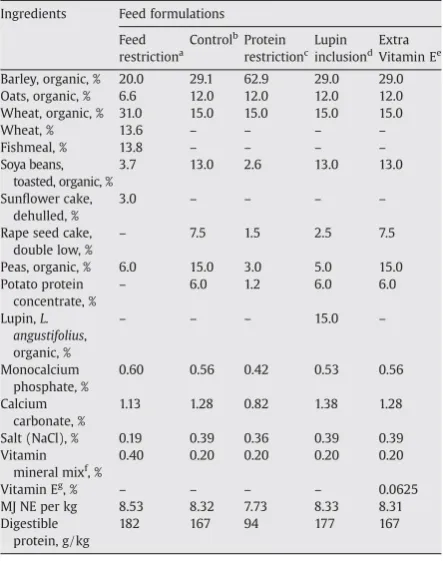
The feed used in the feed restriction experiment was obtained from a commercial feed supplier while the other diets were produced at Research Centre Foulum. The composition of the diets is outlined in Table 1. The feed ingredients met the requirements for organic pig production.
2.3.1. Feed restriction
The control piglets had ad libitum access to the feed while the experimental piglets were fed restrictively start-ing with a daily allowance of 400 g feed on day 1 (first 24 h), gradually increasing by 40 g per day to 800 g feed on day 10 of the experiment. Half the daily restricted ration was fed in the morning and half in the afternoon. The feed used in this experiment was a commercial diet, thus the com-position deviates from the control diet used in the other experiments.
2.3.2. Protein restriction
2.3.3. Lupin inclusion
L. angustifoliuswas included at the expense of peas and rape seed cake.
2.3.4. Extra vitamin E
The basal diet contained 60 mg/kg ofall-rac-α-tocopheryl acetate. The basal diet was supplemented with additional 150 mg/kg RRR-α-tocopheryl acetate.
2.4. Challenge with E. coli
TheE. colistrain 9910045-1 (O149:F4) was used (named E. coliO 149 from here on). TheE. coliO 149 was originally
isolated at the Danish Institute for Food and Veterinary Research from the intestinal contents of a pig with weaning diarrhoea. According to polymerase chain reaction (PCR) analysis of virulence factor genes, the bacterial strain harbours genes for enterotoxins STb, LT, EAST1 andfimbriae F4ac (Frydendahl et al., 2001). E. coli O 149 causes beta-haemolysis when grown on blood agar (BA) (Colombia agar [Oxoid] supplemented with 5% calf blood).
E. coliO 149 was stored at−80 °C in a Luria-Bertani (LB) medium (Merck) with glycerol (1:1 v/v). For each inocula-tion, a fresh culture was prepared. FrozenE. coliO 149 was streaked on BA and grown at 37 °C for 18 h. A swab of colony material was suspended in 200 ml Veal Infusion broth (Merck) and grown for 5 h at 37 °C in an incubator with constant shaking at 200 rpm. After incubation the suspension was centrifuged (17,700 g) at 4 °C for 20 min. The bacterial pellet was resuspended in sterile 10% sodium chloride (NaCl). This bacterial suspension was diluted in serial ten-fold dilutions with NaCl as the diluent and plated on BA for quantitative determination of theE. colicolony forming units (CFU). Each piglet received anE. coliO 149 dose of 1 × 10⁸CFU in 20 ml NaCl on days 1 (day of weaning = day 0) and 2 (and 3 for thefirst experiment which was with feed restriction) via an oro-gastric tube. After the first experiment, it was our experience that piglets receivingE. colion three consecutive days became too unthrifty for experimental purposes and thus E. coli inoculations on day 3 was omitted thereafter. Piglets destined to receive anE. coliO 149 dose that had a faecal score of 5 or more (see below), received sodium bicarbonate instead of theE. coliO 149 dose. Thus a total of ten piglets received one inoculation less than maximum planned. The oro-gastric tube was inserted and then gently
flushed with a few ml of a buffer (sodium bicarbonate) to ascertain that the tube was correctly placed since buffer from a tube incorrectly placed in the lungs would make the pig cough. After inoculation the tube wasflushed with approxi-mately 30 ml sodium bicarbonate to ascertain that all suspension ofE. coliwas given to the piglet. Non-inoculated piglets received equivalent amounts of sodium bicarbonate via an oro-gastric tube.
All procedures involving animals were approved by the Danish Animal Experiments Inspectorate under the Ministry of Justice.
2.5. Feeding and housing
The sows were fedad libitumduring lactation. During the nursing period, the piglets hadad libitumaccess to creep feed from 14 days of age and accumulated consumption for each litter was recorded from 28 days of age. If waste occurred an estimate was subtracted from the consumption. Based on this recording and litter size, an estimated average daily creep feed uptake per piglet was calculated. The composition of the creep feed is outlined in Table 1. During the 10 day experimental period all piglets were fedad libitum, except the restrictively fed piglets in the experiment on feed restriction. The piglets had free access to water.
[image:3.544.41.263.74.355.2]At weaning piglets were moved to individual 0.8 × 1.3 m pens with concreteflooring and sawdust bedding. The piglets inoculated withE. coliwere housed in one room, and the non-inoculated piglets were housed in an adjacent and similar Table 1
Composition of the experimental diets.
Ingredients Feed formulations
Feed restrictiona
Controlb Protein restrictionc
Lupin inclusiond
Extra Vitamin Ee
Barley, organic, % 20.0 29.1 62.9 29.0 29.0
Oats, organic, % 6.6 12.0 12.0 12.0 12.0
Wheat, organic, % 31.0 15.0 15.0 15.0 15.0
Wheat, % 13.6 – – – –
Fishmeal, % 13.8 – – – –
Soya beans, toasted, organic, %
3.7 13.0 2.6 13.0 13.0
Sunflower cake, dehulled, %
3.0 – – – –
Rape seed cake, double low, %
– 7.5 1.5 2.5 7.5
Peas, organic, % 6.0 15.0 3.0 5.0 15.0
Potato protein concentrate, %
– 6.0 1.2 6.0 6.0
Lupin,L. angustifolius, organic, %
– – – 15.0 –
Monocalcium phosphate, %
0.60 0.56 0.42 0.53 0.56
Calcium carbonate, %
1.13 1.28 0.82 1.38 1.28
Salt (NaCl), % 0.19 0.39 0.36 0.39 0.39
Vitamin mineral mixf
, %
0.40 0.20 0.20 0.20 0.20
Vitamin Eg
, % – – – – 0.0625
MJ NE per kg 8.53 8.32 7.73 8.33 8.31
Digestible protein, g/kg
182 167 94 177 167
a
Used for both the control and the feed restricted group in the experiment with feed restriction. Used as creep feed in both blocks.
b, cUsed in the experiment with protein restriction including. Each diet used as creep feed in one block.
b, d
Used in the experiment with lupine inclusion including use as creep feed. Each diet used as creep feed in one block.
b, e
Used in the experiment with extra vitamin E including use as creep feed. Each diet used as creep feed in one block.
f
I.E. per gram, mg per kg.Feed restriction diet: Vit. A 2200 I.E., vit. D3 500 I.E., α-tocopherol 30,000 mg, K3 vit. 1100 mg, B1 vit. 1100 mg, B2 vit. 2000 mg, B6 vit. 1650 mg, B12 vit. 11 mg,D-pantothenic acid 5500 mg, Niacin 11,000 mg, Biotin 27.5 mg, Fe (II) sulphate 25000 mg, Zn oxide 40,000 mg, Mn (II) oxide 13,860 mg, Cu (II) sulphate 10,000 mg, I (potassium iodide) 99 mg, Se (sodium selenite) 150 mg.Other diets: Vit. A 2500 I.E., vit. D3 300 I.E., α-tocopherol 33,000 mg, K3 vit. 2200 mg, B1 vit. 1100 mg, B2 vit. 1100 mg, B6 vit. 1650 mg, B12 vit. 11 mg,D-pantothenic acid 5500 mg, Niacin 11,000 mg, Biotin 27.5 mg, Fe (II) sulphate 44,000 mg, Zn oxide 55,000 mg, Mn (II) oxide 22,000 mg, Cu (II) sulphate 12,500 mg, I (calcium iodate) 114 mg, Se (sodium selenite) 175 mg.
gNatur E granulate, 40% (400,000 IU/kg = 300,000 mg RRR-α-tocopheryl
room in order to avoid cross contamination from the bacterial challenge. The non-inoculated animals were always handled before theE. coliinoculated animals. Environmental condi-tions such as temperature, air change and bedding were the same in the two rooms.
2.6. Daily recordings
Daily recordings were obtained for weight, feed intake and faecal score (1 = solid and cloddy, 2 = compact, 3 = soft with shape, 4 = soft and liquid, 5 = watery and dark, 6 = watery and yellow). The faecal scorings were performed by two persons jointly and during the experiments a total of three persons were involved.
2.7. Faecal sampling and analyses
On days 1, 2 and 3 of the experiment, faeces were collected from the rectum of the piglets. The day 1 sample was taken before inoculation with theE. coliO 149. Faeces were analysed for dry matter content (Association of Official Analytical
Chemists, 1980) and for content of haemolytic E. coli
according to the following bacteriological examination. A minimum of 1 g faeces was suspended in 10% NaCl solution (10 ml per g faeces) and homogenised by stomaching (BagMixerR400, Interscience, St. Nom, France). Quantification
of the haemolyticE. colifaecal shedding was performed on serial ten-fold dilutions on BA (incubated at 37 °C for 18 h),
with a detection range of 105to 1011Colony Forming Units
(CFU) of Haemolytic bacteria per g faeces. When more than 50% of the colonies were haemolyticE. coli, 5 colonies were selected and sent to the Danish Institute for Food and Veterinary Research, where they were tested by seroaggluti-nation for O 149 type according toFrydendahl (2002).
2.8. Blood sampling and analyses
Blood was obtained by puncture from the jugular vein day 0 and 8 from one block from the feed restriction, protein restriction and lupin inclusion experiments. Serum was obtained after centrifugation at 3000 ×g and stored at −80 °C until analyses. Serum concentrations of immunoglo-bulin G and M (IgG and IgM, respectively) were measured using commercial kits (pig ELISA quantification kit, Bethyl Laboratories, Montgomery, Texas). Measurements of antibo-dies specific to E. coliO 149 K88 in serum were done by indirect ELISA as described byLauridsen and Jensen (2005). The titre values are reported as arbitrary values (i.e., the last dilution [×102] that gave a positive reaction).
2.9. Statistical analyses
[image:4.544.39.507.402.663.2]All data from four piglets that died during the experiments were excluded from the analyses. All data from the piglets that received one inoculation less than their subgroup mates were included in the analyses. The performance and faecal data (see
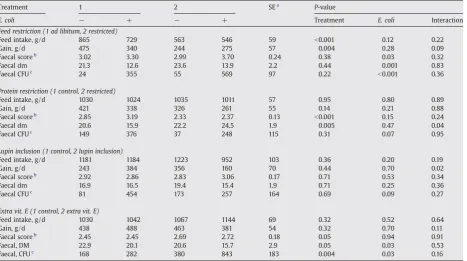
Table 2
Performance of piglets weaned at seven weeks of age and allocated to different dietary treatments in combination withE. coliinoculation (LS means).
Treatment 1 2 SEa P-value
E. coli − + − + Treatment E. coli Interaction
Feed restriction (1 ad libitum, 2 restricted)
Feed intake, g/d 865 729 563 546 59 b0.001 0.12 0.22
Gain, g/d 475 340 244 275 57 0.004 0.28 0.09
Faecal scoreb 3.02 3.30 2.99 3.70 0.24 0.38 0.03 0.32
Faecal dm 21.3 12.6 23.6 13.9 2.2 0.44 0.001 0.83
Faecal CFUc
24 355 55 569 97 0.22 b0.001 0.36
Protein restriction (1 control, 2 restricted)
Feed intake, g/d 1030 1024 1035 1011 57 0.95 0.80 0.89
Gain, g/d 421 338 326 261 55 0.14 0.21 0.88
Faecal scoreb
2.85 3.19 2.33 2.37 0.13 b0.001 0.15 0.24
Faecal dm 20.6 15.9 22.2 24.5 1.9 0.005 0.47 0.04
Faecal CFUc
149 376 37 248 115 0.31 0.07 0.95
Lupin inclusion (1 control, 2 lupin inclusion)
Feed intake, g/d 1181 1184 1223 952 103 0.36 0.20 0.19
Gain, g/d 243 384 356 160 70 0.44 0.70 0.02
Faecal scoreb
2.92 2.86 2.83 3.06 0.17 0.71 0.53 0.34
Faecal dm 16.9 16.5 19.4 15.4 1.9 0.71 0.25 0.36
Faecal CFUc
81 454 173 257 164 0.69 0.09 0.27
Extra vit. E (1 control, 2 extra vit. E)
Feed intake, g/d 1030 1042 1067 1144 69 0.32 0.52 0.64
Gain, g/d 438 488 463 381 54 0.32 0.70 0.11
Faecal scoreb
2.45 2.45 2.69 2.72 0.18 0.05 0.94 0.91
Faecal, DM 22.9 20.1 20.6 15.7 2.9 0.05 0.03 0.53
Faecal, CFUc
168 282 380 843 183 0.004 0.03 0.16
a SE = Standard error of the non-inoculated control group.
b 1 = cloddy, 2 = compact, 3 = soft but with shape, 4 = soft and liquid, 5 = watery and dark, 6 = watery and yellow. c
Table 2) were analysed separately for each of the four dietary factors by a mixed model including block, treatment, inocula-tion and the treatment by inoculainocula-tion interacinocula-tion and using the MIXED procedure of SAS (Littell et al., 1996). Repeated measurements were taken into account by including random effects of i) block and sow, ii) block, sow and piglet and iii) block, sow, piglet and inoculation in the model. Effect of diet was systemic. Note that room andE. coliinoculation are completely confounded.
The antibody response parameters measured in serum
(seeTable 3) were analysed in a model as described above
except that day and its interactions were included while block was excluded when only one block was present. Repeated measurements were taken into account as described above except that block was excluded from the random effects when only one block was present. The measures of antibodies toE. coli were log-transformed prior to the statistical analysis. Least squares means (LS means) were back-transformed by the exponential function, and back-transformed standard errors were calculated as the back-transformed LS mean multiplied with the log-transformed estimate of the standard error.
To investigate possible archetypes of animals, the response profiles over time were clustered using the “partitioning around mediods” algorithm. Details of this method are described byKaufman and Rousseeuw (1990). Correlations are Pearson correlation coefficients.
3. Results
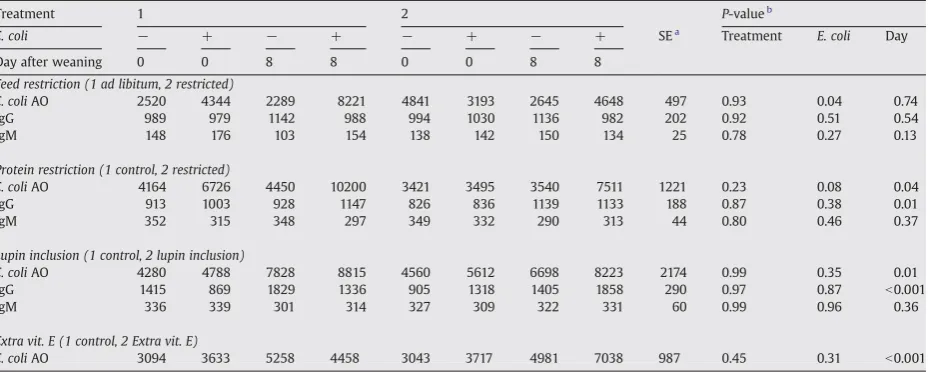
The effects of the four investigated dietary factors and the E. colichallenge on performance and faecal characteristics are presented inTable 2and the effects on the antibody response parameters are presented inTable 3.Table 3also includes the effect of time (day 0vs.day 9).
3.1. Feed restriction
Two piglets died from diarrhoea during the trial. They were littermates and both were onad libitumfeeding level and challenged withE. coli.No data of the two are included in the analysis. As expected, feed restriction decreased the weight gain (P= 0.004), while faecal characteristics were unaffected. E. coli challenge clearly affected the faecal characteristics (P≤0.03), and there was a tendency for an interaction (P= 0.09) between feed restriction and E. coli challenge with regard to ADG, i.e. theE. colichallenge may decrease ADG for piglets on ad libitum feeding. Feed restriction did not affect serum IgG and IgM while the serum concentration of antibodies toE. coliwas the highest (P= 0.04) inE. colichallenged piglets.
3.2. Protein restriction
[image:5.544.44.509.74.260.2]Two piglets died from diarrhoea during the trial. They were littermates and one was on normal and one was on restricted protein, and they were both challenged withE. coli. No data of the two are included in the analysis. There was a tendency that protein restriction decreased weight gain (P= 0.14). Protein restriction decreased faecal score (Pb0.001) and increased faecal dry matter (P= 0.005) while faecal CFU of Haemolytic bacteria was unaffected. There was an interaction between protein restriction andE. colichallenge with regard to faecal dry matter (P= 0.04), i.e. theE. colichallenge decreased faecal dry matter for piglets on the control protein level. Protein restriction did not affect serum IgG and IgM while there was a tendency that challenge with E. coli increased (P= 0.08) serum concentration of antibodies to E. coli. Serum concentration of antibodies to E. coli and IgG increased (P≤0.04) from day 0 to day 8 in experiment.
Table 3
Antibody responses of piglets weaned at seven weeks of age and allocated to different dietary treatments in combination withE. coliinoculation (LS means).
Treatment 1 2 P-valueb
E. coli − + − + − + − + SEa
Treatment E. coli Day
Day after weaning 0 0 8 8 0 0 8 8
Feed restriction (1 ad libitum, 2 restricted)
E. coliAO 2520 4344 2289 8221 4841 3193 2645 4648 497 0.93 0.04 0.74
IgG 989 979 1142 988 994 1030 1136 982 202 0.92 0.51 0.54
IgM 148 176 103 154 138 142 150 134 25 0.78 0.27 0.13
Protein restriction (1 control, 2 restricted)
E. coliAO 4164 6726 4450 10200 3421 3495 3540 7511 1221 0.23 0.08 0.04
IgG 913 1003 928 1147 826 836 1139 1133 188 0.87 0.38 0.01
IgM 352 315 348 297 349 332 290 313 44 0.80 0.46 0.37
Lupin inclusion (1 control, 2 lupin inclusion)
E. coliAO 4280 4788 7828 8815 4560 5612 6698 8223 2174 0.99 0.35 0.01
IgG 1415 869 1829 1336 905 1318 1405 1858 290 0.97 0.87 b0.001
IgM 336 339 301 314 327 309 322 331 60 0.99 0.96 0.36
Extra vit. E (1 control, 2 Extra vit. E)
E. coliAO 3094 3633 5258 4458 3043 3717 4981 7038 987 0.45 0.31 b0.001
Blood samples were obtained at day 0 and 8 after inoculation, and analysed for antibodies toE. coli(AO in arbitrary units), IgG (mg/dL), and IgM (mg/dL). a
SE = Standard error of the non-inoculated control group day 0 after weaning. b
3.3. Lupin inclusion
There was an interaction between lupin level andE. coli challenge with regard to weight gain (P= 0.02), i.e. theE. coli challenge decreased growth in piglets on the diet with lupin. Inclusion of lupin had no effects on feed intake and faecal characteristics. There were no significant effects of lupin inclusion or E. coli challenge on the antibody response parameters. Serum concentration of antibodies toE. coliand IgG increased (P≤0.01) from day 0 to day 8 in experiment.
3.4. Extra vitamin E
The faecal characteristics were affected by vitamin E, faecal dry matter decreased (P= 0.05) while faecal score (P= 0.05) and number of haemolytic bacteria (P= 0.004) increased in piglets fed supplementary vitamin E. Growth,
feed intake and serum concentration of antibodies toE. coli were not affected by the extra dietary vitamin E. Serum concentration of antibodies to E. coli increased (Pb0.001) from day 0 to day 8 in experiment. Serum concentrations of IgG and IgM were not included in this experiment.
3.5. General effects across experiments
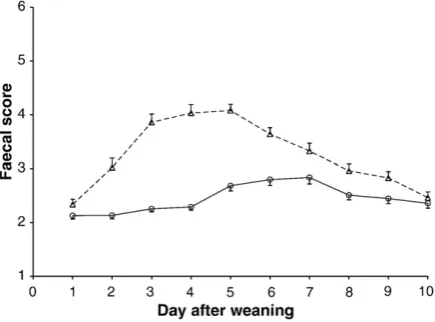
The general effect across all four experiments of theE. coli challenge on faecal characteristics was in an adverse direction as exemplified by the faecal score (Fig. 1).
Using the clustering algorithm “partitioning around med-iods”, the material could be divided into two clusters, one cluster comprising piglets with a diarrhoea-like condition and the other cluster comprising piglets with only a minor increase in faecal score (Fig. 2). The weight gain over the entire experimental period as dependent on feed intake during thefirst day after weaning is shown inFig. 3for the two clusters. The weight gain over the entire experimental period was not affected by feed intake during thefirst day after weaning. However, the cluster comprising piglets with a diarrhoea-like condition was more frequently represented in the interval below a daily feed intake of 200 g during thefirst day after weaning than is the cluster comprising piglets with only a minor increase in faecal score indicating that a low feed intake immediately after weaning may predispose for diarrhoea. In line with this indication, the correlation between first day feed intake and average faecal score was−0.66 (P=0.01) for theE. coliinoculated piglets while it was−0.31 (P=0.24) for non-inoculated piglets. Thus, piglets that have a relatively high feed intake immediately after weaning are less predisposed to diarrhoea after anE. coliinfection.
Creep feed consumption was recorded on a litter basis. Thus, creep feed consumption cannot be associated to measures made on individual piglets but rather to average litter measures. The average daily creep feed consumption per piglet from 28 to 49 days of age was 151 g (SD = 75 g). The correlation between average daily creep feed consumption within a litter and the average faecal score was −0.23 (P= 0.38) for the non-inoculated piglets and −0.31 (P= 0.24) for the E. coli inoculated piglets. The correlation between average daily creep feed consumption and feed intake during thefirst day after weaning was 0.48 (P= 0.06).
[image:6.544.39.257.51.222.2]Fig. 1.Faecal score day 1 to 10 after weaning in non-inoculated piglets (circles in solid line) and piglets inoculated withE. coli(triangles in broken line) (see text for details). All piglets were included regardless of dietary treatment. SE of each point is indicated.
[image:6.544.282.502.55.184.2]Fig. 2.Faecal score day 1 to 10 after weaning in two clusters of piglets, i.e. piglets developing a diarrhoea-like condition (triangles in broken line) and piglets with only a slight increase in faecal score (circles in solid line) (see text for details). All piglets were included regardless of dietary treatment and inoculation. SE of each point is indicated.
[image:6.544.39.257.478.639.2]4. Discussion
Pigs reared according to organic farming conditions in Denmark are not allowed to be weaned until they are at least 7 weeks of age. Under free-ranging semi-natural conditions, the weaning process would be initiated approximately at this age, but is not fulfilled until 14–17 weeks of age (Jensen, 1986;
Petersen, 1994). Thus, although piglets of organic farmed
sows are weaned at an older age than are conventionally farmed piglets (approximately 4 weeks in Denmark), milk is still a major nutrient component, and the gastro-intestinal system has to abruptly cope with a diet mixture without milk at the time of weaning.
The challenge withE. coliO 149 had variable effects since faecal characteristics were affected to various degrees in the different experiments. It is obvious that the piglets responded variably to the E. coli challenge although they were all susceptible to the particular strain ofE. coli. Thus, althoughE. coli inoculation can be used to introduce a diarrhoea-like condition, the method, as conducted in the present experi-ment, does not produce uniform experimental subjects. It is possible that methodological modifications with regard to for example time of inoculation relative to weaning, dosage size and frequency may improve the model. Clearly any model that attempts to control the pathogen pressure in individually penned piglets cannot directly represent commercial condi-tions where oral-faecal exchanges will occur among pen-mates. Also other housing conditions will likely not cover commercial conditions. Nevertheless, controlledE. coli chal-lenge models seem appropriate since it is difficult to study dietary effects on spontaneous weaning diarrhoea that may be have low and variable incidence.
Feed restriction is commonly used as an approach to reduce weaning diarrhoea despite studies that demonstrate intestinal malfunction and damage (McCracken et al., 1999; Spreeuwenberg et al., 2001) as a result of this strategy. On the other hand, restricted feeding day 3 to 8 after weaning has been shown to reduce diarrhoea (Rantzer et al., 1996). Restricted feeding from day 3 will prevent piglets that have not eaten much during thefirst two stressful days, to engorge on an ad libitum available diet when recovering from the stress. Such an engorgement may be associated with digestive upset. In the present experiment, feed restriction had no advantageous effects on faecal score or faecal dry matter content compared to ad libitum feeding. Thus, the health benefits necessary to compensate for the inevitable reduction in growth at restricted feeding were absent, and our results therefore do not support the hypothesis that feed restriction after weaning may limit weaning diarrhoea. However, the fact that two inoculated piglets on ad libitum feeding died indicates that the results have to be interpreted with caution. In the present experiment, feed restriction was imposed at the individual piglet level. However under commercial conditions with piglets kept in groups, restricted feeding will lead to considerable variation in individual feed intake due to differences in for example speed of feed intake and hierarchy order.
It is well known that the presence of food in the gut is necessary for maintenance of intestinal mucosa (Kelly et al., 1991). It is likewise well known that dietary restriction will lead to villus atrophy (e.g.Pluske et al., 1996). Thus, the risk of
intestinal damage and malfunction may be reduced if feed intake after weaning remains uninterrupted. Furthermore, if feed intake of a piglet remains uninterrupted immediately after weaning, i.e., during thefirst day, under circumstances with maximum stress (transport, foreign location, absence of the sow etc.), it seems unlikely that this piglet will decrease feed intake as a consequence of weaning during the following days. Also the risk of engorgement on anad libitumavailable diet and the associated risk of digestive upset may be minimal if the piglet has a relatively high feed intake from the day of weaning. Thus, a potential effect of low feed intake on gut health and performance may be associated with a low feed intake during the first day after weaning. Therefore feed intake during thefirst day after weaning and its effect on the growth performance over the entire experimental period was studied in two clusters of piglets, i.e., one cluster with piglets developing a diarrhoea-like condition and another cluster with piglets characterised by only a minor increase in faecal score. Contrary to our expectation, the overall performance during the experimental period was not significantly affected by feed intake during thefirst day after weaning. On the other hand, in the analysis including piglets from all four experi-ments, the cluster comprising piglets with a diarrhoea-like condition is more frequently represented among piglets with a feed intake below 200 g during thefirst day after weaning than is the cluster comprising piglets with only a minor increase in faecal score. In addition, inE. coliinfected piglets there was a negative correlation between feed intake during thefirst day after weaning and faecal score indicating that a relatively high feed intake immediately after weaning will make the piglets less susceptible for diarrhoea. This indicates that although the overall effect of feed intake during thefirst day after weaning on growth was limited, piglets with a relatively low feed intake immediately after weaning may be more susceptible to diarrhoea. In accordance,Carstensen et al.
(2005) found the highest incidence of faecalE. coliin the
piglets eating the least after weaning at 4 weeks of age. Protein restriction decreased the degree of diarrhoea and there was a tendency towards a decrease in growth. This result is in accordance with the findings of Eggum et al.
(1987) who found a significant decrease in growth. These
results thus confirm that a strategy with decreasing the diet protein level immediately after weaning may decrease the degree of weaning diarrhoea. Whether the decrease in the degree of diarrhoea is sufficient to compensate for the decrease in growth performance is debatable.
In organic farming there is some interest in self supply of animal feed. In Denmark, lupin may be a potential source of protein. In addition, lupin is rich in galactose, a substrate for galactane, which has been shown to reduce the number of intestinalE. coli(Mathew et al., 1993). Thus potentially lupin might possess the capability to reduce intestinalE. coli.This was however not confirmed in this experiment since the number of colonies of haemolytic bacteria was unaffected by inclusion of lupin in the diet. Lupin seems an acceptable source of protein since piglets given 15% lupin in the diet showed performance results comparable to piglets given the control diet.
vitamin E content in diets for lactating sows has been found to reduce frequency of treatment for weaning diarrhoea and the serum concentration of antibodies to E. coli of piglets
(Lauridsen and Jensen, 2005). Thus, it was expected that
extra vitamin E would have protected against diarrhoea inE. coliinfected piglets. However, faecal dry matter was lowest and faecal CFU of Haemolytic bacteria was highest among infected piglets given extra vitamin E.
Generally, the antibody response measures in serum increased from the day of weaning to eight days after weaning although the effect was not consistent among the four feeding experiments. The age dependent increase in serum concentration of antibodies toE. colimay be attributed to an increase in the invasion of E. coli as suggested by
Lauridsen and Jensen (2005).
In conclusion, the studied dietary factors could not alleviate a diarrhoea-like condition and at the same time maintain the growth rate. Furthermore, the results indicate that performance after weaning at 7 weeks of age can be improved if piglets achieve a daily feed intake of at least 200 g from the day of weaning.
Acknowledgement
The research was supported by a grant from Danish Research Centre for Organic Food and Farming (DARCOF).
References
Association of Official Analytical Chemists, 1980. Official Methods of Analysis, 13th ed. AOAC, Washington, DC, USA.
Callesen, J., 2004. Feeding of piglets (In Danish: Fodring af smågrise). Danish Pig Production, Denmark. 13 pp.
Carstensen, L., Ersboll, A.K., Jensen, K.H., Nielsen, J.P., 2005.Escherichia coli post-weaning diarrhoea occurrence in piglets with monitored exposure to creep feed. Vet. Microbiol. 110, 113–123.
Eggum, B.O., Chwalibog, A., Danielsen, V., 1987. The influence of dietary concentration of amino acids on protein and energy utilization in growing rats and piglets. 3. Diets of high biological value but with different protein concentrations. J. Anim. Physiol. Anim. Nutr. 57, 52–64.
Ellis, R.P., Vorhies, M.W., 1976. Effect of supplemental dietary vitamin E on the serologic response of swine to anEscherichia colibacterin. J. Am. Vet. Med. Assoc. 168, 231–232.
Frydendahl, K., 2002. Prevalence of serogroups and virulence genes in Escherichia coli associated with post-weaning diarrhoea and edema disease in pigs and a comparison of diagnostic approaches. Vet. Microbiol. 85, 169–182.
Frydendahl, K., Imberechts, H., Lehmann, S., 2001. Automated 5'nuclease assay for detection of virulence factors in porcineEscherichia coli. Mol. Cell. Probes 15, 151–160.
Hayak, M.G., Mitchell Jr., G.E., Hamon, R.J., Stahly, T.S., Cromwell, G.L., Tucker, R.E., Barker, K.B., 1989. Porcine immunoglobulin transfer after prepartum treatment with selenium or vitamin E. J. Anim. Sci. 67, 1299–1306.
Jensen, P., 1986. Observations on the maternal behaviour of free-ranging domestic pig. Appl. Anim. Behav. Sci. 16, 131–142.
Jensen, M., Fossum, C., Ederroth, M., Hakkarainen, R.V.J., 1988. The effect of vitamin E in the cell-mediated immune response in pigs. J. Vet. Med. 35, 549–555.
Jørgensen, L., Johansen, M., Hansen, C.F., 2000. Restrictively feeding of piglets to limit weaning diarrhoea and mortality due toE. coli(in Danish: Restriktiv fodring af smågrise til forebyggelse af dødsfald forårsaget af E. coli). Danish Pig Production, Denmark. 8 pp.
Jørgensen, C.B., Cirera, S., Archibald, A.L., Anderson, L., Fredholm, M., Edfors-Lilja, I., 2004. Porcine polymorphisms and methods for detecting them. International application published under the patent cooperation treaty (PCT). PCT/DK2003/000807 or WO2004/048606-A2.
Kaufman, L., Rousseeuw, P.J., 1990. Finding groups in data: An introduction to cluster analysis. John Wiley, New York, USA.
Kelly, D., Smyth, J.A., McCracken, K.J., 1991. Digestive development of the early-weaned pig. 2. Effect of level of food intake on digestive enzyme activity during the immediate post-weaning period. Br. J. Nutr. 65, 181–188. Lainea, T., Yliahof, M., Myllysa, V., Pohjanvirtaa, T., Fossia, M., Anttilaa, M.,
2004. The effect of antimicrobial growth promoter withdrawal on the health of weaned pigs in Finland. Prev. Vet. Med. 66, 163–174. Lauridsen, C., Jensen, S.K., 2005. Influence of supplementation of
all-rac-tocopheryl acetate preweaning and vitamin C postweaning on alpha-tocopherol and immune responses of piglets. J. Anim. Sci. 83, 1274–1286. Littell, R.C., Milliken, G.A., Stroup, W.W., Wolfinger, R.D., 1996. SAS (R) System
for mixed models. SAS Institute Inc., Cary, NC, USA.
Madec, F., Bridoux, N., Bounaix, S., Jestin, A., 1998. Measurement of digestive disorders in the piglet at weaning and related risk factors. Prev. Vet. Med. 35, 53–72.
Madec, F., Bridoux, N., Bounaix, S., Cariolet, R., Duval-Iflah, Y., Hampson, D.J., Jestin, A., 2000. Experimental models of porcine post-weaning coliba-cillosisand their relationship to post-weaning diarrhoea and digestive disorders as encountered in thefield. Vet. Microbiol. 72, 295–310. Mathew, A.G., Sutton, A.L., Scheidt, A.B., Patterson, J.A., Kelly, D.T., Meyerholtz,
K.A., 1993. Effect of galactan on selected microbial populations and pH and volatile fatty acids in the ileum of the weanling pig. J. Anim. Sci. 71, 1503–1509.
McCracken, B.A., Spurlock, M.E., Roos, M.A., Zuckermann, F.A., Gaskins, H.R., 1999. Weaning anorexia may contribute to local inflammation in the piglet small intestine. J. Nutr. 129, 613–619.
Melin, L., Katouli, M., Lindberg, Å., Fossum, C., Wallgren, P., 2000. Weaning of piglets. Effects of an exposure to a pathogenic strain ofEscherichia coli. J. Vet. Med., B 47, 663–675.
Petersen, V., 1994. The development of feeding and investigatory behaviour in free-ranging domestic pigs during theirfirst 18 weeks of life. Appl. Anim. Behav. Sci. 42, 87–98.
Pluske, J.R., Williams, I.H., Aherne, F.X., 1996. Villous height and crypt depth in piglets in response to increases in the intake of cows' milk after weaning. J. Anim. Sci. 62, 145–158.
Rantzer, D., Svendsen, J., Weström, B., 1996. Effects of strategic feed restriction on pig performance and health during the post weaning period. Acta Agric. Scand., A Anim. Sci. 46, 219–226.
Rasschaerta, K., Verdoncka, F., Goddeerisa, B.M., Duchateaucb, L., Coxa, E., 2007. Screening of pigs resistant to F4 enterotoxigenicEscherichia coli (ETEC) infection. Vet. Microbiol. 123, 249–253.