OF MYCOPHENOLATE SODIUM 360mg
DELAYED-RELEASE TABLETS
Dissertation submitted to
The Tamilnadu Dr. MGR Medical University, Chennai-32
In partial fulfillment of the requirements
In partial fulfillment of the requirements
In partial fulfillment of the requirements
In partial fulfillment of the requirements
for the award of the degree of
for the award of the degree of
for the award of the degree of
for the award of the degree of
MASTER OF PHARMACY
IN
PHARMACEUTICS
By
REG. NO: 26113901
Under The Guidance of
Under The Guidance of
Under The Guidance of
Under The Guidance of
Mr. V. SIVAKUMAR, M.Pharm
,
DEPARTMENT OF PHARMACEUTICS
ARULMIGU KALASALINGAM COLLEGE OF PHARMACY Anand Nagar, Krishnankovil-626190
This is to certify that the dissertation work entitled
“
FORMULATION DEVELOPMENT AND EVALUATION OFMYCOPHENOLATE SODIUM 360mg DELAYED-RELEASE TABLETS
”
was carried out by
Reg. No: 26113901
in the Department of
Pharmaceutics,
Arulmigu Kalasalingam College of Pharmacy
,
Krishnankovil, affiliated to the Tamilnadu Dr M.G.R Medical
University, Chennai. This work was guided and supervised by
Mr.V.SIVAKUMAR, M.Pharm,
(PhD)
Assistant Professor, Department
of Pharmaceutics.
Date:
Place:
KrishnankovilDr. M. PALANIVELU, M.Pharm, PhD
Principal,
Arulmigu Kalasalingam College of Pharmacy,
Krishnankovil.
CERTIFICATE
CERTIFICATE
CERTIFICATE
CERTIFICATE
This is to certify that the dissertation work entitled
“
FORMULATION DEVELOPMENT AND EVALUATION OFMYCOPHENOLATE SODIUM 360mg DELAYED-RELEASE TABLETS
”
was
carried out successfully by
Reg. No: 26113901
in the Department of
Pharmaceutics,
Arulmigu Kalasalingam College of Pharmacy
,
Krishnankovil, (T.N), under my guidance and supervision during the
academic year 2012-13.
Date:
Place:
KrishnankovilMr. V. SIVAKUMAR, M.Pharm,
Assistant Professor,
Department Of Pharmaceutics,
Arulmigu Kalasalingam College of Pharmacy,
This is to certify that the dissertation work entitled
“FORMULATION DEVELOPMENT AND EVALUATION OF
MYCOPHENOLATE SODIUM 360mg DELAYED-RELEASE
TABLETS”
is submitted by
Reg. No: 26113901
to
“The Tamil Nadu
Dr. M.G.R. Medical University,” Chennai,
in partial fulfillment of the
requirements for the
award of degree of
MASTER OF PHARMACY
in
PHARMACEUTICS
under the guidance and supervision of
Mr. V. SIVAKUMAR, M.Pharm.,
Date:
Centre:
Arulmigu Kalasalingam College of Pharmacy,
Anand Nagar, Krishnankoil-626126,
Virudhunagar District, Tamilnadu.
Examiners:
1.
First and foremost I express my Cordial gratitude to the Almighty
god who helped me to complete my project work. My Endeavour would stand
incomplete without few words of gratitude to the persons who have contributed
much towards the successful completion of the present work.
As I submit the thesis, I am indebted to the
priceless grace
and
endless mercy
of
God, the Almighty.
I owe my cordial gratitude to my guide
Mr. V. SIVAKUMAR M.Pharm.,
Assistant Professor, Department of
Pharmaceutics, Arulmigu Kalasalingam College of Pharmacy, who was the
core and source of all encouragement, inspiration and guideline in the
endeavour.
I would like to express my heartful thanks to
Dr. M. PALANIVELU M.Pharm., PhD,
Principal
, Arulmigu Kalasalingam
College of Pharmacy, for their immense support.
I thankfully acknowledge the unreserved encouragement,
timely help and valuable suggestions rendered to me by
Mr. K. ANANDA RAJA GOPAL M.Pharm.,
Assistant Professor,
Department of Pharmaceutical Chemistry, Malaysia.
I owe my deep gratitude to
Prof. G. VINOTHAPOOSHAN
all encouragement, inspiration and guideline in the endeavour.
I express my heartfelt gratitude
Dr. P. BHARATHIDHASAN,
M.Pharm, PhD
professor,
Department of Pharmaceutics, Arulmigu
kalasalingam College of Pharmacy, for their immense support.
I am also thankful for the support and suggestions given to me by
Dr. J. JAYA ANANTHI M.Pharm., PhD
Department of Pharmaceutics,
Arulmigu kalasalingam College of Pharmacy
I take this opportunity to express my sincere thanks to the
Mr. JERRIN VINCENT M.Pharm
, Deputy Manager, Formulation R&D,
Bafna pharmaceutical Ltd., Chennai for providing drug samples.
I also express gratitude to
Mr. E. GOVINDARAJAN M.Sc.,
Senior Executive, Analytical R&D, Bafna Pharmaceutical Ltd., who took the
full effort and helped me in carrying out the Dissolution studies successfully.
I gracefully acknowledge the co-operation rendered by
Mr. R. BALAMURUGAN, Librarian
, which enabled me to utilize the library
facilities for my project purpose.
I also extend my whole hearted thanks to my classmates whose
CHAPTER-1 CHAPTER-1CHAPTER-1 CHAPTER-1 INTRODUCTION 1 CHAPTER-2 CHAPTER-2 CHAPTER-2 CHAPTER-2
REVIEW OF LITERATURE 23
CHAPTER-3 CHAPTER-3 CHAPTER-3 CHAPTER-3
AIM AND OBJECTIVE 34
CHAPTER-4 CHAPTER-4 CHAPTER-4 CHAPTER-4
PLAN OF WORK 35
CHAPTER-5 CHAPTER-5 CHAPTER-5
CHAPTER-5
DRUG AND EXCIPIENTS PROFILE 36
CHAPTER-6 CHAPTER-6CHAPTER-6
CHAPTER-6
MATERIALS AND METHODS 67
CHAPTER-7 CHAPTER-7CHAPTER-7 CHAPTER-7
RESULTS AND DISCUSSION 89
CHAPTER-8 CHAPTER-8 CHAPTER-8 CHAPTER-8
SUMMARY ANDCONCLUSION 118
CHAPTER-9 CHAPTER-9 CHAPTER-9 CHAPTER-9
BIBLIOGRAPHY 121
CHAPTER-10 CHAPTER-10 CHAPTER-10 CHAPTER-10
INTRODUCTION
The past two decades witnessed enormous research and development in the field of
medicine and pharmacy. Research, development and sales of drug delivery systems are
increasing at rapid pace throughout the world. This worldwide trend will intensify in this
decade as cuts in public health expenses demand lower costs and higher efficiency. To meet
this demand, many efficient drugs currently in use have to be reformulated within the
delivery system that can be value-added for optimal molecular activity.
Now a significant awareness in the scenario has been observed that instead of
searching for new drugs using random hit or miss approach, the development of superior drug
delivery system which enhance the therapeutic efficacy of conventional drugs by controlling
the release rate or by targeting to the tissue site may be an effective approach to improve the
efficacy of the chemotherapeutic agent.
With many drugs, the basic goal of therapy is to achieve a steady-state blood or tissue
level that is therapeutically effective and non-toxic for an extended period of time. The design
of proper dosage regimen is an important element in accomplishing this goal1
.
There are two ways to accomplish this goal,
1. Development of new, better and safer drugs with
long half-lives and large therapeutic indices
2. Effective and safer use of existing drugs through
PRINCIPLES OF DOSAGE FORM DESIGN
Drugs are rarely administered solely as pure chemical substances, but are almost
given as formulated preparations. The principal objective of dosage form design is to achieve
a predictable therapeutic response to a drug included in the formulation3
.
Before a drug substance can be successfully formulated into a dosage form, many
factors must be considered. These factors can be broadly grouped in to 3 categories,
1. Biopharmaceutical considerations (Factors affecting absorption of drugs)
2. Drug related factors (Physical and Chemical properties of the drug)
3. Therapeutic considerations (Disease to be treated and Patient factors)
Among various orally administered dosage forms (tablets, capsules, syrup, solution
etc…), the tablet dosage form is the most widely used. Compressed tablets are defined as
solid unit dosage forms made by compaction of the formulation containing the drug and
certain fillers or excipients selected to aid in the processing and properties of the drug
product.
Advantages of Tablets:
The primary potential advantages of tablets4
are
They are the unit dosage forms, which offer the great capabilities of all oral
dosage forms for the greatest dose precision and the least content variability.
The cost is lowest of all oral dosage forms.
They are in general the easiest and cheapest to packaging and shipment.
Product identification is potentially the simplest and cheapest, requiring no
additional processing steps when employing an embossed or monogrammed
punch face.
They may provide the greatest ease of swallowing with the least tendency for
hang up above the stomach, especially when coated, provided the tablet
disintegration is not excessively rapid.
They lend themselves to certain special release profile products, such as enteric or
delayed release products.
They are better suited to large scale production than with other unit oral dosage
forms.
They have the best combined properties of chemical, mechanical and
microbiological stability of all the oral forms.
Disadvantages:
Inspite of all these advantages, tablets also possess some disadvantages4
. The
disadvantages of tablets include the following
Some drugs resist compression into dense compacts, owing to their amorphous
nature or flocculent, low density character.
Drugs with poor wetting properties, slow dissolution properties, intermediate to
large dosages, optimum absorption high in the GIT or any combination of these
features may be difficult or impossible to formulate and manufacture as a tablet
Bitter tasting drugs, drug with obnoxious odor or drugs that are sensitive to
oxygen or atmospheric moisture may require encapsulation / entrapment prior to
compression / coating.
CLASSIFICATION OF TABLETS
Tablets are classified in different ways5
. They are
a) Classification based on mode of administration
1) Tablets to be swallowed
2) Chewable tablets
3) Tablets used in oral cavity
a. Buccal tablets
b. Sublingual tablets
b. Troches and lozenges
c. Dental cones
4) Tablets administered other than oral route
a. Implants
b. Vaginal tablets / suppositories
b) Classification based on drug manufacturing process
1) Standard compressed tablets
2) Multiple compressed tablets
a. Compression – coated tablets
b. Layered tablets
3) Coated tablets
4) Molded tablets (Tablet triturates)
c) Classification based on drug release profile
2) Immediate Release tablets
3) Controlled Release tablets (Sustained Release tablets)
4) Delayed Release tablets (Enteric coated tablets)
d) Tablets used to prepare solutions
1) Effervescent tablets
2) Dispersible tablets
TABLET EXCIPIENTS:
The excipients are classified according to the function, they perform in the tablet4
.
They include the following.
a) Fillers / Diluents
b) Binders
c) Disintegrants
d) Lubricants
e) Glidant
S.No CATEGOR
Y
DEFINITION EXAMPLES
1 Fillers / Diluents
They are the bulking agents which are inert substances added to active ingredient in sufficient quantity to make a reasonably sized tablet.
Lactose, Sucrose, Dextrose, Mannitol, Sorbitol, Starch, Micro crystalline Cellulose, Calcium carbonate, Calcium phosphate (dibasic and tribasic). 2 Lubricants These agents are required to
prevent adherence of the granules to the punch or dies.
Metal stearates (0.5 to 2% of Ca, Mg, Zn), Stearic acid fine powder (1 to 3%), Talc and Starch 1500 (5 to 10%), PEG 4000 and 6000 (2 to 5%)
S.No CATEGOR
Y
DEFINITION EXAMPLES
3 Binders These are glue that holds the powder together to form granules. They are adhesives added to tablet formulation to provide cohesiveness required for bonding together granules, under compaction to form tablets.
Gelatin, Glucose,
Methylcellulose, Water, Acacia, Starch paste, Alcohol,
Polyvinylpyrrolidone, Sorbitol.
4 Disintegrants These agents are added to tablet formulation / granulation for the purpose of causing the compressed tablet to break apart (disintegrate) when placed in aqueous environment.
Starch USP (5 to 20%w/w), Starch 1500(5 to15%w/w), Avicel pH 101,102
(Microcrystalline cellulose 5 to 15%w/w), Sodium starch glycollate (Explotab 2 to 8% w/w), PVP and cross linked PVP (0.5 to 10%w/w), Sodium Carboxyl Methyl cellulose. 5 Glidants These are materials that
improve the flow
characteristics of granulations by reducing inter particulate
friction.
TABLET MANUFACTURING PROCESS:
An outline of the various steps involved in the manufacturing of tablets6
by different
methods is mentioned below,
Wet Granulation Dry Granulation Direct Compression Milling of drugs and
excipients
Milling of drugs and excipients
Milling of drugs and
excipients
Mixing of milled products Mixing of milled products
Mixing of milled
products Preparation of the binder
solution
Compression in to large hard
tablets called slugs
Tablet compression
Mixing binder solution with
powder mixture to form wet
mass
Screening of slugs
Coarse screening of wet
mass
Mixing with lubricant and
disintegrating agent Drying moist granules Tablet compression Screening dry granules with
lubricant and disintegrant Mixing Screened granules
with lubricant and
disintegrant
Tablet compression
The various process involved in the manufacturing of tablet are,
Granulation
Drying
Milling / Sizing
Compression
Coating
Packing
Mixing:
Mixing is defined as to put together (substances / things / one substance / thing with
another) in one mass assemblage with more or less through diffusion of the constituent
elements among one another. The three main mechanisms involved in mixing are diffusion,
convection and shear.
Types of mixers:
a) Batch type:
Double cone blender, V- Shaped, Barrel, Planetary, Ribbon, and Fluid bed Granulator,
Fluidized bed dryer.
b) Continuous:
Zig zag mixer.
Granulation is any process of size enlargement whereby small particles are gathered
together into large permanent aggregates to render them in to free flowing state.
Reasons for granulation:
Render the material free flowing
Densify material
Prepare uniform mixtures that do not separate
Improve compression characteristics of drug
Control the rate of drug release
Removes dust
Improve appearance of the tablet
Types of granulation:
Wet Granulation.
Dry Granulation.
Direct Compression.
Wet Granulation – Schematic Representation:
Drug → Grind → Adjuvant → Blend → Binder Addition → Agglomerate → Pellets
Tablet¯ Compress ¬ Lubricate ¬ Blend ¬ Screen ¬ Dry
The equipment widely used for wet granulation process is “RAPID MIXER
GRANULATOR”.
Drug → Grind → Adjuvant → Blend → Pellet [Compaction] → Crush → Screen
¬
Tablet ¯ Compress ¬ Lubricate ¬ Blend
Direct Compression Schematic Representation:
Drug → Grind → Adjuvants → Blend → Compress → Tablet
Drying:
Drying is defined as removal of water / other liquid from a solid / semisolid mass by
evaporative process.
The various equipments used for drying are
Tray Dryer
Turbo tray dryer
Fluidized Bed Dryer
Spray Dryer
Compression:
Compression is defined as a process of applying pressure to a material. In
Pharmaceutical tabletting an appropriate volume of granules in to die cavity is compressed
between upper punch and lower punch to consolidate the material into a single solid matrix,
which is subsequently ejected from the die cavity as “INTACT TABLET”
• Single Punch Tablet Compression Machine
• Rotary Tablet Compression Machine.
THE SUSTAINED RELEASE CONCEPT
Sustained release, sustained action, prolonged action, controlled release, extended
action are the terms used to identify drug delivery systems that are designed to achieve a
prolong therapeutic effect by continuously releasing medication over an extended period of
time after administration of single dose. The extended, slow release of controlled release drug
products produces a relatively flat, sustained plasma drug concentration that avoids toxicity
(from high drug concentrations) or lack of efficacy (from low drug concentrations)7
.
The desirable therapeutic advantages of a sustained release form are,
1. Frequency of drug administration is reduced and thus patient compliance can
be improved.
2. The blood level oscillation characteristics of multiple
dosing of conventional dosage forms is reduced.
3. Total amount of drug administered can be reduced, thus maximizing
availability within minimum dose.
4. Safety margin of high potency drugs can be increased, and the incidence of
both local and systemic adverse effects can be reduced.
5. Overall, administration of sustained release forms enables
Subtherapeutic range A B Toxic range Therapeutic range P la sm a D ru g C o n ce n tr a tio n (m cg /m l) 2 4 6 8
0 4 8 12 Time (hr)
There are various approaches in delivering a therapeutic substance to the target site in
a sustained release fashion. Microspheres, which are matrix systems containing drug
throughout (either in solution or microcrystalline form) the structure are potential candidates
for oral sustained release 8
.
Typical plasma drug concentration versus time profiles for an ideal sustained
release microencapsulated product (A) and conventional dosage form (B) repeatedly given
orally9
.
Probably the earliest work in the area of sustained drug delivery dosage forms can be traced
to the 1938 patent of Israel Lipowski. This work involved coated pellets for prolonged
release of a drug and was presumably the forerunner to the development of the coated particle
approach 10
With many drugs, the basic goal of therapy is to achieve a steady state blood on tissue
level that is therapeutically effective and nontoxic for an extended period of time. The design
of proper dosage regimen is an important element in accomplishing this goal. A basic
objective in dosage form design is to optimize the delivery of medication so as to achieve a
measure of control of the therapeutic effect in the face of uncertain fluctuations in the In-vivo
environment in which drug release takes place 11.
Sustained release, sustained action, prolonged action, controlled release, extended
action, timed release are terms to identify drug delivery systems that are designed to achieve
a prolonged therapeutic effect by continuously releasing medication over and extended period
of time after administration of a single dose.
Oral injection has long been the most convenient and commonly employed route of
drug delivery. Indeed, for sustained release of systems the oral route of administration has
received the most attention with respect to research on physiological and drug constraints as
well as design and testing of products. This is because there is more flexibility in dosage
form design for the oral route than there is for the parenteral route12
MODIFIED RELEASE SYSTEMS
To overcome the potential problems associated with conventional drug therapy modified
release systems were developed and may be divided into four categories 13
.
1. Sustained release
a. Controlled release
b. Prolonged release
2. Site specific release
3. Receptor
4. Delayed release
Sustained release system
Sustained release are that which achieves slow release of drug over an extended
period of time and in this drug is initially made available to the body in amount to cause the
desired pharmacological response.
Controlled release system
An ideal controlled drug delivery system is that which delivers the drug at
predetermined rate, locally or systemically for the predetermined period of time. Thus
maintaining constant drug level in blood or target tissue.
Site specific and receptor release system
Site specific and receptor release and targeted release system refers to targeting of the
Prolonged release system
Prolonged release system, prolongs the duration of action without maintaining a
constant drug blood level.
Conventional dosage forms are associated with many side effects such as the initial
dose may not be adequate enough to reach the therapeutic range to elicit pharmacological
response. Besides this the repeated drug administration at the equal intervals may result in
severe side effects. These problems of conventional dosage forms are overcome by
controlled drug delivery systems since sustained release dosage forms usually consists of two
parts an immediately available dose to establish the blood level quickly and a sustaining part
that contains several times the therapeutic dose for protracted drug levels
In conventional drug therapy it can be seen from the figure that the administration of
drug by either intravenous injection or an extravascular route e.g. orally, intramuscularly or
rectally does not maintain drug blood level within the therapeutic range for an extended
period of time. The short action is due to the inability of conventional dosage forms to
control temporal delivery 13
FIGURE – 1
Drug Blood Level Vs Time Profile for Intravenous injections (eg. Dextrose and Sodium
Chloride Injections) and extra vascular route of administration (Acetaminophen tablet
given orally)
Oral drug delivery has been known for decades as the most widely utilized route of
administration among all the routes that have been explored for the systemic delivery or
drugs via various pharmaceutical products of different dosage forms. The reasons that the
oral route achieved such popularity may be in part attributed to its case of administration as
well as the traditional belief that by oral administration the drug it as well absorbed as the
foodstuffs that are ingested daily. In fact, the development of a pharmaceutical product for
oral delivery, irrespective of its physical form (solid, semisolid, or liquid dosage form),
involves varying extents of optimization of dosage form characteristics within the inherent
constraints of gastrointestinal (GI) physiology 14
Pharmaceutical products designed for oral delivery and currently available on the
prescription and over-the counter markets are mostly the immediate-release type, which are
designed for immediate release of drug for rapid absorption. Because of their clinical
advantages over immediate-release pharmaceutical products containing the same drugs,
sustained-release pharmaceutical products, such as those formulated on the basis of spansule
coating technology, have over their introduction into the marketplace. Recently, a new
generation of pharmaceutical products, called controlled-release drug delivery systems, such
as those developed form the osmotic pressure-activated drug delivery system, have recently
received regulatory approval for marketing and their pharmaceutical superiority and clinical
benefits over the sustained-release and immediate-release pharmaceutical products have been
increasingly recognized.
All the pharmaceutical products formulated for systemic delivery via the oral route of
administration. Irrespective of the mode of delivery immediate, sustained or controlled
release and the design of dosage forms (either solid dispersion or liquid) must be developed
within the intrinsic characteristics of GI physiology. Therefore, a fundamental understanding
of various disciplines including GI physiology, pharmacokinetics, pharmacodynamics and
formulation design is essential to achieve a systematic approach to the successful
development of an oral pharmaceutical dosage form (or drug delivery system). The more
sophisticated a delivery system the greater is the complexity of these various disciplines
involved in the design and optimization of the system. In any, case the scientific frame work
required for the successful development of an oral drug delivery system consists of a basic
understanding of the following three aspects: (i) physicochemical, pharmacokinetic and
characteristics of the gastrointestinal tract and iii. physicomechanical characteristics and the
drug delivery mode of the dosage form to be designed.
Although it is often impractical to alter the physicochemical, pharmacokinetic and or
pharmacodynamics characteristics of a drug to be delivered by a chemical approach, such as
the synthesis of an analog or medically undesirable to modify the anatomic and physiologic
characteristics of the gastrointestinal tract, the design of a controlled-release oral dosage form
by optimization of dosage form characteristics with GI anatomy and physiology taken into
consideration could provide some opportunity to rationalize the systemic delivery of drugs
and maximize their therapeutic benefits.
The term “Controlled-release oral dosage form: is not new to most people working in
various fields of pharmaceutical research and development. In fact, approximately 30 years
ago, the U.S. Food and Drug Administration (FDA) published regulatory requirements for
release products. Unfortunately there has been a proliferation of
controlled-release dosage forms on the marketplace that may have little rationale and provide no
advantages over the same drugs in conventional dosage forms. Over the last decades there
Potential Advantages of Sustained Drug Therapy
Sustained drug therapy is used for the following purposes 11
1. Patient compliance due to reduction in frequency of dosing
2. Employ minimum drug
a. Minimize or eliminates local and systemic side effects.
b. Obtain less potentiating or reduction in drug activity with chronic use.
c. Minimize drug accumulation with chronic dosing.
3. Improve efficacy in treatment
a. Cure or control condition more promptly
DELAYED RELEASE SYSTEM17
Delayed release systems are those that used repetitive intermittent dosing of the drug
from one or more immediate release units incorporated into single dosage form.
Definition:
Delayed-Release tablets that are intended to resist the gastric fluid and to release their
active substance in the in the intestinal fluid. Usually they are prepared from granules or
particles already covered with a gastro-resistant coating or in certain cases by covering tablets
with a gastro-resistant Enteric coated tablets.
For tablets covered with a gastro-resistant coating carry out the test for disintegration
with the following modifications. Use 0.1M Hydrochloric Acid as a liquid. Operate the
apparatus for 2 hours, without the discs and examine the state of the tablets. The time of
resistance to the acid medium varies according to the formulation of the tablets to be
examined. An authorized deviation is not less than 2 hours. No tablet shows signs of either
disintegration or cracks that would allow to escape of the contents. Replace the acid by
phosphate buffer solution PH
6.8 and add a disc to each tube. Operate the apparatus for 60
minutes and examine the state of the tablets. If the tablets comply because of adherence to the
discs, repeat the test a further 6 tablets omitting the discs. The tablets comply with the test if
all 6 have disintegrated.
ENTERIC COATING TECHNIQUE:
This technique is used to protect the tablet core from disintegration in the acid
environment of the stomach for one or more of the following reasons:
Prevention of acid attack on active constituents unstable at low pH;
To protect the stomach from the irritant effect of certain drugs;
To facilitate absorption of a drug that is preferentially absorbed distal to the stomach.
The following polymers are among those commonly used for the purposes of enteric coating:
Cellulose acetate phthalate
Polyvinyl acetate phthalate
Because they possess free carboxylic acid groups on the polymer backbone, they exhibit a
differential pH
solubility profile. They are almost insoluble in aqueous media at low pH
, but as
the pH rises they experience a sharp, well denned increase in solubility at a specific pH, e.g.
pH
5.2 for cellulose acetate phthalate.
COMPARISON CHART FOR DELAYED-RELEASE WITH IMMIDIATE RELEASE
REVIEW OF LITERATURE
M Salvadori, H Holzer, A Mattos18
The introduction of mycophenolate mofetil
represented a major advance in transplant medicine, although optimal use may be
limited by gastrointestinal side-effects. An enteric-coated formulation of
mycophenolate sodium (myfortic®
) has been developed with the aim of improving the
upper GI tolerability of mycophenolic acid. Therapeutic equivalence of EC-MPS (720
mg b.i.d.) and MMF (1000 mg MMF b.i.d.).
Staatz, Christine E, Tett, Susan E19This review aims to provide an extensive
overview of the literature on the clinical pharmacokinetics of mycophenolate in solid
organ transplantation and a briefer summary of current pharmacodynamic
information. Strategies are suggested for further optimisation of mycophenolate
therapy and areas where additional research is warranted are highlighted.
Mycophenolate has gained widespread acceptance as the antimetabolite
immunosuppressant of choice in organ transplant regimens. Mycophenolic acid
(MPA) is the active drug moiety.
L Chan, S Mulgaonkar, R Walker20
Patient-Reported Gastrointestinal symptom
burden and health-related quality of Life following Conversion from Mycophenolate
Mofetil to Enteric-Coated Mycophenolate Sodium.
Klemens Budde, Petra Glander, Lutz Fritsche, Duska Dragun21
Enteric-coated
mycophenolate sodium (myfortic®, Novartis Pharma AG) is an advanced formulation
to improve mycophenolic acid -related upper gastrointestinal adverse events by
delaying the release of mycophenolic acid until reaching the small intestine.
K Budde, P Glander, BK Kramer, W Fischer22
Conversion From Mycophenolate
Mofetil to Enteric-Coated Mycophenolate Sodium in Maintenance Renal Transplant
Recipients Receiving Tacrolimus. Clinical, Pharmacokinetic and Pharmacodynamic
activity.
G Crotts, A Sheth, J Twist, I Ghebre-Sellassie23
Development of an enteric coating
formulation and process for tablets primarily composed of a highly water-soluble,
organic acidic tablet core should be applied to prevent retardation in drug release.
Ciancio G, Sageshima J, Burke GW, Rosen A, Miller J24
A Randomized Trial
Comparing Tacrolimus/ Mycophenolate Mofetil (CellCept) Versus
Tacrolimus/Enteric-Coated Mycophenolate Sodium (Myfortic) In First Renal
Transplants Induced With Both Daclizumab And Thymoglobulin. With Steroid
Avoidance.
Oellerich, Michael; Shipkova, Maria; Schütz, Ekkehard; Wieland,
Eberhard25
Pharmacokinetic and Metabolic Investigations of Mycophenolic Acid in
Pediatric Patients After Renal Transplantation: Implications for Therapeutic Drug
W.Arns26
Noninfectious Gastrointestinal Complications of Mycophenolic Acid
Therapy. Mycophenolic acid , a reversible inhibitor of inosine 5″-monophosphate
dehydrogenase (IMPDH), selectively inhibits T- and B-cell proliferation.
Mycophenolic acid exposure correlates inversely with the risk of acute rejection.
Mycophenolate mofetil is an immediate-release formulation of Mycophenolic Acid
that is absorbed in the stomach and small intestine.
Theodore W. Perry, Uwe Christians, James F. Trotter, Jamie Bendrick-Peart27
Mycophenolate mofetil is one of the major immunosuppressive agents used in liver
transplantation recipients. In an attempt to mitigate one of the most common side
effects of Mycophenolate mofetil (gastrointestinal symptoms), enteric-coated
mycophenolate sodium was developed. In this study, we report the pharmacokinetic
profile of enteric-coated mycophenolate sodium in stable liver transplantation
recipients administered a single 720 mg dose.
Kobashigawa JA, Relund DG, Gerosa G, Almenar L, Livi U, Ross H Yonan N28
Similar Efficacy and Safety of Enteric-coated Mycophenolate Sodium Compared
with Mycophenolate Mofetil in De Novo Heart Transplant Recipients: Results of a
12-Month, Single-blind, Randomized, Parallel-group, Multicenter Study.
Arns WW, Glander P, Schuhmann R, Mai I, Fischer WH, Budde K29
Conversion From Tacrolimus to Everolimus Does not Influence The
Pharmacokinetic. But Increases Pharmacodynamic Response Of Mycophenolate
M30
Safety assessment of the conversion from mycophenolate mofetil to
mycophenolate sodium in stable renal transplant recipients. Full dose tolerability
with enteric coated mycophenolate sodium.
Dumortier J, Gagnieu M-C, Salandre J, Guillem P, Adham M, Boillet O31Conversion from Mycopenolate mofetil to enteric-coated Mycopenolate sodium in
liver transplant patients presenting gastrointestinal disorders.
Bjarnason I.32
Enteric coating of mycophenolate sodium: a rational approach to
limit topical gastrointestinal lesions and extend the therapeutic index of
mycophenolate.
Fanak et al., (2012)33
reported that physical and chemical stability of Mycophenolate
Mofetil (MMF) suspension prepared at the hospital. Suspension formulations were
prepared from both tablets and capsules forms of MMF. Thereafter the stability
parameters such as pH, microbial control, thermal and physical stability and particle
sizes were evaluated. The amount of MMF, in the suspension was measured at various
time points by HPLC. According to the obtained results in this study, capsule-based
suspension was stable for as long as 14 days at 5°C.
Kathleen et al., (2012)34
reported that race and drug formulation influence on
of Clinical Pharmacology. Mycophenolic acid clearance and dose-normalized area
under the concentration-time curve 0-12 (AUC) were determined. Mixed model
statistics evaluated the main effects of race, drug formulation, and interaction of race
and drug formulation (R × D) with albumin, cyclosporine trough, renal function, and
diabetes and enterhepatic recirculation. The findings concluded that race influences
MPA exposure between MMF and EC-MPS and may warrant therapeutic monitoring
during formulation conversion.
Hari and Karen et al., (2012) 35
reported that current state of renal transplant
immunosuppression: Present and future. World Journal of Transplant 2012; 2(4):
51-68. Regimens designed to limit or eliminate calcineurin inhibitors and/or
corticosteroid use are actively being pursued. An ideal immunosuppressive regimen
limits toxicity and prolongs the functional life of the graft. This article contains a
critical analysis of clinical data on currently available immunosuppressive strategies
and an overview of therapeutic moieties in development.
Zeher, et al., (2011)36
reported that efficacy and safety of enteric-coated
treatment of active lupus nephritis. This exploratory study suggests that EC-MPS may
facilitate glucocorticoid reduction without loss of efficacy in patients with active
lupus nephritis, but results require confirmation in a controlled, longer-term study
versus the current standard of care.
Esquivel et al., (2010) 37
reported that comparison of dissolution properties of 2
enteric-coated formulations containing Mycophenolate sodium: Myfortic vs Femulan.
For both formulations, mycophenolate sodium content was within the 90% to 110%
range of the label claimed dose, and no impurities were present as determined at
high-performance liquid chromatography. Mycophenolate sodium release was assayed by
applying the US Pharmacopeia apparatus 2 dissolution test at 2 different pH values
(1.2 and 6.8) to mimic conditions in the stomach and the small intestine, respectively.
At pH 1.2, mycophenolate sodium release was less than 2%, with respect to the label
claimed dose, for both formulations. At pH 6.8, mean (range) mycophenolate sodium
release with Myfortic was 104.9% (104.0%–105.6%), and with femulan was 62.3%
Sarah et al., (2010) 38
reported that therapeutic drug monitoring of mycophenolate
mofetil and enteric-coated mycophenolate sodium in patients with systemic lupus
erythematosus. MPA AUC between 0 and 12 h (AUC0–12h), Cmax, Tmax, and 12-h trough
concentrations (C12h) were determined. Means of dose-normalized MMF– or
EC-MPS–MPA Cmax were 64.6 ± 25 and 61.4 ± 27.1 h mg/l, respectively. MPA Tmax for
EC-MPS was longer and more variable than for MMF. MMF-MPA AUC0–12h and C12h
were correlated (r = 0.78, p = 0.0001), but EC-MPS–MPA Cmax and single
concentrations were weakly correlated. A limited-sampling strategy (LSS) combining
Cmax and C12h gave satisfactory predictive performance to estimate MPA AUC0–12h after
EC-MPS administration.
Dario et al., (2007) 39
reported that Pharmacokinetics of Mycophenolate sodium and
comparison with the Mofetil formulation in stable kidney transplant recipients.
Patients who were taking the enteric-coated formulation had mycophenolic acid time
of occurrence for maximum drug concentration that ranged from 0 to 480 min and
higher dosage-adjusted mycophenolic acid trough levels compared with patients who
were given mycophenolate mofetil. Conversion from the enteric-coated formulation
of mycophenolate sodium to mycophenolate mofetil resulted in an improvement of
the mycophenolic acid kinetics profiles.
Budde et al., (2004) 40
reported that enteric-coated Mycophenolate sodium: safe
Enteric-coated mycophenolate sodium (EC-MPS) is an advanced formulation
delivering mycophenolic acid (MPA), developed with the objective of improving
MPA-related upper GI adverse events. A pivotal, 12-month, phase III, randomized,
multicenter, double-blind, double-dummy, parallel group study investigated whether
stable renal transplant patients can be converted from MMF to EC-MPS therapy
without compromising tolerability or efficacy.
Maurizio et al., (2004) 41
reported that enteric-coated mycophenolate sodium is
therapeutically equivalent to mycophenolate mofetil in de novo renal transplant
patients. An enteric-coated formulation of mycophenolate sodium (EC-MPS;
myfortic) has been developed with the aim of improving the upper GI tolerability of
mycophenolic acid. Within 12 months, 15.0% of EC-MPS patients and 19.5% of
MMF patients required dose changes for GI adverse events (p=ns).
Enteric-coated-MPS 720 mg b.i.d. is therapeutically equivalent to MMF 1000 mg b.i.d. with a
comparable safety profile.
Monica et al., (2004) 42
reported that Mycophenolate sodium versus Mycophenolate
concludes that considering the limited number of studies comparing these two agents,
it is difficult to establish significant concluding remarks of the advantages of using
ECMS over MMF. What is obvious, however, is that ECMS does represent an
alternative to the significant number of patients suffering from the common
gastrointestinal intolerance reported with MMF. Whether ECMS's consistent capacity
to achieve the target AUC (0-24) of >30 µg/ml is of clinical relevance needs further
investigation.
Nashan et al., (2004) 43
reported that conversion from mycophenolate mofetil to
enteric-coated mycophenolate sodium in maintenance renal transplant patients:
Preliminary results from the myfortic prospective multicenter study. Enteric-coated
mycophenolate sodium (EC-MPS) is a new formulation delivering mycophenolic acid
developed with the aim of improving upper GI tolerability. A large prospective,
open-label, multicenter program (myPROMS: myfortic PROspective Multicenter Study) is
underway to determine the efficacy and safety of EC-MPS, in combination with
cyclosporine microemulsion in a large population of de novo and maintenance renal
transplant recipients. The preliminary data summarized here are from two
subprotocols, which investigated the benefits of converting maintenance renal
that the conversion from MMF to EC-MPS is well tolerated in maintenance renal
transplant recipients.
Budde et al., (2003) 44
reported that enteric-coated Mycophenolate sodium can be
safely administered in maintenance renal transplants patients from the results of a 1 –
year study. American Journal of Transplantation 2003; 4: 237-243. The study
concluded that renal maintenance patients can be converted from MMF to EC-MPS
without compromising the safety and efficacy profile associated with MMF.
William et al., (2003) 45
reported that immunosuppression with Mycophenolic Acid: One size does not fit all. An enteric-coated formulation of mycophenolate sodium (Myfortic) is in the final stages of drug development. Presumably the enteric coating avoids upper GI tract toxicity and delivers the drug more distally, where it may be absorbed better. Randomized blinded trials are in progress, but thus far there is no evidence that this formulation has a better efficacy or side effect profile than MMF.
Schuurman et al., (2002) 46
reported that Mycophenolate sodium: tolerability and
efficacy in transplantation in the rat. Mycophenolate sodium (MPS) is in clinical
development as an enteric-coated formulation to alleviate this gastrointestinal adverse
effect. Accompanying this development, MPS and MMF were evaluated in a
models. The minimal effective dose to prevent rejection of a kidney or heart allograft
or a hamster heart xenograft is a daily dose of 10-20 mg/kg MPS, at which dose the
first adverse side effects can be observed: the compound at 40 mg/kg is not tolerated.
This window is even narrower for MMF than for MPS, and in most models, a
minimal effective MMF dose could not be established. The window between optimal
immunosuppression and adverse side effects is larger when the compounds are given
in combination with cyclosporine A: in all models investigated combinations were
established yielding long-term survival without histologic signs of rejection and
without signs of side effects. Thus, the combination of an IMPDH inhibitor (MPS,
MMF) and a calcineurin inhibitor (cyclosporine A) enables fine-tuning in achieving
optimal immunosuppression avoiding drug side effects.
AIM
The aim of formulation development was to formulate Mycophenolate sodium Tablets
360mg (Enteric coated), which are robust, stable and bio-equivalent to the Generic product of
Myfortic 360mg Tablets marketed by Novartis pharma stein AG which is used as
Reference Listed Product for comparison & Developmental studies. Product development
was carried out on Mycophenolate sodium Tablets 360mg. All the critical process parameters
identified at development stage were confirmed and proved that the process is capable of
producing a drug product of the required quality with the proposed process & product
parameters.
OBJECTIVE
To develop a formulation of Delayed-Release tablets ofMycophenolic acid of
strength 360mg which shall be bioequivalent to Reference product.
To develop a best processing method using different grades of excipients.
To develop a seal coating and enteric coating formula by various weight buildup.
To develop and evaluate the in-vitro dissolution release of the prepared tablets and to
compare with the Reference product.
Data characterization and compilation of the final formulated product.
PLAN OF WORK
Literature survey
Reference product evaluation
Pre-formulation Studies
Drug-Excipients Compatibility Studies – For selection of compatible excipients.
Formulation development for core tablet.
Formulation development for seal coating.
Formulation development for enteric coating.
Formulation development for dissolution comparable with Innovator product.
Stability studies of finalized product
Weight variation
Thickness
Hardness
Friability
Disintegration
Dissolution
Related Substances
DRUG PROFILE
DESCRIPTION AND COMPOSITION OF THE DRUG PRODUCT
Each Enteric coated Tablet contains:
Mycophenolic acid …… 360mg.
FORMULATION STUDIES
Mycophenolate sodium Tablet is indicated as an immunosuppressant drug used to
prevent rejection in organ transplantation. It was initially marketed as the prodrug
mycophenolate mofetil (MMF) to improve oral bioavailability. More recently, the salt
mycophenolate sodium has also been introduced.
MANUFACTURER FOR ACTIVE SUBSTANCE
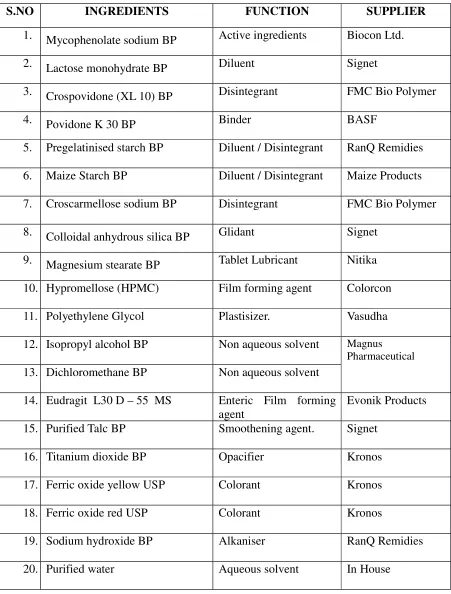
COMPONENTS OF DRUG PRODUCTS:
Physico-Chemical characterization of Mycophenolate sodium:
Mycophenolate sodium is an off white crystalline hygroscopic powder. It
is slightly soluble in methanol and very slightly soluble in water.
Molecular Formula:
C
17H
20O
6Molecular weight :
320.34 g·mol−1
Chemical Structure:
PHARMACOLOGY15
Mycophenolate sodium (MPS) is an enteric coated, delayed release monosodium salt
fermentation product of several Penicillium species. While it was initially studied as an
antibiotic, it was in the early 1970’s that MPA was demonstrated to suppress antibody
responses and prolong skin-graft survival in mice. Inhibitors of inosine monophosphate
dehydrogenase (IMPDH) are effective immunosuppressants and MPA is a potent, selective,
uncompetitive and reversible inhibitor.
In vitro studies have demonstrated that only free MPA is available to inhibit IMPDH
after NADH (nicotinamide adenine dinucleotide) is released but before XMP which is the
committed step in de novo guanosine nucleotide synthesis. The structure of IMPDH also
indicates that MPA inhibits the enzyme by simultaneously mimicking the nicotinamide
portion of the NAD cofactor and a catalytic water molecule. Clinical studies have shown
MPA to be 4.8 times more active against type-II IMPDH than type-I, thereby increasing its
selectivity toward activated lymphocytes. Enteric-coated MPS was developed for the
potential to reduce MPA-associated side effects such as nausea, vomiting, dyspepsia,
abdominal pain and discomfort based on the hypothesis of sharing a similar mechanism of GI
toxicity with that of non-steroidal anti-inflammatory agents (NSAIDs). Preliminary studies
showed that MPA is a potent uncoupler of mitochondrial oxidative phosphorylation similar to
NSAIDs.
PHARMACOKINETICS15
ABSORPTION
In vitro studies demonstrated that the enteric-coated mycophenolic acid
tablet does not release mycophenolic acid under acidic conditions (pH
less than 5) as in the
stomach but is highly soluble in neutral pH
conditions as in the intestine. Following
conducted in renal transplant patients, consistent with its enteric-coated formulation, the
median delay (tlag) in the rise of mycophenolic acid concentration ranged between 0.25 and
1.25 hours and the median time to maximum concentration (TMAX) of mycophenolic acid
ranged between 1.5 and 2.75 hours. In comparison, following the administration of
mycophenolate mofetil, the median TMAX ranged between 0.5 and 1 hour. In stable renal
transplant patients on modified cyclosporine-based immunosuppression, GI absorption, and
absolute bioavailability of mycophenolic acid following the administration of mycophenolic
acid delayed-release tablet was 93% and 72%, respectively. Mycophenolic acid
pharmacokinetics is dose proportional over the dose range of 360mg to 2,160mg. In the early
post transplant period, mean mycophenolic acid AUC and CMAX were approximately one-half
of those measured 6 months post transplant. The trials in other solid organ transplant types;
heart and liver, have demonstrated equivalent pharmacokinetic parameters relative to MMF.
There is significant intra and inter-patient variability in pharmacokinetic parameters which is
dependent on organ type, concurrent immunosuppressive therapy and weeks post-transplant.
DISTRIBUTION
The mean (± SD) volume of distribution at steady state and elimination phase
for MPA is 54 (± 25) L and 112 (± 48) L, respectively. MPA is highly protein bound to
albumin, >98%. The protein binding of mycophenolic acid glucuronide (MPAG) is 82%. The
free MPA concentration may increase under conditions of decreased protein binding (uremia,
hepatic failure, and hypoalbuminemia).
METABOLISM
MPA is metabolized principally by glucuronyl transferase to glucuronidated
metabolites. The phenolic glucuronide of MPA, mycophenolic acid glucuronide (MPAG), is
the predominant metabolite of MPA and does not manifest pharmacological activity. The acyl
stable renal transplant patients on cyclosporine, USP (MODIFIED) based
immunosuppression, approximately 28% of the oral Myfortic dose was converted to MPAG
by presystemic metabolism. The AUC ratio of MPA:MPAG:acyl glucuronide is
approximately 1:24:0.28 at steady state. The mean clearance of MPA was 140 (± 30) mL/min.
ELIMINATION23
The majority of MPA dose administered is eliminated in the urine
primarily as MPAG (>60%) and approximately 3% as unchanged MPA following MPS
administration to stable renal transplant patients. The elimination half-life of MPA and MPAG
ranged between 8 and 16 hours, and 13 and 17 hours, respectively.
EFFECTS OF FOOD24
The effect of a high fat meal compared to the fasting state has been
assessed. There was no effect on MPA AUC, along with a 33% decrease in CMAX and a
significant delay in TMAX.26
DRUG INTERACTION
The following drug interaction studies have been conducted with Mycophenolate
sodium 360mg enteric coated tablets.
Gastroprotective agents: Antacids with magnesium and aluminum hydroxides
Proton Pump inhibitors: Cholestyramine and Drugs that Bind Bile Acids: Oral Contraceptives: levonorgesterol Live Vaccines: Influenza vaccinationThe principal adverse reactions associated with the administration of Mycophenolate
sodium include constipation, nausea, and urinary tract infection in de novo patients and
nausea, diarrhea and nasopharyngitis in maintenance patients.
THERAPEUTIC DRUG MONITORING23
Therapeutic drug monitoring in the context of MMF and MPS has been
defined as a diagnostic method that assigns drug concentration values, based on studies
relating patient outcome measurements to drug concentrations, to predict efficacy (usually a
lowered rate of graft rejection) or toxicity (short-term or long-term) in individual patients.27
Renal function and drug related side effects has been found for the 12hours dose interval
MPA AUC0-12 and the pre-dose trough MPA concentration. Maximum plasma concentration
(Cmax ) (>30mg/L) and AUC values (>microgram*h/ml) for MPA are associated with a
lower risk of renal allograft rejection; while levels of therapeutic exposure >60-70
microgram*h/ml are associated with a significant proportion of patients withdrawing from
treatment due to adverse events, mainly GI intolerability.
MPS is available in 180mg and 360mg enteric coated tablets.12 Because
of this coating the tablets should not be crushed. The pharmacokinetic behavior of MPA and
MPAG previously described in this document require that both MPS and MMF be
administered twice daily. The dosage of MPS tablets was designed such that a 720mg dose of
MPS would provide the nearest molar equivalent of MPA provided by 1000mg of MMF. The
MMF daily dose of 1000mg BID is accepted based on the results of pivotal trials that have
shown this to be the accepted dose for prophylaxis in renal transplantation.7 Daily doses of
MPS 720mg and MMF 1000mg are utilized for liver transplant recipients while higher doses
of MPS 2160mg and MMF 3000mg are used for heart transplant recipients.
EXCIPIENT PROFILE
Excipients are selected based on the excipients of Reference Product. Apart from the
Reference product excipients other excipients are selected based on the proposed composition
& possible use of them.
LACTOSE MONOHYDRATE
Nonproprietary Names
• BP: Lactose monohydrate
• PhEur: monohydricum Lactosum
• JP: Lactose
Chemical Name
O-β-d-Galactopyranosyl-(1→4)-α-d-glucopyranose monohydrate
Empirical Formula
C12H22O11·H2O
Functional Category
Binding agent, diluents for dry-powder inhalers, tablet binder and diluents.
Applications in Pharmaceutical Formulation or Technology
Lactose is widely used as a filler or diluents in tablets.
Description
Lactose is white to off-white crystalline particles or powder, odorless and slightly
sweet-tasting. In the solid state, lactose appears as various isomeric forms, the stable
crystalline forms of lactose are α-lactose monohydrate, β-lactose anhydrous and stable α
-lactose anhydrous.
Stability and Storage Conditions
Mold growth and brown coloration may occur under humid conditions. Lactose
should be stored in a well-closed container in a cool, dry place.
Incompatibilities
Lactose is also incompatible with amino acids, aminophylline, amphetamines and
Safety
Adverse reactions to lactose are largely lead to cramps, diarrhea, distension, and
flatulence
POVIDONE
Nonproprietary Names
• BP: Povidone • JP: Povidone • PhEur: Povidonum • USP: Povidone
Synonyms
poly [1-(2-oxo-1-pyrrolidinyl)ethylene]; polyvidone; polyvinylpyrrolidone; PVP;
1-vinyl-2-pyrrolidinone polymer.
Chemical Name
1-Ethenyl-2-pyrrolidinone homopolymer
(C6H9NO) n
Functional Category
Disintegrant, dissolution aid, suspending agent and tablet binder.
Applications in Pharmaceutical Formulation or Technology
In tableting, Povidone is used as binders in wet-granulation processes and as coating
agents.
Description
Povidone occurs as a fine, white to creamy-white colored, odorless or almost
odorless, hygroscopic powder and freely soluble in acids, chloroform, methanol, and water
practically insoluble in ether, hydrocarbons and mineral oil.
Stability and Storage Conditions
The powder is hygroscopic; it should be stored in an airtight container in a cool, dry
place.
Povidone is compatible in solution with a wide range of inorganic salts, natural and
synthetic resins, and other chemicals.
Safety
Povidone may be regarded as nontoxic since it is not absorbed from the
gastrointestinal tract or mucous membranes.
CROSPOVIDONE
Nonproprietary Names
• BP: Crospovidone • PhEur: Crospovidone • USP-NF: Crospovidone
Synonyms
Crospovidonum; Crospopharm; crosslinked povidone; E1202; Kollidon CL; Kollidon CL-M;
Polyplasdone XL; Polyplasdone XL-10; polyvinylpolypyrrolidone; PVPP;
1-vinyl-2-pyrrolidinone homopolymer.
Chemical Name
1-Ethenyl-2-pyrrolidinone homopolymer
Tablet disintegrant.
Applications in Pharmaceutical Formulation or Technology
Crospovidone is a water-insoluble tablet disintegrant and dissolution agent used at 2–
5% concentration in tablets prepared by direct compression or wet- and dry-granulation
method Crospovidone can also be used as a solubility enhancer dissolution rate.
Description
Crospovidone is a white to creamy-white, finely divided, free flowing, practically
tasteless, odorless or nearly odorless, hygroscopic powder.
Stability and Storage Condition
Since crospovidone is hygroscopic, it should be stored in an airtight container in a
cool, dry place.
Incompatibilities
Crospovidone is compatible with most organic and inorganic pharmaceutical
ingredients. When exposed to a high water level, crospovidone may form molecular adducts
with some materials.
Crospovidone is used in oral pharmaceutical formulations and is generally regarded as
a nontoxic and nonirritant material.
MAIZE STARCH
Nonproprietary Names
• BP: Maize starch, Potato starch, Rice Starch, Tapioca Starch, Wheat Starch • JP: Corn Starch, Potato Starch, Rice Starch, Wheat Starch
• PhEur: Maize Starch, Pea Starch, Potato Starch, Rice Starch, Wheat Starch • USP-NF: Corn Starch, Potato Starch, Tapioca Starch, Wheat Starch
Synonyms
Amido; amidon; amilo; amylum; C*PharmGel; Eurylon; fecule;Hylon; maydis amylum;
Melojel; Meritena; oryzae amylum; Pearl;Perfectamyl; pisi amylum; Pure-Dent; Purity 21;
Purity 826; solaniamylum; tritici amylum; Uni-Pure.
Chemical Name
Empirical Formula
(C6H10O5)n where n = 300–1000.
Functional Category
Tablet and capsule diluent; tablet and capsule disintegrant; tablet binder; thickening
agent.
Applications in Pharmaceutical Formulation or Technology
Starch is a versatile excipient used primarily in oral solid-dosage formulations where
it is utilized as a binder, diluent, and disintegrant.
Description
Starch occurs as an odorless and tasteless, fine, white to off-white powder. It consists
of very small spherical or ovoid granules or grains whose size and shape are characteristic for
each botanical variety.
Stability and Storage Conditions
Dry starch is stable if protected from high humidity. Starch is considered to be
chemically and microbiologically inert under normal storage conditions. Starch solutions or
pastes are physically unstable and are readily metabolized by microorganisms; they should
therefore be freshly prepared when used for wet granulation. Starch should be stored in an
airtight container in a cool, dry place.
Incompatibilities
Starch is incompatible with strongly oxidizing substances. Colored inclusion
compounds are formed with iodine.
Starch is an edible food substance, considered a food ingredient and not a food
additive. It is regarded as an essentially nontoxic and non irritant material.
PREGELATINIZED STARCH
Nonproprietary Names
• BP: Pregelatinised Starch • PhEur: Starch, Pregelatinised • USP-NF: Pregelatinized Starch
Synonyms
Amylum pregelificatum; compressible starch; C*PharmGel; Instastarch; Lycatab C; Lycatab
PGS; Merigel; National 78-1551; Pharma-Gel; Prejel; Sepistab ST200; Spress B820; Starch
1500 G; Tablitz; Unipure LD; Unipure WG220.
Chemical Name
Pregelatinized starch
Empirical Formula
(C6H10O5)n where n = 300–1000.
Tablet and capsule diluent; tablet and capsule disintegrant; tablet binder.
Applications in Pharmaceutical Formulation or Technology
Partially pregelatinized starch is a modified starch used in oral capsule and tablet
formulations as a binder, diluent, and Disintegrant.
Description
Pregelatinized starch occurs as a moderately coarse to fine, white to off-white colored
powder. It is odorless and has a slight characteristic taste.
Stability and Storage Conditions
Pregelatinized starch is a stable but hygroscopic material, which should be stored in a
well-closed container in a cool, dry place.
Safety
Pregelatinized starch and starch are widely used in oral solid-dosage
formulations. Pregelatinized starch is generally regarded as a nontoxic and nonirritant
excipient. However, oral consumption of large amounts of pregelatinized starch may
COLLOIDAL ANHYDROUS SILICA
Nonproprietary Names
• BP: Colloidal Anhydrous Silica • JP: Light Anhydrous Silicic Acid • PhEur: Silica, Colloidal Anhydrous • USP-NF: Colloidal Silicon Dioxide
Synonyms
Aerosil; Cab-O-Sil; Cab-O-Sil M-5P; colloidal silica; fumed silica; fumed silicon dioxide;
hochdisperses silicum dioxid; SAS; silica colloidalis anhydrica; silica sol; silicic anhydride;
silicon dioxide colloidal; silicon dioxide fumed; synthetic amorphous silica; Wacker HDK.
Chemical Name
Silica
Empirical Name
CiO2
Functional Category
Adsorbent; anticaking agent; emulsion stabilizer; glidant; suspending agent;
tablet disintegrant, thermal stabilizer; viscosity-increasing agent.
Applications in Pharmaceutical Formulation or Technology
Colloidal silicon dioxide is widely used in pharmaceuticals, cosmetics, and food
products; its small particle size and large specific surface area give it desirable flow
characteristics that are exploited to improve the flow properties of dry powders in a number
Description
Colloidal silicon dioxide is a submicroscopic fumed silica with a particle size of about
15 nm. It is a light, loose, bluish-white-colored, odorless, tasteless, amorphous powder.
Stability and Storage Conditions
Colloidal silicon dioxide is hygroscopic but adsorbs large quantities of water without
liquefying. When used in aqueous systems at a pH
0–7.5, colloidal silicon dioxide is effective
in increasing the viscosity of a system. However, at a pH greater than 7.5 the viscosity
increasing properties of colloidal silicon dioxide are reduced; and at a pH
greater than 10.7
this ability is lost entirely since the silicon dioxide dissolves to form silicates. Colloidal
silicon dioxide powder should be stored in a well-closed container.
Incompatibilities
Incompatible with diethylstilbestrol preparations.
Safety
Colloidal silicon dioxide is widely used in oral and topical pharmaceutical products
and is generally regarded as an essentially nontoxic and nonirritant excipient. However,
intraperitoneal and subcutaneous injection may produce local tissue reactions and/or
MAGNESIUM STEARATE
Nonproprietary Names
• BP: Magnesium stearate • JP: Magnesium stearate • PhEur: Magnesii stearas • USPNF: Magnesium stearate
Synonyms
Magnesium octadecanoate, octadecanoic acid, magnesium salt, stearic acid, magnesium salt.
Chemical Name
Octadecanoic acid magnesium salt
Empirical Formula
C36H70MgO4
Functional Category
Tablet lubricant.
Applications in Pharmaceutical Formulation or Technology
Magnesium stearate is widely used as a lubricant.
Description
It is a very fine, light white, precipitated powder of low bulk density, having a
faint odor of stearic acid with a characteristic taste and greasy to the touch and readily
adheres to the skin. Practically insoluble in ethanol, ether and water; slightly soluble
in warm benzene.
Magnesium stearate is stable and should be stored in a well-closed container in
a cool, dry place.
Incompatibilities
Incompatible with strong acids, alkalis, iron salts and strong oxidizing
materials.
Safety
Oral consumption of large quantities may produce a laxative effect or mucosal
irritation.
CROSCARMELLOSE SODIUM
Nonproprietary Names
• ••
• BP: Croscarmellose Sodium • JP: Croscarmellose Sodium • PhEur: Croscarmellose Sodium • USP-NF: Croscarmellose Sodium
Ac-Di-Sol; carmellosum natricum conexum; crosslinked carboxymethylcellulosesodium;
Explocel; modified cellulose gum; NymcelZSX; Pharmacel XL; Primellose; Solutab;
Vivasol.
Chemical Name
Cellulose, carboxymethyl ether, sodium salt, cr