Robot Bilby for Emerging Engineers
Mark W Phythian,
Faculty of Engineering
&
Surveying,
University of Southern Queensland.
Abstract
,
\The Robot Bilby Competition is forging valuable links between
Universities and secondary schools in Australia and encouraging high
school leavers to consider a career in Engineering. At a time when
universities are keen to encourage secondary school students into science
and engineering disciplines and schools are looking to enhance their
technology programs, such competitions provide a win-win scenario. This
paper presents the development, features and outcomes of the Robot Bilby
Competition and Technology Workshops, and the recent introduction of the
Online Bilby Simulator. The composition of these programs is presented,
with statistics showing their acceptance by teachers and students of the
Darling Downs Region.
Keywords:
Bilby, competition, secondary school, simulation.
1 Introduction
Several national and international robotics competitions [1] have been established to cater for enthusiasts or experts from universities or research laboratories, but few have been developed which operate successfully at the secondary school level. In Australia the limited level of technical ability of both teachers and students has impeded the development of activities of this type. Only in recent years has that situation improved with the introduction of new technology curricula. Even so, the types of technology topics offered to students vary widely depending on the human and financial resources available to the schools.
broaden their experience, and students with a forum to apply their new found skills.
1.1 The Bilby Concept
The Micromouse contest [2] has been running internationally for over eighteen years. There are a number of powerful reasons for its continuing appeal. The objectives are very easy to understand and contestants can improve their performance because the contest is ongoing. An essential feature of Micromouse is that the mice are totally self-contained. This makes the pre-university entry level of expertise too high for all but a very few contestants.
The Robot Bilby Competition is similar in concept but utilises a much simpler robot to race along a path. The Bilby path is based on the same size matrix as the Micromouse, but instead of alleyways it uses eighteen-centimetre squares cut from white board. The squares are laid edge to edge on a black surface to form a layout that looks a bit like a crossword puzzle. By allowing the robot to be attached to a personal computer the programming task also becomes much simpler.
The entry-level contest requires the robots to race along a dozen squares or so, negotiating a few turns to reach the finish. Even this simple task requires sensing, exploring and steering control. Once these first stages have been successfully accomplished, progress to the solution of a maze-like path can proceed. At the same time, the contestants will probably become dissatisfied with the performance of the simple stepper motor robots and will experiment with faster motors and better sensors. The next challenge is to build the processing power into the Bilby.
The Robot Bilby Project has been operating in the Darling Downs region around Toowoomba, Australia since 1995. Beginning as a promotional activity for the Faculty of Engineering and Surveying, the competition has flourished to the point where over thirty schools in the Darling Downs region are involved, along with several schools in Brisbane, and others as far north as Cairns and west to CharIeville. A second host organisation, the Newcastle Regional Museum, adopted the Bilby project in 1997 and also has many schools participating.
2 The Robot Bilby Competition
The objective of the competition is to build, program and race a robot to complete an unknown path or maze in the shortest time. Students can choose to race their Bilbies along a simple path of squares and/or race across an 8 by 8 maze of squares. The three divisions offered are called - 'Path', 'Maze' and 'Home Grown'. The 'Home Grown' division encourages students to build their own robot which they race in the Path and Maze divisions. The division winner is judged as the best performance by a Home Grown Bilby.
The robot may be constructed of any available materials providing it is safe to handle and does not damage or mark the path. The maximum allowable
dimensions of the robot are: length
=
25 cm; width=
25 cm; height=
norestriction. The robot may be automatically controlled by a computer through an
umbilical or an on-board computer and may be powered via a lead to a mains
supply or batteries. .
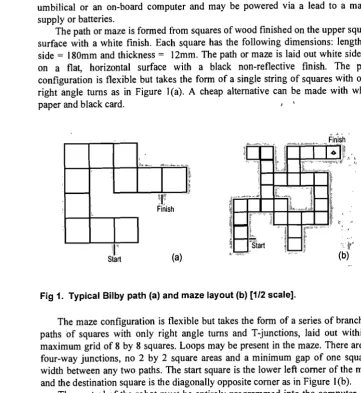
The path or maze is formed from squares of wood finIshed on the upper square surface with a white finish. Each square has the following dimensions: length of
side = 180mm and thickness = l2mm. The path or maze is laid out white side up
on a flat horizontal surface with a black non-reflective finish. The path
configuration is flexible but takes the form of a
singl~
string of squares~ith o~ly
right angle turns as in Figure lea). A cheap alternative can be made With white
paper and black card. , \
(a)
Fig 1. Typical Bilby path (a) and maze layout (b) [112 scale].
The maze configuration is flexible but takes the form of a series of branching paths of squares with only right angle turns and T-junctions, laid out within a maximum grid of 8 by 8 squares. Loops may be present in the maze. There are no four-way junctions, no 2 by 2 square areas and a minimum gap of one square's width between any two paths. The start square is the lower left comer of the maze and the destination square is the diagonally opposite comer as in Figure I (b).
The control of the robot must be entirely programmed into the computer, that is - no human control is allowed during the race except to start, stop and restart the robot. The path or maze configuration is not allowed to be pre-programmed into the computer to aid in the solution. The program may however record the path or maze configuration during any run for use in subsequent runs.
The competition is based on a collection of timed runs in a series of heats and
a final. The run time is measured from the instant the Bilby crosses the join
between the first and second squares, to the instant it crosses the join between the 2nd last and last square for the path problem, or the instant it stops centred on the last square for the maze problem.
A practice session is held before the competition to allow teams to test a~d
[image:2.852.435.797.51.444.2]fastest run time for their Bilby. A nominated number of teams recording the fastest run times are selected to participate in the final. Once these teams are selected their Bilbies are 'caged' ready for competition, an"d no further modifications are allowed to either the robot or the control software. The path configuration is changed for the final to ensure no advantage is gained from previous runs. Teams participate in the final according to run time order, from slowest to fastest.
The Bilby website can be found at www.usq.edu.au/users/phythianibilby.htrn.
2.1 The Bilby Robot
To encourage the greatest level of participation a Bilby Robot kit was designed to provide to schools on a long-term loan. The kit has progressed through several revisions resulting in the simple design described below. The kit can be produced in small quantities at a cost of less than A$150, excluding assembly. In addition to the robot, a twenty page Users Guide, a twenty page Technology Workbook and sample QBasic software are provided to ensure a quick start for the students. Further details on the kit's development and application can be found in [3].
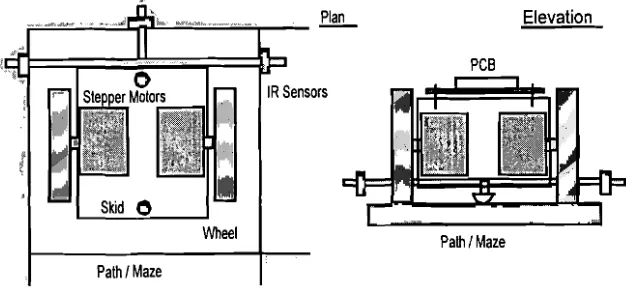
The fundamental design of the Bilby is a wheel chair configuration of two wheels directly driven by two stepper motors. Two skids (front and rear) which are formed by the end of an adjustable bolt and nut assembly limit the pitch of the robot. A box-shaped chassis made from a section of PVC drainpipe supports the motors and skids, rods for the sensors and the PCB. The PCB utilises a ULN2803 darlington array to drive two 4-phase stepper motors from the 8-bit port of an IBM PC printer interface. Four inputs on the same interface are used to accept sensor input from up to four OPB704 infrared reflective sensors. Figure 2 illustrates the standard kit robot configuration.
Elevation
PCB
Wheel Path/Maze
Path/ Maze
Fig 2. Plan and elevation of the kit Bilby Robot.
As the competition has matured some entrants have chosen to construct their own Bilby robots and have enquired about the use of on-board controllers. In 2000 an on-board controller based on the MC68HC811 E2 running SBasic is to be introduced as an option for the USQ group. The Newcastle group [4] took a different approach right from the start and ran workshops on how to construct their robots utilising a supplied controller based on a PIC processor, the Basic Stamp I from Parallax. Both groups have found workshops invaluable to the project.
3 Technology Workshops , \
The greatest challenge in establishing the competition was overcoming the reservations held by teachers to successfully supervise such an activity. The offering of a free three-hour workshop early in the competition season greatly increased the participation and retention rates. The topics covered in the USQ workshops include:
• fundamental electrical theory
•
• AC and DC power sources
•
• analog and digital signals
•
• PC interfacing and safe practices •
• simple input/output circuitry
software for input/output transistor switches stepper motors
an introduction to the Bilby robot
At these workshops teachers are provided with a copy of the Technology Workbook which accompanies the Bilby kit, a small prototyping interface board for the IBM PC printer port and some simple devices such as LEDs, resistors and switches. Teachers are led through the material in the booklet, from which they discover how to connect input and output devices to the PC, and how to write a QBasic program to utilise that interface. These workshops are very well received and teachers often comment on how they intend to utilise the knowledge they gain in other school projects.
So successful have these workshops been that teachers have requested the workshops be presented to technology classes at their schools. This kind of direct contact with teachers and students has proven to be a great promotional vehicle for encouraging students into Engineering studies.
Workshops conducted by the Newcastle group include full day sessions for teachers and students on sourcing parts, constructing and programming their own Bilby robots. While this approach requires more training and teacher involvement the concept of constructing their own autonomous robot greatly appeals to the students and teachers.
4 Online Bilby Simulation
[image:3.846.55.368.393.539.2]National Competition co-ordinated by the USQ Bilby Project Group. While there was some interest this invitation met with limited response.
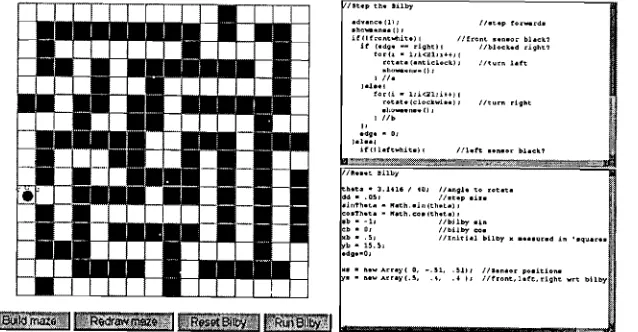
An alternative approach was devised to bring the Bilby to the direct attention of the secondary schools students around Australia. The Online Bilby Simulation was conceived and developed by Prof. John Billingsley at the USQ using his favoured JOLLIES implementation. The simplicity of the Bilby environment and robot configuration lent itself to simulation on the Internet with the use of Javascript. There are some major advantages in using Javascript for this application - (l) basic elements of the language are easy to understand and use, (2) robot control scripts can be written or pasted directly into text boxes on the web page for execution and (3) robot control scripts can be e-mailed and semi-automated for organisation of a competition. The simulator can also be downloaded and run offline in the classroom. Figure 3 shows the Online Bilby Simulator maze graphic and Javascript text boxes.
,dvlneltll; f/ltlpfo.-_rdl
eh",_ .. n •• o,
ifUfr.,,,twhitl)( I/fronl. .enlO. bhel<?
if Cld ... , -- diht)( IIblocl<,d right? tor" .. l,i<:.Ilu.j.+/(
ret I t I (."tl.eloc:l<) I
,h"_ .. ",, .. O;
1/1.
Id . . t
(orli-1:i<21;i++)(
rotn,(c:loc:lr.wiu)I flturn rlillt ,1""_tn •• O,
lilt>
..
edg'-O/
)el •• t
ifllldt"'hitiit I f l . f t "n'''~ bhclr.?
blt.:l - l , U 1 6 / 'OJ I/angle to rotat_ d d ' .05, / I , u p l i n
.iro'l'II't . . . "Uh.ljl](tI, .. l.) I
eo.1'h,t'-"'th,col(th,t.),
.t> .. -11 Ilbilby dll
IIbilby co.
ICb' .S, I/Inirlll bUlly II "'Iund in 'Iql,l;l, .. , .
b" 15.!n
Idg,-Oj
111'111 .. Aruy( 0, -.51, .SI)l 11'1 .. lor ,,"Iitionl . . . II'" Acrlye.5, .t, .4~, IIt'ront,l.t't, right .. rt bilby
Fig 3. The maze and control text boxes of the Online Bilby Simulator.
While the base 'path' problem was achievable in this environment raising the difficulty level to the maze problem allowed for much more scope. With the physical limitations of the real robot competition lifted the size of the maze was increased to 16 by 16 squares for added interest. The objective of the Online Bilby version of the competition is similar to that of the 'Maze' division for the real robots, where the destination is the centre of the maze and run times are replaced with a weighted combination of the number of steps and sensor readings taken during a run. The Bilby Simulator is at www.jollies.com/jollieslbilbylbilby.htm.
To date the Online Bilby Simulator has been used in trials by several groups of secondary school students with a very positive response. An accompanying web site including competition details, hints and tips and links to other interesting robotics sites is currently under development.
5 Outcomes of the Bilby Project
The growth of the competition is testimony to the simplicity of the concept and the way it capivates the attention of teachers, students and the general public. Figure 4 shows the growth in the number of secondary schools involved the project since its inception in 1995. Currently over sixty percent of secondary schools in the Darling Downs Region have a Bilby Kit and in anyone year up to sixty percent of those schools compete.
In a recent survey of supervising teachers the perceived benifits of the Bilby Project were evaluated. Approximately half the participating 'schools responded. Results indicated
-• 90% of teachers agreed that the Bilby Project provided an opportunity for
students to apply their computing/technology studies that they would not nonnally have
• 90% of teachers agreed that the Bilby Project provides students with an
opportunity to improve their problem solving skills
• 60% agreed that the Bilby Project provided students with experiences which
can help them in their selection of a career path
• 100% of teachers found the Technology Workshops infonnative
• 85% of teachers found the Technology Workshops useful for the own teaching
• 100% of teachers found the Technology Workshops useful for the Bilby
problem 35 30 25 20 15 10 5 0
1995 1996 1997 1998
Year
Fig 4. Growth in Bilby Competition Participants.
6 Conclusion
1999
m
Kits Distributed • Teams in Comp [image:4.842.406.803.41.573.2] [image:4.842.46.365.234.400.2]concept is simple, the robots are relatively inexpensive to build and just what many secondary school technology teachers have been looking for.
References
1. T. Braunl: "Review of Mobile Robot Competitions", ACRA99, Mar 1999,
pp 85-89.
2. J. Billingsley: "Micromouse - Mighty mice battle in Europe", Practical
Computing, Dec 1982, pp 130-131.
3. M. Phythian, J. Billingsley: "Secondary School Robotics Competition",
ACRA99, Mar 1999, pp 80-84.
4. Supernova: "The Newcastle Robot Bilby Project", Jan 1999, URL