Abstract: The repercussions of sickle cell anemia is cognitive function study in the world is small. in Morocco this study is one of the first to Identify the neurocognitive performance (nonverbal intelligence) in a population of school-affected children aged 6 to 14 years Followed the pediatric ward of the Hospital & Idrissi Kenitra was two-year period 2010 and 2012 by Appearing with a control group from the Saami area 60 affected children Was compiled with a mean age of 11 ± 0, .27 years and 66 control children with a mean age of 11.6 ± 0.3 years. Academic results are Collected Officials from school, the Raven Progressive Matrices Standard Test That is standardized for age and adjusted Was used to cognitive performance for Assessment and hematocrit Was Determined was counter automaton type (Coulter). The results Obtained-have shown normal That children do Their school careers than children with sickle cell disease with a highly significant difference (chi-square = 13.75, P <0.001), However the correlation of hematocrit results with the scores Obtained by the Raven test HAS allowed us to observe a positive correlation (r = 0.61; p <0.001) as well, a positive correlation entre les scores Obtained Raven and age Was Observed in children with sickle cell disease (r = 0.4; p = 0, 02). Thus It was deduced que la hematocrit is a significant predictor of cognitive impairment in affected children.
Key words : alterations , deductive, inductive, sickle cell disease, children, Morocco.
Index Terms: Alterations, deductive, inductive, sickle cell disease, children, Morocco.
I.INTRODUCTION
Sickle cell disease is one the most common genetic disease worldwide affecting more than 300,000 newborns each year [1] (WHO, 2006). Yet it is still considered an orphan disease. It is particularly prevalent in sub-Saharan Africa due to the relative protection against malaria. This is a painful disease in which symptoms can express functional symptoms associated with vaso-occlusive crises, episodes of splenic sequestrations, acute chest syndrome and stroke (CVA). These strokes can
Revised Manuscript Received on Mai 2019.
Mouden Samira : UFR Human Biology and Population Health. Unit of Clinical Neurosciences and nutritional health. Department of Biology. Ibn Tofail University. Kenitra. [email protected]
Ahami Ahmad Omar: UFR Human Biology and Population Health. Unit of Clinical Neurosciences and nutritional health. Department of Biology. Ibn Tofail University. Kenitra. [email protected]
khorassani : Unit of Hematology and Pediatric Oncology CHU Ibn Sina
Fayek Aicha: Regional Centre Hospitalier Kenitra, medical analysis laboratory services
Abd Hamdan: Ibn Tofail Faculty of Science, Laboratory of Agro-physiology, Biotechnology, Environment and Quality;Kenitra, Marocco.
N. Ait Said : Laboratory Biotechnology, Quality and Environment, Faculty of Sciences, University Ibn Tofail Kenitra, Morocco.
lead to the long physical, but also cognitive disorders [2]. Chronic anemia, frequent hospitalizations, truancy can aggravate learning difficulties and psycho-mental abnormalities [3-4]. Cognitive functions are divided into four classes, including receptive functions, memory and learning, the non-verbal reasoning and executive function [5]. These functions are very sensitive indicators of nutritional, educational and socio-economic, especially if the effect of these parameters affects the child in infancy. The psychosocial effects of sickle cell disease have been the subject of several works on various profiles of populations, however the impact thereof on cognitive function is little studied in the world. In Morocco this study is one of the first to explore the relationship between sickle cell anemia and neurocognitive performance.the objective of our study is to evaluate neurocognitive performance (nonverbal intelligence) in a population of school children with sickle cell disease aged 6-14 years hospitalized at hospital pediatric department of El Edrissi kénitra located in the Gharb Chrarda Beni region Hssen in comparaisant with a group of control children living in the same region. the performance of these children are evaluated by the test Progressive Matrices Raven Standards (SPMR) and are correlated to the hematocrit.
II.
Materials and Methods
This is a type of prospective study cohort, spread over a two-year period between July 2010 and June 2012, conducted among two groups of children (case / control) live in the same socio-economic and environmental conditions. The first group of affected children is followed to hospital pediatric department of El Idrissi kénitra, listed through the service consultation registers, the selection parameters are; patient age was between seven and fourteen; the existence of major sickle cell signs; a pathological hemoglobin electrophoresis. The control group consists of normal children (not sickle cell) between educated 1st year of primary school (CP1) and 2nd year (college), as the Moroccan educational system, belonging to the same region of the Gharb (northern Morocco in the town of West Mnasra and El Had) and chosen at random. The survey was conducted within the precincts of the schools with the support of their managers. Academic results were provided by the heads of institutions, this is how interviews were planned using a protocol pre -établi through a questionnaire written in French and administered in dialectal Arabic, which includes
identifying issues
socio-economic and
Study of alterations of deductive and inductive
function in sickle cell children CHR in the region
of Rabat-Sale-Kenitra, Morocco.
environmental conditions of families.
III.
Biological Data Collection
Hematocrit data is obtained from the medical records for the patient group, the control group, a sample is taken before the start of the questionnaires. Children underwent venipuncture into a tube containing K2 EDTA (anticoagulant) for the embodiment of the blood cell counts of examination (NFS). The blood counts were determined on a type of PLC counter (Coulter) to the biology laboratory of the hospital IDRISSI Kenitra.
IV.
Cognitive development
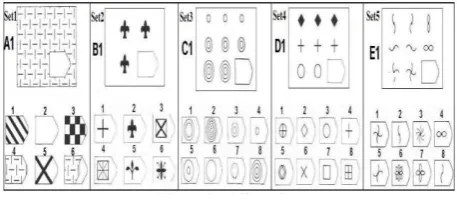
[image:2.595.54.283.507.607.2]Subsequently, the children underwent a battery of cognitive tests including the test was applied or Raven Progressive Matrices Raven, which measure non-verbal reasoning ability and inductive capacity of the individual. This test was designed to assess intelligence, intellectual ability and general mental ability through the comparison of forms and reasoning by analogy. The test consists of 60 problems that come in white and black, distributed 5 series A, B, C, D and E, each of the series is composed, in turn, problems 12, ordered in increasing degree of difficulty. Each item is a pattern with a missing part, 6-8 images are proposed below among which the subject must make a choice to complete the missing part adequately. The test was administered in two sessions; the first comprising the series A, B and C (in 30 minutes) and the second comprising the series D and E (20 min) (Raven and al. 2003). The test was administered individually by a team of our laboratory, and the scores have been prepared on a percentile scale according to age (Raven, 1958 Ivanovic and al. 2003) [6] [7]. To put this performance we will use the first two calibrations of Kuwaiti [8) and second of Britain [9] in addition to the percentiles of a menu sbaibi study [10] on children of the town Sidi lkamel Morocco.
Figure 2: The first elements from five sets of progressive dies Raven.
V.
Statistical analysis
The collected data were entered into Excel and analyzed using SPSS software. Statistical methodology was based on the calculation of frequencies or averages of each variable studied that allowed us to describe the cases of affected children.We used the chi-square test to test the hypothesis of an identical distribution of children in the different groups. For this study, we selected a 5% significance threshold. The correlation coefficient (r) was investigated for the presence or absence of a significant difference.
VI.
RESULTS
During the study period 60 children with sickle cell disease have been identified, the average age of patients was 11 ± 0.27 years, with ends between seven and fourteen years of which 33.3% were female (20 girls) and 66 6% were male (40 boys). However, the control group consists of 66 students average age 11.6 ± 0.3 years, with 29 girls (44.4%) and 37 boys (55.6%). The academic performance of curriculum has been divided into two categories: normal schooling and educational backwardness, it is associated with the repetition criterion. Each child repeated at least once during his schooling, he was considered redoubling. Table 1 presents the percentages of repeaters among patients and controls
Table 1: Repetition percentages group of children.
repeaters non repeaters
children with
sickle cell
disease
36(60 %) 24(40%)
child
witnesses
18(27,27%) 48(72,73%)
The percentage of repeaters of affected children is 60%, it is higher compared to the control groups (27, 27%), the chi-square test at 5% has revealed a highly significant difference (chi-square = 13.75; P < 0.001) between the two groups studied, allowing us to deduce that healthy children do their school careers more than the affected children. This allows to conclude that repercussions of sickle cell disease on the education of the child.The cognitive performance of children from the Raven Progressive Matrices are shown in Table 2. The students tested (patients and controls) performed quite poorly. However calculating the chi-square test, has allowed us to show no significant difference between patients and the control group (chi-square = 447, df = 1, p = 0.17).
Table 2: Performance of children tested PM38.
Average Median Mode Standard
Deviation
Score
Raven P
20,7 20 19 7,6
Score
Raven T
26 26 16 9,6
[image:2.595.306.549.532.638.2]Table 3: Performance of children tested against three calibrations.
Patients Average Median Mo de
Standard
Deviatio
n
Etalonnage M 4 3 3 3,6
Etalonnage UK 5 5 5 0,4
Etalonnage KW 4,5 5 5 0,6
witnesses
Etalonnage M 3 3 3 0,5
Etalonnage UK 5 5 5 0,6
Etalonnage KW 4,3 4 4 0,6
From the results of Table 3, there is a similarity between the results of the Raven test in children according to the UK and calibration KW which places them in low percentiles (KW: grade 5; UK: grade 5). These grades correspond to defective intellectual levels, while the Moroccan calibration differs, it positions patients in grade 4 which is below average intellectual capacity [5-25] and the witness in the Grade 3 which is equal to average intellectual capacity.
To study the influence of SCD on neurocognitive performance was conducted to make a correlation between the results obtained by the test scores of Raven and the hematocrit in both groups (controls and patients).
[image:3.595.45.288.70.255.2]The average hematocrit of hospitalized patients is 21 ± 0.7% for the control of the average hematocrit of 39 ± 0.3%. To study and visualize correlations between scores, and hematocrit we calculated the correlation coefficient. We found that hematocrit was significantly correlated with the scores obtained by Raven according KW calibration and UK patients hospitalized one hand, on the other hand no significant difference between hematocrit and
Raven
scores according
'Moroccan calibration (Table 5). The lack of significant difference according to Moroccan calibration can be explained by the low sampling Moroccan workforce since the standard is limited to the age group [11 (9) -14 (8)].Table 5: Association with Raven scores hematocrit.
Hte P*les 3 scores
r x2 P HteT*l es 3 scores
r x2 P
score M -0,03 3,8 > 0,05 score
M 0,2 24,8 > 0,05 score
KW
0,61 47,4 <0,001 score
KW 0,2 32,2 >0,05 score UK 0,5 35,2 0,02 score
UK
0,2
1 24,2 >0,05
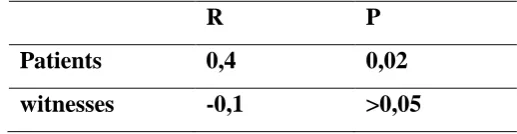
Results from the table below, a positive correlation between the scores obtained Raven and age was observed in children with sickle cell disease (r = 0.4; p = 0.02). For control cases no significant differences (r = -0.1, p> 0.05).
Table 6: Correlation between the scores of Raven and age.
R
P
Patients
0,4
0,02
witnesses
-0,1
>0,05
VII.DISCUSSION
Sickle cell disease is a chronic disease whose clinical expression is highly variable, ranging from no symptoms to very severe paintings. During which can express functional symptoms associated with vaso-occlusive crises, hemolytic anemia, with episodes of splenic sequestrations and acute chest syndrome and stroke. These complications may accompanied the child with sickle cell disease in all its stages of development that can affect neurocognitive level and consequently on their academic performance.During the study period, 60 affected children were collected with a mean age of 11 ± 0.27 years. The male is most predominant in both groups studiedThe school performance of children with sickle cell disease characterized by the repetition criterion is inferior to witnesses with a highly significant difference (chi-square = 13.75, P <0.001), these results are similar with the work of OgunfoworoOBet al, 2005, (11) and Schatz J. 2004 (12), they have shown that sickle cell patients were at higher risk of hospitalization than children who witness this results in a higher school absenteeism. Thus in this work 60% of SCD had repeated a class. This frequency was 53.7% for Oyedeji Nigeria. Repetition occurred especially among the child of seven to 11 years, during the primary cycle which explains 36.8% of sickle cell disease aged 12-16 years were still in primary school versus 18% among controls. The determinants of these repetitions did not appear clearly in this work. Indeed, the number and duration of absenteeism, number of crises, and generally precarious, low family income and non uniformity of treatment, seem a priori determinants. By contreRichards Burlew and in 1997 13) did not observe significant difference in school performance between sickle cell disease. In fact, by neurocognitive tests, Ashley-Koch and al, 2001; Steen, 2002; Wasserman and al, 1991) [14] [15] [16] observed a normal IQ distribution among sickle cell and witnesses. This is consistent with our results by the Raven test. However, the results obtained were significantly poor, with scores that match the faulty intellectual levels, according to British and Kuwaiti and Moroccan calibration. Calculating chi-square test, has allowed us to show no significant difference between patients and the control group (chi-square = 447, df = 1, p = 0.17).
A study of children from Africa Sub-Saharan Africa, sickle cell anemia is associated with death and generates archaic notched [17] These childhood fears and anxieties of death infiltrate their intellectual functioning and paralyze their thinking. It follows these children may use their intellectual skills.In addition, children of low socioeconomic status generally suffer more than high socioeconomic status children issues affecting performance on cognitive tests, including inadequate medical prenatal
[image:3.595.45.292.578.709.2]deficiency anemia [23], deficit attention disorder untreated [24], environmental exposure to lead [25-26], aridity Education [27], the low attendance [28], poor social environment [29-30).According hematocrit results obtained low hematocrit values in patients it was noted. However the correlation of hematocrit results with the scores obtained by the Raven test, we found a positive correlation (r = 0.61; p <0.001), and it was deduced that the low hematocrit is a significant predictor cognitive impairment in children with sickle cell disease, these results are also found in [31] suggesting that cognitive impairment is associated with chronic hypoxia. Referring to the literature, [32] we found that the cognitive impairment in case of sickle cell disease is associated with a reduction of hematocrit, even in the absence of ischemic injury.In addition, both this study and cooperative study of sickle cell disease [33], found that cognitive ability tends to decrease with age.
VIII.
CONCLUSION
Our study aimed the highlighting of the effect of sickle cell disease on neurocognitive abilities of children studied and the identificationpotential neurocognitive deficits that may affect the normal development of the child and affect his training and his future as well. These challenges must be managed very early in the course of care these children. Then a reflection effort is needed from us "as a researcher," as well as from other stakeholders in the field of school health. These efforts should set the goal to identify all the factors inducing these disorders and the various methods remédiassions, and establish a clinical management protocol, and psycho-cognitive suitable for these children.
RÉFÉRENCES BIBLIOGRAPHIQUES
1. OMS. (2006). Drépanocytose (No. A59/9). Geneva: Organisation Mondiale de la Santé.
2. DeBaun. M., Schatz J, Siegel MJ, et al examens de dépistage cognitif pour infarctus cérébraux silencieux dans la drépanocytose. Neurologie 1998; 50: 1678 -1682
3. Brown RT, Davis PC, Lambert R, Hsu L, Hopkins K, Eckman J. Neurocognitive functioning and magnetic resonance imaging in children with sickle cell disease. J Pediatr Psychol 2000;25:503–513. 4. Noll RB, Stith L, Gartstein MA, et al. Neuropsychological functioning
of youths with sickle cell disease: comparison with nonchronically ill peers. J Pediatr Psychol 2001;26:69–78
5. Bérubé, L., 1991, Terminologie de neuropsychologie et de neurologie du comportement, Montréal, Les Éditions de la Chenelière, pp.176. 6. Raven JC., 1958, Test de Matrices Progresivas. Escala Especial
Buenos Aires. Buenos Aires:
Piados,
7. Ivanovic R, Forno H, Dura´n MC, et al. 2000, Estudio de la capacidad
intelectual (Test de
Matrices Progresivas de Raven) en escolares de 5 a 18 años. I.
Antecedentes generales,
normas y recomendaciones. Regio´n Metropolitana. Chile. 1986–
1987. Iberpsicologia
2003; 8.1.1. (Complete version is published in Rev Psicol Gen Apl Esp; 53:5.
8. Abdel-Khalek, A. M., & Raven, J. (2006). Normative data from the standardization of ravens standard progressive matrices in Kuwait in an international context. Social Behavior and Personality: an international journal, 34(2), 169-180.
9. Raven, J. (1981). Research Supplement No.1: The 1979 British standardisation of the standard progressive matrices and Mill Hill vocabulary scales, together with comparative data WPE Raven 12 from earlier studies in the UK, US, Canada, Germany, and Ireland Manual for Raven’s
Progressive Matrices and Vocabulary Scales. San Antonio, TX: Harcourt Assessment.
10. Sbaibi, R., Aboussaleh, Y., & Ahami, A. O. T. (2014). The Standard Progressive Matrices Norms in an internationalcontextamong the middle school children of the rural commune Sidi el Kamel (North-Western Morocco).WebPsychEmpiricist. Retrieved from http://wpe.info
11. Ogunfoworo OB, OlanrewajuDM, AkenzuaGI. 2005. A comparative
study of academic
achievementofchildrenwithsicklecellanemiaand their healthy siblings.
J Natl Med Assoc;
97: 405-8.5.
12. Schatz J. 2004. Academicattainmentinchildren with sickle cell disease. J Pediatr Psychol.; 29: 627-33.
13. RichardHW, BurlewAK. 1997. Academic performance among
children with sickle cell
disease:setting minimum standards for comparison groups. Psychol Rep; 81: 27-34.
14. totheoccurrenceofdevelopmentaldisabilities:a population- based study. Genet Med; 3: 181-
15. SteenRG, HuXJ, ElliotVE, MilesMA, Jones S, WangWC. 2002. Kindergartenreadnessskills in children nwithsickle cell disease: evidence of earl neurocognitivedamage?J.Child Neurol ; 17 (2): 111-6 16. WassermanAL, WilimasJA, FaircloughDL, Mulhern RK, Wang W..,
1991. Subtle
neuropsychologicaldeficitsinchildren withsickle cell disease. Am J
Pediatr Hematol
Oncol ; 13 (1): 14-20.
17. PruneauJ,FerezS,MaillardF,etal.Accès à la culture biomédicale et
enjeux socio-symbolique des
représentationsdeladrépanocytosedansunepopulationscolairedeGuadel oupe.Etudescarribéennes2009.
http://etudescaribeennes.revues.org/368.
18. Naeye RL, Peters EC. Antenatal hypoxia and low IQ values. Am J Dis Child 1987; 141:50–54?
19. Wallace IF, Rose SA, McCarron CM, Kurtzberg D, Vaughan HG. Relations between infant neurobehavioral performance and cogni tive outcome in very low birthweight preterm infants. J Dev Behav Pediatr 1995; 16:309–317.
20. Nield TA, Langenbacher D, Poulsen MK, Platzker AC. Résultat neurologique à 3,5 ans chez les enfants traités avec le soutien de la vie extra: relation de diagnostic primaire J Pediatr 2000 ; 136 : 338 -344.CrossRef Medline
21. Aboussaleh, Y., Ahami, A. O. T., Bonthoux, F., Marendaz, C., Valdois, S. et Rusinek, S., 2006, Performances cognitives des enfants anémiques âgés de 6 à 11 ans en milieu urbain du Nord Ouest Marocain. Journal de Thérapie Comportementale et Cognitive, 16(2), 49-54.
22. Gorman KS. Malnutrition and cognitive development: evidence from experimental/quasi-experimental studies among the mild-tomoderately malnourished. J Nutr 1995; 125:2239S–2244S.
23. Pollitt E. Iron deficiency and cognitive function. Annu Rev Nutr 1993;13:521–537.
24. Detterman DK, Thompson LA. What is so special about special education? Am Psychol 1997;52:1082–1090. 30
25. Azzaoui, F-Z., Ahami, A.O.T., Rusineck, S., 2010, Etude d’impact du milieu environnant sur les fonctions cognitives des enfants marocains de la région du Gharb. Antropo, 21, 19-25. www.didac.ehu.es/antropo. 26. Needleman HL, Shell A, D Bellinger, Leviton A, Allred FR. Les effets à long terme de l'exposition à de faibles doses de plomb dans l'enfance:. Un rapport de suivi de jusqu'à 11 ans N Engl J Med 1990 ; 311 : 83 -88 27. Brody N. Intelligence, schooling, and society. Am Psychol 1997; 52:
1046–1050?
28. Ceci SJ, Williams WM. Schooling, intelligence, and income. Am Psychol 1997; 52:1051–1058.
29. Suzuki LA, Valence RR. Course-ethnicité et l'intelligence mesurée: implications éducatives Am Psychol 1997 ; 52 : 1103 -1114CrossRef 30. Mouden Samira, Ahami Ahmad Omar, Mouilly Mustapha, Fayez
31. Steen RG, Xiong X, Mulhern RK, Langston JW, Wang WC. Anomalies cérébrales subtiles chez les enfants atteints de la drépanocytose: la relation à l'hématocrite du sang Ann Neurol 1999 ; 45 : 279 -286.
32. Grant Steen, Mark A. Miles, Kathleen J. Helton, Susan Strawn, Winfred Wang,Xiaoping Xiong, and Raymond K. Mulhern Cognitive Impairment in Children withHemoglobin SS Sickle Cell Disease:Relationship to MR ImagingFindings and AJNR Am J Neuroradiol 24:382–389, March 2003
33. Wang W, Enos L, Gallagher D, et al. Neuropsychometric performance in school-aged children with sickle cell disease: a report from the Cooperative Study of Sickle Cell Disease. J Pediatr 2001; 139:391–397.
AUTHORS PROFILE
Mouden Samira : UFR Human Biology and Population Health. Unit of Clinical Neurosciences and nutritional health. Department of Biology. Ibn Tofail University. Kenitra. [email protected]
Pr Ahami Ahmad Omar: UFR Human Biology and Population Health. Unit of Clinical Neurosciences and nutritional health. Department of Biology. Ibn Tofail University. Kenitra. [email protected]
Pr khorassani : Unit of Hematology and Pediatric Oncology CHU Ibn Sina