International Journal of Innovative Technology and Exploring Engineering (IJITEE) ISSN: 2278-3075,Volume-8, Issue-11, September 2019
Abstract: Theft of software code is rapidly increasing with the growth of internet all over the world. That becomes the serious issue for the creator of the software code, as they invest their time and money to develop software code. Code for the Web based application can be accessed easily, as they are available as open source. These software codes can be tempered and can be misused any time. The protection of such web application code is essential. For the security of such codes from unauthorized accessibility, number of protection methods have been designed and developed. A model was proposed by Himanshu et al [4] for the protection of copyright of software code. In which few extra character stings were embedded in the encrypted original string. In this model concept of cryptography was implemented. This research paper is presented as the implementation procedure of the Digital Watermarking Technique to secure Intellectual Property Right of the web application code developed in ASP.NET using Visual C# programming language.
Keywords : Algorithm, Detection, Digital Watermarking, Encryption, Embedding, Intellectual Property Right, Web enabled application.
I. INTRODUCTION
A
number of web enabled applications are running over
the network as the Internet facility is increasing day by day, to provide the facilities to the end users. They are using these web enabled applications to improve the efficiency and effectiveness of their business work by reducing cost, provide fastest accessibility and secure transaction etc. The main drawback of the development of Web enabled Application uses is that the code is required to be put publically. This code may be accessed by any unauthorized user by entering into the system. Such unauthorized user can temper, and misuse this software code. Protection of such software code is necessary. The protection can be done by Intellectual Property Right using Digital watermarking. Intellectual Property (IP) is described as any "original creative work manifested in a tangible form that can be legally protected". Intellectual Property rights, means to control the method IP is used, accessed or distributed. The IP laws were enforced throughout the world by World Intellectual Property Organization (WIPO). With the help of protecting IP, weRevised Manuscript Received on September 05, 2019.
* Correspondence Author
Himanshu Rastogi*, Research Scholar, Mewar University, Chittorgarh,
Rajasthan, India. Email: [email protected]
Dr. Birendra Kumar Sharma, Professor and Head, Department of
MCA, AKG Engineering College, Ghaziabad, India. Email: [email protected]
want to promote creativity and encourage the creator. In year 2018, a global survey report was released by the Business Software Alliance [2]. Which shows the rate of illegal use of software in various countries is shown in Table 1.1.
Table 1.1: Unlicensed Software Installation Rates in percentage
Country Name Years
2011 2013 2015 2017
Asia Pacific 60% 62% 61% 57%
C & E Europe 62% 61% 58% 57%
Latin America 61% 59% 55% 52%
ME & Africa 58% 59% 57% 56%
N America 19% 19% 17% 16%
W Europe 32% 29% 28% 26%
It means privacy of software directly affects the revenue of software vendors. The software vendors are loosing millions of US dollars every year. Last four (alternative) year data have been shown in Table 1.2
Table 1.2: Amount of Loss in $ Country
Name
Years
2011 2013 2015 2017
Asia Pacific $20,998 $21,041 $19,064 $16,439 C & E Europe $6,133 $5,318 $3,136 $2,910 Latin America $7,459 $8,422 $5,787 $4,957 ME & Africa $4,159 $4,309 $3,696 $3,077 N America $10,958 $10,853 $10,016 $9,458 W Europe $13,749 $12,766 $10,543 $9,461 Digital Watermark technique was actively came into existence in the mid of 1990s, for copyright protection, and intellectual property right etc for digital contents or documents that are either in any form like image, video, or text. In digital watermarking a pattern is embedded in the original IP such that actual working cannot be disturbed. Different methods have been discussed time to time to protect software code from piracy and unauthorized accessibility and tempering. In software watermarking technology, a security or special key will be embedded into the original software code, to prove the ownership in such a manner that it would not disturb the actual code[5][10]. This embedding can be done either at design time or at run time.
Implementation of Digital Watermarking
Technique to Secure IPR of Web Application
Code
This security or special key or watermark can be extracted when required to prove ownership. Security and piracy of software become an important issue. The secret key includes data of the actual owner like developer and IT Company, developed that code. The flow of the application program cannot be disturbed by an embedded watermarked. This will not affect the application code. [11]. Software watermarking can be enhanced with other forms of protection, copyright infringement and decompilation [12].
It has been observed that web based application plays a major role in any transaction over Internet [1]. All the sectors are taking the advantage by using these Web applications. And so any one as individual or a company wants to create an web application without putting much efforts towards the development of such web applications. Such developer wants to get code form the internet and they implement the same code in their websites. Hence, protection of software code putting publically and in the visible form is major issue.
Protection model for web enabled application code is developed by using ASP.NET and C#. Microsoft developed ASP.NET which is an open-source web application framework designed for the development of dynamic web sites, and services. The main advantage of using ASP.NET is to reduce the programming code which is required to implement protection model. It was first released in January 2002 under .NET framework. This framework allows web developers to write code with the help of any .NET language like visual C# [14].
Watermarked module is implemented in the form of DLL file, to prevent it from unauthorized access. A DLL is a library contains functions and data which can be used by more than one program at the same time. These dll files are registered with GAC (Global Assembly Cache) to make it shared assembly. So that it can be accessed from its original location. To make it shared assembly a strong name key must be required [15][16].
II. RELATEDWORK
Ashwag Alrehily et al [3] proposed a Return-Oriented Programming (ROP) based software watermark design. In their research paper they considered that to improve the efficiency of the software watermarking security, a secured Hash algorithm plays an important role. In the method discussed, they focused on categories and analysis of the gadgets. H. Rastogi et al [4] proposed a method of embedding an encrypted key in the original data. In this research paper, the technique of cryptography was implemented with an assigned key and also explained the working procedure of the technique. Nisha [6] has done survey based on various techniques of watermarking and, further, explained the comparison between different techniques on the basis of experimental results. Advantages and disadvantages of these techniques of watermarking were also discussed in her research paper.
Atef Zaki Ghalwash et al [7] proposed a technique, which embeds and detects the watermark in the data structure of software. The technique works on two different stages in which Variable-base Factorial generated watermark is embedded in a Quad-tree data structure. In the second stage,
find out the accuracy and reliability of detecting the watermark.
Vasudev [8] suggested that the vast popularity of internet presents different multimedia resources through different digital networks. These multimedia resources or digital media must be secured against various unauthorized attacks.
Kaur et al [9] proposed a innovative method for the protection of digital contents using digital image watermarking. In this proposed method author, presented a technique using a combination of spatial domain technique and frequency domain techniques.
Dwivedi et al [11] proposed a database watermarking techniques with constraints and analyze the strengths and weaknesses. They suggested in their paper that in todays digital scenario not only images related contents, video enabled data, and audio based data are in digital form, but relational databases also have been migrated towards in digital form. These databases are used as a service in the applications in different forms like finance related databases, multimedia related databases, personnel related databases etc. It is not so easy to embed Digital Watermarking in relational database without losing the integrity because databases have very little redundancy, if we compared with multimedia data.
For the protection of digital contents, Awasthi et al [12] proposed a technique for Digital Image Watermarking. Technique presented in the proposed model is based on the mixture of Spatial Domain Technique (SDT) and Frequency Domain Techniques (FDT. Three different techniques used in watermarking viz Discrete Wavelet Transform (DWT), Singular Value Decomposition (SVD) and Least Significant Bit Techniques (LSBT) are combined to give strength to the watermarked image and also to get better the quality of watermarked image.
Sharma et al [13] explained static and dynamic techniques for software watermarking. In their research paper, they discussed that the watermarks are embedded in the source code at the time of coding of the application, in static software watermarking techniques. While in dynamic software watermarking techniques the watermarks are generated at run time or during execution time and embedded later at run time. In their paper, they have discussed about the Modular Programming and also proposed a new static watermarking technique for the same
III. DIGITALWATERMARKINGTECHNIQUE a) For Embedding: Following is the proposed algorithm
International Journal of Innovative Technology and Exploring Engineering (IJITEE) ISSN: 2278-3075,Volume-8, Issue-11, September 2019
………. (1)
………. (2)
Where CO⇒ Original Character String
CE⇒ Encrypted form of CO
Cw⇒ Watermarked Character String
CR⇒ Random Character String
CL⇒ Character String based on the character length of CO
Fig: 1. Embedded Code Algorithm Method
Watermarking Algorithms: Following are the two algorithms used in this paper. Abbreviations used in the algorithms are shown in table 3.1:
Table 3.1 : Abbreviations used in Algorithm
Sr.No Abb Used Purpose
1. AV Actual Value
2. ENV Encoded Value
3. RS Random Character String
4. CL String CL to find out length of Actual Value
5. nOP Number at Once Position
6. nTP Number at Tense Position
7. nAV Length of Actual Value
8. EXV Extracted Value
9. OV Observed Value
3.1 Embedded Code Algorithm:
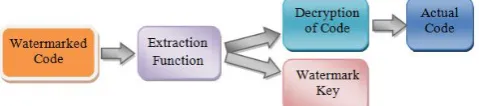
[image:3.595.308.548.203.256.2]b) For Extraction: This algorithm is the reversible process of the algorithm used in Embedded code. In this algorithm, Watermarked code will be split on the basis of the last two character code of the embedded code. These two character code will be converted in to number system form to get the length of actual text string. Let say it is ‘n’. After that, first ‘n’ characters of the watermarked code will be split and decrypt with the same key as used in the embedded code algorithm. If it is found as same as embedded during watermarked code, then the code owner is authenticated otherwise the user is fake.
Fig: 2. Extraction of watermark code algorithm Method
3.2 Extraction of Watermark Code Algorithm:
IV. IMPLEMENTATIONOFTECHNIQUEINWEB APPLICATIONDEVELOPEDINASP.NET Above algorithm has been implemented in web enabled application using ASP.NET framework and Visual C#. For the execution of the algorithm, functions for Embedding and Extraction are defined in .dll file. To create .dll file, we have to select .
1) Read: (AV); 2) n = Length(AV) 3) for i =0 to n-1 do
4) ENVi = Char(Int(AVi) + 3) 5) end for;
6) Generate string of random characters RS30-n; 7) for i=0 to 30-n
8) RSi = RSi + Char(RandomNo); 9) end for
10) ENV = append(AV, RS);
11) Define string CL with 10 different characters 12) nOP = n / 10;
13) nTP = n Mod 10;
14) ENV = append(ENV, CL(nTP) , CL(nOP));
1) Input(ENV);
2) Extract last two characters from ENV and find the index of these characters from string CL, defined in algorithm (2).
3) Find the Length of string (CL) and assign it to nCL; 4) for i =0 to nCL
5) if last value of ENV matched with CLi then 6) nOP = i;
7) end
8) if second last value of ENVmatched with CLi then 9) nTP = i;
10) end 11) end for
12) Find length of AV by nAV= 10 * nTP + nOP; 13) Extract first nAV characters from ENV 14) for i = 0 to nAV -1
15) EXVi = EXVi + ENVi; 16) end for
15) for i =0 to nAV-1 do
16) OVi = Char(Int(EXVi) + 3) 17) end for;
18) if OV is same as AV then 19) ownership PASS 20) else
NET Framework (Class Library) during selection of a new project in visual studio. Here we wrote these functions and compiled this code using Build Solution option, to create .dll file.
This created .dll file need to be registered as shared assembly so that it can be used by more than on user at the same time. For registration, we need to use visual studio command prompt and write the following command to create strong name file:
C:\sn –k “Path of the location where snk file will be saved” With this command we have created strong name file. Added this file into ASP.NET file, where we have used these functions. To add reference of this strong name file following sequence of the procedure was followed:
Project Menu → Properties→ Signing→ “Here check option Sign the Assembly”
And select the .snk file (Strong Name File), using browse option.
Again rebuild the code to update .dll file.
Now, this .dll will need to register with GAC (Global Assembly Cache) by using visual studio command prompt with the following syntax:
C:\ gacutil –I “Path of the .dll file” This will attach with GAC.
Now this .dll is ready to connect with any .aspx file or project.
Function definition used in .dll file: namespace WebApplication
{
public partial class clsValidationCheck {
protected string EncryptString(String strText) {
//---Code For Encryption of String
//---code for random char generation--- //---code to add two additional numbers for length }
protected string DecryptString(String encString) {
//---code for extraction of original string length & encrypted string //---code for conversion in to original string-- }
} }
Function call in .aspx file: namespace WebApplication {
public partial class myWebPage : System.Web.UI.Page {
protected void btnEncrypt_Click(object sender, EventArgs e) {
clsValidationCheck objClass = new clsValidationCheck(); objClass. EncryptString(strString);
protected void btnDecrypt_Click(object sender, EventArgs e) {
clsValidationCheck objClass = new clsValidationCheck(); objClass.DecryptString(strString);
} } }
V. PERFORMANCEEVALUATIONMETRICFOR
WATERMARKEDWEBAPPLICATION
The performance of any software code is always based on space consumed by the system, speed of the processor and time taken for the execution of the application. For the evaluation of the performance of watermarked web enabled application code, mathematically it can be expressed as follows:
The size of the watermarked web enabled application code should not increase significantly as a web server hosts lots of web applications. Let the size of an actual web application code (Actual Value) ‘x’ be S(x) and also let the size of the web application code after watermarking (Watermarked Value) ‘W(x)’ be S(W(x)), the performance (W(x),x) of web enabled application code is expressed as:
Performance of watermarked Code (W(x), x)
= ((Actual Value – Watermarked Value)) / Actual Value
= [S(x) – S (W(x))] / S (x)
VI. CONCLUSION
As we know that Web enabled application plays a major role on internet for every sectors of any business like Education, Healthcare, Automobiles, etc. For the analysis of the protection of software code for web application, different research papers were surveyed. In our research paper, in which an expected model was developed for the protection of copyright of software code using digital watermarking, we have implemented the same model using ASP.NET framework and Visual C#. In this research paper, we have discussed about the algorithm with mathematical representation and also the steps involved in using the model. This implementation could be either in visible form or in invisible form.
REFERENCES
1. Himanshu Rastogi, Dr. B.K.Sharma “Web Based Application Protection using Software Watermarking: A Study” in the 2nd International Conference on Managerial Strategies for Technological Transformations in 21st Century, 2019, ISBN: 978-93-86789-82-2, Chapter ID: IC-MSFTTI21C/YB/AP-18, pp.135-139.
2. Software Management: Security Imperative, Business Opportunity, BSA Global Software Survey, June 2018
3. 2018 Computer Security and Software Watermarking
International Journal of Innovative Technology and Exploring Engineering (IJITEE) ISSN: 2278-3075,Volume-8, Issue-11, September 2019
5. S. E. Tsai, K. C. Liu, and S. M. Yang, “An Efficient Image Watermarking Method Based on Fast Discrete Cosine Transform Algorithm”, Hindwani-Mathematical Problems in Engineering, Volume 2017, Article ID 3509258.
6. Nisha, “Digital Watermarking Techniques: Review”, International Journal of Advanced Research in Computer Science and Software Engineering, Volume 7, Issue 1, (2017), ISSN: 2277 128X.
7. 2017 A Watermark Methodology for Software Copyright Protection 8. Rajiv Vasudev,“A Review on Digital Image Watermarking and Its
Techniques”, Journal of Image and Graphics, Vol. 4, No. 2, (2016), page no 150-153
9. Maninder Kaur and Nirvair Neeru. “Digital Image Watermarking using New Combined Technique”, International Journal of Computer Applications, (2016), 145(2):26-30.
10. Sumedh P. Ingale et al, “Digital Watermarking Algorithm using DWT Technique”, International Journal of Computer Science and Mobile Computing, Vol.5 Issue.5, (2016), pg. 01-09
11. Anuj Kumar Dwivedi, Dr. B. K. Sharma, Dr. A. K. Vyas, “Watermarking Techniques for Ownership Protection of Relational Databases”, International Journal of Emerging Technology and Advanced Engineering; ISSN 2250-2459 (Online), Volume 4, Special Issue 1, (2014) International Conference on Advanced Developments in Engineering and Technology (ICADET-14), INDIA.
12. Yogesh Awasthi, R.P.Agarwal, B.K. Sharma, “Intellectual Property Right Protection of Browser based Software through Watermarking Technique”, International Journal of Computer Application(IJCA), Volume 97– No.12, (2014), 32-36
13. Dr. B. K. Sharma, Dr. R. P. Agarwal, Dr. Raghuraj Singh, “An IPR of software codes using watermarking For Modular Programming”, ISST Journal of Mathematics & Computing System, ISSN No. 0976-9048, Vol. 1 No.1, (2010), p.p. 55-58
14. https://en.wikipedia.org/wiki/ASP.NET
15. https://support.microsoft.com/en-in/help/815065/what-is-a-dll 16. https://www.c-sharpcorner.com/article/assembly-in-net/
AUTHORSPROFILE
Himanshu Rastogi has completed his MCA from CCS
University, Meerut in 2000 and M.Phil. in Computer Science from Alagappa University, Tamilnadu in 2004. He is currently pursuing Ph.D. from Mewar Univerisity. His academic experience is approx 16 Years. His research interests include Digital Watermarking, Data warehousing, Data Mining and, Computer Networking. He has published his research papers in International/National Journals/Conferences. He has the experience of all phases of SDLC and PDLC to deliver business focused solutions as Technical/Team Lead, Developer.
.
Dr. Birendra Kumar Sharma is a Professor and Dean
Hostel of Ajay Kumar Garg Engineering College, Ghaziabad. He has obtained his MCA degree from JNU,
New Delhi, M.Tech. from Guru Gobind