International Journal of Innovative Technology and Exploring Engineering (IJITEE) ISSN: 2278-3075, Volume-8 Issue-10, August 2019
Abstract: In this concept, analyze two processes model with certain tuning conditions. Design process with nonlinear conditions, disturbance and unstable position along with mutually interaction. Most of the processes are dynamic only w.r.t manipulated variable, disturbances and other unexpected conditions. Two models are resembled as interactive and mutual controlled process through sensors. Compare both processes with and without nonlinearity along with disturbance with tuning condition upto reach set point. Estimate prediction horizon, control horizon, weighted input, weighted rate of input, weighted output and desire trajectory are imposed for both processes by nonlinear predictive control. The main intense to regulate pressure and get desire level with impact of disturbances as temperature, added impurities etc… In this work, can be extended interaction of process with NMPC by adding more complexity and stabilize with certain tuning methods. NMPC is advance method to predictive input as well as output with respected sample time based on prediction horizon and control horizon on receding horizon of axis.
Index Terms: Control horizon, NMPC, nonlinearity, prediction horizon, unstable.
I.INTRODUCTION
In industry, controllers are play vital role for maximum optimization, tuning, adjustment and necessary set points are influenced. The controller can be evolved from classic to advanced predictive level, looking into real time response methods and exhibit better performance. MPC controller is imposed in chemical plants but now, implied for better optimal and computational progress. MPC can be explicitly handle constrains, optimize problem set up and prediction horizon. It can handle and predict input and output simultaneously. The motivation of this work is reference my previous work for interactive loop processes such as quadruple & octal tank process. Extended this work with references of [5], [6] & [7] added various disturbance level and apply tuning techniques for stabilize processes. E. Harinath [1] at all explains the role of MPC for thermo-mechanical pulp for optimization of processing. Even though MPC can be applied in agriculture filed is explained by Ying Ding at all [2] Model predictive control and its application in agriculture. John Espinoza at all defines for Real-Time Implementation of MPC in a Low-Cost Embedded device [3]. Similarly add information
Revised Manuscript Received on August 05, 2019
Dr.P.Srinivasarao, Department of EEE, Sree Vidyanikethan Engineering College, Tirupathi, India.
G.Hemanth kumar, Department of EIE, Sree Vidyanikethan Engineering College, Tirupathi, India.
K.S. Chakradhar, Department of ECE, Sree Vidyanikethan Engineering
for ral time implementation for speed control of motor by Mujtaba Jaffery at all [4]. Analyze process integration and control by Mengfei Zhou at all [8]. Functioning and navigation systems are defined by NMPC for process by [9], [10]. In this paper prepare nonlinear unstable and linear unstable processes with source of input as pressure, disturbance as temperature and output as level indicator. The process is viewed by disturbance as temperature and analyzed by different tuning conditions. This work is presented as follows: first the Introduction, then the design of process model, later the predictive controller, after that the performance analysis of processes with result and Conclusions respectively.
II. DESIGNOFPROCESSMODELS
Here consider two processes with manipulated variable as pressure of flow, disturbance of temperature and outputs as level of flow. In general, flow and vacuum are more common interactive variables. It can be extended four tank process in industries with different loop system, but not resemble of FTP. If there is flow in process it may divert into another way, while flow in-stream it can be interrupted with disturbance like pressure, temperature, force and vacuum. Due to nonlinearity of design process the desired set point can be deviated. Similarly instability would be cause for deviate into desired set point.
The plant has two inputs as low pressure and high pressure units of Pa, disturbance as temperature in K with respect to pressure and two outputs as heat flow & level and cool flow &
level units of
J S
/
/
oC
and M. proposed two type processes are one is unstable interactive process and other one is unstable nonlinear interactive process. Both process are working similar method but one process is influenced by nonlinearity condition has shown in fig 1 & 2.The high pressure is applied at one input passing through filter. At the outset pressure is mixed with low pressure through filter from other input. The pressure level is oscillated because of nonlinearity and exponentially functions. Meanwhile disturbance is added as temperature on process, it reflects to alter expected set point. Here inject different temperature as disturbance in process before reach set point passed through one more filter.
Low pressure is consider at other input and combined with high pressure through unstable interactive filter. Source is applied for unstable closed loop and exhibits oscillate response.
Stabilize Nonlinear Interactive Process By
Predictive Method On Receding Horizon
Later response has been passed through 2nd order filter along with nonlinear condition. In this situation, temperature is added from external disturbance before reach set point ahead passing through another filter. Due to unstable, disturbance and nonlinearity condition is consumed more time to expected set point.
Fig.1. Unstable nonlinear interactive process.
In general, most of interactive processes are availed more settling time to approach set point with some tolerance. Analyze and observe response with different disturbance. Similarly examine another process without unstable filter. It is exhibited better response compare with unstable nonlinear process with marginally tolerance only.
Here, specify and express filers below for both processes
2
1
6
G
S
2
2
3
7
G
S
1
3
1
G
S
3 23
4
4
4
2
1
G
S
S
S
21
5
3
1
G
S
22
1
6
2
2
1
S
G
S
S
1
1
H
S
2
1
2
1
H
S
Fig.2. Unstable interactive process
III. PREDICTIVECONTROLLER
More advanced and expert controller is useful for MIMO systems. This controller have specially designed for
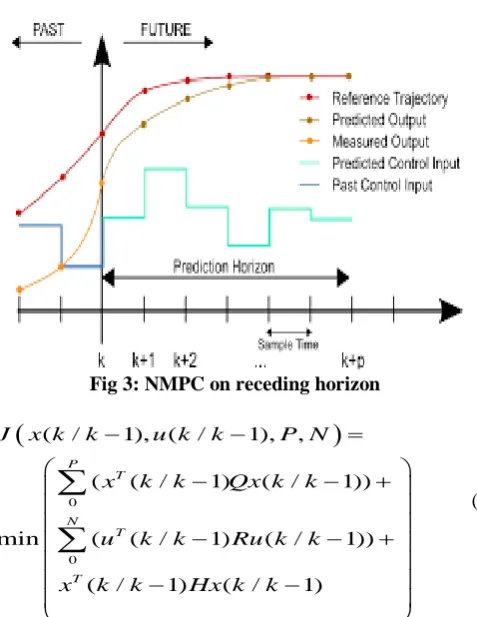
input at each sample time on receding horizon controller is shown in fig 3 .
[image:2.595.309.548.179.488.2]At each and every sample time, compute current sequence and next step of system state with recomputed. Like every step it computes and track the trajectory of input simultaneously predict further output. NMPC can be consist of cost function, quadratic program, prediction horizon, control horizon, rate of weighted input, weighted input, weighted output and state variable. Compute MPC function can be expressed below as in equation (1).
Fig 3: NMPC on receding horizon
0
0
( / 1), ( / 1), ,
( ( / 1) ( / 1))
min ( ( / 1) ( / 1)) ( / 1) ( / 1)
P T
N T
T
J x k k u k k P N
x k k Qx k k
u k k Ru k k
x k k Hx k k
(1)NMPC optimization is a function of input u and state variable x; these two parameters are tuned externally by P, N and internally by Q, λ, R as per Eqn. (1). All these parameters are however described underneath in the following sections.
A.Prediction Horizon P
Predictive output with respect input based on no of level on receding horizon. Main focus of process to reach steady state, it will lead to approach set point without oscillation. The role of P is to minimize aggressiveness response and adjust the expected value. P is defined of my reference as given below
P k
t
r
T
s
(2)
int
1
P
M C
k
(3)
t
P T
p
k or
r
(4)P is tuned from the various parameter, like, settling time ts,
rise time tr , no of outputs k , higher order of process η , no of
[image:2.595.48.282.377.687.2]International Journal of Innovative Technology and Exploring Engineering (IJITEE) ISSN: 2278-3075, Volume-8 Issue-10, August 2019
horizon M, process response time Tp, sampling time TS,
delay time td and response of rise time 60,80,90,95 w.r.t Tp. P
value is calculated as average of number of outputs.
B.Control horizonN
N is different from P and oppositely working. Response of process depends on rise time and settling time. It is tune input for track and predict output and control aggressiveness along with P. If increase N may leads unstable process and consider less than of P. N is defined as below
min int
2 ,int
4
1
N
t
s
P
(5)
int
N
kn ts
(6)
C.Output Weighted Matrix Is Represented by Q
This matrix has elaborated smooth response of output. It is simulate the output relative weight according process either MIMO or SISO system.
Consider smoothness, expression for both stable and unstable phase will be
1
Q
(7)det T
Q C C (8)
Here C is output matrix of linear state space equation.
D.Weights on the Magnitude of the Inputs R
Weighted input is defined as per track of output and input trajectory depends on response of process with delay and disturbance.
The weighting matrices ‘Q’ and ‘R’ are tuned until desired performance is achieved. This is a tradeoff between a smooth signal and a fast system performance. If a smooth signal is desirable then the ratio Q/R is to be low and if one wants a fast system then the ratio should be greater. Q is defined may be less than equal1.
E.Weights on The Rate of Change of Inputs λ
Penalizing the rate of change produces a more robust controller but at the cost of the controller becoming more sluggish. Small value adjustments yield a more aggressive controller. Weight has been applied as rate for tuning manipulated variable for desired set-point without oscillation. Expression are defined as
1 P
(9)F.Weights on The Rate of Change of Inputs λ
Trajectory has shown path from input, disturbance and output as defined track shown in fig . It is designed between initial value and final value, j=1…P.
j closedloopts openloopts
(10)
0
j1(11)
IV. PERFORMANCEANALYSISOFTWO
INTERACTIVEPROCESSES
Two processes are designed with reference of interactive Quadruple Tank Process (QTP) in addition with unstable, disturbance and nonlinear conditions. In QTP main focus on minimum and non -minimum phase condition only based on water regulation. Here analyze and optimize process with certain conditions of disturbance and impact of process for deviation of expected set-point.
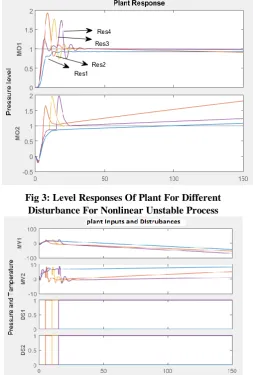
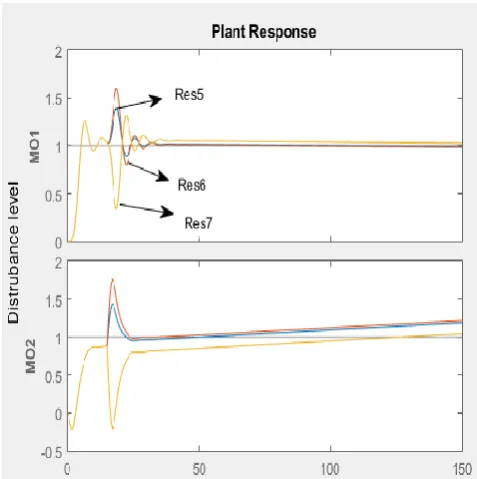
[image:3.595.305.560.287.480.2]Now come to first processes is shown in fig 1, which is analyzed at various tuning and disturbances. The tuning parameters are tabulated in table1 for all responses shown in fig 4 & 5 for plant level response with tune of pressure and disturbance of temperature. The disturbances of temperature are applied at 5, 10, and 15 second and analyzed response. Obtain and observe different levels for applied temperature at different amplitude level for 15 seconds delay with tunable pressure level are shown fig 5 & 6.
[image:3.595.303.557.291.667.2]Fig 3: Level Responses Of Plant For Different Disturbance For Nonlinear Unstable Process
Fig 4: Tuning Of Pressure And Applied Temperature As Disturbance For Nonlinear Process
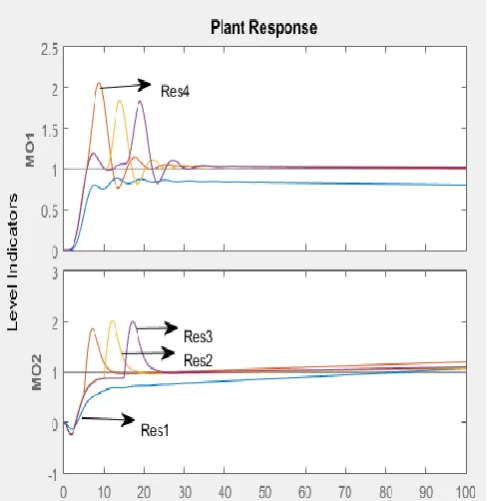
response with tune of pressure and disturbance of temperature. The disturbances of temperature are applied at 5, 10, and 15 second and analyzed response. Obtain and observe different levels for applied temperature at different amplitude level for 15 seconds delay with tunable pressure level are shown fig 9 & 10.
Table1: Data For Unstable Nonlinear Interactive Model
OUT
PUT
P N R Q λ Distrubance
and time
Res1 16 4 0.01 0.9 0.09 no
Res2 20 4 0.02 0.8 0.09 Step & 5s
Res3 20 5 0.01 0.8 0.08 Step & 10s
Res4 20 5 0.01 0.8 0.08 Step & 15s
Res5 20 5 0.01 0.8 0.08 0.5%& 15s
Res6 20 5 0.01 0.8 0.08 0.8% & 15s
Res7 20 5 0.01 0.8 0.08 -Ve step &
15s
Table2: Data For Unstable Interactive Model
OUT
PUT
P N R Q λ Disturbance
and time
Res1 16 3 0.02 0.9 0.09 no
Res2 25 5 0.015 0.95 0.09 Step & 5s
Res3 20 4 0.01 0.99 0.09 Step & 10s
Res4 20 5 0.01 0.9 0.09 Step & 15s
Res5 25 5 0.015 0.95 0.09 0.5%& 15s
Res6 20 5 0.01 0.8 0.08 0.8% & 15s
Res7 16 3 0.02 0.9 0.09 -Ve step &
[image:4.595.306.545.49.289.2]15s
Fig 5: Level Responses Of Plant For Different Amplitude Disturbance As 50%, 80% And –Ve 100% For Nonlinear
[image:4.595.312.541.331.612.2]Process
Fig 6: Tuning Of Pressure And Applied Temperature Disturbance As 50%, 80% And –Ve 100% For Nonlinear
International Journal of Innovative Technology and Exploring Engineering (IJITEE) ISSN: 2278-3075, Volume-8 Issue-10, August 2019
[image:5.595.307.546.53.353.2]Fig 7: Level responses of plant for different disturbance for linear unstable process
Fig 8: Tuning of pressure and applied temperature as disturbance for linear process
Fig 9: Level responses of plant for different amplitude disturbance as 50%, 80% and –Ve 100% for linear
[image:5.595.48.291.359.668.2]process
Fig 10: Tuning of pressure and applied temperature disturbance as 50%, 80% and –Ve 100% for nonlinear
[image:5.595.307.546.389.688.2]Author-3 Photo
V.CONCLUSION
In this work, compare two unstable processes with and without nonlinearity condition meanwhile added various level of disturbance to process. Both processes are exhibit similar response but linear unstable process has small deviation for all disturbances. This process may similar to any industries but conventional controller may not be stabilized nonlinear processes. MPC can stabilize, tune and track path to move desired set point. In both process exhibit better response without disturbances while added disturbances it may exhibit deviations and consume time to move towards desired path. Low pressure path has more deviation compare with high pressure path.
REFERENCES
1. Eranda Harinath, L.T. Biegler and Guy A. Dumont “Predictive optimal control for thermo-mechanical pulping processes with multi-stage low consistency refining” Journal of Process Control, vol.23, 2013, pp.1001– 1011.
2. Ying Ding, Liang Wang, Yongwei Li and Daoliang L “Model predictive control and its application in agriculture: A review” “Journal of Computers and Electronics in Agriculture” vol. 151, June 2018, pp.104–117. 3. John ESPINOZA at all “Real-Time Implementation of Model Predictive
Control in a Low-Cost Embedded Device” “Proceedings of the 9th International Multi-Conference on Complexity, Informatics and Cybernetics” ,IMCIC 2018, pp.106-111
4. Mujtaba Jaffery, Sohaib Aslam, Moinuddin Ghauri, M. Shahzad Khuram, SikandarRafiq and Subhan Khan “Real-time implementation of model predictive control on a 16-bit microcontroller for speed control of a dc motor” “Journal of Engineering Technology”, vol. 6, Jan 2018, pp.415-434.
5. P. Srinivasa Rao and K.S.Chakradhar “Tuning and Stabilize of Nonlinear Interactive Loop Process by Nonlinear Model Predictive Control” “International Journal of Control Theory and Applications”, vol.10, Aug 2017, pp.223-235.
6. P. Srinivasa Rao and Dr.P.Subbhai “Tuning and Analysis of Multiple Interactive Loop Process by Model Predictive Control”, “International Journal of Engineering and Technology” vol.6, Mar 2014, pp.212-226. 7. P. Srinivasa Rao and Dr.P.Subbhai “Tuning of Nonlinear Model Predictive
Control for Quadruple Tank Process”, “Journal of Theoretical and Applied Information Technology” vol. 67, September 2014, pp.316-326. 8. Mengfei Zhou at all “Integration of Process Design and Control Using
Hierarchical Control Structure”, “Science Direct, preparation of Process Design and Control Using Hierarchical Control” vol.48 2015, pp.188–192.
9. Qidan Zhu, Yu Han , Chengtao Cai, and Yao Xiao “Robust Optimal Navigation Using Nonlinear Model Predictive Control Method Combined with Recurrent Fuzzy Neural Network”, Hindawi Mathematical Problems in Engineering Aug 2018, pp. 801401 1- 8014019.
10. Hajer Degachi ,Bechir Naffeti, Wassila Chagra, and Moufida Ksouri
“Filled Function Method for Nonlinear Model Predictive Control”, “Hindawi Mathematical Problems in Engineering”, vol.94 ,2018, pp.97611-97618.
AUTHORSPROFILE
Received the B. Tech in Instrumentation engineering from Andhra University , M.Tech from COE Pune university, Ph.D from Dr. M. G.R. Educational Research and Institute University. Had around 13 years teaching experience and research in process control, sensor and image processing. Currently working as associate professor with the department of electronics and electrical engineering, Sree vidyanikethan engineering college in Tirupati, Andhra Pradesh, India.
Received the B. Tech in electronics and instrumentation engineering from chirala engineering college, chirala, in 2010. He is currently pursuing the Ph.D. degree with the Department of Electronics and Communication Engineering, The St. Peter's Institute of Higher Education and Research in Chennai. His current research interests are in the area of control systems, wireless sensor networks and Internet of Things. From 2012 to till now, he is an Assistant Professor with the department of electronics and instrumentation engineering, Sree vidyanikethan engineering college in Tirupati.
Third Author personal profile which contains their education details, their publications, research work, membership, achievements, with photo that will be maximum 200-400 words.