Towards Fully Automatic Annotation of Audiobooks for TTS
Olivier Boeffard, Laure Charonnat, Sébastien Le Maguer, Damien Lolive, Gaëlle Vidal
IRISA - University of Rennes 1, Lannion, France {olivier.boeffard,sebastien.le_maguer,damien.lolive}@irisa.fr,
{laure.charonnat,gaelle.vidal}@univ-rennes1.fr
Abstract
Building speech corpora is a first and crucial step for every text-to-speech synthesis system. Nowadays, the use of statistical models implies the use of huge sized corpora that need to be recorded, transcribed, annotated and segmented to be usable. The variety of corpora necessary for recent applications (content, style, etc.) makes the use of existing digital audio resources very attractive. Among all available resources, audiobooks, considering their quality, are interesting. Considering this framework, we propose a complete acquisition, segmentation and annotation chain for audiobooks that tends to be fully automatic. The proposed process relies on a data structure, ROOTS, that establishes the relations between the different annotation levels represented as sequences of items. This methodology has been applied successfully on 11 hours of speech extracted from an audiobook. A manual check, on a part of the corpus, shows the efficiency of the process.
Keywords:Audiobook, annotation, phone segmentation
1.
Use of Large Corpora for Speech
Synthesis
The use of statistical models, mainly from the speech recognition field, occurs in all the automatic language and speech processing disciplines. Learning such models on speech units needs a large number of observations and im-plies the use of large speech corpora. A direct consequence of the size of corpora is that conventional methods used to build, segment and annotate them have shown their limits. When we consider the field of speech synthesis, the unit generally used is the phoneme together with its precise lin-guistic and acoustic context. Representing in a database the whole set of the units generated by the combination of all the linguistic and acoustic features (about 50 features are used in HTS (Tokuda et al., 2000)) is impossible. Nonethe-less, learning models of the units that are present in the tar-get language can be done by the analysis of large natural speech corpora.
The increasing availability of digital resources enables re-search laboratories to have a great variety of recordings covering many speaking styles and recorded in varied con-ditions. In the framework of speech synthesis, we consider the use of audiobooks which enables to have recordings, read by a professionnal speaker and with a good acoustic quality, accompanied with the script. Audiobooks have a lot of benefits and can complete or even replace ad-hoc cor-pora. As an example, we can find different books read by the same speaker which increases the variety of speaking and literary styles, or we can find the same book recorded by different speakers and thus enabling studies using par-allel data. In addition, a specificity of textual data associ-ated to audiobooks is that they are nearly constant from one recording to another. However, possible variations may ex-ist in the case of multiple editions (translations, unfinished manuscripts, etc.).
An important step to build a new voice is the annotation of the signal and the associated text. This step may ap-pear simple if it is limited to the synchronisation of words onto the signal, but uses complex temporal relation when
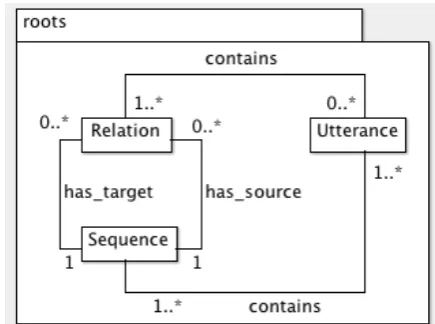
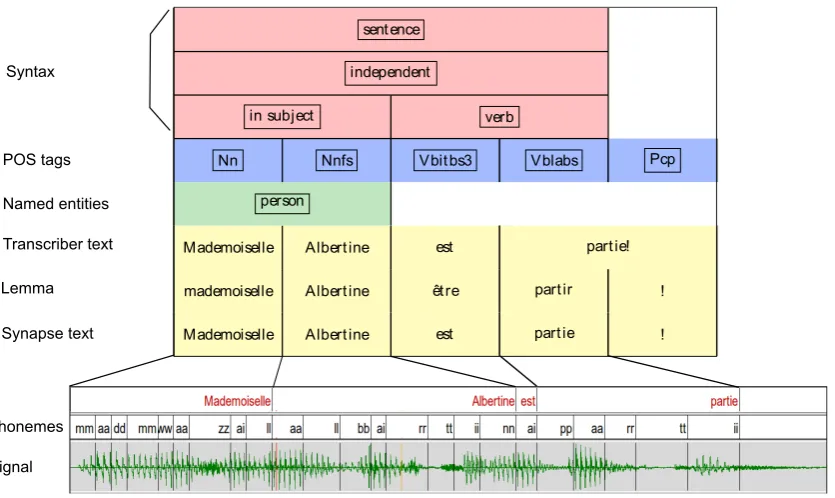
it comes to dealing with other levels of analysis, as seman-tic, lexical, grammatical, syntactical, phonetic or prosodic annotations. For each of these annotation levels, previous works found in the literature proposed automatic annotation systems that define labels to place on the text linked to the signal. Generally, these systems have been built separately and, consequently, use different description formats but not the same time scale. Their use on a corpus often requires a lot of conversions and generates a lot of heterogeneous and scattered files. In order to avoid desynchronized de-scriptions, we have recently proposed a solution based on relations between sequences, ROOTS(Barbot et al., 2011). This approach enables to define a minimal set of relations that exist between levels of description. Primitive relations are first defined and then all the necessary missing relations between two sequences of annotation are composed using algebraic rules.
The aim of this study consists in describing the process used to build speech corpora from audiobooks. This automatic annotation process is applied to several dozen hours of con-tinuous speech. This study is restricted to mono-speaker recordings but the only constraint is to have an acoustic content and the corresponding text. The ouput of the sys-tem, according to the annotation levels required, is a set of ROOTSfiles, stored as XML files. These files put together give the structure of all the relations from text to signal. The rest of the paper is organized as follows. In part 2, the proposed annotation process is described. The struc-ture representing the information linked to the utterance is then introduced in part 3. This structure is used by the text splitting and alignment processes, detailed in section 4, and also to keep all the information obtained form the anno-tation step, section 5. Finally, part 6 illustrates the whole process with an application of the methodology.
2.
Annotation Process
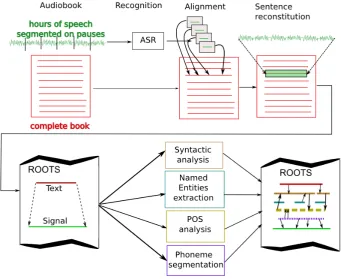
Figure 1: This figure describes the audiobook annotation process which begins with a complete text and the corresponding recording. This process is based on (1) the use of ASR to split the complete text and signal into smaller pieces (of the size of a sentence) and (2) the annotation of the text using the ROOTSstructure.
Figure 3: Example of relation graph obtained from relations contained in ROOTSfiles. This graph shows 4 sequences and their relations as arcs between sequences. Relations can be composed to move from one sequence to another in the graph. Here, the sequence namedWord Synapsecan be considered as a pivot in the graph.
segmented to be annotated and manipulated more easily, especially for human operations.
We have chosen to realize the text alignment with the signal in three steps like illustrated in the figure 1:
1. Split the signal on large acoustic pauses,
2. Find the corresponding text description of the signal by using Automatic Speech Recognition (ASR) Sys-tem,
3. Align the recognized text with the original one.
The main goal of this alignment is to put text anchors in the signal.
Rought cutting of a speech signal is based on the observa-tion of energy levels and lengths of silent pauses.
Thresh-olds are determined and adjusted by the current speaking rate and recording levels. The goal is to produce segments that represent units smaller than a sentence.
Text recognition of each signal fragment is achieved by us-ing the Nuance ASR system (Nuance, 2010). Models are speaker independent and the language model is learnt on the text extracted from the whole analyzed audiobook. By comparing the original text with the recognized one, we can determined word error rates. These errors can result of wrong recognition achieved by the system or a mistake realized while the speaker reads the text (like a bad pro-nounciation or a text replacement). In our experiments, the analysis of the audiobook we use, which duration is more than 11 hours, leads to a word error rate of 5.2%. This rate can be reduced by adapting the speaker models with a small amount of sentences extracted from the original audiobook.
The text provided by the recognition system is aligned with the original text using a Levenstein distance computed at a word level. When the end position of a text segment is found, the original text segment is associated to the signal and deleted from the original text. This process is repeated until text end.
bound-majority of words, connections are optional too and may be preceded or followed by short silences. Finally, pauses can be replaced by inspirations. During the segmentation step, the speech segments we use are as short as possible in order to take into account variations directly in the graph without reducing the efficiency of the alignment algorithms. The text used by the segmentation process does not take into account the lexical and pronunciation tags inserted in the Transcriber files, but takes into account the manual correc-tions of text splitting.
6.3.2. Phone Segmentation Accuracy
On 82,936 phonetic units manually checked, 94.17% are correctly labeled, 2.52% are missing and 3.31% are re-placed by another label. Furthermore, we can mention that 2.77% of phone insertion occurs. A great part of elisions involves /ø/ (46%), this phoneme is generally optional, and 24% of its occurrences were not detected. The majority of substitutions (41%) concerns the substitution of /e/ by /E/ which is the result of a specific pronounciation. The second important part of substitutions (19%) deals with pauses and inspirations. Insertions are mainly composed of pauses and inspirations (72%).
These results are quite good but they can be improved by at least two means:
• Variants taking into account the speaker specific pro-nunciation may be added,
• Post-processing can be done on pauses and inspira-tions.
The alignment of phones leads to a good score: 86.34% of the phone boundaries are located at less than 20ms of man-ual positions, the average distance is about 8.7ms which is less than a shift between two frames. These measures are also collected before a manual correction of the text align-ment. In that case the proportion of correct phone labels is91.12% and86.24% of phone boundaries were placed at less than 20ms from manual marks.
7.
Conclusion
The automation of the whole process that converts an au-diobook to a corpus annotated at several levels gives a quick access to large corpora. The time reduction gained with this methodology to build new speech synthesis voices is considerable when we take into account the time saved for both corpus recording and corpus annotation. The corpus representation generated by ROOTSremoves the problems
related to the heterogeneity of the files provided by each an-notation systems and simplifies its handling. However, the annotation process has to be reinforced by confidence indi-cators for each annotation step, either to remove uncertain areas, or to enable a supervised modality. In that case, the indicators would be given to an operator to guarantee a fast intervention as well as data in an appropriate format for the validation tools.
8.
References
N. Barbot, V. Barreaud, O. Boeffard, L. Charonnat, A. Del-hay, S. Le Maguer, and D. Lolive. 2011. Towards a ver-satile multi-layered description of speech corpora using
algebraic relations. InProceedings of the International Conference on Speech Communication and Technology (Interspeech), pages 1501–1504.
C. Barras, E. Geoffrois, Z. Wu, and M. Liberman. 2001. Transcriber: Development and use of a tool for assist-ing speech corpora production. Speech Communication, 33(1-2):5–22.
F. Bechet. 2001. Liaphon - un systeme complet de phoneti-sation de textes. Traitement Automatique des Langues (T.A.L.) edition Hermes, 42(1).
N. Braunschweiler, M.J.F. Gales, and S. Buchholz. 2010. Lightly supervised recognition for automatic alignment of large coherent speech recordings. InEleventh Annual Conference of the International Speech Communication Association.
Synapse Developpement. 2011. Documentation Tech-nique: Extraction d’entités nommées.
P.J. Moreno and C. Alberti. 2009. A factor automaton ap-proach for the forced alignment of long speech record-ings. In Proceedings of the 2009 IEEE International Conference on Acoustics, Speech and Signal Processing, pages 4869–4872. IEEE Computer Society.
Nuance. 2010. Dragon Naturally Speaking - SDK Server Edition - version 10.
K. Prahallad, A.R. Toth, and A.W. Black. 2007. Auto-matic Building of Synthetic Voices from Large Multi-Paragraph Speech Databases. In Proc. of Interspeech. Citeseer.
Synapse. 2011. Documentation technique: Composant d’étiquetage et lemmatisation.
Mademoiselle Albertine est partie ! mademoiselle Albertine être partir ! Mademoiselle Albertine est partie!
person
Nn Nnfs Vbitbs3 Vblabs Pcp
in subject verb
independent sentence
Syntax
POS tags
Named entities
Transcriber text
Lemma
Synapse text
Phonemes
Signal