Development of a complex system of the enterprise’s
consumer and partner interaction
Y.V. Astashova1,*, and A.I. Demchenko1
1
South Ural State University, Chelyabinsk, Russia
Abstract. The article considers a methodological approach to formation of the industrial enterprise’s consumer and partner interaction system. It shows that the purpose of interaction is a long-term mutually beneficial cooperation or loyalty of consumers and business partners. The offered approach is complex and based on application of tools from different functional spheres of corporate activities. It identifies stages of the interaction process, as well as factors influencing formation and maintaining of loyalty. For building of the interaction system we have used the process approach allowing to ensure management continuity, as well as development of unified indicators of efficiency evaluation. The article presents a model of the interaction system based on the process approach. It develops criteria of the consumer and partner interaction system efficiency based formation of material flow value and cost.
1 Introduction
One of strategic missions of a modern organization is achievement of a dynamic balance with the environment, which key elements are consumers and partners (including suppliers). Availability of stable mutually beneficial links with suppliers and partners, as well as a stable base of loyal customers increases business stability, as well as lays the foundation for its growth and development.
Nevertheless, there is still a widespread approach in business practice, when spheres of the industrial enterprise’s consumer and partner interaction are not considered as elements of a uniform system and refer to different functional management loops, which excludes application of a complex approach and, in our opinion, reduces efficiency of interaction processes.
Development of scientific approaches to management of functional business spheres is often focused on solution of tasks within the framework of one discipline sphere, which also restricts applications of the complex approach to consumer and partner interaction management.
2 Urgency of the Issue. Review of
Literature
The issue of efficient consumer and partner interaction management is cross-disciplinary. Its individual elements have been developed in detail in different spheres of enterprise management.
Issues of consumer interaction have been traditionally considered in the sphere of marketing in order to form and support consumer loyalty. Currently there is a concept of marketing interaction developing
under the auspices of Professor G.L. Bagiev (St. Petersburg). This concept is focused on long-term customer relationship, as well as achievement of objectives of market entities taking part in market processes [1], i.e. it also considers business partners. In this regard, the main focus is made on marketing activities, tasks of business partner interaction management are secondary [2].
The most widespread marketing concept is “relationship marketing” offered by American expert in the sphere of service marketing L. Berry in 1983 as an approach focused on long-term customer relationship [3]. This concept has many interpretations drawing attention to different lines of the company’s relationship with its environment. According to Ph. Kotler, relationship marketing is a practice of building long-term mutually beneficial relations with key partners interacting in the market: consumers, suppliers, distributers in order to establish long-term privileged relationship [4]. This definition most fully answers the purposes of this research.
Supplier and partner relationship is the subject of logistics researches. The logistic concept of Supply Chain Management (SCM) is a process of planning, implementation and control of operations of a supply chain in order to satisfy customers’ demands as efficiently as possible [5]. Within the framework of the SCM concept a focus is made on integration of the enterprise and its partners (and their business processes) into a supply chain to gain mutual benefits and to satisfy the customer’s demands, i.e. provision of a proper product in a proper place and at proper time with minimum expenses.
considered in the article of Professor O.D. Protsenko [6], including:
“Consumer relationship management” business process, aimed at customer relationship, development of new products and services;
“Supplier relationship management” business process aimed at development of reliable links with most important suppliers.
Let us consider two groups of enterprise processes. Firstly, these are business processes focused on consumer and partner interaction, to which marketing techniques and tools can be successfully applied. Secondly, these are business processes ensuring this interaction (determining quality of goods and its compliance with the customers’ demands, delivery terms, continuity of the production process, development of new products, etc.).
Thus, we can speak about presence of tendencies for joint use of marketing and logistics techniques at individual sections of the supply chain and in other functional management spheres.
Over the last decade there have appeared publications in the scientific environment devoted to different aspects of marketing and logistics interaction: general issues of interaction between the said spheres and functions [6-10], problems of application of logistics and marketing tools in individual fields and spheres of activity [11-15]. The said publications note similarity of objectives, as well as evaluate potential increase of management performance at combination of the marketing and logistics approach.
In the context of the research problematics it is worth noticing developments in the sphere of management of interaction between business, suppliers, consumers and other related parties. Interaction processes are most widely considered within the framework of SCM, as well as formation of value chains [16-20]. In these researches the logistics approach to relationship management prevails. They analyze forms of interaction between counterparties in the chain and offer principles and mechanisms of interaction in the course of value adding.
Common approaches uniting consumers and suppliers within a uniform interaction system are developed in the stakeholder theory offered by Professor R. Freeman in 1984 [21]. Broadly defined, stakeholders are considered as groups of influence (of related parties), on keeping the balance of which interests the company must be focused. In this regard, respecting of the suppliers’ and consumers’ interests is considered on a par with the demands of the society, state, investors, credit organizations, etc. [22].
Urgency of development of a complex interaction system is predetermined by economic expediency of keeping permanent relationship both with consumers and partners and suppliers.
Thus, the issue of the research is cross-disciplinary. Implementation of the in-house interaction system requires methodological adjustment of the available concepts in the sphere of consumer and partner interaction and development of a complex approach to
3 Statement of Research Objectives
The research objective is development and justification of a complex approach to consumer and partner interaction within the framework of in-house systems.
The interaction system is aimed at long-tern cooperation with the enterprise’s consumers and partners, as well as formation of their loyalty. The complex approach is based on identification of factors influencing formation and maintaining of consumer and partner loyalty and contains criteria for evaluation of the interaction system efficiency.
4 Basic Research Findings
Let us consider justification of expediency of building the enterprise’s uniform consumer and partner interaction system.
The backbone factor is a common interaction objective. Irrespective of applied approaches (logistics or marketing) and interaction entities (consumers or partners), interaction pursues a common objective – long-term mutually beneficial cooperation and loyalty.
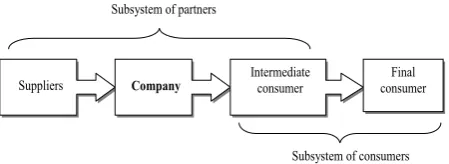
Let us exemplify the requirement of the interaction system unity by fig. 1.
As it is shown in fig. 1, two interaction management subsystems can be outlined for a company: subsystem of company’s partners and subsystem of company’s consumers. The said subsystems have a common area, which allows to speak about their interaction and to apply the system approach to their management.
Suppliers Company Intermediate consumer
Final consumer Subsystem of partners
[image:2.595.311.536.447.529.2]Subsystem of consumers
Fig. 1. Structure of the partner and consumer interaction system.
Another factor, which allows to consider consumer and partner interaction as a uniform system, is their interconnection at the level of management tasks.
important task of efficient interaction between the system’s participants is exclusion of breaks in the demands communication flow, reduction of “hindrances” and corruptions. We can speak about “a stretching principle” of system performance, when the ability to meet the demands of the final consumer and other system participants is a criterion for selection and evaluation of performance of enterprises being the chain participants. Such chain participants interact with each other to achieve their common objective.
Let us consider expediency of application of the complex approach for consumer and partner interaction system management consolidating marketing, logistics and other management approaches and concepts.
Issues of interaction in order to form and maintain customer loyalty fall under the sphere of marketing. For achievement of these objectives marketing applies a marketing complex for segments B2C and B2B. Thus, from the perspective of the value chain the marketing complex can be focused both on consumers and partners.
Use of marketing with respect of suppliers and partners, as well as consumers is based on their satisfaction with a series of interaction factors. Such factors include product quality, cost level, delivery terms and conditions, quality and scope of furnished information, management quality, etc. The influence of marketing on the on the above factors is restricted.
Thus, marketing is not able to ensure high consumer and partner loyalty without application of tools from other functional spheres of the enterprise.
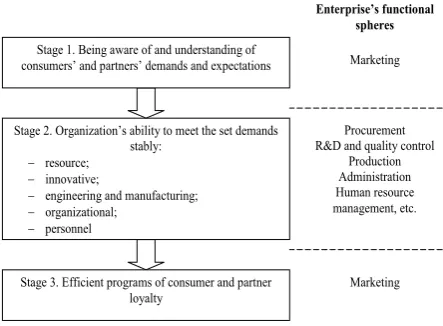
Complexity of the offered approach to interaction assumes application of multi-disciplinary tools, as well as identification of stages within the framework of the interaction process shown in fig. 2.
Stage 2. Organization’s ability to meet the set demands stably:
resource;
innovative;
engineering and manufacturing;
organizational;
personnel
Stage 1. Being aware of and understanding of consumers’ and partners’ demands and expectations
Stage 3. Efficient programs of consumer and partner loyalty
Procurement R&D and quality control
Production Administration Human resource management, etc. Marketing
Marketing
[image:3.595.313.530.209.361.2]Enterprise’s functional spheres
Fig. 2. Stages of the interaction process.
Fragmentary use of the stages shown in fig. 2 or violation of their sequence in practice leads to low efficiency of marketing loyalty programs. Analysis of errors omitted at building of customer loyalty programs shows that unsuccessful programs are most often focused on granting of discounts, bonuses and other motivators of behavior. In this case, a product or service is offered to the consumer, which does not meet his/her expectations, or no competitive price level is provided.
As a result, the loyalty program has an adverse effect – loss of customers.
Special attention to product and service quality in interaction processes is also preconditioned by specificity of recently established markets, including the Russian market. Many Russian brands have not yet formed the necessary level of trust among consumers and business partners.
Interconnection of parameters influencing consumer and partner loyalty and determining efficiency of the interaction process is shown in fig. 3.
Product quality Price level Service quality
Company’s potential:
Level of technologies, management efficiency and quality, cost level, personnel satisfaction and involvement (including in service), innovative potential, availability of up-to-date information on the
market Satisfaction of consumers and
partners
Loyalty of consumers and partners
[image:3.595.60.282.472.635.2]Business image and high trust of consumers and partners
Fig. 3. Model of interconnection of factors influening formation and maintaining of consumer and partner loyalty.
Thus, complexity of the approach to partner and consumer interaction management is based on the following:
partner interaction and consumer interaction are elements of a uniform system;
partner and consumer interaction management is based on application of cross-disciplinary tools (marketing, logistics, quality management, human resource management, etc.), and requires involvement of different company divisions in the process;
interaction management includes all stages of consumer and partner loyalty formation, such as: monitoring and analysis of demands; ensuring consumers’ and partners’ satisfaction by meeting of these demands; formation and maintaining of loyalty.
Implementation of the complex approach requires development of a methodological approach to building of the interaction system. In our opinion, the process approach to management having the following advantages most fully corresponds to the content of the offered complex approach:
the process approach ensures consumer orientation by coordination of demands along the entire process chain; due to management continuity at the junction of separate processes the process approach allows to integrate different functional spheres of the enterprise; use of the process approach allows to establish intercompany systems ensuring management continuity and integrity;
the enterprise’s processes and within intercompany systems.
The model of the interaction system based on the process approach is shown in fig. 4.
Partner-supplier
Partner-consumer Consumer
Enperprise
Material flow (stock, materials, semi-finished products, goods) (M)
Information flow accompanying the material flow (I) Financial flow (F)
Information flow ensuring other interaction with partners, consumers and the environment (I*)
[image:4.595.61.281.117.248.2]SYSTEM OF PARTNERS
Fig. 4. Proces model of partner and consumer interaction.
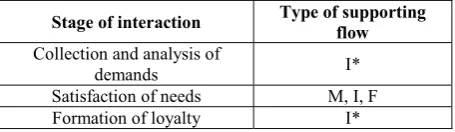
[image:4.595.57.285.367.433.2]As it is shown in fig. 4 partner and consumer interaction can be presented by means of three flows: material, financial and information, which allow to describe interaction in view of the previously identified stages (table 1).
Table 1. Participation of flows in stages of the consumer and partner interaction process.
Stage of interaction Type of supporting flow
Collection and analysis of
demands I*
Satisfaction of needs M, I, F
Formation of loyalty I*
The material flow forms the basis of interaction, therefore, it is suggested to consider its characteristics at development of interaction efficiency indicators.
Let us consider the following characteristics of the material flow: value (v) and cost (c). Value of the material flow is a multi-dimensional characteristics and includes quality of the supplied product, its compliance with the demands and expectations, as well as quality of the accompanying service. Thus,
Q g Q, Q), (1)
where Q – quality of material objects (goods,
materials, components, etc.);
Q – quality of the company’s service accompanying
the supplied material objects (discipline and completeness of delivery, completeness of information, speed of claims settlement, convenience for the buyer).
The cost of material flow (c) is equal to the value of the expected reverse financial flow. It is determined based on the expenses connected with value adding and level of the desired process profit.
Consumer’s (partner’s) satisfaction (CS) depends on the flow value Q and cost and can be presented as follows:
CS Qc (2)
In this regard, the flow value for the consumer must exceed or at least be equal to its cost, otherwise, consumer’s satisfaction cannot be achieved. We can outline two tasks on satisfaction increase: increase of the flow value in the eyes of potential consumers and/or decrease of the flow cost as shown in the expression:
&6Ĺ Q (3)
It should be noted that the above tasks can be solved both by changes of the material flow parameters (due to improvement of technologies, product and service quality increase) and by means of the informational influence on the consumer, for example, by marketing tools (influencing her/her perception of goods and company in general, forming consumer’s expectations, etc.). Development of loyalty programs granting different discounts and bonuses to consumers actually decreases the actual product cost for the consumer.
Let us consider the mechanism of value and flow cost formation implemented within the framework of each process. For positive influence on consumer’s satisfaction the flow value growth in the scale of the entire system must exceed its cost growth as shown in fig. 5.
Process 1 Prrocess 2 Process 3
Q0 ɫ0
Q1
Q2
Q3
ɫ1
ɫ2
ɫ3
'Q01!'ɫ01 'Q12'ɫ12 'Q23='ɫ23
'Q03!'ɫ03
Value
Cost
'Q01
'Q12
'Q23
'ɫ23
'ɫ12
'ɫ01
Fig. 1. Material flow value and cost adding in the course of its reformation within the framework of processes.
Let us introduce efficiency criteria for assessment of the consumer and partner interaction system. In general, efficiency can be considered as:
1) ability of the system to achieve the set objectives, which reflects its performance. Whereas the objective of interaction is formation and maintaining of long-term customer and partner relationship, it is expedient to believe that systems or processes, which at the output ensure excess of the flow value above its cost, are efficient.
2) efficiency as ability of the system to achieve objectives in view of the resources spent. It is proposed to believe that interaction systems, in which growth of the flow value exceeds growth of its cost, i.e. – C > 0, are efficient.
[image:4.595.313.527.396.526.2]make conclusions on contribution of each process to the overall result. Within the framework of the system shown in fig. 5 only process 1 can be acknowledged efficient, whereas its contribution to consumers’ satisfaction is determining for the entire system.
5 Conclusions
The offered complex approach uses tools of different functional spheres of activity and is aimed at formation of the industrial enterprise’s consumer and partner loyalty. For integration of different elements of the value chain it is proposed to use the process approach. The process approach allows to ensure focusing of the enterprise’s activity on the consumer, as well as to form uniform indicators of consumer and partner interaction efficiency.
The work was supported by Act 211 Government of the
References
1. G.L. Bagiev, News of Saint-Petersburg State University of Economics, 4 (2010)
2. I.I. Okolnishnikova, O.U. Juldasheva, Economics & Management Research Journal of Eurasia, 1(1), 48-61 (2013)
3. L.L. Berry, G.L. Shostak, G. Upah, Emerging Perspectives on Services Marketing, 25-38 (1983) 4. F. Kotler, Marketing Management (Piter Com, St.
Petersburg, 1998)
5. R.K. Oliver, M.D. Webber, Logistics: The Strategic Issues, ed. M Christopher, Chapman Hall, 63-75 (1992)
6. !"#$%'4, 30-31 (2013)
7. + <=? XY ZY \11,
77-82 (2011)
8. ^ \`={? #= |$' 5, 9-11
(2004)
9. +} ~?$? <'Y{ XY
Management: New Challenges and Prospects, 1, 304-305 (2010)
10. ? + #$? }
Structuration of Economics, 2, 3, 19-20 (2008).
11. !<{$===<#=$`?
University of Economics, 2, 87-94 (2010)
12. E.A. Kandrashina, Russian Business, 4, 55-58, 5, 80-83 (2005)
13. <+ chagin, Ju.N. Rizaeva, Bulletin of Transport Information, 24-27 (2010).
14. I.S. Shilko, Prospects of Science and Education, 2, 164-171 (2013)
15. X\X=~=Z{
1, 44-45 (2010)
16. ^Y?Y==2, 6-9 (2011)
17. S.V. Krasnov, S.V. Sorokin, Bulletin of Volzhsky University named after V.N. Tatishchev, 52-60 (2012)
18. N.P. Karpova, I.V. Fedechkina, Bulletin of Samara State University of Economics, 102, 39-43 (2012)
19. !\ $? \{ #={ XY
Law, 1, 101-105 (2013)
20. I.V. Gudova, Bulletin of the Siberian State Automobile and Highway Academy, 14, 61-65 (2009)
21. R.E. Freeman, Strategic Management: A stakeholder approach (Pitman, Boston, 1984)