International Journal of Innovative Technology and Exploring Engineering (IJITEE) ISSN: 2278-3075, Volume-8 Issue-7, May, 2019
Energy-Efficient Routing Protocol Based on
Mobile Sink Node in Wireless Sensor Networks
Amairullah Khan Lodhi, M. S. S. Rukmini, Syed Abdulsattar
Abstract— Wireless networks be comprise of spatially spread independent sensor node linked with each other for maintaining and detecting the environmental as well as physical states of the given application. The batteries of these sensor nodes are outfitted with limited energy to work as a source of energy. Hence, efficient energy utilization is a significant challenge in these types of networks, which are equipped with batteries having limited power storage capacities. Thus, routing techniques with energy efficiency are needed in corporate operations of WSN to provide the connectivity and data transmission in a network with minimum energy consumption. So, routing protocols are one of the key considerable factors to minimize the consumption of energy and lifetime elaboration of the network. Thus, this work gives the development of routing protocol with efficient energy to elaborate systems lifetime by selecting a proper route with the consideration of “reactively the status of an intermediate node”. Proposed protocol “reactively the status of an intermediate node” computes the route finding metric based on current energy condition of an intermediate node. To offer a complete understanding of energy-aware routing, protocols are developed for WSN and superimpose the path for forthcoming investigation; in this paper, the feat of “energy-aware routing protocol based on residual status” is analyzed in detail. Based on performance parameters analyzed such as delivery of the packet, the lifetime of the network, and delay (end to end); through NS2 simulator, the result shows proposed system performs better than the present protocols in terms of systems lifetime as well as other metrics considered.
Keywords: Efficient Energy, WSN, Route Discovery Time, Delay, Packet Loss.
I. INTRODUCTION
Nowadays different waste delivered from several Industries is an improbable issue. These materials will lead to pollution of the environment; this industrial waste contains a vast number of non-biodegradable substances. As of late, utilization of this industrial waste has been considered in pavement construction with incredible enthusiasm for creating communities. The usage depended on specialized, financial, and living criteria. The absence of conventional pavement materials and the protection of nature make it essential to examine the credible utilization of these materials. Many researchers has carried out their research to control fatigue cracking in flexible pavements by using modified bitumen at binder course but still more research has to be carried. Base course of a pavement have low resistance towards the tensile stresses and dynamic loads which leads to the failure of pavements and maintenance of roads,
Revised Version Manuscript Received on 04 May, 2019.
Amairullah Khan Lodhi, Research Scholar, ECE Department Vignan’s Foundation for Science, Technology, & Research ( Deemed to be
University),Vadlamudi, Guntur, India.
M.S.S. Rukmini, ECE Department, Vignan’s Foundation for Science,
Technology, & Research (Deemed to be university), Vadlamudi, Guntur, India.
Syed Abdulsattar, Principal & Professor, ECE Depart, Nawab Shah Alam Khan College of Engineering & Technology, New Malakpet, Hyderabad, India.
The major failure in flexible pavements is fatigue cracking This fatigue leads to formation of cracks, pot holes and undulations on the pavements. In flexible pavements load will be distributed into lower layers in decreasing order. EPDM rubber consists of properties like tensile strength, abrasion, resistance to temperature. Wireless communication technology in WSN contains two types of communication methodologies i.e., Wireless transportation based communication model and wireless transportation-less network communication model [1]. Wireless transportation based communication model contains wireless movable nodes and permanent nodes. The wireless movable nodes exchange the information data with fixed nodes through pre-established transportation [2]. The wireless transportation-less system communication model is nothing but wiretransportation-less MANETs which contains movable wireless nodes spread in the radio communication region and they communicate with each other through relying on in-between node i.e., with lacking transportation and thus WSN has to perform as a peer to peer network. However, contact among communicating nodes is very challenging due to the features of WSN. Moreover, wireless movable node working in a network has restricted with power batteries and it is not probable to recharge the energy of the batteries during the given task. Applications of WSN mainly include military, healthcare, natural, household & commercial areas as well as disaster recovery. Due to its variety of features, WSN is paying attention by the majority of the researchers and hence the group of routing protocols has been intended based on considering diverse parameters. One of those routing protocols is “energy aware routing protocol based on the reactive status of movable nodes” [3]. This work present the state of art performance analysis of “energy aware routing protocol based on the reactive status of mobile nodes” designed for wireless networks. However, it is a lot demanding to justice the current position of routing protocol for the particular network state. In future, the motivation is to split the network state into different categories and after that evaluates the different routine metrics. Based on present investigation parameters such as delivery of packets, the lifetime of the network, and end-to-end delay our work performance is analyzed with the help of network simulator-2 (NS-simulator-2) [4]. Furthermore, the performance grades of our work can be used by researchers for their future research. Even though a lot of research efforts carried out within literature in the direction to calculate the performance of dissimilar routing protocols for WSN based on different network circumstances, this work contains performance investigation metric as the lifetime of the network, delivery of packet, overhead and delay (end-to-end). Furthermore, these metrics extremely suitable to calculate the execution of energy-aware routing
The paper’s remaining part is prearranged as, the 2nd Section will discuss regarding Efficient-Energy Based different routing protocols in WSN. Furthermore, the part 3 provides the performance assessment of the proposed work. Finally the work is concluded in fourth and final part of the work.
I.EFFICIENT-ENERGY BASED
ROUTING IN WSN
[image:2.595.52.288.656.763.2]Routing is the methodology to discover the path/route among communicating nodes, in addition, to transmit the information data throughout the selected path in the form of packets. The main feature of routing is to select the path between the communicating nodes and to keep up the path up to the successful transmission of the information packets. In WSN, routing protocol appearances an additional overhead in contrast by means of wireless transportation based sets of connections, due to its features such like mobility, heterogeneity within the movable nodes, the lack of an intermediate controller and peer to peer system. Furthermore, several routing protocols developed in WSN based on various frameworks, attributes, and features of the network. Utmost of the available routing protocols in WSN considered based on a variety of patterns consequently as to manage with network features of WSN [5]. One of the major challenges in WSNs is efficient-energy routing, since its applications are built-in disaster assistance, military, and health care. Throughout the assignment application, it is not at all possible to recharge or put back the battery. Various routing protocols designed are discussed in literature survey taking into consideration that the energy of the wireless nodes in WSN. Out of that one such routing protocol is “energy aware routing protocol based on the reactive status of mobile nodes”. The intention of the development of this routing protocol is to expand lifetime as well as to achieve energy-efficiency of the network in the system [6]. The routing protocols, which are designed based on energy awareness i.e., selecting the routing path, connecting transmission nodes through the nodes which have utmost left over power or greatest residual energy, are reserving the several of the wireless nodes intended for transmission of the data information due to their higher remaining energy [7]. This condition in the network known as blockage transitional node and bottleneck intermediary node drops the packet due to two reasons such as each of the wireless nodes does not have enough buffer to hold the traffic or its processor does not support the incoming packets in a transitory approach. Figure 1 show the bottleneck intermediate node's situation, in this node 4 becomes a bottleneck node [8].
Fig.1 Scenario of node becoming bottleneck (node-4 is a bottleneck node)
In this work, focus is given on energy efficient protocols developed for WSNs and classified them to obtain an ideal solution. The substitute to above energy-aware routing protocols is “energy aware routing protocol based on the reactive status of mobile nodes”. This protocol is designed based on the existing position of a transitional node concerning its energy as well as the buffer. Furthermore, while choosing a routing path, this protocol checks the position of each transitional node reactively concerning nodes energy as well as the buffer [9]. Therefore, due to the blockage or bottleneck transitional node it drops the packet. To overcome the scenario of a bottleneck intermediate node, it defined a new route scheme metric which is called as “residual status of intermediate node regarding energy and buffer”. This metric is calculated by a multi-objective optimization technique.The two main objectives are remaining power and energy to transmit the information packets [10]. It calculates the metric by the knapsack algorithm in equation-1 i.e. “residual status of transitional node is concerning energy as well as a buffer”.
Each node in a system outfitted by means of a battery with energy ′ ′ joules for processing the packet ′ ′, a buffer with a capability of ′ ′ to hold the packets ′ ′
.
Throughout the time period ′ ′, let anyone ′i′ packet throughout the sensor node, which consumes a limited amount of energy as well as utilize properly the buffer size as well. Subsequently parameters of the nodes, like “ ” the remaining energy and nodes residual buffer “ ” become as follows,= E− ei, > i ………1 = B− i, > i …... 2
The point at which the node will drop the packet is the packet processing capability of the node without dropping it, in available energy and buffer [11]. It can be computed by satisfying the below situation through the assistance of knapsack algorithm,
1. Processing of packets should be done within the remaining energy and buffer
2. The utmost packet should be processed through the node 3. Fraction or part of the packet must not be processed, it will believe as an illegal condition
“Optimized ability to restrict packet drop‟ metric designed by remained energy as well as a leftover buffer of the target node. Annotation considers in this work is specified inside the table1. Assumptions are made that the node gets information packets from numerous sources contained by the limits of leftover energy ‘ ’ as well as buffer ‘ ’ correspondingly. The nodes capability to control the packet drop is ‘ ’ packets. The processing of the packets ‘n’ successfully from exclusive of a drop, the conditions below should assure
1. Complete processing of packet should be done from the node
2. A Packet can drop as of a node completely; it means incomplete processing should not happen,
International Journal of Innovative Technology and Exploring Engineering (IJITEE) ISSN: 2278-3075, Volume-8 Issue-7, May, 2019
The capability to control the packet drop is 1, 2, 3, 4, ……, , all packets use energy ‘ i’ and buffer ‘ i’ of the node to process.
It requires estimating the nodes capability to control packet drop in both cases like buffer and energy; in addition, it needs to calculate the utmost processing capability of a node to process number of packets without drop [12].
[image:3.595.312.563.212.449.2]For example, it’s needed to discover out the capability to process the utmost packets of count { }, to gather packets with ∑ ,
where
‘ ’ & ‘ ’ with respect to , ≤ and , ≤Table.1: Notation used
To calculate the “optimized ability to restrict packet drop” metric by means of both buffer and energy, the convenient technique is to try every attainable process related to ‘ ’. It can be computed through the assistant of Knapsack Algorithm, it gives two-dimensional arrays through the entries [13],
0 ….. , 0 …. ∀1 ≤ ≤ 0 ≤ ≤ 0 ….. , 0 …. ∀1 ≤ ≤ 0 ≤ ≤
Such that Ji, E, and Li, B is the highest processing capability with leftover energy and buffer without loss of a packet. The main thing is the following conditions should not entertain, 0, = 0∀0 ≤ ≤ and 0, = 0∀0 ≤ ≤ 0, = −∞∀ ≤ 0, not acceptable and 0, = −∞∀ ≤ 0, not acceptable
Calculation of the “optimized ability to restrict packet drop” through energy as well as a buffer is given below
i, = max Ji − 1, Li + Li − 1, − +1 ∀1 ≤ i ≤ and 0 ≤ ≤ ,
Li, = max Mi−1, Mi+Li − 1, − +1 ∀1 ≤ i ≤ and 0 ≤ ≤ ,
For getting the advantageous result from Knapsack Algorithm subset, it is needed to expand supporting Boolean arrays
i,
, ,and
i, ,in the same way. It becomes
one (1) for the node while processing the i ℎpacket does not drop if not becomes zero (0).II. PERFORMANCE ANALYSIS
A. PERFORMANCE CALCULATION
METRICS
The execution stage of the particular system is helpful to have an effect on the approval of its users. Moreover, the specified system is appropriate whenever its propositions accept transmission services [14]. The Performance investigation attributes are combining noticeable and additional system framework such as the ability to transmit information data at very higher delivery speed and a lesser amount of delay with controllable overhead. Performance analysis attributes measured in this work are delivery of the packet, network lifetime, delay and overhead.
Sr.
No. Network Parameter Values Used
1 Simulation Time 10, 20 and 30 Sec
2 Nodes in numbers 20 - 100
3 Type of Link Layer (LL) Logical Link
4 Type of MAC 802.11MAC
5 Propagation Model of Radio Two-Ray Ground
6 Type of Queue Drop-Tail
7 Antenna Omni Antenna
8 Routing Energy-aware routing
9 Traffic Constant bit rate
10 Network Area 750m x 750m
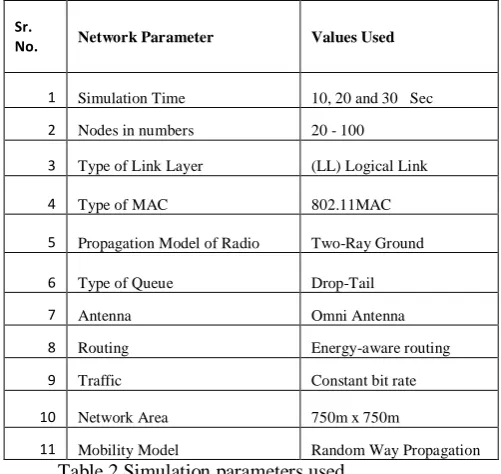
11 Mobility Model Random Way Propagation Table.2 Simulation parameters used
Among the above metrics, the information packet delivery speed is considered as, the percentage of the amount of arriving packets by sink node or destination, by the number of packets transmitted by the source node. Network lifetime considered as the time taken to die individual node in a system due to consumption of energy [15]. The metric delay can be defined as, the time taken to transmit the information packet by a source node to reach the sink or destination node [16].
B. ENVIRONMENT OF SIMULATION
Network Simulator of version NS 2.34 is used to calculate the performance of the system “energy aware routing protocol based on the reactive status of mobile nodes”. The main purpose of our performance assessment is towards study the ability of “energy aware routing protocol based on the reactive status of mobile nodes” to act in response to the various traffic situation in WSN, such as variable packet size, radio transmission region, and mobility. Furthermore, the objective which plays a key role is the comparison of the measured results with the evaluated results. Finally, the main objective is to assess the in-depth performance assessment of “energy aware routing protocol based on the reactive status of mobile
nodes”. Simulation
C.EVALUATION OF PERFORMANCE In order to work out the performance of “energy aware routing protocol based on the reactive status of mobile nodes” on the basis of inconsistent hop count, mobility and radio transmission region. In all the run of the simulation, the input folder was taken, which explains the complete node as well as data packet information within the system throughout the transmission process. In this work, two simulation scenarios are considered to assess the results in terms of the metrics such as network lifetime, packet delivery, delay, and the overhead.
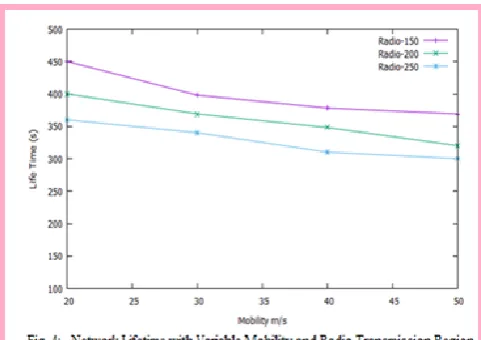
Variable radio transmission ranges for each node (150m, 200m, and 250m) by means of mobility. The variable hops counts up among transmission nodes with mobility.
Performance assessment of projected method is approved by NS-2 through suitable expansion in accessible libraries and also compared by existing algorithms for selection of cluster head with the same network surroundings. Results show that the proposed protocol “energy-aware protocol based on the reactive status of mobile nodes” outperforms as compare to the available protocols.
Figure 2, 3, and 4 show that the performance of delay, packet delivery ratio and network lifetime. Performance of “Energy-aware routing protocol based on the reactive status of mobile nodes” is good in changing mobility and the different radio transmission region. As, the proposed routing protocol detach the node to turn out to be a bottleneck node, which interns enlarge the networks lifetime and minimize the loss of information packets in that way improves the delivery of packets with less delay. From our simulation results, it is considered that the proposed routing protocol is well suitable for WSN applications.
III. CONCLUSION & FUTURE WORK
In WSN, routing is an active research area and a variety of routing protocols are designed by taking into consideration various features and system circumstances. Therefore, by considering various circumstances this work analyses the performance of “energy aware routing protocol based on the reactive status of mobile nodes”. Hence, through the results of the simulation, it concludes that the proposed routing protocol is well suited for the various applications of WSNs. Moreover, it elaborates the lifetime of the system as well as accumulates energy of the node. Furthermore, this work gives the technique to scrutinize the current condition of the node in the system, so it is used as a selection of cluster head in a proactive manner in the future approach.
REFERENCES
1. Sarkheyli, Azadeh, and Elnaz Sarkheyli. "Smart Megaprojects in Smart Cities, Dimensions, and Challenges." In Smart Cities Cybersecurity and Privacy, pp. 269-277. Elsevier, 2019.
2. Chen, Yan, Zhung-Han Wu, Yi Han, and KJ Ray Liu. "Wireless signals and techniques for determining locations of objects in multi-path environments." U.S. Patent Application 10/168,414, filed January 1, 2019.
3. Movva, Pavani, and Polipalli Trinatha Rao. "Novel Two-Fold Data Aggregation and MAC Scheduling to Support Energy Efficient Routing in Wireless Sensor Network." IEEE Access 7 (2019): 1260-1274.
[image:4.595.309.550.53.223.2]International Journal of Innovative Technology and Exploring Engineering (IJITEE) ISSN: 2278-3075, Volume-8 Issue-7, May, 2019
5. Al-Turjman, Fadi. "Cognitive routing protocol for disaster-inspired internet of things." Future Generation Computer Systems 92 (2019): 1103-1115.
6. Bhushan, Bharat, and G. Sahoo. "Routing Protocols in Wireless Sensor Networks." In Computational Intelligence in Sensor Networks, pp. 215-248. Springer, Berlin, Heidelberg, 2019. 7. Bello, Lucia Lo, Riccardo Mariani, Saad Mubeen, and Sergio
Saponara. "Recent Advances and Trends in On-board Embedded and Networked Automotive Systems." IEEE Transactions on Industrial Informatics 15, no. 2 (2019): 1038-1051.
8. Moneypenny, Timothy P., Anna Yang, Nathan P. Walter, Toby J. Woods, Danielle L. Gray, Yang Zhang, and Jeffrey S. Moore. "Product distribution from precursor bite angle variation in multitopic alkyne metathesis: evidence for a putative kinetic bottleneck." Journal of the American Chemical Society 140, no. 17 (2018): 5825-5833.
9. Qureshi, Kashif Naseer, Abdul Hanan Abdullah, Omprakash Kaiwartya, Fasee Ullah, Saleem Iqbal, and Ayman Altameem. "Weighted link quality and forward progress coupled with modified RTS/CTS for beaconless packet forwarding protocol (B-PFP) in VANETs." Telecommunication Systems (2016): 1-16.
10. Mohammad, Arshad Ahmad Khan, Ali Mirza, and Mohammed Abdul Razzak. "Reactive energy aware routing selection based on knapsack algorithm (RER-SK)." In Emerging ICT for Bridging the Future-Proceedings of the 49th Annual Convention of the Computer Society of India CSI Volume 2, pp. 289-298. Springer, Cham, 2015. 11. Babayo, Aliyu Aliyu, Mohammad Hossein Anisi, and Ihsan Ali. "A review on energy management schemes in energy harvesting wireless sensor networks." Renewable and Sustainable Energy Reviews 76 (2017): 1176-1184.
12. Al-Turjman, Fadi. "Energy-aware data delivery framework for safety-oriented mobile IoT." IEEE Sensors Journal 18, no. 1 (2017): 470-478.
13. Wen, Zhenyu, Jacek Cała, Paul Watson, and Alexander Romanovsky. "Cost effective, reliable and secure workflow deployment over federated clouds." IEEE Transactions on Services Computing 10, no. 6 (2017): 929-941.
14. Galinina, Olga, Konstantin Mikhaylov, Sergey Andreev, Andrey Turlikov, and Yevgeni Koucheryavy. "Smart home gateway system over Bluetooth low energy with wireless energy transfer capability." EURASIP Journal on Wireless Communications and Networking 2015, no. 1 (2015): 178.
15. Nayak, Padmalaya, and Anurag Devulapalli. "A fuzzy logic-based clustering algorithm for WSN to extend the network lifetime." IEEE sensors journal 16, no. 1 (2016): 137-144.
Lodhi, Amairullah Khan, and Syed Abdul Sattar. "Cluster Head Selection by Optimized Ability to Restrict Packet Drop in Wireless Sensor Networks." In Soft Computing in Data Analytics, pp. 453-461. Springer,
![Figure 1 show the bottleneck intermediate node's situation, in this node 4 becomes a bottleneck node [8]](https://thumb-us.123doks.com/thumbv2/123dok_us/8205487.261996/2.595.52.288.656.763/figure-bottleneck-intermediate-node-situation-node-bottleneck-node.webp)