Using Clouds to Provide Grids Higher-Levels of Abstraction and Explicit Support for Usage Modes
Shantenu Jha
∗†, Andre Merzky
∗, Geoffrey Fox
‡§∗ Center for Computation and Technology, Louisiana State University † Department of Computer Science, Louisiana State University
‡ Community Grids Lab, Indiana University §Department of Computer Science, Indiana University
Abstract—Grids in their current form of deployment and implementation have not been as successful as hoped in engendering distributed applications. Amongst other reasons, the level of detail that needs to be controlled for the successful development and deployment of applications remains too high. We argue that there is a need for higher levels of abstractions for current Grids. By introducing the relevant terminology, we try to understand Grids and Clouds as systems; we find this leads to a natural role for the concept of Affinity, and argue that this is a missing element in current Grids. Providing these affinities and higher-level abstractions is consistent with the common concepts of Clouds. Thus this paper establishes how Clouds can be viewed as a logical and next higher-level abstraction from Grids.
Index Terms—Distributed Infrastructure, Distributed Comput-ing, Grid, Cloud, Abstractions, Interfaces, Affinity
I. INTRODUCTION
There is a level of agreement that computational Grids have not been able to deliver on the promise of better applications and usage scenarios. The lack of possible applications is not completely unrelated to the significant challenges in Grid deployment and management, the difficulty of providing inter-operability (both system level [1] and application level [2]), and of composing cross-Grid applications and services. Al-though the reasons are often context dependent and resist over-simplified explanations, if there is a single factor that stands out above others, it is probably the complexity associated with Grids – both from a programmatic point of view as well as from a technology, management and deployment perspective. Grids as currently designed and implemented are difficult to interoperate: there have been major attempts to create Grids that interoperate seamlessly, in particular by the ‘Grid Inter-operation Now (GIN)’ effort within OGF [1]. Understandably, the various Grid programming and run-time environments vary significantly. But even if some level of homogenization could be imposed across different Grids, managing application level control programmatically across different virtual organization will remain difficult. Additionally, the lack of commonly accepted means of system support for cross-Grid applications (e.g. co-scheduling resource across more than one VO) makes aggregating cross-Grid resources difficult. Many of these dif-ficulties underscore GIN’s limited impact on applications in spite of the groups extensive and sincere efforts. It is important to note, that we are not suggesting that Grids are not useful, but pointing out, how it is generally agreed that the vision
of pervasiveness, ubiquity and interoperability of computing resources and infrastructure – as promised, in the early days of Grid computing [3], have not come to fruition.
From our own experience as both end-users and developers of Grid infrastructure, there is a need to expose less detail and provide functionality in a simplified way. If there is a lesson to be learned from Grids it is that the abstractions that Grids expose – to the end-user, to the deployers and to application developers – are inappropriate and they need to be higher level. As we will go on to show, Web-Services and their multiple incarnations have interfaces that are at a level that is too low, to enable the effective deployment of infrastructure and application development.
Clouds are clearly related to Grids, both in goals and implementation, but there are differences which are difficult to discuss as both terms do not have agreed upon definitions. We believe that Clouds as systems are not orthogonal to Grids, nor are they necessarily complementary to Grids: in some ways, Clouds are the evolution of Grids (and they can both in turn be viewed as evolution of Clusters). In many ways, Clouds may just be composed of regular, vanilla Grids with suitable ser-vices and interfaces superimposed on them. Whether Clouds are a somewhat fuzzily defined concept, or possibly a simple repackaging of earlier concepts from distributed systems [4], it is important to clarify their relationship to existing classic Grids.
A fundamental difference between Clouds and Grids, in our opinion, is the support for interfaces that are syntactically simple, semantically restricted and high-level; standardized or not is an open question. In this paper we will introduce the notion of Usage Mode and Affinities of systems; the former describes the high-level characterisation of the primary ways in which applications use the system, and the latter describes the systems’ internal properties that support these patterns. We argue, that an emphasis onUsage ModesandAffinitiesis the putative cause for the simplicity of use of Clouds and this will be a major focus of this paper.
the next generation of the TeraGrid to take cognizance of the developments in Cloud computing – where Cloud computing is a catch-all term for better contextualization, virtualization and most importantly simplicity of use. Some such as Blatecky [5] advocate stronger positions, i.e. TeraGrid should focus on an exit strategy and give way to developments in virtualization such as Clouds and Web 2.0.
Our approach does not analyse specific examples of Grids and Clouds in relation to each other, but is a theoretical analysis of these systems. So although, our approach may be limited in its ability to describe a specific Grid or a specific Cloud, we believe our approach has general applicability. It is also important to mention that we do not discuss Cloud SLAs, buisness or provisioning models, even though they are seen by some as the distinguishing characteristics, if not the defining properties of Clouds, and admittedly, some level of technical details will inevitably be dependent upon the specifics. We argue that our contribution is nevertheless useful, in that it provides a certain well defined framework of definitions and terminology, which may prove useful for discussing Grid and Cloud system properties; this is topical, as some structure in the often vague discussions and distinctions between Grids and Clouds is required. Furthermore, we acknowledge that we do not address issues around security – Grids or Clouds, and only provide a limited discussion of interoperability issues. Although these points, and others, are without doubt important, in particular for commercial systems, we feel that a thorough discussion is both out of scope of relevance and our expertise.
As a side note, the attention given to Clouds is partially due to the (coincidental but) simultaneous development in interests in green computing. Green computing may not be the most critical architectural design point [6], but if green practices arise naturally then that is an advantage. A natural way to construct a Cloud is ab initio, and thus there is significant scope to utilize green locations and green energy sources1. It
is conceivable that current social and political trends may lead to a situation where green computing considerations play an important role along side technical ones; we are not advocating green computing trends or technologies – for that matter we are not advocating Cloud computing either, but surely, the alignment of industrial trends and academic computing cannot be harmful for either.
The remainder of this paper is structured as follows: In the next section we briefly outline and discuss the main recurring concepts in this paper, followed by specific examples of these concepts. We will then discuss Cloud Affinityas arising from the focus on interfaces and not on implementations. An analysis of the concepts involved leads to a strawman architecture for Clouds; we then analyze the implications of the proposed high-level architecture for Clouds and Grids, and close with some outstanding questions of relevance that we hope will be addressed by the community in the near future.
1Grids on the other hand are mostly constructed from a set of existing
resources.
II. DEFINITIONS
This section attempts to list definitions for terms frequently encountered throughout the paper. These definitions are working definitions, and are probably not universally applicable nor rigorous; detailed definitions would have been impossible with the limited scope of this paper. We feel that these working definitions whilst simple and basic, are enough to facilitate discussions of the issues in hand.
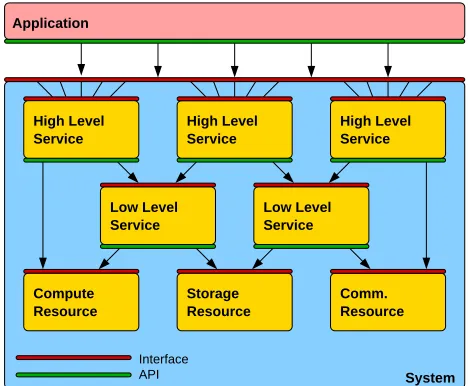
Resource:A physical or virtual entity of limited availability. Physical resources are compute, storage and communication resources, etc. Virtual resources are usually services, which provide direct or indirect access to physical resources.
Service: An entity which provides a capability on a re-source, or which allows actions to be performed on resources. Services can in turn be Low Level Services – which act primarily on physical resources, orHigh Level Serviceswhich act primarily on virtual resources (i.e. on other services). Services expose their capabilities via service interfaces.
System: A set of services and resources, which form an integrated whole. The concept of a system is inherently hierarchical, i.e. there are systems of systems. Higher Level Systems are systems which make use of other systems (i.e. Lower Level Systems), through aggregation.
Semantics (of Systems):The set ofcapabilities, or features, available within a system. The semantics of a system can be greater (more powerful) than the semantics of its individual (lower level) systems combined.
System Interface:A set of interfaces that allow an applica-tion (and other higher level systems) to access the capabilities of a system.APIsprovide programmatic access to these inter-faces.Application Environmentsprovide user level abstractions to APIs and thus also access to service interfaces System interfaces often expose only parts of the entire semantics of the system.
Virtualization: An additional layer between real systems and applications which translates concurrent access to real systems into seemingly exclusive access to the virtual system. The virtualization interface often hides details and differences of the real system components.
Application:An entity making use of a system, e.g. by using an API, or an application environment (see below).
Portals and Science Gateways: High level application environments that are oriented towards facilitating end usage; these access interfaces allows the description, instantiation, deployment and management of applications – both abstract and concrete – on a system. Application environments may provide additional, often application specific, semantics which is originally not available in the underlying system.
(MD) application can be used stand-alone or as a component that is just a part of a larger application. A stand-alone MD application could in turn be used in different ways. For example, identical ensembles of the same application could be used for parameter-sweeps (decoupled) or for Replica-Exchange (loosely-coupled) simulations. Additionally, a single instance of the application could be used in a “long-running” mode, or a sequential (multi-stage) mode. Finally, a single MD application can be either used on one machine or split over multiple machines. These are all different usage modes of a single application, and the infrastructure used and the tools required to support each usage mode are different.
Affinity: An inherent property of a system that describes a relationship between two or more (real or virtual) resources. The relationship is indicative of the types ofUsage Modesthat the system supports. Affinities can be indicative of support for data-oriented, compute intensive, or communication intensive computing, etc.
Application
Interface
API System
Resource Comm. Storage
Resource Compute
Service
Low Level Low Level Service
Service High Level High Level
Service Service
High Level
[image:3.612.57.291.283.476.2]Resource
Fig. 1:Figure showing the relationship between the different concepts associated with a system. Systems are composed of services, which provide access to resources. Interfaces allow systems to be accessed and used; APIs in turn allow applications to access interfaces.
III. EXAMPLES
We will show through concrete examples that although, the above definitions are prima facie simple and limited, they permit a description of real world systems. In the following examples, we discuss the semantic properties of various enti-ties, and provide a motivation for a later discussion ofaffinities and usage modes.
A. Resources
Resources can be classified as either compute, storage or communication, amongst other types. Some simple examples of (physical) compute resources are dedicated clusters and idle CPU cycles on workstations; single hard drives or large shared file systems are examples of storage resources; the Internet in
various physical representations is an ubiquitous example of a communication resource. Numerous other types of resources exist, such as remote instruments, sensors, software licenses, human experts etc.
The semantics of a resource consist of a set of core capa-bilities specific to the resource and the ability to manage those capabilities (provisioning, availability, QoS, security etc.) The core capabilities are usually variable – a CPU can run many kinds of applications; a disk can store many types of data; a network can connect to many types of endpoints etc. The means provided to exploit resource semantics, say via the resource interface, are thus also often flexible (assembly for CPUs; various file systems or driver interfaces for disks; TCP and other low level protocols for networks, etc.). The tradeoff is between the flexibility and complexity of these interfaces.
B. Services
Low Level Services: There are many low level services that allow actions on resources; OS level file systems, OS process schedulers etc. are low level services. Note that these services limit the exposed semantic capabilities of the resources (i.e. using a file system, a user will not be able to explicitly address individual blocks on the disk anymore: she must adhere to the notion of files and directories.)
In distributed environments, typical low level services are:
• job/batch schedulers: LSF, GRAM, Mauii, etc.
• file systems: Google file system, AFS, GFS, etc.
• communication: TCP streams, monitoring systems, etc.
High Level Services: High level services often build upon multiple low level services and resources. For example, a replica service such as the Globus RLS would exploit storage resources (e.g., a global virtual file system), other storage resources (e.g., a database for meta data storage), and com-munication resources (e.g. a network for data movement). The semantic power is often greater than that of the individual pieces combined (a replica service may have the notion of replication policies, which make no sense on the level of the individual resources). On the other hand, the service interface will often limit theexposedsemantics, according to the target use cases (e.g., the RLS API does not allow the creation of arbitrary tables in the meta-data database).
In distributed environments, typical high level services are:
• job managers: meta-schedulers, supporting reservation and co-allocation, registries, etc.
• file systems: replica systems, federated file systems, etc.
• communication: message passing infrastructures,
compo-nent systems, publish/subscriber systems, etc.
C. Systems
1) Operating Systems: Broadly defined [7], an Operating System (OS) can be considered as the software that manages the resources of a computer and provides programmers with an interface used to access those resources.The focus here is on a single computer. Although distributed operating systems exist, one can argue that the existence of the OS implies the existence of a single distributed computer. Interestingly, a system interface is an intrinsic part of the (operating) system; indeed, most systems would be useless without an interface to use that system (possibly apart from truly autonomous systems).
2) Grids: Grids are systems which, according to Ref [8], have the following properties:
• Coordinate resources that are not subject to centralized control,
• Use standard, open, general-purpose protocols and inter-faces,
• Deliver non-trivial qualities of service.
The TeraGrid[9], for example, is a system which provides more than 750 Teraflops of compute resources, more than 30 Petabyte of storage, and high performance network con-nections. Resources are administrated by individual TeraGrid sites. The infrastructure is based on open source software which implements (at least some) open standards. TeraGrid’s native system interface is increasingly complemented by a number of application oriented Science Gateways – whereby the powerful but complexnativesystem interfaces are wrapped and abstracted by domain specific portals, which provide a limited, but simpler interface to the end-users.
The TeraGrid is a General Purpose Grid, as its interfaces provide access to a wide variety of capabilities, and does not limit the usage of the Grid resources for a specific application domain. In contrast to general purpose Grids, Narrow Grids (i.e. domain specific Grids) provide more focused services and interfaces2. For example, the Cern Data Grid aims to create a Grid with the ability to store and distribute large amounts of data, with less emphasis on high performance computing. A number of high-level services have been created to provide the required functionality on top of a general purpose Grid, effectively limiting its semantic capability, but increasing its ease-of-use for the target domain of distributed data management.
3) Clouds: Cloud systems (or just Clouds) are, in some respects, narrow Grids, with a limited set of features exposed, while still being able to serve a large fraction of the domain specific use cases (the Cloud’sUsage Mode). For example, the Simple Storage Service by Amazon[11] (S3, details below) is
2It is important to distinguish the use and definition of narrow Grids in this
paper from Ref [10]. In Ref [10] theBroad Gridconcept was introduced as a comprehensive term for essentially any (large-scale) distributed system that is coordinated or managed for some goal, and would, for example encompass Globus and general Web Services systems; Narrow Grids were defined as software suites or infrastructure deployed as part of a larger project. Thus by definition in Ref [10], TeraGrid and EGEE would classify as Narrow Grids, whereas using the definition of a Narrow Grid outlined in this paper, TeraGrid is a general-purpose Grid, whilst EGEE is a narrow Grid. For this paper, TeraGrid will serve as a prime example of a general-purpose Grid.
a data Grid which, if compared to the Cern Data Grid, has less exposed semantics. The exposed feature set is, however, large enough to attract a significant user base and meet application requirements, which is also due to the simplicity of the exposed system interface.
Amazon S3 and EC2: These are probably some of the best known examples of Clouds. S3 provides the ability to outsource data – temporary store or archive with a given tightly defined quality of service guarantee on availability, durability and persistence of data. S3 has a simple cost model based upon usage measured in GB/month, with a certain cost for data transfer across S3 boundaries. Users are not charged for transfer if they use the “cooperative” EC2 – Elastic Compute Cloud[12], another service by Amazon, although they are charged for the compute time. S3 in principle provides infinite data storage, continuous availability and durability. Similarly EC2 represents the ability to accommodate a very large number of compute jobs (if not an infinite number in principle), without the end-user realizing that it is a shared resource. EC2 is a nice example of an infrastructure’s explicit support for different usage modes (bursty, high-throughput and parameter-sweep).
Ref [13] concluded, though not without its doubters [14], that S3 although a useful concept, may not be suitable for scientific projects and applications such as particle physics experiments, due to reasons primarily related to security, cost model and as well as performance. In any case, it is unclear if performance (or lack thereof) will be an issue in the uptake of these systems (S3 and EC2 specifically, but Clouds in general) for niche high-end applications; we argue that a “sweet spot” balancing the high-level interfaces and abstractions on the one hand, with the need for performance requirements on the other, will be an important consideration. Interestingly, Cloud vendors such as IBM, are working towards composite Clouds built from sub-Clouds, called ensembles[15].
D. System Interfaces
As defined above, interfaces expose the semantics of sys-tems. We will elaborate on the interfaces of the systems examples presented earlier.
1) Operating Systems: A modern Linux OS has, for exam-ple, a number of interfaces: system calls, system tools (which mostly use the system calls), the /proc file system, raw devices and others. These interfaces expose different aspects of both the OS itself, and also of the underlying resources. Often two interfaces expose different aspects of an underlying resource (think file system and raw disk device).
2) Grids: The interfaces exposed by general purpose Grids are mostly programmatic interfaces, e.g. web service interfaces plus client libraries to these web service interfaces. Addi-tionally, tools (using a subset of the programmatic interface) provide the most commonly used capabilities in a convenient way to the end-user, e.g. as command line tools or GUIs.
complex, and the level of detail that needs to be controlled for the successful development and deployment of applications remains too high. In fact, we believe that Grid interfaces tend to expose a maximal set of functionality of the Grid system to the end user. High-level APIs such as SAGA and CoG are an additional layer on top of Grids, which provide additional system interfaces with increased simplicity and usability, while limiting the degree of semantics exposed. These higher level APIs are, however, neither typical nor required by Grid systems.
In particular, the WS-* services often employed by Grid sys-tems expose very rich distributed system semantics. There is circumstantial evidence that this level of detail has failed large parts of the Grid community, as (a) it is in practice often not interoperable, as real implementations of these WS-* are rarely faithful to the standard or just wrong[1]; and (b) it is hard to build higher-level services, tools and applications against these complex interfaces[2]. Maturing of these standards, their implementations, and the continued effort to ensure pairwise Grid system interoperability may be able to alleviate these deficiencies over time.
3) Clouds: In contrast to Grid system interfaces, Cloud sys-tem interfaces are minimalistic and they do not expose internal system characteristics. Typically the exposed capability set is usually much more limited than the set of capabilities avail-able inthe Cloud system itself. The dominant consideration determining which partsof the system semantics are exposed via the Cloud interface are the Cloud’s target Usage Mode. ”current Clouds seem to target one usage mode, although by no means is this assured to hold true in the future.” I’m not sure we can say this with sufficient confidence or empirical evidence. Thus, we believe that Clouds characteristically ex-pose a minimal set of system semantics required to support the Cloud’s usage modes3.
While certainly not true of all cases, consider the following numbers, which we believe represent the above points well: the Globus Toolkit Version 4.2 provides, in its Java version, ap-proximately 2,000 distinct method calls. The complete SAGA Core API [16] provides roughly 200 distinct method calls. The SOAP rendering of the Amazon EC2 cloud interface provides, approximately 30 method calls (and similar for other Amazon Cloud interfaces, such as Eucalyptus [17]). The number of calls provided by these interfaces is no guarantee of simplicity of use, but is a strong indicator of the extent of system semantics exposed. For EC2, it would be difficult to decide which call to drop without undermining the target usage mode (VM provisioning). This is arguably not true for SAGA or Globus: both would continue to be very useful APIs even if a few random calls were dropped – just possibly less complete. On the other hand, both SAGA, and much more so Globus, would not want to limit their applicability by dropping a number of currently provided methods. On the contrary, our experiences with SAGA indicate a need by some users to
3”It seems that perfection is reached not when there is nothing left to add,
but when there is nothing left to take away”[Antoine de Saint Exup´ery]
add further functionality! Further, we suspect that the method set exposed by Globus is a fairly complete rendering of the system capabilities provided by the globus middleware. We think it would be difficult to add API methods to Globus, without actually adding semantically new elements of Globus middleware.
E. Virtualization
Recent virtual machine technologies such as Xen and VMWare amongst others, provide excellent examples of virtu-alization – the process by which a well known system interface (the virtual machine and its OS) is provided on top of another similar system interface (the host resource). Thus the details of the host system are hidden and apparent exclusive access to the system resources on the virtual machine are provided, while actually performing concurrent resource sharing within the system as multiple virtual machines can be run on the host resource.
F. Application
Although it may be intuitively obvious to the reader what an application is, we provide an explicit example here: Assume a map-reduce based distributed application, which creates a genome index of a genome data-set, and is running on the Amazon EC2 compute Cloud, using data from the Amazon S3 cloud. The map-reduce components (executable) are running on virtualized resources, which utilize physical resources, managed by EC2’s Cloud system. For the end-user of the genetic information, the index creation algorithm is the appli-cation, with map-reduce being the programming model, and EC2/S3 being the systems used to run that application. The system interfaces utilized are the virtual machines of EC2, the REST/HTTP based interface of S3 for data access, and the REST/HTTP based interface for starting jobs on EC2. It is important to stress however, that what may be an application for one user, may be consider as a system by another: Amazons EC2 cloud itself can well be considered an application of the underlying service layer.
G. Portal/Science Gateway/Application Environment
The usability of a system is greatly increased if a high level interface is provided to the end-user, which is designed to specifically support that users native work modus4.
That can be achieved in multiple ways, depending on the prefered work environment of that user, or on the need to integrate with other, existing user tools. With respect to the genetics application example discussed above: a portal which allows the end-user to easily switch from a data acquisitions application (genome sequencing) to a data analysis application (the indexing described above) will greatly facilitate the usability of a system to the geneticist. Other styles of application environments, such as workflow environments, or command line tools etc., may achieve the same goal. The key here is the integration into the
4‘Work modus’ in the sense of a day-to-day sequence of actions performed
prevalent working environment of the end-user in a minimally disruptive way.
IV. USAGEMODES ANDSYSTEMAFFINITIES We stated above that Grid system interfaces, in particular for general purpose Grids, tend to be complete – that is, they try to expose a complete set of available system capabilities, and that Cloud interfaces tend to be minimalistic (i.e. they expose only a limited set of capabilities, just enough to ‘do the job’).
It is important to understand the reason for this difference. In our experience, general purpose Grids are mostly designed bottom-up: existing, often heterogenous resources are feder-ated as VOs, and their combined capabilities, plus additional capabilities of higher-level Grid services, are offered to the end-user. This is not generally not applicable for Clouds: clouds are often designed around a specific functionality and usually with a finite set of SLAs and specific business models. look we said we were going to ignore SLAs and buisness models, and here we are, reintroducing it via the backdoor! true. But we are at least not doing that as defining properties, but just as an observation. Acceptable? In other words, and relevant for the current discussion, the design of Clouds seems to be mostly top-down. Clouds are designed to serve a limited, specific set of use cases and usage modes, and the Cloud system interface is designed totypicallyprovidespecific functionality. 5
A. Usage Modes
Specific users and user communities tend to create different applications but with shared characteristics. For example, the particle data community tends to focus on very loosely cou-pled, data intensive parameter sweeps involving Monte Carlo simulations and statistical analyzes. Although the specific applications vary widely, many share these basic properties. Systems used by these communities are thus designed to support these application classes before others.
TheUsage Modedefined earlier tries to catch the dominant properties of the main application classes, insofar they are relevant to the design of the system, and to the operational properties of the system. For example, the usage mode ‘mas-sively distributed, loosely coupled’ implies that the system’s design prioritizes on compute resources (e.g. cycle scavanging, large clusters), and to a lesser degree on communication (a non-critical need for fast links between application instances). In contrast, the usage mode ‘massively distributed, tighly coupled’ would imply a critical dependence on compute resources, on fast communication between near nodes, and on the physical co-location of processes; these should be reflected in the system’s design.
5These differences do not imply that Clouds are trivial to implement; in
practise, due to issues of scale and other reasons, the opposite is most likely true. Clouds may very well build upon general purpose Grids, or narrow Grids, and at least face the same challenges; but their system interfaces do not expose those internal capabilities.
B. Affinities
Currently Clouds seem to be designed to mostly support one usage mode, e.g. data storage,orhigh throughput computing, ordatabase access, etc. This does not preclude Clouds target-ing more than one domain or usage mode, however. We define the overarching design features and guidelines employed to support the main target usage mode of Cloud systems, as its
affinities. In other words, affinity is the term we use to indicate a type of computational characteristics that a Cloud supports. That property can very often be expressed as the need to use different aspects or elements of a systemtogether(hence the term ‘Affinity’, in the sense of ‘closeness’).
For example, the usage mode‘distributed, tightly coupled’ implies that an application requires the use of multiple com-pute resources, which need to be ‘near’ to each other, together with fast communication links between these compute re-sources. The system needs to have a‘compute-communication affinity’, and a‘compute-compute affinity’. In another example, ageolocation affinitymay allow resources to be selected close to the geographical location of the end user. Geolocation affinity plus sensor-compute affinity may allow the compute intensive evaluation of geographically local sensor data.
Affinities as used in this paper are, however, not always mappable to ’closeness’. For example, we say that a system that supports ’persistent storage, data replication, data inten-sive’ usage mode, may have ’bulk storage affinity’ – in the sense that it needs to be designed to have bulk storage proper-ties (availability guarantees, long term consistency guarantees etc). This example also shows that affinities are, in some sense, related to Quality of Service (QoS) properties exposed by the system, and thus to Service Level Agreements (SLAs) about these qualities of service. Finally, Cloud affinity can also serve as qualitative descriptors of more quantitative measures of system-properties.
Cloud interoperability is interesting, insofar as it enables the distinct affinities from different Clouds to be combined, to allow for more complex usage modes through aggregation. For example, a compute affine cloud, a sensor Cloud, and a storage Cloud when combined would allow for compute intensive sensor evaluation with historical sensor data. System-level Cloud interoperability may thereby provide additional QoS, such as a guaranteed response time for accessing data elements in a storage Cloud from within a compute Clouds. This provides a mechanism to expand the set of Cloud affinities, without significant increase in the Clouds interface semantics or complexity.
C. Discussion
observation is that Clouds have at least one affinity, a corollary to which is that Cloud system interfaces are, designed to serve at least one specific set of users or usage modes
One can argue that narrow Grids also expose affinity, e.g. that a Data Grid has data affinity. That may well be true, and we think that the term affinity may be useful for the discussion of narrow Grids as well, but the main difference between Clouds and Grids remains that the interfaces of narrow Grids are still designed so as to expose the complete set of capabilities related to the affinity of narrow Grids, whereas Cloud system interfaces expose the minimal set of capabilities related to its affinities. For the application developer, but more likely the application deployer, information about the affinity of Clouds should be complemented by SLA information, e.g. providing replicated data in case of loss, co-scheduling at the application level, or low latency communication. Traditionally SLAs are, implicitly or explicitly, provided by the “service provider” based upon infrastructure, policy, usage modes, or negotiation. For Clouds, SLAs are an implicit part of the system interface: the Cloud’s affinities imply a certain QoS to be met, for every use of the system.
V. OBSERVATIONS
In this section, we list a number of high level observations made while investigating real world systems. It would go beyond the scope of the paper to discuss these observations in full detail. They are, however, useful in discussing the matter at hand.
Definitions
The discussion in the previous two sections III and IV exposed a clear distinguishing feature between Grids and Clouds: the amount of exposed system semantics. We use that observation to come up with the following set of definitions:
Grid: General purpose Gridsare high-level systems which typically expose a maximal set of available semantics to the end-user, while narrow Gridstypically to focus on a specific application domain. Narrow Grids tend to expose the complete subset of semantics applicable in that domain.
Cloud: instead of exposing the largest possible amount of semantics for a specific domain, Clouds tend to expose a minimalamount of semantics to the end-user, while still being useful for specific usage modes.
Observation 1
System interfaces expose a complete semantic feature set as required by the set of target applications.
This observation may seem either trivial or even contradic-tory to our earlier examples, where we claim that general-purpose Grids, for example, expose a maximal set of se-mantics. The resolution of the apparent contradiction emerges when the large target application space is factored in, i.e., general-purpose Grids have large semantic feature sets because they try to address a broad range of applications and usage modes.
On the other hand, narrow Grids expose a subset of the se-mantics exposed by broad Grids. This is wholly consistent with
the fact that narrow Grids are used by a smaller (narrower) set of target applications. Within the target semantic space, however, narrow Grids expose a complete set of semantics that any single application could use. So, a corollary to the observation above is:If the target application space of a system is very narrow, the system interfaces tend to be narrow, too, i.e. tend to expose only the semantics required by that application space,±.
Example:Operating systems have an extremely broad target application space, and thus expose semantically powerful inter-faces, which allow a range of services, distributed applications, purely number crunching codes, graphical user interfaces and others to be programmed. There are hardly any applications which require richer semantics to access the underlying re-sources, and if there were, extensions to the OS interface will emerge shortly (e.g., many operating systems allow for additional drivers and libraries to (ab)use the graphics card resources for number crunching).
Observation 2
Higher-level systems tend to support more specific target application and usage modes than lower-level systems.
Although higher-level systems, by aggregation or otherwise, can have richer semantics than lower level systems, they expose only a subset of that semantics via their interfaces, specifically targeting increasingly specific applications and application usage modes.
Example: Compared to the operating system example above, Grids expose only a small subset of semantics internally available: it is not possible to access resources like graphics cards directly via their service interfaces, but only via the underlying operating system interfaces. The reason is that applications performing graphical rendering on these cards are not in the target application space for Grids.
Observation 3
The narrower a system interface, the easier it is to use. This observation has a definite subjective element, but in spite of that, we observe that narrow interfaces, by virtue of Observation 2, target specific usage scenarios, and are thus easier to use for these specific scenarios.
Example:Some people may find MPI more difficult to use than BSD sockets, although MPI is, without doubt, much narrower than sockets. One should keep in mind that the comparision should be done for the same application: sockets are certainly not that easy to use if you have to implement performance collective operations on a dynamically changing set of processes. MPI, as a narrow system interface, makes that specific use case simple.
VI. IMPLICATIONS
A. For System Architects
does not neccessarily imply a system architecture, but is really just an ordering.
Obviously, applications can use any of the systems shown. We want to argue, however, that applications tend to use the highest level system possible, as that makes the appliciation development as simple as possible (Observation 2 & 3).
Resources
Storage Network Resources Application Environments
Clouds
Grids
Operating System
[image:8.612.319.555.53.360.2]Compute Resources
Fig. 2:Semantic ordering of an abstract representation of the entities discussed in this paper. The semantic complexity of entities decreases towards higher-levels; the usability of the entities from end-users perspective increases as the semantic complexity decreases.
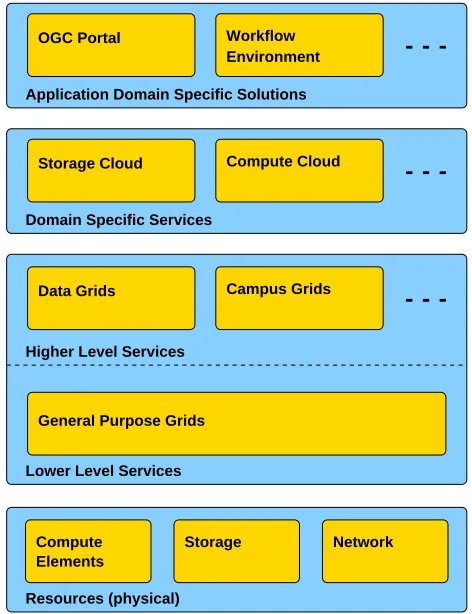
Further, we think is is useful to consider the abover system order when designing systems. In particular, we find that the system order allows for a very generic architecture of real systems, as shown in fig. 3: this figure shows the same system order as above (Operating systems left out), but the annotations connect the examples we gave in the earlier discussion very nicely.
Assuming that this architecture is indeed able to describe real world systems, it seems that Grids are required to expose a number of core capabilities, required to implement scalable Clouds. Amongst these core capabilities we would count:
• system management and monitoring
• authorization / authentication / accounting
• resource virtualization (compute, data, communication)
• scalability, fail safety, QoS, SLA
These are all capabilities which are certainly required within a Cloud system, but are only partially (if at all) exposed to the Cloud application layer. One should also note that these capabilities are amongst the declared target capabilities for current Grid systems[18]!
B. For Resource Providers
Resource providers and thus system implementers should carefully look at their target user space. Ignoring the level of semantic abstraction required by the application space, and thus providing system interfaces which either expose too much
Network Lower Level Services
General Purpose Grids Higher Level Services
Data Grids Campus Grids Compute Cloud Storage Cloud
Domain Specific Services
Workflow Environment
Application Domain Specific Solutions OGC Portal
Elements
[image:8.612.58.292.142.341.2]Resources (physical) Compute Storage
Fig. 3: A concrete realization of the abstract ordering in Figure 2, in form of a system architecture. This is a validation that although simple, the abstract ordering and relationship between entities can be useful to represent real systems.
semantics, or too little, will always result in interfaces which are cumbersome to use, or not to use at all.
There are clear imperatives for high level resource providers to adopt the Cloud model of utility computing: as Grids, Clouds are able to leverage economies of scale, and by supporting a limited but very common set of application classes, Clouds are able to reach out to a large fraction of the user base.
Given that Clouds arelarge, it is not obvious at the moment whether there is a strong need for Clouds to inter-operate; but there is possibly a need for passive inter-operation, often referred to as seamless access, i.e. the ability to submit to NSF or Amazon Clouds. Cloud’s high level interfaces should make this easy, relative to current Grid interoperability efforts [1].
Further, Clouds seem to support an evolving internal in-frastructure: it seems perfectly acceptable to keep engineering “the base” infrastructure, as long as this high-level interface is stable. In contrast, the detailed interfaces that Grids expose makes a straight forward evolution very difficult. This may pose an important advantage to resource providers, as it allows the evolution of their internal infrastructure, without major disruption of the service provided to the end users.
intra-CPU virtualization, as for example provided by systems such as Xen and VMWare. This could possibly be integrated with the inter-CPU virtualization provided by Grids, where brokers manage the deployment of services and applications on the most appropriate resource.
C. For Application Developers and End Users
We believe that program developers should be able to develop applications in the environment they are most com-fortable with, and should not have to include details of their run-time environment into their development process in anything but the most simple way. This is in contrast to the approach where many applications are developed to be explicitly aware of their run-time distributed environment. Applications for Clouds can almost by definition be unaware of the the distributed environment they run.
Related to the need to be unaware of runtime environment details, is the need to provide simple interfaces, potentially in multiple renderings, to keep the application agnostic of the underlying system implementation. Clouds do have these simple interfaces, which are sometimes rendered in different technologies. As an example, the S3 interfaces is provided as REST, SOAP, HTTP and BitTorrent renderings.
The decoupling of applications from resource mapping and resource specific details, lead us to the notion of abstract applications – applications that do not have run-time environ-ment dependencies built into them. As an example, workflow descriptions are usually abstract applications: they can be mapped to different systems and resources, as long as the individual components do not depend on specific resource details.
Clouds and other high level systems, seem to support the notion of abstract applications, and provide a mechanism to create instances of these abstract applications, by binding them to specific resources. An additional bonus for the application developer is that abstract applications provide horizontal in-teroperability, in that these applications can be instantiated on different systems, with no or moderate porting effort, depending on the standardization of the system interfaces. That also avoids vendor lock-in, which may be crucial for a wider acceptance of Cloud technologies.
D. For OGF
The observation is that the development of Grid applications has proven difficult, as has the managment and deployment of Grids. How should a primarily Grid oriented standards organization such as the OGF respond to seemingly broad industrial support for Clouds?
In general, the discussed architecture for Grids and Clouds motivates opportunities for standards at two levels: at infras-tructure level (core capabilities) and at the Cloud interface level. We have already stated that primarily due to the func-tional simplicity, the advantages of a standardized Cloud inter-face in are questionable. When viewed from the motivation of interoperability for applications however, the advantages are obvious. The need for infrastructure standardization may also
be arguable (Are current Clouds built upon standards? Does it matter?), but (a) we feel that standardization is important for any future academic Cloud efforts, and (b) we believe that infrastructure standardization will enable companies to offer Cloud services on top of externally provided resources.
1) Standardization at the Interface Level: We have dis-cussed earlier that the need for standards at the Cloud interface level is arguable, as current Clouds interfaces are essentially so simple, that porting an application is, consequently trivial too. Nevertheless, we feel that for users who wish to use interface from different Cloud systems into a thin or thick client applications, standards will be advantageous, as it will to enable them to interact with any Cloud service. Efforts at standardizating such a Cloud service interface may be premature at this time, as the Cloud usage models are not yet fully understood or developed, but it is certainly an area that OGF could be involved in. Obvious next steps are to understand better the usage models.
There is currently no international group that is addressing the standardization of interfaces to Cloud systems. The Com-puting Community Consortium which are organizing events to try to get parts of the Cloud community together, are probably the closest. This is therefore a relatively green field for the OGF, which has the expertise and mandate to show how interfaces defined within OGF can be used to access Clouds. OGF also has the community to define use cases and develop core architectures and technologies.
Access to many of the services specified by OGF can be encapsulated within APIs such as those produced from the SAGA-WG. Applications developed using these high-level interfaces should seamlessly migrate to Clouds.
2) Standardization at the Core Capability Level: OGF offers a set of standards to support the compute aspects of resource services (HPC-BP, BES, DRMAA), and an emerging set of standards to support data resource services. To the OGF community’s credit, impressive strides in the development of standard interfaces which are agnostic to the underlying architecture and infrastructure details have been made. We believe that these standards can form an essential core when designing and implementing Cloud systems.
will be crucial.
E. For SAGA
SAGA6 is an application level interface that provides a
unified and consistent API to the most commonly used dis-tributed functionality. Given possible changes in the develop-ment landscape, a pertinent question is: what might be the implications for SAGA? As a first step, there is clearly a need to understand the interfaces that are typically exposed by Clouds. However simple the native system interface, there is a need for programmatic support for application development and deployment via abstractions, e.g., providing abstractions to express and address the affinity of Clouds. The SAGA group at the OGF should try to analyze if the notion of affinity can help by designing APIs which are oriented toward specific application domains and usage modes.
In general, the emergence of Clouds with an emphasis on supporting usage modes is an interesting complement to the SAGA approach; both are top-downapproaches for providing application-oriented capabilities and/or interfaces. Currently Clouds provide application-support, at the internal system-level, i.e., by providing capabilities required by applications as intrinsic features of the Cloud system. For example, support for MapReduce by major providers such as Google and Yahoo (via Hadoop), is just one indication of the utility and need for programming abstractions.
VII. DISCUSSION ANDOPENISSUES
We have barely begun to understand Clouds as a viable dis-tributed computing architecture and there are many technical issues, both internal and external to a Cloud that remain to be formally addressed. A limited, random sampling of these are given below:
• High-level interfaces have a role to play in making Clouds and other infrastructure easy to use. There is a need to ad-dress how utilizing distributed systems can be made easier and more effective through abstractions, i.e., via support for commonly occuring patterns, which could be either programming patterns, application usage patterns and/or infrastructure usage patterns. High-level interfaces should make supporting programming abstractions easy, whether it be widely known and utilized abstractions such as Map-Reduce [19], or more recently adopted approaches such as All-Pairs [20] for data-intensive computing.
• The model of computing that a Cloud can support needs to be well defined, and is arguably the most important public attribute of a Cloud; we have introduced the con-cept of Cloud Affinity to address this important attribute. We argue that the internal configuration should not be an attribute that is exposed. The question however, remains: What types of internal configuration are available to support these? For example, can Clouds with suitable network connectivity between compute nodes provide
6Simple API forGrid Applications, an OGF proposed recommendation.
Disclaimer: two of the authors are co-chairs of the SAGA Working Group.
affinity for capability distributed computing (i.e. multiple modest size MPI jobs)?
• We currently find Clouds that are “homogenous” – either just data (S3) or compute Clouds (EC2) or just very large private (commercialized) data centers. Is that an intrinsic property, or can future Clouds be heterogeneous? The issue of homogeneity and heterogeneity is not just academic: for most scientific computing needs, Clouds that provide only data storage facilities are probably going to be insufficient. There is thus a need to intro-duce data-compute affinity and with it arise questions such as, how easily can compute power be provided to data? or possibly, how can data be moved across to the compute (without significant costs of transfer)? Currently S3’s business model charges for data transfer across S3 boundaries; but with network capacity on average doubling faster than compute capacity (though not storage capacity) there is clearly scope for “integrated” Clouds, at least at the logical level if not physically.
• Both Grid and Cloud systems are evolving technological fields, and thus there are many unanswered questions, the answers to many of which will become obvious possibly only with hindsight:
– Is there going to be a situation where we would want to link Clouds together either from different providers or between different functionalities (data Cloud to compute Cloud)?
– If interoperability is required widely (if not univer-sally), then what will be the model of aggregation of Cloud resources? A “Cloud of Grids”? A “Grid of Clouds”? Will Clouds internally span cross-domain?
– Are individual institutions or groups going to want to construct their own Clouds, as they have campus Grids?
– Is there an underlying scheduler for the use case where demand exceeds supply and how would this affect externally available services?
– What can end users expect in terms of fail safety of the Cloud system as a whole? How can users avoid vendor lock-in?
• Clouds do not currently cross administrative domains; this could be the reason behind simpler security models compared to Grids, and the fact that Cloud Security has currently not been seriously exposed to end-users. But if and when they do cross administrative domains, will the the security model remain simple? Either way, an important point will be that the details of the security model and its implementation do not show at the Cloud interface level.
• Do Clouds have an effect on the distribution of
com-puting infrastructure, as is commonly represented by the Branscomb Pyramid[21]? Clouds with different affinities and support for different usage modes, would seem to flatten the pyramid into several isolevel blocks.
enhanced support for virtualization. Additionally, before any intellectually honest conjecture that Clouds are viable, useful systems can be made, with any level of rigour, many of these open issues and questions will need to be placed on a firm footing.
VIII. SOMERELATEDWORK
A draft version of the present paper was circulated as an OGF informational document [22], and received a large num-ber of very informed and relevant comments. Several of those pointed to alternative attempts to define Cloud Computing, and to clarify its relation to Grid computing, and other distributed compute paradigms, such as Software as a Service (SaaS), Platform as a Service (PaaS), or Utility Computing. In this section we will attempt to relate our approach to those and many other alternatives that the community has considered at different stages to varying extents.
A widely accepted approach employed to provide working definition of Clouds is to tie them to an underlying prevalent business model. For example,Per Usage Billingis sometimes cited as a necessary property of Cloud systems; Simplicity of Payment is also sometimes cited as pre-requisite for cloud systems. Do we have references for these? Along similar lines, other definitions state that On Demand Provisioning is the distinguishing neccessary system feature, or that Policy Base AccessandSLAs. Simple references to where these are taken from? It can be argued, that these properties are mostly al-ternative expressions of the same principle, namely simplicity of use or, at least clarity in how to use. The implementation of these properties will by no means be trivial, but their presence will significantly simplify Cloud usage for specific user and application groups. For example, implementing a well-defined SLA (e.g. 99.9% uptime) is non-trivial for the Cloud provider, but enables a large set of applications which require such stringent QoS, for in the absence of such an SLA, it would have been significantly more complex for the application developer and deployer to ensure such as quality-of-service.
In Ref [23], Clouds are defined as, “... virtualized com-puters that are dynamically provisioned and presented as one or more unified computing resources based on service-level agreementsestablished throughnegotiationbetween the service provider and consumers7.” While we are not sure how, or if existing major Clouds fit this definition entirely, for example EC2 does not have mechanism to negotiate SLAs), we find the set of properties consistent with most models of deployed Cloud systems. As indicated by the working definition in Ref [23], another system property that has recieved immense attention isVirtualization, and is widely seen as a necessary prerequesite for several of the afore-mentioned properties, such as Per Usage Billing, On Demand Provisioning, etc. For example, Ref [24] outlines how the combination of virtualization, a simple API and command line interfaces/tools to Globus based Grids enables an EC2-like
7We have used bold-face to emphasis the properties
system. Here, virtualization provides the technological means to implement dynamic provisioning, amongst other things. Another simple approach to providing an EC2-like interface, but arguably more versatile and extensible is the Eucalyptus open-source software infrastructure for implementing “Cloud Computing” on Clusters [17].
The Google Cloud-Computing group [25] also discussed a list of defining features for Cloud systems [26], while leaving open the question if all of these features need to be present, or how many. It is interesting to note that the list includes Non-trivial QoS,Cross Multiple Administrative Domains, and Accessibility through Open Standards – a list which could have been copied from the three-point Grid checklist [8]! But it also includes Interoperability, Resource Metering and Analysis, Security, Virtualization, etc. Again, it is difficult to find existing Clouds which support all these features, but these attributes reflect both the expectations and promises of Cloud systems. Finally, on the Yahoo Cloud-Computing group, there were interesting discussions regarding the perils of providing, and limitations of using functional definitions of Cloud [27].
In general, however, any currently used single definition of Cloud computing is unlikely to provide a comprehensive and ultimately rigorous definition: the field is too young and too diverse for that, and the interest around Cloud computing makes it tempting to cluster a large number of related (and unrelated) technologies under the same umbrella term. It is useful to recall that Grid computing and Utility computing, amongst others, had similar evolution trajectories and that it took a while for coherence in definition, and a consensus in practise to emerge; a similar transition to steady-state for Cloud Computing should be expected as well.
IX. CONCLUSIONS
These are interesting times: Grids are clearly evolving both due to internal and technological pressures as well as external developments including market forces. As the efforts to build scalable systems with standardized interfaces have begun to yield dividends, Clouds – with the not so insignificant commercial interest behind – have emerged as potentially competing approach for architecting large distributed systems. We hope this paper is able to contribute to that discussion, (a) by providing a common terminology to build an analysis of Grids and Clouds, including the notion ofaffinity; and (b) by discussing the key differences between them: Grids on the one hand provide a wide semantic scope to a broad target space of distributed systems and applications; Clouds on the other hand expose a limited, if not minimal set of semantics to support a set of well defined usage modes.
X. ACKNOWLEDGEMENTS
SJ would like to acknowledge support from the e-Science Institute, Edinburgh for supporting the theme, “Distributed Programming Abstractions”. We thank Malcolm Atkinson for helpful discussions, and Steven Newhouse for slides of his presentation at OGF-Boston which lead to the formalization of the ideas around support for abstractions and usage modes. We would also like to thank the many contributors to Google and Yahoo Cloud Mailing lists for their insightful remarks and comments on an early draft of this paper.
REFERENCES
[1] M. Marzolla, P. Andreetto, V. Venturi, A. Ferraro, S. Memon, S. Memon, B. Twedell, M. Riedel, D. Mallmann, A. Streitet al., “Open Standards-Based Interoperability of Job Submission and Management Interfaces across the Grid Middleware Platforms gLite and UNICORE,” IEEE International Conference on e-Science and Grid Computing, pp. 592– 601, 2007.
[2] S. Jha, H. Kaiser, A. Merzky, and O. Weidner, “Grid Interoperability at the Application Level Using SAGA,”IEEE International Conference on e-Science and Grid Computing, pp. 584–591, 2007.
[3] I. Foster and C. Kesselman,The Grid: Blueprint for a New Computing Infrastructure. Morgan Kaufmann, 2004.
[4] P. H. Enslow Jr, “What is a” Distributed” Data Processing System?”
Computer, vol. 11, no. 1, pp. 13–21, 1978.
[5] “The Future of the TeraGrid, Position Papers.” [Online]. Available: http://www.teragridfuture.org/positionpapers
[6] C. Lee, “Evolutionary Pressures on the TeraGrid and the Larger Grid/Distributed Computing Community,”The Future of the TeraGrid, Position Papers, 2008. [Online]. Available: {http://teragridfuture.org/ node/222}
[7] “Wikipedia.” [Online]. Available:{http://en.wikipedia.org/}
[8] I. Foster, “What is the Grid? A Three Point Checklist,” Grid Today, vol. 1, no. 6, pp. 22–25, 2002.
[9] C. Catlett, “The philosophy of TeraGrid: building an open, extensible, distributed TeraScale facility,” Cluster Computing and the Grid 2nd IEEE/ACM International Symposium CCGRID2002, pp. 5–5, 2002. [10] Geoffrey Fox and Marlon Pierce, Grids
Chal-lenged by a Web 2.0 and Multicore Sandwich,
http://grids.ucs.indiana.edu/ptliupages/publications/CCGridDec07-Final.pdf.
[11] Amazon, Inc., “Amazon Simple Storage Service.” [Online]. Available: htpp://aws.amazon.com/s3
[12] Amazon, Inc., “Amazon Elastic Compute Cloud.” [Online]. Available: http://aws.amazon.com/ec2
[13] M. Palankar, A. Iamnitchi, M. Ripeanu, and S. Garfinkel, “Amazon S3 for Science Grids: A Viable Solution?” Accepted for The First International Workshop on Data-Aware Distributed Computing Boston, Massachusetts, 2008.
[14] Interview with Kate Keahey, “Converging Virtualization with Distributed Computing.” [Online]. Available: {http://www.gridtoday. com/grid/1086063.html}
[15] I. Wladawsky-Berger, “OGF-22 Keynote: Cloud Computing, Grids and the Coming IT Cambrian Explosion,” February 2008. [Online]. Available: http://www.ogf.org/gf/event schedule/?id=1137
[16] T. Goodale, S. Jha, H. Kaiser, T. Kielmann, P. al Kleijer, A. Merzky, J. Shalf, and C. Smith, “A Simple API for Grid Applications (SAGA),” OGF Document Series 90, http://www.ogf.org/documents/GFD.90.pdf, 2008.
[17] EUCALYPTUS - Elastic Utility Computing Architecture for Linking Your Programs To Useful Systems http://eucalyptus.cs.ucsb.edu/. [18] I. Foster, C. Kesselman, J. Nick, and S. Tuecke, “The physiology of
the Grid,”Grid Computing: Making the Global Infrastructure a Reality, 2003.
[19] J. Dean and S. Ghemawat, “MapReduce: Simplified Data Processing on Large Clusters,”Operating Systems Design and Implementation (OSDI ’04), 2004.
[20] C. Moretti, J. Bulosan, D. Thain, and P. J. Flynn, “All-Pairs: An Abstraction for Data-Intensive Cloud Computing,” Accepted for IPDPS08), 2008. [Online]. Available: {http://www.nd.edu/∼dthain/
papers/allpairs-ipdps08.pdf},
[21] L. Branscomb, T. Belytschko, P. Bridenbaugh, T. Chay, J. Dozier, G. S. Grest, E. F. Hayes, B. Honig, N. Lane, J. William A. Lester, G. J. McRae, J. A. Sethian, B. Smith, and M. Vernon, “NSB 93-205 – NSF Blue Ribbon Panel on High Performance Computing,” October 1993. [22] http://www.ogf.org/Public Comment
Docs/Documents/2008-07/cloud-grid-saga.pdf.
[23] R. Buyya, C. S. Yeo, and S. Venugopal, “Market-oriented cloud com-puting: Vision, hype, and reality for delivering it services as computing utilities,”CoRR, vol. abs/0808.3558, 2008.
[24] K. Keahey, I. Foster, T. Freeman, X. Zhang, and D. Galron, “Virtual Workspaces in the Grid,”Lecture Notes In Computer Science: Proceed-ings of Europar 2005, vol. 3648, p. 421, 2005.
[25] Google Cloud Computing Group. [Online]. Available: http://groups. google.com/group/cloud-computing
[26] Google Cloud Computing Group – Wiki. [Online]. Available: http://sites.google.com/site/cloudcomputingwiki/