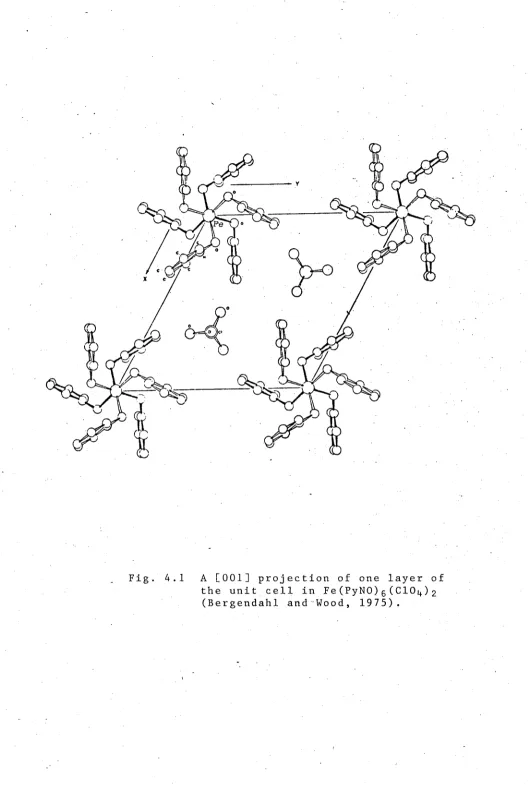
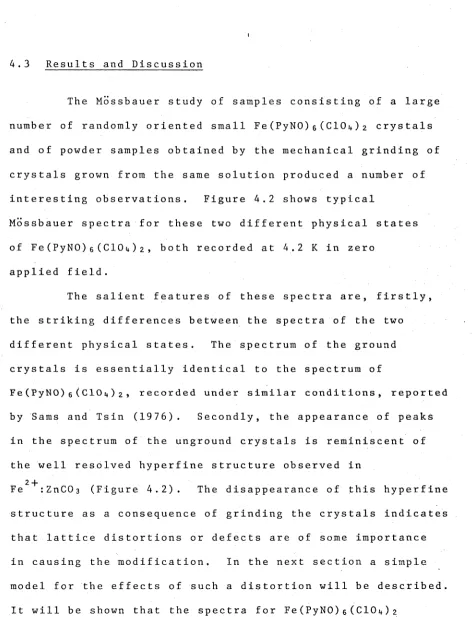
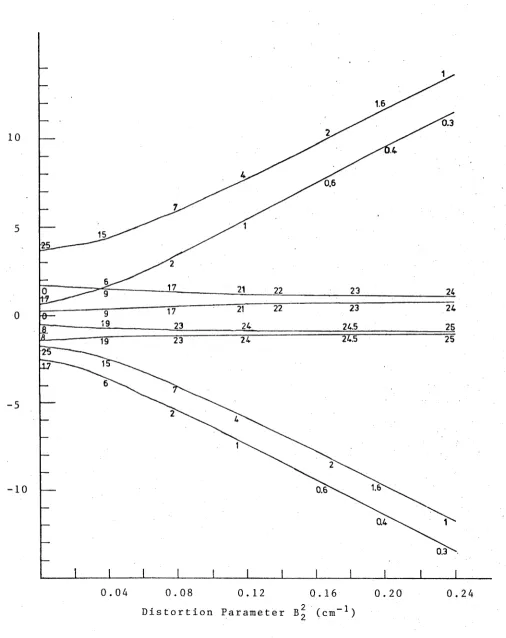
A thesis submitted for the degree
of Doctor of Philosophy
of the
Australian National University
by
Bat it i y V&nnit> Howza
J
anuary 19 80
The research described in this thesis was
carried out while I was a full-time research scholar
at the Australian National University, and except where
due reference is made is my own.
This thesis contains no material that has been
accepted for the award of any other degree or diploma
in any university or similar institution.
6
.
B.D. HOWES
I w i s h to e x p r e s s my a p p r e c i a t i o n and g r a t i t u d e
to my s u p e r v i s o r , Dr. D.C. Price, for s t i m u l a t i n g d i s c u s s i o n s and h e l p f u l g u i d a n c e d u r i n g this cou r s e of study. I am
also i n d e b t e d to Dr. D. C r e a g h for o f f e r i n g his e q u i p m e n t and time to c a rry out the X - r a y study of the
(M.^ e^ ) ( Py NO ) g ( C104 ) 2 c o m p o u n d s and dis c u s s the r e sults of the analy s i s .
I am g r a t e f u l to Dr. M. W i l t s h i r e and Dr. D. Tay l o r for their i n t e r e s t in my w o r k and also to the t e c h n i c a l
s t aff of the D e p a r t m e n t , p a r t i c u l a r l y Mr. G. S a m p i e t r o for his p r e p a r a t i o n of the Co^ ^ F e ^ C l 2 c r ystals.
F i n a l l y I w o u l d like to thank the A u s t r a l i a n N a t i o n a l U n i v e r s i t y for o f f e r i n g me a Ph.D. s c h o l a r s h i p and also the D e p a r t m e n t of Solid State P h y s i c s for the p r o v i s i o n of l a b o r a t o r y f a c i l i t i e s .
The 57Fe Mössbauer spectra of F e (P y N O )g (C 10 4 ) 2 ,
where PyNO is Pyridine - N - oxide
[viz.
C^-H^NO) , recorded lat low temperature in zero applied magnetic field showed
2. "f*
effects of slow relaxation of the Fe ion between its
lowest two (quasi-degenerate) energy levels. The spectra
of small crystals display resolved paramagnetic hyperfine
structure which disappeared when the crystals were ground
to power. These spectra have been reproduced using a
2 +
model in which the Fe sites, which are trigonally distorted
octahedra, experience a small off-axial distortion. The
magnitude of the off-axial crystal field, represented by a
term B 2^ 2 ’ ^s considered to be of the same order as the
hyperfine interaction, so the two were applied together as
perturbations to the coupled electron-nuclear quantum
2 +
system of the high spin Fe ion. Distributions of values
2 2 — 1
of the parameter centred at B n = 0 or 0.03 cm enabled
simulation of the experimental spectra for the unground
2 -1
crystals whereas a distribution centred at B^ = 0.3 cm
was required for the ground crystals. One effect of
grinding the crystals thus appears to be a significant
increase in the average cation site distortion.
2 +
Substitution of Fe ions into the isomorphous
compounds M (P y N O )6 (C 1 0 4 ) 2 (M = Zn,Mg) provided a further
opportunity to study the cation site distortion thought to
d i stortion model mentioned above. The Mössbauer spectra
for the Zn-Fe series indicated that, for a certain
2 -t
c on c e n t r a t i o n range, the proportion of distorted Fe sites is
diminished with respect to F e ( P y N O ) 0(0104)2*
An unusual dependence on the iron concentration was
found for the Mössbauer spectra of the Zn-Fe series. An X-ray
powder diffraction analysis showed that the cell constants
of the Zn-Fe series also exhibit abnormal behaviour as a
function of iron concentration. No such behaviour was
observed for the Mg-Fe series in either the Mössbauer or
X-ray results. The dependences of the Mössbauer spectra and
cell constants on iron concentration in the Zn-Fe series
appear to be correlated and related to changes in the degree
of disorder in the crystal lattice. However, the origin of
this disorder is uncertain.
The solid solution series Co Fe Cl? has also
1 -x x z
been studied. This hexagonal layered system is of particular
interest because of the competing spin anisotropies of the
2+
two cations. The Fe m a g n etisation direction and homogeneity
have been examined as functions of iron concentration at
4.2 K in zero applied field by observation of the hyperfine
interactions at the ferrous site. The results obtained to
date indicate that the hyperfine field direction, and thus
the spin, of the ferrous ion rotates, from its orientation
thought to be a result of competition between the ferrous
2 +
spin anisotropy energy and the Co crystal field
anisotropy energy.
A c k n o w l e d g e m e n t s (iii)
A b s t r a c t (iv)
C h a p t e r 1 G e n e r a l I n t r o d u c t i o n 1
1.1 5 7F e 2+ Ions in the M ( P y N O ) g (CI O4I 2 3 C o m p o u n d s ( M = Fe,Zn,Mg)
1.2 57F e 2+ Ions in C o C l2 7
C h a p t e r 2 T h e o r e t i c a l R e v i e w 12
24
-2.1 E l e c t r o n i c Level S t r u c t u r e of Fe 13 Ions in Sites of T r i g o n a l S y m m e t r y
2.1.1 C r y s t a l Field I n t e r a c t i o n 14 2.1.2 S p i n - O r b i t I n t e r a c t i o n 18
2.2 H y p e r f i n e I n t e r a c t i o n s 19
2.3 M a g n e t i c H y p e r f i n e I n t e r a c t i o n 21 2.3.1 O r i g i n s of the M a g n e t i c 26
H y p e r f i n e I n t e r a c t i o n
2.4 R e l a t i v e I n t e n s i t i e s of A b s o r p t i o n 29 Peaks
2.4.1 S i n g l e C r y s t a l A b s o r b e r s 29 2.4.2 R a n d o m l y P a c k e d P o l y c r y s t a l l i n e 34
Ab s o rb e r s
2.4.3 R e l a t i v e I n t e n s i t i e s of 36 T r a n s i t i o n s b e t w e e n Cou p l e d
E l e c t r o n - N u c l e a r States
2.5 E v a l u a t i o n of C r y s t a l Field P a r a m e t e r s 39 from M ö s s b a u e r S p e c t r a
3.1.1 Crystal Growth 40
3.1.2 Absorber Preparation 42
3.2 Apparatus 4 4
3.2.1 Mössbauer Spectrometer 44
3.2.2 Variable Temperature Controller 46
3.3 Evaluation of Mössbauer Spectra 46
Parameters
Chapter 4 Evidence for Cation Site Distortions 49
in Fe (PyNO)6(ClOy)2
4.1 Introduction 49
4.2 Crystal Sturcture 51
4.3 Results and Discussion 52
4.4 Model for the Distortion of the Cation 56
Site in Fe (P y N O ) s (C1 0 y)2
4.4.1 Derivation of the Coupled 58
Electron-Nuclear Basis States
4.5 Discussion 62
4.6 Conclusions 68
2 +
Chapter 5 Further Studies of the Fe Ion in the 69 Isomorphous M ( P y N O )g (CIO4) 2 Compounds
(M = Zn, Mg)
5.1 Introduction 69
5.2 Results 70
5.2.1 Mössbauer Data 70
5.2.2 X-ray Diffraction Analysis 71
5 . 3 Discussion 74
5.3.1 Mössbauer Data 74
5.3.2 Spin-Spin Coupling between 76
2+
Fe Ions in the M (PyNO) § (C1 01+)2 Compounds
5.3.3 X-ray Analysis 78
5.3.4 Correlation of the Mössbauer 80
and X-ray Results
5.3.5 Effects of Changes in the 82
Crystal Preparation Conditions
5.3.6 Temperature Dependence of 83
the Spectral Features
5.4 Future Work 84
5.5 Conclusions 85
2. ”4"
Chapter 6 Magnetic Behaviour of the Fe Ion in 87
C o C 1 2
6.1 Introduction 87
6.2 Crystal Structure of Co, Fe Cl? 88
6.3 Theoretical Considerations 89
6.4 Results and Discussion 92
6.5 Future Work 97
6.6 Conclusions 98
References 99
C H A P T E R
1
GENERAL I NTRODUCTI ON
The emission and absorption of y-rays without
loss of energy due to recoil of the nucleus is known as
the Mössbauer effect as it was first observed by Rudolf
Mössbauer in 1957 (Mössbauer, 1958). Mössbauer spectroscopy
has since found applications in many diverse fields, such
as solid state physics and chemistry, biology and
archaeology. Its great value derives from the fact that
the width of the emission (or absorption) lines resulting
from transitions from metastable nuclear levels are often
smaller than the interactions between the nucleus and
atomic electrons, the so-called hyperfine interactions.
— i 2
This extremely high degree of resolution (ca. 10 )
has allowed the observation of phenomena which before the
discovery of the Mössbauer effect were considered to be
unmeasurable, for instance, a laboratory measurement of
gravitational red shift and observation of the Zeeman
splitting of nuclear levels. The strength and nature
of the hyperfine interations depend critically on the
electronic, chemical and magnetic state of the atom.
Mössbauer spectroscopy can thus provide considerable
Many nuclides are known to be suitable for use as
Mossbauer nuclides but in the context of this thesis only
57Fe will be considered. Two distinct groups of high spin
ferrous compounds will be examined. Although they have
dissimilar properties they are linked by their common
rhombohedral crystalline structure and consequent
octahedrally coordinated cation sites with trigonal
symme try.
In a cubic octahedral field the free ion ground
multiplet (5D) of the high spin ferrous ion is split into
an orbital doublet and a lower lying orbital triplet
T . Spin-orbit coupling leads to further splitting of
the orbital levels resulting in a triplet ground state.
In the presence of a trigonal field this triplet is split
into a singlet and a doublet which, for the cases of
interest in the present study, is the lower. The
separation of the doublet and singlet is a key factor in
determining the appropriate description for the magnetic
properties of the ion and its characterisation (when
desired) by an effective (or psuedo) spin.
These
level separations and hence the aforementioned characteristicsof the ion are dependent upon the relative magnitudes of
the trigonal field and spin-orbit interactions.
Two particular cases are pertinent to the present
work. In the first, the trigonal field is much larger
than the spin-orbit coupling, giving rise to a ground
doublet well separated (by ~ 100 cm ) from higher lying
c o u p l i n g are of the same order of m a g n i t u d e w h i c h results in a small s e p a r a t i o n (~ 10 cm ) b e t w e e n the do u b l e t and singl e t . T h e s e cases are c o n s i d e r e d in C h a p t e r 4 and
C h a p t e r 6 r e s p e c t i v e l y . It wi l l be seen that the a p p r o a c h c h o s e n to a n a l y s e the e x p e r i m e n t a l data is g r e a t l y
-i n f l u e n c e d by the d e g r e e of s e p a r a t -i o n of the s p -in^j 1 eve 1 s . F u r t h e r d e t a i l s of the e l e c t r o n i c s t r u c t u r e of a high spin f e r r o u s ion in a t r i g o n a l e n v i r o n m e n t wi l l be g i ven in S e c t i o n 2.1.
1.1 5 7 F e 2 Ions in the M (P y N O ) 6 (C 1 0 4)2 C o m p o u n d s (M = F e , Zn, M g )
2 +
P a r a m a g n e t i c Fe ions in F e ( P y N0)6(C1 0 4)2, where PyNO is Pyridine - N - oxide (viz. C^H^NO), and iron
doped into the d i a m a g n e t i c i s o m o r p h o u s structures
M (P y N O ) e (C 1 04)2 (M = Zn, Mg) c o n s t i t u t e the first group of m a t e r i a l s studied. The i n t e r e s t in these c o m p o u n d s o r i g i n a t e d from an i n v e s t i g a t i o n of high spin ferrous s u b s t a n c e s d e s i g n e d to e x p l o r e the p o s s i b i l i t y that some of them m ight d i s p l a y slow r e l a x a t i o n and, if so, to u n d e r s t a n d the s t r u c t u r a l c o n d i t i o n s r e q u i r e d to allow o b s e r v a t i o n of such p r o c e s s e s .
B e f o r e p r o c e e d i n g f u r t h e r it is of v a l u e to b r i e f l y recall that the e l e c t r o n i c r e l a x a t i o n rates of p a r a m a g n e t i c
2 “f"
spin-lattice and spin-spin interactions tend to disorient
the electronic spin both in time and space. It is a
consequence of these interactions that relaxation rates
are fast in paramagnetic systems. The fast relaxation
causes the magnetic moment of the ion and the resultant
hyperfine field at the nucleus to fluctuate rapidly with the
result that the nuclear spin does not experience a unique
direction of the hyperfine field to precess around.
Consequently, the Mossbauer effect measures a time averaged
field of zero at the nucleus.
Observation of slow relaxation effects in the
• • 2
"I-Mossbauer spectra for Fe ions in ZnC0 3 (Price et ai . ,
1977) and M g C 0 3 (Srivastava, 1976) suggested that other
2 ”{■
substances in which the Fe ions have the same site
symmetry might also show slow relaxation effects. The
cations in these rhombohedral carbonates are coordinated
octahedrally with a trigonal distortion of the octahedron
(point symmetry C .). In the majority of cases for which
* X
ferrous ions occur in distorted octahedral sites the ionic
ground state is an orbital singlet. Spin-orbit mixing
with excited states gives rise to a non-magnetic singlet
ground state and two excited doublets. At low temperatures
only the singlet is occupied and no hyperfine structure
will be visible in the spectra. At higher temperatures
one might expect that Raman relaxation processes within
the ground quintet will allow faster relaxation than is
large excitation energies, A, to states above the ground
doublet. This is the result of a A -2 term in the
expression for the Raman relaxation rate (Price et al.,
1977). It follows that observation of hyperfine structure
in the Mössbauer spectra for such ions is less probable
than for cases with doublet ground states and relatively
large separations from higher lying states (if spin-spin
relaxation is unimportant). Such a system exists in the
carbonates mentioned earlier. A further example is found
in F e ( P y N O ) 6 (C104) 2 •
In the absence of an applied magnetic field the
Mössbauer spectra for F e (P y N O )6(C 1 0 4 ) 2 at low temperature
(Sams and Tsin, 1975a, b; 1976) do not exhibit the
we 11-r e so 1ved paramagnetic hyperfine structure evident
in the spectra of the carbonates. However, application
of small (~ 0.1 T) magnetic fields results in the appearance
of resolved hyperfine structure (Sams and Tsin, 1976). A
similar effect was observed by Price and Srivastava (1976)
24“
for Fe ions in C a C 0 3 and C d C 0 3 . The site symmetry of
the ferrous ions in these carbonates is the same as in
Z n C 0 3 and M g C 0 3 , but to observe resolved hyperfine structure
an applied magnetic field was necessary.
It was suggested by Price and Srivastava that the
doublet ground state was split by £ 0.5 cm and on
this assumption they were able to satisfactorily interpret
their data. Zimmermann et al. (1974a,b) discovered evidence
F e (p a p t )2•C6H6 and tetr a k i s - (1,8- na ph th y r i d i n e ) iron
(II) perchlorate. Both substances have a doublet
- l
ground state which is split by less than 1 cm . The
transition probabilities for spin-lattice relaxation
between the doublet ground states were determined by
Zimmermann to be very small thus enabling the observation
of resolved hyperfine structure in the presence of an
2 +
applied field. In the case of Fe ions in Z n C Ü3
the states of the unsplit ground doublet are magnetic
and resolved hyperfine structure is visible at sufficiently
2 “I"
low temperature whereas for Fe ions in C a C Ü3 the states
of the slightly split ground doublet are non-magnetic and
an external field is required to remagnetise them and allow
the observation of hyperfine structure.
The observations of F e (P y N O )6(C 1 04 ) 2 made by Sams
and Tsin ( 19 75a,b; 19 76 ) and the new results reported
in the following chapters may be well described by a
model in which the doublet ground state is slightly
split by a small off-axial distortion. The splitting is
considered to be of the same order of magnitude as the
magnetic hyperfine interaction and thus even in zero
applied field the split states will be remagnetised to a
small extent by the nuclear magnetic moment. This results
in the onset of hyperfine structure manifested as the
line broadening of the powder spectra of Sams and Tsin
(1975a,b; 1976) and the resolved structure of the many-
The off-axial distortion mentioned above was for
reasons of simplicity assumed to be of rhombic form
resulting from random strain fields within the crystal.
Such a distortion is not expected to be an accurate
r e p resentation but within the limitations of the model
it was anticipated that it would provide a reasonable
insight into the system.
It appears evident from the foregoing that the
2 +
assumption of fast relaxation for high spin Fe ions
is not valid under certain conditions which result in a
doublet ionic ground state well separated from
higher states. In other words it is highly probable that
2 ”4"
the slow relaxation observable in high spin Fe ions
is a consequence of the site symmetry.
1.2 5 7Fe Ions in C o C l2
The randomly mixed two component systems of the
type R M X , where R and M are different magnetic cations 1 “ X X
with competing spin anisotropies and X represents the
anions, have attracted much attention because the differing
characteristics of the constituent cations give rise to
interesting magnetic properties.
Fishman and Aharony (1978) have considered the
concentration versus transition temperature phase diagrams
of alloys of two materials which have competing anisotropies.
They have predicted three kinds of ordered phases and
also a tetracritica 1 point in such systems. The ordered
at either end of the concentration range and to a new
phase, which for a mixture of two antiferromagnets with
different anisotropies has been called oblique-
ant i f er romagnet (OAF)(Matsubara and Inawashiro, 1977), in
the intermediate concentration region. In the OAF phase
there is simultaneous ordering of the two spin components.
The spin of each species of cation has its own axis of
sublattice magnetisation which is directed obliquely to
the easy axis of the pure system. Such a phase is thought
to have been found in, e.g. Co ^ Fe C 1 2 .2H20 (Katsumata
et a l . , 19 79 ) and K2Mn^ x ^ ex ^ 4 (Bevaart et a l . , 19 78).
The solid solution series Co Fe C l 2 is a system l -x x
which has competing spin anisotropies and constitutes
the second group of materials investigated in this thesis.
Anhydrous F e C l 2 and C o C l 2 are hexagonal layered compounds
of the C d C l 2 type in which layers of metal ions are
separated by two layers of halide ions (further details
of the crystal structures will be given in Section 6.2).
Magnetic susceptibility measurements (Starr et a l., 1940)
showed that the susceptibilities of both compounds, from
room temperature to 75 K, obeyed the Curie-Weiss law
(viz. x = C/(T-0) where x is the susceptibility, 0 is the
Curie temperature and C a constant). Extrapolation of these
results gave rise to a positive value of the paramagnetic
Curie temperature which according to the Weiss theory
the occurrence of a ferromagnetic transition. However,
susceptibility measurements at lower temperatures reveal
maxima at approximately the same temperatures as A-type
anomalies observed in the specific heat measurements (Trapeznikowa
and Shubtiikov , 19 35;Trapeznikowa e t a l . , 19 36 ) thus implying
antiferromagnetic transitions. Furthermore, for both compounds a
large fraction of the expected saturation magnetisation can be
produced by magnetic fields that are much smaller than
those usually associated with the exchange coupling in
an antiferromagnet which has a transition temperature
of ~ 24 K (Wilkinson et al., 1959). Materials which
exhibit these unusual magnetic properties are known as
metamagnets (Becquerel and van den Handel, 1939). Below
the ordering temperature of the compound (23.5 K for F e C l2,
24.9 K for C0C I2) the cation spins are aligned ferro-
m a g netically within any one layer while the spins in
alternate layers are aligned antiparallel resulting in an
overall antiferromagnetic structure. The spins are
oriented parallel and perpendicular to the trigonal axis
in F e C l2 and C0C I2 respectively as a result of the dominant
crystal field anisotropy.
There has been some conflict in the literature
concerning the relative magnitudes of the trigonal field
splitting 6 and the spin-orbit coupling parameter A for
2 +
F e C 1 2 • The magnetic properties of the Fe ion are
dependent upon the ratio 6/A and thus it is of importance
to resolve which assessment is more appropriate. Kanamori
that the trigonal field dominated the spin-orbit
interaction (i.e. 6 >> A ) in F e C 1 2 • Thus at low temperatures
a good approximation of the spin system can be given by
an Ising model. This means that the ground doublet of the
2 +
Fe ion is well separated from the higher lying singlet
and consequently the transverse spin components are
completely quenched. Such a model was pursued by other
authors (e.g. Heap, 1962; Yomosa, 1960) to calculate a
number of properties. However, the results of a Mössbauer
study of F e C l2 (Ono et a l. 1964) showed that 6/A ~ 1. In
systems which have 6/A ~ 1 the separation between the doublet
and singlet states is ~ 10 cm and the Ising model, as
described above, is not a valid representation of the magnetic
2 +
properties of the Fe ion. Hazony and Ok (1969) repeated
the Mössbauer analysis and their interpretation of the
measurements was found to support K a n a m o r i ’s contention.
Both sets of authors obtained almost identical temperature
dependences for the quadrupole splitting but their
interpretations of the data were quite different. Ono
et al. derived A = 95 cm 1 , 6 = 119 cm 1 (6/A = 1.25) whereas Hazony and Ok found A = 42 cm , 6 = 340 cm
(6/A = 8.4). Before proceeding further it should be pointed
out that it is possible to obtain such widely differing
deductions from two similar sets of data because the
temperature dependence of the quadrupole splitting does
not offer a reliable or unambiguous method for estimating
static crystal field parameters (see Section 2.5). The
i n d i c a t e s that the c l o s e s t d e s c r i p t i o n of the m a g n e t i c 2 +
p r o p e r t i e s of the Fe ion in F e C l2 is g i ven in terms of a m o d e l in w h i c h the e f f e c t i v e spin is 1 and 6/A ~ 1, in a g r e e m e n t wi t h O n o 's a n a l y s i s of the M o s s b a u e r data.
A m o d e l of this type has be e n used to i n t e r p r e t m e a s u r e m e n t s o b t a i n e d from e.g. n e u t r o n - s c a t t e r i n g , Raman s c a t t e r i n g , the para 1lei and perpendicular
s u s c e p t i b i l i t i e s and the s p e c i f i c heat of F e C 12 by B i r g e n e a u et al. (1972), J o h n s t o n e et a l . (1978),
B e r t r a n d et al. (1974) and L a n u s s e et al. (1972) r e s p e c t i v e l y . All a c h i e v e d good a g r e e m e n t b e t w e e n theory and e x p e r i m e n t .
T a w a r a y a and K a t s u m a t a (1979) have o b s e r v e d , u s ing s u s c e p t i b i l i t y m e a s u r e m e n t s , three d i s t i n g u i s h a b l e
m a g n e t i c a l l y o r d e r e d p h a s e s in C o 1 ^ F e ^ C l2 • They a s s o c i a t e d these phases w i t h the F e - r i c h and C o - r i c h
a n t i f e r r o m a g n e t i c phases, and a p h a s e at the i n t e r m e d i a t e c o n c e n t r a t i o n region (viz. 0.75 £ x £ 0.65 at 5 K) they i d e n t i f i e d w i t h the OAF p h a s e m e n t i o n e d earlier. In the pre s e n t s t udy of Co ^ ^ F e ^ C l2 the b e h a v i o u r of the ferrous spin as a f u n c t i o n of iron c o n c e n t r a t i o n is o b s e r v e d via the h y p e r f i n e i n t e r a c t i o n s at the iron ion. Such an
C H A P T E R 2
T H E O R E T I C A L R E V I E W
In this c h a p t e r o u t l i n e s and d e f i n i t i o n s w i l l be g i v e n only of the e s s e n t i a l t h e o r e t i c a l a s p e c t s w h i c h are r e l e v a n t to the w o r k of this thesis and that p r o v i d e
p e r t i n e n t b a c k g r o u n d i n f o r m a t i o n . In p a r t i c u l a r the d e r i v a t i o n of the e l e c t r o n i c e n e r g y level s t r u c t u r e of
2 +
Fe ions u n der the i n f l u e n c e of a tr i g o n a l c r y s t a l field and s p i n - o r b i t c o u p l i n g w i l l be d i s c u s s e d . F e a t u r e s of the h y p e r f i n e i n t e r a c t i o n s will be c o n s i d e r e d wi t h
p a r t i c u l a r r e f e r e n c e to the d e s c r i p t i o n of the m a g n e t i c h y p e r f i n e i n t e r a c t i o n by the e f f e c t i v e field a p p r o x i m a t i o n . The r e l a t i v e i n t e n s i t i e s of M ö s s b a u e r a b s o r p t i o n peaks
2
T-2.1 E l e c t r o n i c Level S t r u c t u r e of Fe Ions in Sites of T r i g o n a l S y m m e t r y
The M ö s s b a u e r s p e c t r a of ions in a crystal l a t t i c e depe n d v e r y s t r o n g l y on the e l e c t r o n i c energy level s t r u c t u r e of the ions in a p a r t i c u l a r c r y s t a l l i n e e n v i r o n m e n t . In this s e c t i o n it is i n t e n d e d to p r o v i d e an o u t l i n e of the e ffects of the v a r i o u s factors a c t i n g upon the free ion g r o u n d state
2 +
of a Fe ion when it is l o c a t e d in a site of t r i gonal
2 |
-s y m m e t r y . This d i s c u s s i o n w i l l be r e s t r i c t e d to Fe ions in t r i g o n a l sites b e c a u s e of their p a r t i c u l a r r e l e v a n c e to the w o r k p r e s e n t e d in this thesis.
The H a m i l t o n i a n w h i c h d e s c r i b e s the s p l i t t i n g of the free ion ground term ( 5D) may be wr i t t e n :
X = X ^ + W
+ X
+ X + X
2.1ct so ss m q
w h e r e X ^ r e p r e s e n t s the c r y s t a l field i n t e r a c t i o n , Xgo is the i n t r a i o n i c s p i n - o r b i t i n t e r a c t i o n ,
X
is the i n t e r i o n i css
s p i n - s p i n i n t e r a c t i o n ,
X
is the n u c l e a r m a g n e t i c dip o l e mi n t e r a c t i o n and
X^
r e p r e s e n t s the n u c l e a r e l e c t r i c q u a d r u p o l e i n t e r a c t i o n .The i n t r a i o n i c s p i n - s p i n c o u p l i n g will be n e g l e c t e d b e c a u s e in the pre s e n t c o n t e x t it w i l l not lead to f urther s p l i t t i n g of the ionic sta t e s (the only n o n - z e r o m a t r i x el e m e n t s are those d e r i v e d from the spin o p e r a t o r S^) and since it is e x p e c t e d to be small (< 1 cm 1 ; A b r a g a m and Ble a n e y , 19 70).
The last two terms of E q u a t i o n 2.1 o p e r a t e on
the n u c l e a r and e l e c t r o n i c c o m p o n e n t s of the w a v e f u n c t i o n s
i m p o r t a n c e of such terms, p a r t i c u a r l y in the c o n t e x t of this t h e s i s ) w i l l b e c o m e a p p a r e n t in C h a p t e r 4. In this s e c t i o n only p u r e l y e l e c t r o n i c w a v e f u n c t i o n s are c o n s i d e r e d and thus these terms are ignored. The term 3Cs a r i s e s from d i p o l e - d i p o l e c o u p l i n g and e x c h a n g e i n t e r a c t i o n s b e t w e e n the e l e c t r o n spins of n e i g h b o u r i n g ions. Both of these i n t e r a c t i o n s may indu c e t r a n s i t i o n s b e t w e e n spin states,
l e a d i n g to the we l l k n o w n s p i n - s p i n r e l a x a t i o n process. In a p a r a m a g n e t i c c o m p o u n d the e x c h a n g e i n t e r a c t i o n is e x p e c t e d
to be s m a l l and d i p o l a r c o u p l i n g b e t w e e n n e i g h b o u r i n g e l e c t r o n s p ins is not s u f f i c i e n t l y s t r o n g to have any s i g n i f i c a n t
e f f e c t s on the e l e c t r o n i c s t r u c t u r e . T h e r e f o r e , it is
p o s s i b l e to omit these i n t e r a c t i o n s from a d i s c u s s i o n of the e l e c t r o n i c s t r u c t u r e of ions in a p a r a m a g n e t i c compo u n d . W h e n a c o m p o u n d w h i c h is m a g n e t i c a l l y o r d e r e d is c o n s i d e r e d , h o w e v e r , the degeneracy of the e l e c t r o n i c levels may be lifted by the e x c h a n g e i n t e r a c t i o n s . The form and i m p l i c a t i o n s of the p r e s e n c e of stro n g e x c h a n g e i n t e r a c t i o n s will be e x a m i n e d in C h a p t e r 6 for the p a r t i c u l a r case of the a n t i f e r r o m a g n e t i c Co Fe^ Cl^ c o m p o u n d s . In this s e c t i o n only those terms in the H a m i l t o n i a n 2.1 r e p r e s e n t i n g the c r y s t a l field and s p i n - o r b i t i n t e r a c t i o n s w i l l be c o n s i d e r e d .
2.1.1 C r y s t a l Field I n t e r a c t i o n
V ( r , 0 , <J>)
l
j2 . 2
w h e r e i s t h e c h a r g e o f t h e j n e i g h b o u r i n g i o n l o c a t e d
a t a d i s t a n c e R f r o m t h e o r i g i n . T h e p o t e n t i a l ma y b e
e x p a n d e d i n s p h e r i c a l h a r m o n i c s u s i n g t h e s p h e r i c a l h a r m o n i c
a d d i t i o n t h e o r e m (e . g . G r i f f i t h , 1 9 6 1 ) a n d w r i t t e n a s i n
E q u a t i o n 2 . 3 ( B l e a n e y a n d S t e v e n s , 1 9 5 3 , H u t c h i n g s , 1 9 6 4 ) :
V ( r , 0 , <J)) I Am < r n > Ym ( 0, ( f ) ) 2 . 3 n , m
w h e r e Ym ( 9 , d ) ) a r e s p h e r i c a l h a r m o n i c s , Am d e n o t e s a c r y s t a l l i n e
n n
f i e l d p a r a m e t e r a n d < r n > i s t h e e x p e c t a t i o n v a l u e o f t h e n ^
p o w e r o f t h e d e l e c t r o n r a d i u s . T h e p r o d u c t s A™ < r n > a r e
n o r m a l l y d e t e r m i n e d b y f i t t i n g t h e c r y s t a l l i n e f i e l d H a m i l t o n i a n
t o e x p e r i m e n t a l d a t a . U s i n g o p e r a t o r e q u i v a l e n t s a n d
f o l l o w i n g O r b a c h ( 1 9 6 1 ) i t i s p o s s i b l e t o r e w r i t e E q u a t i o n
2 . 3 a s :
v , m n _ _ m , _ . ) A < r > 6 0 ( L)
L n n n —
n , m
2 . 4
T Bm 0 m ( L ) u n n — n , m
w h e r e 0 (_L) a r e o p e r a t o r e q u i v a l e n t s , t h e f o r m o f w h i c h i s
g i v e n b y O r b a c h ( 1 9 6 1 ) , a n d B™ = A™ < r n > 0 ^ . T h e m u l t i p l i c a t i v e
f a c t o r s 0 ^ a r e t a b u l a t e d b y H u t c h i n g s ( 1 9 6 4 ) .
p
-j-T h e Fe i o n s c o n s i d e r e d h e r e i n a r e i n c u b i c -
o c t a h e d r a l c r y s t a l f i e l d s w i t h a t r i g o n a l d i s t o r t i o n a l o n g
t h e [ 1 1 1 ] d i r e c t i o n o f t h e o c t a h e d r o n . I f t h e q u a n t i s a t i o n z
w h i c h is a t h r e e - f o l d s y m m e t r y a x i s , t h e n b e c a u s e in the
p r e s e n t c a s e m a n y of the t e r m s in E q u a t i o n 2.3 h a v e zero
m a t r i x e l e m e n t s the g e n e r a l f o r m of V s h o w i n g a d i s t o r t i o n
a l o n g the [ 1 1 1 ] d i r e c t i o n is ( B l e a n e y and S t e v e n s , 1 9 5 3 ) :
V B ° 0 ° + B ° 0 ° + B ^ O * 2 . 5
E q u a t i o n 2.5 is a s u m m a t i o n of c u b i c an d a x i a l
c r y s t a l f i e l d terms.
It is a s s u m e d t h a t the c r y s t a l f i e l d i n t e r a c t i o n
is m u c h w e a k e r t h a n the i n t r a - a t o m i c C o u l o m b i n t e r a c t i o n s ,
so that no a d m i x t u r e of s p e c t r o s c o p i c t e r m s by the c r y s t a l
f i e l d is c o n s i d e r e d . It is a l s o a s s u m e d that the c u b i c
c o m p o n e n t of the c r y s t a l f i e l d i n t e r a c t i o n is m u c h l a r g e r
t h a n a ny of the o t h e r p e r t u r b i n g e f f e c t s . In f act, for
2 *4"
Fe i o n s in o c t a h e d r a l s y m m e t r y in c r y s t a l s s u c h as t h o s e
of i n t e r e s t h e r e the s p l i t t i n g d ue to the c u b i c f i e l d is
~ 10 cm w h e r e a s th a t for the t r i g o n a l f i e l d is < 1 0 J
- l
cm . On thi s b a s i s it is p o s s i b l e to m a k e the
a p p r o x i m a t i o n that the g r o u n d s t a t e in the c u b i c f i e l d can
be u s e d to c a l c u l a t e the s t a t e s r e s u l t i n g f r o m o t h e r
s m a l l e r p e r t u r b a t i o n s . In o t h e r w o r d s , a d m i x t u r e s w i t h
the e x c i t e d c u b i c s t a t e m a y be i g n o r e d in s o m e
c i r c u m s t a n c e s . In this c a s e the g r o u n d 5T s t a t e is
2g
c o n s i d e r e d to be e q u i v a l e n t to a 5P s t a t e w i t h the
r e p l a c e m e n t of by an e f f e c t i v e o r b i t a l a n g u l a r m o m e n t u m
a jL w h e r e £ = 1 and a = -1 ( G r i f f i t h , 1 961; A b r a g a m and
P r y c e , 1 9 5 1 ) . C a l c u l a t i o n s p e r f o r m e d by Sa m s a n d Tsin
i n t o t h e g r o u n d s t a t e ( 5T ) , i n d i c a t e d t h a t s i g n i f i c a n t
2 8
e r r o r s w e r e n o t i n t r o d u c e d b y t h i s a p p r o x i m a t i o n .
T h e t e r m f o r n = m = 0 h a s b e e n o m i t t e d i n t h e
e x p r e s s i o n f o r t h e c r y s t a l f i e l d p o t e n t i a l 2 . 5 b e c a u s e
i t i s a n a d d i t i v e c o n s t a n t a n d d o e s n o t g i v e r i s e t o
s p l i t t i n g o f s t a t e s .
5 2 +
T h e D g r o u n d s t a t e o f t h e F e i o n ( c o n f i g u r a t i o n
3 d 5 ) i s s p l i t b y t h e c u b i c - o c t a h e d r a l f i e l d i n t o a g r o u n d
s t a t e o r b i t a l t r i p l e t ( 5 T ) a n d a n o r b i t a l d o u b l e t ( 5 E )
2g g
s e p a r a t e d t y p i c a l l y b y ~ 1 0 4 cm ( A b r a g a m a n d B l e a n e y ,
1 9 7 0 ) ( F i g u r e 2 . 1 ) . T h e a n g u l a r p a r t s o f t h e 5 T
28
w a v e f u n c t i o n s ma y b e w r i t t e n a s ( B l e a n e y a n d S t e v e n s , 1 9 5 3 )
4>i = ~ (2 / 3>2 Y~ 2 - ( i / 3)2 y '2
K
-h
h
<t>-1 = (2/ 3) y
\
- ( 1/ 3) YjT h e s e s t a t e s a r e s p l i t b y t h e t r i g o n a l f i e l d i n t o
a n o r b i t a l d o u b l e t (<{) + ^ ) a n d a n o r b i t a l s i n g l e t ( ( j ) ^ ) . T h e
3 - 1
s e p a r a t i o n b e t w e e n w h i c h i s t y p i c a l l y < 10 cm ( A b r a g a m
a n d B l e a n e y , 1 9 7 0 ) ( F i g u r e 2 . 1 ) . T h e M o s s b a u e r
q u a d r u p o l e i n t e r a c t i o n d a t a o f Sams a n d T s i n ( 1 9 7 5 a ) a n d
2
-f-Ono et al. ( 1 9 6 4 ) h a v e s h o w n t h a t f o r F e i o n s i n a l l t h e
c o m p o u n d s s t u d i e d i n t h e p r e s e n t w o r k t h e o r b i t a l d o u b l e t
2 . 1 . 2 S p i n - O r b i t I n t e r a c t i o n
E a c h of the o r b i t a l s t a t e s h a v e f i v e - f o l d s p i n
d e g e n e r a c y . T h e s e d e g e n e r a c i e s a r e p a r t i a l l y l i f t e d w h e n
a c c o u n t is m a d e of the c o u p l i n g b e t w e e n the s p i n a nd
o r b i t a l a n g u l a r m o m e n t a . F or the f r e e i on this c o u p l i n g
h a s the f o r m
A
L- S w h e r eA
= - 103 cm 1 . T h e e f f e c t s ofo— — o
c o v a l e n c y on an ion s i t u a t e d in a c r y s t a l m u s t be
c o n s i d e r e d , h o w e v e r , a nd m a y be a p p r o x i m a t e d by a f r a c t i o n a l
d e c r e a s e in Aq ( I n g a l l s , 1 9 6 4 ) . T h u s the s p i n - o r b i t
c o u p l i n g m a y n o w be w r i t t e n :
A
L - S = a 2A
[L S + h (L,S + L S. ) ]— — o z z + - - +
w h e r e a 2 is a f a c t o r w h i c h a c c o u n t s for the d e c r e a s e in
2 . 7
A
o
d u e to c o v a l e n c y e f f e c t s .
A p p l i c a t i o n of s u c c e s s i v e p e r t u r b a t i o n c a l c u l a t i o n s ,
w h i c h i n t r o d u c e s u c c e s s i v e l y s m a l l e r t e r m s of the H a m i l t o n i a n
2.1 to the f r e e ion g r o u n d s t a t e , r e s u l t in the e l e c t r o n i c
l e v e l s t r u c t u r e s h o w n in F i g u r e 2.1. It is n o t e d that the
s p a c i n g s s h o w n a r e i l l u s t r a t i v e o n l y a n d do no t a c c u r a t e l y
2m\~ #
r e p r e s e n t e i t h e r of the Fe s y s t e m s s t u d i e d in th i s t h e s i s .
It s h o u l d be s t r e s s e d t h a t th e a b o v e d i s c u s s i o n
of the e l e c t r o n i c l e v e l s t r u c t u r e h a s a s s u m e d th a t the
t r i g o n a l f i e l d i n t e r a c t i o n is m u c h l a r g e r t h a n the s p i n -
o r b i t i n t e r a c t i o n w h i c h c a n th u s be a p p l i e d as a
p e r t u r b a t i o n to the t r i g o n a l s t a t e s . T h i s is, h o w e v e r ,
v e r y o f t e n n o t the c ase. In s u c h i n s t a n c e s the s a m e s t a t e
d e g e n e r a c i e s w i l l r e s u l t as a re i n d i c a t e d for the s p i n -
XL.S
Fig. 2.1 Schematic diagram of the electronic energy
levels of the high spin F e2+ ion in a crystal
field of trigonal symmetry as in F e (P y N O )5(C I O4 )2
and F e C l2. (a) The effect of the cubic and
trigonal crystal fields the 5D free ion state.
(b) The effect of the trigonal crystal field component and the spin-orbit coupling on the 5T
orbital triplet. The values of the parameters
used were for illustrative purposes only o
2
2g
B u = - 55.56 cm 1 , B° = - 125 cm 1 and
- 1
[image:28.552.27.538.44.797.2]s p l i t t i n g s b e t w e e n states will, of course, be m o d i f i e d d e p e n d i n g on the r e l a t i v e m a g n i t u d e s of the t r i gonal field and s p i n - o r b i t i n t e r a c t i o n s . In a n h y d r o u s ferrous c h loride, for inst a n c e , the t r i g o n a l field i n t e r a c t i o n is of the same o rder as the s p i n - o r b i t i n t e r a c t i o n (Ono et a l ., 1964). In this case the t r i g o n a l field and s p i n - o r b i t i n t e r a c t i o n s are a p p l i e d j o i n t l y to the c u b i c states to d e t e r m i n e the e n e r g y level s t r u c t u r e p e r t i n e n t here.
2 . 2 H y p e r f i n e I n t e r a c t i o n s
The h y p e r f i n e i n t e r a c t i o n s w h i c h o r i g i n a t e from the c o u p l i n g b e t w e e n the n u c l e u s and the atomic e l e c t r o n s
c o n t r i b u t e terms to the total H a m i l t o n i a n for the atom w h i c h may be w r i t t e n :
Jf = JC + (E + M, + E, + h i g h e r order terms) 2.8
o o 1 z
r e p r e s e n t s all terms in the H a m i l t o n i a n for the atom except the h y p e r f i n e i n t e r a c t i o n s . is the e l e c t r i c
m o n o p o l e i n t e r a c t i o n , M x is the m a g n e t i c dip o l e i n t e r a c t i o n and E 2 is the e l e c t r i c q u a d r u p o l e i n t e r a c t i o n .
p r o d u c e d by the e l e c t r o n s w h i c h s u r r o u n d the nucleus.
The e l e c t r i c m o n o p o l e term E , w h i c h r e p r e s e n t s the
o
C o u l o m b i n t e r a c t i o n b e t w e e n the e l e c t r o n s and a point n u c l e a r c h a r g e is not a h y p e r f i n e i n t e r a c t i o n . H o w e v e r , the c o r r e c t i o n to this interaction, r e q u i r e d to a c c o u n t for the o v e r l a p of the e l e c t r o n s w i t h a n u c l e u s of finite
dimensions, is a h y p e r f i n e i n t e r a c t i o n and d e t e r m i n e s the s o - c a l l e d iso m e r shift. As a c o n s e q u e n c e of the d i f f e r i n g c h a r g e radii of the g r o u n d and e x c i t e d levels of the n u c l e u s
the C o u l o m b i n t e r a c t i o n w i t h the e l e c t r o n i c charge is d i f f e r e n t for the two states. The y - r a y e n e r g y is thus c h a n g e d r e l a t i v e to its v a lue for a point n u c l e u s by an a m o u n t p r o p o r t i o n a l to the total e l e c t r o n d e n s i t y at the n u c l e u s . If the c h e m i c a l e n v i r o n m e n t s of the M ö s s b a u e r ions
in the s o u r c e and a b s o r b e r differ, the total s e l e c t r o n d e n s i t i e s at the s o u r c e and a b s o r b e r n u c l e i will also be
d i f f e r e n t . The s u b s e q u e n t d i f f e r e n c e in t r a n s i t i o n e n e r g i e s , the i s o m e r shift AE, has been d e r i v e d by, for example,
W e r t h e i m (1964):
AE = f1- Z e 2 [R2- R 2 ][ 14» <0) I 2 - I tjj(o) I 2 ] 2.9
5 e g ' 1 a 1 's
w h e r e R and R are the e f f e c t i v e radii of the e x c i t e d and
e g
g r o u n d n u c l e a r states, | ip (0 ) | ^ and | ip ( 0) | ^ are the total s e l e c t r o n d e n s i t i e s at the a b s o r b e r and sou r c e nuclei.
m o m e n t r e f l e c t s the d e v i a t i o n of the n u c l e u s f r o m s p h e r i c a l
s y m m e t r y and n u c l e i w h o s e s p i n s a re 0 or \ h a v e a zero
q u a d r u p o l e m o m e n t . T h e H a m i l t o n i a n w h i c h d e s c r i b e s this
i n t e r a c t i o n is w r i t t e n in E q u a t i o n 2 . 1 0 in the f o r m
d e t e r m i n e d by A b r a g a m (1961) and C o h e n and R e i f (1957).
“ f r f e j
C3Iz - I(I+1)+ n<i* - i;>]
2 -10
w h e r e eq = 9 2V / 3 z 2 (i.e. the z c o m p o n e n t of the e l e c t r i c
f i e l d g r a d i e n t ) and r\ is the a s y m m e t r y p a r a m e t e r of the
e . f . g . d e f i n e d by
n = ( 3 2V / 3 x 2 - 3 2V/3y2 y 3 2V / 3 z 2
w h e r e the x , y and z a x e s a r e n o r m a l l y c h o s e n so that
3 2 V / 3z 3 2 V/3x 3 2 V / 3y
a n d h e n c e 0 < n < 1.
T h e m a g n e t i c d i p o l e i n t e r a c t i o n , Mi, is the c o u p l i n g
of the n u c l e a r m a g n e t i c d i p o l e m o m e n t w i t h the e l e c t r o n s .
It is p o s s i b l e , f o l l o w i n g A b r a g a m and P r y c e ( 1 9 5 1 ) , to
r e p r e s e n t this i n t e r a c t i o n in a s p i n - H a m i l t o n i a n form:
S • A- I 2.11
w h e r e A is k n o w n as the m a g n e t i c h y p e r f i n e t e n s o r . Th i s
i n t e r a c t i o n w i l l be d i s c u s s e d in s o m e d e t a i l in the
f o l l o w i n g s e c t i o n .
2 . 3 M a g n e t i c H y p e r f i n e I n t e r a c t i o n
be d i s c u s s e d f u r t h e r w i t h the v i e w to u n d e r s t a n d i n g w h e n o ne
is j u s t i f i e d in d e s c r i b i n g it by the e f f e c t i v e f i e l d
a p p r o x i m a t i o n .
T h e e f f e c t i v e f i e l d a p p r o a c h is a s i m p l i f i e d
d e s c r i p t i o n of the i n t e r a c t i o n that is v a l i d u n d e r c e r t a i n
c i r c u m s t a n c e s w h i c h w i l l be c l a r i f i e d b e l o w . O n e c o n s i d e r s
th a t the e l e c t r o n s i n t e r a c t w i t h the n u c l e u s v i a a m a g n e t i c
f i e l d at the n u c l e u s p r o d u c e d by the e l e c t r o n s . As a
c o n s e q u e n c e of t r e a t i n g the i n t e r a c t i o n in this w a y the
b a c k e f f e c t of the n u c l e a r m a g n e t i c m o m e n t on the e l e c t r o n i c
s y s t e m is i g n o r e d . T h i s m e a n s t h a t the e l e c t r o n i c s y s t e m
is a s s u m e d to be u n a f f e c t e d by the i n t e r a c t i o n an d any
a d m i x t u r e of e l e c t r o n i c s t a t e s is n e g l i g i b l e . T he
f u n d a m e n t a l a p p r o x i m a t i o n m a y be o b t a i n e d f r o m the
g e n e r a l i s e d H a m i l t o n i a n ( E q u a t i o n 2.11) a nd is w r i t t e n :
K = <S •A> . I
m — = —
2.12
and H < S • A>
— e f f — =
w h e r e _H ^ is the m a g n e t i c h y p e r f i n e f i e l d ( e f f e c t i v e
f i e l d ) . T h e c o u p l i n g b e t w e e n the n u c l e a r m a g n e t i c m o m e n t ,
p , and the e l e c t r o n s m a y be r e w r i t t e n : — n
" H r :e f f
2. 1 3
g 3 I * H n n— — eff
w h e r e g is the n u c l e a r g - f a c t o r a nd 3 d e n o t e s the n u c l e a r
n n
m a g n e ton.
the f o l l o w i n g m a n n e r : the m a g n e t i c h y p e r f i n e i n t e r a c t i o n
d o e s n o t c o u p l e e i g e n f u n c t i o n s of the e l e c t r o n i c H a m i l t o n i a n .
In o t h e r w o r d s the h y p e r f i n e o p e r a t o r s do n ot c a u s e a d m i x t u r e
of the e l e c t r o n i c s t a t e s b e c a u s e the o n l y n o n - z e r o m a t r i x
e l e m e n t s of the e l e c t r o n i c c o m p o n e n t of the h y p e r f i n e
i n t e r a c t i o n are the d i a g o n a l o n e s a nd t h e s e ar e e q u i v a l e n t
to an e f f e c t i v e f i e l d a c t i n g on the n u c l e u s . In this
a p p r o x i m a t i o n the e l e c t r o n i c and n u c l e a r s y s t e m s a re t r e a t e d
i n d e p e n d e n t l y of e a c h o t h e r and the w a v e f u n c t i o n s for the
c o m b i n e d q u a n t u m s y s t e m of the o p e n s h e l l e l e c t r o n s a nd the
n u c l e u s of the ion c a n t h e n be w r i t t e n in the p r o d u c t
form:
<J> (e , n)
^i (e) Xj(n)
w h e r e e , n r e p r e s e n t the e l e c t r o n a nd n u c l e a r c o o r d i n a t e s
r e s p e c t i v e l y . X ^ ( n ) c a n be w r i t t e n in t e r m s of the b a s i s
s t a t e s I I , m > .
If the e l e c t r o n i c l e v e l s e p a r a t i o n is l a r g e c o m p a r e d
- 2 - 1
w i t h the m a g n e t i c h y p e r f i n e i n t e r a c t i o n e n e r g y (~ 10 cm )
th i s a p p r o x i m a t e t r e a t m e n t is p e r f e c t l y v a l i d . H o w e v e r ,
if t h e y a r e of the s a m e o r d e r of m a g n i t u d e t h e r e m a y be
m i x i n g of the e l e c t r o n i c s t a t e s by the h y p e r f i n e o p e r a t o r s
a nd the a p p r o x i m a t i o n w i l l t h e n n o t be a p p l i c a b l e . U n d e r
s u c h c i r c u m s t a n c e s the e l e c t r o n i c a nd n u c l e a r s y s t e m s m u s t
be c o n s i d e r e d as o ne c o u p l e d q u a n t u m s y s t e m w i t h b a s i s
s t a t e s d e f i n e d by lL,m ,S ,m ,I,m >.
' L s I
It is i m m e d i a t e l y a p p a r e n t that the s i z e s of the
of the coupled electron-nucleus system are much larger than
in the corresponding cases for which the effective field
approximation may be applied and only the nuclear matrix
elements are required. Nevertheless, for cases in which
the hyperfine coupling between well separated electronic
states may be ignored the computational difficulties can
be eased and relatively small matrices obtained if basis
states of the type ijj^(e) [l,m >, where the are only those
eigenfunctions of the electronic Hamiltonian that are
degenerate or nearly degenerate, are used. This procedure
will be employed to derive the eigenfunctions of the
coupled electron-nucleus quantum system in F e( Py N0)6(C1 0 4 ) 2
(Section 4.4).
The compounds studied in the present work will now
be examined with a view to determining whether the effective
field approximation of the magnetic hyperfine interaction is
2
-f-valid for the lowest electronic states of the Fe ion.
2
-f-The states of the ground doublet of the Fe ion
in Co Fe C l 2 are highly magnetically anisotropic (g = 0)
1 X X J_
and for this reason they are not mixed by the hyperfine
interaction (i.e. the hyperfine Hamiltonian within the
ground electronic doublet is diagonal). Thus, matrix
elements of the hyperfine Hamiltonian may be written in
the form:
< ^ i (e) |3C(e) I
\p±
(e)><x.
15C ( n ) | , >where i[i^(e) represents electronic states of the type |a >
<a|JC(e)|si> is non-zero for some of the forms
of 3f(e) (e.g. L ,S ) but z z
<a 13C( e ) I b> is zero always. These matrix
elements ensure that the electronic and nuclear wavefunctions
may be determined separately since the hyperfine Hamiltonian
cannot mix these electronic states. In (M Fe )(PyNO)G~ l -x x
(0104)2? however, the magnitude of the splitting of a
similar ground electronic doublet by the presence of a
site distortion is of the same order as the magnetic
hyperfine interaction. The resultant non-magnetic rhombic
states, \fj i and
ip
2 , have the form:« 1 2 - — (|a> ± |t> >)
’
Jl
The trigonal wave f unc t ions |3-> and |b> of Figure 2.1 (for
Fe(PyN0)6(C104)2) are of the form:
| a > 0 .9 9 4»! I - 2 > - 0 . 1 0 4 » I - 1 >
+
0 1—* 0-©
-1 0 V
11
A
0 .104)! I
o> -
0 . 1 0 4 ) I i > +0 0 * 99 4)_ 1 1 2 >
w h e r e <j) , (J) a r e t h e w a v e f u n c t i o n s o f t h e g r o u n d o r b i t a l
t r i p l e t ( 5 T 2
) •
gI t i s c l e a r t h a t t h e r h o m b i c s t a t e s m a y
be mixed by the magnetic hyperfine interaction, i.e.:
| 3 C j ^ >
+
0It follows that the effective field approximation is not
2 . 3 . 1 O r i g i n s of t h e M a g n e t i c H y p e r f i n e I n t e r a c t i o n
T h e r e a r e t h r e e m a j o r c o n t r i b u t i o n s to t h e m a g n e t i c
d i p o l e h y p e r f i n e i n t e r a c t i o n . T h e f i r s t a r i s e s f r o m t h e
i s o t r o p i c F e r m i c o n t a c t i n t e r a c t i o n p r o d u c e d b y t h e d i r e c t
o v e r l a p of u n p a i r e d e l e c t r o n s w i t h t h e n u c l e u s . T h e s e
e l e c t r o n s a r e m a i n l y i o n i c c o r e s e l e c t r o n s w h i c h h a v e a
n e t d e n s i t y at t h e n u c l e u s d u e to e x c h a n g e i n t e r a c t i o n s
w i t h t h e o p e n s h e l l e l e c t r o n s . T h e t w o o t h e r t e r m s r e s u l t
f r o m t h e o r b i t a l a n d s p i n m o m e n t s of t h e i o n . B o t h of t he
l a t t e r c o n t r i b u t i o n s a r e a n i s o t r o p i c a n d c a u s e t h e a n i s o t r o p y
w h i c h m a y b e o b s e r v e d in t h e m a g n e t i c h y p e r f i n e i n t e r a c t i o n .
In d e t a i l , t h e t h r e e c o n t r i b u t i o n s o r i g i n a t e as f o l l o w s :
(a) W h e n t he t o t a l o r b i t a l a n g u l a r m o m e n t u m L is
n o n - z e r o t h e r e is a c o u p l i n g w i t h t h e n u c l e u s a r i s i n g f r o m
t h e o r b i t a l m o t i o n of t h e o p e n s h e l l e l e c t r o n s ( t h e 3d
e l e c t r o n s f o r t h e f e r r o u s i o n c a s e ) . T h e o r b i t a l c o n t r i b u t i o n
to t h e m a g n e t i c h y p e r f i n e H a m i l t o n i a n m a y b e e x p r e s s e d
(A b r a g a m a n d B l e a n e y , 1 9 7 0 ) :
d C = 2 g 3 3 < r _ 3 >(L . I) 2. 14
L n n — —
w h e r e 3 is t h e B o h r m a g n e t o n a n d r is t h e 3d e l e c t r o n r a d i a l
c o o r d i n a t e .
(b) T h e c o n t r i b u t i o n f r o m t h e d i p o l e m o m e n t o f t h e
e l e c t r o n i c s p i n d i s t r i b u t i o n is g i v e n by:
( 3 S • r ) ( r • I )
2g 33 < r 3 >
n n - S . I 2 . 1 5
T h i s c o n t r i b u t i o n is n o n - z e r o o n l y w h e n t h e o r b i t a l s
r e l a t e d to the v a l e n c e e l e c t r i c field g r a d i e n t w h i c h r e sults from an a s p h e r i c a l charge d e n s i t y ( A b ragam and Bleaney,
1970). U s i n g e q u i v a l e n t o p e r a t o r s E q u a t i o n 2.15 may be w r i t t e n in the more c o n v e n i e n t form (Abragam and Bleaney, 19 70) :
K = - 2g ßß < r ~ 3> C [ | ( L - I ) ( L - S ) + 4 ( L - S ) ( L - I ) - L ( L + 1 ) (S .I )]
D n n z — — — — l — — — — — —
2 . 16
w h e r e £ is a co n s t a n t d e p e n d e n t upon the e l e c t r o n i c
1 2 +
c o n f i g u r a t i o n of the ion (- for Fe ).
(c) The c o u p l i n g b e t w e e n the n u c l e a r m a g n e t i c m o m e n t and the u n p a i r e d e l e c t r o n d e n s i t y at the nucleus,
the s o - c a l l e d Fermi c o n t a c t i n t e r a c t i o n , has the form ( A b r a g a m and Bleaney, 19 70) :
K
I
6 ( r .) (s . • I) 2.17c 3 n n V i l —
l
w h e r e the delta f u n c t i o n r e p r e s e n t s the e l e c t r o n d e n s i t y at the nucleus. In t r a n s i t i o n m e t a l ions this i n t e r a c t i o n a r i s e s p r e d o m i n a n t l y b e c a u s e of p o l a r i s a t i o n of the inner s e l e c t r o n s by the 3d e l e c t r o n s . D i f f e r e n t e x c h a n g e
i n t e r a c t i o n s e x p e r i e n c e d by e l e c t r o n s of o p p o s i t e spin o r i e n t a t i o n p r o d u c e a r e s u l t a n t d i f f e r e n c e in d e n s i t y for s e l e c t r o n s at the n u c l e u s (viz. |ijj^(0)|2-|i|^(0)|2).
T h r o u g h the Fermi c o n t a c t i n t e r a c t i o n this net spin d e n s i t y at the n u c l e u s c o n t r i b u t e s to the h y p e r f i n e
Kc = - 2§n3 ß n <r 3> *(£•!) 2 . 1 8
w h e r e K is a n u m e r i c a l f a c t o r w h i c h m e a s u r e s t h e p o l a r i s a t i o n
To s u m m a r i s e , t h e m a g n e t i c d i p o l e h y p e r f i n e
i n t e r a c t i o n b e t w e e n a n u c l e u s a n d i t s s u r r o u n d i n g e l e c t r o n s
m a y b e e x p r e s s e d b y t h e H a m i l t o n i a n :
3C = 2g ßß I
m n n . —
-ri r i
3 ( r . •s .)(r . • JO
7 'I + --- 1--- —
---+ 6 ( r . ) ( s . • I )
3 l i — 2 . 1 9
w h e r e t h e i n d e x i r e f e r s to t h e e l e c t r o n s of t h e i o n .
C o n t r i b u t i o n s f r o m e l e c t r o n s in c l o s e d s h e l l s v a n i s h
l e a v i n g t e r m s f r o m o n l y t h e 3d e l e c t r o n s , e x c e p t of c o u r s e
f o r t h e d e l t a f u n c t i o n t e r m . E q u a t i o n 2 . 1 9 m a y b e r e w r i t t e n
u s i n g o p e r a t o r e q u i v a l e n t s as:
U = 2g ß ß <r 3> { L - I - C [ | ( L . I ) ( L - S ) + 4 ( L . S ) ( L . I ) - L ( L + 1 ) ( S . I ) ]
m n n — — 2 — — — — 2 — — — — — —
- K(S_.I_)} 2 . 2 0
%
It is p o s s i b l e to c o n s i d e r t h i s i n t e r a c t i o n , u n d e r
c e r t a i n c i r c u m s t a n c e s , in t e r m s of a m a g n e t i c f i e l d at t h e
n u c l e u s , p r o d u c e d b y t h e e l e c t r o n s , c o u p l i n g w i t h t h e n u c l e a r
m a g n e t i c m o m e n t - t h e e f f e c t i v e f i e l d a p p r o x i m a t i o n .
R e c a l l i n g t h e f o r m of E q u a t i o n 2 . 1 3 t h e e f f e c t i v e f i e l d ü e f£
m a y b e w r i t t e n :
H = - 2 3 < r _ 3 > { L - £ [ |l ( L . S ) + | ( L •S ) L - L ( L + l ) S ]
— eft — 2— — — i — — — —
The field is considered to result from three major
constituent f i e 1ds ■ (M a r s h a 11 and Johnson, 1962)
corresponding to the orbital, dipolar and Fermi contact
interactions. The relative magnitudes of the contributions
are determined by the electronic configuration and the
environment of the ion.
2 •4 Relative Intensities of Absorption Peaks
In the presence of a magnetic field and/or an
electric field gradient the nuclear states will, in general,
not be pure states (i.e. there will be mixing of nuclear
substates). This is evident from an examination of the
magnetic dipole and electric quadrupole Hamiltonians
(Equations 2.20 and 2.10) for systems in which the principal
axis of the e.f.g. is not along the magnetic field direction
and r) is non-zero. Transitions between these states for
57
Fe allow the observation of eight line Mossbauer spectra.
The intensity formalisms appropriate to magnetic dipole
transitions for single crystal and randomly packed
p o 1y c r y s t a 1 1 ine absorbers will be described in this section.
Reduction of the generalised expression to some simpler
commonly occurring situations will also be discussed.
2.4.1 Single Crystal Absorbers
The system under consideration is one in which
transitions occur between generalised states (of the type
shown in Equation 2.22) arising from a nuclear spin I = — e 2
and a spin I = ~ manifold, as for 57Fe, with I values of