Named Entity Recognition for Telugu Language
Dr. M. Humera khanam1and P.Udayasri2
1
Department of Computer Science Engineering, SVU College of Engineering, Tirupai, India 2
Department of Computer Science Engineering, SVU College of Engineering, Tirupai, India
Abstract—Named entity recognition (NER) is a subtask of information extraction that seeks to locate and classify elements in text into predefined categories such as names of persons, locations, organizations, date, measures etc; NER has many applications in Natural Language Processing(NLP). Data classification, more accurate internet search engines, automatic indexing of documents, automatic question answering, cross language information access, and machine translation system etc are applications of NER in NLP.
This paper describes about the development of a two stage hybrid Named Entity Recognition system for Telugu language.We have used Maximum Entropy Model in this system.We have used variety of features and contextual information for predicting the various Named Entity (NE) classes. We have also tried to identify the nested named Entities by giving some linguistic rules.
Keywords :Ambiguity, Maximum entropy approach, Named Entity Recognition,NE features,Telugu
1. INTRODUCTION
Natural Language processing refers to the use and ability of systems to process sentences in a natural language such as English, Telugu rather than in a specialized artificial computer language such as C, C++, java etc;[12]. The development of NLP applications is challenging because computers traditionally require humans to speak to them in computer programming language that is precise, unambiguous and highly structured commands. Human language, however, is not always precise. It is often ambiguous and the linguistic structure can depend on many complex variables, including slang, regional dialects and social context.
The ultimate goal of NLP is to do away with computer programming languages altogether. Instead of specialized languages such as Java or Ruby or C, there would only be “human”.
Some of the tasks in Natural language Processing include Automatic summarization, Discourse analysis, Machine Translation, Morphological segmentation, Named Entity Recognition, Natural Language generation, Natural Language understanding, Parts of Speech tagging, Parsing, Question answering, Sentiment analysis, Speech recognition, Word sense disambiguation.
2. APPROACHES IN NER
Various approaches used for NER are Rule based approaches, machine learning techniques or statistical approaches. Both methods can be combined to yield best results.
2.1 Rule based approach
2.2 Machine learning based approach
Machinelearning techniques uses large amount of annotated data to train the model. Several ML techniques include Hidden Markov models, Maximum entropy model, Conditional random fields and Support vector machines[10].This approach explores the study and algorithms that can learn from and make predictions on data.This approach is used to build a model from example inputs in order to make predictions or decisions.
2.3 Hybrid approach
In Hybrid approach both rule based approach and machine learning approach is used to improve accuracy of a model.Some times more than one machine learning approaches are used in a model in order to improve accuracy.For example Hidden markov model and Maximum Entropy model can be used to design a model.
3. DESIGN CHALLENGES
NER is most challenging task in the field of NLP.Most of the text processing applications such as search systems, spelling checkers do not treat proper names correctly.This implies that names are difficult to identify and interpret in unstructured data.There are several reasons for this difficulty.There are some rules like capitalization in English language to identify named entities. But in non-English languages like Indian languages,there exist no such rule.
In languages like Telugu,same name can be interpreted as person name and location name.We need to resolve this ambiguity. Most of the Indian languages do not have proper resources like corpus,dictionaries, gazetteer lists.Due to unavailability of resources,the task of identifying named entities in Telugu language is becoming challenging task.Detection of nested entities is also design challenge of NER.Most of the existing named entity recognition models focused only on single word entities.To identify nested entities we need to make some rules.
Ambiguity is major challenge.For example
తిరుపతిcan be identified as person name and location name. [tirupati]vs [tirupati]
సత్యంcan be part of person name and part of organization name. [satyam]vs [satyam]
విశఖపట్నంcan be location name or organization name. [vishaakhapaTnam]vs [vishaakhapaTnam]
4. PROPOSED METHOD
NER for Telugu language is a two tier process.In first step,nouns are identified in given test file.In this step,Maximum Entropy approach is used for identifying nouns.In second step,Named Entities are identified.To find Named Entities several gazetteer lists and some rules are used. With this model the following named entities are identified.
Person names Location names Organization names Date
4.1 Noun Identification
To identify noun phrases,one of the machine learning methods Maximum entropy model is used. Machine Learning is a method of data analysis that automates analytical model building.Using algorithms that iteratively learn from data,machine learning allows computers to find hidden insights without being explicitly programmed where to look.The iterative aspect of machine learning is important because as models are exposed to new data,they are able to independently adapt.
The principle of maximum entropy states that,subject to precisely stated prior data,the probability distribution which best represents the current state of knowledge is the one with largest entropy. This model assigns outcome for each token in test data based on history and features. This model calculates probability values of a word belonging to each class. That is, given a sequence of words, the probability of each class is obtained for each word. To find the most probable tag corresponding to each word of a sequence, we can choose the tag having the highest class conditional probability value.
In this model,we use training corpus with only three tags,’noun’,’verb’,and for all words ‘others’ tag.We developed our own corpus.Data is collected from various resources like newspapers,blogs,Wikipedia.
Mathematical model for Maximum Entropy model:Let X be the set of conditions, and Y the set of possible outcomes.
P(Y | X)=1/Z(X)exp(*Σλifi(X,Y)] (1)
whereλi –s are the parameters chosen to maximize the likelihood of the training data, and Z(x) is a normalization constant, which ensures that for every x the sum of probabilities of all possible outcomes is 1. The features used in the maximum entropy framework are binary. An example of a feature function is
f(X,Y) = { 1 if word(X)=kaaMgrees and type=org 0 otherwise
4.2 Named Entity identification
To identify Named Entities,Rule Based approach is used. A rule based systems needs more grammatical and linguistic analysis to make rules. We observed that Rule Based approaches may give good result with sufficient gazetteers lists,language dependent features and rules. These rules are language dependent. To identify Named entities like Date,Time we have used regular expressions.
Every language uses some specific patterns which may act as ending words in proper names and the list of this type of words is called as suffix list.For example
వడ(vaaDa),జిల్లా(jillaa),పట్టణం(paTTaNam),పల్లా(palle),పురం(puram)–suffix list for location names.
నాయుడు(naayuDu),రెడ్డి(reDDi),శరమ(sharma),రజు(raaju),చౌదరి(choudari) – suffix list for person names
యూనివరిిట్ీ(yuunivarsiTee),సంసథ(samstha),పరటట(paarTii) – suffix list for organizations name. To identify person names we can consider context features like శ్రీ(shree), మిసటర్(misTar),
We need to make rules to identify Named Entities having ambiguity.For example
If wiisperson name and wi+1 is preposition then assign wi location tag else assign wi person tag.
If wiisperson name and wi+1 is a token from organization suffix list, then assign wi organization tag else assign wi person tag.
5. ALGORITHM
Step1:Read test file and perform tokenization using delimiters “., “.
Step2:Read training data that contains parts of speech(POS) tag for each word in training file.
Step3:Test file and Training file are given as input to Maximum entropy model.Maximum Entropy model considers each POS tag in training file separate class.
Step4:Find the probabilities of each class for every token in test file. Step5:Consider the class for each token having highest probability.
Step 6:Consider tokens with tags “noun” and “others”,ignore rest of the tokens.
Step 7:Prepare gazetteer lists for each Named Entities separately and prepare gazetteer lists for suffix lists.
Step 8:Prepare rules to resolve ambiguity.
Step 9:Tokens with “noun” tag and “others” tag are compared with prepared gazetteer lists and rules.
Step 10:Assign Named Entity tags.
7. EXPERIMENTAL RESULTS 7.1 Sample Input test file:
నాేరుఉదయశ్రీ.నేను31-01-1993 వతేదీనఉదయం10:00 AM
కిజనిమంచాను.నేనుయస్ియూనివరిిట్ీల్ోచదువుత్ునానను.నేనుపరొ పెసిరుుమెరఖలనంగరిగెైడ్ెన్లోపరొ జెక్టేసుునాన
ను.ఉమ్మడ్డఆంధ్ొపొదేశీజధానిహ ైదరబాదు.హ ైదరబాదురంగరెడ్డిజిల్లాల్ోఉంది.ఆంధ్ొపొదేశ్మమఖయమ్ంతిొచందొబాబునా
యుడుగరు.ఆదివరంమ్లక్ళాశల్క్ుస్ెల్వు.
7.2 Transliterated form for input file:
naapEruudayashree.nEnu 31-01-1993 vatEdeenaudayam 10:00 AM kijanminchaanu.nEnuyasviyuunivarsiTylOchaduvutunnaanu.nEnuprofesarhumeraakhaanamgaarigai DenslOprojekTchEstunnaanu.ummaDiaandhrapradEshraajadhaanihaidaraabaadu.haidaraabaaduran gaareDDijillaalOundi.aandhrapradEshmukhyamantrichandrabaabunaayuDugaaru.aadivaarammaakaL aashaalakuselavu.
7.3 Output:
ఉదయశ్రీ(udayashree) - person
31-01-1993 -date
10:00 AM -Time
యస్ియూనివరిిట్ీ(yasviyuunivarsiTy) -organization
హుమెరఖలనం(humeraakhaanam) -person
హ ైదరబాదు(haidaraabaadu) -location
రంగరెడ్డి(rangaareDDi) -location
చందొబాబునాయుడు(chandrabaabunaayuDu) -person
ఆదివరం(aadivaaram) -week
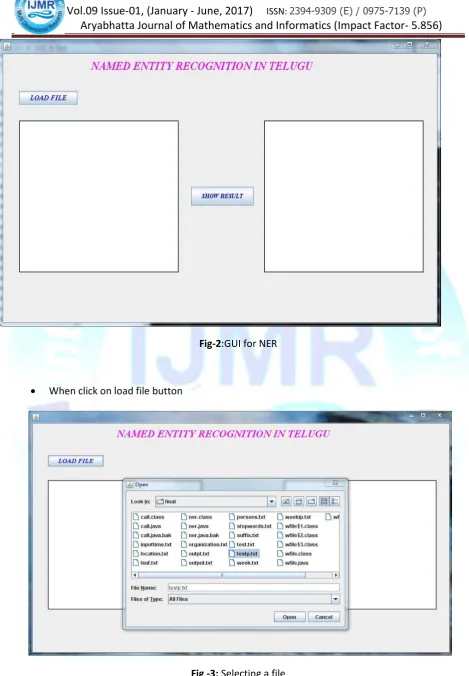
Fig-2:GUI for NER
When click on load file button
Loading test file
Fig -4 : Load a file
when click on show result button
Fig -5: Results
8. CONCLUSION AND FUTURE WORK
identifies nested entities also.We can try to identify more Named Entities.It works only for Telugu language.We can try to improve the model by making this language independent model.
REFERENCES
[1] Sujan Kumar Saha, Sanjay Chatterji, SandipanDantapat,SudeshnaSarkar and PabitraMitra 2008 “A Hybrid Approach for Named Entity Recognition in Indian Languages” Proceedings of the IJNLP-08 workshop on Ner for South and South East Asian Languages.
[2] Mónica Marrero, JuliánUrbano, Sonia Sánchez-Cuadrado, Jorge Morato, Juan Miguel Gómez-Berbís,”Named Entity Recognition: Fallacies, Challenges and Opportunities”.
[3] Ekbal A. and Bandyopadhyay S. 2007. Lexical Pattern Learning from Corpus Data for Named Entity Recognition.In Proceedings of International Conference on Natural Language Processing (ICON), 2007.
[4] CucerzanSilviu and Yarowsky David. 1999. Language Independent Named Entity Recognition Combining Morphological and Contextual Evidence. In Proceedings of the Joint SIGDAT Conference on EMNLP and VLC 1999, 90–99.
[5] Gu B. 2006. Recognizing Nested Named Entities in GENIA corpus. In Proceedings of the BioNLP Workshop on Linking Natural Language Processing and Biology at HLT-NAACL 06, pages 112-113. [6] Kumar N. and Bhattacharyya Pushpak. 2006. Named Entity Recognition in Hindi using MEMM. In
TechnicalReport, IIT Bombay, India.
[7] H. L Chieu., H Tou Ng, “Named Entity Recognition: A Maximum Entropy Approach Using Global Information”, In Proceedings of the 6th Workshop on Very Large Corpora, 2002.
[8] McCallum, D. Freitag, F. Pereira,“Maximum Entropy Markov Models for Information Extraction and Segmentation”, In Proceedings. of the 17th International Conference on Machine Learning,2000,pp.591-598.
[9] GuoDong Zhou and Jian Su. 2002. Named Entity Recognition using an HMM-based Chunk Tagger. In Proceedings of the Fortieth Annual Meeting of the Association for Computational Linguistics, pages 473–480.
[10] Borthwick.,”A Maximum EntropyApproach to Named Entity Recognition,Ph.Dthesis, New yark University.
[11] Kumar, N. and Pushpak Bhattacharyya. 2006.Named Entity Recognition in Hindi using MEMM. Technical report, IIT Bombay,India.
[12] Srikanth, P, Murthy, KaviNarayana,"Named Entity Recognition for Telugu",Proceedings of the IJCNLP-08 Workshop on Named Entity Recognition for South and South East Asian Languages,2008,IIIT,Hyderabad,India.
[13] B. Andrew, “A Maximum Entropy Approach to NER,” Ph.D.dissertation, 1999.
[14] Michael Fleischman, “Automated sub categorization of named entities”. Proc. Conference of the European Chapter of Association for Computational Linguistic, pp 25–30, 2001.
[15] Yungwei ding hsinhsi Chen and ShihchungTsaI, “Named entity extraction for information retrieval”. Proc. of HLT-NAACL.
[16] G. Raju, B.Srinivasu, D. S. V. Raju, and K. Kumar, “Named Entity Recognition for Telugu using Maximum Entropy Model,” Journal of Theoretical and Applied Information Technology, vol. 3, pp. 125–130, 2010.