Maths4Lif
e
P
athfinder r
Emily Brewer
Marketing and Publications Officer Institute of Education
University of London Tel: 020 7947 9501 Email: [email protected]
We welcome feedback on the content and accessibility of this publication. This should be sent to:
Publications NRDC
Institute of Education 20 Bedford Way London WC1H 0AL.
Telephone: +44 (0)20 7612 6476 Fax: +44 (0)20 7612 6671 email: [email protected] ISBN 1-905188-13-7
© Crown Copyright 2006
Extracts from this publication may be used or reproduced for non-commercial, research, teaching or training purposes on con-dition that the source is acknowledged.
NRDC is a consortium of partners led by the Institute of Education, University of London (see back cover for a list of members) and is part of the Bedford Group for Lifecourse and Statistical Studies at the IoE. www.ioe.ac.uk/bedfordgroup
Contents
Reflective practice
Pages 12-23 This section leads the reader through background literature on reflective practice, outlines Maths4Life's approach to reflective practice and gives guidance on ways of engaging in reflection about numeracy and mathematics.
2
Numeracy and speaking and listening
Pages 24-35 This section presents key findings from the Maths4Life pathfinder on the roles of speaking and listening in motivating offenders to take up numeracy provision. There are reflective practice activities for readers to try out.
3
Numeracy and ICT
Pages 36-43 This section presents key findings from the Maths4Life pathfinder on the use of mobile learning in the teaching and learning of numeracy provision. There are reflective practice activities for readers to try out.
4
5
Level 4 numeracy teacher education
Pages 52-58 This section presents key findings from the Maths4Life pathfinder on reasons for undertaking and for not undertaking level 4 numeracy teacher education programmes. There are reflective practice activities for readers to try out.
6
Background
Pages 7-11 This section gives key information about Maths4Life, the stage one pathfinder projects, relevant literature on motivation and numeracy, and how to use this publication.
1
Strategies to increase the take-up of
numeracy provision
Pages 44-51 This section presents key findings from the Maths4Life pathfinder on strategies to increase the take up of numeracy. There are reflective practice activities for readers to try out.
References
Pages 59-60 This section gives a full list of references which are used in this publication.
Appendices
and Maree Adams.
CTAD pathfinder leader: Jo Colley. Researcher: Alison Tomlin.
NIACE pathfinder leader: Sue McClure. Researcher: Alison Tomlin.
LLU+ pathfinder leaders: Noyona Chanda and Graham Griffiths.
Researcher: Jon Swain.
Eastern Region (ACER).
Foreword
This publication is a radical new departure for the NRDC. We have produced it for numeracy and maths practitioners, to enable you to use a reflective practice approach to think about and develop your work with learners. Reflective practice is not new and much has already been written about it, as you will see in section 2. Maths4Life has drawn on previous work to develop a new approach to teaching and learning maths and numeracy. We hope our approach is easy to remember, flexible to use and useful for teachers and others working with post-16 learners whatever the context.
Motivating adult learners and teachers of adults to engage in numeracy and maths is one of the biggest challenges in the Skills for Life sector. We know from research and from national surveys that huge numbers of adults have problems with maths, with a powerful impact on people’s life chances and success at work. Maths4Life is a three-year project, funded by DfES, as part of the Skills for Life strategy. Its aim is to address these critical issues. Motivation, participation and improving teaching and learning lie at its heart. As part of stage one of Maths4Life, we launched four ‘pathfinder’ projects in 2004 to explore different aspects of motivating teachers and learners in numeracy and maths. This publication embeds the outcomes of the pathfinders in the reflective practice model mentioned above. The four projects covered wide-ranging aspects of
motivation for maths: practitioners’ speaking and listening skills; motivating learners and teachers to engage through innovative uses of Information and Communications Technology (ICT); strategies to increase take-up of adult numeracy provision and finally,
practitioners’ reasons for undertaking or not undertaking level 4 numeracy teacher education. Sections 3–6 of this publication
lead you through key points about each project and then suggest reflective practice activities related to the focus of each one.
The variety of subjects covered by the Maths4Life pathfinders means that you may want to select those sections that are of most relevance to you. If you want to develop strategies using ICT, for example, you might want to concentrate on section 4 together with sections 1 & 2 which give you background information and an overall introduction to the reflective practice approach. We have designed the publication to be used as a whole or for dipping in and out according to your interests. If you want to use selected sections, you can download these individually from the website. See www.maths4life.org/p1report
We hope that there is something useful in this publication for readers with diverse needs and interests. Four pathfinders cannot begin to cover all aspects of numeracy and maths teaching – but you can tailor the generic approach to reflective practice to your specific needs. And we hope the publication will stimulate those readers who are not – or not yet – numeracy specialists to try out the reflective practice approach in their work.
As you will see in section 2, there is plenty of scope for you to contribute to the development of Maths4Life’s work on reflective practice. We need your ideas for using it. So once you have applied the approach, please tell us how things went and how our approach, as well as your work, could benefit. You can email us on [email protected]. We’ll look forward to hearing from you.
Ursula Howard
1. Overview
This publication develops the findings of four Maths4Life pathfinder projects, which focused on motivating learners and teachers in post-16 numeracy and mathematics. It uses an approach to reflective practice which Maths4Life is developing. The publication guides readers in how to use reflective practice as a tool to examine and develop their work, whatever its focus.
Section 1 gives relevant background information about Maths4Life, the four
Maths4Life stage one pathfinders and research on motivation. This section also highlights the relevance of this publication to different user groups and provides guidance on how to use it. Please see section 7 below for further details.
2. Maths4Life
The Maths4Life project started in August 2004 and will finish in March 2007. Maths4Life is led by the National Research and Development Centre for adult literacy and numeracy (NRDC), Institute of Education, University of London. Other partners in Maths4Life are LLU+ at London South Bank University, King’s College London, the Learning and Skills Development Agency (LSDA), the National Institute for Adult Continuing Education (NIACE), Cambridge Training and Development (CTAD) and the University of Nottingham.
Maths4Life is located within a broad policy context which emphasises the urgent need to implement far-reaching reforms to the teaching and learning of mathematics, both pre- and post-16. Concerns about numeracy or mathematics are reflected in the following key documents:
• Coben, D. et al. (2003). Adult numeracy:
review and research of related literature.
London: NRDC.
• DfES (2003).The Skills for Life Survey. A national needs and impact survey of literacy, numeracy and ICT skills.
London: DfES.
• DfES (2004). 14-19 Curriculum and Qualifications Reform. Final Report of
the Working Group on 14-19 Reform(The
Tomlinson Report). London: DfES. • DfES (2005). 14-19 Education and Skills.
London: DfES.
• DfES, DTI, HM Treasury and DWP (2005).
Skills: Getting on in business, getting on
at work. London: DFES.
• Hudson, C. (2006). The implications of post-16 numeracy and maths of the Smith and Tomlinson reports, the 14-19
White Paper and the Skills White Paper.
A policy discussion paper. London: NRDC. • Parsons, S. and Bynner, J. (2005). Does
numeracy matter more?London: NRDC.
• Smith, A. (2004). Making Mathematics Count: The report of Professor Adrian Smith’s Inquiry into post-14 Mathematics
Education.London: The Stationery Office.
Maths4Life aims to develop post-16 numeracy and non-specialist mathematics teaching and learning for everyday life and work in England. Central themes within Maths4Life are:
Attracting new learners: the motivation, engagement and achievement of new learners.
Attracting new teachers and developing the existing workforce: capacity building.
Developing attractive provision in a modern environment.
To achieve its aims, Maths4Life has initiated an integrated programme of research and development which draws on expertise within and beyond the NRDC consortium.
3. The Maths4Life stage one pathfinders
An important strand of Maths4Life is two stages of pathfinder projects. Pathfinder projects, as the name suggests, aim to discover, try out and collect evidence on new ways of doing things. With the exception of the LLU+ pathfinder, (see section 6), the
Maths4Life stage one pathfinders have been primarily developmental. The focus of the projects has been on building an identified area of practice. Each pathfinder has also included some research. Evidence has been systematically collected and analysed on the aspect of practice which each project aimed to develop.
The four Maths4Life stage one pathfinders have explored different aspects of motivation (see section 5) in relation to the teaching and learning of post-16 numeracy or
mathematics. The focus of each pathfinder is summarised in the table below.
Please see appendix 1 for methodological information about the four projects.
4. Generalisability
When you reflect on what the Maths4Life pathfinder findings mean in your professional context, it is important to remember that, as outlined above, the projects were principally developmental, with a research strand. The sample sizes and how the samples were selected mean that the pathfinder findings are not generalisable to, for instance, all numeracy practitioners and learners. However, as Silverman (1993) points out, research does not have to be generalisable to be relevant. The aim of this publication is that the work of the four Maths4Life stage one pathfinders should provide helpful starting points for readers to question and develop their practice, using the approach to reflective practice outlined in this publication (see section 2).
5. Motivation
The research evidence relevant to the motivation of teachers and learners of adult numeracy and mathematics is complex and, in places, contested.
Motivation is often considered in terms of intrinsic and extrinsic motivation. Intrinsic motivation refers to motivation which is innate or within, and which stimulates
Talking Up Numeracy
Institute of Education,
University of London
Practitioners’ use of speaking and listening in initial assessment and individual learning plan (ILP) sessions, to help motivate offenders to take up numeracy provision.
Led by Focus
Pathfinder
ICT CTAD The use of mobile technologies to motivate
adult numeracy learners.
Why did they (not) do it?
LLU+ Reported reasons for participation and non-participation in Level 4 adult numeracy teacher education. Practitioners’ views on Level 4 numeracy teacher education at the LLU+.
Attracting Adult Learners
NIACE Strategies to promote the take-up of adult numeracy provision.
engagement in activity for its own sake. Extrinsic motivation refers to external factors, usually in the form of rewards or pressures, which prompt an individual to take action in an identified area, such as learning numeracy or mathematics. Extrinsic motivation fosters engagement in activity as a means to an end.
An NRDC study (Swain et al. 2005) explores why numeracy learners in the sample attended numeracy classes. Most learners reported a range of reasons for attending numeracy. Some related to intrinsic motivation. For instance, many of the learners wanted to prove something to themselves about their mathematical capabilities. Nearly all learners in the study wanted to develop their mathematical understanding. Other stated reasons related to extrinsic motivation. Reported reasons included wanting to gain mathematics qualifications, get a job, get on a course, help children with schoolwork, and use
mathematics in everyday activities, such as paying bills and doing the shopping.
Coben et al.’s (2003) NRDC review of research into adult numeracy presents a range of findings which are relevant to motivation and numeracy or mathematics. Teaching and learning is one area
considered. Evidence at school level underlines that teaching methods influence learners’ views of mathematics. For instance, Ofsted reported that the main teaching method in upper secondary mathematics in the United Kingdom (UK), in the mid 1990s, was that the teacher
explained a mathematical concept. The students then worked through exercises. Classes were, on the whole, setted. This approach to mathematics teaching helped shape a range of negative beliefs about mathematics (Becker, 1995; Boaler, 1997; Cobb et al. 1991, cited in Coben et al. 2003) which deterred students from studying mathematics after the age of 16 (Landau, 1994; Quiter and Harper, 1988, cited in Coben et al. 2003). In contrast, evidence indicates that, on the whole, students respond positively to learning mathematics through discussion and exploratory activities, in an environment which,
particularly in the case of girls, is not highly competitive (Becker, 1995; Boaler, 1997; Morrow and Morrow, 1995; Thompson, 1995, cited in Coben et al. 2003).
A third NRDC study (Baxter et al. 2005 forthcoming) on the teaching and learning of common measures, particularly at entry level, discusses changes in the meaning of the word motivation. In the 1970s and 1980s, it is stated, motivation referred to
circumstances that led to students enrolling on courses. It was considered good practice to negotiate the curriculum around student preferences. Baxter et al. (2003) argue that, in contrast, motivation is now more akin to encouragement. Government, teachers and referral agencies are important in being proactive in fostering learners’ motivation to attend numeracy.
As part of Maths4Life, a forum on motivation and numeracy was conducted in 2005, through the Maths4Life website
(http://www.maths4life.org). This forum stimulated many contributions. The Maths4Life project team has summarised responses below:
We asked you what motivates teachers and learners into adult numeracy provision. There was a lot of traffic on the boards and we received a good number of comments.
Many considered that motivation for existing teachers comes from the satisfaction of seeing learners begin to enjoy mathematics and feel that they are succeeding at it. Practitioners see this motivation in the positive facial expressions and body language of their learners. Interestingly, there were no comments which suggested accreditation was a motivating factor, although this is an opinion often quoted by policy makers and practitioners.
We would welcome comments on how we can motivate people to become numeracy teachers.
The previous points indicate that the Maths4Life stage one pathfinders are located within a context of wider research evidence and practitioner debate on motivation and numeracy or mathematics.
6. Audience
The principal audience for this publication will probably be teachers and managers of post-16 numeracy or mathematics. However, this publication is designed to be relevant to a wide-ranging audience, and you will probably find it interesting if you are:
A post-16 numeracy or mathematics teacher.
A post-16 numeracy or mathematics manager.
A post-16 numeracy or mathematics teacher educator.
A post-16 numeracy or mathematics researcher.
A policy maker who is interested in post-16 numeracy or mathematics.
A practitioner or researcher who is interested in speaking and listening.
A practitioner or researcher who is interested in ICT.
Interested in reflective practice.
7. How to use this publication
This publication is designed to be used flexibly. The diagram opposite illustrates how the publication is structured.
Sections 3–6 are wide ranging in the aspects of numeracy and motivation covered. Some readers may wish to use the whole
publication. Others may find that some sections are more relevant to their practice than others. Those readers may wish to select the sections which are most relevant to their professional context. Readers who are particularly interested in numeracy and ICT, for example, may want to focus on section 4 on the ICT pathfinder, in
conjunction with sections 1 and 2 on background information and reflective practice. The publication has therefore been designed both to be used as a whole and to enable readers to dip in and out of it. For those readers who want to use selected sections, a limited amount of key
information is repeated across sections 3–6, to help readers interpret and use the section accurately. Individual sections of this publication can be downloaded online at www.maths4life.org/p1report.
Even if your specific area of interest isn’t covered in sections 3–6 of the four Maths4Life pathfinders, you can tailor the generic reflective practice approach covered in section 2 to your own area of interest. So, this publication can also be used by readers who are not numeracy specialists, but who are interested in developing their work, whatever its focus, through a reflective practice approach.
8. Further reading
If you would like to find out more about motivation in relation to post-16 numeracy or mathematics, or about post-16 numeracy in general, you might want to follow up three NRDC reports, available through the NRDC website.
• Baxter, M., Leddy, E., Richards, L., Tomlin, A., Wresniwiro, T. and Coben, D. (2006). The report of the NRDC teacher research project into the teaching and learning of common measures,
especially at entry level. London: NRDC.
• Coben, D. with Colwell, D., Macrae, S., Boaler, J., Brown, M. and Rhodes, V. (2003). Adult numeracy: review of
research and relevant literature.
London: NRDC.
• Swain, J., Baker, E., Holder, D., Newmarch, B., and Coben, D. (2005).
‘Beyond The Daily Application’: Making numeracy teaching meaningful to adult
How to use this publication
3
Section 3
Numeracy and speaking and listening
Each section is split into:
4
Section 4
Numeracy and ICT
5
Section 5
Strategies to increase the take-up of numeracy
provision
6
Section 6
Level 4 numeracy teacher education
Action >
Read
according
to your
area of
interest
Action >
Read this
section
2
Section 2
Reflective practice
Action >
Read this
section
1
Section 1
Background
Part A. Overview
Part B. Pathfinder focus and findings
Part C. Reflective practice activities in this area
1. Using this section
This publication uses a reflective practice approach to examine and build on practice in the aspects of numeracy and motivation considered in sections 3–6. Section 2 provides the basis for using a reflective practice approach in sections 3–6. You are therefore advised to read section 2. You can also, if you wish, use the framework provided in section 2 to examine and develop any area of your practice, beyond areas which are directly related to motivation and numeracy.
2. Research on reflective practice
Reflective practice is not new. There is a large body of research literature exploring different aspects of reflective practice (e.g. Schön, 1983, 1987; Maynard and Furlong, 1995; Day, 1999; Calderhead, 1989; Beardon et al. 1995). There is also a journal called Reflective Practice. Seminal thinkers on reflective practice in education include Donald Schön (1983, 1987) and Lawrence Stenhouse (1975). Reflection has been an important part of many teacher education programmes for some years, although it is not always made explicit what reflection means or what the purpose of reflection is (Maynard and Furlong, 1995). Goodman (1987) explored the
importance of the reflective practitioner, in relation both to beginning teachers and their mentors. Clarke and Chambers (1999) argue that, in Europe, there is a strong basis from which to extend the role of reflective practice in initial teacher education (ITE) and the continuing professional development (CPD) of teachers.
Whilst there is no single definition, it is probably fair to say that reflective practice potentially encompasses:
• Having the space (time and appropriate context) to analyse professional practice.
• Explicitly questioning one’s professional beliefs and practices.
• Being aware of alternative professional beliefs and practices.
• Being able to change professional beliefs and practices, where appropriate.
• Experimenting and learning from any mistakes, as part of the process of changing professional beliefs and practices.
• Tolerating a period of discomfort as part of the process of changing professional beliefs and practices.
• A process over time, not an event.
(Adapted from Day, 1999; Schön, 1983, 1987).
Some of the NRDC’s research has involved reflective practice. Reflective practice is built into NRDC’s engagement of practitioners as researchers across all its programmes.The Institute of Education’s Maths4Life stage one pathfinder used a reflective practice
approach, and evidence from this pathfinder will be used later in section 2. NRDC research on Skills for Life in the National Health Service (NHS) (Hudson and Lopez, 2005) found that those practitioners who
participated in the research appeared to gain most from reflective practice when it was:
• Related directly to the practitioners’ concerns.
3. Approach to reflective practice
Drawing on the existing body of knowledge, Maths4Life has developed an approach to reflective practice which aims to be easy to remember and straightforward to use. The reflective practice approach used here centres on a symbol which should be familiar to all readers: traffic lights.
Reflection, planningand action, or stop, get ready, and go, form the three stages of a reflective practice cycle. This cycle can be repeated as many times as is appropriate and feasible. The second cycle should build on the activity of the first cycle, and so on.
Below we set out the three stages of the reflective practice cycle. It shows how the second cycle builds on the first and suggests that there could potentially be a number of related reflective practice cycles.
Stage 3
The green‘go’ signal represents practitioner
action.
Stage 2
The amber ‘get ready’ signal represents practitioner
planning.
Stage 1
The red ‘stop’ signal represents
practitioner
reflection.
Reflective practice cycle 1
Stage 1 Reflection.Reflect on the identified aspect(s) of your practice. Ask yourself generic and specific questions.
Stage 2Planning.
Using your stage 1 reflection, detail your planning for stage 3.
Stage 3 Action.
Try out what you have planned.
Reflective practice cycle 2
Stage 1 Reflection.Reflect on what you did in stage 3: action of the first reflective practice cycle. Ask yourself generic and specific questions.
Stage 2Planning.Use your reflections from stage 1 of the second cycle, to plan what you will do in stage 3 of the second reflective practice cycle.
Questioning is central to reflective practice and should help stimulate your thinking. There is flexibility about who the questioner is. You may want to ask yourself questions about identified areas of your practice. If you are designing the questions, this means that you can tailor them to help you address very specific concerns in your own practice, which you may be more aware of than others are. It will also probably result in greater flexibility about when and where you work on reflective practice, than if you have to arrange to meet with someone else. Alternatively, you may find it easier to reflect on what you do if someone else, such as a colleague you trust, asks you questions. A third option is to use a
combination of both.
You can use and adapt the questions given in this publication. You’ll probably also want to develop your own questions which are appropriate to your context. Ask as many relevant questions about your practice as possible. Make sure each question is worded appropriately, to help you reflect on the issue you would like to explore. The quality of your reflections will probably be related to the quality of the questions you use.
Making explicit what is commonplace in your practice is not always straightforward. This is partly because the everyday can seem too obvious to be worth pointing out. It is also because, paradoxically, it can sometimes be difficult to be aware of deeply ingrained actions and thoughts. When you make explicit the relevant aspects of your practice in stage 1 (reflection) of the reflective practice cycle, make sure you include the most everyday aspects of what you do. If you find it difficult to be aware of these, you might find it helpful to involve someone else in the process of questioning, to help you see more clearly what you do by standing back from it.
If something has not worked out in stage three (action), you may want to try it out again, in stage three of a second reflective practice cycle. This is because sometimes people need time and several attempts at something to get used to doing something differently. The questions you ask yourself, as part of reflecting after stage three (action), will help you judge how well what you have tried out has worked
and whether you want to incorporate what you have tried out into your practice in the future.
4. Engaging in reflective practice
Overview
There is no single way to engage in reflective practice. You may want to try some or all of the suggestions below. You can use the ideas below as they stand or you can adapt them. You may wish to put into practice other ideas, which are not covered here. Experiment to find out what works and what does not work for you and why, and what is feasible within your professional context.
Practitioner reflective log
You may find it helpful to use a practitioner reflective log. The example opposite is the basis for the reflective practice activities in sections 3–6 of this publication. There’s also a template of this log at appendix 2. This reflective log is not intended to be prescriptive. You can tailor it to your context by, as appropriate, adding, amending and deleting questions. Alternatively, if you find that talking, rather than writing, helps you reflect on what you do, then you can select questions from the log to use in discussion with others. If you are working on your own and find talking a more helpful tool for reflection than writing, you could tape your reflections about your work, and then listen to them. If you would prefer a different type of practitioner log, then you can design your own log.
The log in this publication is based on the three stages (reflection (stop), planning (get ready) and go (action)) of the reflective practice cycle described above. For the reflection stage of the cycle, under the heading ‘Practitioner
Using your stage 1: reflection, detail your planning for stage 3: action.
Try out what you have planned.
Give brief details, if appropriate, such as:
Session date:
Session focus:
Number of learners in session:
Any other relevant information:
Generic
Practitioner reflective log
What do I do/say?
What evidence is there of learners’ responses?
What works well and why?
What doesn’t work well and why?
What would I like to try out and why?
Add your own generic questions, if appropriate.
Write your own specific questions here, targeted to the aspect of your practice you are focusing on.
Specific
Cycle 1
Stage of cycle Practitioner questions, responses and comments
Stage 1
REFLECTION
Stage 2
PLANNING
Stage 3
Recording in your practitioner reflective log
Writing things down can be a good way of helping to make explicit thinking and actions. Do not be over-ambitious about the amount you will write in the practitioner reflective log. If you are, this may mean that you will not write anything at all! Target selected sessions and make sure you complete the log for these sessions.
Record your observations and ideas in the ways you are most comfortable with. You may want to use, for instance:
• Notes.
• Continuous prose. • Tables.
• Annotated diagrams.
• Mind maps. A mind map is a good way to give an overview of a subject. A mind map represents visually the connections between, for example, main points, and main and sub-points (see example p.17). • Flow charts. A flow chart is a good way of
illustrating the different stages of a
process and the progress between stages.
Make sure you date and save every entry. Then you will be able to see changes in your thinking and practice over time.
On p.18 there is an example of a completed practitioner reflective log, based on the numeracy and speaking and listening pathfinder, covered in section 3. The practitioner in the log is exploring learners’ numeracy skills and trying to motivate learners to take up numeracy provision, during initial assessment sessions. She is focusing on her use of questions, ‘wait time’ after asking a question, and mathematical terminology and concepts.
It may not be feasible for you to record your thoughts and actions in as much detail as in the log below. The log on p.18 is an example of how entries can be recorded. Make your own entries in the way that is most helpful to you.
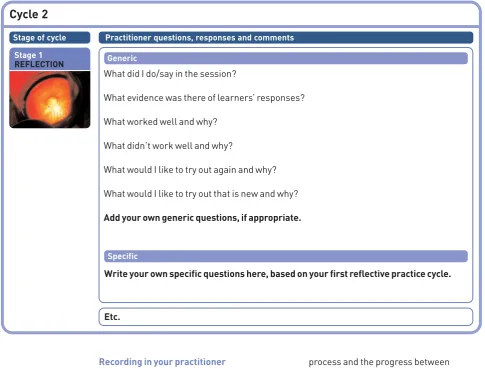
Generic
What did I do/say in the session?
What evidence was there of learners’ responses?
What worked well and why?
What didn’t work well and why?
What would I like to try out again and why?
What would I like to try out that is new and why?
Add your own generic questions, if appropriate.
Write your own specific questions here, based on your first reflective practice cycle.
Etc.
Specific
Cycle 2
Stage of cycle Practitioner questions, responses and comments
Stage 1
[image:16.595.50.536.127.496.2]Exampl
e of a mind map
Her
e is an e
xampl
e of a mind map f
or numer
acy and speaking and lis
tening (see section 3). This mind map
illus
tr
at
es that two aspects of speaking and lis
tening ar
e the use of ques
tions and e
xplanations, and that it is
import a nt t o r efl
ect on diff
e
rent aspects of ques
tioning and giving e
xplanations. In cr
eating mind maps, c
o
lour,
shape and spac
e c
an be used cr
eativ el y, t o f acilit at e r efl
ection on the c
onnections between c
onc
epts.
Explanation
Ho
w do I use
mathematical terminol
ogy?
Ho
w do I
e
xplain numerical
c
onc
epts?
Do I r
e
late the
c
onc
ept to the
learner’
s lif
e?
Do I c
o
nv
e
y
enthusiasm
about the clas
s?
What do I say to e xplain about numer
acy
pr
o
vision?
Do I talk about
when/wher e the clas s tak e s plac e?
Do I talk about the c
ontent of
clas
ses?
Do I ask about the learner’
s curr
ent
feelings about numer
acy?
Do I ask about numer
acy
his
tory?
Do I ask open or closed ques
tions?
When do I ask ques
tions?
Do I ask an initial ques
tion and
series of f
oll o w-up ques tions?
Use of
ques
tions
Do I use
visual aids?
Do I ask about learner’
s wider inter es ts or c onc erns?
What do I ask
ques
tions about?
Speaking
and lis
What do I do/say?
I start with a general conversation, to try to relax the learner.
Then I move on to finding out about the learner’s numeracy history and skills.
What evidence is there of learners’ responses?
Learners sometimes avoid eye contact, adopt defensive body language (e.g. folding arms tightly), or look anxious, if I use mathematical language.
What works well and why?
Using learners’ non-verbal communication helps me make judgements about their mood and mathematical confidence.
Smiling at learners usually helps relax them.
Starting with a general conversation about learners shows I’m interested in them as people, and that I’m not an intimidating mathematical genius!
What doesn’t work well and why?
What would I like to try out and why?
• Waiting longer after I’ve asked a question (see specific questions below).
• Asking follow-up questions after an initial question (see specific questions below). • Using mathematical terminology and concepts in ways that are accessible to the
learner (see specific questions below).
Specific
What questions do I ask, to help motivate potential learners to take up numeracy provision?
Do I ask about:
• Numeracy history? If so, what?
• Aspects of numeracy the potential learner would like to know more about? If so, what?
• Other questions relevant to my own situation.
I ask learners how they got on in general at school, how they got on with maths at school, if they have any qualifications etc. I try to be careful, try not to reinforce any sense of failure. I try to keep the tone light.
Do I tend to ask an initial question and then a series of follow-up questions, to probe or develop the potential learner’s thinking?
Find this difficult. I think I tend to ask an initial question, get a short response from the learner, and then move on to something else.
Do I tend to wait after I’ve asked a question, to give the potential learner time to think and respond?
Find it very difficult to wait. A pause can seem like eternity! I feel uncomfortable and I
Generic
Practitioner reflective log - example
Cycle 1
Stage of cycle Practitioner questions, responses and comments
Stage 1
Using your stage 1: reflection, detail your planning for stage 3: action.
• I did some very firm talking to myself about making sure, in the initial assessment session, a voice inside myself tells me, loudly and clearly, not to speak for the learner.
• I made and laminated some visual resources to use when I explore the learner’s understanding of mathematical terminology and concepts. Pictures are of: 1. A room and its measurements, to use if talking about area.
2. A well-fed person (‘the boss’) sitting at a table, with piles of coins and notes on the table, with the caption, ‘I earn £2,500 a month. I’ve got a 3 per cent wage increase. How much will I earn?’ I’ll use this to talk through percentages. 3. Someone shovelling sand, cement and water into a cement mixer, scratching
his/her head about quantities, to use if talking about ratio.
4. Someone making a carrot cake, holding up two carrots and saying, ‘My recipe says ounces, but my scales are in grams. How many carrots do I need?’ to use if talking about weight.
I’ll judge which of the resources to use, depending on the learner.
• I prepared a series of linked questions to ask about each of the pictures. I’ll need to be flexible about the questions I ask, depending on what the learner says, but I want to have something there as a basis to build on and adapt.
Try out what you have planned.
Give brief details, if appropriate, such as:
Session date: 26 January 2005
Session focus: Initial assessment session with Jim Baker, to find out about his understanding of numeracy and to try to motivate him to attend numeracy classes.
Number of learners in session: 1
Specific continued
think the learner feels uncomfortable. I want to help the learner feel relaxed, so I often do the talking for him/her.
How do I use mathematical terminology, when I am questioning a potential learner?
Find it difficult to judge when and how to use terminology. When I use terminology like ratio, percentages and multiplication, I’m not always sure that the learner
understands the terms. I think learners can find mathematical terminology offputting. I don’t think I ask enough questions about a mathematical concept, to find out whether or not the learner understands it.
Stage 1
REFLECTION
Stage of cycle Practitioner questions, responses and comments
Stage 2
Generic
Cycle 2
Stage of cycle Practitioner questions, responses and comments
Stage 1
REFLECTION
What did I do/say in the session?
See specific questions below.
What evidence was there of learners’ responses?
Jim smiled at the thought of the well fed boss.
Jim got frustrated when he couldn’t work out the percentage wage increase. However, then he said: ‘This is what I need to do. Then you know where you are with the boss. They always try to rip you off.’ I felt encouraged by this.
What worked well and why?
Initially relating the task about percentages to Jim’s experience helped to get him talking.
Using a whole series of questions to break down the task about percentages (see specific questions below) helped me understand that Jim wasn’t just confused about how to do percentages, but also about division, multiplication and addition (and probably subtraction too). For instance, he couldn’t multiply to get 3 per cent, after working out 1 per cent. He tried to add instead, and got into a particularly big muddle because of the per cent.
If I hadn’t asked all those questions, I wouldn’t have realised this. The questions helped me understand what Jim could benefit from focusing on in numeracy classes.
All the questions about percentages could have been really heavy going for Jim, but using the picture helped, I think, make the task more intelligible for him. It also added some humour.
What didn’t work well and why?
Found it very difficult to handle silences after I’d asked a question, because I wanted to ease the situation for Jim (and perhaps for myself!).
What would I like to try out again and why?
I’d like to try out the pictures and the questions again. I think that the combination of both was a good way to explore Jim’s understanding of percentages. It’s made me realise how important it is to ask a series of related questions about maths, to understand more about a learner’s thought processes. I took things too much at face value before and probably came to some wrong conclusions because of this!
Will try out waiting after I’ve asked a question, again and again! Need to get used to this. Think I’ll be explicit with learners that many people need some time to think before they answer a question, and that’s why I’m waiting after asking a question.
What would I like to try out that is new and why?
I’ll ask Sue (a colleague) if she’ll try out using the pictures too, as we’ve shared
resources before. I’d like to compare how she gets on with them. If she gets on well, we could add to the collection, to cover other mathematical terminology. Could also share our ideas about how to use questions to explore learners’ understanding of
Generic continued
to ask learners about different mathematical concepts (to be used flexibly, of course!). Will try to find out more about learning styles. Jim seemed to like the picture. Does that mean he’s a visual learner? Will google it!
Write your own specific questions here, based on your first reflective practice cycle.
Did I manage to pause after asking a question, to give Jim a chance to answer?
Yes, but this wasn’t easy. I had to work hard to stop myself doing the talking for Jim. On some occasions, I think waiting helped Jim think out an answer. However, Jim didn’t always come up with an answer. I found some of the silences painful!
How did I use a series of questions to find about Jim’s understanding of mathematical concepts and terminology?
Jim volunteered that he’d worked on percentages in the past. He said that he’d like to do some more work on percentages.
I used the picture of the boss and the money (see above: stage two: planning, for details).
First of all, I tried to relate the situation to Jim’s experience, by asking him if he’d ever been in the situation of having to work out a percentage increase in his salary. He said that his wife had recently had a wage increase, and they hadn’t understood how it had been worked out. We talked around this.
Then I asked Jim if he knew how to work out the percentage increase in the picture. Jim said he didn’t.
So I broke the task down into stages, by asking a series of questions. I asked Jim:
1. What 100 per cent of the current salary would be. 2. How he would work out 1 per cent of the current salary. 3. How he would work out 3 per cent of the current salary. 4. How he would work out what the new salary would be. I broke each of those stages into a series of sub-questions.
Stage 1
REFLECTION
Stage of cycle Practitioner questions, responses and comments
Practitioner feedback
A practitioner’s comment in the Institute of Education Maths4Life stage 1 pathfinder underlined that using a reflective log had helped her to develop her practice in speaking
and listening.
Taping sessions
You may find it helpful to tape selected numeracy sessions. There is often a difference between what people think they have done or said, and what they actually did or said. You can use an audio or video recording as the basis for your reflections about the session, rather than relying on memory.
In the Institute of Education pathfinder, practitioners used the transcripts of those initial assessment and ILP sessions which had been taped, to reflect on and plan their use of speaking and listening. The practitioner’s
comment, left, illustrates that using a tape can help increase self-awareness.
Some people can feel uncomfortable listening to or watching a recording of
themselves, or reading a transcript of what they have said. One of the practitioners exclaimed: ‘God! I hate transcripts!’ after receiving her first transcript. However, this practitioner subsequently observed that the transcript formed a helpful basis to plan how to develop her practice. So, if listening to or watching a recording of yourself makes you feel uncomfortable, try to tolerate this. In the end, the benefits are likely to outweigh any initial discomfort!
Working with a colleague
You might want to work on an aspect of numeracy and motivation with a colleague. If you do, it is sensible to work with someone who also wants to develop his/her practice and whom you trust. Working with a colleague could provide an opportunity to talk through relevant aspects of your practice. If you’re
using the practitioner reflective logs, these could form the basis for your discussions.
You may also want to observe each other’s sessions, particularly if it is not possible to audio- or video-record sessions. If you are conducting peer observations, it is probably a good idea to agree some ground rules, so that you have a shared understanding of your roles as observers.
Examples of ground rules might be to: • Agree the focus for an observation and
keep to that focus.
• Avoid making comments which are judgemental. As part of this, you may want to think through ways of feeding back to each other, after observing each other’s sessions. For example, it is sensible to avoid negative comments such as, ‘That didn’t work.’ Instead, it is more constructive to ask questions about a point you have observed, to stimulate reflection and discussion.
Questions might include:
• What do you think worked about …? Why?
• Is there anything you’d do differently next time? Why?
• Agree practicalities, such as where the observer will sit in a session and
arrangements for storing any paperwork related to observations.
Meetings
Perhaps you will be able to work on reflective practice in meeting time. If you are a
numeracy manager, you may be aware of issues about motivation and numeracy shared by practitioners you are responsible for. A one-off meeting probably will not be particularly useful. However, if you can schedule some time to take a reflective practice approach to the issue in question, in a number of meetings over time, this may support the CPD of practitioners you are responsible for.
If you are a numeracy practitioner who is interested in reflective practice about an identified area of numeracy, you could talk to your manager about the feasibility of using meeting time to focus on the identified area.
That (log) is where we formed our learning. I think those questions (in the reflective log) should be something that other teachers would benefit from asking themselves.
If you are using meetings to work on a reflective practice approach, then you may want to select questions in the practitioner reflective log, for discussion.
Seminars and conferences
You may be able to attend or coordinate a seminar, a series of seminars or a small conference on reflective practice about an identified aspect of numeracy. A series of seminars would enable practitioners to reflect and build on practice over time. If the only option is a one-off seminar or conference, then this could be combined with
practitioners:
• Engaging in reflective practice, outside the seminar.
• Feeding back to peers involved in the seminar or conference, through, for instance, group email.
If you are a numeracy manager, you may be able to provide structured opportunities for CPD, through arranging a series of seminars on reflective practice on identified aspects of numeracy. If you are a numeracy practitioner, you could discuss the possibility of arranging professional development events, with your manager.
In the Institute of Education Maths4Life pathfinder, there were three seminars which took place at the beginning, middle and end of the project. These enabled pathfinder practitioners to:
• Present and reflect on their findings on speaking and listening, as reported in their practitioner reflective logs.
• Engage in sustained discussion with peers about speaking and listening.
• Get new ideas for speaking and listening, through listening to peers.
E-discussions
E-discussions can complement work on reflective practice undertaken in meetings and seminars, or between pairs of colleagues. Alternatively, if your work context means it is difficult to meet with other practitioners, then
e-discussion may provide your main way of communicating with other professionals about identified aspects of numeracy.
The Maths4Life website contains discussion forums which you can use to debate any aspect of motivation, reflective practice or anything else related to numeracy or mathematics that you are interested in. Visit http://www.maths4life.org. A summary of a discussion forum on motivation and numeracy or mathematics was included in section 1 (p.9).
Practitioners could also set up their own email groups to share ideas and progress on
reflective practice and numeracy.
Change and reflective practice
Reflective practice involves self-analysis, change and planned risk taking, within a structured framework. Whilst change is planned (stage 2 of the reflective practice cycle), it also involves experimenting with something new. Some people tend to prefer the familiar to the unfamiliar. If something you try does not work out, then do not look upon this as an irreversible error which you will never want to think about. Instead, you could use the stage one (reflection) questions in the practitioner reflective log to explore the reasons why something did not work out as planned. Reflecting critically about what you did may help you see what needs to happen differently next time, to make something work better. Alternatively, reflection may help you arrive at a balanced judgement about why something is not appropriate for your context. So, reflection can lead to learning and what initially may have seemed a negative experience can have a positive outcome.
Feedback on reflective practice
1. Audience
All readers who are interested in the use of speaking and listening in relation to numeracy.
Numeracy managers.
Numeracy practitioners.
Practitioners who conduct initial assessment and ILP sessions.
Teacher educators who would like to focus on speaking and listening with their students.
Researchers interested in speaking and listening, in the context of numeracy and more generally.
2. Focus
• Summarises some of the research evidence on speaking and listening (part B).
• Outlines key points from the Institute of
Education’s stage one Maths4Life pathfinder (part B).
• Using the reflective practice cycle, presents reflective practice activities which build on the Institute of
Education pathfinder (part C).
• Gives suggestions for further reading (part D).
• Should be used in conjunction with section 1, background and section 2, reflective practice.
3. Methods
• For methodological details about this pathfinder, please see appendix 1.
• Remember that the size of the samples and the ways in which they were selected mean that the views expressed in this section are not representative of all numeracy practitioners and offenders.
• The views expressed are, however, useful in providing a starting point for readers to reflect on aspects of their practice in relation to numeracy, speaking and listening and motivation.
Part A.
4. Existing evidence
There is a wide-ranging body of research on speaking and listening. Some key findings about classroom interaction are that:
• Teachers do most of the talking. Students do most of the listening (e.g. Cazden, 1988; NCES, 2003; Alexander, 2003). • Teachers ask most of the questions
(Alexander, 2003; Mercer, 2003). • Most questions are closed, not open
(Alexander, 2003).
Closed questions tend to require brief answers. Sometimes responses consist of yes/no. It’s appropriate to use closed questions if, for example, you want to check learners’ factual knowledge, before potentially moving on to discuss an issue. Closed questions also help address practicalities quickly (e.g. Do you want the window open?)
Open questions are questions which have many possible responses, some of which may be unanticipated by practitioners. Open questions are a good way of encouraging learners to develop their thinking and to stimulate discussion.
• Students tend to ask questions about procedural points (Alexander, 2003).
• Teachers often do not ask a series of follow-up questions to an initial question. Most teacher questions take the first part of a three stage exchange: • Initiation (teacher).
• Response (student).
• Feedback (teacher, to close the exchange).
This exchange is sometimes referred to as IRF (initiation, response, feedback). On the whole, IRF does not enable learners to explore their thinking.
• There is little speculative talk or thinking aloud (Alexander, 2003).
• Teachers usually do not leave enough ‘wait time’ after asking a question, for students to think through an answer (Edwards, 2003).
5. Background to Talking Up Numeracy
Reflective practice was central to Talking Up Numeracy. Eight pathfinder practitioners made explicit and developed their use of speaking and listening in initial assessment and ILP sessions, to help motivate offenders in custody and on community supervision to take up numeracy provision. The pathfinder practitioners were supported in examining their practice by two project researchers. They interviewed the practitioners at least twice during the project, and observed at least two selected initial assessment and ILP sessions for each practitioner. As highlighted in section 2, three project seminars enabled the eight practitioners to discuss their use of speaking and listening together. Offenders were also interviewed about their views of numeracy and of practitioners’ speaking and listening skills. For further methodological information, please see appendix 1.
Whilst Talking Up Numeracy was concerned with practitioners working with offenders, the focus on speaking and listening and the project findings are relevant for practitioners working with wider groups of Skills for Life learners.
6. Aspects of speaking and listening
The eight practitioners used a practitioner reflective log to collect evidence on their use of aspects of speaking and listening in selected initial assessment and ILP sessions. The Talking Up Numeracy log was an earlier version of the practitioner reflective log used in this publication. As illustrated below, the log covered nine aspects of speaking and listening, and included examples of questions for practitioners to ask themselves. Where appropriate, practitioners could include other aspects of speaking and listening, beyond those listed in the log. The practitioners selected two or three aspects of speaking and listening, to focus on the project.
The aspects of speaking and listening and examples of questions for each area of speaking and listening are outlined overleaf. The questions are starting points for practitioner reflection. If you work on these aspects of speaking and listening, you will probably want to add further questions, to explore your practice in detail.
Aspect Explanation
What questions do I ask to help motivate potential learners to take up numeracy provision? E.g. Do I ask about numeracy history, the aspects of numeracy the potential learner would like to know more about? Etc.
Asking questions (initial and follow up)
What do I say to encourage a potential learner to ask questions about aspects of numeracy provision s/he does not understand or wants to know more about? Etc.
Enabling potential learners to ask questions
What do I say to explain, for example, what numeracy provision is like, to relate numeracy provision to potential learners’ lives, etc? Use of language? Tone of voice? Pace?
How do I summarise/ reinforce what I’ve said? Etc.
Explaining
How do I judge if a potential learner has understood what I’ve said? What do I say? How do I make sure I’ve understood what a potential learner has said? Etc.
Checking understandings
How do I use language to emphasise the choices a potential learner has in relation to numeracy provision? Tone? Pace? Etc.
Giving choices
Additional aspect of speaking and listening
How do I make sure that I have heard what the potential learner has said? How do I show the potential learner that I am
listening/ have been listening to him/her? Use of language? Use of pauses? Etc.
Listening, including reflective listening
What messages does my non-verbal communication give the potential learner? Facial expression? Eye contact? Positioning? Movements? Are these the same messages as those I am conveying through my speaking and listening? Etc.
Use of non-verbal communication, in combination with speaking and listening
What kinds of things am I saying inside myself during the session? To what extent is this conversation the same as my conversation with the potential learner? Etc.
Links between your thinking, and your speaking and listening
Do I use any mathematical terminology? If so, which
mathematical terms do I use? How much do I use mathematical language? Do I use other types of technical language (e.g. the levels of the National Standards)? How do I make sure potential learners have understood the terminology? Etc.
Use of technical language
7. Responses to speaking and listening
Practitioners thought that their use of speaking and listening developed over the pathfinder, through the reflective practice activities. For example, one practitioner, who focused on asking follow-up questions to enable offenders to explore their thinking, commented:
I did more supplementary (i.e. follow-up) questions than I probably would have done before. I would probably have said before, ‘Why was it easy?’ but then … I probed a bit further. ‘What exactly about it was easy?’ In fact, if I hadn’t kept doing that we wouldn’t have realised. I had to explain to him (the offender) what I meant by decimals clearly. There was a muddle in his mind about what decimals are. If I hadn’t pushed it, we couldn’t have clarified that.
Follow-up questions helped this
practitioner to understand more clearly the offender’s mathematical misconceptions.
Another practitioner, who was focusing on her listening skills, observed:
I am finding that the whole speaking and listening exercises that I am doing as part of pathfinder are making me far more aware of my speaking and listening and other people’s speaking and listening skills. It is quite interesting because I now see other tutors and think they are not listening. They are just spouting what they have to spout but not actually listening to what the person is saying.
Some offenders interviewed were aware of practitioners’ speaking and listening skills. For instance, one commented:
When she (the practitioner) goes over it and explains it, she does it in a simple way so that everyone gets it. Some people aren’t as clever as others.
Another said:
Maths teachers are like psychiatrists. Some psychiatrists talk to you in a load of medical sentences you don’t
understand and you get others that talk to you in a way you do understand.
8. Approaches to numeracy
Findings from Talking Up Numeracy suggest that, in broad terms, the eight practitioners had four main ways in which they tended to talk about numeracy, in initial assessment and ILP sessions. These are represented in the typology ‘Approaches to numeracy, p.28.
A typology is a way of classifying
information. In a typology, information is grouped into different categories. A typology can therefore help to present information in a way which is intelligible and easy to remember. The typology ‘Approaches to numeracy’ is not intended to be
prescriptive. It does not suggest that each practitioner’s approach to numeracy fitted into one category, across sessions or even within one session. Furthermore, the typology does not preclude the possibility of other approaches to numeracy, as you’ll see if you do the reflective practice activities in part C.
9. Pathfinder practitioners’ responses to ‘Approaches to numeracy’
Overall, the pathfinder practitioners thought that ‘Approaches to numeracy’ provides a framework to reflect critically on whether the extent to and ways in which they talked about numeracy were appropriate for the offenders they worked with. The eight practitioners thought that their main approaches to numeracy, in initial assessment and ILP sessions, were ‘Talking up numeracy’ and ‘Talking around numeracy’.
Practitioner comments:
One practitioner said about the approach, ‘Talking up numeracy’ (emphasising the relevance of numeracy to offenders’ lives, using some mathematical language):
You’ve got to have something to sort of peg the maths onto, like you can talk about if they’ve been doing a job, construction stuff. ‘Did you do any of the measuring?’ Or we can talk about making cement. I’d say, ‘Well, that’s the kind of thing we do. That’s ratio. We do it here.’
Aspect Explanation
The practitioners tended to talk explicitly about numeracy, using specific mathematical terminology, such as fractions or decimals, when they perceived that offenders were reasonably confident about and motivated to improve their numeracy.
Talking about numeracy
mathematical terminology
On some occasions, the practitioners tended to draw on the broader relevance of numeracy to offenders’ lives, using specific mathematical terminology. This tended to happen when the practitioners judged that offenders were reasonably positive about and had some understanding of numeracy. At the same time, the practitioners considered that these offenders were not sufficiently confident to respond to and use mathematical terminology in a more abstract context, as in ‘Talking about numeracy’ above.
Practitioners used mathematical terminology in relation to a wide range of real-life contexts, such as cookery, pool, gardening, working out wages, working out value-added tax (VAT), working the till, helping children and making cement.
Talking up numeracy
mathematical terminology and relevance
Sometimes the pathfinder practitioners highlighted the broad relevance of numeracy to offenders’ lives, without using mathematical language. This tended to happen when the practitioners judged that offenders had a problem with mathematics, such as fear of mathematics, but that, with appropriate support, the offenders concerned might take up numeracy. Because of the offenders’ perceived problems with numeracy, the practitioners tended to avoid using
mathematical language.
Talking around numeracy
broad relevance
Sometimes the eight practitioners judged that it was sensible to avoid numeracy completely.
Practitioners tended to avoid the subject of numeracy when, for example, offenders appeared particularly bristly, aggressive or fearful, sometimes about numeracy. Instead, the practitioners focused on using speaking and listening to build rapport with the offenders concerned, to encourage them to attend the next session.
Talking
avoidance of numeracy
A practitioner commented as follows about the approach, ‘Talking’ (avoiding the subject of numeracy):
The conclusion I have come to is … what you say to motivate them (offenders) may have nothing whatsoever to do with numeracy. It is to do with them as an individual… You have to go with what you find… If they (offenders) are really bad, I probably limit it to pleasantries, try to get a smile out of them. We can talk about it (numeracy) later down the line.
The pathfinder practitioners highlighted that reflecting on ‘Approaches to numeracy’ had made them aware that, with some offenders, they could probably talk more about
numeracy, integrating more mathematical terminology into conversation, than was the
case during the pathfinder. One practitioner reflected:
I think it (the typology) is a tool for reflective practice, because you could be reflecting on your own practice with this in front of you, and maybe you think to yourself, ‘I am too much in the avoiding numeracy category. Perhaps I ought to think about moving up to the next step and think about talking about numeracy in the context of people’s lives.’… I think that if you don’t reflect enough, you can probably get stuck in the habit of being in one of these things (categories) and not realising that you can move around and up and down.
10. Guidance
For the reflective practice activities below, you will need to use:
• Section 2 of this publication, on reflective practice.
• The account above of the Institute of Education Maths4Life stage one pathfinder.
• The practitioner reflective log.
Remember that the practitioner reflective log is not prescriptive. It is a flexible tool to help you reflect, plan and take action. You can use some or all of the generic and specific questions. Feel free to add your own generic and specific questions, where appropriate. Remember also that you can complete the log in the way you prefer. That might be by using, for example, notes or mind maps (see section 2). If you do not find writing a helpful tool for reflection, then you could use selected questions from the log, as the basis for, for example, discussion activities with colleagues.
You may want to focus on your use of speaking and listening when teaching numeracy, rather than when motivating potential learners to take up numeracy. If this is the case, then adapt the questions as appropriate. There are two practitioner reflective logs below. The first is to work on ‘Aspects of speaking and listening’ (see p.26). The second is to work on ‘Approaches to numeracy’ (see p.28). You might wish to use one or both of the logs.
11. Practitioner reflective log 1: Aspects of speaking and listening
One aspect of speaking and listening, asking questions, is used below, to demonstrate how to use the practitioner reflective log. You can use the log to work on other aspects of speaking and listening (see p.26) You may want to adapt the log to work on more than one aspect of speaking and listening at the same time. You can look back at p.18 to see an example of a completed log about questioning.
Generic
Specific
Aspect of speaking and listening: e.g. asking questions
What questions do I ask, to help motivate potential learners to take up numeracy provision?
Do I ask about:
Numeracy history? If so, what do I ask?
The aspects of numeracy the potential learner would like to know more about? If so, what do I ask?
Etc .
Do I tend to ask an initial question and then a series of follow-up questions, to probe or develop the potential learner’s thinking?
Do I use closed and open questions where appropriate? (see p.25)
Do I tend to wait after I have asked a question, to give the potential learner time to think and respond?
Do I tend to use short or long sentences when I ask questions?
How do I use mathematical terminology, when I am questioning a potential learner? What do I do?
What evidence is there of potential learners’ responses?
What works well and why?
What does not work well and why?
What would I like to try out and why?
Add your own generic questions, if appropriate.
Aspects of speaking and listening
Cycle 1
Stage of cycle Practitioner questions, responses and comments
Stage 1
Specific continued
How do I use tone of voice, so that, for instance, the potential learner knows I am asking a question?
Add further specific questions about asking questions.
If you are working on another aspect of speaking and listening, add your own specific questions below.
Using your stage 1: reflection, detail your planning for stage 3: action.
Try out what you have planned.
Give brief details where appropriate on, for example:
Session date:
Session focus:
Number of learners in session:
Any other relevant information:
Generic
What did I do/say in the session?
What evidence was there of potential learners’ responses?
What worked well and why?
What did not work well and why?
What would I like to try out again and why?
Stage of cycle Practitioner questions, responses and comments
Stage 2
PLANNING
Stage 3
ACTION
Cycle 2
Stage 1
REFLECTION
Stage 1
Generic continued
What would I like to try out that’s new and why?
Add your own generic questions, if appropriate.
Specifc
The questions you ask will depend on what you have done in stage 3 of the first reflective practice cycle.
Examples might be:
What initial and follow-up questions did I ask?
How did the potential learner respond to my initial and follow-up questions?
Overall, to what extent did my use of initial and follow up questions work well?
Why/not? What evidence am I using to make this judgement?
What closed questions did I ask?
What open questions did I ask?
To what extent was my use of closed and open questions fit for purpose (i.e. Did I use closed questions when a very brief answer was appropriate, and open questions to encourage the potential learner to explore his/her thinking?)? Why/not?
Add your own specific questions, based on the first reflective practice cycle.
Stage of cycle Practitioner questions, responses and comments
Stage 1
Specific
What do I do?
What evidence is there of potential learners’ responses?
What works well and why?
What does not work well and why?
What would I like to try out and why?
Add your own generic questions, if appropriate.
Does how I talk about numeracy fall primarily within one of the four categories of ‘Approaches to numeracy’ (Talking about numeracy, Talking up numeracy, Talking around numeracy or Talking) (see p.28), or is it distributed equally across categories?
To what extent do I think that how I talk about numeracy is appropriate, in terms of the potential learners I work with? Why/not?
Could I introduce into initial assessment and ILP sessions more talk about numeracy than I tend to? Why/not?
Do I integrate mathematical terminology into initial assessment and ILP sessions appropriately?
(If yes) how? (If no) why not?
Overall, are the extent to and ways in which I talk about numeracy guided by the needs of the potential learner or by my perceived needs?
Are the ways I talk about numeracy not reflected in the typology ‘Approaches to numeracy’? If so, how can I characterise my approaches to numeracy?
Generic
Practitioner reflective log 2. Approaches to numeracy
Cycle 1
Stage of cycle Practitioner questions, responses and comments
Stage 1