Parents' Experiences of the
Process of Choosing a
Secondary School
R
E S E A RC H
A nationally representative survey of parents of children in school years
5, 6 and 7
Office for National Statistics: Social Survey Division
John Flatley, Helen Connolly and Vanessa Higgins
An analysis of policies and practices of LEA admission authorities in
England
Sheffield Hallam University: School of Education
Parents’ Experiences of the
Process of Choosing a Secondary
School
A nationally representative survey of parents of children in school years 5,6,and 7 Office for National Statistics: Social Survey Division
John Flatley, Helen Connolly and Vanessa Higgins
An analysis of policies and practices of LEA admission authorities in England Sheffield Hallam University: School of Education
John Williams, John Coldron, Kathy Stephenson, Angela Logie and Nicola Smith
Department for Education and Skills
The views expressed in this report are the authors' and do not necessarily reflect those of the Department.
© Queen’s Printer 2001. Published with the permission of the Controller of Her Majesty's Stationery Office. Applications for reproduction should be made in writing to The Crown Copyright Unit, Her Majesty's Stationery Office, St Clements House, 2-16 Colegate, Norwich NR3 1BQ.
Executive Summary
5Introduction
17Aims of the research 19
Policy background 19
Conduct of the research 21
Part 1: Policies and practices of admission authorities
23Introduction 25
The statutory context 27
Categorising modes of practice 31
Expressing a preference 35
The use of application forms and procedures for expressing a preference 41
Selection 45
Information provided for parents 51
Quality of admissions information provided on LEA Internet pages 59 Discussion of some issues relating to LEA modes of practice 63
Part 2: The nationally representative survey
71Introduction 73
Finding out about schools 75
The process of applying for schools 87
Parental satisfaction with application process and outcome 111 Factors that parents take into account when choosing secondary schools 128 Parents of children due to enter secondary school in September 2001 148
Excellence in Cities 159
References
168Appendices
172Appendix 1
Frequency of over-subscription criteria: a comparison of EiC and non-EiC LEAs 174
Appendix 2
Applying for school places in different LEAs. How helpful is the information
provided to parents? 186
Appendix 3
Methodology: The nationally representative survey 198
Appendix 4:
1. Introduction
The report is about parents’ experience of choosing a secondary school. It is in two stages; firstly, an analysis of policies and practices relating to school admission in Local Education Authorities (LEAs) in England and, secondly, the findings from a nationally representative survey of parents of children about their experience of choosing a secondary school. Taken together, the report describes and analyses both the context of choice for parents and their views about the process and outcomes of choosing a secondary school.
2. Diversity in LEA admission practices
The School Admissions Code of Practice requires admission arrangements to be clear, objective and to give every child a fair chance of a satisfactory school place. The report documents the diversity of practices that exist across LEAs as they attempt to achieve the central aim identified in the Code of Practice.
In some areas the number of foundation and voluntary schools with their own admission criteria means that LEA admission criteria apply to only a small proportion of schools within the LEA area. In some LEAs responsibility for admission criteria has been delegated to the schools themselves and the LEA doesn’t set its own admission criteria. This may mean that describing an LEA mode of practice does not necessarily provide a meaningful description of the process experienced by all parents. Similarly, a substantial number of parents apply to schools outside their ‘home’ LEA and if they live near the borders of several LEAs they may find themselves using several different admission procedures. Some larger LEAs may also use different arrangements for different geographical areas of the authority making it difficult to classify the LEA mode of practice. The nationally representative survey of parents examines their experience of applying for a secondary school place against the background of this diversity of LEA admissions practices.
3. Legal judgements
4. LEA management of the process
In managing the admission process LEA practices can be charted along a continuum with, at one end, some LEAs managing the admission process by co-ordinating centrally the offer of places to all parents and, at the other end of the continuum, more of a quasi market approach with parents having to apply to individual schools but able to apply for as many schools as they wish. In some LEAs a parent may be expected to express a preference for only one school, whereas, at the other extreme, in theory, a parent may have an opportunity to apply for a place in numerous schools.
For LEAs the central task is to resolve the tension between managing the provision of, and access to, secondary school places effectively and efficiently whilst also fulfilling the legal obligation of meeting parental preference wherever possible. The tension between ensuring that the needs of the whole community are provided for whilst also ensuring that individual preferences are met presents many challenges and this is resolved in different ways in different LEAs.
The diversity between LEAs can be partly explained by differences in the density of their population, the geographical distribution of schools in relation to where parents live, the balance between supply and demand for school places in particular locations and the comparative popularity and unpopularity of particular schools. The pattern of demographic change and the history of school building and school closure policies also has an impact and, in part, bears testimony to how well, or otherwise, the planning of school places has anticipated changes in the demography of an area.
5. Finding out about schools
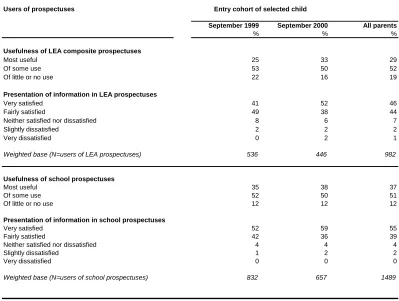
Stage 1 of the report found that the provision of information to parents is variable and, whilst parents use a variety of information and are not wholly dependent upon what an LEA provides, there is a lack of clarity about the information provided in some LEA composite brochures. Stage 2 of the report found that less than half of parents used LEA prospectuses. Of those who did, less than 1 in 3 rated them ‘most useful’ and 1 in 5 thought they were ‘of little or no use’.
The sources of information which were most frequently used by parents, and regarded by them as the most useful, were visits to schools and talking with other parents. Around 8 out of 10 parents used at least one of the following kinds of formal literature: LEA
prospectuses, school prospectuses, OFSTED reports or school performance tables.
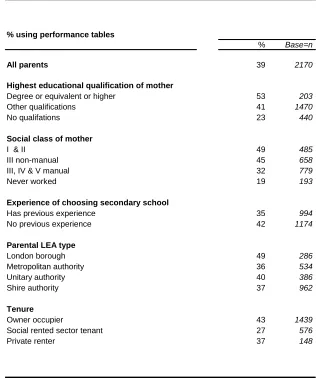
Nearly 4 in 10 parents used performance tables to find out about schools. Almost one-third of the users found performance tables 'most useful', whilst 14% found them of ‘little or no use’. Five out of 10 parents who consulted the tables did so through newspapers and 4 out of 10 through school publications.
Around half of all parents consulted primary school teachers. In some LEAs this is an integral part of the admission process. Less than 1 in 20 parents had used the Internet to access information about school admission. Stage 1 of the report found that there is room for improvement in the quality and accessibility of information that LEAs provide on the internet.
Overall, nearly 9 in 10 parents said that they were satisfied they had all the information they needed to help them choose a school.
6. Knowledge and information about over-subscription
It is a statutory requirement to publish the over and under-subscription figures for schools. However, by themselves the numbers may not mean very much. Most LEAs do not give guidance by drawing out the implications of the raw figures and, for example, providing a commentary that parents can take into account when deciding for which schools they will express a preference. This gap in the information provided is important because, where schools are over-subscribed, guidance about what the figures mean may help parents to make the admission process more predictable. A written commentary may enable them to make a more realistic assessment of the likely outcomes of expressing particular
preferences than would otherwise be the case. Whilst some LEAs provide little or no information that would help parents in this regard, at the other extreme some LEAs do provide information, for example, about the furthest a parent could live from a school and still gain a place. Some LEAs also publish postcode information to provide examples of the area from where a school mostly draws its pupils. However, the validity of the information can change from year to year and what was accurate in a previous year may no longer be the case in the following year.
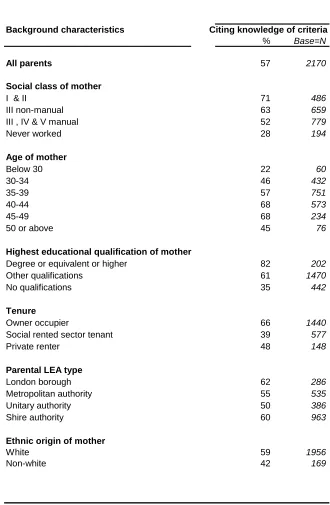
Nearly 1 in 4 parents said that they took account of over-subscription criteria when
considering to which schools to apply. A number of factors were found to be independently associated with reported use by parents of over-subscription criteria. Some of the main findings were:
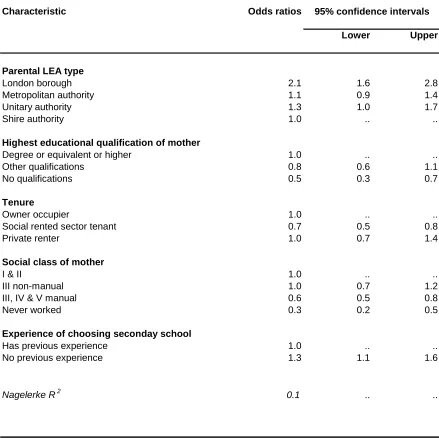
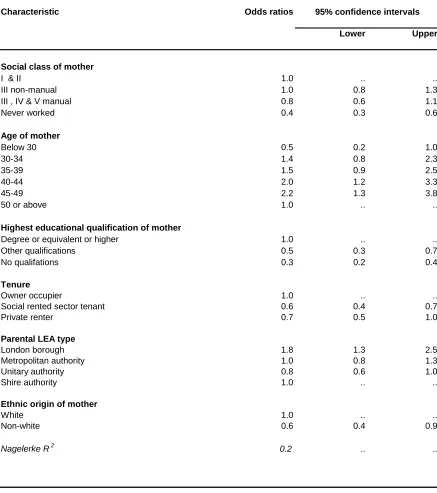
• parents among whom the mother had a degree or higher qualification were three times more likely than those without any qualifications, and approximately twice as likely as those with lower qualifications, to say they knew how popular schools allocated;
• owner occupiers were approximately twice as likely to say they knew as were parents who were social renters;
• parents among whom the mother was of white ethnic origin were nearly twice as likely to say they knew as those with a mother of non-white ethnic origin.
7. Reasons for choosing or rejecting a school
The most common reason that parents gave for wanting a place in their favourite school was that the school had good academic outcomes, mentioned by 4 out of 10 parents. Other common reasons were that a sibling attended the school, nearness from home, travel
convenience and the child's preferences. Almost three-quarters (72%) of parents applied for a place in their nearest state school, but 28% did not. Among the parents who did not apply to their nearest school, the most frequently cited reasons for not doing so were poor
discipline, mentioned by more than 1 in 3 (35%), followed by poor academic results, cited by 31%. Other less frequently cited reasons were bullying problems, mentioned by 14%, and the fact that the particular school was not a denominational one, cited by around 1 in 10.
There was a relationship between the reasons articulated for favouring a particular school and the background characteristics of parents. For example, in the most extreme contrast in the multivariate analysis, parents who lived in London, were of a non white ethnic origin, were owner occupiers and where the mother was in Social Class I or II were more than 10 times as likely to cite academic reasons for choosing their favourite school than the group comprising parents in a Shire authority, who rented in the social sector, were of white ethnic origin and where the mother had never worked.
Around 6 in 10 of the schools that parents most wanted their children to attend had higher GCSE scores than their LEA average. As before, the proportion wanting such a school for their children varied according to parental background characteristics. For example, the group most likely to want such a school comprised parents with no previous experience of choosing a secondary school, who were owner occupiers and lived in London, who had a degree level qualification or above and were in a non-manual social class.
Parents in Shire authorities were more likely than parents in other LEA types to express a preference for their local school. A common-sense explanation suggests this relates to the greater distances between schools in Shire LEAs making the choice of an alternative school less realistic, especially since travel convenience and nearness to home are key factors in parental preference. However, the explanation may be more complex than this because the population density of different Shire authorities varies considerably and, for example, some have extensive urban developments within their boundaries or are close to urban centres of population in other LEAs.
8. The application process
The report examined the information given to parents and several features of the
application process to see what variation existed across the country and whether or not this had any impact on parental satisfaction with the process.
An analysis of LEA composite prospectuses was carried out and one finding to emerge was that the majority of LEA prospectuses do not make clear the consequences of not
expressing a preference for school(s). All prospectuses make the point that a parent must express a preference in order for it to be considered but many are not explicit about what the consequences are likely to be if a preference is not expressed.
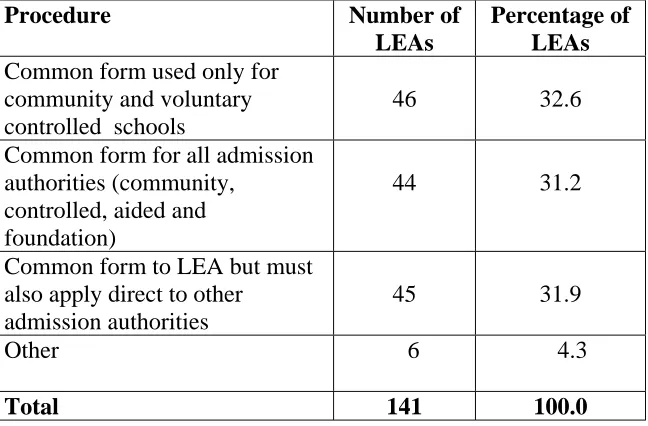
The number of forms that parents have to complete to apply for a school place varies from one LEA to another: around one-third of LEAs require parents to complete just one form to apply for community schools and voluntary controlled admission authorities and separate forms for other schools; one-third allow parents to use one common form for all admission authorities, and just over a third of LEAs expect parents to complete a common form to the LEA but to apply direct to other admission authorities. At one extreme a parent can
complete just one form to apply for all types of school in an LEA and also schools in another LEA. At the other extreme a parent may have to complete a form for each school applied for within an LEA and separate LEA forms for any schools applied for outside the LEA. Over 60% of LEAs use common dates for applications and decisions about
admission.
Two-thirds of parents applied to a single admission authority and 9 out of 10 completed an application form provided by their own LEA. Two-thirds of parents reported that they were asked by their LEA to list their preference for school in rank order on their application form. Around 10% of parents reported that their children had been interviewed by at least one of the schools that they had applied to and 9% of parents reported that a test formed part of the application process for one of the schools to which they applied. With regard to the reports of being interviewed it seems most likely that this refers to those parents who apply for a place at a denominational school where participation in Church activities and religious commitment is one of the criteria for admission. Thus, whilst children cannot be admitted or refused entrance to a school on the basis of an interview it can be used for eliciting information about an application to a denominational school. The reported
parents perceive erroneously that the End of Key Stage Standardised Assessment Tasks are related in some way to secondary school admission.
9. Applying for a school place in another LEA
Some of the differences in LEA practices occur because of differences in policy. In some LEAs information is provided to parents about applying for schools outside their own LEA whereas in others no information or advice is given. In some LEAs all parental preferences are taken into account irrespective of where a school is located, including schools in other LEAs, whilst in other LEAs only preferences for schools within the LEA boundary are taken into account. Generally, LEAs that attract pupils from other LEAs tend to adopt a different attitude to those LEAs where there is a net loss of pupils to other LEAs. In the former there may be a more relaxed view about parents applying for a place outside the LEA and, in some cases, this extends to making it clear that if this happens it won’t affect the priority order in which parents have applied for a place for schools within their ‘home’ LEA. In effect this means that a parent can apply to as many schools outside the LEA without it impacting on the chances of securing a place at a preferred school inside the LEA. An exception to this is in London where those LEAs that are net importers of pupils are often faced with great difficulties in meeting the demand for places. In this situation there are examples of LEAs who insist on being told of all the schools for which a parent has applied and all preferences are taken into account in priority order even if they are distributed across several LEAs.
Analysis of the relationship between parental background characteristics and the likelihood of applying for a place in a school outside the parents’ own LEA showed that LEA type had the strongest independent effect. Specifically, parents living in London were 6 times more likely than those living in Shire authorities to have applied for a place in a school outside their own LEA, once other variables had been controlled. Educational
qualifications were also independently associated with the likelihood of applying for a place in school outside the parents’ own LEA area. Parents where the mothers’ highest educational qualification was a degree or higher were twice as likely to have applied
outside their own LEA as those among whom the mother had no educational qualifications.
10. Methods for indicating school preferences
Although there were examples of LEAs using more than one method for different types of school there were four main ways in which LEAs asked parents to express a preference. The most common, found in 75% of LEAs, asked parents to name a number of schools as preferences in rank order (first preference, second preference, etc.). The LEA admission authority then attempts to allocate them a place at their first choice school.
where parents are asked to express multiple preferences and each preference is treated as if it is equal and parents would be happy for their child to attend any of the schools on the list. LEAs then allocate one of those preferred schools in accordance with their admission criteria often taking into account the distance a child may have to travel to a school.
Just under 10% of LEAs use a single preference system where parents are invited, initially, to express a preference for just one school and if this is unsuccessful they are able to apply for an alternative school(s) at further stages of the process.
LEAs do have some discretion over how places are allocated when parents are asked to express more than one preference and a school is over-subscribed. How preferences should be used by admission authorities to allocate school places is the subject of differing legal interpretations. In general there are different views about whether the preference(s) a parent expresses should be considered in a rank order or treated as if they are equal. The
implications of this can be very important for parents. If preferences are dealt with in the strict order of priority as expressed by parents it may mean that a parent who is
unsuccessful in obtaining a place at their first preference school is unable to obtain a place at their second preference school even if the school is close to where the parent lives. Some LEAs avoid this problem by ensuring that, if a parent does not obtain a place at their first preference school, a place is available at the local school as long as they have put it as their second choice.
11. The London effect
In London, there is often a shortage of school places and this creates additional tensions in managing demand. A significant feature of admissions in London is the extent of cross border traffic with some 60,000 pupils crossing from their 'home' LEA to attend school in another LEA on a daily basis. Not surprisingly, London parents reported the highest levels of knowledge of how places are allocated at popular schools. As outlined above, after other variables had been controlled, parents living in London were the most likely to have
applied to a school outside their own LEA. Further analysis showed that, holding other variables constant, London parents were two and a half times more likely not to apply to their nearest school than parents living in Shire authorities; there were similar but weaker contrasts between parents living in London and parents living in Unitary and Metropolitan authorities. Parents in London were also found to be the most likely to have made
applications to more than one admission authority.
The greater number of schools within reasonable travelling distance may mean that the impact of not being able to attend a school in the ‘home’ LEA is not necessarily as great as it would be in other less densely populated parts of the country where schools are more sparsely distributed.
Competition for places in London schools appears to be more intense than elsewhere. London parents were the least likely to be offered a place for their child in the school they would most like - nearly 70% compared with 85% nationally. In an analysis which
less likely to be offered the school they most wanted than were parents living in a Shire authority.
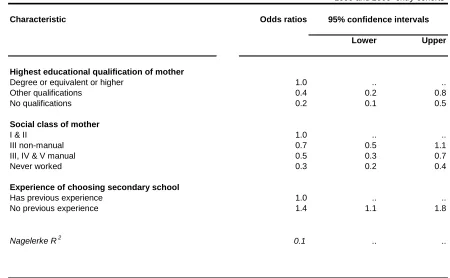
In a similar multivariate analysis, parents in London were found to be twice as likely as those in Shire authorities to use performance tables and to have considered
over-subscription criteria when choosing schools for their children. The likelihood of parents living in urban areas other than London considering over-subscription criteria did not differ statistically significantly from those living in Shire authorities.
In general, the proportion of parents appealing against non-admission did not vary by the background characteristics of parents. The one exception was that 12% of parents resident in London made an appeal compared with 4% in all other LEA types.
12. Excellence in Cities
Sixteen, of the 33 London local authorities are part of the EiC initiative and many of the following points have a particular resonance for London parents. Phase 1 of the EiC initiative is based in London and other major conurbations where the greatest levels of social and economic disadvantage and urban deprivation exist. In this regard Phase 1 EiC LEAs differ in the degree of disadvantage experienced compared with those LEAs that are part of Stage 2 of the EiC initiative. Below we summarise some of the key differences in results for parents in EiC areas compared with the national results. These findings do not control for the possible effect of other variables.
Higher proportions of parents in Phase 1 EiC areas made multiple applications for places than was the case nationally. For example,16% of parents applied to three or more
admission authorities compared with 11% nationally. Across England as a whole, nearly 1 in 8 parents applied for a place in a school outside their own LEA area compared with 1 in 4 in EiC Phase 1 areas. In part, this is likely to reflect urban density and greater availability of schools within close proximity. This may also partly account for the higher proportion of parents not applying for a place in their nearest state school - 4 in 10 did not do so
compared with nearly 3 in 10 nationally. Parents living in a Phase 1 EiC LEA were also slightly more likely to apply to a school which was its own admission authority - 48% did so compared with 44% nationally.
Although lower proportions of parents in EiC areas applied for a place in a foundation school compared with national figures applications to voluntary aided schools were more common than was the case for England as a whole. These findings are likely to reflect variation in the provision of such schools by area. In London there are proportionately more voluntary aided schools for which a parent might express a preference.
13. Parental satisfaction
Nationally, over 8 in 10 parents were offered a place in the school they most wanted and over 9 in 10 received an offer of a place in their first preference school. About 4% of parents were not offered a place in any school for which a preference had been expressed. Eight per cent of parents reported that there were other state schools they would have preferred for their children over the ones in which they had applied for a place.
The vast majority of parents, 9 out of 10, said that they were satisfied with the outcome of the application process. The majority of parents expressed satisfaction with the process itself but nearly 1 in 7 parents were not satisfied with the process. Views on the process were coloured by the outcome - satisfaction with the outcome was related to whether or not parents were offered their preferred school. For parents of children in Year 7, who were interviewed some 9 months after admission to secondary school, 1 in 10 felt less satisfied with the outcome than they had before their child had actually started at the school whilst more than one in three said they were more satisfied, and half said they felt the same.
In general, there were clear socio-economic differences in knowledge about and use made of information about the admission process, as well as the reasons given for applying for particular schools. These socio-economic differences were not as strong regarding
satisfaction with the final outcomes of the process. The proportion of parents offered places in the school they most wanted tended not to vary by the socio-economic characteristics analysed in the research. A stronger factor influencing parental satisfaction with the outcome of the process is the type of LEA area in which parents live. In particular, as indicated above, there is an important distinction between the experiences of parents
resident in London and those resident in other areas; the contrast was most marked between parents living in London boroughs and those in Shire authorities.
14. The interaction of types of admission practice and parental satisfaction
Admission authorities need to take into account how different practices interact and impact on parents. Thus, for example, focusing on maximising choice may not be very helpful if, for example, one of the consequences of this is that a substantial number of parents do not find out until very late in the process where their child may be attending school. Some children begin the summer break not knowing which school they will attend in September.
Taking the relevant factors together a presumption that parents value choice per se is questionable. Clearly, many parents who are faced with the prospect of sending their child to a school that is considered in their terms as ‘unsuitable’ want a better alternative - if one is available. One issue is the extent to which parents are seen as mainly engaged in a
satisficing process of sending their child to a local school, if that option is available and the school is regarded by them as 'good enough', or whether they are viewed as engaged in a
maximising strategy of choosing the ‘best possible’ school available - judged by academic
Parents may be more concerned about whether the outcomes of the admission process can be predicted/manipulated (predictability), where, all things being equal, there is a narrower rather than a wider range of actual choice (choice); where there is less rather than more diversity (diversity); where one admission authority such as an LEA has a strong rather than a weak co-ordinating role (co-ordination) and where the outcomes of the admission process are known sooner rather than later (timescales). Each factor may not be particularly significant by itself; rather it is the way in which they interact in particular localities that is the most significant issue.
The issue of predictability concerns the transparency of the link between parental action and likely outcomes of their actions. In some LEAs it is known that having a sibling in a school or residence in a particular area, or living a particular distance from a school means that it may be possible to calculate that a place will be available in a particular school.
In those areas where there is maximum ‘choice’, because the admission system is operated as if it were a quasi market system, the transaction costs are very high for everyone
involved. In these circumstances, LEA and school staff may have to spend a lot of time supporting pupils and families for whom no place is offered. The complexity of matching pupils and schools may need to take place over a protracted period of time.
The way in which local factors interact means that there is no simple relationship between the numbers of parents gaining their first preference place and the level of appeals. The contingent nature of LEA modes of practice means that there is a weak relationship between different modes of practice and particular outcomes. The key issue is not necessarily the individual modes of practice used per se but their application and
1.1 Aims of the research
The Department commissioned research in 2000 into parents' experiences of the process of choosing a secondary school for their child. The research comprised three related components or stages:
• collection of information from each local education authority (LEA) on the type of admissions systems it operated;
• a nationally representative survey of parents who had recently experienced the process; who were currently experiencing it; or who were about to experience it;
• a qualitative survey of parents and other key players in the admissions process.
This report provides the findings from the first two stages of the research1. The School of Education, Sheffield Hallam University collected the information on admissions systems used by LEAs. The nationally representative survey was carried out by the Social Survey Division of the Office for National Statistics.
The research project had four main aims:
• to draw out the key issues for parents in choosing a secondary school for their child;
• to establish what information is needed by these parents to make informed decisions;
• to identify improvements which could be made to the admissions process or associated information, to ensure that as many parents as possible are satisfied with the outcome;
• to provide a baseline for research on parental choice issues in the ‘Excellence in Cities’ conurbations.
1.2 Policy background
Every maintained school has an admission authority which decides which children will be admitted to the school. For most schools this is the local education
authority, but for foundation schools and voluntary-aided schools it is the school governing body.
The concept of parental choice is fundamental to the law on admissions. LEAs must arrange for all parents to be able to express their preference(s) and admission authorities must comply with those preferences except in specific circumstances. Most of these circumstances are about incompatibility between pupil and school, for example a girl applying to a boy’s school, a non-Catholic to a Catholics-only school, or a child who has not passed the designated test to a school that selects by
1
general ability. The most common allowable circumstance for refusing application is that the school has more applicants than places. In that event the admission authority must follow the over-subscription criteria in its published admission arrangements to decide which applicants get the places.
The present government has introduced a new admissions framework, to replace the previous system. The new framework is in the School Standards and Framework Act 1998. The Act’s admission provisions came into force between October 1998 and September 1999. The Act requires the Secretary of State to issue a Code (or Codes) of Practice on Admissions, giving statutory guidance to which all admission authorities must have regard. The main Code came into force on April 1 1999. A supplementary Code on Admission Appeals came into force on 1 September 1999. Both apply to arrangements that lead to primary and secondary school intakes from September 2000 onwards. The immediately previous intake (school year
commencing September 1999) may have benefited somewhat from Interim DfEE Guidance to admission authorities issued in September 1998, but this could not say anything inconsistent with previous legislation and admission authorities were not obliged to take account of it.
The new legislation and Code included the introduction of the following:
• requirements for all admission authorities to consult each other on their proposed admission arrangements and criteria, with the possibility for other admission authorities (and in the case of existing partial selection arrangements, parents) to complain to the Schools Adjudicator if they think the arrangements are not in the interests of local children and parents;
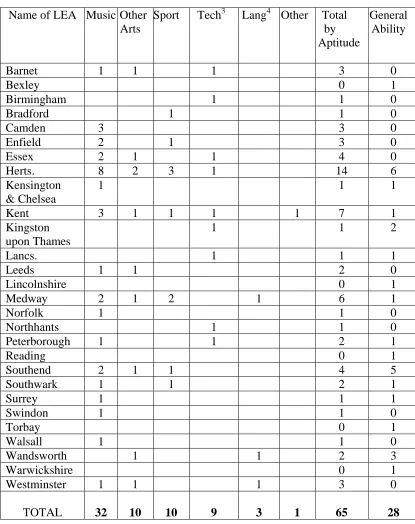
• the outlawing of any new selection by ability, while allowing up to 10% selection by aptitude to be introduced in certain cases;
• requiring all admissions criteria, in particular over-subscription criteria, and all ability and aptitude testing arrangements to be clear, fair, objective and
published;
• encouragement in the Admissions Code for admission authorities in an area to have standard application forms and common timetables and agree
arrangements in new Admissions Forums;
• requiring LEAs to publish composite prospectuses with summary admissions information for all schools in their area, including how over-subscribed they have been in the past;
• ruling out admissions interviews, except for church schools checking religious commitment and boarding schools checking boarding suitability;
In March 1999 the Government introduced the ‘Excellence in Cities’ initiative for education in the inner cities. This aims to give targeted support and resources to schools in selected inner cities and provide a package of measures designed to meet the needs of the individual pupil. Key elements of the initiative are:
• an expansion of the Specialist and Beacon schools programmes and a new network of learning centres;
• measures to extend opportunities for gifted and talented children;
• a strategy to strengthen school leadership, recruit and train teachers, head teachers and school governors;
• provision of extra support through measures to tackle disruption in schools and support the learning of individual pupils.
In the first phase, twenty-five authorities were involved: sixteen of them in London. The second phase involved a further twenty authorities, all but two of which were outside London. A third phase will extend the initiative further.
A study by NFER in 1995 found that 15% of parents said that their child had not been offered a place at their preferred secondary school. An Audit Commission survey in 1996 found that 10% of parental secondary school preferences could not be met and that 9% were not expressing their genuine first preference. These findings implied dissatisfaction of some parents with the outcome and process of parental choice of secondary school. In addition the number of appeals has been rising gradually over the last decade.
Other issues of concern have been raised. One is whether parents feel sufficiently informed to be able to choose and whether they do in fact make informed choices. A second is whether all parents understand the admissions process and are able to use it effectively or whether parents in certain social groups are better able to use the system to achieve a satisfactory outcome. A third is whether over-subscribed schools and partially selective schools are allocating their places on a clear, fair and objective basis.
1.3 Conduct of the research
Stage 1 of the research, concerning the policies and practices of admission
authorities, was conducted by Sheffield Hallam University. The objectives of this stage were:
• to gain information from all LEAs in England about their present admission arrangements;
• to identify different modes of practice and the frequency of those modes;
• to gain evidence of the quality of information on the Internet from each LEA concerning admission;
Information was gained from all LEAs in England from the composite prospectuses sent to parents in 1999 whose children were entering secondary school in
September 2000. From this information about their present admission arrangements different modes of practice were identified and analysed. The composite
prospectuses and the web-sites of each LEA were also assessed as to the quality of the information provided to parents. The results of the analysis of policies and practices of admission authorities is intended to provide a context against which the results of the survey of parental experiences can be read. The intention was to use the emerging results from Stage 1 to inform the design of the nationally
representative survey questionnaire. However, in the event the difficulty of
developing a small number of categories that would capture both the complexity of LEA practices as well as be meaningful to parents meant that the resulting typology only informed the design of the nationally representative survey to a limited extent.
Stage 2 of the research was conducted by the Office for National Statistics. In 2000, the quantitative survey interviewed nationally representative samples of parents of 3 cohorts of children:
• parents whose children had entered secondary school in September 1999;
• parents whose children would enter secondary school in September 2000;
• parents whose children would enter secondary school in September 2001.
The 3 cohorts were chosen to reflect the experiences and expectations of parents for whom the issues were particularly salient. At the time they were interviewed for the survey, parents of children in the September 1999 entry cohort had completed the process of choosing and their children were in their first year of secondary school. Parents of children in the September 2000 entry cohort had either just completed the formal process of choosing a secondary school or were still engaged in it. Parents of children in the September 2001 entry cohort were about to start to be involved in the formal process of choosing a school.
Part 1
Policies and practices of
LEA admission authorities
Sheffield Hallam University:
School of EducationJohn Williams John Coldron Kathy Stephenson
1.
Introduction
The School Admissions Code of Practice requires admission arrangements to be clear, objective and give every child a fair chance of a satisfactory school place. In particular, the Code states that:
• The arrangements should enable parents’ preferences for the schools of their choice to be met to the maximum extent possible.
• The admission criteria should be clear, fair and objective, for the benefit of all children including those with special educational needs or with disabilities.
• The local admission authorities should consult each other and co-ordinate their arrangements.
• Parents should have easy access to helpful and full information to make an informed choice.
The objectives of Stage 1 of the project were:
• To gain information from all LEAs in England about their present admission arrangements.
• To identify different modes of practice and the frequency of those modes.
• To gain evidence of the quality of information on the Internet from each LEA concerning admission.
2.
The statutory context
2.1 As far as possible all LEAs have to allocate places in secondary schools in
accordance with expressed parental preference. 86(1) of the School Standards and Framework Act (SSF) requires LEAs to make arrangements for enabling parents to express a preference as to the school they want their child to be educated and to give reasons for the preference. However, whether parents have a right to express a single preference or more than one preference is interpreted differently by different LEAs. One Education Officer describes how his LEA recently changed its
admission form:
…to make it clear that a parent only has a statutory right to express one preference. However, the form enables parents to submit second and third non-statutory preferences. We recognise that this conflicts with some of the legal advice but the advice we have been given is as a result of an approach we made to leading counsel.
Letter from an LEA Education Officer, Jan 2001
2.2 86 (2) of the SSF puts a specific duty on LEAs and governing bodies to comply with that preference except in a specified range of circumstances. In the case of secondary schools compliance with parental preference does not apply if it would:
• Prejudice efficiency
• Be incompatible with preserving the religious character of a school
• Not be compatible with the selection arrangements of a school that selects by high ability
• Mean admitting a child who had been permanently excluded from 2 or more schools and at least one of the exclusions took place after 1 September 1997
2.3 When allocating places LEAs must first carry out their duty to meet expressed parental preferences before operating any other allocation policy and they must first consider those parents who have expressed a preference over those parents who have not expressed any preference. However, LEAs must also ensure that a suitable school place within a reasonable travelling distance is available to children whose parents have not expressed any preference.
over parents who live within the catchment area but have not formally expressed a preference for that school.
2.5 The Code of Practice points out that there is some discretion over how places are allocated when parents are asked to express more than one preference and a school is oversubscribed. Priority can be given to the parents’ order of ranking but this is not a statutory requirement. How this is interpreted by different LEAs is the source of some of the variation in practice that exists concerning admissions.
2.6 Where a parent has been asked or chooses to express more than one preference for a secondary school, how those preferences are used by admission authorities to allocate school places is the subject of differing opinions. In general terms this concerns whether the preferences a parent expresses should be considered in a rank order or treated as if they are equal. The implications of this can be very important for parents. If preferences are dealt with in the strict order of priority as expressed by parents it may mean that a parent who is unsuccessful in obtaining a place at their first preference school is unable to obtain a place at their second preference school even if the school is nearby where the parent lives. Some LEAs avoid this problem by ensuring that if a parent does not obtain a place at their first preference school, a place is available at the local school as long as they have put it as their second choice (see 4.1 below).
2.8 There are differences in opinion about the variations in LEA practice that exist and whether they merely reflect differing local circumstances and different demographic and geographical differences or whether they arise out of differences in
interpretation of their statutory duties. This difference of opinion is reflected in the Annual Report of the Office of the Schools Adjudicator.
Circumstances differ widely from area to area and it is obviously desirable that an LEA, in the admission arrangements it makes should respond to these as sensitively as it can. But the rights of parents and the duties of admission authorities, as these are laid down in the
legislation, do not differ from area to area. Local variation must always be consistent with those rights and duties. Yet it is apparent that there are different interpretations amongst admission authorities of the nature of their statutory responsibilities. Not all can be correct….at some stage, more may need to be done to ensure a consistent understanding within all admission authorities of their statutory duties.
3.
Categorising modes of practice
3.1 Collecting data from LEAs
All LEAs in England were asked to provide their composite prospectus, copies of admission forms, letters and further information relating to secondary school admission at the age of 11. Of the 150 English LEAs 9 Authorities were excluded from the sample because either they operated a different age of transfer, or they did not provide secondary education. The resulting cohort of 141 LEAs, on which this Stage 1 report is based, comprises 100% of those authorities in England where children transfer to secondary school at the age of 11. It is important to note that all the information in Part 1 relates to arrangements that were in place for admission in September 2000. Any subsequent changes have not been included.
3.1.1 The Department has a particular interest in establishing baseline data about practice in LEAs that are part of the Excellence in Cities (EiC) initiative. In view of this, wherever it is appropriate, the tables throughout Part 1 compare EiC LEAs with ‘non’ EiC LEAs. Table 1 indicates how many LEAs are in each phase of the initiative compared with the LEAs who are not participating.
Table 1: Proportion of LEAs in this study which are part of EiC initiatives
Number of LEAs
Percentage of LEAs
Phase 1 EiC areas 24 17.0
Phase 2 EiC areas 22 15.6
Non-EiC areas 95 67.4
Total 141 100.0
3.2 Capturing complexity
Finding a means of categorising LEA modes of practice which captures the complexity that exists for parents, whilst ensuring that a useful and useable
typology was developed, presented several challenges. For example, in some LEAs community schools were in the minority compared with foundation and voluntary-aided schools and parental preferences may have been dealt with differently for different types of school.
3.2.1 A substantial number of parents applied to more than one admission authority and, therefore, only categorising the admission arrangements that an LEA had devised for use in relation to community schools may not have captured most parents’ experience of the admission process.
3.2.2 In some areas LEA admission criteria applied to such a small proportion of schools within the LEA that describing the LEA mode of practice did not necessarily provide a meaningful description of the procedures that many parents used. Similarly, a substantial number of parents applied to schools outside their ‘home’ LEA and if they lived near the borders of several LEAs in densely populated urban areas they may have found themselves involved in a range of different procedures.
3.2.4 There is also a question about the relationship between a parent’s beliefs about the priority given to the school preferences and how those preferences are actually taken into account when making decisions about the allocation of school places. As one LEA officer commented:
…. what does first choice mean? Because … we [used to] have something called the [LEA] admission form where parents would express a preference for three schools. It was meaningful, ….[applications] would be considered by the first school and then [the next school] … this is the normal, rational understanding of what preferences mean – but then, as schools became their own admission authorities, we continued [to use] this form but it is misleading to parents because actually it may not mean anything. We [as an LEA] can’t have any impact on what happens to those preferences but more worryingly, some schools are using those preferences to do additional sifting. So the schools would say, you know, these are our admissions criteria : A, B, C and D. None of them mentioned first preference or second preference but they would mention siblings, SEN, whatever it may be - but then they would say, “Well, we will only look at you if you have put us down as first preference… LEA hierarchical preference … is actually not
meaningful because we are not able to do anything with that.
Interview with an LEA Admissions officer
3.2.5 Taken together, all these factors mean that the attempt to classify LEA practices needs to find a way of dealing with the ambiguities that exist. Where such
ambiguities exist the approach adopted here has been to try to classify LEA modes of practice in terms of how the dominant mode of practice is likely to be perceived by the majority of parents in an area. This is done in the knowledge that, whilst it simplifies some of the complexity, there is also a risk of over-simplification. However, little useful purpose would be served by trying to accommodate every unique feature and nuance of an LEA’s practice This would lead to a proliferation of categories that would be of little use in trying to summarise the main modes of practice that exist and bear little relationship to the choices that parents perceive are open to them.
3.3 The main features of admission arrangements that have implications for the parental experience of choosing a school
3.3.1 General approach to admissions
The different historical, geographical and demographic contexts of LEA's have led to different ways of implementing the statutory requirements. Some simply use the order of parental preference as the prime criterion (until over-subscription criteria apply); others link it in different procedural ways to feeder primary or catchment area criteria. Wholly selective systems raise different issues again.
3.3.2 Procedures for parents to express a preference
The approach to admissions of the LEA is reflected in the procedures adopted for parents to express a preference. This procedure is decisive and therefore the form in which parents experience it has important implications. Parents are also able to express a preference for schools outside the LEA in which they reside so the arrangements for facilitating this are also of interest.
3.3.3 The application of over-subscription criteria
This refers to the different criteria that are used and the way they are applied when there are more preferences expressed than places available at particular schools. Over-subscription criteria may apply across an LEA to all categories of schools, or an LEA may delegate responsibility for admission to individual schools. foundation and voluntary-aided schools normally set their own admission criteria. These criteria and their implementation are potentially important in the way they affect parents' expression of preference. They are particularly relevant to the question of satisfaction since they are used to reject some applications for popular schools.
3.3.4 Appeals
4.
Expressing a preference
4.1 The procedures for expressing a preference
The procedures for expressing a preference have an impact on the experience of parents choosing a secondary school. The procedures found in the composite prospectuses have been categorised into four types. They are described below and Table 1 shows their frequency. The four types are:
Type 1 Multiple preference – Rank order:
The parent is invited to name a number of schools as preferences in rank order (first preference, second preference, third preference etc.) and the LEA admission
authority attempts to allocate them a place at their first choice school. Though the first choice takes precedence in the majority of cases it is not guaranteed that a parent’s first choice will take precedence over someone else’s second choice. There are circumstances where a second choice takes precedence, particularly if this means a pupil would be spared a long or difficult journey to an alternative school. Sometimes a multi-stage process is involved whereby parents may be asked to enter the next stage of the admission procedure and identify further preferences if they have been unsuccessful with their initial preferences.
Type 2 Invitation to accept a designated school or choose another
Parents are notified of a place allocated at a school chosen by the LEA on the basis of the general admission arrangements of the authority and invited to confirm that particular school as their expressed preference or to name one or more alternative preferred schools. The parent must confirm in writing that the allocated school is acceptable otherwise it is treated as a non-preference and no place is reserved.
This procedure is most commonly used in those areas where a catchment or priority area system is in place. How the consequences of this are handled by LEAs varies considerably. Some LEAs state explicitly that not putting the designated school down as first preference may mean that a place is not available at this ‘local’ school should they be unsuccessful in gaining a place at a different first preference school. Other LEAs state explicitly that parents who put their ‘catchment’ school down as a second preference who do not get their first preference will not be treated any less favourably than a parent who chose the catchment school as their first preference.
Type 3 Multiple preference equal weighting
Parents are asked to express multiple preferences and each preference is given equal weighting. LEAs then allocate to one of those preferred schools on the basis of their general admission arrangements. This is often in a context where the admission system is complex involving a number of admission authorities. In such
Type 4 Single Preference System
Parents are invited to express a single preference and if this proves unsuccessful they may apply to an alternative school(s) in a second stage of dealing with preferences.
Table 2: Frequency of procedures for expressing a preference: All LEAs
Type of System Number of
LEAs
% of LEAs
1. Multiple preference – rank order 105 74.4
2. Invitation to accept a designated school or express a preference for other school(s)
18 12.8
3. Multiple preference – equal weighting 7 5.0
4. Single preference 11 7.8
Total 141 100.0
Table 3: Frequency of procedures for expressing a preference: Breakdown of Non EiC, EiC 1 and EiC 2 LEAs
Type of System Number of Non EiC LEAs % of Non EiC LEAs Number of EiC 1
% of EiC 1
Number of EiC 2
% of EiC 2
1. Multiple preference – rank order
70 73.7 16 66.6 19 86.4
2. Invitation to accept a designated school or express a preference for other school(s)
13 13.7 3 12.5 2 9.1
3. Multiple preference – equal
weighting
5 5.2 1 4.2 1 4.5
4. Single preference
7 7.4 4 16.7 0 0
4.2 Banding
Banding is used in a small number of LEAs and also by some schools as a method of allocating places. It is used mainly when the aim is to ensure that a balanced comprehensive intake of ability is achieved. It is also used as a defensive mechanism by some schools in response to the use of partial selection by a neighbouring school. The aim in this situation is to stop higher ability children being ‘creamed off’ by a school that operates partial selection. Essentially, banding is a method of allocating school places rather than a means for enabling parents to express a preference.
4.3 Catchment areas and feeder schools
Changing school rolls can make some catchment areas obsolete and the relative popularity of schools also means that a linked feeder school system can create administrative difficulties with over and under-subscription in different parts of an LEA area. There is little point in having admission criteria that give priority to link or feeder schools if there are too few places to accommodate the feeder primary school population. Similarly, a link or feeder school admission policy will be problematic if it is likely to leave a set of parents dissatisfied with the secondary school to which they would be expected to send their children. Potentially, it could have a knock-on effect on feeder primary schools and make them unpopular or popular because of their secondary school links rather than their intrinsic features.
4.4 A survey by Forrest2 showed that in 1985, some 76 (51%) of LEAs were using catchment areas for secondary admission but by 1996 this had dropped to 51 (44%). Changes in local government boundaries and political devolution means that the current figures are not directly comparable but the 14.9% of LEAs now using catchment area arrangements, as recorded in this Stage 1 survey, shows that their use is now very much in decline as a practice for allocating school places.
4.5 The Greenwich judgement has hastened the decline of catchment areas as one LEA officer explained:
The ‘Greenwich judgement’ and the location of our schools cause major problems. The schools are mainly located around the periphery of the borough and large numbers of non-[home LEA] residents are able to gain access to our schools. Approximately 1000 of this year’s transfer cohort for our schools will be non-[home LEA] pupils. About 250 of our children will start at out-borough schools, most of them unwillingly.
Communication from an LEA officer
4.6 ‘Hybrid’ LEA Practices
This is intended to illustrate some of the complexity when trying to allocate LEA modes of practice to a single category.
LEA1
The LEA uses a common form that every parent has to complete but if parents are interested in voluntary-aided and foundation schools those schools have their own admission forms and parents complete an additional form for that particular school. There is a two-part form and on one side they choose up to five schools that they are interested in. On the second side, which is confidential to the LEA, parents list an order of preference which only comes into play if parents meet the admission criteria for a place at more than one school. If they satisfy the admission criteria of more than one school the LEA looks at the order of preferences but this is not shown to the schools. The LEA allocates places for its community schools and has the admission lists for the other voluntary-aided and foundation schools. The schools provide the LEA with a list of children that have been offered places.The LEA identifies those that are going to be offered a place at more than one school, and then rejects the lower preference places. The information will normally be sent to a voluntary/foundation school saying that it has been possible to meet a parent’s preference. It is only when parents meet the admission criteria for more than one school that the list of preferences is looked at.
LEA2
Most parents are offered a place at their 1st preference school. However, for community and voluntary controlled schools, all 1st and 2nd preferences are
considered equally when applying the admission criteria. Thecompositeprospectus states that parents who put their catchment school down as a second preference who do not get their first preference ‘ will not be treated any less favourably than a parent who chose the catchment school as their first preference’.
LEA3
Parents are asked to express multiple preferences in rank order (up to 3) and they are guaranteed a place at a designated school (the priority area school) if they rank this as either first or second choice. It means that a parent who expresses a second preference for a particular school will have a greater chance of obtaining a place at that school compared with someone who has expressed a first preference for the same school providing it is the designated school for the former parent but not for the latter parent.
LEA4
Parents are required to prioritise only their preferences for the 3 community schools. At the same time, they can make preferences of equal standing for one or more voluntary-aided schools.
LEA5
4.7 Explaining the consequences of expressing or not expressing a preference
The following set of tables looks at the extent to which LEAs provide a clear explanation of the importance of expressing a preference and the consequences of not so doing. The judgements are those of the research team who examined all the prospectuses and made judgements which were then subject to a moderation procedure. To be categorised as giving a clear explanation did not require an LEA to mention the Greenwich and Rotherham judgements by name or to provide chapter and verse on the legal context. It did require a prominent statement explaining clearly what parents must do and what would happen if the advice was not followed.
Table 4 Legal Context: Are the consequences of expressing or not expressing a preference made clear?
Number of LEAs Percentage of LEAs
Made clear 50 35.5
Not made clear 91 64.5
Total 141 100.0
Table 5: Legal context: Are the consequences of expressing or not expressing a preference made clear?: Breakdown of Non EiC, EiC 1 and EiC 2 LEAs
Number of Non EiC LEAs % of Non EiC LEAs Number of EiC 1
% of EiC 1
Number of EiC 2
% of EiC 2
Made clear
35 36.8 7 29.2 8 36.4
Not made clear
60 63.2 17 70.8 14 63.6
Total 95 100.0 24 100.0 22 100.0
5.
The use of application forms and procedures for expressing a
preference
5.1 LEAs were asked whether there is a common application form and a common admission timetable for those parents with children entering secondary school in September 2000. Three ways of making application were identified. These were:
• A common form used only for community and voluntary controlled schools for which the LEA is the admission authority;
• A common form used for all admission authorities (community, controlled, aided and foundation) within the Borough;
[image:41.612.138.462.314.527.2]• A common form sent to the LEA but in addition the parent must also apply direct to other admission authorities.
Table 6: The frequency of different ways of making application
Procedure Number of
LEAs
Percentage of LEAs
Common form used only for community and voluntary controlled schools
46 32.6
Common form for all admission authorities (community,
controlled, aided and foundation)
44 31.2
Common form to LEA but must also apply direct to other
admission authorities
45 31.9
Other 6 4.3
Total 141 100.0
Table 6 shows that there is quite an even distribution in the types of form that parents are expected to complete when expressing a preference for different types of schools. The easiest option for parents is to complete one form for all schools but, as the table demonstrates, this is only available in forty-four LEAs. The category 'Other' refers to LEAs where common forms are not used, for example, in one LEA parents apply to as many schools as they wish using individual school application forms. All the schools administer their own forms independently of each other and some parents may receive multiple offers whilst other parents may
Table 7: Frequency of different ways of making application: Breakdown of Non EiC, EiC 1 and EiC 2 LEAs
Procedure Number of Non EiC LEAs % of Non EiC LEAs Number of EiC 1
% of EiC 1
Number of EiC 2
% of EiC 2
Common form used only for community and voluntary controlled schools
28 29.5 10 41.7 8 36.4
Common form for all admission authorities (community, controlled, aided and foundation)
27 28.4 8 33.3 9 40.9
Common form to LEA but must also apply direct to other admission authorities
35 36.8 5 20.8 5 22.7
Other* 5 5.3 1 4.2 0 0
Total 95 100.0 24 100.0 22 100.0
* see text below Table 6
Table 8: The extent to which common dates are used across schools for applications and decisions:
Number of LEAs Percentage of LEAs
Yes 89 63.1
No 40 28.4
No stated policy 12 8.5
Total 141 100.0
In the majority of LEAs there are common closing dates for applications and
common dates for informing parents of outcomes. However, in nearly 30% of LEAs it has not been possible to co-ordinate dates. In some LEAs, for example Enfield and Hertfordshire, there is an attempt to ensure that every parent receives an offer of a school place for their child on the same day.
Table 9: The extent to which common dates are used across schools for applications and decisions:
Breakdown of Non EiC, EiC 1 and EiC 2 LEAs
Number of Non
EiC LEAs
% of Non EiC LEAs
Number of EiC 1
% of EiC 1
Number of EiC 2
% of EiC 2
Yes 64 67.4 12 50.0 13 59.1
No 24 25.3 9 37.5 7 31.8
No stated policy
7 7.4 3 12.5 2 9.1
Total 95 100.0 24 100.0 22 100.0
6. Selection
6.1 The purpose of the analysis in this chapter is to describe the modes of practice in areas where selection is practised and to consider the implications for the parental experience of choosing a secondary school. The term ‘wholly selective’ implies selection by high ability i.e. a selective grammar school. The Departmental definition of a selective area is one where over 25% of the pupils in an LEA area attend selective grammar schools. It should be noted though that while maintained schools that have a wholly selective intake usually have grammar in their title, this is not invariable and some schools that use the title grammar are in fact
comprehensive or independent schools. The names of the non-selective schools in a selective area vary. They may be called secondary modern, high schools, all-ability schools or wide-ability schools. The latter two types are an acknowledgement that the admission criteria enable a range of abilities to be represented.
6.2 Modes of practice relating to the management of preferences:
The management of preferences has a considerable impact on the parental experience of choosing a school. Potentially, there is a difficult issue for parents who wish to apply for a selective place if, at the time of stating their preferences for all schools, they do not know if their child is eligible for a place. If they prefer a place at a selective school and their child does not reach the required standard (or too many do) it is possible that they would not get their preferred non-selective school if that was over-subscribed. This may happen if the non-selective school had already reached its admission limit through the allocation of first preferences. Based on current practice in the sample of LEAs that were looked at three distinct ways of managing this were found.
Mode 1: Separate Preferences Arrangement
This arrangement is where the LEA maintains separate selective and non-selective school preference lists, deciding which to use when the child's 11-plus result is known. Thus, in effect there are two lists neither of which has any impact on the other.
Mode 2:Automatic First Preference
Parents express preferences for selective and non-selective schools on a common form but the highest preference non-selective school becomes, in effect, the first preference if it turns out that the child does not pass the grammar school test to be eligible to apply for a place at a selective secondary school. The Schools
Mode 3: Rank Order of Preferences Irrespective of Types of School Selected
Parents are asked to express preferences for both selective and non-selective schools on a common form without first knowing if their child has general
eligibility for a place at a selective school. The rank order of preferences is used as the basis for allocating places and parents who have expressed a preference for a place at a selective school may be disadvantaged if their child is unsuccessful in the test for admission to such a school. This is because parents who have expressed a first preference for the particular non-selective school will be given priority over everyone else if that school turns out to be ‘oversubscribed’.
6.3 In areas where selective secondary schools are available only in the voluntary-aided sector, parents who want their child to attend a popular school have to consider not only their child’s ability but other over-subscription criteria. They may well
improve their chances if they follow a particular religion or gain a place at a Church primary school. This is the case for parents where a Church school is perceived as the best choice whether selective or not. Conversely, parents who are really committed to a place at a church school may need to make a choice between
applying for a denominational place and applying for a selective non-church school place. To express a preference for the latter over the former may be interpreted as a lack of commitment to a church school education and may make it difficult to gain a place in such a school in the event of failing to secure a place at a selective non-church school.
6.4 Parents will have a different range of choices and need to manage the admission process in different ways depending on whether they live in a selective area, a non-selective area, or an area with some non-selective or partially non-selective schools. Some may live on borders between different types of authorities. Some parents may aspire to selective education for their child but find few selective schools within
reasonable travelling distance. Others have to travel outside their area if they wish to ‘escape’ the impact of selection. For yet other parents, the way in which selection operates may deny them a place at their local school
6.5 The following comments from an LEA officer illustrates the point that for some parents:
…there is access toa whole series of selective schools…or partially
selective schools in different LEAs and there’s a group of parents who apply for all those schools for their children and if they don’t get into any of them they’ll send them private ….
comprehensive, still test children the year before so they can set them so you’ll end up doing tests come what may, more or less whatever school you wanted your child to go to.
6.6 Applying for places at a selective school
In some areas all children in the last year of primary school are entered for the test with parents able to withdraw them by request. This method of entry is common for wholly selective areas and provides universal access and raises no obvious equity issues beyond those generally associated with selective systems. In others children are entered on the primary school’s recommendation with parents able to include
them by request. This involves, as a formal part of the process, a discussion with primary school staff about the child’s secondary education and raises issues about the status of p