The Sc ot tish Parliament and Scottis h Parliament I nf or mation C entre l ogos .
SPICe Briefing
Draft Budget 2013/14: Further
Education
31 October 2012
12/64
Camilla Kidner
This briefing considers the Scottish Government‟s Draft Budget 2013/14 for the further
education sector and looks at recent funding trends in the light of Government policy priorities.
2
CONTENTS
EXECUTIVE SUMMARY ... 3
SCOTTISH GOVERNMENT PRIORITIES FOR FURTHER EDUCATION ... 4
Opportunities for All ... 5
Focus on recognised qualifications and improving retention ... 5
SCOTTISH GOVERNMENT BUDGET ... 6
SCOTTISH GOVERNMENT ALLOCATION TO SFC ... 6
Comparing 2012/13 and 2013/14 budgets... 6
Changes over the spending review ... 7
SKILLS DEVELOPMENT SCOTLAND BUDGET ... 8
Modern Apprentices ... 8
SFC ALLOCATIONS TO COLLEGES ... 8
Revenue grant to colleges ... 8
Capital Funding ... 9
Funding Regionalisation... 10
Regionalised Funding ... 11
SOURCE: SFC, 2012E (CIRCULAR 09/2012) ... 11
COLLEGE PLACES ... 12
Places provided by Scottish Funding Council ... 12
SDS college places ... 14
STUDENT AND STAFF NUMBERS ... 14
STUDENT SUPPORT ... 15
ANNEX 1: FIGURES FOR CHARTS ... 17
ANNEX 2 : COLLEGE FUNDING BY REGION ... 19
SOURCES ... 20
EXECUTIVE SUMMARY
Funding for colleges is provided by the Scottish Government mainly to the Scottish Funding Council (SFC) with a small amount of provision delivered through Skills Development Scotland (currently 4%). Funding reached a ten year peak in 2010-11 and is now falling. Although there is a small cash terms increase in the draft budget for 2013/14 compared with the 2012/13 draft budget, the overall trend is one of reduced resources.
While student support funds are being maintained, funds for teaching have been reduced from £469m in academic year 2010/11 to £396m in academic year
2012/13.1 Staff numbers have been falling. In quarter 2 of 2012, staff numbers were down 8.2% from the same time the previous year.
Although the Scottish Government draft budget 2013/14 shows the SFC draft revenue budget for further education as £511.7m, Ministerial guidance to the SFC issued on 4th October stated that it would be reduced to £496.8m. The money will however still be ringfenced for colleges, but is being transferred to SDS (see below). The SFC translate financial year allocations to academic years. The Government has asked the SFC to secure £18m efficiency savings in academic year 2013/14 rising to about £33m in academic year 2014/15. These falling budgets are
happening at a time of considerable change as colleges are being re-organised into 13 regions. However the SFC expects mergers to produce cash savings which can be used to fund student places.
The Scottish Government has a target to maintain student numbers. In 2012/13, the volume of learning activity that SFC was asked to fund was reduced to 96% of the initial level in 2011/12. In consequence £13.1m was transferred to SDS to secure the remaining 4% of provision through short employability courses for young people. They have a target to get 5,800 students on this scheme, although it is difficult to identify whether this is equivalent to 4% of learning activity funded by the SFC as the two organisations use different ways of counting learning provision. Since the
publication of the draft budget 2013/14 the Government has announced that it will be transferring £24m from the SFC to SDS. In consequence, the SFC target has been reduced to 91.5% of the 2011/12 baseline, suggesting that SDS will be providing the remaining 8.5% of provision.
1
4
SCOTTISH GOVERNMENT PRIORITIES FOR FURTHER
EDUCATION
Colleges are currently undergoing a significant period of transition in terms of funding and governance arrangements. The Government's proposals for post 16 reform were first outlined in Putting Learners at the Centre (Scottish Government, 2011a).
Further detail was provided in Proposals for Implementing Putting Learners at the Centre (Scottish Government and Scottish Funding Council, 2011). At the same time, the Scottish Government had commissioned a review of further education governance by Professor Russel Griggs (June 2011 to January 2012). The main outcome of these developments is the reorganisation of colleges into 13 regions and an increased focus on employability for young people. In some regions colleges will merge, but in others, they will form federations or other structures to enable close collaboration. This process is expected to be completed in most regions during 2013/14 (Russell, M. letter 4th October 2012). The associated governance changes will require legislation and a bill is expected to be introduced soon.
[image:4.595.67.528.404.710.2]In 2012/13 colleges started producing outcome agreements, specifying what they would provide for the public funding they receive. Guidance issued in January 2012 asked that these: “set realistic but challenging targets on both restructuring and delivery” (Russell, M. Letter 25 January 2012). The Cabinet Secretary is looking for “significant improvements” in the process and agreements for 2013/14 are expected to be completed by the beginning of 2013 (Russell, M. Letter 4 October 2012). The table below compares the key points from the last three years of Ministerial guidance which illustrates continuing themes of employability, particularly for young people, and generating efficiencies through mergers and collaboration.
Table 1: Ministerial Guidance to SFC, 2011/12 to 20113/14
Guidance for 2011/12 Guidance for 2012/13 Guidance for 2013/14
Maintain volume of activity
Refers to commitment on student numbers
Protect student support budget
Protect student support budget
Greater collaboration between colleges
“Substantial savings” to be achieved through mergers, collaborations and more coherent planning.
Continue regionalisation process
Prioritise 16-24 yr olds The guarantee for 16-19 year olds is „paramount‟, with a similar offer „where possible‟ to 20-24 year olds.
Delivering Opportunities for All
Focus on skills for the labour market
Reduce school/college partnership activity by focusing on older pupils
Reduce non-recognised
qualifications and ensure those that remain focus on progression
towards employment.
Focus on retention rates, early leavers “unacceptably high”
Improve joint working with SDS, schools, local authorities etc.
industry linked vocational provision with a focus on employment
ensuring improved progression in access level provision
source: Ministerial guidance letters:17 Nov 2010, 21 Sept 2011, 25 Jan 2012, 4 Oct 2012.
5
difficult task” (Russell, M. letter 17th
November 2010). The guidance for 2012/13 set out the planned budgets for the current spending review and reflected: “ambitious, radical proposals” for the reform of post 16 education. It recognised that: “the spending review settlement for colleges is unquestionably a tough one” (Russell, M. letter 21st September 2011).
Additional guidance in January 2012 stated that the reduction in the teaching budget for 2012/13 should not exceed 8.5% for any individual college and that student support should be protected in cash terms (Russell, M. letter 25th January 2012). While the previous year‟s guidance had stated that the „standard unit of resource‟ (a measure of funding for student places) should be maintained, the 2012/13 guidance stated that: “any reductions […] should be kept to a minimum” and asked for
efficiency gains “in the order of 1% in cash terms.” Student places were however to be maintained, despite the reduction in resource.
Guidance for 2013/14 emphasised the need to: “strike a balance between raising ambitions of colleges while providing stability.” (Russell, M. letter 4th
October 2012). It asked for 1% of funding to go towards the „growing regions‟ continuing the move towards a „needs-based‟ funding model. As in previous years it asked for closer alignment to Government priorities but also asked for efficiency savings of up to 6% in academic year 2013/14 with further savings expected in 2014/15. In addition the Minister announced a transfer of £24m to SDS for college places and referred to the Government‟s commitment on student numbers.
Opportunities for All
The contribution of colleges to providing employment focused training for 16 to 19 year olds has been a key theme in Ministerial guidance over the last three years. Opportunities for All is a guarantee of an opportunity for a place in education or training for every young person aged 16 to 19. Many will obtain this through the traditional way of staying on at school, going to college, training or moving into employment. The specific focus of this policy is therefore those young people who are at risk of not being in education, employment or training. As such it builds on previous policies of More Choices More Chances and 16+ Learning Choices. The specific „Opportunities for All‟ „brand‟ became operational on 1st
April 2012 and includes funding of £13.1m for college places to be provided via SDS. 74% of these will go to 16 – 19 year olds. Other „Opportunities for All‟ funding is available through Community Jobs Scotland to provide opportunities in the voluntary sector for young unemployed people. The college sector is therefore an important part, but not the totality, of provision under „Opportunities for All.‟
Focus on recognised qualifications and improving retention
Ministerial Guidance in 2012/13 asked colleges to focus on improving student retention. In 2010-11, (the latest year for which statistics are available), 73% of full time students completed their course. The Guidance also asked for focus on
courses that carry SCQF2 recognised qualifications. Enrolments on programmes not leading to a recognised qualification had already fallen by 24% between 2009-10 and 2010-11(SFC,2012a). From 2010/11 the SFC stopped funding very short courses (SFC, 2010a) and in 2011/12 cut school/college partnership provision by £26m (SFC council paper 10\86) which tended to be short, non-certificated activity.
2
6
SCOTTISH GOVERNMENT BUDGET
This section looks at the funding provided to the Scottish Funding Council and to Skills Development Scotland to support further education. Later sections consider how this is passed on to colleges.
SCOTTISH GOVERNMENT ALLOCATION TO SFC
Funding for colleges increased substantially in real terms in the ten years from 1999, reaching a peak in 2010-11. It has since decreased substantially and by the end of the spending review period in 2014/15 it is expected to be at a similar level, in real terms, to the draft budget for 2000/01 (see annex 1 for cash figures).
Chart 1: Funding to SFC for Further Education, draft budgets 1999-2014. £m. 2011/12 prices
source: personal communication Scottish Government, September 2012. Updated for 2013-14 to reflect published budget. See annex for figures, including cash terms figures.
Comparing 2012/13 and 2013/14 budgets
In the spending review, the planned SFC further education revenue budget for 2013/14 was £494.7m, (Table 9.06, Scottish Government 2011b). However, the Cabinet Secretary for Finance announced an extra £17m on budget day this year (Scottish Parliament 2012a), taking the draft budget for 2013/14, as published in September 2012, to £511.7m (Scottish Government, 2012b). This additional money comprises £6m for college places and £11m for student support (SFC, 2012b). Therefore the draft budget for 2013/14 (as published) shows a small cash increase of £4.8m in cash terms compared with the draft budget for 2012/13 (table 2). An extra £11.4m had been added to the SFC FE budget in 2012/13 resulting in a revised budget of £518.3m. As mentioned, the draft budget for 2013/14 is £511.7m. However in the Ministerial letter of guidance, issued on 4 October, the Cabinet Secretary indicated that he would be transferring £24m from the SFC to the SDS
0 100 200 300 400 500 600 700 800
7
budget (£14.9m in 2013/14 and £9.1m in 2014/15). This money would still be ring-fenced for college places, but would be administered by SDS in a similar way to its college places scheme in 2012/13. This suggests that the published draft budget of £511.7m for 2013/14 will be reduced to £496.8m during the year.
This creates a cash terms reduction from the revised budget of £518.3m in 2012/13 to £496.8m in 2013/14 (table 3). These in year revisions are not reflected in the draft budget publication and have yet to receive parliamentary approval through the
budget revisions process.
Changes over the spending review
Over the spending review period as a whole from 2012/13 to 2014/15, even without taking revisions into account, there is a clear reduction in further education funding. In real terms there is a drop over the spending review period of £59m or 11.6% in the Scottish Government‟s draft budget allocations to the SFC for further education revenue funding (table 2). The draft budget allocation in 2011/12 was £544.7m which was increased during that year to £570.7m. This drops to a proposed budget of £461.6m in 2014/15 (table 3). The changes in the draft budgets are set out in the table 2 in cash and real terms. The in-year revisions are shown in table 3 in cash terms.
Table 2: Changes in draft SFC revenue budget for further education before revisions, over 1 year and 2 years. Cash and real terms.
Draft Budget 12/13 to 13/14change 12/13 to 14/15change 2012/13 2013/14 2014/15 £m % £m %
Cash terms 506.9 511.7 470.7 4.80 0.9% -36.20 -7.1%
Real terms
506.9
499.2
448.0 -7.7 -1.5% -58.88 -11.6%
Table 3: Revisions to SFC further education revenue, 2011/12 to 2014/5 cash £m
Draft budget Revisions and proposed revisions Revised
2011-12 544.7 a 15 c + 11 d 570.7
2012-13 506.9 a 11.4 e 518.3
2013-14 511.7 b - 14.9 (to SDS)f 496.8 2014-15 470.7 a - 9.1(to SDS)f 461.6
change -74.0 -109.1
Sources: (a) table 9.06. Spending Review 2011, (b) table 5.06, Draft budget 2013/14, (c) 2011/12 budget spring budget revisions, January 2012 (d) package of budget measures, 10th February 2011, (e) 2012/13 budget stage 3 debate, February 2012 (f) Ministerial letter of guidance 4th October 2012, para 15-16 and Scottish Government personal communication 18th October 2012.
The extra £26m for 2011/12 is made up of:
£15m for the college transformation fund. Announced 7th December 2011 and added to the 2011/12 budget through Spring budget revisions to 2011/12 budget, schedule 3.4 (Scottish Government, 2012c). This money was allocated to the budget in 2011/12 but deployed in 2012/13.
£7m for student bursaries announced as part of the 2011/12 budget on 10th February 2011 (Scottish Government, 2011c)
8
In February 2012 an extra £11.4m for student support was announced by John Swinney in the Stage 3 debate on the 2012/13 (Scottish Parliament, 2012b) and confirmed in SFC circular 09/2012 (SFC, 2012b).
The proposed reduction to the 2013/14 and 2014/15 draft budgets are a £24m transfer to SDS. This money will still be ringfenced for colleges. The money will be removed from SFC in two tranches, £14.9m in 2013/14 and £9.1m in 2014/15 (Russell, M. letter of 4 October 2012). Table 3 therefore shows the money going to SDS in the same two tranches.
SKILLS DEVELOPMENT SCOTLAND BUDGET
SDS is playing an increasing role in procuring college places as well as co-ordinating the delivery of national training programmes such as modern
apprenticeships. Through the New College Learning Programme the Scottish Government provided £13.1m for SDS to secure 4% of college provision in 2012-13. In 2013/14 and 2014/15 they will be given a total of £24m from the SFC budget for a similar scheme. This is discussed further at p. 14
Modern Apprentices
SDS delivers National Training Programmes which includes co-ordinating the Modern Apprenticeships scheme. While much of this is delivered through private training providers, colleges contract directly with SDS to provide around 11% of Modern Apprenticeships. In addition, a number of colleges are sub-contractors to private training providers to deliver some elements of the modern apprenticeship (Mullen, F. 2012). The Scottish Government is on track to deliver 25,000 new Modern Apprentice starts in each year of the Parliament. Latest SDS statistics
show that in the first quarter of 2012/13, 4,306 modern apprenticeship starts were delivered. The 2013/14 budget for SDS was increased by £11m from £176m to £187m (Scottish Government, 2012d)in order to cover a shortfall in funding created by the termination of European Social Funds, some of which supported Modern Apprenticeships (SDS personal communication, 18th October 2012).
SFC ALLOCATIONS TO COLLEGES
The further education Scottish Budget allocation discussed above is provided mainly to the SFC who distribute it to colleges. The SFC allocates funds to individual
colleges on an academic year basis (August to July) and in doing so, takes into account the letter of Ministerial Guidance.
Revenue grant to colleges
9
Chart 2: SFC grant to colleges, Academic Year 2010/11 to 2012/13. £m Cash
Scottish Funding Council 2010a, 2010c, 2011, 2012c, 2012d
Notes: Tables in annex. Funds for places includes £8.4m in each of the three years from „economic downturn/ ESF money‟ and a further £8m in 2012/13. Does not include money for student places distributed via Skills Development Scotland. Figures for 2012/13 student support includes extra £11.4m allocated during the year and £3.9m for childcare for higher education college students which was previously provided by SAAS.
In academic year 2013/14 the Scottish Government is looking for about £18m efficiency savings from the SFC rising to £33m in 2014/15. All college regions are expected to contribute, but none should be expected to make efficiency savings of more than 6% in2013/14 (Russell, M. letter 4th October 2012). For comparison, in 2011/12 the SFC delivered 4.8% efficiency savings - representing a cut of £22m to college budgets. At that time the SFC advised the Scottish Government that: “more than a 5% efficiency gain would be likely to damage quality of provision” (p. 7 SFC, 2010b).
Capital Funding
Capital grants to colleges increased substantially between 2000 and 2010 and as a result, nearly one third of the total building space in Scotland‟s colleges has been built since 2000. For substantive new build projects, the Scottish Government is now using revenue funded NPD3 to invest in the college estate including £200m in
Glasgow, £50m in Inverness and £50m in Kilmarnock. These projects are now in procurement and will be financed through charges to colleges' future revenue budgets. However, colleges are expected to fund preparatory costs for these
projects through their current capital budgets. Ministerial guidance asks the SFC to: “exercise rigorous scrutiny and challenge on those preparatory costs, including requiring the colleges involved to make as full a contribution to them as they can.” (Russell, M. letter 4th October 2012).
Capital funding for colleges has fallen from a peak of £109m in financial year
2010/11 (SFC, 2010a) (SFC/14/2010) to a joint universities and colleges allocation of £46m for 2013/14. This is likely to provide around £27m for colleges (personal
communication Scottish Government, 13 September 2012).
3
Non Profit Distributing. Capital projects paid for over 20 to 30 years through revenue budgets after they are built.
£469 £421 £396 £84
£96
£100 £28
£21 £19
£0 £100 £200 £300 £400 £500 £600 £700
2010/11 2011/12 2012/13
10
Funding Regionalisation
The Scottish Government‟s consultation Putting Learners at the Centre: Delivering Our Ambitions for Post-16 Education (2011) set out the need for regionalisation and suggested that it could create savings:
“Work by the SFC shows there is too much duplication and unnecessary competition within colleges and regional universities. Very often different colleges and universities are competing for the same students and similar programmes are being run by institutions within a few miles of each other. Moreover, evidence from recent mergers shows money can be saved and service to students sustained and improved by the creation of larger efficient colleges”.
Outcome Agreements for 2012/13 include eight mergers and the creation of two federations. These are set out in table 4 below:
Table 4: College regionalisation
Region Change by Merger or Federation Outcome
Edinburgh&
Lothians Oct-12
Merge Telford, Stevenson and Jewel&Esk
1 college
Rural University
College Oct-12
Merge Barony, Elmwood, Oatridge and Scottish Agricultural College
1 college
Lanarkshire in 2012-13
Federation of Coatbridge, Cumbernauld, Motherwell and South Lanarkshire
4 colleges
Ayrshire Aug-13
Merge Ayr, Kilmarnock and James Watt (Kilwinning)
1 college
West Aug-13
Merge Clydebank, James Watt (Inverclyde) and Reid Kerr.
1 college
Fife Aug-13
Merger Adam Smith, Carnegie and part of Elmwood 1 college Glasgow Aug 2013 or soon after
Merge Anniesland, Cardonald and Langside.
Merge Stow, North and John Wheatly. City of Glasgow college is the result of a recent merger.
3 colleges
North East
not specified
Federation of Aberdeenshire and Banff and Buchan
2 colleges
Tayside
not
specified Merger of Angus and Dundee Colleges
1 college
Highlands&Islands
Currently nine colleges working in partnership (seven SFC funded)
9 colleges
Borders Already single college region 1 college West Lothian Already single college region 1 college Dumfries&Galloway Already single college region 1 college Central Already single college region 1 college Source: Outcome Agreements 2012-13, SFC online.
The SFC also fund Newbattle Abbey College and Sabhal Mor Ostaig. Taken together, this suggests that the number of SFC funded colleges will be reduced from 40 to 284. A £15 million college transformation fund is being provided in this academic year primarily to fund mergers, collaborations and redundancies. In
4
11
addition, £18.4 million strategic funding is being provided, some of which will be used to support mergers and federations. Mark Batho (SFC) told the Education and Culture Committee that:
“regionalisation and restructuring of colleges can deliver, and is delivering, quite significant savings across the piece. For example, the City of Glasgow College […] has indicated that the savings from the merger are in the order of £6m a year. […] Edinburgh College projected £9m of savings as a direct result of restructuring.” (Education and Culture Committee, 2012b).
He was therefore confident that, by re-investing these kind of savings into college provision, student places could be maintained:
“we are clear that there will be sufficient resource within the system in the academic year 2013/14 to deliver the amount of teaching that the Government seeks [..] if the projections are right, there will be resource to spare.” (Education and Culture Committee, 2012b)
Audit Scotland, while recognising the efficiency savings generated by the Glasgow merger, has stated that regionalisation will have cost implications for individual colleges, “although these are not fully clear at this stage” (Audit Scotland, 2012 para 36). It recommended that:
“the Scottish Government should provide a clear assessment of the expected benefits an costs of regionalisation including structural change, how these benefits contribute to its reform objectives and how costs are to be funded” Regionalised Funding
Funding for 2012/13 was provided to individual colleges, but presented in the new regional groupings. Funding for academic year 2013/14 will be provided to the new regions rather than to individual colleges. Chart 3 below shows the 2012/13 allocations of teaching funds according to the new college regions. Allocations by individual college are show in annex 2. This shows that there is one very large region (Glasgow) which is ten times the size of the smallest regions.
Chart 3: Regional allocations of teaching and fee waiver grant, 2012/13. £m.
Source: SFC, 2012e (circular 09/2012) £77
£43 £38 £33
£31 £30 £30 £28 £24 £18
£7 £7 £7 £6 £0
12
COLLEGE PLACES
In spite of considerable budgetary pressures, the intention over recent years has been to maintain the number of college places through a mixture of efficiencies and targeted funding. The extra funds that have been made available have generally been targeted at young people, particular those at risk of unemployment.
Places provided by Scottish Funding Council
In evidence to the Education and Culture Committee, the SFC wrote that:
“70% of the activity secured through regional outcome agreements will be for young people aged 16 to 24” (Education and Culture Committee, 2012a) This appears to be an acceleration of a recent trend. In 2010/11 £8.4m was
provided for 4,100 extra college places for 16-24 year olds at risk of unemployment (SFC, 2010a). Similar provision was made in 2011/12 and 2012/135 (SFC 2010c, 2012c). Also in 2012/13 an extra £8m was targeted at regions with particularly high levels of unemployment (SFC 2012c) and an extra £13.1m was provided for
employability courses provided through SDS(Russell, M. letter 9th February 2012). Latest statistics on college students are for 2010/11 and at that time 66% FTE (38% headcount) college students were aged between 16 and 24 (SFC inFact database). The funding since targeted at this age group suggests that this may be increasing. The Scottish Government has a commitment to maintain student numbers. This has been described as 116,000 FTE (Scottish Government, 2012a). Rather than using student places, the SFC allocates its teaching and fee waiver grant using Weighted Student Units of Measurements or WSUMs. The calculation of WSUMs can be thought of as equivalent to around 40 hours of teaching or 1 SCQF credit (eg a Higher is 24 credits and an HND, 240). In January 2012, the Cabinet Secretary wrote to the SFC to set the student number target. He said:
“I am asking the SFC to set the sector an overall student number target of 2,109,958 WSUMs for academic year 2012/13 representing 96% of the
baseline figure you announced in December 2010 for academic year 2011-12. As I said in my recent letter to college principals, I am developing proposals though which we shall secure the remaining 4% of student numbers jointly through colleges and SDS” (Russell, M. 2012a).
Maintaining student places would therefore appear to mean provision equivalent to 2.2m WSUMs. In 2010/11 colleges had been given a target of 2.3m WSUMs. (SFC, 2010a, 2010c). In 2011/12, they were given an initial target of 2.2m (SFC, 2010c). During the year, an extra £6.6m was made available for student places which converted into around 35,000 WSUMs. This extra provision was not targeted, but distributed on a pro-rata basis and does not form part of the baseline (SFC, 2011). In 2012/13, the colleges were given an initial WSUMS target of 2m to fund 93% of places. Another 1% is being created through efficiency saving and 2% is being funded through £8m „brought forward‟ from 2013/14 and 2014/15. This 2% is being targeted at the following regions: Ayrshire, Borders, Dumfries and Galloway,
5
13
[image:13.595.79.488.410.646.2]Highlands and Islands and Lanarkshire (SFC, 2012c). As mentioned, SDS were contracted for 4% of provision.
Table 5 summarises the funding and WSUMs targets for 2012/13. It shows that there was £414m available to fund 2.2m WSUMs in 2011/12, but there is only £400m available across the SFC and SDS to fund provision in 2012/13. This implies that even if student places are being protected, they are being provided with less funding.
Table 5: WSUMS targets and college funding 2012/13
WSUMs Funding Academic Year £m
Baseline from 2011/12 2.19m £414.3 initial allocation for 2011/12
2012/13 allocations:
93% 2.04m Teaching and fee waiver £379.5 1% 0.02m Funded through efficiencies 2% 0.04m Targeted to certain regions £8.0
Total SFC 96% 2.10m £387.5
(provided via SDS) 4% 0.09ma Targeted to „employability‟ £13.1
100% 2.19m £400.0m
source: SFC figures from SFC, 2012c (SFC/02/12) notes: in addition, the SFC provides £8.4m towards an ESF project focused on 20-24 year olds. This provides around an extra 50,000 WSUMs on top of the 2.1m provided through the main teaching grant. This is funded through an SFC contribution of £8.4m and funds from the ESF of around £5m. (a) SDS do not use the WSUMs methodology, so this assumes 4% of provision = 4% of WSUMs.
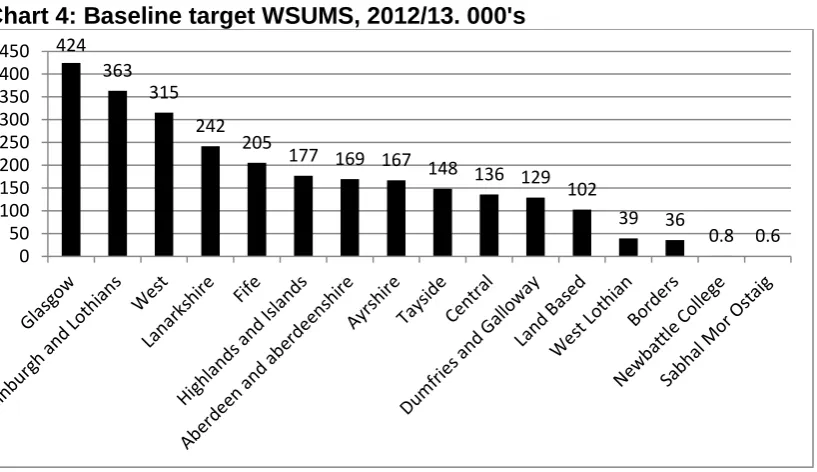
Chart 4 below shows the baseline target for WSUMs for the new college regions for 2012/13.
Chart 4: Baseline target WSUMS, 2012/13. 000's
Source: SFC, 2012e (SFC circular 09/2012). Certain regions will have increases due to the allocation of an extra £8m providing 2% of college places.
In 2013/14, colleges are being asked to provide 2m WSUMS with the balance provided by SDS (Russell, M. Letter 4th October 2012). (91.5% of the baseline).
424 363
315 242
205
177 169 167
148 136 129 102
39 36
0.8 0.6 0
14
SDS college places
In 2012/13, was asked to procure 4% of what had previously been funded by the SFC. The Scottish Government provided £13.1m for this. Places are commissioned by SDS from colleges and consist of „short employability‟ courses mainly for 16-19 year olds. These include 192 hours of learning in the classroom (employability) and 192 of work experience (vocational). Students will get a certificate of employability or „work-readiness.‟ The focus is on young people not in full time employment. The vast majority (74%) of places are for 16 to 19 year olds, 20% are for 20-24 year olds and 6% are for those aged 25 plus (Education and Culture Committee, 2012a). The exact focus of the SDS provided places in future years has yet to be determined (Scottish Government personal communication 12th October 2012).
If SDS were to secure 4% of provision, this suggests they might provide places equivalent to around 88,000 WSUMs (4% of the baseline WSUMs target of 2.19m). However, SDS do not use WSUMs. They have a delivery target of 5,800 new starts (Education and Culture Committee, 2012a) but they do not have a target for the amount of learning activity or number of full time equivalent places that this would represent (SDS, personal communication). This raises the issue of how the Scottish Government will ensure that the equivalent of 4% of the learning activity previously delivered via the SFC is secured.
In 2013/14 SDS will have £24m transferred to them from the SFC budget as part of a new „Employability Fund‟. As a consequence, the SFC are being asked to provide only 91.5% of the baseline WSUMs target of 2.19m. In order to maintain the same volume of learner activity, this leaves 8.5% to be provided outwith SFC funding. The Ministerial guidance letter of 4th October stated:
“I am arranging for £24m to be transferred from your (the SFC) FE funding line to SDS” […] “against this background your student number target for academic year 2013-14 will be 2,011,000 WSUMS. The remaining provision necessary to meet our commitment on student numbers will be secured through the Employment Fund. Your financial year budget for 2013-14 will therefore be £496.8m and for 2014-15 £461.6m”
It might therefore be expected that in 2013/14 SDS would secure college provision equivalent to 8.5% of the SFC baseline WSUMs target.
STUDENT AND STAFF NUMBERS
Although student numbers (measured as FTE) remained relatively steady up to 2010-11 (which is the latest published data), staff numbers (measured as headcount) reduced and have continued to reduce. Table 6 shows that the college sector lost 8% of its staff between 2011-12 and 2012-13. The Cabinet Secretary has noted that he is “encouraged” that compulsory redundancies have been avoided “in the vast majority of cases” (Russell, M. Letter 4th
15
Table 6: Changes in student and staff numbers since 2006/07
Students Staff
year students (FTE) % change staff (headcount) % change
2006-07 123,627 n/a 16,600 n/a 2007-08 125,158 1.2% 16,700 0.6% 2008-09 126,285 0.9% 16,900 1.2% 2009-10 127,943 1.3% 16,900 0.0% 2010-11 126,939 -0.8% 16,000 -5.3% 2011-12 n/a n/a 15,900 -0.6% 2012-13 n/a n/a 14,600 -8.2% Sources: student numbers from SFC inFact database, staff numbers for Scottish Public Sector employment statistics. Scottish Government 2012e. Note: not all college places attract public funding. Staff figures are for quarter 2 of the relevant year starting with quarter 2 of 2006.
STUDENT SUPPORT
While there has been pressure on funding for student places, the student support budget has been maintained over the last few years, largely due to announcements of extra funds after initial allocations were provided.
At stage 3 of the budget process in February 2011 an extra £15m was announced for student support. This provided an extra £5m to the 2010/11 academic year budget and an extra £10m to the 2011/12 academic year budget (SFC, 2011). Similarly, at stage 3 of the budget process in early 2012 an extra £11.4m was announced for student support. This was provided in two equal tranches in academic year 2012/13. The first £5.7m was simply added to the initial student support allocation of £84m, but the second tranche was reserved for the 2% of places that were being targeted at specific regions and also for places under the SDS college places scheme (SFC 2012d). This is summarised in the table below:
Table 7: Changes in student support, 2010/11 to 2012/13. Cash terms £m academic
year
initial
allocation additions final explanation of additions
2010/11 £78.9 £5.0 £83.9
part of an extra £15m announced during budget process, the balance going to 2011/12
2011/12 £84.2 £11.4 £95.6
£1.4m was part of an extra £8m, the balance going to student places, £10m was part of an extra £15m, the balance going to student support in 2010/11.
2012/13 £84.2
£11.4
£3.9 £99.5
Two tranches of £5.7m, one targeted at SDS scheme and the places provided by the extra £8m „brought forward‟ and targeted at certain regions. The other, distributed pro-rata to all colleges. An extra £3.9m for childcare for higher education college students.
16
In the draft budget 2013/14, the Cabinet Secretary announced an extra £17m for colleges, £11m for student support and £6m for places (Scottish Parliament, 2012a). It is yet to be seen how this will translate into academic year allocations from the SFC although the letter from the Cabinet Secretary to the Education and Culture Committee of 18th October 2012 states that the £6m will form part of a larger transfer of £24m to SDS relating to the Employability Fund.
17
[image:17.595.77.491.72.372.2] [image:17.595.71.492.403.683.2]ANNEX 1: FIGURES FOR CHARTS
Figures for chart 1: SFC FE draft budget
£m, cash % change on previous year
Resource Capital Total Resource Capital Total
1999-00 213 4 217 .. .. .. 2000-01 329 26 355 54% 550% 64% 2001-02 378 35 413 15% 35% 16% 2002-03 395 21 416 4% -40% 1% 2003-04 404 21 425 2% 0% 2% 2004-05 432 38 470 7% 81% 11% 2005-06 464 66 530 7% 74% 13% 2006-07 510 88 598 10% 33% 13% 2007-08 526 88 614 3% 0% 3% 2008-09 539 89 628 2% 1% 2% 2009-10 565 83 648 5% -7% 3% 2010-11 584 109 693 3% 31% 7% 2011-12 545 45 590 -7% -59% -15% 2012-13 507 28 535 -7% -38% -9% 2013-14 512 27 539 1% -4% 1% 2014-15 471 27 498 -8% 0% -8%
Real terms: SFC FE draft budget (£m, 2011-12 prices)
£m, 2011-12 prices % change on previous year
Resource Capital Total Resource Capital Total
1999-00 278 5 283 .. .. ..
2000-01 427 34 461 54% 546% 63%
2001-02 482 45 526 13% 32% 14%
2002-03 491 26 517 2% -41% -2%
2003-04 492 26 517 0% -2% 0%
2004-05 511 45 556 4% 76% 7%
2005-06 536 76 612 5% 70% 10%
2006-07 574 99 673 7% 30% 10%
2007-08 578 97 674 1% -2% 0%
2008-09 576 95 671 0% -2% 0%
2009-10 595 87 682 3% -8% 2%
2010-11 598 112 710 1% 28% 4%
2011-12 545 45 590 -9% -60% -17%
2012-13 494 27 521 -9% -39% -12%
2013-14 486 26 512 -1% -6% -2%
2014-15 437 25 462 -10% -2% -10%
18
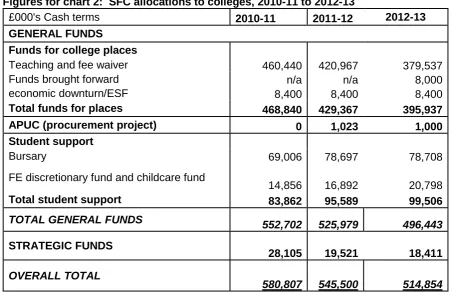
Figures for chart 2: SFC allocations to colleges, 2010-11 to 2012-13
£000's Cash terms 2010-11 2011-12 2012-13 GENERAL FUNDS
Funds for college places
Teaching and fee waiver 460,440 420,967 379,537 Funds brought forward n/a n/a 8,000 economic downturn/ESF 8,400 8,400 8,400
Total funds for places 468,840 429,367 395,937
APUC (procurement project) 0 1,023 1,000
Student support
Bursary 69,006 78,697 78,708
FE discretionary fund and childcare fund
14,856 16,892 20,798
Total student support 83,862 95,589 99,506
TOTAL GENERAL FUNDS 552,702 525,979 496,443
STRATEGIC FUNDS
28,105 19,521 18,411
OVERALL TOTAL
580,807 545,500 514,854
Notes: Figures do not include capital or the College Transformation Fund and are based on
figures in SFC main grant circulars. Figures are adjusted slightly during the year. The £8.4m in each year and the £8m „brought forward‟ funds have been placed within „funds for places‟ as they fund college places. The APUC line has been separated as it doesn‟t fund college places (Advanced Procurement for Universities and Colleges). However, the presentation in the SFC circulars is slightly different. Total student support for 2012/13 includes extra £11.4m allocated during the year and higher education childcare which was provided previously by the Student Awards Agency Scotland (SAAS).
19
ANNEX 2 : COLLEGE FUNDING BY REGION
Regions Colleges Teaching grant 2012/13
Aberdeen & Aberdeenshire Aberdeen £22,875,569
Banff and Buchan £6,870,918
Ayrshire Ayr £8,849,455
James Watt (Kilwinning) £9,808,261
Kilmarnock £8,878,596
Borders Borders £6,232,961
Central Forth Valley £17,971,134
Dumfries and Galloway Dumfries and Galloway £7,364,668
Edinburgh and Lothians Telford £18,696,799
Jewek & Esk £10,415,114
Stevenson £14,216,918
Fife Adam Smith £20,037,000
Carnegie £8,890,651
Elmwood (non-land based) £2,271,203
Glasgow Anniesland £7,999,863
Cardonald £11,830,939
Glasgow £27,480,001
John Wheatley £6,471,073
Langside £8,644,757
North Glasgow £7,538,318
Stow £6,699,884
Highlands and Islands Inverness £7,074,154
Lews Castle £2,161,858
Moray £4,804,481
Perth £5,897,379
North Highland £7,111,207
Orkney £1,259,874
Shetland £1,475,580
Lanarkshire Coatbridge £6,675,630
Cumbernauld £5,691,660
Motherwell £14,339,888
South Lanarkshire £6,042,496
Land Based Barony £1,985,127
Elmwood (land based) £2,821,180
Oatridge £2,427,728
Tayside Angus £6,954,842
Dundee £16,959,337
West Clydebank £9,457,617
James Watt (Inverclyde) £15,149,146
Reid Kerr £13,017,143
West Lothian West Lothian £7,102,465
Newbattle College £474,746
20
SOURCES
Audit Scotland. (2012) Scotland’s Colleges: current finances, future challengers. Edinburgh: Audit Scotland.
Griggs, R. (2012) Report of the review of further education governance in Scotland
Edinburgh: Scottish Government. Available at:
http://www.scotland.gov.uk/Topics/Education/UniversitiesColleges/17135/CollegeGovernanc eReview/FEGovernanceReport
Mullen, F. (2012) Youth Unemployment: Policy. SPICe Briefing 12-20. Edinburgh: Scottish Parliament. Available at:
http://www.scottish.parliament.uk/parliamentarybusiness/49310.aspx
Russell, M. (2010) Letter from Michael Russell, Cabinet Secretary for Education and Lifelong Learning to Scottish Funding Council. Letter dated 17 November 2010. Edinburgh: Scottish Funding Council. Available at:
http://www.sfc.ac.uk/web/FILES/About_the_Council/Scottish_Government_Guidance_Letter _17_11_2010.pdf
Russell, M. (2011) Letter from Michael Russell, Cabinet Secretary for Education and Lifelong Learning to Scottish Funding Council. Letter dated 21 September 2011. Edinburgh:
Scottish Funding Council. Available at:
http://www.sfc.ac.uk/about_the_council/lettersofguidance/letterofguidance.aspx
Russell, M. (2012a) Letter from Michael Russell, Cabinet Secretary for Education and Lifelong Learning to Scottish Funding Council. Letter dated 25 January 2012. Edinburgh: Scottish Funding Council. Available at:
http://www.sfc.ac.uk/web/FILES/About_the_Council/Letter_from_Scottish_Government_with _additional_12-13_guidance_re_college_sector.pdf
Russell, M. (2012b) Letter from Michael Russell, Cabinet Secretary for Education and Lifelong Learning to Scottish Funding Council. Letter dated 04 October 2012. Edinburgh: Scottish Funding Council. Available at:
http://www.sfc.ac.uk/about_the_council/lettersofguidance/letterofguidance.aspx Russell, M. (2012c) Letter from Michael Russell, Cabinet Secretary for Education and Lifelong Learning to college principals. Letter dated 09 February 2012.
Scottish Funding Council. (2010a) Circular 14/2010. Main grants for 2010/11. Edinburgh: Scottish Funding Council. Available at:
http://www.sfc.ac.uk/news_events_circulars/Circulars/2010/SFC1410.aspx
Scottish Funding Council. (2010b) SFC Paper 10/86 provided to council meeting, 10 December 2010. Edinburgh: Scottish Funding Council. Available at:
http://www.sfc.ac.uk/about_the_council/council_board_committees/Councilpapersandmeetin gdates/2010/Councilmeeting10December2010.aspx
Scottish Funding Council. (2010c) Circular 35/2010. Indicative grants for 2011/12 Edinburgh: Scottish Funding Council. Available at:
http://www.sfc.ac.uk/news_events_circulars/Circulars/2010/SFC3510.aspx
Scottish Funding Council. (2011) Circular 09/2011. Main grants for 2011/12 Edinburgh: Scottish Funding Council. Available at:
http://www.sfc.ac.uk/news_events_circulars/Circulars/2011/SFC0911.aspx
Scottish Funding Council. (2012a) College performance indicators 2010-11. Edinburgh: Scottish Funding Council. Available at:
http://www.sfc.ac.uk/web/FILES/Statistics_FE_PIs/College_performance_indicators_2010-11_chart14updated_14.03.12.pdf
Scottish Funding Council. (2012b) Paper 12/87. Scottish Government draft budget 2013/14 Edinburgh: Scottish Funding Council. Available at:
21
Scottish Funding Council. (2012c) Circular 02/2012. Indicative college financial decisions for 2012/13. Edinburgh: Scottish Funding Council. Available at:
http://www.sfc.ac.uk/news_events_circulars/Circulars/2012/SFC0212.aspx
Scottish Funding Council. (2012d) Circular 15/2012. Final allocation of student support funding for AY 2012/13. Edinburgh: Scottish Funding Council. Available at:
http://www.sfc.ac.uk/news_events_circulars/Circulars/2012/SFC1512.aspx
Scottish Funding Council. (2012e) Circular 09/2012. Confirmation of student support funding for AY 2012/13. Edinburgh: Scottish Funding Council. Available at:
http://www.sfc.ac.uk/news_events_circulars/Circulars/2012/SFC0912.aspx Scottish Funding Council. Outcome Agreements. Available at:
http://www.sfc.ac.uk/collegeoutcomeagreements [Accessed 12 October 2012] Scottish Funding Council. In Fact Database. Available at:
http://www.sfc.ac.uk/statistics/further_education_statistics/infact_database/infact_database.a spx [Accessed September 2012].
Scottish Government (2011a) Putting learners at the centre. Edinburgh: Scottish
Government. Available at: http://www.scotland.gov.uk/Publications/2011/09/15103949/0
Scottish Government. (2011b) Scottish Government spending review 2011 and draft budget 2012-13. Edinburgh: Scottish Government. Available at:
http://www.scotland.gov.uk/Publications/2011/10/04153155/0
Scottish Government. (2011c) Budget 2011-12: Package of Measures. Edinburgh: Scottish Government. Available at:
http://www.scotland.gov.uk/Topics/Government/Finance/18127/budget2011-12
Scottish Government. (2012a) College numbers maintained for 2012/13. News release 10 September 2012. Edinburgh: Scottish Government. Available at:
http://www.scotland.gov.uk/News/Releases/2012/09/college-funding10092012 Scottish Government. (2012b) Scottish draft budget 2013/14. Edinburgh: Scottish Government. Available at: http://www.scotland.gov.uk/Publications/2012/09/7829 Scottish Government. (2012c) Scotland’s Budget Documents. Spring budget revisions
2011-12. Edinburgh: Scottish Government. Available at: http://www.scotland.gov.uk/Publications/2012/01/3837/0
Scottish Government. (2012d) Level 4 figures for draft Budget 2013/14. Edinburgh: Scottish Parliament. Available at:
http://www.scottish.parliament.uk/parliamentarybusiness/17534.aspx
Scottish Government. (2012e) Public sector employment in Scotland. Statistics for quarter 2, 2012. Edinburgh: Scottish Government. Available at:
http://www.scotland.gov.uk/Publications/2012/09/8779
Scottish Government. (2012f) Education Maintenance Allowance 2010-11. Edinburgh: Scottish Government. Available at:
http://www.scotland.gov.uk/Publications/2012/01/6891/downloads2
Scottish Government and Scottish Funding Council (2011) Proposals for implementing putting learners at the centre. Edinburgh: Scottish Funding Council. Available at:
http://www.sfc.ac.uk/news_events_circulars/Consultations/2011/Consultations_jointconsultat ion.aspx
Scottish Parliament. (2011) Official Report 9th February 2011. Edinburgh: Scottish Parliament. Available at:
http://www.scottish.parliament.uk/parliamentarybusiness/28862.aspx?r=7133&mode=pdf Scottish Parliament. (2012a) Official Report 20 September 2012. Edinburgh: Scottish Parliament. Available at:
22
Scottish Parliament. (2012b) Official Report 8th February 2012. Edinburgh: Scottish Parliament. Available at:
http://www.scottish.parliament.uk/parliamentarybusiness/28862.aspx?r=7164
Scottish Parliament Education and Culture Committee. (2012) Official Report 25th meeting 2012, Session 4, 2nd October 2012. Edinburgh: Scottish Parliament. Available at:
http://www.scottish.parliament.uk/parliamentarybusiness/28862.aspx?r=7400&mode=pdf Scottish Parliament Education and Culture Committee. (2012) Papers, 25th meeting 2012 (Session 4) 2 October 2012. EC/S4/12/25/1. Available at:
http://www.scottish.parliament.uk/S4_EducationandCultureCommittee/Meeting%20Papers/P apers_20121002.pdf
Amendments made 31st October
Table 4: 7 colleges in Highlands and Islands region funded by SFC not 5. Annex 1: cash terms % change 2012/13 to 2014/15 is +1% not -0.7%.
23
24
RELATED BRIEFINGS
SB11-55 Scotland's Colleges
SB12-20 Youth Unemployment: Policy
Scottish Parliament Information Centre (SPICe) Briefings are compiled for the benefit of the Members of the Parliament and their personal staff. Authors are available to discuss the contents of these papers with MSPs and their staff who should contact Camilla Kidner on extension 85376 or email [email protected]. Members of the public or external organisations may comment on this briefing by emailing us at
[email protected]. However, researchers are unable to enter into personal discussion in relation to SPICe Briefing Papers. If you have any general questions about the work of the Parliament you can email the Parliament‟s Public Information Service at
Every effort is made to ensure that the information contained in SPICe briefings is correct at the time of publication. Readers should be aware however that briefings are not necessarily updated or otherwise amended to reflect subsequent changes.