i
Water management in the
developing town: a complex
systems perspective
Magnus Moglia
A Thesis Submitted for the Degree of Doctor of
Philosophy at the Australian National University
ii
Declarations
This work contains no material which has been previously submitted for a Degree or Diploma in a University or other tertiary institution. It has concurrently been submitted on this day to the Australian National University. To the best of my knowledge and beliefs, this thesis contains no material previously published or written by any other person, except where due reference has been made in the text.
The word count of the body of this thesis is 96,720 including all tables and figures, which is in accordance with the Australian National University’s 100,000 word limit. Preliminary information, references and appendices are not included in this count.
Part of this thesis has been made publicly available in the form of journal articles and conference articles:
Moglia M, Cook S, Sharma A, Burn S (2010) Assessing decentralised water solutions: towards a framework for adaptive learning, Water Resources Management 25(1), pp. 217-238
Moglia M, Perez P, Burn S (2009) Modelling an Urban Water System on the Edge of Chaos, Environmental Modelling and Software 25(12), pp. 1528-1538
Moglia M, Burn S, Tjandraatmadja (2009) Vulnerability of Water Services in Pacific Island Countries: combining methodologies and judgment, Water Science and Technology 60(6), pp. 1621-1631.
Moglia M, Perez P, Pope S, Burn S (2009) Small Town Water Governance in Developing Countries: the Uncertainty Curse, MODSIM 09 Conference, Cairns, Australia, 13-17th July 2009.
iii Moglia M, Perez P, Burn S (2008b) Urbanization and Water Development in the Pacific Islands,
Development 51(1), pp. 49-55.
Moglia M, Perez P (2007) Participatory assessment of water developments in an atoll town, in Adaptive and Integrated Water Management: Coping with Complexity and Uncertainty, eds. C. Pahl-Wostl and J. Möltgen, pp. 381-403, Springer Verlag, Berlin.
Moglia M, Perez P and Burn S (2007) How complex is water service delivery in a small atoll town?, in ‘Pre-proceedings of the 1st International Workshop on Complexity and Organizational Resilience’, eds. R Kay and KA Richardson, pp. 105-128, ISCE Publishing, Mansfield, MA.
Moglia, M, Perez, P, Burn, S (2006) Strategic and Adaptive Small Town Water Management, Enviro 06, 9-11th May 2006, Melbourne: e6013.
Signed:
iv
Acknowledgments
A number of individuals have provided critical input into this study. I would specifically like to thank Ian White, Paul Jones, Marc Overmars, Marjorie Sullivan and Tony Falkland. Anne Dray deserves an extra mention for her help with Agent Based Modelling. Thank you also to staff and students at the Resource Management in Asia Pacific Program who have inspired me and helped me; in particular Rachel Lorenzen, Sarinda Singh and Mary Walta. Also thank you to Sandra Davenport for reading and commenting on thesis. Thank you to the helpful I-Kiribati in Tarawa, such as Teboia Metutera and Eita Metai, who made critical contributions during my field work. Taking a historical view, when I started as an experimental scientist at the CSIRO, I was encouraged to undertake PhD studies, and this is also when I was introduced into the world of Complex Systems Science. Bertil Marksjo was instrumental in this regard; as was David Batten who wrote that book Discovering Artificial Economics which opened up my eyes to this exciting field of research. I would also like to acknowledge George Grozev and Peter Newton for mentoring and encouragement, which then allowed me to move on towards PhD studies. A number of colleagues have provided critical discussion throughout my PhD studies and I would like to particularly mention the following: Andrew Rixon for his creativity, David Marlow for his grounded realism, Paul Davis for his scientific mindset, Stephen Cook for his critical thinking, and Grace Tjandraatmadja for her deep technical know-how and dedication. Along the journey there are also meetings with people who contributed via discussions, and I would like to particularly acknowledge some of these: Claudia Pahl-Wostl, Elinor Ostrom, Neil Powell, Scott Heckbert, Kim Alexander, Rebekah Brown, Beris Gwynne, Tim Baynes, Roger Bradbury, Anna Hurlimann, Nils Ferrand, Blair Nancarrow, Geoff Syme, Anna Taylor and Sukaina Bharwani.
Thank you to my family back in Sweden for your patience with me while being on the other side of the planet. I do miss you.
v
Abstract
vi
Table of Contents
Declarations ... ii
Acknowledgments ... iv
Abstract ... v
Table of Contents... vi
Table of Figures ...ix
Table of Tables ... xiv
Glossary of Terms ... xviii
Chapter 1: Introduction ... 1
1.1 The need for practical frameworks ... 1
1.2 Problem statement ... 4
1.3 Underlying assumptions ... 4
1.4 Thesis aim and objectives ... 5
1.5 Structure of thesis ... 6
Chapter 2: Context review ... 11
2.1 Challenges of urbanisation ... 12
2.2 Key dimensions of urbanisation ... 15
2.3 Perspectives on urban water ... 25
2.4 Frameworks for urban water management ... 37
2.5 Tarawa in the context of the South Pacific ... 42
2.6 Review summary ... 56
Chapter 3: Methods Review ... 57
vii
3.2 Going from qualitative data to computer models ... 67
3.3 Complexity modelling ... 74
3.4 Integration frameworks ... 90
3.5 Consideration of stakeholders ... 98
3.6 Review summary ... 105
Chapter 4: Methodology ... 107
4.1 Assumptions and requirements ... 108
4.2 Case study selection ... 115
4.3 Integration framework ... 119
4.4 Sequence of activities ... 126
4.5 Historical review ... 128
4.6 Interviews ... 129
4.7 Delphi survey ... 134
4.8 Agent Based Modelling ... 139
4.9 Bayesian Networks ... 145
Chapter 5: Review of case study site ... 153
5.1 Study area description ... 154
5.2 Case study historical review ... 168
5.2 Case study summary ... 186
Chapter 6: Information collection ... 187
6.1 Interviews and field observations ... 188
6.2 Delphi survey ... 212
viii
Chapter 7: Modelling ... 225
7.1 Agent Based Model ... 226
7.2 Bayesian Networks ... 280
7.3 Modelling chapter summary ... 307
Chapter 8: Discussion ... 309
8.1 Key themes ... 310
8.2 Implications of Complexity ... 321
8.3 Using models in the context of small town water governance... 327
8.4 Framework ... 331
8.5 Prerequisites ... 347
8.6 Discussion chapter summary ... 352
Chapter 9: Conclusions ... 353
9.1 Contributions to knowledge ... 354
9.2 Limitations of the research ... 361
9.3 Limitations of the framework ... 362
9.4 Recommendations for future research ... 363
9.5 Rapid improvements of the water system in Tarawa ... 367
ix
Table of Figures
Figure 1-1: Thesis structure ... 6
Figure 1-2: Street life in the case study location in Tarawa, Kiribati ... 8
Figure 2-1: Mapping of urban areas based on two key dimensions ... 17
Figure 2-2: Map of the South Pacific regions ... 46
Figure 2-3: Cross-section of a small coral island showing features of a freshwater lens ... 49
Figure 3-1: Second approach for eliciting and using qualitative data to develop models... 68
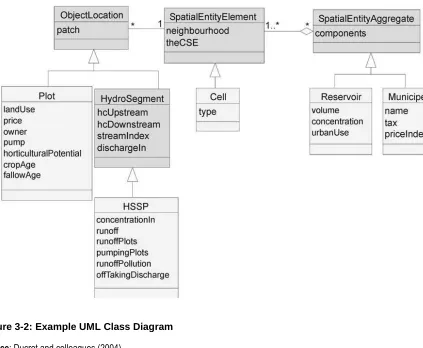
Figure 3-2: Example UML Class Diagram ... 83
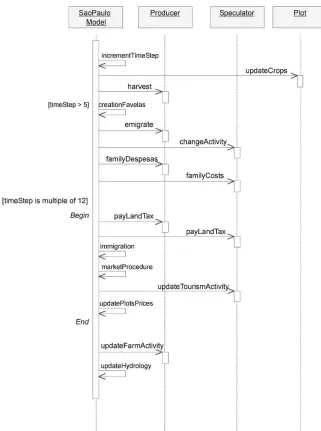
Figure 3-3: Example UML Sequence diagram ... 84
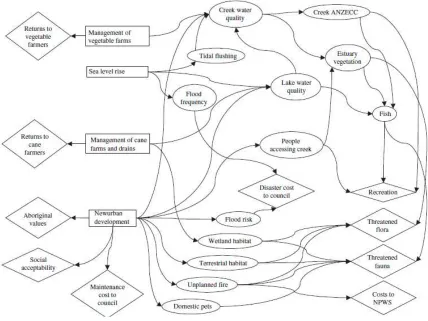
Figure 3-4: Example BN influence diagram ... 88
Figure 3-5: Typical cyclic framework in a ComMod application ... 96
Figure 3-6: Single- and double-loop learning cycles ... 101
Figure 4-1: Dialectic progression of thesis, contradiction and synthesis ... 112
Figure 4-2: Research process as iteration between reflection, field study and modelling ... 125
Figure 4-3: Study process and timelines ... 127
Figure 4-4: Historical context of study ... 128
Figure 4-5: Kiribati water sector organisational and responsibility diagram ... 133
Figure 4-6: Delphi dialogue process as it is applied in this study ... 136
x
Figure 4-8: General description of a typical Cormas ABM model structure ... 144
Figure 4-9: Illustration of how probes are displayed in the Cormas software ... 145
Figure 4-10: User Interface for an example BN Model in Sheba ... 152
Figure 5-1: Traditional Maneaba structure, a focal point in I-Kiribati culture ... 153
Figure 5-2: Map of Tarawa Atoll and the surrounding Central Pacific Ocean ... 157
Figure 5-3: Typical household buildings in South Tarawa ... 158
Figure 5-4: Organisational structure in Kiribati society ... 163
Figure 5-5: Spatial layout of infiltration galleries in Bonriki ... 171
Figure 5-6: Spatial layout of infiltration galleries in Buota ... 171
Figure 5-7: Impact of the 1998-2001 droughts on groundwater salinity ... 173
Figure 5-8: Framework for co-management of water reserves... 184
Figure 6-1: Shallow household well in South Tarawa... 195
Figure 6-2: Bonriki chlorination plant ... 196
Figure 6-3: Sand mining on water reserves in Bonriki ... 197
Figure 6-4: South Tarawa water facilities and distribution schematic diagram ... 203
Figure 6-5: Benefits of participatory design ... 209
Figure 6-6: Network view of inter-related factors ... 221
Figure 7-1: Waterscape UML class diagram ... 228
xi
Figure 7-3: Part of the user interface used to initiate the specifics of the freshwater lenses ... 233
Figure 7-4: User interface section to initiate the specifics of the leakage calculations ... 235
Figure 7-5: User interface section to initiate the specifics of the rain tank population ... 236
Figure 7-6: Water sources and water uses ... 237
Figure 7-7: UML sequence diagram for a customer's use of drinking water ... 240
Figure 7-8: UML sequence diagram for calls related to charging for water ... 248
Figure 7-9: Map of the spatial representation, showing islands, ocean and the lagoon ... 249
Figure 7-10: Map of location of the properties on reserves stretching across the islands ... 250
Figure 7-11: Map of the spatial representation; vegetation on islands ... 251
Figure 7-12: User interface as a pop-up window before the model runs ... 252
Figure 7-13: Cell growth frequency versus Health Hazard ... 268
Figure 7-14: Customer health trigger versus Health Hazard ... 268
Figure 7-15: Customer group illegal connections proportion versus Health Hazard ... 269
Figure 7-16: Bonriki sustainable extraction rate versus Health Hazard... 269
Figure 7-17: Sap flow versus Health Hazard ... 270
Figure 7-18: Land lease amount versus Health Hazard ... 270
Figure 7-19: Real estate price versus Health Hazard ... 270
Figure 7-20: Illegal connections leakage versus Health Hazard ... 271
xii
Figure 7-22: Pipe leakage versus Health Hazard ... 272
Figure 7-23: Population growth rate versus Health Hazard ... 273
Figure 7-24: PUB tanker delivery volumes versus Health Hazard ... 273
Figure 7-25: PUB tanker spillage versus Health Hazard ... 273
Figure 7-26: Capacity per tank versus Health Hazard ... 274
Figure 7-27: Proportion maintained versus Health Hazard ... 274
Figure 7-28: Proportion overhanging trees versus Health Hazard ... 275
Figure 7-29: Tariff structure charge versus Health Hazard ... 276
Figure 7-30: Water preference cooking volume versus Health Hazard ... 276
Figure 7-31: Water preference drinking volume versus Health Hazard ... 277
Figure 7-32: Factors considered to impact on the risk of the Reserves extension strategy ... 281
Figure 7-33: Factors considered to impact on the risk of the Desalination strategy ... 282
Figure 7-34: BN diagram showing factors influencing successful reserves extension ... 285
Figure 7-35: BN model of successful Reserves Extension implemented in Sheba ... 288
Figure 7-36: BN diagram showing factors influencing successful rainwater harvesting ... 295
Figure 7-37: BN model of successful Rainwater harvesting implemented in Sheba ... 300
Figure 7-38: BN diagram showing factors influencing successful desalination ... 303
Figure 7-39: BN model of successful Desalination harvesting implemented in Sheba ... 306
xiii
Figure 8-2: Suggested management structure for the Tarawa water system ... 333
Figure 8-3: New Framework process ... 336
Figure 8-4: Impact and risk assessments and how they feed into cost-benefit analysis ... 340
Figure 8-5: Dialectic progression of thesis, contradiction and synthesis ... 344
xiv
Table of Tables
Table 2-1: Observed and predicted levels of urbanisation in major global regions ... 13
Table 2-2: Distribution of world population in a range of urban size categories ... 17
Table 2-3: Population sizes of towns and cities mentioned in this chapter ... 19
Table 2-4: Health indicators and access to improved water and sanitation ... 22
Table 2-5: Major urban areas in the South Pacific region, and their populations ... 44
Table 2-6: Percentage of populations in urban settlements ... 47
Table 2-7: Main freshwater resources and uses in PICs ... 50
Table 2-8: Extent of poverty in PICs ... 54
Table 3-1: Cognition and quality in conceptual modelling ... 71
Table 3-2: Systems features of Complex and Adaptive Systems ... 75
Table 3-3: Evaluation results of six modelling approaches against five criteria ... 77
Table 3-4: Examples of applications of BNs in urban water contexts... 89
Table 3-5: Examples of BNs in general water related contexts ... 89
Table 4-1: Inductive theory building ... 113
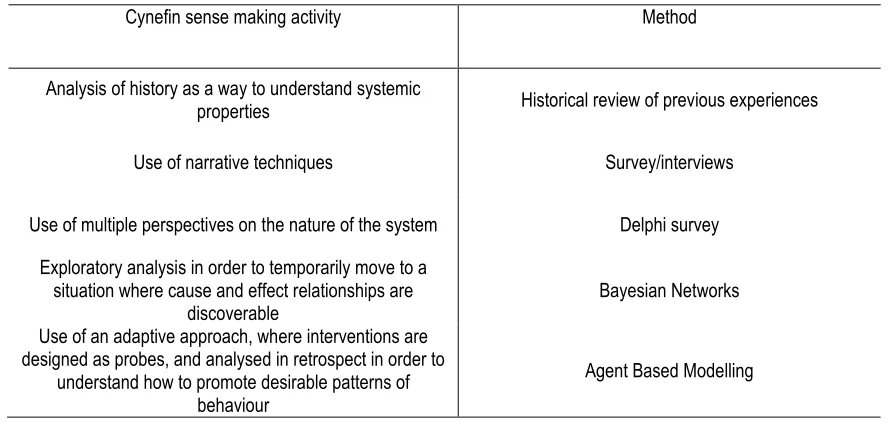
Table 4-2: Methodological guidance based on the Cynefin framework ... 122
Table 4-3: Stakeholder panels in the Delphi study ... 138
Table 4-4: Selected ABM integrated development environments ... 142
xv
Table 5-1: Kiribati estimated population, land area and population density ... 159
Table 6-1: Water supply technology options and their issues ... 190
Table 6-2: Community of Practice design requirements ... 212
Table 6-3: Selection of most important factors by each panel ... 216
Table 6-4: Selection of most important factors by each panel, translated into meta-categories .. 217
Table 6-5: Factors classified as Challenges, Constraints and Enablers ... 223
Table 7-1: Descriptions of classes in Tarawa Waterscape ... 229
Table 7-2: Categorisation of classes in the Waterscape Model ... 230
Table 7-3: Values on sustainable extraction rates for each freshwater lens ... 233
Table 7-4: Tariff structure parameters ... 253
Table 7-5: Vegetation parameters ... 254
Table 7-6: Population increase parameters ... 255
Table 7-7: Water use behavioural change parameters ... 255
Table 7-8: Leakage parameters ... 256
Table 7-9: Raintanks parameters... 257
Table 7-10: Freshwater lens parameters ... 258
Table 7-11: Land division parameters ... 259
Table 7-12: Water use volume parameters ... 260
xvi
Table 7-14: Water inflow and outflow parameters ... 262
Table 7-15. Water management options on Tarawa explored in the Waterscape model ... 264
Table 7-16. Description of variables used for exploring outcomes of scenarios ... 265
Table 7-17. Outcomes of each scenario and management option in the Waterscape model ... 266
Table 7-18: Parameters explored in sensitivity analysis... 267
Table 7-19: Descriptions of topic domains impacting on successful water reserves extension .. 284
Table 7-20: Data sources for ‘Reserves extensions’ – status quo scenario ... 289
Table 7-21: Data sources for ‘Reserves extensions’ – co-management scenario ... 290
Table 7-22: Results Status quo – reserves extension ... 290
Table 7-23: Results Co-management scenario – reserves extension ... 290
Table 7-24: Management options and their marginal chance of success ... 291
Table 7-25: Combinations of management options and their joint chances of success... 291
Table 7-26: Descriptions of topic domains impacting on successful water rainwater harvesting 294 Table 7-27: Data sources for ‘Rainwater harvesting’ in current situation ... 296
Table 7-28: Data sources for ‘Rainwater harvesting’ if better processes were applied... 298
Table 7-29: Results of current approach (rainwater harvesting) ... 299
Table 7-30: Results of adequate process and support for households (rainwater harvesting) ... 299
Table 7-31: Descriptions of topic domains impacting on successful desalination ... 301
xvii
Table 7-33: Data sources for ‘Desalination’ in best-case scenario ... 305
Table 7-34: Results of current approach (desalination) ... 307
Table 7-35: Results of best case scenario (desalination) ... 307
Table 8-1: Observations and Model based inferences relating to Boundary conditions ... 312
Table 8-2: Observations and Model based inferences relating to Technical issues ... 313
Table 8-3: Observations and Model based inferences relating to Socio-technical issues ... 314
Table 8-4: Observations and Model based inferences relating to Policy issues ... 316
xviii
Glossary of Terms
Adequate water services: As per the definition of improved water sources and improved
sanitation by the World Health Organisations’ Joint Monitoring Programme (WHO 2006) which is relatively vague but which usually requires water of sufficient quality and of sufficient quantity provided to within the household; typically via a tap, and with wastewater transported from the house via a pipe network and treated in a safe manner before disposal.
Complex Adaptive Systems (CAS): This term is used in this thesis for a special type of
‘system’, as described by Holland (1995); Batten (2000); Richardson (2002); Perez and Batten (2006); and Miller and Page (2007). These systems involve particular properties that make them adaptive and dynamic; and largely unpredictable. These properties are in particular: non-linear behaviour, feedbacks, path dependence and equifinality as well as self organisation and emergence. The analysis of these systems typically involves exploration of a large number of variables interacting in complicated manners, as well as breaking down populations into their individual components interacting with each other and other sub-systems; creating a distributed view of the system.
Deductive reasoning: This term is used in the thesis for a type of reasoning that is built on
formal logic and is appropriate in situations where the premises are sufficient grounds to infer whether an argument is true or false. As per Batten (2000), deduction is reasoning from the general to the particular. A perfectly logical deduction yields a conclusion that must be true provided that its premises are true. Thus deduction involves specifying a set of axioms and proving consequences that can be derived from those premises.
Inductive reasoning: In this thesis, inductive reasoning is a type of reasoning which relies on
xix
Level of development: The level of development, as used in this thesis, is related to economic
development and the workings of key institutions, and is here used in the same sense as is done in the development of the Human Development Index by the United Nations Development Program (UNDP 2006).
System: The word ‘system’ is used in this thesis as within the discipline of Systems
Engineering as described by Haimes (1998); and which holistically incorporates not only technical machinery but also people, processes, natural systems and economic factors; or in fact any factors that are important for the outcome.
Small towns: This term, in this thesis, refers to urban settlements that are in the population
range of 2,000-50,000 people, as defined by Pilgrim et al. (2004), and that often lack resources such as finances and educated staff. It is recognised that the provision of water services and urban water management in this context is particularly challenging.
Social complexity: Refers in this thesis to viewing social systems as Complex and Adaptive
Systems; and focussing on these particular features of social interactions. It thus concerns aspects such as distributed systems, non-linear feedback loops and conflicting goals; overall leading to a messy and dynamic as well as relatively unpredictable situation. Behavioural aspects and cognitive processes are key drivers in socially complex situations. A key journal in this area is the Journal of Artificial Societies and Social Simulation (JASSS) and applications of social complexity modelling tend to focus on policy.
Stakeholder: This term in this thesis refers to those people, or groups of people, or institutions,
or organisations that have a stake in a particular decision, or in a particular operation, or who have some influence over, or who may block, the decision making process (Nandalal and Simonovic 2003).
Tactical: The term tactical is used in this thesis in the sense of a focus on strategies to achieve
1
Chapter 1: Introduction
Provision of water services is a critical strategy for addressing worldwide poverty, which is one of the most pressing challenges today and is directly linked to issues such as population growth and indirectly to climate change.
Unfortunately progress has been slow in achieving even the Millennium Development Goals aimed at improving coverage of adequate water services and professionals are struggling to cope with the diversity and scale of situations. This is particularly true in the context of small developing towns.
This thesis addresses the problems of towns in Pacific Island Countries and the aim is to provide a causal explanation of difficulties in these locations with the subsequent aim to formulate managers and policy-makers with recommendations that recognize local constraints and opportunities to best practice management which aim to promote participation, encourage flexible realizations and rely upon financial prudence.
1.1 The need for practical frameworks
With the rapid urbanisation of the world and the slow progress towards achieving the Millennium Development Goals regarding adequate water services (see Appendix 1); there is an urgent need to devise effective and adaptive strategies to narrow the gap between adequately serviced and less favoured communities.
2
Guidelines for water services provision
Major international agencies such as the United Nations, the World Bank and the Asian Development Bank, have edicted a consistent range of guidelines concerning the provision of water services in developing nations. As an example, the United Nations, in their report ‘Water: a Shared Responsibility’ (United Nations 2006a) have recognised that to achieve better water service provision, there is a need to design holistic and comprehensive solutions aiming at improving water governance by encouraging the active participation of all components of the civil society. Unfortunately, this laudable aspiration is often difficult to convert into practice.
Water services provision in practice
Water services provision is a context-dependent process. While available and suitable solutions in rural areas are often limited when compared with those in urban areas, developing countries face the same limitations in comparison with developed nations. In many ways, water governance in rural areas is easier because the number of people involved in operation and management is smaller, and systems are often relatively easier to comprehend.
At this scale, participatory governance is often applied, involving users and relevant components of the civil society. This is often combined with relatively simple and inexpensive technologies suitable for local conditions. At larger urban scales, engineers create technological systems, typically based on large water storages, treatment plants and reticulated networks. Customers receive water services for a fee. These systems are relatively predictable and easy to control as human influences are purposefully limited by regulatory and economic frameworks.
The challenge of water services provision in small towns
3 In terms of demography, small towns represent a significant proportion of the world’s population. By 2015 it is projected that approximately 24 percent of the world’s population will live in urban areas that have a population of less than 500,000 (United Nations 2002). Furthermore, for every large town in the population range of 50,000 to 200,000 people there are ten smaller ones in the population range of 2,000 to 50,000 people (Pilgrim et al. 2004). Exact data is not available, but these numbers indicate that as much as 10-15% of the world’s population live in smaller towns.
Politically towns tend to lack the influence of larger cities and in many instances, that of smaller rural communities. The plights of small towns often lack priority. From an infrastructure and financial point of view, there is often a lack in the economy of scale that is required to support centralised technological systems. This often means an increase the operational complexity:
These towns face special challenges in the provision of their water and sanitation services. The demand for differentiated technologies – piped water supply in the core, alternative technologies in the fringe areas – and the often rapid, unpredictable water demand and spatial growth requires planning, design and management skills that exceed “rural” community-based management approaches. But, unlike larger towns or cities, these smaller towns lack the financial and human resources to independently plan, finance, manage and operate their water and sanitation systems (Pilgrim et al. 2004: iii).
4 would involve processes and tools for local water managers that will need to acknowledge a high level of system complexity and constraints such as limited funding and human resources.
1.2 Problem statement
As is commonly accepted, current provision of water and sanitation services in small towns in developing countries is fraught with difficulties; and implementing best practice guidelines is challenging. To be able to devise solutions to these problems, this thesis aims to find description and causal explanations of the complex dynamics and difficulties of water services provision in those locations. Subsequently, this thesis addresses the challenge of developing a practical framework incorporate best-practice management for the provision of water services in the case study. This framework aims to provide local managers and policy-makers with concepts and ideas for how to re-structure planning and decision making processes. Finally, whilst not an aim of the study per se, the hope is that the analysis tools that are developed may help local stakeholders to incorporate systems thinking, uncertainty as well as constraints and opportunities into best practice management.
1.3 Underlying assumptions
The first assumption is that complex systems models, such as Agent Based Modelling and Bayesian Networks modelling can provide adequate description and at least partial causal explanations of the context. This is backed up by the current discussion on the epistemic value of simulation and probabilistic logic (Gruene-Yanoff 2010; Pearl 1999)
5 A second assumption of this study is that water management in general, and small town water management specifically can effectively be viewed as Complex Adaptive Systems. Following Pahl-Wostl (2002a), it is considered that water management incorporates indeed complex interactions between social, technical and natural systems. Furthermore, it is intended to use sense-making concepts developed by Kurtz and Snowden (2003) for complex and uncertain contexts.
Methodologically, a third assumption of this study is that by generating an understanding via case study, it will be possible to synthesise a range of information in order to allow the formulation of frameworks that will help improve local water managers and administrators in their professional roles for the wider context of small towns. This is in line with the ideas of Flyvbjerg (2006) regarding the usefulness of case study research.
1.4 Thesis aim and objectives
In order to reach the goals of the thesis, this study includes six different stages:
1. To critically explore and describe the context of small town water management at a single case study location.
2. To explore the wider context, the current best practice, as well as a cross cutting analysis of urban water management in Pacific Island Countries via knowledge elicitation of a wider group of professionals with relevant expertise.
3. To develop systems representations of the single case study location that will help improve the understanding and causal explanations of the complex dynamics of this context.
4. To use causal explanations and to develop suitable tools that will likely be able to help support recommendations for local water managers and administrators.
6 6. As a key recommendation, to develop a preliminary framework for improved small town water management in the case study location that takes into account limitations and constraints, but which at the same time considers best-practice, and acknowledges the full complexity of the task.
1.5 Structure of thesis
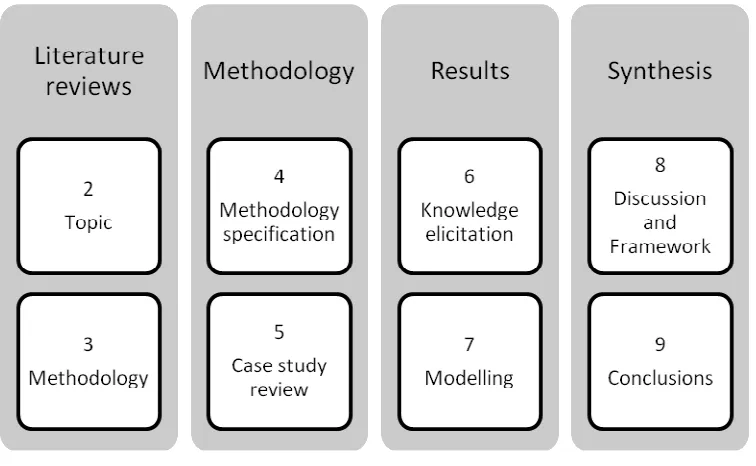
[image:26.595.57.435.388.621.2]The structure of this thesis develops as follows: 1) Literature reviews, 2) Methodology 3) Results, and 4) Synthesis, as per Figure 1-1. The linear structure is an after construction and is not a fully accurate representation of the research process. In reality, the research process has tended to be iterative and circular. The sections of the thesis are described in the following sections.
Figure 1-1: Thesis structure
1.5.1 Part 1: Literature reviews
7 (chapter 3) describes the methodological thinking that needs to be considered and the methodological tools that appear to be suitable.
In chapter 2, the scope and challenges of urbanisation are laid out. This includes a mapping of the diversity of urban situations based on population size and level of economic development. Secondly, chapter 2 also provides a description of three perspectives on urban water governance, i.e. economic, environmental and social. These perspectives provide dynamically inter-linked viewpoints. Thirdly, chapter 2 also provides a description of frameworks for urban water management. These frameworks include sustainability principles, good governance, regulation as well as public participation and institutional decentralisation. Fourthly, chapter 2 describes specific issues of small towns in Pacific Island nations. This includes considerations relating to Small Island Developing States (SIDS); and in particular economic limitations, cultural complexity, historical background and institutional concerns.
In chapter 3, tools are identified that can generate a better understanding of the studied systems. Specifically, there is a review of knowledge elicitation techniques as well as systems analysis approaches from the complex systems science area. To support the formulation of a management framework, concepts such as social learning, post-normal science and participatory integration frameworks are also described. In this chapter, the need for participation and modelling within an integrated framework is identified. Unfortunately, none of the reviewed integrated framework approaches are perfectly suitable for this particular study.
1.5.2 Part 2: Methodology
The methodology section is divided into two sections. The first section (chapter 4) defines the methodology. The second section (chapter 5) describes the case study context via a historical review as well as an assessment of the current state.
8 information was collected via case study based interviews and cross-cutting Delphi survey. The chapter also include specifications of the modelling; using Agent Based Modelling and Bayesian Networks approaches.
Figure 1-2: Street life in the case study location in Tarawa, Kiribati
Notes: Photography by Anne Dray.
Chapter 5 provides a description of the case study location from a number of perspectives such as geography, language, demography, distant history, culture and customs, environment and a number of challenges with aid and development. Chapter 5 also describes the more recent experiences in urban water management at the case study location, finding that there were a number of recent failures in addressing their raft of problems.
1.5.3 Part 3: Results
9 Bayesian Network models that have been developed, and used to develop causal explanations. There is also some discussion about the inferences that can be made from these models.
Chapter 6 provides a description of the results from the interviews. Interviewing is a technique that is not bound by traditional scientific constraints, but will allow for gaining a more integrated, and rich understanding of issues and factors. The understanding based on the interviews is based primarily on induction, i.e. pattern recognition. These results are hence a personal perception and interpretation of the situation in the Tarawa water supply system. However, whilst subjective the results are, to the extent possible, sense-checked by local stakeholders and experts. These results are to some extent also based on more objective observations and elicited mental models.
Chapter 6 also describes the results from the Delphi survey. The cross-cutting survey formally collected perspectives and narratives of diverse stakeholders and experienced individuals in the wider Pacific Islands region. This allows for the making of wider generalisations. The understandings based on the Delphi survey are the outcome of a designed convergent process where the multiple perspectives of a range of participants are collated, socially evaluated, narrowed down and prioritised.
Chapter 7 provides a description of the results of the ABM. The ABM allows for systems analysis whereby probes can be designed and explored using scenario analysis. The impacts of these probes and scenarios are evaluated from a number of perspectives. The ABM helps to provide an understanding of how to promote desirable patterns of behaviour in the system.
10 1.5.4 Part 4: Synthesis and framework
In the final section, results are integrated into a non-contradictory whole. This takes the shape of theory and management framework. There is also an attempt to identify the domain and boundary conditions for this framework.
Chapter 8 provides discussion of the results of the study. The results are formally presented on the basis of themes identified in the Delphi survey. These themes are: Socio-technical issues, Boundary conditions, Policy issues and Technical issues. Each theme is discussed by exploring the results in categories of observations and model inferences. Here it is acknowledged that model inferences are context-dependent, and it is also not possible to capture the full complex and adaptive reality. Chapter 8 also describes a theory for what contributes to system complexity in these contexts. This leads on to a discussion about the implications for management strategies; in terms of potential complexity reduction, and complexity management.
Chapter 8 also describes a definition of an operational and practical management framework that is suitable to the context in Tarawa. This framework is based on a multi-scale approach which includes an operational, a tactical and a strategic level; and which includes adaptive learning cycles. The framework has been formulated on the basis of the realisation of a number of deficiencies in both the interactions between the management scales, as well as deficiencies in the tactical and adaptive capacity. It is argued that by strengthening the adaptive learning cycle, this framework can turn weakness into strength, and hence provide a manageable situation.
11
Chapter 2: Context review
In this chapter, the context of urban water management is reviewed; in particular for small towns. Urban water management is viewed from a number of perspectives, and some key frameworks for urban water management are described. Furthermore this chapter also provides some of the background justification as to why small town water issues are critical in the big picture of poverty reduction and for achieving the Millennium Development Goals.
As the world population continues to grow, more and more people are populating an ever increasing number of towns and cities. When people arrive in cities and towns, there is a reasonable expectation that there should be adequate household water and sanitation provision. Unfortunately, as anyone who has travelled to countries such as India or Cambodia knows, that expectation is far from being fulfilled. For example, the World Health Organisation (2006) reports that in the South East Asian region, 94 percent of urban households have access to improved water services, but only 65 percent of urban households have access to improved sanitation services, and considerable variation in access to such services exists within the region. With this in mind, the scope of this literature review is on urban water governance and management.
12
2.1 Challenges of urbanisation
Managing the impacts of increasing urbanisation was recognised as one of the key concerns internationally over 20 years ago by the United Nations’ World Commission on Environment and Development, and articulated by the former Norwegian prime minister Gro Harlem Brundtland:
The future will be predominantly urban and the most immediate environmental concerns of most people will be urban ones (World Commission on Environment and Development 1987: 255).
Since Brundtland’s statements, there has been an escalation in urbanisation rates, particularly in the developing regions of the world; and in 2007 for the first time, more than half of the world’s population lives in cities; and this is seen as a threat to public health because the pace of urbanisation outstrips governments’ capacity to provide essential infrastructure (World Health Organisation 2010).
More than two thirds of the world’s population now live in Africa, Asia and Latin America and in these regions the urban population has grown more than fivefold since 1950. At the time of writing, there are 19 mega-cities in the world with over ten million inhabitants, totalling 275 million people, and a further 348 urban centres with a population over a million (UN-HABITAT 2003). The majority of these ‘million cities’ are in Africa, Asia and Latin America (Satterthwaite 2000a). New York was the first city to reach a population size over ten million people, during the early 1940s. In 2003, only four of the world’s mega-cities were in the developed world (New York, Los Angeles, Tokyo and Osaka) while the remainder were in Africa, Asia or Latin America (UN-HABITAT 2003).
13
Table 2-1: Observed and predicted levels of urbanisation in major global regions
Region
Urban dwellers (%)
1950 1975 2000 2030
Oceania 61.6 72.2 74.1 77.3
Europe 52.4 67.3 73.4 80.5
Asia 17.4 24.7 37.5 54.1
Africa 14.7 25.2 37.2 52.9
Northern America 63.9 73.8 77.4 84.5
Source: United Nations 2002.
As highlighted by Chakrabarty, rapidly expanding populations compound the pressures of urban management issues such as: inadequate housing and urban services (water, sanitation, transport and so on); spiralling land prices and construction costs; proliferation of slums; and pollution and deterioration of the urban environment (2001: 331). Satterthwaite, focussing on less developed areas, however recognises a similar but slightly different set of interrelated deprivations for inhabitants of urban areas:
• Inadequate or unstable income (which translates into inadequate consumption);
• Inadequate, unstable or risky asset bases: including social, human, financial, physical (e.g. capital goods, equipment, housing) and natural (for instance access to productive land and freshwater);
• Limited or no right to make demands within the political or legal system – often within a framework which does not guarantees civil and political rights – for instance the right to have representative government, the right to organise and to make demands and to get a fair response, the right to protection against forced eviction); [and]
14 It is noted that the references to water in this document (Satterthwaite 2000b) relate specifically to the lack of adequate water supply for sections of the community, and more generally to inadequate service provisions available to communities. In addition, Satterthwaite stresses the fundamental importance of institutional management as environmental shortcomings typically result from inadequate economic and political response.
It may be misleading to refer to many of the most pressing urban environmental problems as ‘environmental’ since they arise not from some particular shortage of an environmental resource (land or freshwater) but from economic or political factors which prevent poorer groups from obtaining them or from organising to demand them. The very inadequate access to freshwater supplies that so many of the urban poor face is a serious environmental problem for them but rarely is its cause environmental; in most cities, it is not a shortage of freshwater resources but governments’ refusal to give a higher priority to water supply (and the competent organisational structure its supply, maintenance and expansion requires) (2000b: 19).
In the most temporary and least developed areas of cities, such as slums, a clear link has been established between poverty and inadequate water supply and poor sanitation provision (UN-HABITAT 2003). Linked to the nexus of issues of water, environment, poverty and slums, there is a global political recognition of urban water and sanitation issues as stipulated in the seventh United Nations Millennium Development Goal (MDG) (the MDGs are detailed in Appendix 1):
Goal 7: Ensure environmental sustainability
1. Integrate the principles of sustainable development into country policies and programmes; reverse loss of environmental resources.
15 3. Achieve significant improvement in the lives of at least 100 million slum dwellers, by 2020
(United Nations 2000).
Despite decades of awareness and agreement of the importance of action needed to ‘ensure environmental sustainability’, there has been very limited progress towards this particular goal to date. A recent United Nations report argues that despite considerable attention given to water developments, little has been achieved on the ground and notes the following shortcomings (adapted from United Nations 2006b: 44-45):
• Worldwide, 1.1 billion people still lack access to safe drinking water;
• Good governance is essential for managing our increasingly stretched supplies of freshwater, and indispensable for tackling poverty but unfortunately the commitment to good governance is often poor;
• There is no blueprint for good water governance… but it is known that it must include adequate institutions – nationally, regionally and locally – strong effective legal frameworks and sufficient human and financial resources;
• Local participation, transparency and solutions that are suitable in the context of diverse local circumstances are needed;
• Many governments recognise the need to localise management but fail to delegate adequate powers and resources to make it work.
Whilst these issues are not confined to urban contexts, it is clear that constraints to progress relate specifically to insufficient governance and inadequacy of institutions. This resonates with observations by Satterthwaite (2000b) and Chakrabarty (2001).
2.2 Key dimensions of urbanisation
16 constrained ability for utilising economy of scale (Pilgrim et al. 2004), and because a city and its production base may grow to exceed the capacity of freshwater sources to supply enough water on a sustainable basis (Satterthwaite 2000b). Secondly, the level of human and economic development, as indicated by for example the Gross Domestic Product (GDP) or the Human Development Index (HDI), in an urban area has an impact on the amount of available human and financial resources (Pilgrim et al. 2004).
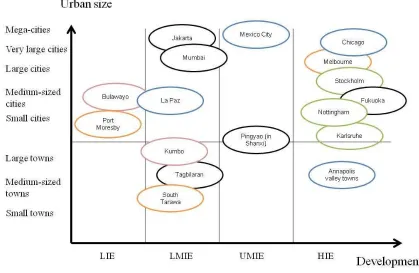
Some further factors that impact on the urban water sector are described in Appendix 2. In an effort to compare and contrast urban areas of relevance to this thesis, towns and cities from different regions have been mapped on the basis of size and development status (Figure 2-1). It is noted that there is some bias in Figure 2-1 towards the edges of the figure and no representations from certain categories, i.e. towns in the LIE category or in the UMIE category. The urban settlements in this diagram represent the locations referenced in articles used in this chapter.
2.2.1 Urban size
17
Figure 2-1: Mapping of urban areas based on two key dimensions
Notes: The ovals in Figure 2-1 represent urban areas mentioned in the references in the literature review, and the
colours represent the respective regions in which the urban area is located, i.e. black represents the Asian region;
blue represents the American region; green represents Europe; orange represents the Pacific region, and purple
represents the African region. The development, x-dimension, has four categories: Low income economies (LIE);
Lower-middle-income economies (LMIE); Upper-middle-income economies (UMIE) and High-income economies
(HIE) as per national categorisations by the World Bank (2008). For the y-dimension, the size based categorisation of
towns and cities is based on a World Bank sponsored report by Pilgrim et al. (2004). Population data has been
collected from a trusted web site (City Populations 2008).
18
Table 2-2: Distribution of world population in a range of urban size categories
Urban size bracket
% of total population
2000 2015 Category*
10 million or more 3.7 4.7 Mega city
5 million to 10 million 2.8 3.7 Very large city
1 million to 5 million 11.1 13.3 Large city
500,000 to 1 million 4.8 4.9 Medium-sized city
Fewer than 500,000 24.8 27.1
Small city (>200,000)
Large town (>50,000)
Medium-sized town
Small town (<20,000)
Rural areas 52.8 46.3 Village (<2,000)
Sources: This table shows the size brackets that have been developed by Pilgrim and colleagues (2004) and used
for the purposes of urban water management. The current and projected percentage of population in each urban size
bracket has been collected from a United Nations report (2002).
Considering the demographic importance of towns, it is apparent that improving the capacity for town water services provision is of critical importance in order to achieve the Millennium development goals as is argued also by the United Nations as a key step towards addressing worldwide poverty.
Inadequate provision for water and sanitation affects hundreds of millions of people in small urban centres and is a major constraint to the achievement of the Millennium Development Goals (UN-HABITAT 2006: 1).
It is noted that there are particular problems for (small, medium-sized and large) towns:
19 of knowledge about institutional arrangements and planning processes
appropriate to towns (Pilgrim et al. 2004: 6).
These problems are particularly severe for small and medium sized towns that are characterised by (adapted from Pilgrim et al. 2004):
• Lack of resources: skilled staff, finances, information and knowledge;
• Unpredictable population growth in population in individual towns;
• High levels of uncertainty in source availability and economic capacity; and
[image:39.595.113.459.343.765.2]• Close interactions between rural surroundings and urban areas.
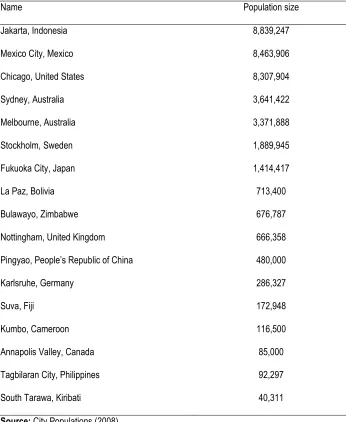
Table 2-3: Population sizes of towns and cities mentioned in this chapter
Name Population size
Jakarta, Indonesia 8,839,247
Mexico City, Mexico 8,463,906
Chicago, United States 8,307,904
Sydney, Australia 3,641,422
Melbourne, Australia 3,371,888
Stockholm, Sweden 1,889,945
Fukuoka City, Japan 1,414,417
La Paz, Bolivia 713,400
Bulawayo, Zimbabwe 676,787
Nottingham, United Kingdom 666,358
Pingyao, People’s Republic of China 480,000
Karlsruhe, Germany 286,327
Suva, Fiji 172,948
Kumbo, Cameroon 116,500
Annapolis Valley, Canada 85,000
Tagbilaran City, Philippines 92,297
South Tarawa, Kiribati 40,311
20 To improve the situation for towns, some argue that generating economies of scale through regional aggregation is the only feasible solution, but this is of course in opposition to the decentralisation argument – for which significant disagreement exists (E-Conference on Town Water Supply and Sanitation 2004). There is however agreement that a new framework is required, and as discussed at a conference on small towns in Addis Ababa in 2002, water professionals agreed on the following elements of success:
Financial and management autonomy, transparency and accountability, professional support, competition, legal framework and regulation, demand responsiveness, and incentives for expansion (Pilgrim et al. 2004: iii).
In this first part of the chapter, the main conclusion is that small towns do not currently have an appropriate management approach for water and sanitation provision, but that there are attempts to define such frameworks by international agencies such as the United Nations and the World Bank.
The reasons for why small town water services provision is particularly problematic is due to severely limited resources, mainly in terms of finances and staff skills, but also in terms of high levels of uncertainty which partly relates to the availability of freshwater resources; as well as issues such as rapid population growth, and a diverse demographic with complex interactions that can not be aggregated and simplified in the same way as is possible at a larger scale.
2.2.2 Level of development
In addition to the size of an urban area, the level of both human development, as well as economic development, defined as per UNDP (2010), are two factors that are strongly related with the capacity for providing adequate or universal water and sanitation services.
21 The reasoning for the economic link is clear because water supply and sanitation relies on investments in infrastructure and services, and lacking economic resources hence jeopardises the efficient maintenance of water infrastructure as well as the potential for investments in water development projects (Saleth and Dinar 2004). Conversely, access to water and sanitation is also vital to support economic development, protect eco-system services, or any initiatives to improve human development (UNDP 2006). This shows that there is a two-way relationship between water and sanitation services, and the level of human and economic development.
It is also noted that improvements in water supply, and sanitation services took many years in the developed world and were initially very costly (UNDP 2010). This may be explained if considering the transaction costs involved with the required institutional reform (Saleth and Dinar 2004) explained through the institutional transaction cost approach (North 1990). The time lag can also be explained from the point of view of the importance of the community’s ability and willingness to pay for water supply and sanitation (Pilgrim 2004). Water supply and sanitation services always need to be affordable and problems occur when institutional reform does not take this fact into account (Noll et al. 1998). This presents a dilemma in terms of infrastructure investments which may lock in a level of service for a longer period of time, and what is affordable at the time of investment may not be adequate towards the end of its lifetime.
Whilst little information is available on a city-by-city basis, this two-way relationship (between economic development and provision of water and sanitation) can be glimpsed in national data from the World Health Organisation (2006) displayed in Table 2-4. This data shows the common inadequacy of urban services in developing countries, as indicated by the less than 100 percent access for urban areas. Furthermore, the considerable difference in infant mortality rates between developing and developed nations serves as a proxy indicator for lack of services in combination with poverty and environmental problems.
22 equivalent rate for developed countries is low (average of 5). Human development categorisations could in fact be defined using thresholds on infant mortality rates without changing the human development categorisation. On the basis of Table 2-4 it is also possible to justify the inclusion of water and sanitation access in the concept of human development (for developing countries), as there is a strong but negative correlation rate, -0.64, between access to sanitation (column 5), and infant mortality rates (column 3). The equivalent correlation rate for access to improved water sources is -0.44. It is also noted that in the South Pacific region, Kiribati stands out as having the highest infant mortality rate and the lowest levels of water and sanitation access, and is also categorised by significantly lower levels of economic and human development than both Samoa and Fiji.
As already mentioned, human development as defined in the Human Development Report (2010) is linked with water supply and sanitation; and is also strongly linked with the level of economic development (World Bank 2008). It is noted that particular local constraints and contexts influence the vulnerability and capacity of nations for development, and the United Nations identify factors that impact considerably on the vulnerability of nations, and therefore also on cities, using the following set of categories to (United Nations Division for Sustainable Development 2007; United Nations 2008b):
• Least Developed Countries (LDC), if satisfying three criteria:
o Low income, as per three-year average estimate of the gross national income per capita (under $750 for cases of addition and, above $900 for cases of graduation);
o Weak human assets, as measured through a composite Human Assets Index; and
o Economic vulnerability, as Economic Vulnerability Index (UNCTAD 2008: 1)
• Land Locked Developed Countries (LLDC) that face the challenges of (UNCTAD 2008: 1): o Poor physical infrastructure;
23 o Small domestic markets;
o Remoteness from world markets; and
o High vulnerability to external shocks.
• Small Island Development States (SIDS) that are vulnerable due to (United Nations Division for Sustainable Development 2007; United Nations 2008b):
o Small size;
o Remoteness from large markets (a factor in high transport costs); and
o High economic vulnerability to economic/natural shocks beyond domestic control.
In the previous section, towns were identified as being problematic in terms of urban water management because of their smaller scale. In this section it has been found that a number of additional circumstances relating mainly to the level of economic and human development are also likely to impact on the capacity for effective urban water management.
A number of factors impact on the capacity for human and economic development, and United Nations (2008b) argue that Least Developed Countries, Land Locked Developed Countries and SIDS are particularly vulnerable.
24
Table 2-4: Health indicators and access to improved water and sanitation
Country Proportion of
population that is
urban (%)
Infant mortality rate
(per 1000 live
births)
Access to improved
water sources,
urban areas (%)
Access to improved
sanitation, urban
areas (%)
Selection of Developing nations
Cambodia 17.5 97 58 53
Pakistan 33.4 80 95 92
Laos 19.7 65 66 61
India 27.9 62 96 58
Nepal 12.2 59 96 68
Bangladesh 22.3 56 82 75
Kiribati 38.6 49 77 59
Fiji 50.2 16 na 99
Samoa 22.3 25 91 100
Selection of Developed nations
Australia 91.2 5 100 100
United States 77.4 6 100 100
United Kingdom 89.5 5 100 100
Sweden 83.3 4 100 100
Germany 87.7 4 100 100
Note: The countries in this table have been chosen on the basis of a combination of those that are shown in Figure
2-1, and those developing nations that have a relatively high infant mortality rate and poor access to improved
services; as well as selected representative countries in the Pacific region.
Sources: The proportion of the population that is urban (United Nations 2002); Infant mortality rate (World Health
Organisation 2006); Access to improved water and sanitation services in urban areas (World Health Organisation
25
2.3 Perspectives on urban water
Having identified the need for better urban water and sanitation services provision, and having subsequently explored issues surrounding how this provision relates to the size of the urban area as well as the level of development, the subsequent sections focus on a review of urban water governance and management. Urban water systems are often considered in terms of triple bottom line concepts (Hellström et al. 2000; Tjandraatmadja et al. 2005; Ashley et al. 2009; Sharma et al. 2009) involving primarily three different perspectives, i.e. the economic perspective, the environmental perspective and the social perspective. Depending on which perspective has the highest priority, the governance of water resources will be different.
Based on these opinions and statements it is clear that the three perspectives are in fact inter-related in a dynamic interplay where at least both the economic and social/institutional perspectives are partly justified on the basis of their capacity for facilitating change; while the environmental perspective is justified on the basis of avoiding unwanted change.
2.3.1 Economic perspective
26 potential to create geographically defined economies of water, with huge consequences for social outcomes. In urban settings, charging for water using tariffs at market based prices is often justified on the basis that charging water users for their use is a critical mechanism for providing the water utilities with funds to operate and manage the system (Jouravlev 2004). The self-financing principle has long been a guiding principle in the Caribbean and Latin America, in particular since the 1980s (Jouravlev 2004). Self-financing is also a common theme in the discussion around small town water management (Pilgrim et al. 2004) and the United Nations (2006b: 14) considers appropriate financing and incentives structures as contributing to a critical enabling environment for moving towards the more integrated water management approach that they promote. Self financing principles are often bundled with privatisation of water utilities, where water users are often referred to as customers; as exemplified by Noll and colleagues (1998). Historically in western countries, during most of the 20th century the cultural symbolism linking water and modernity, and the recognition of the essential importance, and socio-political nature, it was justified that water was managed in a collective public fashion (Bakker 2003). The move towards privatisation in England and Wales came towards the end of the 20th century on the basis of perceived ineffective public sector management (Bakker 2003). That attitude seems to have been adopted by key organisations such as the International Monetary Fund and the World Bank (Grusky 2001). During the current privatisation paradigm, best studied in England and Wales by Bakker (2003), productive efficiency has increased, labour levels have been reduced, planning is focussed on demand management, and efficiency is prioritised over social equity. As an illustration of the attitude, it is sometimes argued:
The [water] utility needs to have a strategy to provide water to all consumer groups with a service level that each can afford (social equity), while increasing the revenue base by providing as many house/commercial connections as possible (Pilgrim et al. 2004: 20).
27 higher that paid by users connected to the public utility. This is in conflict with the notion that access to adequate water is a human right (Jouravlev 2004). Based on the experiences in Bolivia, a number of lessons are listed (Jouravlev 2004: 39):
• There is a need to be flexible about the principle of complete cost-recovery in certain cases, especially in poor countries where the drinking water supply and sanitation sector requires public investment including subsidies;
• The sector’s regulatory framework should be strengthened in the interests of more efficient regulation. Otherwise, any weakness allows companies to impose conditions that eventually affect users;
• Social participation, public access to information and transparent management of services and of the resource itself are clearly fundamental;
• Conflict might have been avoided if the process had included more participation, dialogue and consultation between all those involved.
A difficulty with the concept of water as an economic good is that water is an unusual economic good with many different uses, and this is because it is renewable and fugitive, i.e. water flows in a cycle with little of the total water in storages (Batten 2007). It is also difficult to set up trading schemes or markets for water because the price to weight ratio typically means it is uneconomical, except in the case of bottled water (Batten 2007).
28 agricultural practice. This concept may better allow for incorporating issues such as food security, equity and ecology into water management.
2.3.2 Environmental perspective
The environmental perspective has arisen out of new demands on the urban water and wastewater sector from the community (Berndtsson and Jinno 2008). Such new demands concern increased recycling and reuse of all resources involved, as well as energy, to tackle real and potential resource deficiencies and to lower emissions. It also involves better management of the environmental quality, as well as additional benefits from the urban water system such as urban amenity and recreation (Berndtsson and Jinno 2008). Because of this challenge the urban water sector have responded with activity in redesign of systems and new technologies (Biggs et al. 2009; Gikas et al. 2009; Tjandraatmadja et al. 2009; Cook et al. 2009); new planning frameworks (Lundie et al. 2005; Sharma et al. 2008, 2009, 2010) and a change of mindsets and definitions (Marlow et al. 2010; van de Meene et al. 2009). It also involves considering current waste as a potential resources, for example stormwater can be considered a potentially valuable and typically overlooked domestic and industrial water resource (Niemczynowicz 1999).
Whilst urban water management has historically been mostly concerned with issues relating to public health and providing sufficient water volumes, modern communities demand more in terms of minimizing the impact on the environment. This introduces a new dimension into urban water management, which is here referred to as the ecological perspective. Falkenmark describes the ecological perspective as follows:
29 In other words, this perspective extends water governance to include non-human actors. It is often argued that ecological issues need to be taken into account within urban water management, typically on the basis that too much water is being taken out of the natural systems, and that too much polluted water is discharged (Terpstra 1999). Such ideas are typically framed in terms of sustainability, in a tradition that goes back to the Brundtland report in which ‘sustainability development’ was defined as:
Development that meets the needs of the present without compromising the ability of future generations to meet their own needs (World Commission on Environment and Development 1987: xx).
The importance of the environmental dimension in the water sector has been reinforced by the statement of the Millennium Development Goals (see Appendix 1). It also aligns with the work of practitioners such as Varis and Somlyody (1997). They argue that urban water management is strongly interconnected with, if not a component of, urban planning and environmental management; that is, it needs to consider both the socio-cultural context as well as the natural environment.
30 Another important environmental concern that relates to urban water management is the exploitation of groundwater. Many urban areas depend on groundwater as their water resource and subsequent pollution of this source impacts on the quantity and quality of the groundwater. This happens both as:
1. Groundwater quality or quantity is affected due to changes in land cover and due to non-point source pollution (Frumkin 2002); and
2. Groundwater is extracted, pumped and supplied via pipes to urban customers, such as to households (i.e. public good extraction), or by industrial or commercial operations (i.e. point source extraction).
Most cases in the literature describing the first type of groundwater issue relate to the developed world; as exemplified by the case of Annapolis Valley in the United States which includes six towns where industrial effluent and run-off from urban centres threaten groundwater supplies (Timmer et al. 2007). A similar situation has been shown in Nottingham, UK, where significantly elevated levels of nitrate in the groundwater were found to be related to wastewater and solid waste disposal (Wakidaa and Lerner 2004). A similar situation is described for Karlsruhe, Germany, as found by a pilot study of a groundwater monitoring network (Trauth and Xanthopoulos 1997).