Q
..
->·
-)C
1M
~
External dimension of the internal market and financial services
CHILE
Brussels, 30 May 1995
Ref: Nigg -jv\tcr\chile
XV-A-2
Rue de la Loi 200, B-1049 Brussels, Belgium - Office: C 107 8/43. .
Introduction
In 1993 GDP in Chile reached 17.6 trn CLP (ECUI 34 bn). Economic growth averaged
6% in 1993. Chile has a population of 13.8 mn. This represented a GDP per capita of
1.2 mn CLP (2,500 ECU). .
Overview
Chile has emerged from the post-1985 programme adopted by the government with a
healthier financial services market and a solid financial system. The majority of Cl.rile's 14 domestic banks, however, including the two biggest, Banco de Chile and Banco de Santiago, are still indebted to the Central Bank, following the rescue package adopted by
the government in the 1983 crisis. As part of the package, the Central Bank assumed the
banks' non-performing loans. In exchange, debtor banks must now transfer 70% of their
after-tax profits to pay off their subordinated debt.
Chile's banks are regulated by the Superintendency of Banks and Financial Institutions which reports to the Ministry of Finance. Chile enjoys the highest savings rate in the region as well as one of the most sophisticated domestic financial markets in the region. Regulatory measures introduced since 1985 prohibit banks from engaging directly in pension and insurance business and from undertaking factoring and securitisation activities.
Notwithstanding current restrictions on their activities, banks posted net profits, after payment of subordinated debt obligations, of 20.6 % or 241.1 bn CLP ( 469 mn ECU). Measures adopted in 1994 allowed banks to provide Joans up to 10% of bank capital to a single borrower, effectively doubling the pre-existing limit of 5%. Total banking system assets in· 1993 amounted to 18,594 bn CLP (39.3 bn ECU).
Foreign banks in Chile
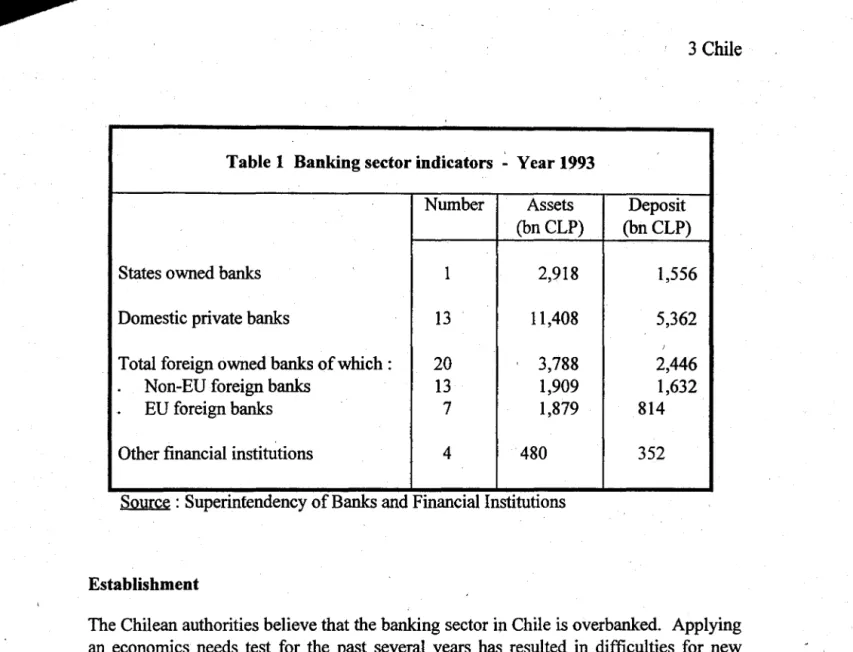
The Chilean banking sector consists of 38 banks and 4 finance companies. Of the 38 total banks operating in. Chile, only one is state-owned the Banco del Estado and 20 are
foreign-owned or controlled. Of these, 7. are EU owned or controlled. The four
financieras (finance companies) in Chile handle letters of· exchange and small promissory notes·. They also guarantee commercial paper and act as intermediaries for the issuance of promissory notes. Private banks concentrate on corporate business. EU-foreign banks in Chile account for 9.5% of deposits and 10.1 % of assets. Foreign assets accounted for 20.4% of total.
'Exchange rates : .
Table 1 Banking sector indicators ~ Year 1993
Number Assets Deposit
(bn CLP) (bnCLP)
States owned banks I 2,918 1,556
Domestic private banks 13 11,408 5,362
!
Total foreign owned banks of which: 20 3,788 2,446
Non-EU foreign banks 13 1,909 1,632
.
EU foreign banks 7 1,879 814Other financial institutions 4 480 352
Source: Superintendency of Banks and Financial Institutions
Establishment
The Chilean authorities believe that the banking sector in Chile is overbanked. Applying
an economics needs test for the past several years has resulted in difficulties for new banks to become established, whether domestic or foreign. Reforms are cun:ently being implemented in the banking sector in Chile to provide for the introduction of new authorised activities and for the adoption of the standards of the Basle convention.
As result of 1994 amendments to the banking law in Chile, equal treatment is guaranteed for foreign banks and direct branching of foreign banks is allowed. Authorisation is required to acquire I 0% or more of an existing bank, both for Chileans and foreigners.
Chile's financial services market is currently segregated. Banks must create subsidiaries to offer financial services that are forbidden to banks directly, such as securities brokerage, pension fund management, factoring and leasing transactions. Chile does not allow commercial presence in the form of representative offices. A one-year period is imposed for repatriation of the capital of foreign subsidiaries.
Activity
Foreign banks enjoy access to the same range of authorised activities as domestic banks. In the context of the exchange rate regime, Chile operates a formal and an informal market. Foreigners may only operate through the formal market and do not have access to the economically important informal money market. Beginning in 1992, banks were allowed to trade currency futures and options as well as foreign currency interest rate futures and options. No restrictions are placed on the interest rates which banks may charge.
[image:3.597.44.569.14.440.2]INSURANCE
In 1981 Chile reformed its social security system by introducing a compulsory savings
scheme. The savings are managed by private companies, Administradoras de Fondos
de Pensiones (AFPs). The AFPs control more than 6 trn CLP (12 bn ECU) ($ 15 bn) which is equivalent to one-third of the national GDP. By the year 2000, the percentage is expected to rise to 80% of GDP and the amount to double. AFPs are therefore the largest institutional investors in Chile.
Under new legislation, AFPs are permitted to diversify their equity portfolios and invest
in instruments such as securities bonds as well as the 300 or so listed companies which
fulfil certain criteria. Mortgage-backed bonds, convertible bonds and revenue bonds are authorised investment In terms of outward investment, AFPs are allowed to invest up to 10% of their portfolios in shares, corporate bonds and gilt-edged securities abroad.
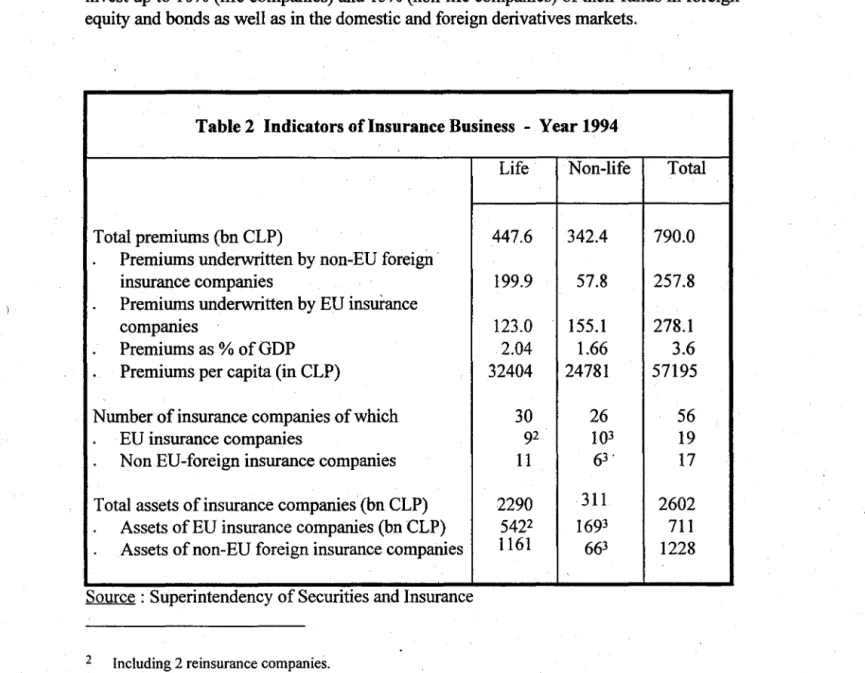
Insurance companies, with about 2.3 trn CLP of funds to invest in 1994, are allowed to invest up to 10% (life companies) and 15% (non-life companies) of their funds in foreign equity and bonds as well as in the domestic and foreign derivatives markets.
Table 2 Indicators of Insurance Business - Year 1994
Total premiums (bn CLP)
Premiums underwritten by non-EU foreign· insurance companies
Premiums underwritten by EU insurance companies
Premiums as % of GDP Premiums per capita (in CLP)
Number of insurance companies of which EU insurance companies
Non EU-foreign insurance companies
Total assets of insurance companies (bn CLP) Assets of EU insurance companies (bn CLP) Assets of non-EU foreign insurance companies
Source : Superintendency of Securities and Insurance
2
3
Including 2 reinsurance companies. Including I reinsurance company.
Life Non-life
447.6 342.4
199.9 57.8
123.0 155.1
2.04 1.66
32404 24781
30 26
92 1Q3
11 63·
2290 311
5422 1693
1161 663
[image:4.597.9.561.362.839.2]Presence of EU insurance companies
In 1994, there were 2 EU AFPs, 16 EU insurance companies and 3 EU reinsurance companies operating in.Chile. Their total share in the premiums market were of 35.2% equivalent to 278 bn CLP.
Establishment
Direct branching is not permitted to foreign insurers. Since the financial services market is segregated, EU firms must establish specialised subsidiaries in -order to provide insurance services.
The insurance and reinsurance business in Chile requires the intervention of the supervising authority (Superintendency) in order to carry out this activity. The company interested must be legally founded in Chile.
No company ,( domestic or foreign) may performs as a whole the insurance business of. first group (risk of low or damage to property of equity) and of the second group (personal risks or that guarantee within a specified term, a capital or income). The insurance companies can only reinsurance risk from the group in which they are authorized to operate. The risk of personal accidents and health may be covered indiscriminately with companies of the first or second group.
All the insurance companies must be a Chilean corporation with a minimum capital of
UF4 90,000 (approximately 2.8 mn $). The reinsurance company founded in Chile must
have a minimum capital of UF 120,000 (approximately 3.8 mn $).
Activity
The insurance sector is broken down by the following categories :
first group : risk of low or damage to property of equity ;
second group : personal risk or that guarantee within a specified term, a capital or income.,
Insurance companies are allowed freely to establish rates and comm1ss1ons, accept foreign reinsurance and to use foreign capital in setting up new companies. The contracts on re-insurance taken with a non-resident insurer are, however, subject to a 2% withholding tax. In the ten years to 1993, written direct premiums grew by a factor of 4.2 while investment grew by a factor of 8.3. By mid-1994, the total value of assets in the market was over five billion dollars with projected figures of 15 billion for the year 2000.
SECURITIES
The overall market is regulated and supervised by the Superintendency of Shares and Securities.
There are two principal stock exchanges in Chile, the Bolsa de Comercio in Santiago
and the Bolsa de Valores in Valparaiso (the Bolsa Electr6nica). A third exchange, the Bo Isa de Corredores, accounts for a· minimal 2% of transactions. All three exchanges engage in trarlsactions relating to corporate equity, co~rate bonds, Central Bank debt and mortgage back~d bank loans. A clearing house was opened by the Santiago Stock Exchange in 1990. Trading was initially restricted to futures contracts, adding options trading in 1994. The volume of trading has fluctuated significantly since opening. Changes are currently being implemented which will allow institutional investors into the market and this is expected progressively to stabilise the volume traded.
New' financial products are approved by the Central Bank or by the Superintendency relating either to banks or to securities and insurance, the latter of which regulates the securities markets in Chile. Market operators tend to be one of three types :
• long term private investors
• institutional investors, such as AFPs, mutual funds, foreign capital investment
funds and insurance companies
• short term speculators.
The equity market is relatively modest. Only 25 of the 300 or so listed companies trade daily and about 70% of all trading occurs in the shares of the privatised companies such as electricity and telephone companies. Chile has many family-owned companies whose shares traditionally are not quoted on any stock exchange.
The institutional investors are by far the most important market players, starting with the pension funds which are currently valued at the equivalent of 22.5 billion dollars. Mutual funds have grown to a value of over I billion dollars. New types of funds and agencies
began operations in the late 80's. These were investment funds, foreign capital
investment funds (FICEs) and rating agencies. Investment funds are similar to mutual funds, but differ in that participants can only divest their shares to other investors and cannot merely redeem their shares. The shares are listed on at least one Chilean stock market so as to create a secondary market for these securities. FICEs were conceived as a device to generate foreign direct investment. Although made up of foreign investors, FICEs must be administered by a Chilean representative. Chilean derivatives market trades options, futures and forward contracts.
Foreign securities firms in Chile
There are 75 full service brokerage firms in Chile. In addition to these, there are 15 specialised securities dealers trading exclusively in fixed income debt.
The major stock exchange the Bolsa de Comercio (Santiago Stock Market), accounting
for about 70% of trading by value, had 46 shareholders of which 5 were foreign owned or controlled.
Table 3 Securities Market Indicators. Santiago Stock Market
1992 1993
Turnover in equity shares (CLP bn) 744.6 1141.7
Turnover as% of GDP 4.9 6.4
Capitalisation equity shares (CLP bn) 11334 19234
Number of listed companies 244 263
Source : FIBV
Establishment
Chile does not prohibit foreign firms from setting up securities operations but its rules limit the form such securities firms may adopt. Chile requires that foreign securities
firms wishing to belong to the stock exchange must establish stock brokers ( corredores
de bolsa) although securities business in Chile can be transacted via either a securities dealer (agendes de bolsa) or a stock broker. Both stock brokers and securities dealers are allowed to act as intermediaries but only stock brokers are permitted to trade on-and off-exchange while securities dealers are limited to over-the-counter trade. On off-exchange transactions cover shares, gold, foreign currencies, long-term debt securities such as corporate bonds, short term debt securities, such as bank deposits, futures contracts investment fund shares.
[image:7.599.21.576.21.589.2]!
I
I
I-Foreign finns operating in Chile benefit from a legally guaranteed policy of non-discrimination. However, foreign investors must maintain their original investment in
Chile for a minimum of one year. If, during this period, the investment appreciates,
capital gains tax is payable. There is also a requirement for 30% of all foreign credits to
be put into a non-interest bearing account in the Central Bank for a year. This depresses the direct acquisition market for Chilean equity.·
Stock brokers and securities dealers are allowed to manage client portfolios, buy and sell foreign securities jointly with foreign brokers, engage in forward operations on interest rates and foreign currencies and provide financial investment advice.
Foreign capital investment funds (FCIF), established using contributions from foreign investors, are required to be managed by a .Chilean corporation. Foreign institutional investors may constitute a FCIF which requites only a legal representative to be resident in Chile. The FCIF must be authorised by the Central Bank or by the Chilean Foreign Investment Committee.