This is a repository copy of
Plasma scale length effects on protons generated in
ultra-intense laser–plasmas
.
White Rose Research Online URL for this paper:
http://eprints.whiterose.ac.uk/110734/
Version: Accepted Version
Article:
Culfa, O., Tallents, G. J. orcid.org/0000-0002-1409-105X, Korkmaz, M. E. et al. (9 more
authors) (2017) Plasma scale length effects on protons generated in ultra-intense
laser–plasmas. Laser and Particle Beams. pp. 58-63. ISSN 0263-0346
https://doi.org/10.1017/S0263034616000811
[email protected] https://eprints.whiterose.ac.uk/ Reuse
Items deposited in White Rose Research Online are protected by copyright, with all rights reserved unless indicated otherwise. They may be downloaded and/or printed for private study, or other acts as permitted by national copyright laws. The publisher or other rights holders may allow further reproduction and re-use of the full text version. This is indicated by the licence information on the White Rose Research Online record for the item.
Takedown
If you consider content in White Rose Research Online to be in breach of UK law, please notify us by
APS
Plasma Scale Lenth Effects on Protons Generated in Ultra Intense Laser Plasmas
O.Culfa,
1, 2G.J.Tallents,
2M.E. Korkmaz,
1A.K.Rossall,
2E.Wagenaars,
2C.P.Ridgers,
2C.D.Murphy,
2N.Booth,
3D.C. Carroll,
3L.A. Wilson,
3K.L.Lancaster,
2, 3and
N.C.Woolsey
21)
Department of Phyics, Karamanoglu MehmetBey University, Karaman,
TURKEY
2)
York Plasma Institute, The Department of Physics, The University of York,
York YO10 5DD, UK
3)
CLF, STFC Rutherford Appleton Laboratory, Didcot, Oxfordshire OX11 0QX,
UK
(Dated: 30 August 2016)
The energy spectra of protons generated by ultra intense (10
20W cm
−2) laser
in-teractions with a pre formed plasma of scale length measured by shadowgraphy are
presented. The effects of the preformed plasma on the proton beam temperature and
number of protons are evaluated. 2D EPOCH PIC code simulations of the proton
spectra are found to be in agreement with measurements over a range of experimental
I.
INTRODUCTION
High power lasers are enabling the irradiation of solid targets at irradiances exceeding
10
18W cm
−2with consequent production of high energy electrons, ions and x-rays.
Ex-periments have demonstrated intense bursts of ions emitted from the rear of targets (the
non-irradiated side) with energies up to several tens of mega-electron volts
1,2with the
ac-celeration produced by the production of an electric potential sheath associated with fast
electrons penetrating through the target. The planar nature of targets enables an
approx-imately one-dimensional acceleration of ions with the process referred to as target normal
sheath acceleration (TNSA). Protons arising from impurity hydrogen on the back surface of
the targets are preferentially accelerated due to their high charge to mass ratio compared
to other ions and their abundance in typical targets at the surface.
The physics of TNSA as an explanation of energetic protons emitted from the back of solid
targets during Petawatt laser irradiation was first presented by Wilks et al
3. More recent
results have been reviewed by Roth and Schollmeier
4. The irradiance of 10
18W cm
−2for
laser light of wavelength
λ
around one micron represents the threshold for the
J
×
B
electron
acceleration process to become significant. In
J
×
B
acceleration, electrons are accelerated
in the direction of the laser
k
-vector due to a
J
×
B
force arising from a transverse current
J
=
n
ee
E
, where
E
and
B
are the laser electric and magnetic fields respectively (and
n
eis the
electron density). The
J
×
B
acceleration starts to dominate at irradiances
>
10
18W cm
−2where the ponderomotive potential (e
2E
2o
/4mω
2with
ω
= 2πc/λ) exceeds the electron rest
mass energy (mc
2). At irradiances
>
10
18W cm
−2, electrons are accelerated to relativistic
velocities into the target. Due to the low cross-section for relativistic electron collisions with
atoms, the electrons pass through even thick (
>
10
µm) targets, with current flow limited
by the Alfven limit as moderated by a return current from back to front of the target. Alfven
showed that the limiting factor for the propagation of an electron beam is the self-generated
magnetic beam, which bends the electrons back toward their source
5. A return current in
the irradiated target area enables the Alfven limit for the electron flux to be exceeded and
a potential in electron volts at the back of the target of value equal to the hot electron
temperature
T
ein electron volts to be formed
3.
The propagation and application of laser accelerated electrons passing through the solid
hollow ion emission for the creation of intense radiation fields equivalent to keV blackbody
intensities due to electrons undergoing bremsstrahlung and Thomson scattering as they
propagate through the target
6,7. In hollow ion, two or more bound electrons are removed
from an atomic inner shell giving rise to uniquely identifiable spectral lines. Such double
ionisation from an inner shell can only be produced by an intense radiation field as Auger
processes quickly fill vacant inner-shell quantum states and, if significant, collisional
ioniza-tion is closely balanced by collisional three-body recombinaioniza-tion.
Experimental parameter studies showing the effects of target thickness and the plasma
scale-length at the front of the target are useful in elucidating understanding and in the
development of applications of laser-accelerated protons arising from the back of the target.
We present measurements of the energies of protons accelerated from the rear of targets
along the target normal in ultra-intense irradiation at 10
20W cm
−2. We have deliberately
used a pre-pulse to irradiate the target before the high power laser irradiation in order
to establish a plasma of controlled scale-length into which the high power laser interacts.
The scale-length of the plasma formed by the pre-pulse at the time of the high power laser
irradiance is measured using transverse probe shadowgraphy. Electron energy and
temper-ature measurements with the controlled density scale-length have been reported by Culfa
et al
8,9. This paper investigates the effects of the electrons accelerated through the target
on the TNSA of protons measured along the target normal at the back of the target. We
present ion spectra and fitted temperatures as a function of the plasma density scale-length
and target thickness. Our experimental measurements are consistent with two dimensional
particle-in-cell (PiC) code simulations also presented.
II.
EXPERIMENTAL SETUP
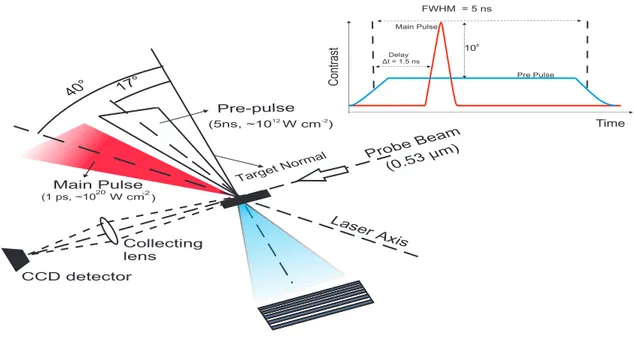
The Vulcan laser system at the Rutherford Appleton Laboratory (RAL) has been utilised
for the measurement of proton energies. The petawatt laser delivers 1.054
µm wavelength
laser pulses of
∼
1ps duration and pulse energies 150
±
20 J with an intensity contrast of
10
8. Laser irradiance of 10
20W cm
−2in a p-polarized beam was incident at 40
◦angle to
a plane target normal. A 5 ns duration pre-pulse was incident at 17
◦incidence angle with
peak irradiance 1.5 ns prior to the main pulse. The petawatt laser was focussed onto plane
a thin (100nm) layer of aluminium buried at depths
≥
3
µm from the target surface. The
experiment set up is schematically illustrated in figure 1.
Proton Beam
RCF Stack
Pre Pulse Main Pulse
Delay t = 1.5 ns
FWHM = 5 ns
8 10
Contrast
Time
FIG. 1. Experimental setup in the Vulcan Petawatt Laser Facility for the measurement of proton
energy along the target normal and density gradients normal to the target surface. The inset shows the timing of a pre pulse used to modify the interaction density scale length.
A frequency doubled optical probe beam was used to record the expanding density profile
of the plasma at the time of the interaction pulse. The probe beam was directed parallel
to the target surface passing through the plasma produced by the longer pulse laser target
interaction. In our previous work
9, we have discussed in detail how to measure and analyse
plasma density scale length from the shadowgraphy images obtained using the optical probe.
The distrubiton of multi-MeV protons along the target normal from the rear of the target
were measured as a function of energy using passive stacks of dosimetry radiochromic film
(RCF)
10, which were located 5 cm from the rear of the target and centered on the target
normal axis. Number, energy and fitted temperature of accelerated protons were measured
as a function of target thickness and the plasma scale length which varies with the pre-pulse
III.
EXPERIMENTAL RESULTS
Proton numbers as a function of energy have been deduced from stacked RCF (Gafchromic
HDF-810) exposure. A 10
µm thick aluminium foil acts to block scattered laser light and all
plasma thermal emission expected from the back of the target (photon energies
<
1 keV). The
electron flux of energy up to 200 MeV is directed parallel to the laser axis at 40
◦to the target
normal
9and is not directed at the RCF stack. Protons are attenuated in the RCF stack
of radiochromic films as they transmit through the different films and interspersed filters,
with the exposure of the films giving the flux of protons of energy sufficient to penetrate
through the overlay films and filters. Each film exposes predominantly at a particular proton
energy due to the Bragg peak nature of proton absorption in matter. The background angle
independent exposure of the RCF film includes exposure due to hard x-ray emission (>
1
keV) and is subtracted from exposure measurements. More details of the RCF measurements
of proton energies and the method of analysis is given by Schollmeier et al
11.
Proton numbers recorded from the back of the target were found to peak on the target
normal axis consistent with TNSA acceleration. The log-linear nature of the proton energy
spectra allows a deduction of a proton temperature (
kT
p) by fitting the proton spectra with
variations of form exp(
−
E/kT
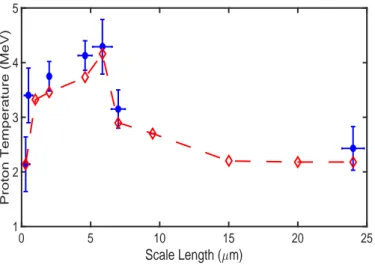
p). The variation of the fitted temperatures with the target
thickness and the measured front surface density scalelength are shown in figures 2 and 3
respectively.
The total number
N
Tof protons can be evaluated from the proton energy spectra using
the spectrum number in MeV extrapolated to zero energy (n(0)) and multiplying by the
deduced proton temperature. We can write that
N
T=
Z
∞0
n(0)exp
−
E
kT
pdE
=
n(0)kT
p.
(1)
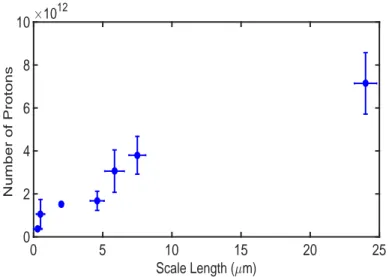
The number of fast electrons increases with the density scale length
8and this results in
a larger number of protons with increasing scale length (figure 4) .
0 50 100 150
Target Thickness (7m)
1 2 3 4 5 6 7
Proton Temperature (MeV)
FIG. 2. Experimental and simulated measurements of proton temperature as a function of the target thickness for a number of individual laser shots. The plasma density scale length measured
experimentally and used in the simulation was fixed at 0.5µm. Red diamonds represents the PIC
code simulations and blue circles are experimental data
0 5 10 15 20 25
Scale Length (7m)
1 2 3 4 5
Proton Temperature (MeV)
FIG. 3. Experimental measurements of proton temperature as a function of the measured plasma
density scale length for a number of individual laser shots (circles) with target thichness of 20µm.
Superimposed are 2D PIC code simulations ( red diamonds) with the preformed scale length and
0 5 10 15 20 25 Scale Length (7m)
0 2 4 6 8 10
Number of Protons
#1012
FIG. 4. Experimental measurements of number of protons as a function of the measured plasma scale length for a number of individual laser shots.
(a)
0 5 10 15 20 25 30
Initial Proton Energy (MeV) 108
1010 1012 1014 1016
Number of Protons
(b)
0 5 10 15 20 25 30
Initial Proton Energy (MeV) 105
1010 1015 1020
Number of Protons
FIG. 5. Comparison of EPOCH 2D PIC code results with experimental proton spectra for a) 20µm
, b) 120µm target thickness. The continuous black line represents the simulation results, while the
blue dotted points are the experimental data. The absolute values of vertical scales are arbitrary and the experimental and simulated spectra are visually superimposed to match vertically.
IV.
COMPARISON OF EPOCH 2D PIC CODE SIMULATIONS WITH
EXPERIMENTALLY MEASURED PROTON SPECTRA
The 2D PIC code EPOCH
12was used to simulate the experimental proton spectra for
different target thicknesses and plasma density scale length. The system size was 90
µm
×
90
µm with a mesh resolution of 1000
×
1000 cells with 48 particles of electrons and
0 5 10 15 20 25
Scale Length (7m)
20 30 40 50 60 70 80
TNSA Sheath Radial Size (
7
m)
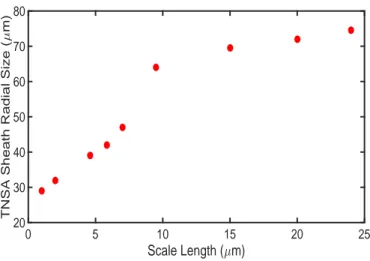
FIG. 6. Simulation results for TNSA sheath field measurements as a function of the plasma scale length.
0 50 100 150
Target Thickness (7m)
0 10 20 30 40 50 60 70 80 90
7
m)
FIG. 7. Measured TNSA sheath field distance obtained by EPOCH 2D PIC simulations as a
function of the target thickness
thicknesses with the laser irradiance of 3.5
×
10
20W cm
−2focussed on a 7
µm focal spot with
an incidence angle of 40
◦degrees was determined. The laser wavelength and pulse duration
were 1µm and 1 ps, respectively. In the simulations, the peak electron density was limited
at 50
n
cwhere
n
cis the critical density. A constant exponential density profile was assumed
with the scale lengths
L
in the range of 0.5
µm to 25
µm.
The proton energy spectra was extracted at time 0.5 ps. Figure 5 compares the generated
target thicknesses. The continuous line represent the EPOCH 2D PIC code simulation
results and red dotted line with diamonds shows our experimental observations.
In order to understand the increase in the number of protons with increasing scale length
with a constant target thickness block (20µm thick) have measured the TNSA sheath field
with varying scale length and target thickness (figures 6 and 7).
Experimentally measured and simulated results of proton temperature as a function of the
target thickness can be seen in figure 2 and as a function of plasma scale length in figure 3.
Blue circles represents the experimental results while red diamons represent PIC simulations.
Experimental and simulations results show that peak proton temperature occurs for target
thickness around 50
µm and density scale lengths around 5
µm.
(a) (b)
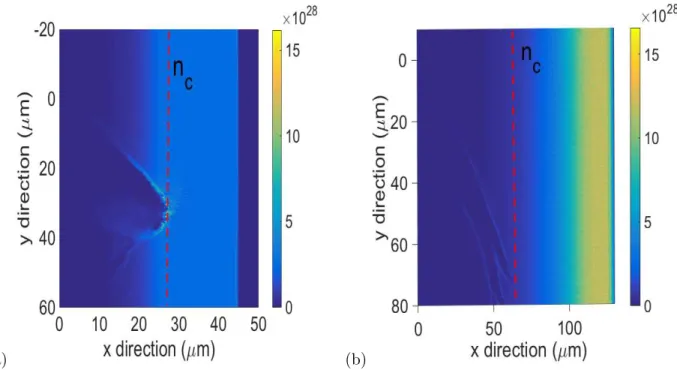
FIG. 8. An example of electron density values colour-coded in units of m−3
after 0.55 ps with a)
5 µm , b) 15 µm scale length as simulated by the EPOCH 2D PIC code. The dashed vertical line
indicates the critical density surface. The laser radiation is incident at 40◦
to the target normal.
At the high irradiances (10
20W cm
−2) of our experiment, electrons are expelled from the
laser propagation axis due to the ponderomotive force. The plasma refractive index on axis
is increased due to the electron density drop which produces a positive lensing effect
13. Laser
pulses also undergo self-focusing due to relativistic mass increase of the electrons accelerated
to expel a significant fraction of the electrons from the high intensity laser region, creating
ion channels (see figure 8). With the longer plasma propagation distances associated with
longer plasma scalelengths, the laser pulse can be subject to transverse instabilities, resulting
in beam filamentation. The filamentation reduces the local laser irradiance and reduces
the temperature of accelerated electrons
9. The drop at electron temperature reduces the
generated proton temperature as well at the longer scale lengths. The measured proton
temperatures vary with plasma scale length (figure 3) following the electron temperature
which show a peak at scale lengths of 7.5
µm (see Culfa et al.
9).
V.
CONCLUSION
We have presented measurements of number, energy and temperature of protons in high
irradiance laser plasma interactions with a preformed plasma of measured density scale
length. The experimentally observed proton temperatures decreases for longer scale lengths
as predicted by a 2D PIC code. Our experimental and simulation parameter studies of
proton energies from high irradiance laser plasmas show that the 2D PIC code simulations
are accurate and will help in the development of applications for laser accelerated protons.
VI.
ACKNOWLEDGEMENTS
The authors gratefully acknowledge the assistance of laser operations, target preparation
and engineering staff at the Central Laser Facility of RAL. Part of the research was supported
by RFBR research project # 15-32-21121 and RAS Presidium Program for Basic Research #
13. This work was in part funded by the UK EPSRC grants EP/G054950/1, EP/G056803/1,
EP/G055165/1 and EP/ M022463/1.
REFERENCES
1
H. Daido, M. Nishiuchi, and A.S. Pirozhkov.
Rep.Prog.Phys.
, 75(056401), 2012.
2
A. Macchi, M. Borghesi, and M. Passoni.
Rev. Mod. Phys.
, 85:751–793, 2013.
3
S.C. Wilks, A.B. Langdon, T.E. Cowan, M. Rooth, M. Singh, S. Hatchett, M.H. Key,
5
H.Alven.
Phys.Rev.
, 55:425, 1939.
6
. J. Colgan, J. Abdallah Jr., A. Ya. Faenov, S. A. Pikuz, E. Wagenaars, N. Booth, O. Culfa,
R. J. Dance, R. G. Evans, R. J. Gray, T. Kaempfer, K. L. Lancaster, P. McKenna, A. L.
Rossall, I. Yu. Skobelev, K. S. Schulze, I. Uschmann, A. G. Zhidkov, and N. C. Woolsey.
Phys.Rev.Lett.
, 110:125001, 2013.
7
S. B. Hansen, J. Colgan, A. Ya. Faenov, J. Abdallah Jr., S. A. Pikuz, I. Yu. Skobelev,
E. Wagenaars, N. Booth, O. Culfa, R. J. Dance, G. J. Tallents, R. G. Evans, R. J. Gray,
T. Kaempfer, K. L. Lancaster, P. McKenna, A. K. Rossall, K. S. Schulze, I. Uschmann,
A. G. Zhidkov, and N. C. Woolsey.
Phys.Plasmas.
, 21:031213, 2013.
8
O. Culfa, G. J. Tallents, E. Wagenaars, C. P. Ridgers, R. J. Dance, A. K. Rossall, R. J.
Gray, P. McKenna, C. D. R. Brown, S. F. James, D. J. Hoarty, N. Booth, A. P. L. Robinson,
K. L. Lancaster, S. A. Pikuz, A. Ya. Faenov, T. Kampfer, K. S. Schulze, I. Uschmann, and
N. C. Woolsey.
Phys.Plasmas
, 21:043106, 2014.
9
O. Culfa, G. J. Tallents, A. K. Rossall, E. Wagenaars, C. P. Ridgers, C.D. Murphy, R. J.
Dance, R. J. Gray, P. McKenna, C. D. R. Brown, S. F. James, D. J. Hoarty, N. Booth,
A. P. L. Robinson, K. L. Lancaster, S. A. Pikuz, A. Ya. Faenov, T. Kampfer, K. S. Schulze,
I. Uschmann, and N. C. Woolsey.
Phys.Rev.E
, 93:043201, 2016.
10
F. Nurnberg, M. Schollmeier, E. Brambrink, A. Blazevic, D. C. Carroll, K. Flippo, D. C.
Gautier, M. Geibel, K. Harres, B. M. Hegelich, O. Lundh, K. Markey, P. McKenna,
D. Neely, J. Schreiber, and M. Roth.
Rev.Sci.Inst.
, 80:033301, 2009.
11
M. Schollmeier, M. Geissel, A. B. Sefkow, and K. A. Flippo.
Rev.Sci.Inst.
, 85:043305,
2014.
12
T D Arber, K Bennett, C S Brady, A Lawrence-Douglas, M G Ramsay, N J Sircombe,
P Gillies, R G Evans, H Schmitz, A R Bell, and C P Ridgers.
Plasma Physics and
Controlled Fusion
, 57(11):1–26, 2015.
13