MBER Space-Time Decision Feedback Equalization
Assisted Multiuser Detection for Multiple
Antenna Aided SDMA Systems
Sheng Chen
, Senior Member, IEEE
, Lajos Hanzo
, Fellow, IEEE
, and Andrew Livingstone
Abstract—This paper proposes a space-time decision feedback equalization (ST-DFE) assisted multiuser detection (MUD) scheme for multiple receiver antenna aided space division multiple access systems. A minimum bit error rate (MBER) design is invoked for the MUD, which is shown to be capable of improving the achievable bit error rate performance and enhancing the attain-able system capacity over that of the standard minimum mean square error (MMSE) design. An adaptive implementation of the MBER ST-DFE assisted MUD is proposed using a stochastic gra-dient-based least bit error rate algorithm, which is demonstrated to consistently outperform the classical least mean square (LMS) algorithm, while achieving a lower computational complexity than the LMS algorithm for the binary signalling scheme. Our simulation results demonstrate that the MBER ST-DFE assisted MUD is more robust to channel estimation errors as well as to potential error propagation imposed by decision feedback errors, compared to the MMSE ST-DFE assisted MUD.
Index Terms—Decision feedback equalizer, minimum bit error rate, minimum mean square error, multiple antennas, multiple-input multiple-output, multiuser detection, space-division multiple access, space-time processing.
I. INTRODUCTION
I
N an effort to further increase the achievable system ca-pacity, antenna arrays can be employed for supporting multiple users in a space-division multiple access (SDMA) communications scenario [1]–[12]. We investigate a space-time (ST) decision feedback equalization (DFE) assisted mul-tiuser detection (MUD) scheme designed for multiple receiver antenna aided SDMA systems. To interpret the multiuser-sup-porting capability of such a novel SDMA system [13], it is useful to relate it to classic code-division multiple access (CDMA) multiuser systems [11]. In a CDMA system, each user is separated by a unique user-specific spreading code. By contrast, an SDMA system differentiates each user by the associated unique user-specific channel impulse response (CIR) encountered at the receiver antennas. In a simplistic but conceptually appealing interpretation, the unique user-specific CIR plays the role of a user-specific CDMA signature. In this analogy, the CIR-signatures are not orthogonal to each other,Manuscript received March 10, 2005; revised October 4, 2005. The associate editor coordinating the review of this manuscript and approving it for publica-tion was Dr. Markus Rupp. This work was supported by the European Union under the auspices of the Phoenix and Newcom projects.
The authors are with the School of Electronics and Computer Sci-ence, University of Southampton, Southampton SO17 1BJ, U.K. (e-mail: [email protected]; [email protected]; [email protected]).
Digital Object Identifier 10.1109/TSP.2006.877666
but this is not a serious limitation, because even orthogonal spreading codes become non-orthogonal upon convolution by the CIR. However, owing to the non-orthogonal nature of the CIRs, an effective multiuser receiver is required for separating the users in an SDMA system.
The most popular SDMA-receiver design is constituted by the minimum mean square error (MMSE) MUD [5], [10]–[14]. However, as recognized by [15] in a CDMA context and by [16] in an adaptive beamforming-based MUD scenario, a better strategy is to choose the detector’s coefficients by directly minimizing the system’s bit error ratio (BER). For the single-user single-antenna system, the minimum BER (MBER) equalization design has become popular [17]–[24], and it has been shown that the MBER DFE is less sensitive to the error propagation due to decision feedback errors compared to the MMSE DFE [24]. For the base station employing multiple transmit antennas, an MBER multiuser transmission scheme has been proposed in [25], while for the multiple antenna assisted receiver, an MBER rake receiver has been discussed in [26]. Against this background, the novelty of this paper is that the MBER ST DFE assisted MUD (ST-DFE-MUD) is proposed for the first time in the literature in the context of SDMA. In addition to the theoretically MBER ST-DFE-MUD, which is unachievable in practice, the adaptive least bit error rate (LBER) aided ST-DFE-MUD is proposed for its practical implementation and characterized in terms of its steady-state BER and convergence performance.
In this paper, it is shown that the MBER ST-DFE-MUD de-sign results in an enhanced BER performance in comparison to the standard MMSE design. Moreover, unlike the MMSE sign, whose performance degrades significantly owing to de-cision feedback errors in the presence of multiuser feedback loops, the MBER ST-DFE-MUD is robust to the error prop-agation, as will be demonstrated by our simulation study. An adaptive implementation of the MBER ST-DFE-MUD is con-sidered based on a stochastic gradient learning algorithm re-ferred to as the LBER technique. It is demonstrated that this LBER ST-DFE-MUD consistently outperforms the least mean square (LMS)-based ST-DFE-MUD and yet has a lower com-putational complexity than the latter in the case of the binary phase-shift keying (BPSK) modulation scheme. Simulation re-sults are also provided in support of the theoretical analysis. In this paper, we restrict attention to binary signalling. How-ever, the technique can readily be extended to the quadrature phase-shift keying (QPSK) scheme [27] and other modulation schemes with multiple bits per symbol [24].
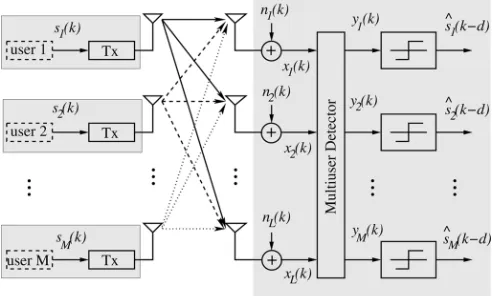
Fig. 1. Schematic of an antenna array aided SDMA uplink scenario, where each of theMusers is equipped with a single transmit antenna and the base station’s receiver is assisted by anL-element antenna array.
II. SYSTEMMODEL
Consider the multiple antenna aided SDMA system sup-porting users, as depicted in Fig. 1, where each of the users is equipped with a single transmit antenna and the receiver is assisted by an -element antenna array. The received signal samples at the symbol rate for are given by
(1) where is an independently identically distributed com-plex-valued Gaussian white noise process with
, denotes the noise-free part of the th receive an-tenna’s output, is the th transmitted symbol of user
, and denotes the tap
vector of the CIR connecting the user and the th receive an-tenna. For notational simplicity, we have assumed that each of the ( ) CIRs has the same length of . We assume further-more that BPSK modulation is employed and hence
. The physical interpretation of the CIRs associated with the model (1) in the generic content of input multiple-output systems can be found, for example, in [10].
A bank of the ST-DFEs constitutes the MUD, and the soft outputs of the ST-DFEs are given by
(2)
for , where denotes the
deci-sion for the transmitted symbol and
denotes the feedforward filter weight vector of the th user’s detector associated with the
th receive antenna, while
denotes the th user’s detector feedback filter weight vector
associated with the th user detector’s feedback signal. Again, for notational simplicity, we have assumed that each of the ST-DFEs has the same decision delay , all the feedforward filters have the same order , and all the feedback filters have the same order . The detectors’ decisions are defined by
(3)
where denotes the real part of and the sign function. Let us define
, , and
(4)
(5)
(6)
(7)
Then the output of the th ST-DFE can be written as
(8)
The ST-DFE structure’s parameters are chosen as follows: , , and . For the single-an-tenna single-user case, this particular choice of the DFE struc-ture’s parameters is sufficient for guaranteeing that the subsets of noise-free signal states are always linearly separable at the de-tector’s output and therefore they guarantee an adequate perfor-mance [18], [19]. This linearly separable property is also valid in the present multiuser system. This choice of the ST-DFE struc-ture’s parameters may not always be optimal, but it does guar-antee an adequate performance. Upon stipulating and , let us first introduce the two overall CIR matrices as
..
. and ... (9)
where the and dimensional CIR
matrices and are given by
(10)
and
respectively, with the 1 and dimensional CIR matrices and defined by
. .. ... ..
. . .. . ..
(12)
and
. .. ... ..
. . ..
(13)
respectively. Let us define furthermore
(14) (15) (16)
where ,
, and
. Then the received signal vector is modeled as
(17)
Under the assumption that the past decisions are correct, and the received signal vector can be expressed
as . Thus, as argued
in [18] and [28], the decision feedback can be viewed as a translation of the original observation space into a new space
(18) In the translated space , the original ST-DFE described by (8) is “translated” into a ST “linear equalizer” described as
(19) where is Gaussian distributed, having a zero
mean and . Note that we
have with
. By extending the results of [18] and [19], the elements of can be computed recursively according to
for
(20)
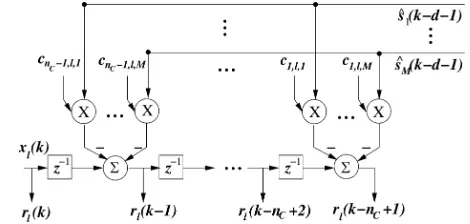
where defines the unit delay operator. Note that the recur-sion (20) realizes exactly the space translation (18) in a
com-Fig. 2. Schematic of the observation space translation withn = n ,n =
n 0 1, andd = n 0 1.
putationally more efficient manner. A schematic of this space translation (20) is illustrated in Fig. 2.
It is important to emphasize that using the detector struc-ture of (19) with the space translation (20) is exactly the same as using the original DFE structure (8). The feedback coeffi-cient vector does not simply “disappear.” It has in fact been set to its “optimal value,” which is . Thus, in an adaptive implementation, one has to estimate the coef-ficients of the CIRs, rather than estimating the coefcoef-ficients of the feedback filters, when adopting the detector structure of (19) and (20). Moreover, when the MMSE solution, as given in (21), is used in the detector (19), the feedback filter coefficient vector in (8) is automatically set to its MMSE solution, which
is . Similarly, if in (19) is
set to the MBER solution, as discussed in the next section, in (8) is automatically set to the corresponding MBER solution.
III. MINIMUMBITERRORRATEMULTIUSERDETECTION
Classically, the th detector’s weight vector is de-termined by minimizing the MSE criterion
, which leads to the following MMSE solution:
(21)
for , where is the
dimen-sional identity matrix and denotes the th column of . An adaptive implementation of the MMSE so-lution can be realized, for example, using the LMS algorithm. The main contribution of this paper is to derive the MBER so-lution for the weight vectors of the ST-DFEs and develop an adaptive MBER multiuser detector for the SDMA systems. Let us denote the number of possible transmitted symbol sequences of as , . Denote fur-thermore the 1 th element of , corresponding to the symbol , as . The noise-free part of the th de-tector input signal, namely, , assumes values from the finite signal set defined as
(22)
This set can be partitioned into two subsets, depending on the specific value of , as follows:
[image:3.594.307.542.66.178.2]Similarly, the noise-free part of the th detector’s output assumes values from the set
(24)
Thus can only take the values from the set
(25)
and can be divided into the two subsets conditioned on the value of
(26)
The conditional probability density function (pdf) of given is a Gaussian mixture given by [15], [16]
(27)
where and is the number of the constellation points in . Thus the BER of the th ST-DFE associated with the detector’s weight vector is given by
(28)
where
(29)
and
(30) Note that the BER is invariant to a positive scaling of . Simi-larly, the BER may be calculated based on the other subset . The MBER solution for the th detector is then defined as the weight vector that minimizes the error probability (28), namely
(31)
This MBER solution may be found by setting the derivative of to zero. The gradient of with respect to is given by
(32)
Given the gradient expression (32), the optimization problem (31) can be solved iteratively by commencing the iterations from an appropriate initialization point using a gradient algorithm. Since the BER is invariant to a positive scaling of , it is computationally advantageous to normalize to a unit length after every iteration, so that the gradient expression (32) can be simplified to
(33)
The simplified conjugate gradient algorithm of [29] and [15] provides an efficient means of finding an MBER solution for the optimization problem formulated in (31).
IV. ADAPTIVEMINIMUMBITERRORRATEIMPLEMENTATION
The evaluation of the error probability requires the knowledge of the pdf of the ST-DFE’s output signal . The pdf of
can be explicitly expressed as
(34) and the associated BER can alternatively be calculated ac-cording to
(35)
with
(36)
where the summation is carried out over the number of el-ements . In reality, the pdf of is channel dependent and hence is unknown. Hence, some form of pdf es-timation is required for supporting the adaptive implementation of the MBER ST-DFE assisted MUD.
A. Block-Data Based Gradient Adaptive MBER ST-DFE
, a Parzen window density estimate of the pdf in (34) takes the form
(37) where the radius parameter is related to the standard devi-ation of the system’s noise. The accuracy analysis of the Parzen window density estimate is well documented in the lit-erature [30]–[32]. The pdf estimate (37) is known to possess a mean integrated square error convergence rate having an order of [30].
Based on the estimated pdf of (37), the estimated BER is given by
(38)
with
(39)
The gradient of is given as
(40)
Upon substituting by in the simplified conjugate gradient updating mechanism, for example, a block-data-based adaptive algorithm is obtained [15], where the step size and the radius parameter are two algorithmic param-eters that control the rate of convergence. The radius parameter also has an influence on the accuracy of the pdf and hence on that of the BER estimate.
B. Stochastic Gradient-Based Adaptive MBER ST-DFE
Our aim is to develop a sample-by-sample adaptive imple-mentation of the MBER ST-DFE. In the Parzen window es-timate (37), the kernel width explicitly depends on the detector’s weight vector . However, the BER is in-variant to , and a constant kernel width may also be adopted in the density estimate. An advantage of using a con-stant kernel width , rather than , in the density estimate is that the gradient of the resultant estimated BER has a simpler form, which leads to a considerable computational com-plexity reduction. Adopting this approach, an alternative fixed kernel-width-based Parzen window estimate of the true pdf (34) is given by
(41)
and the resultant approximate BER formula becomes
(42)
where we have
(43)
This approximation is an adequate one, provided that the width is chosen appropriately.
In order to derive a sample-by-sample adaptive algorithm for updating the detector’s weight vector , consider a single-sample estimate of , namely
(44)
Conceptually, from this single-sample pdf “estimate,” we have a single-sample or instantaneous BER “estimate” . Using the instantaneous stochastic gradient formula of
(45)
gives rise to a stochastic gradient adaptive algorithm, which we referred to as the LBER algorithm
(46) The adaptive gain as well as the kernel width are the two algorithmic parameters that have to be set appropriately. Specif-ically, they are chosen to ensure adequate performance in terms of both the achievable convergence rate and the steady-state BER misadjustment. Note that there is no need to normalize the weight vector to a unit length after each update.
The CIR taps for , , and
, which are needed to perform the space transformation (20), can be estimated using the standard LMS algorithm. It is interesting to compare the LBER ST-DFE (46) with the standard LMS ST-DFE, which is given by
(47)
with
(48)
TABLE I
SYSTEM’SCIRS FOR AFOUR-ANTENNAFOUR-USERTIME-INVARIANTSDMA SYSTEM
V. SIMULATIONSTUDY
In our simulation investigations, unless otherwise stated, perfect channel estimates are assumed in performing the space translation (20). Hence our attention is focused on the per-formance of the adaptive MBER and MMSE designs, rather than on the adaptive channel estimator, which is well doc-umented in the classic adaptive signal-processing literature [33]. The effect of imperfect channel estimates on the perfor-mance of a ST-DFE-MUD, however, was investigated in our simulation study. In order to avoid obfuscating the prevalent MBER/MMSE performance trends by asynchronous trans-missions, we assumed synchronous communications and an identical CIR dispersion for all users.
A. Time-Invariant System
The system used in our simulations supported users with the aid of receiver antennas. All the four users had an equal transmit power. The resultant 16 CIRs are listed in Table I, each having taps. In the simulations, all the 16 CIRs were normalized according to for the sake of providing a channel gain of unity. Since the length of the CIRs was , the ST-DFE structure was defined by the parame-ters of , , and . The theoretical BER curves of the MMSE and MBER ST-DFE-MUDs, computed using the BER expression of (28), are plotted in Fig. 3 over a range of signal-to-noise ratio (SNR) conditions, where the MMSE solu-tions were calculated using (21) while the MBER solusolu-tions were obtained numerically using the simplified conjugate gradient optimization algorithm. It can be seen that for all four users, the MBER ST-DFE-MUD provided a better BER performance than the MMSE ST-DFE-MUD. The BER calculated using the BER expression (28) represents the theoretical best case perfor-mance, since it was obtained assuming that the correct symbols were fed back in the ST-DFE-MUD’s feedback loop. In reality, the ST-DFE-MUD may produce erroneous symbol feedback.
For the sake of investigating the effects of decision feedback induced error propagation, the BERs of the MMSE and MBER ST-DFE-MUDs were also calculated using simulations with the error-prone detected symbols being fed back, and the results are also depicted in Fig. 3, in comparison to the corresponding theoretical best case performance. It is interesting to see that the BER performance degradation owing to DFE-induced error propagation is less serious for the MBER ST-DFE-MUD than for the MMSE ST-DFE-MUD. Note that this phenomenon has
Fig. 3. Theoretical and simulated bit error rate comparison of the MMSE and MBER ST-DFE-MUDs for the four-user four-antenna time-invariant system, where DF indicates simulated BER with detected symbols being fed back: (a) user 1, (b) user 2, (c) user 3, and (d) user 4.
been observed before in the single-antenna single-user scenario of [24]. In the multiuser case, the effects of error propagation are aggravated for the MMSE ST-DFE-MUD to some degree owing to the multiple-user feedback effects. In particular, the users originally benefitting from the best performance owing to their specific CIRs suffer the most serious degradation, as seen by comparing user 2 and user 3 in Fig. 3. By contrast, the MBER ST-DFE-MUD appears to be significantly more robust to error propagation. This has important implications, especially in decision-directed (DD) adaptation.
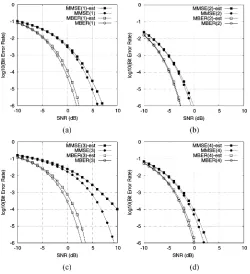
Fig. 4. Theoretical bit error rate comparison of the MMSE and MBER ST-DFE-MUDs for the four-user four-antenna time-invariant system, where “est” indicates imperfect channel estimates were used: (a) user 1, (b) user 2, (c) user 3, and (d) user 4.
solutions. The theoretical BERs of the MMSE and MBER ST-DFE-MUDs so obtained based on the “estimated” CIRs were averaged over ten “estimations” and the results are illus-trated in Fig. 4, in comparison with the performance derived using the perfect channel knowledge. It can be seen from Fig. 4 that the performance degradation due to imperfect channel estimates is less serious for the MBER ST-DFE-MUD than for the MMSE one. We conclude that MBER design is more robust to channel estimation errors than the MMSE design. This agrees with the previous conclusion regarding the robustness to error propagation due to decision feedback errors.
[image:7.594.41.291.78.352.2]The LMS and LBER ST-DFE-MUDs were also investigated under the condition of SNR dB. Fig. 5 depicts the learning curves of the two adaptive MUDs, averaged over 20 runs and started from an initial condition of , . The adaptive MUD operated in two modes, namely, the training mode in which the transmitted symbols were known to the receiver and the DD adaptation mode, in which the detected symbols were used for substituting . The adaptive algorithmic parameters, namely, the adaptive gain of the LMS algorithm, and the adaptive gain as well as the kernel variance of the LBER technique, were empirically tuned for achieving the best performance in terms of the achievable convergence speed and steady-state BER misadjustment. For example, was found to be appropriate for the LMS ST-DFE-MUD, and if was increased to 0.005, divergence occurred. It can be seen that the LBER ST-DFE-MUD consistently outperformed the LMS
Fig. 5. Learning curves of the LMS and LBER ST-DFE-MUDs in terms of theoretical BERs averaged over 20 runs for the four-user four-antenna time-in-variant system with SNR = 1dB and givenw (0)with the first element being 0.10j0.1 and the rest of elements all being 0.0+j0.0 for1 m 4, where DD denotes the decision directed adaptation with^s (k 0 d) substi-tutings (k 0 d): (a) user 1, (b) user 2, (c) user 3, and (d) user 4. For the LMS algorithm, = 0:001was used for all four users while for the LBER algorithm, = 0:2and = 16 6:34for user 1, = 2:0and
= 100 39:71for user 2, = 0:2and = 16 6:34for user 3, and = 0:4and = 20 7:94for user 4. In the LBER case, the training and DD learning curves are mostly indistinguishable.
ST-DFE-MUD. In particular, the LBER ST-DFE-MUD was capable of taking full advantage of DD adaptation, as is clearly demonstrated in Fig. 5, where it can also be seen that the DD LMS ST-DFE-MUD clearly failed to converge to the MMSE solution for user 3. A range of different initial conditions,
including for , were tested,
and the same conclusions were observed.
B. Slow Fading System
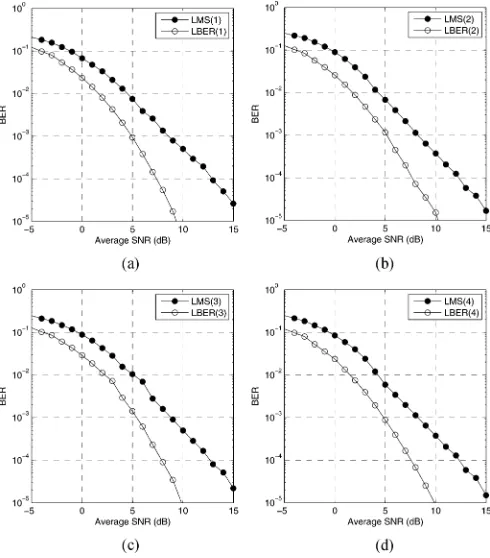
Fig. 6. Bit error rate comparison of the LMS and LBER ST-DFE-MUDs for the four-user four-antenna slow fading system: (a) user 1, (b) user 2, (c) user 3, and (d) user 4.
Fig. 6 that the LBER ST-DFE-MUD consistently outperformed the LMS ST-DFE-MUD for all four users.
VI. CONCLUSIONS
A novel minimum bit error rate design has been proposed for the space-time decision feedback equalization assisted mul-tiuser detector employed in multiple antenna aided space-divi-sion multiple-access systems. It has been demonstrated that this MBER design is capable of achieving better performance and hence of improving the attainable system capacity, compared to the classic MMSE design. An adaptive implementation of the MBER ST-DFE-MUD has also been derived based on the LBER algorithm, which has been shown to consistently out-perform the classic LMS algorithm and yet maintain a lower computational complexity than the latter for BPSK modula-tion. Another interesting result observed in this paper is that the MBER ST-DFE-MUD is significantly more robust against the error propagation caused by error-prone detected symbols used in the MUD’s feedback loop, in comparison to the stan-dard MMSE ST-DFE-MUD. This is an important advantage, especially in situations, where decision-directed adaption has to be employed.
REFERENCES
[1] J. H. Winters, J. Salz, and R. D. Gitlin, “The impact of antenna diver-sity on the capacity of wireless communication systems,”IEEE Trans. Commun., vol. 42, no. 2, pp. 1740–1751, 1994.
[2] A. J. Paulraj and C. B. Papadias, “Space-time processing for wire-less communications,”IEEE Signal Process. Mag., vol. 14, no. 6, pp. 49–83, 1997.
[3] G. Tsoulos, M. Beach, and J. McGeehan, “Wireless personal communi-cations for the 21st century: European technological advances in adap-tive antennas,”IEEE Commun. Mag., vol. 35, no. 9, pp. 102–109, 1997. [4] J. H. Winters, “Smart antennas for wireless systems,”IEEE Personal
Commun., vol. 5, no. 1, pp. 23–27, 1998.
[5] A. J. Paulraj and B. C. Ng, “Space-time modems for wireless personal communications,”IEEE Personal Commun., vol. 5, no. 1, pp. 36–48, 1998.
[6] A. J. Paulraj and E. Lindskog, “Taxonomy of space-time processing for wireless networks,”Proc. Inst. Elect. Eng. Radar, Sonar Navigation, vol. 145, no. 1, pp. 25–31, 1998.
[7] P. Vandenameele, L. van Der Perre, and M. Engels, Space Division Multiple Access for Wireless Local Area Networks. Boston, MA: Kluwer Academic, 2001.
[8] J. S. Blogh and L. Hanzo, Third Generation Systems and Intelli-gent Wireless Networking—Smart Antenna and Adaptive Modula-tion. Chichester, U.K.: Wiley, 2002.
[9] S. Bellofiore, C. A. Balanis, J. Foutz, and A. S. Spanias, “Smart-an-tenna systems for mobile communication networks—Part 1: Overview and antenna design,”IEEE Antennas Propag. Mag., vol. 44, no. 3, pp. 145–154, 2002.
[10] A. Paulraj, R. Nabar, and D. Gore, Introduction to Space-Time Wireless Communications. Cambridge, U.K.: Cambridge Univ. Press, 2003. [11] L. Hanzo, L-L. Yang, E-L. Kuan, and K. Yen, Single- and
Multi-Car-rier DS-CDMA: Multi-User Detection, Space-Time Spreading, Synchronisation, Standards and Networking. New York: IEEE Press/Wiley, 2003.
[12] A. J. Paulraj, D. A. Gore, R. U. Nabar, and H. Bölcskei, “An overview of MIMO communications—A key to gigabit wireless,”Proc. IEEE, vol. 92, pp. 198–218, 2004.
[13] L. Hanzo, M. Münster, B. J. Choi, and T. Keller, OFDM and MC-CDMA. West Sussex, U.K.: Wiley/IEEE Press, 2003. [14] D. N. C. Tse and S. V. Hanly, “Linear multiuser receivers: Effective
interference, effective bandwidth and user capacity,”IEEE Trans. Inf. Theory, vol. 45, no. 2, pp. 641–657, 1999.
[15] S. Chen, A. K. Samingan, B. Mulgrew, and L. Hanzo, “Adaptive min-imum-BER linear multiuser detection for DS-CDMA signals in multi-path channels,”IEEE Trans. Signal Process., vol. 49, pp. 1240–1247, 2001.
[16] S. Chen, N. N. Ahmad, and L. Hanzo, “Adaptive minimum bit error rate beamforming,”IEEE Trans. Wireless Commun., vol. 4, no. 2, pp. 341–348, 2005.
[17] S. Chen, E. S. Chng, B. Mulgrew, and G. Gibson, “Minimum-BER linear-combiner DFE,” inProc. ICC’96, Dallas, TX, 1996, vol. 2, pp. 1173–1177.
[18] S. Chen, B. Mulgrew, E. S. Chng, and G. Gibson, “Space translation properties and the minimum-BER linear-combiner DFE,”Proc. Inst. Elect. Eng. Commun., vol. 145, no. 5, pp. 316–322, 1998.
[19] S. Chen and B. Mulgrew, “The minimum-SER linear-combiner deci-sion feedback equalizer,”Proc. Inst. Elect. Eng. Commun., vol. 146, no. 6, pp. 347–353, 1999.
[20] C. C. Yeh and J. R. Barry, “Adaptive minimum bit-error rate equaliza-tion for binary signaling,”IEEE Trans. Commun., vol. 48, no. 7, pp. 1226–1235, 2000.
[21] B. Mulgrew and S. Chen, “Stochastic gradient minimum-BER decision feedback equalisers,” inProc. IEEE Symp. Adaptive Systems Signal Process., Commun. Contr., 2000, pp. 93–98.
[22] K. A. Phillips, J. H. Reed, and W. H. Tranter, “Minimum BER adaptive filtering,” inProc. ICC’2000, 2000, vol. 3, pp. 1675–1680.
[23] B. Mulgrew and S. Chen, “Adaptive minimum-BER decision feedback equalisers for binary signalling,”Signal Process., vol. 81, no. 7, pp. 1479–1489, 2001.
[24] S. Chen, L. Hanzo, and B. Mulgrew, “Adaptive minimum symbol-error-rate decision feedback equalization for multi-level pulse-amplitude modulation,”IEEE Trans. Signal Process., vol. 52, pp. 2092–2101, 2004.
[25] R. Irmer, R. Habendorf, W. Rave, and G. Fettweis, “Overloaded TDD-CDMA cells with multiuser transmission,” inProc. 2004 ITG Work-shop Smart Antennas, 2004, pp. 235–242.
[26] J. Wehinger, V. R. Anreddy, C. F. Mecklenbräuker, S. Paul, and C. Antón-Haro, “Adaptive minimum bit error rate space-time rake receiver for the uplink of UMTS frequency division duplex mode,” inProc. 3rd IEEE Int. Symp. Signal Process. Inf. Technol., 2003, pp. 294–297.
[28] L. Hanzo, C. H. Wong, and M. S. Yee, Adaptive Wireless Transceivers: Turbo-Coded, Turbo-Equalised and Space-Time Coded TDMA, CDMA and OFDM Systems. Chichester, U.K.: Wiley/IEEE Press, 2002. [29] M. S. Bazaraa, H. D. Sherali, and C. M. Shetty, Nonlinear
Program-ming: Theory and Algorithms. New York: Wiley, 1993.
[30] E. Parzen, “On estimation of a probability density function and mode,”
Ann. Math. Statist., vol. 33, pp. 1066–1076, 1962.
[31] B. W. Silverman, Density Estimation. London, U.K.: Chapman Hall, 1996.
[32] A. W. Bowman and A. Azzalini, Applied Smoothing Techniques for Data Analysis. Oxford, U.K.: Oxford Univ. Press, 1997.
[33] S. Haykin, Adaptive Filter Theory, 3rd ed. Upper Saddle River, NJ: Prentice-Hall.
Sheng Chen (M’90–SM’97) received the B.Eng. degree in control engineering from the East China Petroleum Institute, Dongying, China, in 1982, the Ph.D. degree in control engineering from the City University, London, U.K., in 1986, and the D.Sc. degree from the University of Southampton, U.K., in 2005.
Since 1999, he has been with the School of Electronics and Computer Science, the University of Southampton, U.K. He previously held research and academic appointments at the Universities of Sheffield, Edinburgh, and Portsmouth, U.K. His recent research works include adaptive signal processing, wireless communications, modelling and identification of nonlinear systems, neural network and machine learning, finite-precision digital controller design, evolutionary computation methods, and optimization. He has published more than 240 research papers.
Dr. Chen is listed among the most highly cited researchers in engineering by Institute for Scientific Information.
Lajos Hanzo (M’91–SM’92–F’04) received the master’s degree in electronics in 1976 and the doc-torate degree in 1983. He received the D.Sc. degree from the University of Southampton, U.K., in 2004.
During his 28-year career in telecommunications, he has held various research and academic posts in Hungary, Germany, and the United Kingdom. Since 1986, he has been with the School of Electronics and Computer Science, University of Southampton, where he holds the Chair in telecommunications. He has coauthored 11 Wiley/IEEE Press books on mobile radio communications, published in excess of 550 research papers, organized and chaired conference sessions, presented overview lectures, and received a number of distinctions. He is an enthusiastic supporter of indus-trial–academic liaison. He also offers a range of industrial research overview courses. He is a Non-Executive Director of the Virtual Centre of Excellence in mobile communications, U.K., and an Executive Board Member of the Pan-European Network of Excellence known as NEWCOM.
Prof. Hanzo is a Fellow of the Royal Academy of Engineering (FREng), U.K., and the Institution of Electrical Engineers, U.K. He is an IEEE Distinguished Lecturer of the Communications Society and the Vehicular Technology (VT) Society. He is a Governor of the IEEE VT society.
Andrew Livingstone is currently pursuing the M.Eng. degree in electronics at the School of Electronics and Computer Science, University of Southampton, U.K.
He has published two research papers in wireless communications.