AMONG AUSTRALIAN PROFESSIONALS,
by
ELZBIETA MALINOWSKA-TABAKA
A thesis submitted for the degree of
Doctor of Philosophy of The Australian National University.
ACKNOWLEDGMENTS
To express properly my indebtedness to the many people who helped and encouraged me at different stages of this doctoral dissertation is always a difficult task.
First, I would like to thank Professor F.L. Jones for the supervision of this thesis whose time, experience, and scholarship were instriomental to the successful completion of every stage of this work. His careful attention to numerous drafts and his assistance have greatly
improved the quality of the final version.
I am grateful to my advisors, especially D. Anderson and K. Zagorski. D. Anderson was very helpful as a one of the Principal Investigators of the original study "Professions in Australia", from which the data used in this thesis were drawn. I want to thank him for his advice and support. K. Zagorski helped me greatly to solve many methodological problems, and encouraged me to rethink, in a few cases,
the interpretation of findings. I owe a special debt to him.
I would like also to thank my colleagues from the Department of Sociology in the Research School of Social Sciences for their interest and moral support which encouraged me to bring this thesis to completion.
I thank L. Carrington for her linguistic assistance, and I am grateful to B. Builpitt and K. Tran for preparing and printing my final copy.
My family, Tomasz and Kasia, made an invaluable contribution to my work. Their patience and assistance has been immense.
In 1965 a longitudinal study, "Professions in Australia", commenced for students enrolled in law and engineering and in 1967 for students of medicine and teaching. This study was continued over twenty years, providing an immense source of information on the way in which students acquire the attitudes and values of their profession, and how they
function as "mature professionals".
A large number of studies have originated from the longitidinal data, including this dissertion.
This thesis examines the professions in comparative perspective. Assuming that professions are affected by economic and political developments which may lead towards more uniform behavioural patterns, the main aim of this thesis is to examine homogeneity of professional groups in regard to their occupational commitment. Another related problem is that there is developing a set of common interests among the different professions.
TABLE OF CONTENTS
Page
Acknowledgments iii
Preface v List of Figures ix
List of Tables x
CHAPTER I
PROFESSION AND COMMITMENT - THEORETICAL OVERVIEW 1
The concept of profession 1 Multidimensional concept of occupational commitment 11
Commitment theories 12 Consistency in human behaviour 13
Work and occupational commitment 15
CHAPTER II
SELF-IMAGE, OCCUPATIONAL COMMITMENT AND POLITICAL ATTITUDES
AMONG PROFESSIONALS 20 Outline of the analysis 20 Development of the commitment model 20
Hypotheses and methodological issues 23
Data 25 Plan of the thesis 27
CHAPTER III
AUSTRALIAN PROFESSIONALS 29 Part 1
Income and socio-demographic characteristics of
Australian professionals 30
Measurement and data ^^ Descriptive overview ^2 Income, qualification and job
Social profiles of the four professions 50 The structure of the initial sample 50 Research sample in 1983 and 1984 53
Summary of Part 2 56
CHAPTER IV
THE SELF-IMAGE OF PROFESSIONALS' PRESTIGE 58
Occupational prestige - overview 58
Problem 62 Prestige evaluation, stability and change 64
Who changes evaluation of own prestige 70
Prestige overestimation 74 Social background and prestige evaluation 76
Summary and conclusion 77
CHAPTER V
OCCUPATIONAL CHOICE - OCCUPATIONAL COMMITMENT
REASONS AND CORRELATES 80
Main questions and procedure 83
Method 85 Important factors of occupational decision 88
General Scale of Occupational Choice (GSOC) 92
Specific Scales of Occupational Choice 95 Relative importance of specific scales of occupational
choice and their inter-relationships 98 Social background and occupational choice 103
Conclusion 107
CHAPTER VI
WORK SATISFACTION AMONG PROFESSIONALS AS A DIMENSION OF
OCCUPATIONAL COMMITMENT H O The nature of job satisfaction 110
Important factors related to work and career 114
General scale of job satisfaction 120 Specific scales of job satisfaction 125 Job satisfaction and individual characteristics 133
CHAPTER VII
POLITICAL ATTITUDES OF AUSTRALIAN PROFESSIONALS 139
Identification of the problem 139 Social structure and political attitudes 140
Social profiles and voting preferences 148 Professionals and party choice: the regression analysis 156
The relative stability of voting preferences 166
Conclusion 168
CHAPTER VIII
CONCLUSION 171 Summary of findings 171
Suggestions for further research 179
APPENDIX
Questionnaires : selected questions used in the study 180
Table 3.1. Table 3.2. Table 3.3. Table 3.4. Table 3.5. Table 3.6. Table 3.7. Table 3.8. Table 3.9. Table 4.1. Table 4.2. Table 4.3. Table 4.4. Table 5.1. Table 5.2. studies 7 Australian Professionals and the Labour Force
in 1981 33
Income and qualifications (Doctors, Lawyers,
Engineers, Teachers) 36 Hours worked weekly and qualifications
(Doctors, Lawyers, Engineers, Teachers) 37 Qualification and work in occupation
(Doctors, Lawyers, Engineers, Teachers) 38 Model of regression equation for Professionals
income 43 Regression coefficients for annual income of
Australian Professionals in 1981 44
Standardized regression coefficients of annual
income of Australian Professionals 45 Social profiles of students in four
professional faculties 51 Four professional groups in 1983 and 1984 55
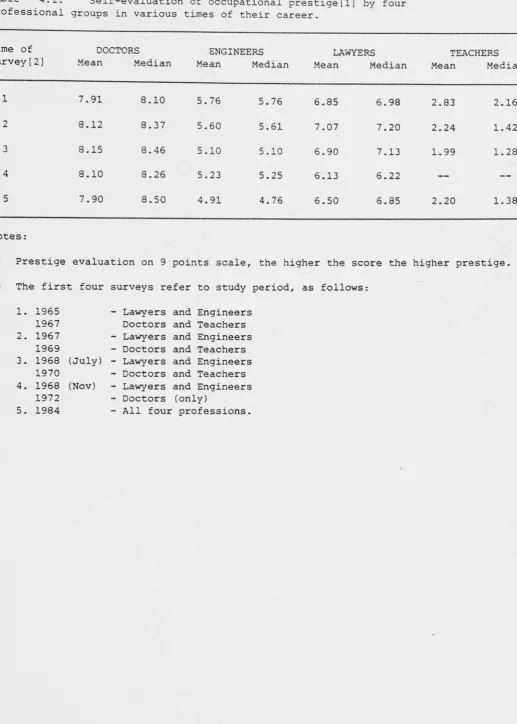
Self-evaluation of occupational prestige by four professional groups in various time
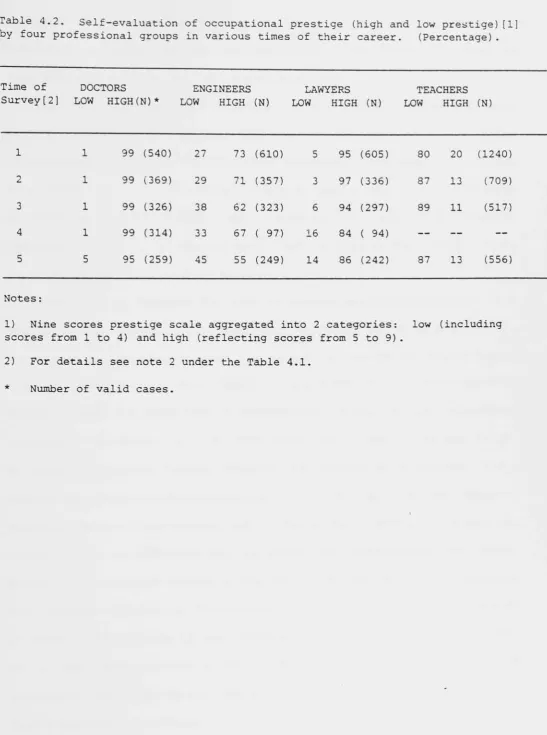
of their career 65 Self-evaluation of occupational prestige
(high and low) by four professional groups 68 Change in prestige self-evaluation among
four professional groups 71 Occupational prestige evaluation by four
professional groups 75 Three most important factors in career
decision 91 General Scales of "Reasons for studying"
LIST OF FIGURES
Figure 2.1, Figure 3.1.
Figure 3.2. Figure 3.3. Figure 4.1.
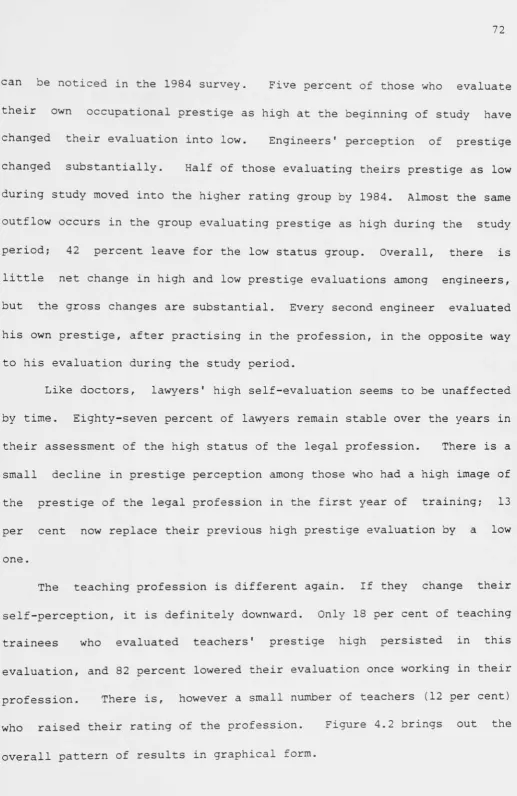
Figure 4.2.
Figure 5.1.
Figure 5.2. Figure 6.1.
Figure 7.1. Figure 7.2. Figure 7.3. Figure 7.4. Figure 7.5.
Page
Hypothetical model of occupational commitment 22 Effect for age on average yearly income for
four professional groups 40 Effect of age on hours worked 41
Effect of age on occupational status 42 Prestige of own occupation percepted by four
professional groups 56 Change of prestige evaluation over time by
four professional groups 73 Cumulative withdrawal among four groups of
professional trainees 89 Mean level of scales "Reasons for studying" 99
Mean level of scales work satisfaction/
dissatisfaction 128 Path model of voting preferences for doctors 159
Path model of voting preferences for lawyers 160 Path model of voting preferences for engineers 161 Path model of voting preferences for teachers 162 Path model of voting preferences for Australian
Table 5.4.
Table 5.5.
Table 6.1.
Table 6.2.
Table 6.3.
Table 6.4. Table 6.5.
Table 6.6.
Table 6.7.
Table 7.1.
Table 7.2.
Table 7.3. Table 7.4. Table 7.5. Table 8.1.
(factor loadings) 96
Correlation coefficients between scales
"Reasons for studying" 102 Background characteristics and "Reasons for
studying" 106 The five most important factors related
to work satisfaction 1 1 5
The five most important problems related
to work 116 General Scale of Job Satisfaction
(factor loadings) 121 Level of Job Dissatisfaction 125
Specific Scales of Job Satisfaction (factor loadings) 127 Mean level of importance of specific scales
of Job Satisfaction 130 Correlation coefficients between job
satisfaction/dissatisfaction scales 142 Professionals' voting preferences.
Changes over time. 149 Voting preferences of Professionals in
1969 and in 1984 150 Social profiles and voting preferences 153
Prestige and voting preferences 154 Descriptive table for regression coefficients 158
'Occupational choice' and Job Satisfaction.
PROFESSION AND COMMITMENT - THEORETICAL OVERVIEW.
The central aim of this Chapter is to provide a critical view of
the concept of profession, as well as an explanation of the term
"commitment" which recurs throughout the study. This discussion of the
theory of professions provides a "working" definition. In the second half
of this Chapter a multidimensional concept of commitment is presented
which serves as a basis for the development of a model of professional
commitment for the remainder of the study.
The concept of profession
The expansion of professional occupations within all industrial
societies in the last few decades stimulates a number of sociological
studies investigating this phenomenon from various perspectives. The
growth in the number of professionals and the emergence of a number of
"new" occupations claiming professional status can be regarded as a
process of social change, defined as a process of professionalisation.
This process is closely linked with various other aspects of change in
the social structure. In both industrial and post-industrial societies,
professions occupied positions in the middle or upper class. Most
professionals do not associate themselves with the working class (Bell,
1972). On the other hand, they do not have the autonomy of ruling
elites. Some researchers have studied the change in the nature of
professionalism parallel in the context of change in the class system
(Elliott, 1972) . The development of an industrial economy, technological
knowledge, the expansion of education, and changes in the function of the
professionals work, developed the deprofessionalization and
proletarianization thesis (Freidson, 1984; Pandey, 1985; Haug, 1975).
While deprofessionalization stresses cultural and political phenomena,
proletarianization emphasises economic and organizational factors. As
Pandey (1985: 27) argued:
"The deprofessionalization involves erosion of characteristics of
the profession, dequalification, and class formation. The process of
deprofessionalization is underway in several ways, namely, the erosion
of the monopoly of technical knowledge, the beginning of professional
accountability; suspicion of service orientation; the violation of the
professional code of ethics; the reputation of the professionals' claim
of being liberal and humanitarian; the cutting of the professionals'
control; and the creation of class antagonism".
Proletarianization of employment status bears on questions about
the relationship to economic autonomy, and whether there is a trend away
from self-employment both for individual professionals and for
professions as a whole. Freidson (1984: 9) pointed out that there is no
doubt that the number of established professions characterized by
self-employment has not declined (in the USA). There is no ground for any
generalization that the self-employed enjoy greater economic security,
higher economic rewards and more autonomy at work than the employed.
It is essential to point out that a major deficiency in theories of
deprofessionalization lies in their ambiguous conception of the
professions. Another, competing approach, widely applied to industrial
societies over the last decade explored the concept of the "new class".
Kristol, 1972; to name only a few) have tried to account for the
prevalance of radical reformist ideas among members of society who would
appear by any objective measure to be favoured in income, status,
freedom, power and other presumed benefits of life. Most new-class
members with relatively high levels of education are found in the
professions.
But new class members are distinguished not just by their
socioeconomic characteristics, but by their cultural distinctiveness as
well; that is to say, by the meanings and symbols through which culture
is expressed. This approach is strong within political sociology.
Many sociologists studying the professions had earlier emphasised
the positive functions and achievements of the professions, but recent
writers have been consistently more critical. In the earlier literature,
most scholarly writers focussed on the analysis of professional norms and
roles, and on interactions in work settings (Carr-Saunders and Wilson,
1964, first published in 1933; Parsons, 1964, first published in 1939).
The more recent literature focusses on the political influence of
professions (Freidson, 1970; Brint, 1984), on the relation of professions
to political and economic elites (Johnson, 1972), and on the relation of
professions to the market and the class system (Lansbury, 1978; Larson,
1977; Form and Ruber, 1976).
Traditional structural-functional analyses of professionalism,
presented by Carr-Saunders and Wilson (1933), Greenwood (1957), or Goode
(1960), viewed professions as occupations that required more skill and
dedication from their members and thus were worthy of special
recognition. To promote the entry of highly motivated persons into the
professions, professionals were awarded higher income and prestige than
the professions (Johnson, 1972: 18).
The major point of dispute in competing sociological approaches to
professionalism (i.e. structural-functional, power theory, and others) has been over the role of power in explaining why and how professions
arise and change.
Regarding recent criticism of the traditional approach to the
professions Freidson (1983 : 20) noted that
"metatheoretical critiques have either addressed false issues or
issues which are essentially insoluble because of the very nature of the
concept of profession itself. For this reason, there has not been any
significant advance in developing a theory of professions over the past
decade or so that does not have as many deficiencies as past theories."
He attempted to advance a theory of professions by arguing that the
concept of professions provides us with a limited number of options. One
option, leading to a coherent and systematic method of analysis, requires
the treatment of professions as a generic concept related to occupations
as a whole within which particular occupations, labelled professions, can
be located. But a different option, which treats the concept as an
historical construction in a limited number of societies, is needed to
advance the theory of professions.
Another difficulty encountered by class theory (Parkin, 1979) is the
attempt to distinguish the established professions from routine
white-collar employees. Many theorists in the Weberian tradition see the
professions ("higher white-collar groups") as having significantly better
market conditions, such as higher pay, and security of employment.
Parkin's theory (1979; 1974), based on the Weberian approach, provides an
absorbed in contemporary Marxist theory. Class and communal boundaries
are seen as aspects of a single problem and as Parkin suggests (1979:42),
they should be analysed in terms of social closure.
By social closure Weber (1968) meant the process by which social
collectivities seek to maximize rewards by restricting access to rewards
and opportunities to a limited circle of eligibles. Weber suggests that
virtually any group attribute (race, language, social origin, descent) may
serve this purpose, provided it can be used for "the monopolization of
specific, usually economic opportunities" (Parkin, 1974:3; after Weber,
1968:342). This monopolization is directed against competitors. When one
group attempts to secure a privileged position for itself at the expense
od some other group (mostly using its market power), it practices
exclusionary closure. Two exclusionary devices for constructing and
maintaining classes are: 1) the institutions of property; and 2)
qualifications and credentials. Sometimes those are codified in a set of
legal arrangements for restricting access to rewards and privileges.
Professionalization, according to this approach, may be understood as
a strategy designed (among other things) to limit and control the supply
of entrants to an occupation in order to safeguard or enhance its market
position. As a result of this strategy, there is a tendency among
professions to raise standards of entry, for example by limiting number of
medical candidates, restricting practice by/to professions and so on. The
medical and legal professions represent prime examples of successful
closure.
To examine several issues addressed by recent writings on the
professions, I turn to the definitional problem, which has produced vast
emphasised, and which differentiate professions from non-professions.
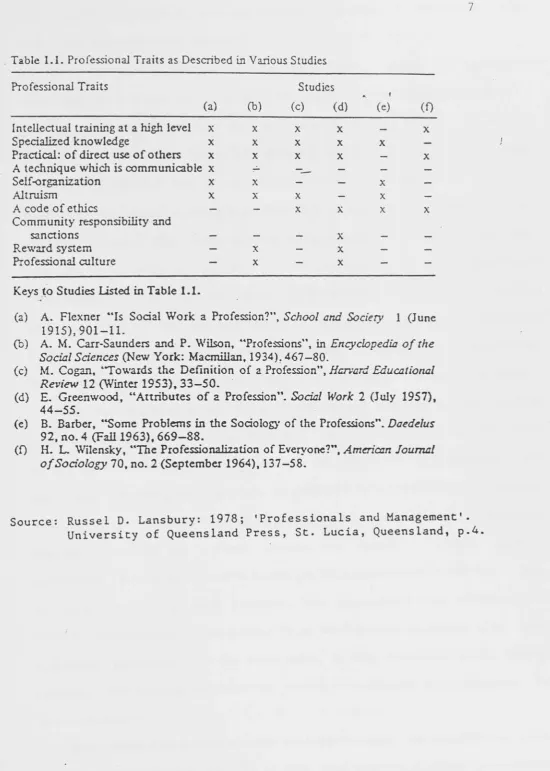
Table 1.1 lists different traits used in defining professions in
various studies. Not only different characteristics, but also
differences regarding the importance attached to them, create problems
when one tries to relate these elements to a specific occupation.
The basic weakness of the trait approach lies in its limited
utility. The traditional ideology about the professions has assumed that
because they involve such characteristics as trust, ethical codes, and a
service ideal, professions "deserve" higher status. Any attack on the
professional model is seen as an attack on the legitimacy of a favoured
status for the professions. Thus, the definitional attempts themselves
seem to involve more than an effort to develop an ideal type in the
Weberian sense, but also an ideal type in valuative sense.
This is evident in the studies on professionals within the
bureaucratic system. Beyond a "taxonomic" view of the professions, some
writers have sought to analyze the professions in terms of a process of
institutional or organizational development (Wilensky, 1964; Johnson,
1972) or by the recognition of its status by the state (Friedman, 1962;
Elliott, 1972). Wilensky defined a profession as follows:
"Any occupation wishing to exercise professional authority must find
a technical basis for it, assert an exclusive jurisdiction, link both
skill and jurisdiction to standards of training, and convince the public
that its services are uniquely trustworthy. While this traditional model
of professionalism, based mainly on the "free" professions of medicine
and law, misses some aspects of the mixed forms of control now emerging
Professional Traits
Studies
. (
(a)
(b)
(c)
(d)
(e)
(f)
Intellectual training at a high level x
X X X XSpeci^ilized knowledge x
X X X X —Practical: of direct use of others x
X X X — XA technique which is communicable x
r^ — — —Self-organization x
X — — X —Altruism x
X X — X —A code of ethics -
— X X X XCommunity responsibility and
sanctions -
— — X — —Reward system —
X — X — —Professional culture -
X — X — —Keys to Studies listed in Table 1.1.
(a) A. Flexner "Is Social Work a Profession?", School and Society 1 (June
1915), 901-11.
(b) A. M. Carr-Saunders and P. Wilson, "Professions", in Encyclopedin of the
Socinl Sciences (New York: Macmillan, 1934), 467-80.
(c) M. Cogan, 'Towards the Definition of a Profession", Hcrvard Educational
Review 12 (Winter 1953), 33-50.
(d) E. Greenwood, "Attributes of a Profession". Sodul Work 2 (July 1957),
44-55.
(e) B. Barber, '^ome Problems in the Sociology of the Professions". Daedelus
92, no. 4 (FaU 1963), 669-88.
(f) H. L. Wilensky, "The Professionalization of Everyone?", American Journal
of Sociology 70, no. 2 (September 1964),\31-si.
[image:19.609.40.591.45.817.2]1. The job of the professional is "technical", based on systematic
knowledge or doctrine acquired only through long prescribed training.
2. The professional adheres to a set of professional norms.
But neither of these criteria for a profession gives a clear
empirical referent. For instance, the notion that professional training
must be prolonged, specialized, and have a theoretical base, is not
precise enough. How long, and how theoretical and specialized must
training be in order to qualify for the professional label. Specifying
professional norms is even more problematic, since norms covering
relations with clients and colleagues do not provide a clear demarcation
between professional and non-professional occupations. Occupational
groups trying to upgrade their status can copy them with relative ease.
Many authors have noted that most recognised professions have gained
legal protection by the State. Friedman (1962 : 144) distinguished three
levels of the recognition by the state: registration, certification, and
licensing. Professionals wanting to practise in a particular occupation
usually must be registered by an official body, acquire a certificate
stating that he has certain skills, and obtain a licence from a
recognised authority in order to engage in a particular activity. This
is very formal, legalistic approach. Some occupations that would not be
usually classified as professional (e.g. builders or plumbers) also have
licensing procedures. On the other hand, in many countries there is no
provision for denying the right of practice to someone not registered in
those trades.
Most social scientists agree that professions are occupations with
special power and prestige. It is true that most established professions
to do with the professional distinctiveness. Attributes of special
status and prestige imply that the professions are linked to the system
of social stratification. Professionals can be viewed as constituting a
class, especially if class is reduced to indicators such as
socioeconomic status and occupation. However, I would rather place them
in the stratum of educated people, or intellectuals in Mannheim's terms,
in contrast with the Marxist tradition.
Attempts to define professions in ideal-typical terms fail because
of several methodological and operational difficulties.
1. Attributes identifying a person as a professional may have only an
approximate fit, and may differ from the self-image of professionals.
2. Any resulting division of occupations into professional and
non-professional is a dichotomy that seems unnecessarily rigid in view of
variations in such attributes.
3. Any list of attributes, does not address the process of
professionalisation, namely the strategies used to secure higher
occupational status.
Moore (1972) has suggested that professionalism should properly be
regarded as a scale rather than a cluster of attributes. Such a scale
should be defined by several characteristics:
1. professional practice is a full-time occupation (a necessary
condition to high ranks on the scale of professionalism);
2. professional qualification involves commitment to a calling;
3- professionals are distinguished by various signs and symbols, often
in formalised organizations;
practice of an occupation;
6. the professional proceeds by his own judgment and authority, and thus enjoys autonomy.
These characteristics are not of equal value, and can be regarded as
points along a scale of professionalism. However, the notion of a scale
of professionalism, although important theoretically, adds little
analytical leverage for the study of the professions. There is the
already mentioned disadvantage of dichotomising professional from
non-professional occupations. Furthermore, failure to meet one criterion on
the scale has no necessary implications for failure on others. So there
is the empirical problem of sorting occupations according to such
criteria.
An attempt to solve the definitional problem from an alternative
perspective was made by Klegon (1978). He argued that the ability to
obtain and maintain professional status is closely related to concrete
occupational strategies and to wider social forces.
"...the way to understand the dynamic of the professional claim is
to examine the relationship of the occupation and its practitioners to
other aspects of the social structure ... Occupations may differ along
such factors as status, degree of control, organization, influence, and
so forth" (Klegon, 1978: 268),
According to Klegon, such a perspective leads to a consideration of
the social meaning of occupational tasks, the resources for the
emergence and continuation of professionalism, and the social
consequences of professionalism. However, he avoids any explicit
definition. In fact, he gives an unsatisfactory explanation of
profession", which in his term is an occupation that has gained
On the basis of different attempts in defining professions, many
sociologists studying particular professions or professionals in general
have developed their own definition, to serve as the most useful
analytical tool for their own purposes. In the same way, I now elaborate
my argument about professions for the limited purpose of this study.
Professions represent a limited number of prestigious but varied
occupations whose members have some kind of higher education such as
university training (or are involved in acquiring such training) and who
are practising in the area of specialization. However, the professions
share characteristics of greater specifity than higher education alone.
They may share common ethics, values, traditions, etc., but all such characteristics are not treated by me as definitional ones.
Apart from speculation about concepts such as profession, professionalisation or deprofessionalization, it is useful to study the
phenomenon of the professions in a given time and society. I find
particularly interesting for research purposes that aspect of the
professions that might explain how they function in the wider social
structure. If there is a close relationship between performance and
attitudes, it is worthwhile studying both, and their relationship.
This study focusses on such problems as images of professional
prestige, attitudes towards own profession, job satisfaction, and
political preferences among professionals. These problems are then
related to various structural variables and used to elaborate a wider
concept of occupational commitment. After reviewing the sociological and
some psychological approaches to the theory of commitment, I develop a
model of professional commitment, which serves as a guide to the
empirical part of this study.
Multidimensional concept of occupational coimnitment.
The early concept of commitment was concerned with the process of
identification with occupation. This process became theoretically
strategic for social scientists, particularly social psychologists, some
decades ago. Individuals identify themselves in terms of the names and
categories current in the groups in which they participate. Becker and
Carper (1956: 341) wrote that:
"By applying these labels to themselves they learn who they are and how
they ought to behave, acquire a self and set of perspectives in terms of
which their conduct is shaped".
It is theoretically useful to break the concept of identification
down into its components, in order to provide an analysis of specific
problems of social structure and personal (or group) development.
My work attempts such a breakdown for an identification with one's
profession, and work. The purpose is to describe, by comparing four
professional groups over time, some of the elements in the process of
identification with an occupation, or to put it more concisely,
occupational commitment.
The four professional groups in my study are compared in terms of
major dimensions of commitment such as:
(a) evaluation of own occupational prestige relatively to other
professions;
(b) reasons for choosing a particular profession;
(c) work satisfaction and dissatisfaction; and
(d) political attitudes in the context of occupational commitment. A brief discussion of each component, as well as the theoretical
appropriate chapters.
The term "commitment" enjoys an increasing vogue in sociological
discussion. Sociologists use it in analyses of both individual and
organizational behaviour. They use it as a descriptive concept to mark
out forms of action characteristic of particular kinds of people or
groups. They use it in analyses of a wide variety of phenomena: power,
religion, occupational recruitment, bureaucratic behaviour, political
behaviour, and so on. However, there are substantive differences between
the way that I employ the concept of commitment in the context of
occupational commitment.
Commitment theories
Abramson, et al. (1958: 16) discuss the concept of in social power
and specify its broad basis in the analysis of lines of action. They
term this broad domain commitment theory. The presence of sanctions, in
their opinion, brings about the decision to act. A commitment they
describe in terms of the line or lines of action, not objectives or
goals, that will probably be followed. Commitment is variously
understood, as:
1. the heightening of the probability that an action will be undertaken;
2. an ordering of the likelihood of actions; or
3. a condition of heightened predictability of action (Abramson, 1958:
16) .
The result of the commitment is to change the lines of action
available to each of the competing actors. The existence of commitment
implies an expectation. Where the two exist within corresponding actors,
and are bound together through a commitment [line of action], the
condition of authority exists (condition of power).
when a person, by making a side bet, links extraneous interests with a
consistent line of activity. An analysis of the value system within
which side bets are made is necessary to understand commitments fully.
Becker considers the uses to which the concept of commitment has
been put and the possible reasons for its increasing popularity. He
indicates the nature of social mechanism to which the term implicitly
refers, and develops a theory of the social processes involved in its
operation. Commitment is used to explain what Becker has called
"consistent behaviour". There are many examples characterising this kind
of behaviour, for which commitment seems to be useful as an explanatory
variable.
To begin with, it persists over some period of time: for persons
following the same political attitudes, remaining in the same occupation,
and so on., commitment involves a consistent line of action. This notion
seems to imply a rejection by the actor of alternative courses open to
him by choosing that which best serves his purposes.
In my study observation of the behaviour and attitudes of
professionals at various stages of their career is of major importance.
So the concept of consistency in human behaviour deserves a few comments.
Consistency in human behaviour
Sociologists still seek an explanation of consistent behaviour.
Some of the most clearly sociological explanations (in the sense of being
based most firmly in the process of social interaction) have been
theories built around the related concepts of social sanction and social
control. These theories propose that people act consistently because
an activity of some kind is regarded as right and proper in their society
or both, to do otherwise. Such a theory, however, has no ready
explanation of consistently deviant behaviour. So many sociologists are
dissatisfied with current explanations of consistent human behaviour.
Use of the concept of commitment in current sociology constitutes an
attempt to solve the problem of explaining consistent human behaviour in
a sociological way (i.e. Becker's side bet).
As Becker argues (I960: 36), independent observations of behaviour
explain its consistency. Such observations consist of:
1. prior actions of the person that show some initially extraneous
interest in following a consistent line of activity;
2. a recognition by him of the involvement of this interest in his
present activity; and
3. the resulting consistent line of activity.
Commitments are not necessarily made consciously and deliberately.
For a complete understanding of a person's commitments an analysis of
the value system is needed.
It is important to recognise that values differ within subcultural
groups in a society. Many side bets producing commitment are made within
systems of values of limited provenance (regional, ethnic, social class,
occupational differences, sex, age etc.). Becker's conception of
commitment has certain disadvantages for empirical and theoretical work,
but it provides the tools for assimilating the common-sense notion that
people often follow lines of activity for reasons quite extraneous to the
activity itself.
From the psychological perspective, commitment is essentially a
subject of "micro-theory" (Kiesler, 1971) and most researchers
concentrate on what sociologists would consider one aspect of commitment,
i.e. behavioural commitment, mostly of the social variety. Their
dichotomous one. That is, people are noire or less conunitted to some
behaviour, rather than being simply committed or not. Kiesler
understands commitment as "pledging or binding of the individual to
behavioral acts" (Kiesler, 1971: 30). The Kiesler and Sakumura experiment
is designed to indicate degree of commitment and to shed light on the
interpretation of the behaviour and its implications for attitudes. They
found "... that the less one pays a person for performing an act
consistent with his beliefs, the more committed he will be to the act.
The greater the commitment to consonant behaviour, the greater the
resistance to subsequent attack on related belief" (Kiesler, 1971: 34).
Work and occupational commitment
The concept of commitment is often understood as work commitment,
and explained in terms of attitudes towards work. Safilios-Rothschild
(1971), and Haller and Rosenxnayr (1971) investigated working mothers'
feeling about work, using the concept of work commitment. This concept
employed such principal variables as motivation for employment, intention
to work in future, and work satisfaction. It can be analyzed adequately
only if the 'social context' in which work participation takes place is
taken into consideration.
From the more psychological perspective, Masih (1967: 653-54)
defined work commitment as :
"(a) the degree to which a person is career motivated;
(b) the degree to which an occupation is important as a source of
satisfaction; and
(c) the degree of priority ascribed to occupation among other sources
Two features of these definitions are particularly important: the
work role as a source of identity in adulthood and the "distribution" of
subjective investments among adult roles.
An interesting approach to the concept of work commitment has been
presented by Bielby and Bielby (1984), who integrated work commitment as
a source of intrinsic satisfaction - into the study of sex-role attitudes
and women's employment. They showed work commitment to be both stable
over time and empirically distinct from sex-role attitudes. Bielby and
Bielby reviewed previous attempts to operationalize work commitment and
presented a measurement model based on multiple indicators of the construct
(commitment).
With regard to previous investigations, they define work commitment
"as the centrality of the work role as a source of intrinsic satisfaction
relative to other adult roles ... work commitment is a unidimensional
construct underlying these expressions" (1984: 235). The best
measurement of work commitment is accomplished with multiple indicators
that capture the expectation, satisfaction and distributional features of
the underlying unobservable construct. Bielby and Bielby argue that, as
a measure of commitment, a construct should exhibit stability over time,
and have discriminant validity with respect to sex-role attitudes.
Drawing upon research on women and work, they developed a model of the
causes and consequences of work commitment that emphasises its
relationship to socialization, schooling experiences, and adult family
and work behaviour. As hypothesized, work commitment had a modest impact
on employment behaviour, but sex-role attitudes did not.
Professional commitment, as examined by Evans and Laumann (1983) ,
stands in contradiction to conventional wisdom about lifelong vocational
commitment to the profession. It appeared to be problematic and
"...do differ in systematic ways with their cognitive foundations and
modes of work and because these differences demonstrably have
characteristic impacts on the patterning of entries and exits
occupations also differ in systematic ways with respect to their relative
levels of internal dissent on such matters as licensure, subjective
identification with the occupation, occupational self-regulation, and
standardization and predictability of occupational performance." (Evans
and Laumann, 1983: 25). They found out that life-long commitment to the
practice of a profession appeared to be rather more the exception than
the rule (possible and important exceptions law, medicine, pharmacy and
dentistry).
So far in this Chapter we have looked at different approaches to the concept of commitment and at attempts to operationalize the concept of
commitment. Becker's theory of side-bets has dominated much of the
sociological critique. As a result there is a significant body of empirical evidence testing this theory.
Ritzer and Trice (1969) studied the relationship between
occupational and organizational commitment among personnel managers.
They tested hypotheses concerning the relationship between commitment and
various background factors (such as age, marital status, salary) which
they treat as side bets. Their results cause them to reject Becker's
theory.
They suggested that organizational commitment is a psychological
phenomenon, based on the subjective meaningfulness of an occupation and
an organization, rather than a structural phenomenon. Where an
occupation is partly bureaucratic and partly professional (e.g. personnel
managers) a dual commitment to both occupation and organization is
Another study by Aranya and Jacobson (1975) examined the theories of
both Becker, and Ritzer and Trice in regard to system analysts (personnel
administration) in Israel. While the hypotheses based on Becker's theory
gain little support, the hypotheses based on Ritzer and Trice's theory
were fully accepted. However, Aranya and Jacobson suggest further
investigations (on more than one occupation) which may provide additional
insights into the relative explanatory value on these theories of
commitment.
Commitment is a complex phenomenon, rather psychological in tone,
and many approaches taken to the study of commitment have focussed very
specifically upon behaviour and its relationship to attitudes.
Commitment is useful when studying occupational intentions, adds a
dynamic perspective to role theory, and it is closely related to work
satisfaction.
In my study of the professions, commitment is observed as a process
based on identification with the particular profession. Each profession
carries a great deal of symbolic meaning, specific tasks and ethics,
skills and knowledge, which all tend to be incorporated into identity.
Occupational commitment (identity) contains an implicit reference to
the person's position in the larger society. If professionals do have
certain professional characteristics, they should contribute to their
occupational commitment. The tasks that constitute the occupation (e.g.
medicine, law) should generate commitment to this occupation.
In this Chapter, I have outlined the background for the hypotheses
and research questions in terms of the concepts of profession and
commitment theory. In the next Chapter I will focus on the central
problem of this study, hypotheses and research questions, methodological
CHAPTER II
SELF IMAGE, OCCUPATIONAL COMMITMENT AND POLITICAL ATTITUDES
AMONG PROFESSIONALS.
Outline of the analysis
The literature on the sociology of professions has not produced a fully developed theory of the professions, as indicated in Chapter I. Its orientation has been consistent with the dominant functional paradigm. This also applies to studies of the process of professionalisation and the ways in which professions enjoy status and power in society. The most neglected factors have been concerned with the issues of how professions are affected by economic and political developments and how they respond to these developments. As a result of the changes in the larger society, professionals also change in terms of their professional performance, attitudes, and commitment to the profession. Previous studies have not given much attention to the comparative analysis of the different professional groups in respect of attitudes towards the profession itself, satisfaction deriving from work, and attitudes external to the profession. What follows attempts to fill some of these gaps, at least for Australian professionals.
Development of the commitment model
Commitment is a multidimensional concept, as noted in Chapter I. Its measurement is problematic, and further efforts to standardize it for particular research purposes are needed. One strategy is to develop specific measures for each dimension of commitment, which may vary from study to study, and then relate them to the underlying theoretical concept. This is the approach adopted here, and I distinguish the following dimensions of occupational commitment:
1. image of the profession; 2. occupational choice; and 3. job satisfaction.
Image of the profession is expressed in terms of its relative prestige perceived by a particular professional group and other professionals. Occupational choice, or reasons for studying at a given professional faculty, is measured by using factor analysis to derive scores from items associated with the area of inquiry (reasons for choosing profession). It facilitates comparison of levels of involvement in the particular profession for individuals and groups.
Job satisfaction is measured in the same way as occupational choice, except that complex aspects of the job form the basis of the factor analysis.
F I G U R E 2.1. H Y P O T H E T I C R L nODEL OF OCCUPflTIONRL COnniTflENT
" O C C U P R T lONflL COnrilinENT" flPPEflRS IN THIS HOOEL flS
R T H E O R E T H I C R L C O N S T R U C T RND IS MEflSURED INDIRECTLY. riERSURED R E L R T I O N S H I P S ARE S H O W N IN C O N T I N U O U S LINES/
H Y P O T H E T I C A L R E L A T I O N S H I P S ARE S H O W N IN DOTTED LINES. "BEHflVIOURflL P A T T E R N S RND A T T I T U D E S " R E S U L T FROn
[image:34.609.55.579.53.811.2]The arrows on the hypothetical model of coininitment indicate the
expected relationships. This model forms the basis for the analyses put
forward in this study. I should also add that the construct of
commitment has limited applicability, because it is only possible to
observe when the same individuals are going through the full process of
commitment, i.e. from initial attraction to the profession to
satisfaction with practice.
Hypotheses and methodological issues
The central purpose of this thesis is to examine different professional groups in relation to their occupational commitment in order
to establish empirical patterns. The main argument of this study is that
Australian professionals respond to similar demands in the socio-economic
market. Despite undergoing different kinds of occupational training they
can be regarded as a homogeneous group in respect to fundamental
dimensions of occupational commitment. At the empirical level this
suggests that:
1. Professionals have an accurate understanding of the social mechanism
of status attainment. Consequently their perception of professionals'
prestige do not differ by profession;
2. they have similar motivations when making their career decisions;
3. in their professional practice they experience comparable problems
and satisfactions stemming from work;
4. they tend to have similar attitudes outside professional practice
itself, for example, political preferences; and
5. the social background of professionals influences to some extent
their image of the profession, choice of field, job satisfaction, and
political preference.
Operationalization involves two comparative procedures. Comparisons
career decisions, work satisfaction and political preferences. Also, it IS possible to trace changes in attitudes over time. So, issues such as perception of prestige and political opinions can be treated retrospectively, or over time, utilising the longitudinal aspect of the study design.
The longitudinal method deserves a few comments at this point. It provides a tool for understanding change and process, the behavioural sciences (Nesselrade and Baltes, 1979). Longitudinal methodology has been defined differently in various disciplines. Sociologists,for instance use panel or wave designs (e.g. Featherman, 1979). But however the method is defined, the sine qua none of longitudinal research is that "the entity under investigation is observed repeatedly as it exists and evolves over time" (Nesselrade and Baltes, 1979: 4).
The main rationale for longitudinal research is the development of theoretical explanation. Of greatest salience are theories pertaining to intraindividual change, the identification of interindividual differences, analyses of behavioural change, and the identification of the causal determinants of such changes.
The analysis in my study revolves predominantly about the second rationale, i.e. the identification of change in different individuals (professionals), and the degree of homogeneity among different groups. However, I also attempt to assess, and to account for, interrelationships among behavioural variables as they change. For example, analyses of self-prestige evaluation are based on five repeated observations, so that determinants of significant change over time in prestige evaluation can be elaborated (Chapter 4).
survey), there is no need to employ cross-sectional techniques to capture age changes and cohort differences. The simple longitudinal design of this present study, while it has some restrictions (Baltes et. al., 1S77: 120-131), has the major advantage that it gives a direct estimate of interindividual differences and intraindividual change.
So far as change-measurement is concerned, the approach taken here is to describe change between two occasions, or two points in time. I also use a multivariate approach to focus directly on changes in relationship among variables (e.g. the analysis of political preference at various times permits an assessment of differences in the influence of several variables; see Chapter 7).
Data
The data for this investigation were drawn mainly from the longitudinal study, "Professions in Australia" which spans a period approaching twenty years (from 1965-1984). The study was designed and conducted jointly by three principal investigators: Don Anderson, John Western, and Trevor Williams. Later on Peter Carpenter joined the team. Over this period the project has been assisted with grants from the Espanda Educational Trust, The Australian Research Grants Committee, and the Education Research and Development Committee.
Faculty ANU Melb Monash NSW Qld WA
Engineering x x x x
Law x x x X X
Medicine x x x
Teaching x x x
Virtually all students who started full-time courses in these
universities were included in the sample. So it is not a random sample
in any sense. Representativeness of the sample and research aims have
been discussed in many places by the principal investigators (e.g.
Anderson, 1980; Western, 1985). Students in a particular faculty (e.g.
engineering, law and medicine) are identified as "future professionals"
in these fields. In the case of teaching, where most students first
complete an arts, science of economics degree before studying education,
prospective teachers were identified by including all Education
Department studentship holders. By and large, students at these six
universities (there were only nine Australian universities in the
mid-1960 's) are a reasonable representation of all students of that time.
Information was obtained through self administered questionnaires
four times during the study period, and then by mail questionnaires at
the next four follow-ups. For the purposes of this study, students who
began their professional courses at university are included in the
analysis, only if they graduated and were practising in their profession
in 1984, or had substantial pre-requisites for such practice, (i.e.
qualifications, but were not working when interviewed).
Supplementary descriptive data are drawn from the one per cent
public use sample of the 1981 Australian Census. This sample covers the
such as employed professionals, and, among them, four specific professions: doctors, lawyers, engineers, and teachers. Several other sources of information are also used such as reports of Commonwealth Tertiary Education Commission and the Department of Employment and Industrial Relations, to provide further background information.
Plan of the thesis
The basic research aims of this thesis are elaborated in Chapters 4, 5, 6, and 7. First three chapters deal with theoretical and descriptive issues.
Chapter 3 describes and analyses the socio-demographic characteristics of Australian professionals using data from the 1981 Census. It also describes the research sample using the Professions in Australia surveys. The first part of this Chapter describes various socio-demographic factors affecting professionals' incomes. Chapter 4 focuses on images of the professions and investigates the subjective evaluation of professionals' prestige at various times in their careers. Stability and change of prestige self- evaluation is discussed in terms of a structural theory of occupational prestige that assumes prestige evaluation is based predominantly on rewards, occupational factors, and authority. Chapter 5 defines a complex measure of "reasons for studying" for students in the different professional faculties: medicine, law, engineering and education.
namely satisfaction and dissatisfaction derived from work. Different elements of job satisfaction are analysed in order to establish more complex measures (using again the two-stage principal component method). I then discuss differences and similarities in levels of overall job satisfaction among the four professions. I also deal with social background characteristics as correlates of job satisfaction.
Chapter 7 is designed to test the extent of homogeneity within a profession in terms of attitudes external to the profession itself. In
it, I discuss political attitudes within the narrow social groupings such as professional groups. I also examine political preferences at two points in time: during the study period and fifteen years after, when they are established in their professions. This span provides a measure of relative stability in voting preferences. A multiple regression analysis relating social characteristics and other socio- psychological variables to political preferences provides a summary account of the relative explanatory power of each variable.
CHAPTER III
AUSTRALIAN PROFESSIONALS
The Australian-born writer, Ivan Illich, in a series of books over
the last decade or so has attacked the professions and established
institutions, including the education system, health services, the
church, and the military. He argued that the best education is
self-education and self-education through work in the community. Pouring money into
the established education industry, in his view, is a waste of time.
After attacking the education profession, he extended his criticism to
the whole spectrum of professionals, challenging their power and the
status quo in contemporary societies.
Similarly, Johnson (1972) has questioned the whole notion of a
"true" profession (i.e. dedicated, altruistic servants working for the
best interests of the whole community), an image used to justify high
status and income in the public mind.
Entry into professional occupations is strictly conditioned by
specialized training in tertiary education institutions (T.E.). But a
more general question arises, namely whether the higher education of
professionals improves their market situation and thus their income.
Although this problem deserves a separate study, I have elaborated a
substitute for it in the first part of this Chapter. In addition to a
descriptive overview of Australian professionals, I analyse the main
determinants of professionals' incomes.
Part 1
Income and socio-demographic characteristics of Australian professionals. Among sociologists in recent years it has become conventional wisdom that levels of education and income are poorly correlated. Jencks et. al. (1979) have written:
Neither family background, cognitive skill, educational attainment, nor occupational status explains much of the variation in men's income.
Measurement and Data
Data from the 1981 Census relate to the working population as a reference group, all employed professionals, and among the latter four specific professions: doctors, lawyers, engineers, teachers. The measure of individual income is gross annual earnings in dollars from the respondent's major employment. Because of the way the census questionnaire was constructed and the data coded (14 categories), real income may be under-reported, especially for groups with high qualifications where bonus payments, and income from multiple sources may apply. For simplicity all income categories are recorded into 7 groups and the mid-point of each category is used to calculate averages.
Since age is a rough proxy of work experience, I introduce age as an independent variable explaining differences among professionals' incomes. As a measure of education I have used qualification: having at least a diploma from the tertiary institution or not (Stuart et. al., 1980). Parallel analyses were conducted within different age bands separately for doctors, engineers, lawyers and teachers, as well as for all four professions together. The definition of other variables used in the analysis are given in Table 3.4. In addition to these descriptive statistics, I use a hierarchical regression model which assumes that effects are linear and additive (Hanushek and Jackson, 1977).
Using the 1 per cent public use sample of individual records from the 1981 Australian Census, I selected professionals using the following criteria:
1. at least a diploma from a higher educational institution (all professions)
(four professions)
These selection criteria significantly reduced the number of
professionals in the analysis but the aim was to include more or less
homogeneous groups in terms of achieved level of education and employment
status, to facilitate comparative analysis with the "Professions in Australia" survey. The groups vary in terms of age, occupational status,
number of hours worked (this variable is crudely measured in the
census), gender, and ethnic origin. Most findings derive from separate
analyses of the total working population, all professionals (that is,
people with diploma), and the four professional groups. By treating each
group separately, it is possible to locate different impacts of
explanatory variables for some groups, which is the aim of the analysis.
For descriptive purposes, men and women are analysed separately (Table
3.1), but in later analyses (Table 3.2, 3.3, 3.7 and figures 3.1, 3.2,
3.3), both sexes are grouped together.
Descriptive Overview
Before I proceed with the analysis, some basic descriptive data on
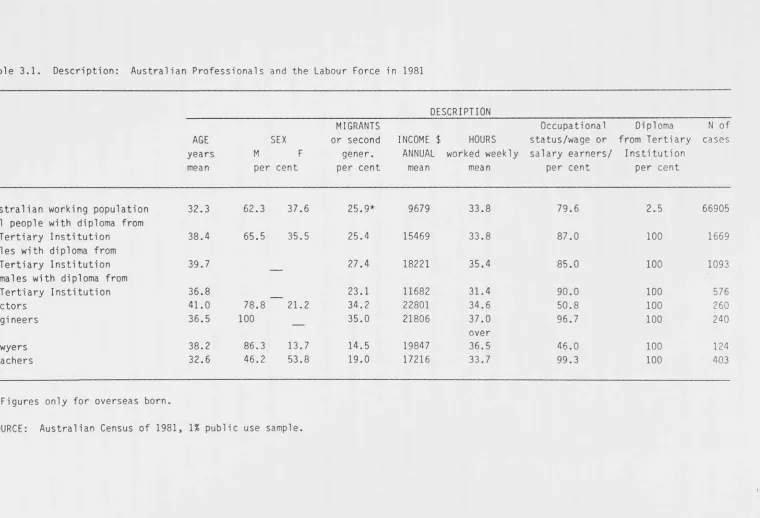
socio-economic characteristics require discussion (see Table 3.1). All
references are to the total working population in Australia in 1981.
Among all working people in Australia, more than two per cent of
people have obtained at least a diploma from a tertiary institution. The
average age of these Australians is 38 years, or 6 years older than the
rest of the working population. The differences between number of males
and females is thirty percentage points in favour of males. A quarter of
professionals are either first or second generation migrants from
non-English speaking countries. Among people with higher education a migrant
DESCRIPTION
MIGRANTS Occupational Diploma N of
AGE SEX or second INCOME $ HOURS status/wage or from Tertiary cases years M F gener. ANNUAL worked weekly salary earners/ Institution
mean per cent per cent mean mean per cent per cent
Australian working population 32.3 62.3 37.6 25.9* 9679 33.8 79.6 2.5 66905
All people with diploma from
Tertiary Institution 38.4 65.5 35.5 25.4 15469 33.8 87,0 100 1669
Males with diploma from
Tertiary Institution 39.7 27.4 18221 35.4 85.0 100 1093
Females with diploma from
Tertiary Institution 36.8 23.1 11682 31.4 90.0 100 576
Doctors 41.0 78.8 ~ 21.2 34.2 22801 34.6 50.8 100 260
Engineers 36.5 100
—
35.0 21806 37.0
over
96.7 100 240
Lawyers 38.2 86.3 13.7 14.5 19847 36.5 46.0 100 124
Teachers 32.6 46.2 53.8 19.0 17216 33.7 99.3 100 403
* Figures only for overseas born.
SOURCE: Australian Census of 1981, 1% public use sample.
[image:45.850.54.815.73.591.2]education (Anderson and Vervoorn, 1983: 107). They conclude that,
overall, students with overseas-born parents participate in higher
education at a higher rate than students of Australian origin.
Most people with diplomas are wage or salary earners (87 per cent),
which is close to the figure for workers with a lower level of education
(80 per cent). They work on average 34 hours weekly, the same number of
hours as the rest of the working people but their income is 60 per cent
above the average income of the whole working population.
Females with diplomas are slightly younger than male professionals
(3 years younger) and there are fewer of them with migrant background
than men. On average a woman's weekly time spent in work is 3 hours
shorter than their male counterparts. Similar results were found from
the 1976 Census (Jones, 1983). Women are more likely to be employed as
wage or salary earners, with an income gap of $6500 compared to men. If
male income is taken as 100 per cent, females on average get 74 per cent
of male incomes.
Looking at the selected professions (doctors, engineers, lawyers,
teachers) we can see that there is a substantial inequality in the
male/female ratio. Except for teachers, males predominate or even
totally dominate (as among engineers). It is interesting to note the
high proportion of doctors and engineers in Australia with a migrant
background. The number of people with non-English speaking background in
these two professions is 10 per cent higher than among other
professionals with diplomas and around 14 per cent higher than among the
total working population. Doctors and lawyers are almost twice as likely
to be self-employed or employers compared with the rest of the
professions. Engineers have the longest working week, teachers the
Income, qualifications and job
To sharpen this portrait of Australian professionals, we can relate
qualifications to income and weekly hours of work. Table 3.2 and Table
3.3 provide these data. To construct Tables 3.2 and 3.3, I included all
those defining themselves as doctors, engineers, lawyers, or teachers.
Because of the small number of respondents in each profession, all are
grouped together for further analysis.
The issue is to relate income earned and hours worked per week among
professionals according to whether their qualifications match their jobs.
We therefore defined these groups:
1. those with a degree and employed in the relevant profession.
2. those with a degree but not working in the relevant profession.
3. those with no degree from a tertiary educational institution
but practising one of the four professions.
The results for income are not surprising. The most successful
professionals financially are those with a job consonant with their
qualifications. They had high income and a shorter working week compared
with others with the same qualification but practising outside the
profession. A large gap in income exists between those with diplomas and
those people without a university degree but working in one of the four
professions. In the last-mentioned group only 10 per cent reach the
highest category of income. They are more likely to appear in the middle
category of earners (25 per cent have annual income around $15,000).
It should be noted at this point that for two occupations,
engineering and teaching, a diploma from a tertiary institution is not a
prerequisite for practising in that profession. Having higher education
enables one not only to work as a professional but also to achieve high
income. Table 3.3 shows that the percentage of people working long hours
Professionals who: 5000 8000 12000 15000 20000 24000 26000 more % percentage
1. Have a diploma and 2.9 2.5 10.3 17.1 20.4 15.4 31.4 27.1 work in the profession
2. Have the diploma but 9.2 10.5 15.7 10.3 16.0 10.5 27.5 8.2 do not work in the profession
3. Have no diploma but work 8.1 6.1 19.5 25.1 20.3 10.8 10.1 64.7 in the profession
Total (four professions) % 6.7 5.5 16.7 21.8 20.0 12.0 17.3 100
P r o f e s s i o n a l s w h o :
H o u r s w o r k e d w e e k l y 10 2 0 3 0 37 +
p e r c e n t a g e
T o t a l
1 . H a v e t h e d i p l o m a a n d w o r k in t h e p r o f e s s i o n
3 . 1 2 . 5 1 1 . 4 8 2 . 9 2 7 . 3
2 . H a v e t h e di p i o m a b u t
d o n o t w o r k in t h e p r o f e s s i o n
6 . 1 5 . 5 4 . 0 8 4 . 3 8.0
3 . H a v e n o d i p l o m a b u t w o r k in t h e p r o f e s s i o n
6 . 7 5 . 1 2 1 . 4 6 6 . 7 64 . 7
T o t a l ( f o u r p r o f e s s i o n s ) % 5 . 7 4 . 5 1 7 . 3 7 2 . 5 1 0 0
S O U R C E : A u s t r a l i a n C e n s u s o f 1 9 8 1 , 1% p u b l i c u s e s a m p l e .
T a b l e 3 . 4 . Q u a l i f i c a t i o n s (Dip) a n d w o r k in O c c u p a t i o n (Occ) for D o c t o r s , E n g i n e e r s , L a w y e r s and T e a c h e r s .
P r o f e s s i o n s N with d i p l o m a
N w o r k in o c c u p a t i o n
Ratio [* D i p / O c c
D o c t o r s 306 273 1.12
E n g i n e e r s 395 514 0.76
L a w y e r s 176 172 1.02
T e a c h e r s 501 2530 0.20
* The R a t i o of those w h o have a d i p l o m a to t h o s e w h o w o r k in the p r o f e s s i o n
[image:50.609.37.567.59.814.2]sample-Tables 3.2 and 3.3 indicate that three indicators together make up high income of professionals: degree, work compatible with the profession, and long work hours. It is of passing interest to note the proportion in each profession qualified at the university level. Table
3.4 is self-explanatory; so I do not discuss it in detail.
Effects on income
The explanatory model for professionals' income, shown in Table 3.5, includes the following variables: age, occupational status, hours worked weekly, sex, migrant origin, job in the profession, and diploma from tertiary institution. Income is significantly affected by most of these background
variables.-Age, occupational status, hours worked weekly and sex of the total working population can be regarded as important indicators of income (see Table 3.6 last column and Table 3.7 column e) . When the four professional groups with university diplomas are considered separately, the situation changes slightly. Age, for example, does not influence significantly doctors' income while for teachers it has a strong effect. One extra year (or seniority on average) means around $115 more in teachers' annual income. Differences in annual income brought about by age are shown in Table 3.7 first line, last 3 columns. One extra year makes a difference in income for professionals of around $135 compared with other working people.
Figure 3.1. Effect of Age on Average Yearly Income of Four Professional Groups
25000
20000
Income
in 15000 dollars
10000
5000
Doctors o - Engineers
Lavyers Teachers
•ir Average inconne
2 3 4 Age groups
1: 29 and below, 2:30-35, 3:36-45, 4.46 and over
Figure 3.2. Professionals: Effect of age on Hours Worked
Pwcent of people vorking 37 hrs i week
or more
Doctors
Engineers
Lawyers
d Teachers
d All Four Professions
1: 29 and below, 2:30-35, 3:36-45, 4:46 and over
Percent of people earning vage or
salary
• Doctors S Engineers ^ Lawyers
H Teachers
D All Four Professions
1: 29 and belov, 2:30-35, 3:36-45, 4:46 and over