EVALUATION OF STRUCTURAL CHANGES OF
MICROSTRUCTURE AND PROPERTIES OF RAIL
FASTENING SYSTEM SKL-12 AFTER LONG-TERM
USAGE
Krzysztof Labisz, Jarosław Konieczny,
Łukasz Wierzbicki & Janusz Ćwiek
Silesian University of Technology,Faculty of Transport, KrasinskiegoStr 8, 40-019 Katowice, Poland
[email protected], [email protected],
[email protected] & [email protected]
Izabella Zaborowska
Silesian University of Technology, AkademickaStr2A,
44-119Gliwice, Poland.
ABSTRACT
Rail transport in Poland is one of the most dense one in Europe and exists form the end of the 18th century, however some issues concerning especially materials and its exploitation are still actual. There have been performed analyses in this paper concerning characterization of applied track infrastructure elementsin form of sleepers fastening system SKL 12 especially characteristics of the material after long-term usage. In this paper have been conducted investigations on the non-used and used fastenersby mind of classic material research methodology. The analysis was carried out based on the results obtained through research using light as well as SEM microscopy, EDS chemical microanalysis and Rockwell hardness testing.
General Terms
Material engineering, microstructure and fatigue of railway steel.
Keywords
Rail fastening system, sleepers, microstructure, ferrite, microstructure, mechanical properties, SKL12 rail steel.
1.
INTRODUCTION
which the railway machines were moved, but there was changed and improvedalso the rail infrastructure. Different types of fasteners are used to attach the track to the sleepers. There are many kinds of them, but the most versatile and functional are described in this work, knownas the elastic SKL 12 system. In this work are presented investigations concerning the authors own research shows primarily the structure and properties, which have been subjected to thematerial obtained from a used as well as non-used SKL fastener (obtained from the Gliwice Railway Station during its renovation), after few decades of usage. Samples of the material passed through a series of laboratory tests such as ordinary light microscope examination, scanning electron microscope microstructure evaluation (SEM), chemical microanalysis testing (EDS) and measurement of Rockwell hardness. This work is placed in the mainstream of current activities to analyze the quality of materials leading to improvements not only of the quality of the material itself, but also to streamline production, reduce susceptibility to damage, increasing the economy of use of the product and other aspects of the material and its processing or application.
2.
INVESTIGATION PROCEDURE
The aim of the performed research is the analysis of changes in the material of the elastic fastening element SKL 12 and comparing the results to the state of a new element not used in railway transport.The investigation tasks involve:
comparison of microstructure images of the material obtained from samples taken from the used and not used fastener,
an analysis of possible changes occurred in the chemical composition of the used material,
analysis of micro-hardness measurements,
Comparison and analysis of changes occurring after usage of the SKL 12 fastener.
It was assumed thefollowing research hypothesis, that the material of the elastic fastener will revealsignificant damaged and that there will appear in the microstructure numerous changes such as the presence of impurities, decrease of mechanical properties and the occurrence of not desired intermetallic phases and/or precipitates. In addition, it was assumed that the sample material will be a low qualitya material, which was produced few decades ago.
2.1
Material for investigation
For investigations was used a new elastic fastener SKL 12 delivered from the producer company FEZ as well asa ca 40 years used fastener SKL 12 obtained during the repair work of the railway station in Gliwice (see Figure 1). Each of them was cut into 12 samples, which are then mounted and prepared for further studies. The samples were tested for the reason to compare the corresponding pair in terms of their microstructure and properties as well as changes occurred during long time usageunder real conditions. The samples have been cut in the same adequate places in the horizontal and longitudinal direction, polished and then etched in 10% natal in room temperature.
2.2
Methodology
During the research works concerning the analysis of changes in the elastic fasteners – used and new – the following research methods were applied:
light microscope,
scanning electron microscope (SEM),
chemical composition investigation using the EDS method,
Fig 1: The investigated fasteners of the SKL 12system
3.
INVESTIGATION RESULTS
3.1
Microstructure investigation using light microscope
+
b) e)
c) f)
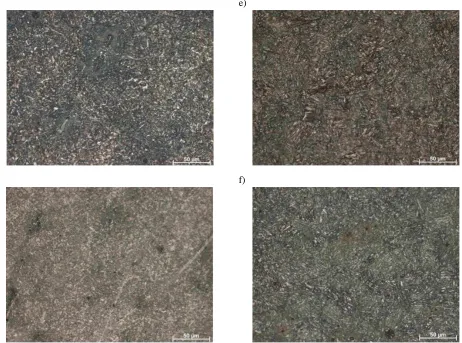
Fig 2: Microstructure of the non-used: a), c), e) and used b), d), f) fasteners of the SKL 12 system,
depending on the sampling place and direction
a)
b)
3.2
Microstructure and chemical composition investigation using scanning electron
microscope with EDS microanalysis
Another investigation, which was used for the samples is scanning electron microscopy. In Figure 4 are presented microstructures obtained during the examination of samples obtained from the non-used and used elastic tabs SKL 12 fastener. In these samples is very well visible fine-grained martensite structure present in this investigatedrailway steel, used for production of the SKL12 elements. The samples contain almost no precipitates in the micro-scale, the entire microstructure in all the investigated places is relatively homogeny with minor changes only resulting in slightly different size of the structure compounds. Within the sample structurethere are not detected any impurities. The grains of the used material are slightly elongated compared to the new fastener. In Fig. 4b are visible some impurities particles, as well as precipitate particles. Compared with the new fastener, the grains are elongated and slightly more densely distributed within the material.
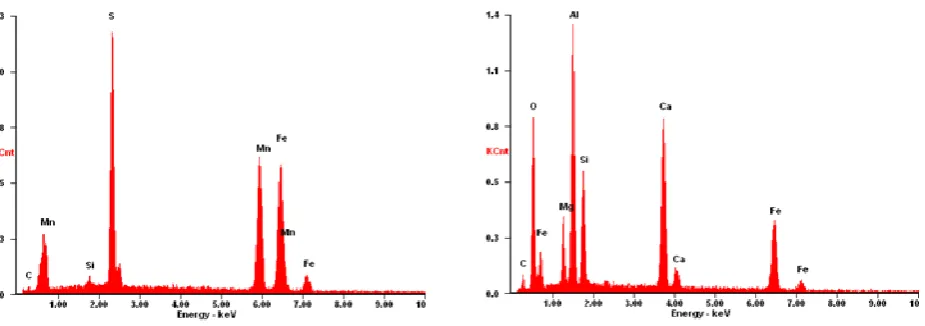
According to the EDS investigation results it can be state what changes have occurred within the material compared between the sample material obtained from the non-used and used SKL12 fastener. The most important issue is the change in the chemical composition of the material phases occurred as impurities as well as intermetallic phases or precipitates. Figures 5a and 5b shows the elements detected in the sample from the non-used 5a and used 5b.
a) b)
Fig 4: Microstructure in the non-used: a) and used b) fasteners of the SKL 12 system, SEM
The used material sample 1bs reveals numerous precipitates, consisting from the following elements such as: O, Mg, Al, S and Ca. The test results for this sample are shown in Figures5afor the non-used material and 5b for the used material, where the precipitates includes also such elements like S and Cu.
3.3
Rockwell hardness measurement results
Another study, which was obtained was the Rockwell hardnessmeasurement. According to data from the production company the hardness value of the material should be in the range 42-46 HRC. Figure 6presents the results obtained for each sample. According to this research, the average hardness of the non-used elastic SKL12 fastener is equal 48 HRC and in used element 45 HRC. Both values are within the established properties of the 50S2steel, as the material for the SKL 12 fastening system. The analysis of the results reveals that the general hardness of the non-used paw and the used ones is close to each other, but with different distribution within the entire element. This is clearly visible in Figure 6.
Fig 6: Hardness measurement results for the chosen places of the fasteners
4.
CONCLUSIONS
Analysis of the presented investigation results allows to conclude that the long-term usage of the SKL 12 fastening system does not affect the material in a significant way, ensuring originally obtained hardness. The study of mechanical properties suggest a slight change in hardness between the material of the non-used and used SKL 12 fastener.
Particularly the following can be found:
For the non-used elastic SKL 12 fastener the determined hardness is 48 HRC and for the used element 45 HRC, what is generally in the range of the allowed measurement error,
The structure of the non-used elastic SKL12 fastener occur a clear ferrite mesh in the top of the surface layer reaching a depth of 100 μm. However, in the used elastic SKL12 fastener the ferrite mesh has a residual character and reaches a depth of about 5 μm only,
The results of the tests carried out by mind of optical microscopy show that the particle size of the non-used elastic SKL12 fastener reaches from 8 to 10 μm, whereas in the used elastic SKL12 fastener the grain size ranges from 10 to 12 μm, depending on the measurement place in the fastener,
5.
REFERENCES
[1] Polevoi, E.V.,Volkov K.V., Kuznetsov E.P., Chudov E.N., Yunusov A.M. Differential Heat Treatment of Rails, Steel in Translation 44 (2014), 550-552.
[2] Ozgowicz W, Labisz K. Analysis of the state of the fine-dispersive precipitations in the structure of high strength steel Weldox 1300 by means of electron diffraction, Journal of Iron and Steel Research International, 18/1 (2011), 135-142.
[3] Kaikai W., Zhunli T., Guhui G., Xiaolu G., Misra R., Bingzhe B. Ultrahigh strength-toughness combination in Bainitic rail steel: The determining role of austenite stability during tempering Materials Science and Engineering: A, 662 (2016), 162-168 .
[4] Ryjáček P., Vokáč M.: Long-term monitoring of steel railway bridge interaction with continuous welded rail, Journal of Constructional Steel Research 99 (2014), 176-186.
[5] Urbańczyk E., Kasprowicz J.: Szyny kolejowe – wymagania, technologia i pozycja na rynku. Huta Katowice–ISPAT Polska Stal, Materiały seminaryjne: Szóste seminarium diagnostyki nawierzchni szynowych, Gdańsk – Jurata (2004), 293-306
[6] Zygmunt T.: Wpływ cyklicznego, kontrolowanego chłodzenia na właściwości mechaniczne i eksploatacyjne szyn, Wydział Inżynierii Materiałowej i Metalurgii, Katowice, 2008
[7] Pagliara F., Biggiero L., Patrone A., Peruggini F., An analysis of spatial equity concerning investments in high-speed rail systems: the case study of Italy, Trnsport Problems 2016 Volume 11 Issue 3, 55-68, DOI: 10.20858/tp.2016.11.3.6