This is a repository copy of Creating a Virtual Museum. Interim Report.
White Rose Research Online URL for this paper: http://eprints.whiterose.ac.uk/114800/
Article:
Ewart, I. and Harty, C. (2015) Creating a Virtual Museum. Interim Report. Working Papers of the Communities & Culture Network+, 6. ISSN 2052-7268
[email protected] https://eprints.whiterose.ac.uk/
Reuse
Unless indicated otherwise, fulltext items are protected by copyright with all rights reserved. The copyright exception in section 29 of the Copyright, Designs and Patents Act 1988 allows the making of a single copy solely for the purpose of non-commercial research or private study within the limits of fair dealing. The publisher or other rights-holder may allow further reproduction and re-use of this version - refer to the White Rose Research Online record for this item. Where records identify the publisher as the copyright holder, users can verify any specific terms of use on the publisher’s website.
Takedown
If you consider content in White Rose Research Online to be in breach of UK law, please notify us by
Creating a Virtual Museum
CCN+ Interim Report
Ian Ewart Chris Harty
May 2015
Virtual Reality entrance to MERL
Background
Efforts to enhance community engagement with local and specialist museums are key to the work of modern museum professionals. Museums, especially specialist or smaller, local museums are evolving their purpose away from the traditional
hallowed repository, to becoming a relevant community resource. Archives and collections are becoming more readily available, and the communities the museum seeks to serve are extending beyond the local, to include specialist groups and interested non-locals. Museums such as the Museum of English Rural Life (MERL) as part of the University of Reading, aim to encompass a wider remit than academic research, and have been developing a series of schemes to engage with the
community and encourage a more diverse the use of their spaces.
This work is happening against a backdrop of general austerity and a significant squeeze on public funds. Work at local museums is dependent on the dedication and originality of the staff to develop new ways of thinking about their collections
without the need for substantial financial resources. Many in the museum sector have been experimenting with the idea of digital archiving, and it has been left to the larger institutions to lead the way in how this might be done. Typically this involves techniques for high quality reproductions of documents and objects, collected
together in a digital database, which is then made accessible to the wider public (e.g. the Petrie Museum, which has created a digital archive that allows web-visitors to manipulate 3D virtual objects in abstract space 1). With collections running into the tens if not hundreds of thousands of objects, such an undertaking is of course prohibitive for all but the upper echelons of the heritage world, and for museums such as MERL, this activity is carried out piecemeal, relying on limited funds and the efforts of volunteers.
Most recently, as well as efforts to digitize their collections, some institutions are experimenting with new ways of experiencing objects in situ, by creating virtual tours that can be explored on line. Examples include the British Museum, which uses themed photographs to form an on-line tour 2, and the Louvre, which has a series of 360° panoramic images linked to form a path of exploration 3. In 2013, in a first for a UK museum, the Science Museum announced the complete recreation of a display space and its objects, recorded in its entirety before being dismantled as part of a major gallery reorganisation. This is now available as a pre-set guided tour on their website 4. Unlike these large and national museums, for smaller museums a lack of funding and technical skills prevents them from attempting such projects. However, developments in digital technologies open up the possibility of wide-scale virtual access, enabling museums to increase engagement with communities who might otherwise not be able or inclined to visit.
Creating a Virtual Museum in a way that is practical for smaller museums, and bringing the resulting representations to communities at the fringes of existing
1http://www.ucl.ac.uk/3dpetriemuseum
2http://www.britishmuseum.org/explore/online_tours.aspx.
Also see http://www.britishmuseum.org/whats_on/museumcraft.aspx where the BM has very recently instigated a project to recreate the Museum digitally using the on-line virtual building community ‘Minecraft’.
3http://www.louvre.fr/en/visites-en-ligne
outreach activities is the basis of this project. We will take advantage of a rare
opportunity at the University of Reading’s ‘Museum of English Rural Life’ (MERL 5), which is due to close temporarily to undergo a major redevelopment, to provide unencumbered access to the interior space and key objects in the collection 6. Using a novel mix of proprietary and emerging digital technologies, we will create a
prototype Virtual Museum and explore the possibilities for enhanced interactivity. The prototype will be imported into a new form of 3D gaming headset and used to interrogate the experience of a virtual recreation of a real world.
Aims and Objectives
The ‘Creatinga Virtual Museum’ project has at its core, two primary aims: to
produce a model of the Museum of English Rural Life (MERL), using consumer-level digital technology (hardware and software); and to interrogate the experience of the VR model as a substitute for, or an extension of, the real place and objects.
At this interim stage, most of the work has focussed on the first of these aims, and especially dealt with the technical challenges. This package of work involved steps to define and identify the level of sophistication of hardware and software that might be reasonable for a museum such as MERL to acquire and use. The skill sets and workloads of museum professionals are such that our focus has been on those digital technologies that are essentially readily available and straightforward to use. This required some compromise in the quality of the outputs, but as we have
discovered, the rate of change of the technologies is such that we would expect there to be significant improvements in the next few years to allow this level of digital hardware and software to be able to handle greater complexity with greater precision.
Some progress has also been made in the second of our aims, to interrogate the experience of VR, by aligning ourselves with local schools. This supports a separate agenda for MERL, which is to increase their outreach activities within the local community, especially as a resource for research and teaching. Discussions have taken place with schools in Reading to establish how the project might offer them opportunities to enhance their teaching within the curriculum requirements,
especially of ITC and History. Our plans are to provide the Museum experience in a number of formats (including for example real objects from the MERL handling collection) to small classes of schoolchildren, designed to explore their response to VR, exploring issues such as realism, immersion, emotional response, desire to investigate further etc.
5http://www.reading.ac.uk/merl/
Progress
1, Data Capture and Creation
Creating the VR museum required the capture of essentially two sets of digital data: one for the buildings and architecture, and the second for a range of objects within the MERL collections.
Beginning with the University of Reading’s Faro laser scanner (as used in CCN+
project “3D Cultural Heritage Visualisations”), we were able to produce a point cloud dataset for a series of rooms. While the scanner itself is reasonably
straightforward to use, there are a number of difficulties. Most obviously is the cost to buy or rent this type of equipment (typically several tens of thousands of £ to buy new). Secondly is the difficulty of handling ‘point cloud’ data, as produced by the laser scanner. At present there is no simple software that joins the millions of coloured dots (the point cloud) into a mesh of surfaces that can be represented as solid. The resulting effect is a ghostly transparency, rather than a solid surface. Software developers are working on this (e.g. Cloudworx), but these are currently aimed at high end professional users such as building surveyors, and depend on technically challenging software.
However, new consumer-level hardware is bridging the gap, and we have successfully tested one such device – the Structure Sensor. This is a mini laser scanner (around £400), which attaches to an iPad, and combines point cloud laser scanning with data from the iPad camera (position, orientation, colour etc.) to produce a laser/photo scan hybrid. Although this is aimed at 3D printing, results appear convincing enough for VR, and will form part of our final model.
The other commonly used method for reconstructing objects and spaces in VR is photogrammetry. This is now a fairly mature technology, but is nonetheless being continually developed in line with new hardware and software. Photogrammetry relies on computer algorithms stitching together multiple photographs of the same object from different angles to create a fully 3D photo-realistic version. Figure 5
shows an object from MERL - a decorated Jug used on narrow boats – created using
photogrammetry software and around 150 photographs. We have also applied this technique to architectural brickwork, with equally impressive results (figures 1&2).
Photogrammetry relies on standard hardware – a reasonable quality camera – and
Figure 1: Photogrammetry model of the entrance to MERL
Figure 2: Photogrammetry model of MERL entrance courtyard
There are some issues with photogrammetry, but these will probably largely disappear in the next year or two. As it stands, the software (we used Autodesk ReCap360) depends on significant overlap between photographs, which means a typical small object would need around 50-100 photographs, while a large or complex object, such as a building façade, would require at least 250. Since processing is done remotely, there is a limit on the volume of data and hence number of photographs that can be uploaded. For ReCap360, this stands at 250. To produce the photogrammetry model of the entrance façade to MERL and the inner courtyard (see figs. 1&2 above) we carried out a series of photographic surveys at different heights, resulting in over 600 photos. Reducing the number to 250 to allow processing did not produce a useable model, so it was split into ‘façade’ and
[image:6.595.159.436.320.532.2]could then be manually put together to produce one architectural VR model of the MERL exterior. However, it is worth noting that even since the start of this project the limitation on photos numbers has increased, and Autodesk have stated their intention to remove the limit altogether in the near future. The issue then becomes one of computing hardware being able to support larger and more complex models. As well as the continual development of computer processing power, we would also expect that new forms of less processing hungry hardware, such as the Structure Sensor mentioned above, will continue to be developed, and this may well shift the balance away from computing hardware and back on to software, in line with ambitions for more sophistication and detailed realism.
Whereas the relatively ornate brickwork façades of the entrance and the inner courtyard lent themselves well to being represented though photographic imagery, the interiors are almost universally white and plain, without the complexity required to identify common points in overlapping photographs in photogrammetry
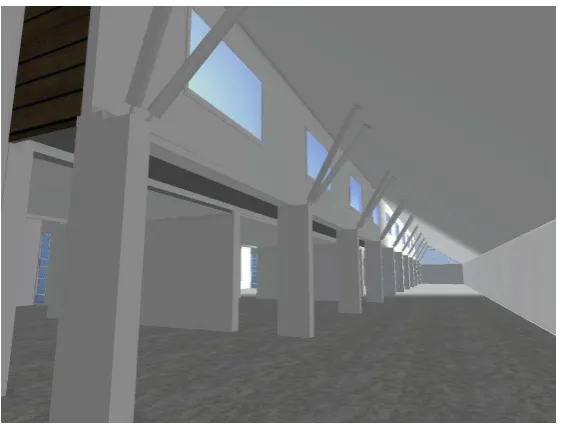
software. To create a digital version of the interiors therefore had to be done using more traditional architectural drawing. In keeping with our aim to use proprietary
consumer-level software, the package we chose was Trimble ‘SketchUp’ – a simple
[image:7.595.157.441.448.659.2]and widely used drawing package that can produce good results very easily, and excellent results with practice and skill. Using drawings produced by the architects for the MERL redevelopment, we produced a basic model of almost the entire interior of the gallery spaces. At the time of writing, this model is being used as a class exercise by a group of students to develop it into a more sophisticated model, which we expect to offer a more realistic immersive experience.
Figure 4: First draft of MERL galleries interior
2, Data Processing
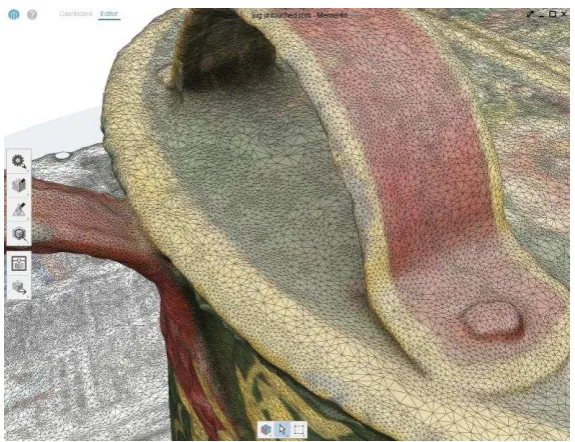
Using Autodesk Recap360 for photogrammetry processing returns a file such as that seen in figure 5 below. This is a 3D model defined as a surface ‘mesh’ and image files that form textures and colours (see figures 6, 7 & 8 below). The initial mesh is edited, for example removing extraneous details such as the table on which the object was
standing, using new Autodesk editing software – Autodesk Memento – that takes
files direct from Recap360. Memento is being developed in response to the growing demand for consumer 3D modelling, in particular for 3D printing, and is a powerful but simple version of other software packages. Perhaps the most commonly used is
Figure 5: Decorated canal boat jug from MERL collections
Reducing the size and complexity of the model ‘mesh’ is critical to the useability of the final Virtual Museum. Meshes are made up of triangular faces (usually referred
to as polygons, or ‘polys’) that create an outer surface, closely matching the shape of
the original. The Jug model created by Recap360 had 1.6 million polys, whilst each of the MERL building meshes (entrance and courtyard) had around 6 million polys. When imported into visualisation packages, a typical number that could be handled would be in the tens to hundreds of thousands. So the complete Virtual Museum, including the photogrammetry facades, the SketchUp interior and around 10 objects needs to be less than around 1M polys. Processing the mesh, by combining smaller
polys into larger and hence less numerous polys, is known as ‘decimation’, and can
Figure 6: Detail of jug with undecimated mesh (1.6 million polys)
Figure 7: Detail of same jug, decimated by 90% (80K polys)
[image:10.595.151.441.334.565.2]resolution of the textures, and the processing capacity of typical PCs and their ability to handle the best models.
Figure 8: Final model of MERL jug, with 20k polys
3, Visualisation
The dominance of gaming environments in the creation of VR means that the
software necessary for visualising models is essentially aimed at satisfying the needs of game developers. We have experience at the University of Reading in using one of
the most popular and powerful gaming engines – Unity - that provides a wide range
Figure 9: Combined model, incorporating the MERL entrance façade, the inner courtyard (both photogrammetry), and the main galleries (SketchUp)
Revizto also includes first-person navigation and a simple output for the Oculus Rift, and so meets our needs quite closely. Where it falls short is in its limited ability to include additional information for the objects (photographs, documents and audio files). We have been able to overcome to a limited extent using the Revizto ‘issue
tracker’, that allows us to add in other documents and photographs but in a way that
could be more user-friendly. However, the balance of functionality to ease of use is heavily in favour of Revizto. As with other points noted in this report, this is a fluid situation. There seems to be a demand for interfaces based on gaming engines that offer selected functionality, but tailored to specific applications. Architectural
visualisations are likely to become more important and we would expect there to be developments that would also suit the VR recreation of public spaces such as
museums, schools, open areas, hospitals etc.
Having created a combined model of buildings and objects in Revizto, our original
aim was to focus on the new Oculus Rift (‘OR’) VR headsets – the leading brand of a new breed of VR visualization technologies. At present these are available as
It is also worth noting that although the OR is currently the leading VR headset, purchased by Facebook for $2bn in 2014, there are a number of other significant new players in this space, including Google/Mattel Viewmaster, Microsoft Hololens, Sony Project Morpheus, HTC, Carl Zeiss/Apple, Razr/Android and others.
Running the model on a standard screen (or high end iPad) is still perfectly feasible without having to resort specialist gaming hardware, although of course this does not give the same immersive experience. Whether that is significant in the
experience of a VR world is a moot point, and one that we will investigate in the demonstrations. Our other options include iPad, which Revizto supports with a custom navigation control system, and standard PC or large scale projected screens, each of which could be controlled with an Xbox type controller. So despite the current limitations that we see with the OR, it will still form part of the user
experience that will allow us to interrogate some of the basic ideas about VR worlds.
Workflow
Most of the work required to produce the VR model of MERL has now been
completed. The SketchUp drawings of the gallery ineriors are being improved, and there are more objects that need to be scanned and incorporated into the final model. Having considered a number of possible solutions to the technical challenges this has required, we have fixed on a workflow that satisfies our objectives of low-cost and non-specialist hardware, and user-friendly software and visual outputs (see diagram below). This is the result of a balancing act between issues of resources (finances and labour) and quality (realism and complexity), in what is undoubtedly a dynamic arena. Even in the course of the few months of this project we have seen several new developments (such as updates to Autodesk Memento and new apps for the Structure Sensor), and more promised (such as Autodesk Recap promising to remove the upper limit of 250 photos for their photogrammetry software). For our purposes, this has led to a relatively conservative approach, attempting to simplify the workflow by using market leading names rather than some of the less well known, even superior products. We expect that in the immediate future there will be further developments in software and hardware, which are likely to become more user-friendly and yet more sophisticated, thus making this type of project easier to carry out.
For the present, we have fixed a point in the Creating a Virtual Museum project where ease-of-use is our key criteria, costly hardware is limited to a high end laptop to run the Oculus Rift headset, and other visual outputs are achieved through
ReCap360 SketchUp Memento Revizto Editor Revizto Viewer Photographs Scan s Site Survey
Skanect Pro / Itseez3D
Data Acquisition Data Processing Mesh Editing DSLR Camera Model Creation Visualization
Structure Sensor / iPad Data Source
High end laptop/ Oculus Rift
iPad VDU / Projector
Xbox controller Output .JPG .OBJ .FBX .FBX .RCM DSLR Camera Memento Photographs
File Type .FBX Hardware
Software Data
Next Steps
The project is now moving into its second phase, where we will have a finalised model to present to target audiences such as schools and museums.
More object scans and additional information need to be gathered from MERL.
The final ‘Virtual Museum’ model will be assembled and tested.
The tested model will be taken to organised events at 2 local schools and a group of volunteers and staff at MERL. These events will include a range of forms of
interaction, including screen and iPad navigable models, Oculus Rift immersive
models, and real objects taken from the MERL ‘handling collection’.
Interactions will be recorded by video, and participants interviewed about their sense of engagement with the museum and its objects.
Once we have gathered data from the users, this will form the basis of our