"
•
"
••
Commission of the European Communities
Selected papers arising from
the EEC primary raw materials
programme (1978-81)
33i~)
Commission of the European Communities
( I/Selected papers arising from
the EEC primary raw materials
programme
(1978-S!t-1984
0.
1./
Directorate-Genera I
Science, Research and Development
:;::;.
EUR 8617
EN-FR
Published by the
COMMISSION OF THE EUROPEAN COMMUNITIES
Directorate-General Information Market and Innovation
Batiment Jean Monnet LUXEMBOURG
LEGAL NOTICE
Neither the Commission of the European Communities nor any person acting on behalf of the Commission is responsible for the use which might
be made of the following information
Cataloguing data can be found at the end of this publication
Luxembourg, Office for Official Publications of the European Communities, 1984
ISBN 92-825-4086-3 Catalogue number: CD-N0-83-037-2A-C
reprinted from Mineralium Deposita
Mineral.Deposita 18, 301 (1983)
Foreword
MINERALIUM
DEPOSITA
©Springer-Verlag 1983
This special issue of
Mineralium Deposita
is devoted to certain aspects of the1978-1981 Research and Development programme of the European Communities in the
field of "Primary Raw Materials". A major aim of this programme was to increase the E.C. potential for self-supply of a number of mineral raw materials, prin-cipally non-ferrous metals. The main research areas were: (1) Exploration, with emphasis both on economic geology and on the improvement of geochemical, geo-physical and remote sensing techniques; (2) ore processing, and (3) mining technology.
In keeping with the orientation of this journal, the papers presented here concern the geology and geochemistry of ore-bearing formations, problems of ore genesis and potential applications to prospecting. Although they do not cover the entire range of research activities that have been sponsored by the E.C. in these particular fields, they do highlight a number of topics of great interest to economic geologists:
- Investigations on fluid inclusions in granites and other rocks - Stable isotope studies
- Geochemical proximity indicators for massive sulphide deposits - Trace element patterns in black shales and carbonates
- The origin of base-metal vein-type deposits in carbonates - A statistical multivariable approach to regional prospecting - Diagenesis in red beds and its bearing on mineralizing processes
More papers on these and other themes may follow in subsequent regular issues of the journal.
On behalf of the Commission, I wish to thank the president of the Society for Geology Applied to Mineral Deposits as well as the editors of
Mineralium
Deposita
for their invaluable assistance in preparing this special issue. May I also express the hope that this is but a first step, a first experiment which will be continued and perhaps amplified upon the completion of the new Raw Materials programme sponsored by the E.C. for the period 1982-1985.J.
BoissonnasMineral.Deposita 18, 303-313 (1983)
MINERALIUM
DEPOSITA
©Springer-Verlag 1983
Thallium, Nickel, Cobalt and Other Trace Elements in
Iron Sulfides from Belgian Lead-Zinc Vein Deposits
J. C. Duchesne
1,
A. Rouhart1, C. Schoumacher
1and H. Dillen
21 Laboratoires associes de Geologie, Petrologie et Geochimie, Universite de Liege, Sart Tilman, Belgique 2 Departement Scheikunde, Universitaire lnstelling Antwerpen, Wilrijk, Belgie
Fe-sulfides associated with Belgian Pb-Zn vein deposits have been analysed by DC arc spectrometry and XRF for Tl, Ni, Co, Mn, Zn, Pb, Ge, Cd, and As. They show high Tl contents (from > 30 ppm upt to 6800 ppm) and Co :Ni ratios < 1. These features permit to distinguish them from Fe-sulfides of sedimentary and high temperature occurrences. The Tl distribution in a botryoidal marcasite of
Vedrin (average Tl content of 0.68%) has been investigated by ion microprobe. It displays a pattern similar to colloform texture. Principal component analysis shows that the behaviour of Tl is partly controlled by a factor opposing Tl to all other elements. This is interpreted as reflecting the influence of sorption mechanisms by contrast with direct precipitation. Tl and the other elements are not considered of magmatic origin because no acidic magmatism is known during or after Variscan times. Extraction from sedimentary rocks by hydrothermal brines is favoured.
INTRODUCTION
A systematic study of the trace element geochemistry of pyrite and marcasite has been undertaken in order to
charac-terized iron sulfides associated with Pb-Zn vein deposits, and to examine whether trace elements could help to understand the conditions of formation of the ore, and thus facilitate the de-tection of hidden deposits. A prelimi-nary study by Duchesne (1964) showed the presence of relatively large amounts of thallium in marcasite from the Vedrin ore deposit (Belgium) and pointed to the similarities with Pb-Zn deposits from the Cevennes border in France. The pure-ly syngenetic origin of these latter deposits proposed by Bernard (1961) was questioned on this basis (Duchesne,
1964), and discussed (Bernard, 1965; Duchesne, 1965). The present study cor-roborates these first results with the help of more powerful analytical tech-niques and statistical methods of in-terpretation.
ANALYTICAL METHODS
ope-304
ration, the method - like any other se-paration method - cannot however war-rant the absolute purity of the analys-ed aliquots of the samples. This fact was taken into consideration in the interpretation of data by means of statistical methods (see below). The use of Clerici's solution (Tl formate and malonate) as a density liquid has been prohibited to avoid contamination by Tl. The final grinding to about -ISO mesh was done in agate mortars.
Three different analytical methods are used:
1. DC arc spectrography
2. X-ray fluorescence spectrometry 3. Ion microprobe analysis (SIMS) 1. DC arc spectrography is used to de-termine Co, Ni, Mn, Cd, Ge, Sb, Bi, Sn, Cr as well as low contents of Tl, Pb and As. The method is inspired from He-gemann and Leybold (19S4). The powdered sample is mixed with 2 parts of "spec-pure" graphite, and loaded in the coni-cal cavity of a graphite electrode
(SCHRIBNER type - National Carbide L4024). A 3 mm diam-rod (Le Carbone-Lorraine type 207) is used as an upper electrode. A drop of Elvacite 2044 di-luted in toluene is placed on the load-ed electrode and driload-ed in order to form a cake. This procedure prevents loss of material during the first seconds of arcing and regularizes burning. An optimum reproductibility (± S%) can thus be obtained.
A stabilized DC arc of 6.S A and 220 V from a PHILIPS Multisource is used to burn the sample (anode) during
J.C. Duchesne et al.
calibration of Co, Ni, Mn, Zn, Cu. The four standards provide excellent work-ing curves for Co, Ni, Mn and Zn, and a good one for Cu. Only one standard out of the four available can be used for Cd, Ag, Sb, Bi, Sn and Cr. There-fore, 45° slope working curves, passing through the standard values, in log-log coordinates, are used for these elements (Ahrens and Taylor, 1961). For Ge synthetic standards obtained by mix-ing Ge to a Fe203 matrix are used. Tl, Pb and As are calibrated with values measured by X-ray fluorescence. The detection limits are: 0.2 ppm Ag; 1 ppm 1
Pb, Mn, Cu, Ge; S ppm Co, Ni, Sb, Bi, Sn, Cr; 10 ppm Tl; IS ppm As, Cd. 2. X-ray fluorescence analysis is used for the determination of relatively high contents of Tl, Pb and As. A CGR alpha 2020 semi-automatic spectrometer working with a Mo-tube at SO kV and SO
rnA
and a LiFIOO analysing crystal is used. Analytical lines are Tl L61, As K61 and Pb L61· Standard samples ASK-3 and PS-I are used to calibrate the method for Pb and As. Synthetic samples made by mixing various amounts of Tl203 to a pyritic matrix are used for Tl. It must be noted that the Tl content of 100 ppm, given by Schron et al. (197S) for PS-1, is highly over-estimated. No Tl is detected by DC arc spectrography, which means that the Tl content is lower than 10 ppm.Inspec-tion of the most sensitive line at S3SO
R
with ICP spectrography also re-veals no Tl. The limits of detection(LD), following Currie (1968), are 30 ppm Tl and Pb and 4S ppm As.
30 sec. All analyses are duplicated. 3. Secondary ion mass spectrometry
Thallium, Nickel, Cobalt and Other Trace Elements in Iron Sulfides 3~
For calibration of Mn, Co and Cu the four already mentioned reference samples are used in the form of pellets, as described by Dillen and Gijbels (1981). No certified standards being available for quantitative Tl analyses, a sample from Vedrin, which has been examined by SIMS and found virtually homogeneous at the 250 ~m-scale (standard deviation for 14 different measuring sites of 250 ~m diameter each: 11%), is used as a reference sample after determination of its Tl content by ICP-AES, in nitric acid solution, using the 5350 ~ Tl-line. The instrument is calibrated by Tl-so-lutions containing the same amount of
[ ]
~
~
*5
~
3.
2.
1.
•
BRUXELLES
0 50Km
iron and acids. A concentration of 6800 ppm is found by that method for the Vedrin sample. A massive part of the specimen is used to determine a sensi-tivity factor for SIMS, with 32
s
as an internal standard.SAMPLING
84 samples belonging to 36 occurrences of marcasite or pyrite have been
anal-LUXEMBOURG
•
Fig. I. Geological sketch map of South Belgium showing the provenance of the
various iron sulfide samples from Pb-Zn vein deposits. 4. Post-Variscan rains; 3. Devonian and Carboniferous terrains; 2. Cambrian and Silurian ter-rains; 1. Numbered stars refer to the investigated occurrences: 1, 2, 3 and 11:
Poppelsberg, Stuck, Lontzen and Mbresnet, respectively; 4: Vedrin; 5: Hayes-Monet; 6: Corphalie; 7: Engis; 8: Angleur; 9: Heure; 10: Villers-en-Fagnes;
[image:7.457.16.421.236.576.2]306
ysed. The main occurrences come from East Belgium (Fig. 1): Poppelsberg
(11 samples) and Stuck (2 samples) are small post-Variscan Pb-Zn vein deposits cutting across Dinantian carbonate rocks and Famennian rocks of the Vesdre Mas-sif. They were recently drilled by the Union Miniere Company. Lontzen (15 sam-ples) also belongs to the same type of mineralization and comes from the same
J.C. Duchesne et al.
DISCUSSION
The results usually show a wide dis-persion in the various Pb-Zn occurrences They can however be summarized as fol-lows:
1. The Co content is low- usually close to or below 5 ppm - in the Belgian Pb-Zn type and contrasts with the sedimen-tary and high temperatures occurrences, area, but is entirely situated in siltic
which show averages of 332 ppm and 2180 to pelitic rocks of Famennian age.
Another well documented site _ the ppm respectively. The Ni content of the Vedrin Mine, near Namur - has also been
investigated. It is a vein deposit in Dinantian carbonate rocks of the Namur synclinorium (Evrard, 1943). Two types of sulfides are studied. The first and most common one is the vein type (12
Pb-Zn type is higher than the Co and can be compared to the sedimentary or high temperature sulfides. Therefore, the Co:Ni ratio is <1 in the Pb-Zn type. According to classical interpre-tations (see e.g. the reviews by Loftus Hills and Solomon, 1967 and Bralia et
samples): a fibro-radiated marcasite al., 1979 ) this would indicate a
sedi-associated with some blende and galena
mentary origin. However, the various in a calcite gangue. The second type
authors usually consider that this cri-(5 samples) is a marcasite, filling
small veins and veinlets of a brecciat- terion is poorly significant when used alone. The present data on sedimentary ed dolostone, at a distance of 10-20 m
occurrences also confirm that the Co/Ni from the main vein.
ratio has to be used with caution. In-Other Belgian Pb-Zn occurrences have deed, 5 out of 12 sedimentary
occurren-also been included: Hayes-Monet, Cor- ces which are studied here show
phalie, Engis and Angleur (2 samples) Co:Ni > 1 an inverse relation to what from the Namur synclinorium; Heure and should
b~
expected since they all con-Villers-en-Fagnes in Devonian strata fromcern typical cubic pyrites in black the Dinant synclinorium; Moresnet and shales or slates. It is likely thatre-Chaudfo~taine i~ the ~esdre Ma~sif, t~e crystallization due to incipient meta-latter ~s a cub~c pyr~te assoc~ated w~th morphism can lead to an enrichment of C a baryte stratiform deposit (Dejonghe, with respect to Ni in such a way that
1979) in Devonian strata. an original Co:Ni :1 might be modified
Two occurrences from the Cevennes to a Co: Ni > 1 .
border - Soulier and St Felix de Pal- It can be concluded that, in Pb-Zn
liere - previously studied by Duchesne deposits, the Co:Ni ratio in iron
sul-(1964) have also been reinvestigated. fides has no genetic significance sine
Moreover, 12 occurrences from sedi- the observed relation ( < 1) is not in mentary rocks, mainly pyrite cubes from agreement with the geological evidence. shales, have been included for the sake It must however be noted that the low
of comparison (Rochelinval, Bayehon, Co content of the Pb-Zn occurrences
Deville, Grand-Halleux, Longfaye, Hue- appears to be a feature restricted to
corgne, Ronquiere, Grufflingen, Boux- this type of deposits and is likely to
harmont, Vise, Gris-Nez - France, Balla- have a promising genetic meaning. chullish - Scotland) as well as pyrites 2 . Thallium is always present (from formed at high temperature (Agrokipia- >30 ppm up to 6800 ppm) in the Belgia
Cyprus, Calamita and Rio Marine - I. Pb-Zn type, whatever the geological un
Elba, Pamour-Canada, Luzenac-France and to which they belong (Dinant or Namur Buranga-Ruanda).
The results of the analysis are sum-marized in Table 1 which gives the aver-age and the range of variation of each trace element in each occurrence.
Table I. Trace element contents (ppm) of iron sulfides POPPELSBERG STUCK Number of samples II Tl X 235 range 30-1600 Co X ? (7) ( 1) range <5-90 Ni X 370 range 45-1650
2 90 30-150 ?
(I)
<5-48 300 10-600
Co/Ni x <0.04-0.14 <0.1-0.5 Pb X 3760 3680 range 15-7500 3500-3850 Zn x 460
Mn Cu Ag Cd Ge As Sb Bi Cr
range 40-2250 400-15000 X 23 range I-125 X 163 range 4-360 X IS range 2-50 X ? (8) range <15-30 X 23 range <1-65 X 383 range <10-2450 X 19 range <5-65 X <5
range range
<5
7 3-11 ISO 3-310 55 4-105 ?
(I)
<15-1900 ?
(I)
<1-470 2500 500-4500 10-100 <5 <5 LONTZEN IS 83 30-190 36 8-98 448 42-1010 0.05-0.
IS
2590 1100-4750 1123 40-9000 22 3-290 397 115-1010 44 18-105 ?
(8)
<15-95 ?
(7)
<1-95 472 50-1010 54 IS-ISO <5 <5
VENDRIN
MAIN
VEIN
12 517 73-6800 <5 17 <5-42 <0.1-0.5 4050 15-12600 445 20-2200 245 1-1000 6 1-25 7 2-34 ? (7) <15-55 19 <1-80 ? (II) <10-40 <5 <5 <5 BRECCIA 5 78 54-88 <5 10 5-17 <0.3-<1 4160 2720-7050 29 20-42 2 <1-3 3 2-4 3 2-4 21 15-25 5 0 <IS <5 <5 <5
OTHER BELGIAN CEVENNES SEDIMENTARY HIGH TEMP OCCURRENCES OCCURRENCES OCCURRENCES OCCURRENCES
9 229 55-650 ?
(6)
<5-220 200 <5-620 4170 25-12000 925 3o-s4oo<
2)
73 1-620 18 1-65 4 1-7 ?
(4)
<15-185 30 <1-95 100 <10-310 ?
(7)
<5-25 <5 <5
3 806 460-1080 <5 5 <5-6 <I 1555 325-3700 293 95-650 113 15-310 34 10-65 45 18-85 <IS <I 2720 1300-5000 310 20-660 <5 <5 12 <10 332 <5-1470 374 8-2050 0.08-14 123 18-485 108 20-610 310 <1-3400 146 10-790 16 1-140 <IS <I 283 20-625 27 <5-180 ?
(8)
<5-35 <5-250 <10 2180 47-6600 145 8-440 2.4-30 ?
(4)
<1-10 79 10-420 35 <1-125 470 3-2200 5 1-16 <IS <I 273 <10-850 ?
(6)
<5-10 (50) (350)
300
mentioned Tl-rich (0,5 to 1%) melniko-vites and marcasites in Palliere.
On the other hand, Tl is absent
( < 10 ppm) from all sedimentary and
high temperature occurrences. According to Ivanov et al. (1960), Tl is commonly found in numerous varieties of poly-metallic deposits. It is usually more enriched in sphalerite or galena than in iron sulfides, e.g. from some Cauca-sus deposits. Shaw (1952) and Albuquer-que and Shaw (1972) also report high Tl content in marcasite from several local-ities (Japan, Caucasus, Central Asia, etc ... ). In Western Europe, since Stoi-ber (1940), Tl is mentioned in Pb-Zn deposits of Belgium, Westphalia, and Silesia. Except for the data of Thein
(1975) on the Meggen deposit (see be-low), no modern analyses have been made available on sulfides and this hampers the study of the chalcophile behaviour of Tl.
In the Belgian Pb-Zn occurrences the maximum Tl content in iron sulfides is found in a radiated botryoidal marcasite from the Vedrin mine (0,68%). The dis-tribution of Tl, as revealed under the ion microprobe, is shown on Plate 1. Tl is not incorporated as independent phases larger than 1 ~m (the resolution power of the ion microprobe) and can thus be considered regularly distribut-ed troughout the marcasite phase. At a larger scale thin alternating bands (from 1 to 50 ~m) of contrasting Tl contents are disposed perpendicular to the radiating directions of the tex-ture. The overall picture is quite sim-ilar to the so-called colloform texture and can be put together with the fact that Tl is notably enriched in colla-form varieties of iron sulfides (Ivanov et al., 1960). In a second specimen from Vedrin an inclusion of a Tl and Pb bearing mineral-possibly hutchinsonite
(Pb, Tl)2(Cu, Ag)As5
s
10 -was also found, thus indicating that trace min-erals can also control the distribution of Tl.3. Some variations can be observed be-tween the different Belgian deposits or even within the same deposit. The Vedrin marcasites are low in Co, Ni, As, Sb, Cu, Ag compared to the East Belgium oc-currences. The Tl, Zn, Mn, Cu and Ag
J.C. Duchesne et al.
contents in the Vedrin marcasite from the brecciated dolostone are lower than in the main vein occurrences; they also display less dispersed values. In Lon-tzen, almost all trace elements are en-riched relative to the Poppelsberg-Stuck type. Since the deposits all be-long to the same fault system, it is likely that this difference is due to the siltic to pelitic nature of the Famennian enclosing rocks at Lontzen as compared to the carbonate rocks at Poppelsberg and Stuck.
4. In addition to the variations be-tween the different occurrences, the trace elements display large intervals of variation within the different de-posits. In order to investigate these variations in detail, the statistical method of principal component analysis has been applied to the Pb-Zn type. The computing has been performed by the Fortran IV program of Davis (1973) adapted for a Heathkit Z89 microcompute with a memory of 64 K of RAM and two 5.25 inch floppy discs.
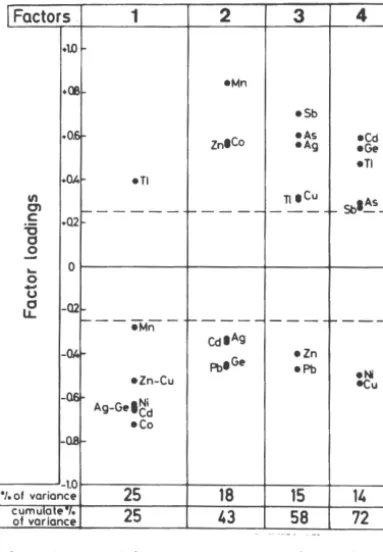
Fig. 2 summarizes the results obtain ed on 40 samples from Pb-Zn deposits, representing the whole population of this type except the samples from the Vedrin mine. Bi and Cr which are absent from the Pb-Zn type yere not considered The reason for disca~ding the Vedrin samples is that the contents in Co, Cd, As and Sb are currently below the limitl of detection of the method. A large num-ber of data below the detection limit can indeed artificially modify the true correlation between the elements.
Four factors can explain 72 % of the variance of the population. They can be interpreted as follows.
Factor 1 opposes Tl to a group of several elements which comprises ele-ments such as Ni, Co, Zn, Cu and Ge which have an ionic radius close to
that of Fe and therefore are compati-ble with their entering in the
collo-Thallium, Nickel, Cobalt and Other Trace Elements in Iron Sulfides 309
Plate 1. Tl distribution in a botryoidal marcasite from the Vedrin mine (Namur, Belgium) as revealed by secondary ion mass spectrometry (ion microprobe). Thin alternating bands (1 to SO ~m) of contrasting Tl contents - the higher the
con-tent, the darker the intensity - are perpendicular to the radiating directions (well displayed in photo 2) of the texture in a pattern similar to colloform texture
form structure, such as Schalenblende or in various "gel"-like or amorphous minerals, such as melnikovite (see Ivanov et al., 1960). Moreover, its size and chemical similarity with large alkali ions is consistent with its ex-traction from solutions by adsorption processes (Albuquerque and Shaw, 1972).
The similarities between the pic-ture of the Tl distribution which is
310
l
Factors. 1 2 3 4•lD
.em
•Mn•Sb
.o.EzniCo •As •Ag •Cd •G.
eTI
,OJ. eTI
11'1 n 1cu
1-
Sb·~-en 1 - - -
-c .Q2
:0
0
2
0
0u
tf
-02- - - -
•Mn - - - - -- - -
r -CdiAg-OJ.
PbiGe eZn •Pb •Ni
•Zn-Cu ecu
-06
Ag-Gel~~
•Co
~as
l· •t. of variance -1.0
25
18
15
14
l
cumulc;tte'/•of vanance
25
43
58
72- - --- -
-Fig. 2. Graphical representation of the principal component analysis of the trace element contents of iron sulfides from Pb-Zn vein deposits. Factor load-ings less than 0.22, below the level of significance following Harman
(1967), are not represented
our factor I is an indication that two different mechanisms play a role in the deposition of the iron sulfides and that, all things being equal, the Tl content of a sample is a measure of the relative importance of sorption effects in the process of formation of the par-ticular sample.
Factor 3 groups together S-As-Ag and is also loaded with Cu and Tl. We inter-pret this as due to inclusion of trace minerals of sulfosalts, some of them containing Tl, which is known to have geochemical affinities with Sb and As (Jankovic and LeBel, 1976).
Factor 2 is positively loaded with Mn and Zn and negatively with Pb-Ag-Cd-Ge. Factor 4 groups Tl with Cd-Ge which are opposed to Ni-Cu, and might indi-cate the influence of inclusions of
J.C. Duchesne et al.
blende which can be rich ~n Tl (Evrard,
1945) and in Ge-Cd.
Factor 2 is difficult to interpret.
It probably results from the combination of several mechanisms. Mn might come from inclusions of blende. It is how-ever hard to understand why Mn, which could easily substitute for Fe, is main-ly controlled here by its substitution with Zn and also why Cd-Ge, classically diadochic of Zn (see factor 4) appears here with factor loadings of sign dif-ferent from Zn. The grouping of Pb with Ag is classical in galena and might also indicate inclusions of trace amounts of this mineral.
Though some points are still some-what obscure, principal component anal-ysis clearly shows that several possi-ble mechanisms can account for the pre-sence of Tl in the population: sorption phenomena and inclusions of sulfosalts and also possibly of blende. This is in agreement with the modes of occurrences of Tl observed under the ion microprobe and in conformity with what is known of its chalcophilic behaviour.
SOURCE OF THALLIUM: AN OPEN QUESTION
Polymetallic deposits which show the highest amount of Tl are related to acidic magmatism either volcanic or plutonic such as in the classical reg-ion of Caucasus (Ivanov et al., 1960) 01
in Turkey (Jankovic and LeBel, 1976). The enrichment of Tl in the late stages of the magmatic differentiation is well in agreement with its similarity of be-haviour with K.
The source of Tl in Pb-Zn deposits in carbonate environment is however a debatable question. In the Meggen de-posit (Westphalia), the distribution of,
Tl in and around the stratiform ore body is considered to be due to the
exhalative origin of the elements (Thei
[image:12.463.31.223.67.343.2]Thallium, Nickel, Cobalt and Other Trace Elements in Iron Sulfides 311
acidic plutonism is restricted to the small granitoids of La Helle and Lam-mersdorf (Germany) (Carin, 1965). They are situated far away from important deposits, such as the Vedrin Mine, and since they have suffered a deformation of Variscan or Caledonian age, they are certainly older than the post-Variscan tectonic event which controls the em-placement of the veins. The presence of a granitic batholith at depth under
the Ardennes has been surmised by Four-marier (in Dewez and Lespineux, 1947) to account for the distribution of the Belgian ore deposits. But no evidence in favour of such an hypothesis has ever been put forward.
Tl, if not magmatic, must find its source in sedimentary rocks from which it was scavenged by hydrothermal brines. When taking the data of Heinrichs et
al. (1980) on sedimentary rocks, it is noted that the Tl content (average: 0.41 ppm; black shales: 2.5 ppm) is
1 high relative to the Pb content
(aver-' age: 16.7 ppm, black shales: 82 ppm). The Tl/Pb ratio varies between 1/50 and 1/30, values which are higher than those commonly found in sulfides from Pb-Zn deposits. Therefore it is not unlikely that any process which would extract and concentrate Pb would also be active for Tl.
CONCLUSIONS
Distribution of trace elements in vari-ous occurrences of iron sulfides indi-cates:
permits to distinguish them from all other occurrences (Tl < 10 ppm). The Co content is lower than in sedimentary occurrences.
2. The mode of occurrence of Tl in iron sulfides is either in the form of trace minerals or is dispersed in the iron sulfide phase according to a zoned and recurrent pattern, similar to a colla-form texture. Several lines of evidence indicate that sorption phenomena and inclusions of sulfa-salts can account for most of the behaviour of this ele-ment in the deposition of the iron sul-fides.
3. The paucity of acidic magmatism in Belgium during Devonian and Carboni-ferous sedimentation or in post-Varis-can times makes the hypothesis of a magmatic source for the Tl difficult
to accept. The hypothesis that Tl to-gether with other elements was scaveng-ed from sscaveng-edimentary rocks by hydrother-mal solutions is favoured.
Acknowledgements.
The present investi-gation is part of a research program supported by the EEC (1 11-79-7-MPPB) and the Belgian SIPS (MP-CE-5) (Pro-ject Leaders: P. Evrard and J. Belliere). The authors wish to express their grati-tude to the Union Miniere, for giving access to drilled samples of Poppels-berg, Stuck and Lontzen; to L. Dejonghe, A.M. Fransolet and F. Dimanche for donating various samples; and to R. Gijbels for the use of the SIMS instru-ment and for interesting discussions.1. The iron sulfides related to Belgian REFERENCES Pb-Zn vein deposits, mainly in carbonate
environment, belonging to different
geological units (Namur Synclinorium, Ahrens, L.H., Taylor, S.R.:
Spectro-Dinant Synclinorium, Vesdre Massif) or chemical analysis (2nd Ed)
Addison-situated in Devonian or Dinantian strata, Wesley, 454 p (1961)
form a group along with two occurrences Albuquerque de, C.A.R., Shaw, D.M.:
from the Civennes border; this group Thallium. In: ''Handbook of
Geochemis-can be distinguished from iron sulfides try". Wedepohl, K.H. (ed) Springer, of various origins by their Ni, Co and Berlin. Vol. II-5 section 81, 1972 Tl contents. Their Co:Ni ratio (<I) Aubagne, M., Leleu, M.: Recherche de
can be compared with sedimentary occur- guides de prospection pour les gites
(Bor-312
dure Cevenole, Gard), B.R.G.M.Compte rendu de fin d'etude, 1981
Bernard, A.: Contribution
a
l'etude de la province metallifere sous-Cevenole. Sci. Terre, 7, 3-4, 123-403 ( 1961) Bernard, A.: Corrnnents on "Presence dethallium dans les sulfures de fer de la mine de Palliere (Gard, France)" by J.C. Duchesne. Ann. Soc. Geol. Belgique 88, 151-152 (1965)
Bralia, A., Sabatini, G., Troja, F.: A reevaluation of the Co/Ni ratio in pyrite as geochemical tool in ore genesis problems. Miner. Deposita, 14, 353-374 (1979)
Christie, O.H.J.: Three trace element geological materials certified as a result of a cooperative investigation. Talanta, 22, 1048-1050 (1975)
Corin, F.: Atlas des roches eruptives de Belgique. Mem.Expl.Cartes Geol. et Min. de Belgique, no 4, 190 p, 1965
Currie, L.A.: Limits for qualitative and quantitative determination. Anal. Chemistry, 40, 586-592 (1968)
Davis, J.C.: Statistics and data anal-ysis in Geology. John Wiley, 420 p,
1973
Dejonghe, L.: Discovery of a sedimen-tary Ba (Fe, Zn, Pb) ore body of Frasnian age at Chaudfontaine, Pro-vince of Liege, Belgium. Mineral. Deposita, 14, 15-20 (1979)
Dewez, L., Lespineux, G.: Les minerais du sol belge. In: "Centenaire de l'A.I.Lg- Congres 1947 Section Geo-logie". Ed. AILg, Liege, 73-120
(194 7)
Dillen, H., Gijbels, R.: Etude de quel-ques elements en traces dans la py-rite par analyseur ionique. J. Microsc. Spectrosc. Electron., 6,
179-194 (1981)
Duchesne, J.C.: Presence de thallium dans les sulfures de fer de la mine de Palliere (France). Ann. Soc. Geol. Belgique, 87, 1-7 (1964)
Duchesne, J.C.: A reply to A. Bernard's comments on "Presence de thallium dans les sulfures de fer de la mine de Palliere (Gard, France)". Ann. Soc. Geol. Belgique, 88, 153-155
(1965)
Evrard, P.: La mineralisation de Vedrin (Province de Namur, Belgique). Ann.
J.C. Duchesne et al.
Soc. Geol. Belgique, 66, M181-202 (1943)
Evrard, P.: Minor elements in sphaler-ites from Belgium. Econ. Geol. 40, 568-574 (1945)
Gwosdz, W., Krebs, W.: Manganese halo surrounding Meggen ore deposit, Ger-many. Trans. Inst. Min. Metal., sect. B, 86, 73-77 (1977)
Harman, H.H.: Modern factor analysis (2nd ed) University of Chicago Press, 1967
Hegernann, F., Leybold, C.: Eine Methode zur quantitativen spektrochemischen Analyse von Pyrit. Zeitschr. Erzberg-bau u. Metallhlittenwesen, v. 7,
108-113 (1954)
Heinrichs, H., Schulz-Dobrick, B., Wedepohl, K.H.: Terrestrial geochem-istry of Cd, Bi, Tl, Zn and Rb. Geochim. Cosmochim. Acta 44, 1519-1533 (1980)
Ivanov, V.V., Volgin, V.Y., Krasnov, A.A., Lizunov, N.V.: Thallium: Basic. geochemical and mineralogical proper-ties, genetic types of deposits and ' geochemical provinces (in Russian), Moscow Academy of Sciences, Transl. International Geology Review, Book-section. Published by the American Geological Institute, 1960
Jankovic, S., LeBel, L.: Le thallium dans le minerai de Bozcukur pres Kitahya, Turquie. Bull.Suisse Minera: Petrol. 56, 69-77 (1976)
Loftus-Hills, G., Solomon, M.: Cobalt, Nickel and Selenium in sulfides as indicators of ore genesis. Mineral. Deposita, 2, 228-242 (1967)
Robinson, P., Walshe, J.L.: Trace-ele-ment analysis of pyrite - an
inter-laboratory survey. Trans. Inst. Min. Metal. 5, B216-218 (1977)
Roedder, E.: The noncolloidal origin o "colloform" textures in sphalerite ores. Econ. Geol. 63, 451-471 (1968) Shal, K.: Thallium. In: Handbook of
Thallium, Nickel, Cobalt and Other Trace Elements in Iron Sulfides 313
Shaw, D.M.: The geochemistry of thal-lium. Geochim. Cosmochim. Acta, 2, 118-154 (1952)
Stoiber, R.E.: Minor elements in sphal-erites. Econ. Geol. 35, 501-519
(1940)
Thein, J.: Geochemische Untersuchungen im Sulfiderz im Nebengestein und in den Boden der Lagerstatte Meggen-West-falen. Doctorate thesis - Rheinische Friedrich-Wilhelms-Universitat zu Bonn, 70 p (unpublished) , 1975 Thorez, J., Pirlet, H.: Petrology of
K-Bentonite beds in the carbonate series of the Visean and Tournaisian
stages of Belgium. In: "Intern. Clay Conference 1978", Mortland
&
Farmer(eds), Elsevier, 323-332 (1979)
Received: October 7, 1982 Accepted: January 4, 1983
Prof. J.C. Duchesne
Laboratoires associes de Geologie, Petrologie et Geochimie,
Mineral.Deposita 18, 315-333 (1983)
MINERALIUM
DEPOSITA
©Springer-Verlag 1983
Scheelite Mineralization in Central East Greenland
C. P. HaUenstein and
J.
L. Pedersen
Nordisk Mineselskab A/ S, The Northern Mining Co. Ltd., Copenhagen, Denmark
Numerous scheelite-mineralized areas have been located in the Caledonian fold
'
, belt of Central East Greenland (70° - 7 4
I/
2 ° N) . The fold belt comprises Archaean and Proterozoic metamorphic complexes flanked by Late Proterozoic and Lower Palaeozoic sediments, and intruded by Upper Proterozoic and Caledoniangran~t~c rocks. Scheelite mineralization occurs in: marble-skarns in Upper
Pro-. terozoic metasediments often spatially associated with Caledonian or older granitic intrusives; skarns and quartz veins in Late Proterozoic sediments (Lower EBG quartzite) up to 7 km from outcropping Caledonian granites; veins in fault zones cutting late Proterozoic sediments (Upper EBG limestones). In this paper, the three types are described with emphasis on structural setting, eralogy and trace-element chemistry. It is concluded that most scheelite min-eralization is associated with Caledonian igneous activity, either at or near granite contacts or as mineralization distal to granites at depth. Of the vari-ous types described, the scheelite veins in Late Proterozoic limestone are con-sidered to be of the best economic potential.
INTRODUCTION
The work of this paper formed part of the project "Study of Scheelite Miner-alization in Central East Greenland" ;vhich was supported by "The program for Research and Development of the European Community in the Field of Pri-nary Raw Materials". The project was Lnitiated in 1979 and completed early
Ln 1982.
Minor scheelite mineralization in :loat and outcrop was known in the area ,rior to the start of the project (Hint-:teiner, 1977). Scheelite had also been •bserved in the area during a regional
.urvey in 1974-1975 as part of the
In-ternational Geological Correlation Pro-gram by Ghisler et al. (1980). They described scattered scheelite grains of detrital origin in quartzitic sediments. Furthermore, tungsten as wolframite oc-curs at the Malmbjerg porphyry molyb-denum (Kirchner, 1964) (Fig. 1).
Geochemical exploration during the course of the project (Hallenstein et al., 1981) enabled the finding of num-erous scheelite-mineralized areas which are described and discussed in this paper.
The East Greenland project area lies between 70°00'N and 74°30'N and is bound-ed to the west by the Greenland ice cap, and to the east by the Greenland Sea
316
0
FAULT0
THRUST0
SCHEELITE MINERALIZED AREAD
ICE, GLACIERS~ POST- CALEDONIAN ROCKS
Ill
F-9 t:::::.:J~
C.P. Hallenstein and J.L. Pedersen
CALEDONIAN AND OLDER GRANITIC ROCKS
LATE PROTEROZOIC AND LOWER PALEOZOIC SEDIMENTS
UPPER PROTEROZOIC METASEDIMENTS AND MIGMATITES
ARCHEAN AND MIDDLE PROTEROZOIC BASEMENT (PARTIALLY OVERLAIN BY UPPER PROTEROZOIC METASEDIMENTS)
Fig. 1. Geological map of Central East Greenland showing scheelite-mineralized
[image:18.445.30.344.58.594.2]Scheelite Mineralization in Central East Greenland 317
by mountainous terrain, varying from glacier-dissected alpine regions with peaks nearing 3000 m above sea level, to less rugged mountains, often topped by plateaus with an elevation of 1000 to 2000 m, and cut by deep U-shaped valleys. Numerous, long, deep fjords dissect the entire area.
The climate of the area is arctic, with average yearly precipitation of 400 mm, and average temperatures for Juli and January of
soc
and -20°C respectively.GEOLOGY
The Caledonian fold belt occupies most of the investigated area (Fig. I). It comprises Archaean and Proterozoic crys-talline rocks, flanked by Late Protero-zoic and Lower PalaeoProtero-zoic sediments. Proterozoic and Caledonian granitic rocks intrude the fold belt (Henriksen and Higgins, I976, and Higgins et al.,
1981). Post-Caledonian rocks include Devonian to Lower Permian molasse sedi-ments, Upper Permian to Cretaceous
most-ly marine sediments, and Tertiary plu-tonic and volcanic rocks (Haller, 197I).
Archaean and Proterozoic Metamorphic
Complexes
Archaean and Middle Proterozoic high-grade-metamorphic basement complexes occupy the western-most parts of the area (Fig. 1). Isotopic age determina-tions have yielded dates of 2935 to 2300 m.y. and I980 to 1705 m.y. for the basement complexes (Steiger et al., 1979; Rex et al., 1976; Rex and Gled-hill, I98I).
The basement complexes are overlain and bordered to the east by Upper Pro-terozoic metasediments and migmatites (Fig. I). These rocks consist of quartz-ites, mica schists and some marbles, and were metamorphosed IIOO m.y. ago
(Hansen et al., I978; Rex and Gledhill, I98I). They were subjected to a stage of migmatization and granitic intru-sion around IOOO m.y. ago (Steiger et al., I979). Upper Proterozoic gran1t1c rocks have been identified in West
Milne Land, South Stauning Alper and in West Andrees Land. They comprise foli-ated augen and muscovite granites.
Late Proterozoic and Lower Palaeozoic
Sediments
The metamorphic complexes are flanked by Late Proterozoic sediments of the Eleonore Bay Group (EBG) and Tillite Group, and by Cambro-Ordovician sedi-ments (Fig. 1). The main belt of these sediments stretches from Alpefjord to northeast of Andrees Land.
The oldest sediments are the Lower EBG, which is sub-divided into the Arenaceous-Argillaceous "series", the Calc-Argillaceous "series", and the Argillaceous-Arenaceous "series". The Lower EBG is best known in the
Alpe-fjord region, and exceeds 8000 m in thickness. The sediments comprise quartzites, siltstones and minor carbo-nate horizons. The overlying Upper EBG is about 4000 m thick, and has been divided into three "series", the 2000 m thick Quartzite "series", which is over-lain by the IOOO m thick Multicoloured "series" and the over 1000 m thick Limestone-Dolomite "series". The
Quartz-ite "series" consists of red and whQuartz-ite quartzites and black to green quartzitic shales. The Multicoloured "series"
com-prises up to 100 m thick, dark
lime-stone units and interbedded yellow, red and green dolomitic and quartzitic shales and light-coloured dolomites. The Limestone-Dolomite "series" is a 1200 m thick sequence of white to black dolomites and limestones. Fossil stud-ies have indicated a very late Riphean or Vendian age for the Upper EBG (i.e., 700 to 600 m.y. old) (Vidal, I979). The Upper EBG is slightly unconformably overlain by Tillite Group tillites and dolomitic shales, and Cambro-Ordovician limestones and dolomites. These are the youngest sediments which were deposited prior to Caledonian deformation.
Caledonian Orogenesis and Granitic
Intrusion
318
throughout the fold belt. Amphibolite facies was reached in some of the Upper Proterozoic metasediments, and the western-most EBG sediments of the
Alpe-fjord-Andrees Land belt have been weak-ly metamorphosed in the greenschist facies (Thyrsted, 1978).
Caledonian deformation occurred most-ly as broad, N-S trending fold struc-tures. Both the metasedimentary com-plexes and the EBG sediments have been affected by the folding. The folding is interpreted as having formed as a result of vertical forces accompanying the updoming of crystalline rocks (Haller, 1971; Higgins et al., 1981). The fold axes exhibit alternating cul-minations and depressions.
Normal faulting along N-S, E-W and NW-SE trends also developed during the deformation (Eha, 1953). The largest displacements are associated with the E-W and NW-SE faults, and may exceed
1000 m.
Caledonian granitic rocks occur in East Milne Land, the Stauning Alper, West Andrees Land and Liverpool Land. They span a wide range of ages and compositions (Steiger et al., 1979; Rex and Gledhill, 1981). The oldest Caledonian granitics, with ages from 560-475 m.y. have the compositions granodiorite, monzonite, and two-mica granite. The intrusions which accom-panied the peak of the orogenesis, from 455-430 m.y. ago also have compositions from granodiorite to muscovite granite. The latest phases of Caledonian activi-ty resulted in late to post orogenic intrusions with an age of 420-375 m.y. These dated rocks comprise biotite granite, aplite and pegmatite.
DESCRIPTION OF SCHEELITE MINERALIZATION
Numerous scheelite-mineralized areas have been found in a 350 km long belt in Central East Greenland. Outcropping scheelite mineralization is known in 12 areas, which vary from 1 to 20 km2 in size, and scheelite-bearing boulders have been located in a further two areas. The location of all areas is indicated
C.P. Hallenstein and J.L. Pedersen
on Fig. 1. It is possible to divide the scheelite-mineralized areas into three groups on account of their geo-logical setting. The groups and their respective areas are as follows: - Scheelite mineralization in Upper Proterozoic metasediments, often spati-ally associated with Caledonian or older granitic intrusions. The areas assigned to this group are Kalkdal, East Milne Land, Knivbjergdal, Gemmedal Roslin Gletscher and Eremitdal.
- Scheelite mineralization in the Lower EBG sediments, up to 7 km from out-cropping Caledonian granites. The areas of this group comprise Bersaerkerbrae, Skjoldungebrae, Trekantgletscher, Ga-lenadal, Scheelitdal and Randenaes. - Scheelite mineralization in fault zones in Upper EBG sediments without
spatial relation to granitic rocks. The areas of this group comprise North and South Margeries Dal, Panora-ma Fjeld, Eleonores Bugt and Noa Dal.
Work in the areas has included geo-logical mapping at scales from
1:10,000 to 1:500 and systematic samp-ling. Samples have been subjected to petrographic and chemical studies. Un-less otherwise specified, chemical ana: yses of tungsten, antimony and arsenic were by XRF and of other elements by
semi-quantitative emission spectroscop: The results of this work are summariz-ed in the following descriptions of the mineralized areas of each group.
Mineralization in Upper Proterozoic
Metasediments
Kalkdal
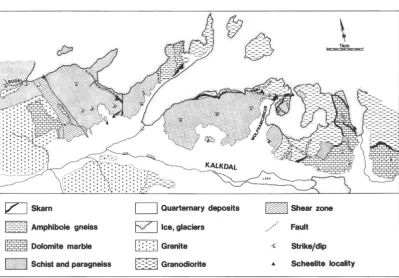
Kalkdal is an E-W trending valley in Liverpool Land, and scheelite mineral zation occurs at several localities within a 20 km2 area of the valley
(Fig. 2).
Scheelite Mineralization in Central East Greenland 319
w
.-
==~==
.
·~
.
-
.
-.-. _·.@
1km\
~Skarn
t=:=::::=:~ Amphibole gneiss
B
Dolomite marbleD
Quarternary depositsEZ:J
Ice, glaciers~Shear zone
/ / Fault
I
:
: :
:
: I
GraniteSchist and paragneiss
t:::;: j
GranodioriteStrike/dip
Scheelite locality
Fig. 2. Geological and scheelite-mineralization map of Kalkdal
sediments at 1183 m.y. (Hansen et al., 1973). The metasediments are dominated by biotite-hornblende-garnet schist and paragneiss, with some dolomitic marble beds and amphibole gneiss. Skarn has developed in marble when in contact with granodiorite and in a marble hori-zon several kilometres from outcropping intrusive rocks. Skarn does not occur
at granite-marble contacts.
Scheelite mineralization in Kalkdal has been located in the skarns (Fig. 2) and in a few pegmatite and quartz veins which cut the skarns.
The skarns at the granodiorite con-tact are from a few centimetres to sev-eral metres thick, and can be grouped into four principal assemblages:
- green diopside skarn, which is formed
from forsterite marble and also con-tains plagioclase and scapolite
- dark green actinolite skarn, which forms as a replacement of diopside skarn;
- grass-green epidote skarn, which alternates with the diopside and
actino-lite skarns, and also contains diopside,
actinolite, plagioclase and scapolite;
- reddish-green garnet skarn, which is a subordinate type and is irregularly distributed. It contains epidote, augite, quartz, humite and fluorite in addition to garnet.
Only the actinolite and garnet skarns contain scheelite. Tungsten contents in hand-sized samples may reach 1%, but the overall content of the skarns is less than 100 ppm. The scheelite is molybdeniferous.
[image:21.446.20.419.50.327.2]320
than SOO ppm. The scheelite-bearing skarns are enriched in lithium (up to 100 ppm) and beryllium (up to 100 ppm).
East Milne Land
Scheelite mineralization is known in a 2 km long zone at the northern contact of an over 100 km2 granodiorite-dominat-ed intrusive complex in East Milne Land
(Fig. 1).
The geological setting of East Milne Land is similar to that of Kalkdal. E-W striking metasediments, comprising marble, quartzite and mica schist, are intruded by a plutonic complex. The oldest, and principal intrusive phase, was granodiorite, which has a radio-metric age of 453 m.y. (Hansen and Tembusch, 1979). The next phase was mafic quartz syenite and the youngest was biotite granite. Biotite granite has been dated at 386 and 373 m.y.
(Hansen and Tembusch, 1979).
Scheelite-bearing skarns have formed at contacts between granodiorite and marble. The skarns occur either as len-ses, up to 2 m wide and 10 m long, in dolomitic marble within SO m of the granodiorite or as a continuous band at the granodiorite-marble contact. The band has been traced for ISO m, is 40 em thick, and is scheelite-bear-ing in the 20 em closest to the marble. The scheelite-bearing skarn consists of tremolite, idocrase, quartz and calcite, together with minor biotite, diopside, chlorite and native bismuth. Diopside, tremolite and scheelite are early minerals of the assemblage. !do-erase represents an intermediate stage, and quartz and calcite fill the final interstices. Hand samples of skarn may contain up to 3% W, 0.5% Bi, 200 ppm Sn and 30 ppm Mo. The average tungsten content of the skarn lenses is about 500 ppm, and of the skarn band about 0.5%.
It is evident from field relation-ships that the formation of the skarn postdates the intrusion of the diorite. Pegmatite veins in the grano-diorite do not continue into the skarn or marble, which indicates a pre-skarn truncation of the veins.
C.P. Hallenstein and J.L. Pedersen
Knivbjergdal
Mineralization has been located in an area of a few square kilometre in Kniv-bjergdal, West Andrees Land (Fig. 1).
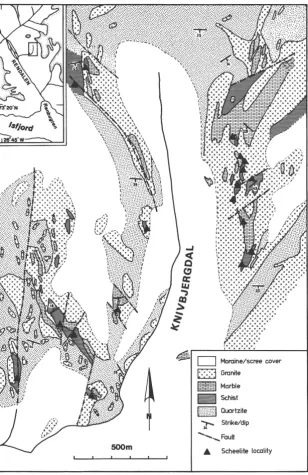
The geology of the area consists of Upper Proterozoic metasediments which are dominated by quartzites, with an interbedded, 100 to 200 m thick horizon of schists and marbles. The metasedi-ments have been intruded by granite, and the schists now occur in the top of the granite as large lenses up to 1000 m long and 100m thick (Fig. 3). The schists comprise biotite, quartz and plagioclase with accessory sphene and apatite. They are calcareous in places and may contain diopside, tremo-lite and clinozoisite. The marbles are calcitic and often bituminous. The mai~
granite intrusion is a grey two-mica
1
granite, although a red, potassium-ric granite also occurs. Pegmatites cross-cut the entire area. The granites havelnot been dated. Two types of skarn - a pale brown zoisite-clinozoisite skarn and a green diopside skarn - have formj
ed in the marble near the contact to
1
the granite. The zoisite skarn envel-opes the diopside skarn.
Scheelite mineralization occurs in both the schist and marble lenses at the top of the granite (Fig. 3). In mineralized schist, scheelite occurs in clinozoisite-rich layers, in cross-cutting shear zones and disseminated i biotite-rich schistose layers. Mineral zation is typically restricted to cent metre-thick bands in the schist with u
to 0.3% W. The overall tungsten conter of the schist is less than 100 ppm. Studies of the schist mineralization have revealed that the more intense scheelite mineralization is accompaniE by increasing contents of fluorite (uJ to 10% by vol.) and apatite (up to 2% by vol.), by bleaching of the biotite and by enrichment in tin (200 ppm) an• beryllium (70 ppm).
Scheelite Mineralization in Central East Greenland 321
500m
Granite
~Marble
~Schist
1;(\~LJ Quartzite
""?--. Strike/dip
34
... ..._Fault
A Scheelite locality
Fig. 3. Geological and scheelite-mineralization map of Knivbjergdal
tungsten content is about 1%, and which are also enriched in copper (150 ppm), lead (150 ppm), tin (400 ppm), beryl-lium (70 ppm), lithium (700 ppm) and bismuth (50 ppm).
Other Areas
[image:23.446.23.331.55.530.2]322
Gletscher (Fig. I). Outcropping marble/ calc-silicate lenses with minor schee-lite occur in biotite-muscovite schist at Gernrnedal. The calc silicates com-prise diopside, clinozoisite, idocrase and garnet. As well as containing up to 3.4% W in hand samples, the calc-silicate rocks are enriched with up to 400 ppm Sn and 200 ppm Bi. The meta-sediments have been intruded by garnet
and tourmaline-bearing, two-mica granite
veins, and have been subjected to post-mineralization deformation.
Boulders of forsterite marble, with scheelite in dark green, massive skarn have been found at Roslin Gletscher. They stem from the migmatized metasedi-ments of the area. The skarn is compos-ed of diopside, plagioclase, scapolite and scheelite. Post-mineralization de-formation of the skarn is evident. A hand sample of skarn contained 2% W and minor tin (80 ppm) and beryllium
(200 ppm) .
The Eremitdal mineralization is also known only in skarn boulders. The boul-ders are of marble cut by veins of tourmaline-bearing, two-mica granite. A scheelite-bearing, up to 0.5 m thick calc-silicate assembl~ge has developed at the granite-marble contact. The calc-silicate rock comprises diopside, gar-net and idocrase, with minor clinozoi-site, sphene, plagioclase, muscovite, actinolite, quartz, calcite, apatite, fluorite and scheelite. The skarn has a low tungsten content ( < IOO ppm), and is enriched in tin (300 ppm).
Mineralization in
the
Lower EBG
Sediments
Alpefjord
Scattered scheelite mineralization has been located along I5 km of the west coast of Alpefjord. The geological set-ting of this area comprises quartzitic sediments of the Arenaceous-Argilla-ceous "series" (Frankl, I95I) and Cale-donian intrusive granites (Fig. I).
Scheelite mineralization has been studied at three localities - Trekant-gletscher at the contact of the lower-most-preserved sediments of the Lower EBG and granite in the south of the
C.P. Hallenstein and J.L. Pedersen
area, and at Scheelitdal and Galenadal which respectively are I km and 3 km stratigraphically higher than the sedi-ments at Trekantgletscher, and which are 5 to 7 km east of the outcropping granite (Fig. I).
At Trekantgletscher, scheelite oc-curs in centimetre to metre dimensioned lenses of contact metamorphosed calca-reous quartzite - the skarnoid rocks. The lenses are often zoned, with an approximately I em thick, greenish horn blende-diopside-clinozoisite rim and a calcareous core usually dominated by hornblende skarnoid. The garnet-hornblende skarnoid comprises quartz, grossularite, diopside, hornblende, clinozoisite, plagioclase, scapolite and calcite. Fluorite and scheelite oc-cur in minor amounts, and sphene, apa-1
tite and opaque minerals are accesso- / ries. In some cases, a zone of garnet-1 idocrase skarnoid occurs within the I garnehornblende skarnoid. The garne
t-1 idocrase skarnoid comprises quartz, grossularite, idocrase, fluorite, cal-· cite, diopside and clinozoisite. Schee~
lite, sphene and opaque minerals are accessories. Most scheelite occurs in the garnet-hornblende skarnoid. Tung-sten contents of hand samples vary from O.I to 0.8% W. The average conten of an entire skarnoid lens is only a few hundred ppm tungsten. The skarnoid. are also enriched in beryllium (300 pp1
tin (200 ppm) and bismuth (100 ppm). At Scheelitdal, scheelite is associ ated with concordant quartz veins. The veins are from fifty to several hundre metres apart, are up to 3 m thick, and can be followed for up to 500 m. In addition to coarse-grained quartz, the veins contain coarse-grained arseno-pyrite and rare scheelite as centimetr large idiomorphic crystals. The schee-lite occur near the contact to the wal rocks.
Scheelite Mineralization in Central East Greenland 323
Fig. 4. Quartz-vein swarm, Galenadal
tinuously exposed, but i t appears as if 150 m thick Calc-Argillaceous "series", one continues for 800 m along its strike.and the rusty shaly quartzites of the Detailed field observations in the Argillaceous-Arenaceous series (Frankl, swarms have revealed the existence of 1953). Large-scale folding has resulted several generations of quartz veins. in tilting of the sediments at about The oldest veins contain most of the 50° to the northeast. The granites scheelite, whereas arsenopyrite, galena, have intruded to a level about 500 m chalcopyrite, pyrrhotite and bismuthi- below the Calc-Argillaceous "series". nite occur in the youngest veins. Some calc-silicate minerals have
devel-Systematic sampling of the vein oped in calcareous rocks during con-swarms indicates an average content of tact metamorphism.
0.1% Wand 0.2% As. The contents of The principal scheelite
mineraliza-other elements in sulphide-rich samples tion at both localites is associated
are 1500 ppm Pb, 200 ppm Bi, 15 ppm Ag, with quartz veins. Minor mineralization
12 ppm Sb, 50 ppm Cu, 25 ppm Zn and 0.1 in calc-silicate rocks has also been ppm Au (Stendal, 1982). seen, but only in boulders.
Bersaerkerbrae and Skjoldungebrae Scheelite mineralization has been found at these two localities in the North Stauning Alper, some 10 km from each other. Both are near the contact be-tween Lower EBG sediments and Caledo-nian granite (Fig. 1).
The geology of both areas consists of grey quartzites of the Arenaceous-Argillaceous "series11
, overlain by
al-ternating limestones and shales of the
At Bersaerkerbrae, 0.5 to 5 em thick veins occur in the Calc-Argillaceous "series11
• The centre of the veins
con-sists of muscovite with accessory fluo-rite, apatite and cassitefluo-rite, and is enveloped by an up to 1 em thick zone of fluorite, muscovite, quartz, plagio-clase and minor scheelite. In the Arena-ceous-Argillaceous 11
series 11
,
[image:25.454.25.359.61.294.2]324
greisen-like, muscovite-rich selvage of the veins, which comprises cassiter-ite, apatcassiter-ite, fluorite and scheelite. The quartz core of the veins contains accessoric bornite, chalcopyrite, cas-siterite, hematite, galena, bismuthinite and stannite. The average tungsten con-tent of the veins is less than 100 ppm, but the muscovite selvage contains on average about 0.5% Sn.
Scheelite mineralization at Skjol-dungebrae occurs in a few, up to 2 em thick quartz-muscovite-fluorite veins, and in more frequent, up to 1 m thick quartz-fluorite-carbonate veins. Tung-sten contents of the veins average less than 100 ppm.
Randenaes
Randenaes is situated on the south coast of Lyells Land just east of the contact zone between Proterozoic metasediments and Lower EBG sediments (Fig. 1). The contact zone is intruded by Caledonian two-mica granites and by pegmatites. The oldest pegmatites are sub-concor-dant to the easterly dipping Lower EBG sediments, and are rimmed by millimetre to centimetre-thick muscovite greisen. Younger pegmatites are sub-vertical and without associated greisen. The meta-sediments are contact metamorphosed and comprise interbedded quartzite, biotite schist and garnet-biotite schist, with some metre-sized lenses of calc-silicate
(skarnoid) rocks.
Most of the scheelite mineralization of the area is associated with the grei-sen rims of the oldest pegmatites. The greisen may also contain cassiterite, arsenopyrite, tourmaline and fluorite. The greisen contains up to 3000 ppm W, 800 ppm Sn and enhanced contents of lithium (200 ppm) and beryllium (SO ppm) Traces of scheelite also occurs in joints in the wall rocks of mineraliz-ed pegmatites and in lenses of skarnoid rocks.
~neraZization in the Upper EBG
Sediments
North and South Margeries Dal
Margeries Dal is a 20 km long,
NNE-striking valley on West Ymers
0.
Schee-C.P. Hallenstein and J.L. Pedersen
lite mineralization is known in two areas about 12 km from each other -North and South Margeries Dal (Fig. 1).
In Margeries Dal, Upper EBG sedi-ments are cut by large E-W striking
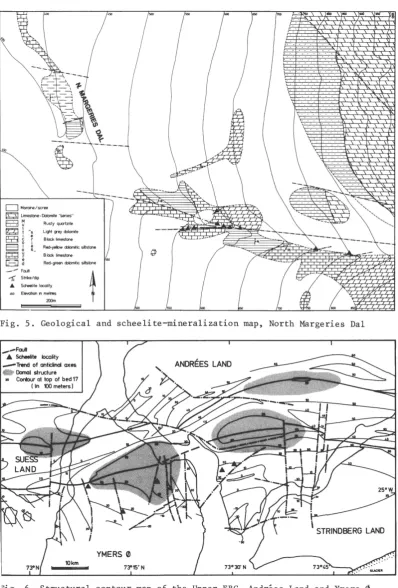
faults, over 10 km long and with throws of 100 to 1000 m (Fig. 6). The northern blocks are generally downthrown. Many second-order faults, up to a few hun-dred metres long, branch off the main faults (Fig. 5). The throws of the second-order faults are up to 100 m, but diminish on going away from the main faults. The sediments of Margeries Dal form part of the easterly dipping flank of an open anticline. On the structural contour map (Fig. 6), it car be seen that the anticline forms a dom<
culmination in West Ymers
0.
Lamprophy1dykes intrude the sediments and contai]
fragments of quartzite and granite.
I
Mineralization in North and South Margeries Dal occurs in the 100 m thicl lowermost limestone unit of the Upper
EBG as veins in second-order structure1
At North Margeries Dal (Fig. 5) the largest vein contains both scheelite
and stibnite in a breccia zone strik- ,
ing 080° and dipping 75°N. Stibnite predominates in the 65 m of the brec-cia zone nearest the main fault. It occurs as decimetre-thick massive vein and as thin veinlets in the hanging wall of the breccia zone in the lime-stone. Scheelite has been observed in the brecciated limestone of this 65 m long zone, but only as scattered grain
West of the stibnite-dominated zone the brecciated limestone is mineralize along strike for 110m, mostly with scheelite, but also with stibnite. Scheelite occurs as irregularly dis-tributed fillings in the 1-2 m thick breccia zone. Stibnite occurs in a few millimetre to decimetre-thick veins ir both the footwall and hanging wall of
the breccia zone. Sampling of the en-tire 110m long zone indicates content of 0.8% W and 2.4% Sb with a thicknesE averaging 3m. Dolomitization and sil] cification of the limestone is also present in the breccia zone. Magnesia contents are up to 5% and silica from
10 to 60%, compared with < 1% MgO and
Scheelite Mineralization in Central East Greenland
---D Moraine/scree
~ Limestone-Oo4omite "series"
E:SJ M Rusty qwrtzite
~
l ":,
Li<t>l g:ey dolomite ~ t Block limestoneE3
!
i.,
Red-yellow dolomitic sitstooe~ ~ B lad< limesla'le
B ~ Red-green dolornrtic sillsla'le
. -·'"' FauH
...r; Strike/dip
.A. Schoelite locality
EleYotim in metres 200m
Fig. 5. Geological and scheelite-mineralization map, North Margeries Dal
ANDREES LAND
YMERS 0
10km
73"15'N
~ig. 6. Structural contour map of the Upper EBG, Andrees Land and Ymers
0
[after Haller, 1971)
[image:27.446.15.414.48.636.2]326
3 ppm), silver (up to 2 ppm) and gold (up to 0.15 ppm). Gold analysis was by fire assay, other elements were analyzed by atomic absorption.
The breccia zone can be traced for a further 50 m to the west. It is 0.5-1 m wide with no visible scheelite or stibnite, but the contents of tung-sten and antimony are still elevated with 4-100 ppm W and 2-100 ppm Sb.
Several other mineralized lenses oc-cur in an overlying limestone unit up to 40 m north of the main fault (Fig. They are up to I m thick, 10 to 15 m long, contain about 1% W but no anti-mony. The tungsten, as scheelite, oc-curs as breccia fillings in second-order fault structures. Similar small scheelite-mineralized lenses have been located in second-order structures in the overlying limestone approximately 200 m east of the main mineralization (Fig. 5).
The main mineralization of South Margeries Dal is a vein in a breccia zone, striking ENE, dipping 80°N, and without any appreciable amount of dis-placement. The zone is up to 3m wide and can be followed from the bottom to the top of the 100 m thick, lower-most limestone unit. Scheelite occurs as breccia fillings in the limestone
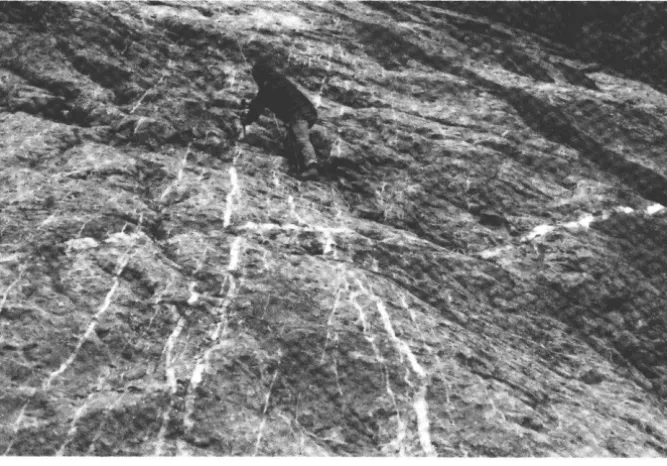
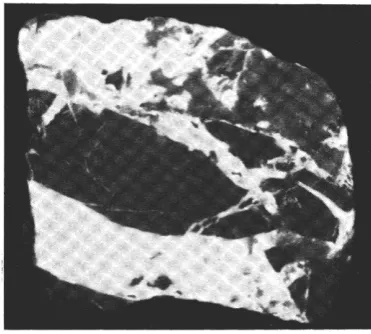
(Fig. 7), and is particularly concen-trated in the breccia zone in the lower half of the unit. The tungsten content averages nearly 3% over an average width of 2.5 m. Dolomitization and si-licification are pronounced and cor-relate well with the distribution of scheelite. Stibnite has not been ob-served, but antimony can be detected as a trace element (up to 19 ppm Sb).
Petrographic studies of the North and south Margeries Dal veins have enabled the description of the textural and mineralogical development during vein formation in the limestone. After cataclastic deformation of the lime-stone, very fine-grained quartz, dolo-mite and scheelite replaced calcite in the fractured limestone. During pro-gressive replacement, large subhedral scheelite grains formed. Fine-grained quartz occurs as inclusions in the rims of the scheelite grains. At a late stage, calcite and stibnite (if present) precipitated in the centre of
C.P. Hallenstein and J.L. Pedersen
Fig. 7. Scheelite-mineralized limestone breccia, South Margeries Dal. Photo in UV-light with scheelite shining white
I
veins. Post-mineralization deformation!
has caused deformation twinning and fracturing of the scheelite grains, and shearing of stibnite into very fine-grained aggregates.
Other Areas
[image:28.446.239.425.62.229.2]