White Rose Research Online URL for this paper:
http://eprints.whiterose.ac.uk/75427/
Version: Accepted Version
Article:
Li, Xin-Zheng, Walker, Brent, Probert, Matthew I. J. orcid.org/0000-0002-1130-9316 et al.
(3 more authors) (2013) Classical and quantum ordering of protons in cold solid hydrogen
under megabar pressures. Journal of physics : Condensed matter. 085402. ISSN
1361-648X
https://doi.org/10.1088/0953-8984/25/8/085402
[email protected] https://eprints.whiterose.ac.uk/
Reuse
Items deposited in White Rose Research Online are protected by copyright, with all rights reserved unless indicated otherwise. They may be downloaded and/or printed for private study, or other acts as permitted by national copyright laws. The publisher or other rights holders may allow further reproduction and re-use of the full text version. This is indicated by the licence information on the White Rose Research Online record for the item.
Takedown
If you consider content in White Rose Research Online to be in breach of UK law, please notify us by
Xin-Zheng Li1,2, Brent Walker1, Matthew I. J. Probert4,
Chris J. Pickard3, Richard J. Needs5, and Angelos Michaelides1∗
1
London Centre for Nanotechnology and Department of Chemistry,
University College London, London WC1E 6BT, U.K.
2
School of Physics, Peking University, Beijing 100871, P. R. China
3
Department of Physics and Astronomy, University College London, London WC1E 6BT, U.K.
4
Department of Physics, University of York, York YO10 5DD, U.K.
5
Theory of Condensed Matter Group, Cavendish Laboratory,
University of Cambridge, J. J. Thomson Avenue, Cambridge CB3 0HE, U.K.
(Dated: January 9, 2013)
A combination of state-of-the-art theoretical methods has been used to obtain an atomic-level picture of classical and quantum ordering of protons in cold high-pressure solid hydro-gen. We focus mostly on phases II and III of hydrogen, exploring the effects of quantum nuclear motion on certain features of these phases (through a number ofab initio path in-tegral molecular dynamics (PIMD) simulations at particular points on the phase diagram). We also examine the importance of van der Waals forces in this system by performing calcu-lations using the optB88-vdW density functional, which accounts for non-local correcalcu-lations. Our calculations reveal that the transition between phases I and II is strongly quantum in nature, resulting from a competition between anisotropic inter-molecular interactions that restrict molecular rotation and thermal plus quantum fluctuations of the nuclear positions that facilitate it. The transition from phase II to III is more classical because quantum nuclear motion plays only a secondary role and the transition is determined primarily by the underlying potential energy surface. A structure of P21/csymmetry with 24 atoms in
I. INTRODUCTION
Hydrogen (H) is the most abundant of the elements and, having one electron, it can form
only a single strong covalent bond. As a result, pure H is expected to remain molecular to very
high pressures. Several solid phases of H have been observed; phase I is a quantum crystal of
rotating H2 molecules on a hexagonal close packed (hcp) lattice but, despite decades of study, the
arrangements of the molecules in phases II and III are unknown.1,2 Evidence has recently been
found for a room-temperature phase IV of solid hydrogen,3–6 although here we study only low
temperatures ofT ≤150 K.
Determining the atomic structures of the different phases presents a formidable challenge to
experiment. Direct experimental structure determinations for solid hydrogen are hampered by
the weak scattering of X-rays by H and the difficulties of combining high-pressure static diamond
anvil cell techniques with such measurements. To date only a single X-ray study covering the
three low-temperature phases has been reported.7 Although this study provides constraints on the
experimental structures and phase transitions, the strongest experimental evidence comes from IR,
Raman, and optical measurements which provide valuable but indirect structural information.1
A key experimental observation is that the boundary between phases I and II depends strongly
on the isotope.1,8,9 At low temperatures, the I/II transition occurs at 28 to 40 GPa (0.28 to
0.4 megabar) in D2,9,10 50 to 69 GPa in HD,11 and 90 to 110 GPa in H2.8,12 In contrast, the
boundary between phases II and III, which occurs at ∼160 GPa,13 is only weakly dependent on
the isotope. Likewise, the transition from phase I to II is strongly temperature dependent, whereas
the II/III transition is essentially independent of temperature. Upon passing from phase I to II the
vibrational roton modes undergo substantial changes, indicating that the molecules change from
a rotationally free state to a rotationally restricted one. The IR activity increases dramatically at
the II/III transition and the IR and Raman vibron frequencies soften by about 80 cm−1.7,14Phase
III remains transparent up to 300 GPa but becomes dark by about 320 GPa.14
The theoretical characterisation of high pressure solid hydrogen is also a major challenge. The
development of a successful model must start with an extensive exploration of structural phase space
in order to identify candidate structures for the different phases.15,16 In addition, the energetics of
the structures must be accurately accounted for, and the optical properties must be well-described,
particularly at the high pressures at which metallisation may occur. Given the low mass of
hydro-gen, quantum nuclear effects including zero-point (ZP) motion should also be accounted for.17–20
the excellent theoretical papers on this system have addressed all of these issues simultaneously. In
this work we have addressed these points using a combination of state-of-the-art methods. We have
used the results from extensive density-functional-theory (DFT) based searches of the potential
en-ergy surface (PES)15,21, so that our simulations start from the most stable structures identified to
date. We have used theab initiopath-integral molecular dynamics (PIMD) method22–24to account
for quantum nuclear motion at finite temperatures. The equilibrated structures obtained from the
PIMD calculations are used to calculate optical properties using theGW many-body perturbation
theory approach, and a hybrid exchange-correlation density functional.25In the PIMD simulations
we use a 144-atom supercell together with the constant-pressure, constant-temperature (NPT)
ensemble.26 This ensemble allows relaxation of the cell shape and size, and reduces the bias
to-wards particular structures which arises from using small fixed cells. The use of large variable cells
and lower-enthalpy static-lattice structures as the starting points of our simulations are important
advances over previous PIMD studies of solid H, where either “quantum localisation” or metallic
structures at too low pressures were predicted.18–20As we show below, the broad range of methods
employed here provides an atomic-level picture of the classical and quantum ordering of protons
in low-temperature solid hydrogen that is consistent with the key experimental results.
II. COMPUTATIONAL DETAILS
The quantum behaviour of the nuclei is described within the PIMD method by a “ring
poly-mer” consisting of beads connected by springs.22–24 Nuclear exchange effects are neglected in our
calculations and we assume an adiabatic decoupling of the electron and nuclear motions. PIMD is
a finite temperature method and the number of beads required to give an accurate sampling of the
imaginary time path decreases with increasing temperature. We have used 64 beads per nucleus
for the simulations at 50 and 100 K, and 16 beads at 150 K. We have performed NPT PIMD
simu-lations at 80 and 200 GPa. The simusimu-lations at 80 GPa were run for 9,000 steps using a time step of
0.25 fs, and the final 8,000 steps were included in the data analysis. Those at 200 GPa were run for
20,000 steps with a time step of 0.125 fs, and data from the final 15,000 steps were included in the
analysis. Convergence tests were performed on the number of beads used, the simulation length,
and the sampling intervals, and we also tested the validity of neglecting the nuclear exchange in the
PIMD calculations, as reported in the supporting information. The DFT-based classical molecular
dynamics (MD) and PIMD simulations were of the Born-Oppenheimer type, i.e., the electronic
were sampled on a k-point grid of spacing 0.05×2π/˚A in all of the calculations. The MD and
PIMD simulations were carried out using the CASTEP code27 with ultra-soft pseudopotentials28
and a 350 eV plane-wave cut-off. The IR and Raman spectra were calculated within
density-functional perturbation theory29, using the CASTEP code, norm-conserving pseudopotentials30,31
and a plane-wave cut-off energy of 800 eV. All of the CASTEP calculations were performed with the
Perdew-Burke-Ernzerhof (PBE) exchange-correlation functional32. The vdW-DF (optB88-vdW)33,
GW, and hybrid functional calculations were carried out using the VASP34,35 code with PAW
po-tentials36,37 and a 600 eV plane-wave cut-off. The X-ray diffraction simulations were performed
using the Powder Cell program.38
III. RESULTS AND DISCUSSIONS
A. Accuracy of PBE
Pickard and Needs performed extensive explorations of the structural phase space of hydrogen,
and a number of low-enthalpy structures were identified at pressures of about 100 GPa where phase
II is stable.15,21 These structures correspond to minima in the static lattice enthalpy, and they do
not include any effects from vibrations. The molecular centres in these structures lie very close to
a hcp lattice, as is generally thought to occur in phase II. In this study we have used theP21/c-24
structure21 as a model for phase II. The P2
1/c-24 structure has 24 atoms in the primitive unit
cell21, and it is a little more stable than the structure of the same symmetry reported in Ref. 25,
which has an 8-atom primitive unit cell. At higher pressures these hcp-based structures become
unstable with respect to a layered structure of C2/c symmetry with 24 atoms in the primitive
cell. A related and slightly less stable structure, with the same space group but a smaller unit
cell, was found by Tse et al.16 DFT calculations using the PBE exchange-correlation functional
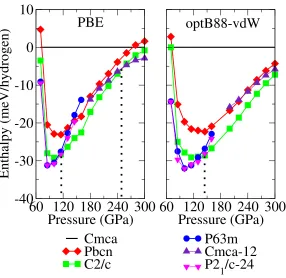
show that C2/c has the lowest static-lattice enthalpy among the plausible candidates for phase
III in most of the pressure range in which it has been observed, see Fig. 1 and Refs. 15 and 21.
Although PBE has been successfully applied in many high pressure studies, it does not account
for van der Waals (vdW) interactions, which are often important in binding molecular crystals.
We have therefore tested the effects of including vdW forces on the relative enthalpies and phase
boundaries using the optB88-vdW functional33within the vdW-DF scheme.39Fig. 1 shows that the
relative stabilities of the structures are generally not altered substantially. However, the transition
60 120 180 240 300
Pressure (GPa)
-40
-30
-20
-10
0
10
Enthalpy (meV/hydrogen)
Cmca
Pbcn
C2/c
60 120 180 240 300
Pressure (GPa)
P63m
Cmca-12
P2
1
/c-24
[image:6.612.163.449.68.346.2]PBE
optB88-vdW
FIG. 1. Enthalpy as a function of pressure relative to the Cmca structure25
at megabar pressures. The results shown in the left panel were calculated using the PBE functional and those in the right panel were obtained using the optB88-vdW functional, which accounts for van der Waals (vdW) interactions within the vdW-DF scheme. TheCmca-12 molecular structure is described in Ref. 15.
C2/cfor phase III) is increased from∼120 GPa with PBE to∼150 GPa with optB88-vdW, in better
agreement with experiment.13 As can be seen in Fig. 1, static lattice PBE calculations indicate
that Cmca25 is less favourable than C2/c over the pressure range in which phase III is observed.
However, including harmonic ZP motion changes the picture significantly5,6, and the softerCmca
structure becomes the most energetically favourable above about 225 GPa. The Cmca structure
is, however, metallic and its vibronic frequencies are considerably lower than those of phase III,
and therefore Cmca is not a plausible model for phase III. As can be seen from Fig. 1, using
the optB88-vdW functional33 instead of PBE leads to an increase in the enthalpies with respect
to C2/c of about 6 meV per proton for the weakly molecular Cmca structure and about 3 meV
per proton for the strongly molecular Cmca-12 structure. When harmonic ZP motion corrections
are added to the static lattice data of Fig. 1 we find that C2/c remains the most stable phase
up to about 300 GPa. Using the optB88-vdW functional therefore removes a major conflict with
experiment in the PBE phase diagram reported in Refs. 5 and 6 and, overall, gives significantly
B. Phases I and II
In order to explore phases I and II in more detail, we have carried out an extensive series ofab
initio PIMD simulations. The first set of calculations was performed at 80 GPa, a pressure safely
within the experimental region of stability of phase II in solid D2 and the region in which static
DFT calculations predict phase II-like structures to be stable. PIMD simulations were performed
on both the P63/m and P21/c-24 structures since they are the two lowest-enthalpy static-lattice
structures at 80 GPa. A 144-atom supercell was used which is commensurate with the cells of both
theP63/m15 and P21/c-24 structures.21 Using D at a temperature of 50 K and starting from the
P63/m structure, MD and PIMD simulations quickly showed a transformation from the original
structure to a new rotationally restricted state. The centres of the molecules still form a hcp
lattice but the molecular orientations differ from the starting state and it is difficult to identify a
corresponding static structure. This indicates that althoughP63/mcorresponds to a minimum in
the PES (with positive harmonic vibrational frequencies), it is so shallow that thermal or quantum
effects are sufficient to disrupt it. Therefore P63/mis not a plausible structure for phase II when
anharmonic nuclear motion is taken into account.
Starting from the P21/c-24 structure, we performed a classical MD simulation at 50 K, PIMD
runs for D and H at 50 K, and a PIMD run for D at 150 K. Some of the key results from these
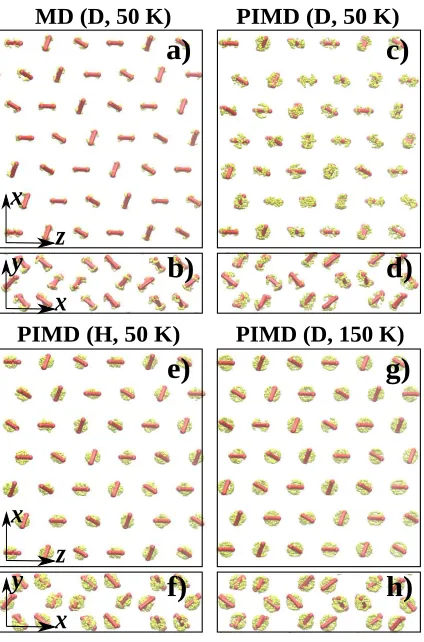
simulations are reported in Fig. 2, where representative configurations of the centroid trajectories
are plotted. We find that the orientational ordering of the starting structure is maintained in the
classical MD simulation (Fig. 2(a) and (b)). Similarly, the initial orientational ordering is rather
well preserved in the PIMD simulation with D (Fig. 2 (c) and (d)). Under the same conditions, but
switching to the lighter H atom, we find that the orientational ordering is almost completely lost, as
reflected by the spherical distributions seen in Fig. 2(e) and (f). Returning to the heavier D atom
but increasing the temperature to 150 K, we again find a spherical trajectory distribution on a hcp
lattice. These qualitative interpretations are supported by a detailed analysis of the probability
distributions associated with the rotational freedom of the molecules. We calculate the angle θ
between the projection of the molecules on the x−y plane and the y axis (inset of Fig. 3 (d)),
and plot probability distributions ofθ and the molecular bond length (r) for each simulation. The
geometry-optimised P21/c-24 structure has molecules aligned between 30◦ and 50◦ and between
−30◦ and−50◦. Two rather broad peaks are seen in the PIMD simulations for D at 50 K at about
±40◦ (Fig. 3 (b)), which are consistent with restricted molecular rotation. On the other hand,
to a probability distribution characteristic of a freely rotating molecular state (Fig. 3 (c) and (d)).
These results show that the degree of orientational order is governed by a competition between
the corrugation of the underlying PES, which favours rotational restriction, and the thermal and
quantum nuclear fluctuations, which oppose it. We find no evidence for the “quantum localisation”
reported in previous PIMD simulations.20
Our results explain in a simple manner the positive slope (dP/dT) of the I/II coexistence line
as well as the isotope-dependence of the transition pressure. The corrugation of the underlying
PES increases with pressure and, as the pressure increases, higher temperatures are required to
overcome the corrugation. The I/II transition for hydrogen occurs at a lower pressure than in
deuterium for a similar reason; quantum effects are greater for hydrogen and so the corrugation
of the underlying PES is more easily overcome by hydrogen than by deuterium. These results are
consistent with the traditional understanding of the quantum nature of phase I.1,8
C. Phase III
DFT structure searches40 have so far provided a single best candidate for phase III: a layered
C2/c structure with significant deviations from close packing within the layers.15 Other
competi-tive structures were found, including an intriguing structure of P bcnsymmetry which consists of
alternate layers of strongly bonded and more weakly bonded molecules (see Fig. 3 of the
supple-mentary information for Ref. 15). P bcnhas a lower ZP enthalpy than structures consisting entirely
of strongly bonded molecules, and it might be favoured when ZP motion is taken into account. We
therefore performed a number of simulations for bothP bcnandC2/c. In particular, we focused on
understanding whether either of these structures is consistent with the experimental observation
that phase III is transparent up to 300 GPa, but becomes opaque by 320 GPa.14 To this end we
calculated the band gap energies of theP bcnandC2/cstructures using a many-body perturbation
theory approach and theGW approximation to the self energy, and PBE0-like density functionals
with different percentages of “exact-exchange” (EXX).41 We found that using a hybrid density
functional including 30% EXX reproduced the direct and lowest band gaps of theP bcnand C2/c
structures obtained within GW theory (Fig. 4). This hybrid density functional was subsequently
used to calculate the optical absorption spectra of the static lattice P bcnand C2/c structures at
pressures between 200 and 350 GPa, see Fig. 5(a) and (b). The peaks in the absorption spectra
correspond to strong inter-band transitions, and a non-zero imaginary part of the macroscopic
a)
b)
c)
d)
e)
f)
g)
h)
MD (D, 50 K) PIMD (D, 50 K)
PIMD (H, 50 K) PIMD (D, 150 K)
z
x
x
y
z
x
[image:9.612.201.413.71.392.2]x
y
FIG. 2. Trajectories of structures obtained from simulations with classical and quantum nuclei at 80 GPa starting from the P21/c-24 structure. Yellow balls show the representative configurations of the centroids
throughout the course of the simulation. The red rods show the static (geometry-optimised) structure. A conventional hexagonal cell containing 144 atoms was used. Panels a, c, e, and g show thez−xplane and panels b, d, f, and h show thex−y plane of the hcp lattice. The four simulations are: 1) MD with classical nuclei at 50 K (panels a and b), 2) PIMD for D at 50 K (panels c and d), 3) PIMD for H at 50 K (panels e and f), and 4) PIMD for D at 150 K (panels g and h). In the MD simulation, the anisotropic inter-molecular interaction outweighs the thermal and quantum nuclear fluctuations. Therefore, the molecular rotation is highly restricted. The thermal plus quantum nuclear fluctuations outweigh the anisotropic inter-molecular interactions in the PIMD simulations of H at 50 K and D at 150 K.
evolution of the absorption spectra shows that P bcn becomes opaque between 270 and 300 GPa
(Fig. 5a), while C2/c turns opaque between 300 and 350 GPa (Fig. 5b). Considering the limited
accuracy of the static pressure, the static-lattice absorption spectra of both P bcnand C2/c are in
qualitative agreement with the experimental observations.
We now consider the changes in the absorption spectra induced by introducing thermal and
quantum nuclear fluctuations To this end we have performed PIMD simulations for H using 48-atom
FIG. 3. Phase diagram of solid H and D with the pressure-temperature coordinates of three key PIMD simulations indicated at 80 GPa (in panel a), and probability distribution functions for these simulations (panels b, c, and d). The three PIMD simulations are: 1) D at 50 K, 2) H at 50 K, and 3) D at 150 K. D at 50 K has the least thermal plus quantum nuclear fluctuations, while H at 50 K and D at 150 K have larger thermal fluctuations. The probability is plotted as a function of r (molecular bond length) and θ (angle between the projection of the molecules on thex−y plane and they axis). The ground state structure has molecules aligned between 30◦ and 50◦ and between−30◦ and−50◦ (inset in panel d and Fig. S1 of the supporting information). The molecules of D at 50 K (panel b) are still rotationally restricted (phase II). Replacing D by H (panel c) or elevating the temperature to 150 K (panel d) leads to free rotation (phase I). Thermal plus quantum fluctuations compete with the anisotropic inter-molecular interactions in the region of the transition from phases I to II.
stability range of phase III. These reveal that theP bcnstructure maintains its original symmetry
but the weak molecular layers evolve to atomic-like layers in which the nearest neighbour distances
are approximately equal. When using the new PIMD structure to calculate the absorption spectra
we find thatP bcnis already opaque at 200 GPa (note the absorption peak within the visible light
region in Fig. 5(c)). This is inconsistent with experiments on phase III which find that it remains
transparent up to∼300 GPa. However, in the PIMD simulations for theC2/cphase, the structure
and consequently the absorption spectrum are only slightly altered compared with the original
geometry-optimised structure (Fig. 5(d)). Therefore, unlike P bcn, C2/c remains transparent up
to pressures as high as 300 GPa when thermal and quantum fluctuations are taken into account.
Zha et al.42 recently reported synchrotron IR measurements for dense hydrogen, finding that the
IR vibron of phase III persists up to at least 360 GPa. This behaviour is also reasonably consistent
0
10
20
30
40
50
% of EXX
1
2
3
4
5
6
E
g(eV)
Lowest band gap
Direct band gap
0
10
20
30
40
50
% of EXX
1
2
3
4
5
6
[image:11.612.126.485.69.237.2]Pbcn at 200 GPa
C2/c at 200 GPa
FIG. 4. Variation of the lowest energy and direct band gaps with the percentage of exact-exchange (EXX) in the hybrid functional calculations for the static P bcn (left panel) and C2/c (right panel) structures at 200 GPa. The black (red) dashed line indicates the LDA based G0W0 results for the lowest (direct) band
gap. The G0W0 results are converged to within 0.01 eV with respect to the number of unoccupied states.
Using 30% exact-exchange reproduces theG0W0 band gaps to within∼0.1 eV.
FIG. 5. Absorption spectra of hydrogen at 200 GPa. Panels (a) and (b) show absorption spectra calculated using 30% exact exchange at different pressures for (a)P bcn, and (b)C2/c, using static geometry-optimised structures. Panels (c) (P bcn) and (d) (C2/c) compare the 200 GPa absorption spectra obtained from static geometry-optimised structures (solid lines) with those obtained from the PIMD simulations (dashed lines). The visible light region is shown by the rainbow in each panel. Using the PIMD structure renders P bcn
[image:11.612.130.477.364.613.2]D. Discussion and Conclusions
From the previous discussion it is clear that our most promising candidate structure for phase
II is P21/c-24, but we have insufficient evidence to identify it as the correct structure. The
P21/c-24 structure is monoclinic, while experiments have suggested that phase II is hexagonal.43
Experiments on D2 have suggested that phase II is incommensurate43, and in a theoretical study18
it was speculated that phase II of H2 might be “diffuse”, meaning that it does not correspond to
a single classical structure. We assign space group symmetries to the static lattice structures, not
to the structures found in the PIMD simulations which include nuclear motion. It is possible that
the nuclear motion might reduce lattice distortions, similar to the way in which heating can lead
to more symmetric structures, although such an effect was not apparent in our PIMD simulations.
The differences between the results obtained with the PBE and optB88-vdW functionals indicate
some sensitivity to the functional used, which must temper our confidence in the accuracy of
DFT results for this system. In addition, our simulations do not account for nuclear exchange
effects such as those that occur in ortho and para molecules, which are known to be important
in a quantitative description of phase I and its transition to phase II44–47. Notwithstanding these
limitations, it is clear that quantum nuclear effects and molecular rotations play a very important
role in the transition between phases I and II and the transition is strongly quantum in nature
even when nuclear exchange is neglected.
As the pressure increases the molecules rearrange with a significant distortion from close packing,
so that the molecules can avoid one another. The difference in the thermal plus quantum motion
of the two phases plays only a secondary role and the II/III transition is therefore only weakly
dependent on the isotope and temperature. Based on the observation of persistent (100) and (101)
X-ray diffraction peaks up to 180 GPa, Akahama et al. have concluded that any distortion from
hcp packing in phase III is small.7 This appears to rule out the C2/c structure. However, we
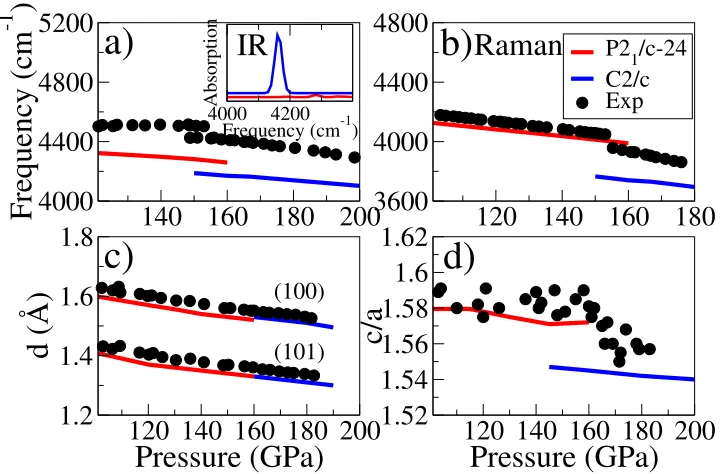
have calculated X-ray diffraction data assuming P21/c-24 for phase II and C2/c for phase III,
finding the positions of the (100) and (101) peaks in the hcp lattice to be in very good agreement
with experiment over a wide pressure range,7 see Fig. 6(c). We have also found the variation
with pressure of the c/a ratios of P21/c-24 and C2/c to be in good agreement with experiment,
including the discontinuous drop at the II/III transition (Fig. 6(d)).7 The variations with pressure
of the IR and Raman frequencies are well accounted for by the P21/c-24 and C2/cstructures, see
Fig. 6(a) and (b). The two ends of a molecule in the C2/c structure have different environments,
inset), as found in experiments on phase III.
In conclusion, we have studied solid hydrogen at megabar pressures using a variety of ab initio
techniques. The transition from phase I to II is governed by a competition between the corrugation
of the underlying PES, which restricts molecular rotation, and the thermal and quantum nuclear
fluctuations, which facilitate it. At very low pressures and temperatures the ZP motion washes out
the corrugation of the PES and leads to the freely-rotating phase I for both isotopes. Including ZP
motion destabilises theP63/mstructure, which is therefore not a plausible candidate for phase II.
Our simulations favour the proposal that phase II is a hcp-based rotationally restricted molecular
phase with a large cell.43 The IR and Raman active vibron frequencies of the P2
1/c-24 structure
are in good agreement with the experimental data for phase II.48 We also find that the (100)
and (101) X-ray diffraction peak positions of P21/c-24 and C2/c, and their c/a ratios, are in
good agreement with experiment.7 The optB88-vdW33 density functional gives a II/III transition
pressure in much closer agreement with experiment than PBE, and it moves theCmcaandCmca
-12 phases to higher enthalpies, so that the C2/c structure becomes the most stable phase up to
about 300 GPa. Using the optB88-vdW functional therefore removes a major discrepancy between
the theoretical and experimental phase diagrams. We have found that C2/c remains transparent
up to 300 GPa, which provides further support for it as a model for phase III. Overall, our study
provides evidence from a range of state-of-the-art theoretical methods which supports the picture
of orientational ordering proposed by Mazinet al.8 and others. We have provided an atomic-level
picture of the evolution of solid hydrogen under megabar pressures which satisfactorily explains
some of the experimental results, and can be tested by further experimental and theoretical studies.
ACKNOWLEDGMENTS
This work was supported by the European Research Council and the EPSRC. XZL thanks Felix
Fernandez-Alonso for helpful discussions on X-ray scattering. We are grateful for computational
resources supplied by the London Centre for Nanotechnology, UCL Research Computing, and the
UK’s national high performance computing service HECToR (for which access was obtained via
the UKCP consortium, EP/F036884/1).
1
140 160 180 200
4000
4400
4800
5200
Frequency (cm
-1)
P21/c-24 C2/c Exp
120 140 160 180
3600
4000
4400
4800
120 140 160 180 200
Pressure (GPa)
1.2
1.4
1.6
1.8
d (Å)
120 140 160 180 200
Pressure (GPa)
1.52
1.54
1.56
1.58
1.6
1.62
c/a
4000 4200 Frequency (cm-1)Absorption
a)
b)
[image:14.612.127.488.71.308.2]c)
IR
d)
(100) (101)Raman
FIG. 6. Comparison of calculated and experimental properties of phases II and III, assuming theP21/c-24
structure for phase II and C2/cfor phase III. Variation with pressure of the IR (a) and Raman (b) vibron frequencies. The inset in (a) shows the dramatic difference in IR intensity between P21/c-24 (phase II)
and C2/c (phase III). The C2/c spectrum is slightly shifted to distinguish it from that ofP21/c-24. (c)
Variation with pressure of the (100) and (101) X-ray diffraction peak positions. (d) Variation with pressure of thec/aratio. Experimental data is indicated by circles; the data in (a) and (b) were taken from Ref. 48 and those in (c) and (d) were taken from Ref. 7.
2
J. M. McMahon, M. A. Morales, C. Pierleoni, and D. M. Ceperley, unpublished(2012).
3
M. I. Eremets and I. A. Troyan, Nature Mater.10, 927 (2011).
4
R. T. Howie, C. L. Guillaume, T. Scheler, A. F. Goncharov, and E. Gregoryanz, Phys. Rev. Lett.108, 125501 (2012).
5
C. J. Pickard, M. Martinez-Canales, and R. J. Needs, Phys. Rev. B85, 214114 (2012).
6
C. J. Pickard, M. Martinez-Canales, and R. J. Needs, Phys. Rev. B86, 059902(E) (2012).
7
Y. Akahama, M. Nishimura, H. Kawamura, N. Hirao, Y. Ohishi, and K. Takemura, Phys. Rev. B82, 060101 (2010).
8
I. I. Mazin, R. J. Hemley, A. F. Goncharov, M. Hanfland, and H. K. Mao, Phys. Rev. Lett.78, 1066 (1997).
9
L. J. Cui, N. H. Chen, S. J. Jeon, and I. F. Silvera, Phys. Rev. Lett.72, 3048 (1994).
10
I. F. Silvera and R. J. Wijngaarden, Phys. Rev. Lett.47, 39 (1981).
11
F. Moshary, N. H. Chen, and I. F. Silvera, Phys. Rev. Lett.71, 3814 (1993).
12
H. E. Lorenzana, I. F. Silvera, and K. A. Goettel, Phys. Rev. Lett.64, 1939 (1990).
13
14
P. Loubeyre, F. Occelli, and R. LeToullec, Nature416, 613 (2002).
15
C. J. Pickard and R. J. Needs, Nature Phys.3, 473 (2007).
16
J. S. Tse, D. D. Klug, Y. Yao, Y. L. Page, and J. R. Rodgers, Solid State Commun.145, 5 (2008).
17
J. Kohanoff, S. Scandolo, G. L. Chiarotti, and E. Tosatti, Phys. Rev. Lett.78, 2783 (1997).
18
S. Biermann, D. Hohl, and D. Marx, J. Low Temp.110, 97 (1998).
19
S. Biermann, D. Hohl, and D. Marx, Solid State Commun.108, 337 (1998).
20
H. Kitamura, S. Tsuneyuki, T. Ogitsu, and T. Miyake, Nature404, 259 (2000).
21
C. J. Pickard and R. J. Needs, Phys. Status Solidi (b)246, 536 (2009).
22
D. Marx and M. Parrinello, Z. Phys. B (Rapid Note)95, 143 (1994).
23
D. Marx and M. Parrinello, J. Chem. Phys.104, 4077 (1996).
24
M. E. Tuckerman, D. Marx, M. L. Klein, and M. Parrinello, J. Chem. Phys.104, 5579 (1996).
25
K. A. Johnson and N. W. Ashcroft, Nature403, 632 (2000).
26
G. J. Martyna, A. Hughes, and M. E. Tuckerman, J. Chem. Phys.110, 3275 (1999).
27
S. J. Clark, M. D. Segall, C. J. Pickard, P. J. Hasnip, M. J. Probert, K. Refson, and M. C. Payne, Z. Kristallographie220, 567 (2005).
28
D. Vanderbilt, Phys. Rev. B41, 7892 (1990).
29
S. Baroni, S. de Gironcoli, A. D. Corso, and P. Giannozzi, Rev. Mod. Phys.73, 515 (2001).
30
D. R. Hamann, Phys. Rev. B40, 2980 (1989).
31
N. Troullier and J. L. Martins, Phys. Rev. B43, 1993 (1991).
32
J. P. Perdew, K. Burke, and M. Ernzerhof, Phys. Rev. Lett.77, 3865 (1996).
33
J. Klimeˇs, D. R. Bowler, and A. Michaelides, J. Phys.: Condens. Matter22, 022201 (2010).
34
G. Kresse and J. Furthm¨uller, Comput. Mat. Sci.6, 15 (1996).
35
J. Klimeˇs, D. R. Bowler, and A. Michaelides, Phys. Rev. B83, 195131 (2011).
36
P. E. Bl¨ochl, Phys. Rev. B50, 17953 (1994).
37
G. Kresse and D. Joubert, Phys. Rev. B59, 1758 (1999).
38
W. Kraus and G. Nolze, Journal of Applied Crystallography29, 301 (1996).
39
M. Dion, H. Rydberg, E. Schroder, D. C. Langreth, and B. I. Lundqvist, Phys. Rev. Lett. 92, 246401 (2004).
40
C. J. Pickard and R. J. Needs, J. Phys.: Condens. Matter23, 053201 (2011).
41
C. Adamo and V. Barone, J. Chem. Phys.110, 6158 (1999).
42
C. S. Zha, Z. X. Liu, and R. J. Hemley, Phys. Rev. Lett.108, 146402 (2012).
43
I. Goncharenko and P. Loubeyre, Nature435, 1206 (2005).
44
J. Igarashi, J. Phys. Soc. Jap.59, 2811 (1990).
45
A. F. Goncharov, M. A. Strzhemechny, H. K. Mao, and R. J. Hemley, Phys. Rev. B63, 064304 (2001).
46
Y. A. Freiman, S. Tretyak, A. Jezowski, and R. J. Hemley, J. Low Temp. Phys.122, 537 (2001).
47
48