White Rose Research Online URL for this paper: http://eprints.whiterose.ac.uk/86709/
Version: Accepted Version
Article:
Greaves, M., Zibarras, L.D. and Stride, C. orcid.org/0000-0001-9960-2869 (2013) Using the theory of planned behavior to explore environmental behavioral intentions in the workplace. Journal of Environmental Psychology, 34. pp. 109-120. ISSN 0272-4944 https://doi.org/10.1016/j.jenvp.2013.02.003
Article available under the terms of the CC-BY-NC-ND licence (https://creativecommons.org/licenses/by-nc-nd/4.0/)
Reuse
This article is distributed under the terms of the Creative Commons Attribution-NonCommercial-NoDerivs (CC BY-NC-ND) licence. This licence only allows you to download this work and share it with others as long as you credit the authors, but you can’t change the article in any way or use it commercially. More
information and the full terms of the licence here: https://creativecommons.org/licenses/
Takedown
If you consider content in White Rose Research Online to be in breach of UK law, please notify us by
Using the Theory of Planned Behavior to explore environmental behavioral intentions in the
workplace
Martin Greaves
Dr. Lara D Zibarras
Psychology Department, City University, Northampton Square, London, EC1V 0HB
Dr. Chris Stride
1 1 2
3 4
5 Running head: TPB and environmental behavioral intentions
6 7 8 9 10 11 12 13 14
Using the Theory of Planned Behavior to explore environmental behavioral intentions in the
15 16
17 workplace
5
22
27 4
Abstract
6
7 This paper presents a study using the theory of planned behavior (TPB) to explore
8 9
environmental behavioral intentions in a workplace setting. The first stage of the research process
10 11
12 was the development of a questionnaire covering TPB constructs, their antecedent beliefs, and
13 14
environmental behavioral intentions across three scenarios (switching off PCs every time
15 16
17 employees left their desks for an hour or more; using video-conferencing for meetings that would
18
19 otherwise require travel; and recycling as much waste as possible), using best practice guidelines
20 21
to ensure that it was specific and precisely defined for the target population. This was then
23
24 administered to N=449 participants, with the resulting dataset used to test hypotheses relating
25 26
antecedent beliefs to behavioral intentions via the potentially mediating effect of TPB constructs.
28
29 TPB constructs were found to explain between from 46% to 61% of the variance in employee
30 31
intentions to engage in three environmental behaviors, and to mediate the effects of specific
32 33
34 antecedent beliefs upon employee intentions to engage in these behaviors. The results form a
35
36 basis upon which interventions could be developed within the host organization, and are
37 38
39 discussed in relation to their implications, in terms of theory, practice and future research.
40 41 42 43 44 45
46 Keywords: pro-environmental behavior; theory of planned behavior; antecedent beliefs;
47 48
individual behavior change
5
22
27
44 4
Using the Theory of Planned Behavior to explore environmental behavioral intentions in the
6
7 workplace
8 9 10 11
12 1. Introduction
13 14
The 2007 report of the Intergovernmental Panel on Climate Change (IPCC) asserted that
15 16
17 evidence for climate change is now unequivocal, and stated with “very high confidence” that this
18
19 planetary warming is the net result of human activity, in particular the emissions of greenhouse
20 21
gases (GHG; IPCC, 2007). The report suggested that globally the total greenhouse gas emission
23
24 from industry is three times that from residential consumption (IPCC, 2007), and in the UK,
25 26
business and agriculture account for approximately double the GHG emissions compared to the
28
29 residential sector (Department of Energy and Climate Change, 2010). Industry clearly has an
30 31
important role to play in reducing GHG emissions; yet in spite of this, initiatives in the UK aimed
32 33
34 at reducing GHG emissions have been targeted predominantly at the domestic sector (DEFRA,
35
36 2006). However, whilst many organizations have taken steps to reduce their energy consumption
37 38
39 through updating infrastructure such as lighting, heating and cooling (Davis & Challenger, 2009),
40
41 less attention has been paid to role of employee behavior in delivering environmental
42 43
improvements. Since environmental issues are largely thought to be caused by human behavior
45
46 (Oskamp 1995, 2000a, 2000b), they may be tackled by changes in human behavior. As a step
47 48
towards understanding how employee behavior can be harnessed to achieve environmental
49 50
51 improvements, this paper presents research that develops and applies a measure based on the
52
53 theory of planned behavior (TPB; Ajzen, 1985) to explore intentions to improve environmental
54 55
56 behaviors in a workplace setting.
5
22
27
44 4
Although previous studies have used the TPB to explore behavior in environmental
6
7 contexts, the vast majority have been conducted in domestic settings (e.g. Trumbo & O‟Keefe,
8 9
2001; Knussen & Yule, 2008). Furthermore, most research focuses on the TPB constructs alone
10 11
12 to determine whether they account for variance in behavioral intentions; however it is argued
13 14
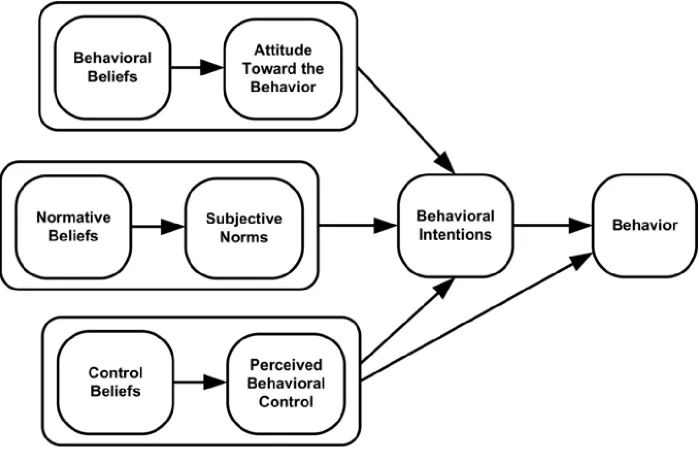
(Ajzen, 1991) that examining the beliefs which are antecedent to these constructs helps to
15 16
17 understand the process through which TPB constructs are related to intentions (this relationship is
18
19 shown in Figure 1). The present study follows best practice guidelines (e.g. Ajzen, 1991) in
20 21
designing a questionnaire based on the TPB to explore the extent to which both the core TPB
23
24 constructs and antecedent beliefs which underlie these constructs are related to environmental
25 26
behavioral intentions. This supports a recent call to action for psychologists to bring their
28
29 attention to environmental behavior in the workplace (Spence, Pidgeon &Uzzell, 2009).
30 31
In a review of the research exploring pro-environmental behavior, Davis, Challenger,
32 33
34 Clegg and Healey (2008) reported that of 165 articles identified, the vast majority concentrated
35
36 on environmental behaviors at home, with few based in organizational settings. Similarly, a
37 38
39 review of studies focusing on energy consumption reduction (Abrahamse, Steg, Vlek &
40
41 Rothengatter, 2005) found that most research had focused on the domestic sector. Although it
42 43
may be tempting to extrapolate the findings of research based in the domestic sector to the
45
46 workplace, the motivations to behave in a pro-environmental manner at home and at work may
47 48
be different. For example, households are usually liable for costs of energy consumption, whereas
49 50
51 at work these costs are not usually visible to or incurred by employees (Carrico & Reimer, 2011).
52
53 Recycling behavior may be subject to different motivations; for instance households may be
54 55
56 compelled to recycle or may be charged for the collection of non-recyclable waste. The
5
22
27
44 4
workplace may offer pro-environmental behaviors not generally available at home, such as the
6
7 use of video-conferencing in lieu of travel.
8 9
One way in which psychologists can investigate pro-environmental behavior is to draw on
10 11
12 social psychological theories such as the theory of planned behavior (TPB; Ajzen, 1985; 1991).
13 14
According to the TPB, the main antecedent of an individual‟s behavior is their intention toward
15 16
17 the behavior; and in turn an individual‟s behavioral intention is determined by three constructs
18
19 (as outlined in Figure 1). The first construct represents the individual‟s attitude towards the
20 21
behavior, which illustrates their overall evaluation of the behavior. This is based upon their
23
24 expectancies concerning whether the behavior will result in particular outcomes, and of whether
25 26
these outcomes are desirable (Ajzen & Fishbein, 1980). The second construct is based upon an
28
29 assessment of the subjective norm: the extent to which the individual believes that they are under
30 31
social pressure to perform the behavior. This is based upon the individual‟s perception of the
32 33
34 expectation of reference groups which they hold to be important, and of their motivation to
35
36 comply with these reference groups. The final construct is perceived behavioral control (PBC),
37 38
39 which is a function of the individual‟s perception of how hard it would be to perform the
40
41 behavior, thus is determined by the extent to which they believe they have self-efficacy to
42 43
perform the behavior, and perceive that they have control over the behavior.
45
46 ***INSERT FIGURE ONE HERE***
47 48
The TPB has been well supported in a wide range of fields. For example, it has been used
49 50
51 extensively to examine behaviors such as health (Conner & Sparks, 1996), drinking and driving
52
53 (Marcil, Bergeron & Audet, 2001) and choice of mode of travel (Bamberg & Schmidt, 2003).The
54 55
56 TPB has been used to explore environmental behaviors within domestic settings and has been
57
58 shown to be more successful in predicting behavior than other variables such as demographics
5
22
27
44 4
(Oreg & Katz-Gerro, 2006; Trumbo & O‟Keefe, 2001). For example Trumbo and O‟Keefe
6
7 (2001), Lam (2006) and Clark and Finlay (2007) studied intentions to conserve water among
8 9
communities in California, China and Bulgaria respectively, and all found the TPB constructs to
10 11
12 be significant predictors of behavioral intention (explaining between 10% and 66% of the
13 14
variance across a range of intentions). Elsewhere, the theory of planned behavior has been used to
15 16
17 explain a range of pro-environmental behaviors including the use of public transport (Heath &
18
19 Gifford, 2002; Bamberg & Schmidt, 2003), the use of a park and ride scheme (de Groot & Steg,
20 21
2007) and environmental activism (Fielding, McDonald & Louis, 2008).
23
24 However, to the best of the authors‟ knowledge, only two studies have applied the TPB to
25 26
environmental behaviors in the workplace. Laudenslager, Holt and Lofgren (2004) found the
28
29 TPB constructs to account for 35% of variance in intention to recycle, 26% of variance in
30 31
intention to conserve energy and 21% of variance intention to participate in a car pooling scheme
32 33
34 among servicemen living on a United States Air Force base. Fielding and colleagues (2005)
35
36 investigated intentions among farmers in Australia to implement agricultural practices designed
37 38
39 to improve water quality, and found that farmers who had strong intentions to implement these
40
41 practices differed significantly in their behavioral, normative and control beliefs to those whose
42 43
intentions where comparatively weak. In sum, the TPB is well supported empirically as a
45
46 theoretical foundation to investigate environmental behaviors and furthermore provides a suitable
47 48
basis for the investigation of such behaviors at work. Given the dearth of organization-based
49 50
51 research (Davis & Challenger, 2009), there is a need to conduct research in such settings to
52
53 examine the applicability of TPB in this context.
54 55
56 In order both to explain and predict behavioral intentions, the theory of planned behavior
57
58 also considers the antecedents of the three core constructs of attitude, subjective norms and
5
22
27
44 4
perceived behavioral control. As conceptualized by Ajzen (1985, 1991), it is these more specific
6
7 beliefs (referred to as the antecedent beliefs) that underpin the core constructs of the TPB and
8 9
represent specific factors which may lead to variances in behavior. This ability to identify
10 11
12 specific factors that might impinge upon behavior is of particular interest to organizations, since
13 14
it enables barriers and facilitators of behaviors not commonly performed to be identified.
15 16
17 Ajzen distinguished three kinds of salient beliefs, each related to one of the TPB
18
19 constructs. Behavioral beliefs are related to attitudes towards the behavior, normative beliefs are
20 21
related to subjective norms, and control beliefs are related to perceptions of behavioral control
23
24 (see Figure 1). In each case these antecedent beliefs are accompanied by a second set of beliefs
25 26
that consider an evaluation of the consequences of the belief. For example, a behavioral belief
28
29 regarding switching off computers when not in use could be “I believe switching my computer
30 31
off will save energy”. The individual holding this belief may then evaluate this belief as “I
32 33
34 believe that saving energy is worthwhile”, and it is the result of this evaluation that determines
35
36 the extent to which the belief manifests as behavior. It is common in fields such as health
37 38
39 psychology research to include these antecedent beliefs to the core TPB constructs in TPB studies
40
41 (Francis, Eccles, Johnston, Walker, Grimshaw et al, 2004). However, research into environmental
42 43
behavior based upon the TPB which included studying the antecedent beliefs underlying the core
45
46 TPB constructs is rare. This is important because, although considering the three core TPB
47 48
constructs may provide an indication of whether they account for variance in behavioral
49 50
51 intentions, it is only in considering antecedent beliefs and evaluations that we may explain why
52
53 this is so. The specific antecedent beliefs determine an individual
‟s intentions and actions in a
54 55
56 given context, and thus may offer the prospect of identifying intervention targets which have the
57
58 potential to change behavior. This may be particularly important within organizations. Thus the
5
22
27
44 4
present research aims to explore not only the core TPB constructs, but also the antecedent beliefs
6
7 associated with these constructs.
8 9
A common criticism of research which seeks to predict behavior from intentions is that
10 11
12 the relationship between intentions and behavior is sometimes weak (Bamberg, 2003; Davis et al,
13 14
2008). Armitage and Conner (2001) reviewed 185 studies based on the TPB and found that the
15 16
17 TPB accounted for variance in both self-reported and actual behavior, and although the predictive
18
19 power was greater for self-reported than actual behavior, the TPB was still an effective measure
20 21
for predicting actual behavior. Crucially, the authors also found that the TPB predicted intentions
23
24 and behavior in a wide range of domains. Considering specifically environmental behaviors, a
25 26
number of studies using the TPB have shown the TPB to be an effective predictor of
28
29 environmental behavior (Taylor and Todd, 1997; Kaiser and Gutscher, 2003). Oskamp and
30 31
Schultz (2005) reviewed research investigating the factors which moderate the relationship
32 33
34 between attitudes and behaviors in studies applying the TPB to environmental behavior and
35
36 found the key moderator to be the precision with which the attitudes and behaviors are defined.
37 38
39 They found that where attitudes and behaviors are well defined (including specifying the context
40
41 of the behavior), reported intentions are found to be reliable predictors of actual behavior (e.g.
42 43
Brandon & Lewis, 1999; Egmond et al, 2005). Therefore research considering, for example,
45
46 “intentions to recycle at work” would be more successful at predicting actual behavior than one
47 48
considering general environmental intentions. A key component of specificity is that the
49 50
51 measures must be as relevant as possible to the target population, for example through including
52
53 content and language which is characteristic of the population. This is best achieved through
54 55
56 eliciting the beliefs from the respondents themselves as part of the research process (Ajzen,
57
58 1991). Taken together these steps reflect best practice in research based upon the TPB behavior
5
22
27
44 4
and serves to increase the reliability of the measures of intention as a suitable proxy for measures
6
7 of actual behavior. This is the approach taken in the present study. Nonetheless it remains that
8 9
although self-reported behavioral intentions are significant predictors of self-reported behaviors
10 11
12 the predictive power of actual behavior is not guaranteed.
13 14
This research addresses some of the criticisms of previous research in the following ways.
15 16
17 First, as recommended by Ajzen (1991) a bespoke questionnaire was developed, following a
18
19 process which included input from the target population to meet the specificity requirement.
20 21
Second, the measures investigated the beliefs which are antecedent to the core constructs of the
23
24 TPB and thus investigate the specific factors influencing behavioral intentions. Third, the
25 26
behaviors and attitudes investigated were defined precisely to further meet the specificity
28
29 requirement. Finally this study was conducted in an organizational setting, making important
30 31
practical and empirical contributions to the research literature.
32 33
34 Following the creation of measures based on TPB, we hypothesized that:
35
36 Hypothesis 1: the core TPB constructs (attitudes, subjective norms, perceived behavioral 37
38
39 control) would significantly predict intentions to engage in pro-environmental behavior.
40
41 Hypothesis 2: the core TPB constructs would mediate the relationship between each 42
43
specific antecedent belief and the related behavioral intention. That is, the effect of antecedent
45
46 behavioral beliefs would be mediated by attitudes; normative beliefs would be mediated by
47 48
subjective norms and control beliefs would be mediated by perceived behavioral control (as
49 50
51 shown in Figure 1).
52 53 54 55
56 2. Material and methods
5
22
27
44 4
There were two key stages to this research, first the development process of the TPB
6
7 questionnaire, and second the administration of the resultant questionnaire to participants within
8 9
the organization. In terms of the development process, best practice guidelines were followed for
10 11
12 the creation of valid and reliable TPB questionnaires (recommended by Francis et al, 2004 and
13 14
Ajzen, 2006). The process comprised five phases. These were: (1) facilitated workshops to gather
15 16
17 potential behaviors; (2) one-to-one interviews to elicit beliefs related to chosen behaviors; (3)
18
19 creation of items focusing on core TPB constructs and their antecedent beliefs to be used within
20 21
three measures for compilation into a questionnaire; (4) three rounds of piloting, resulting in
23
24 changes to items following each pilot; and (5) psychometric analysis of the TPB constructs
25 26
within the measures.
28
29 2.1 Research context 30
31
The research took place in a large, UK-based publicly funded organization operating
32 33
34 within the media sector and employing approximately 25,000 staff at 80 sites across the UK. The
35
36 organization had recently made public commitments to significantly reduce energy and water
37 38
39 consumption, and waste generation, and to increase the proportion of waste that is recycled. It
40
41 was also keen to understand ways in which employee behavior change could improve its
42 43
environmental performance, and to identify possible barriers and facilitators to such behavior
45
46 change.
47 48
2.2 Survey development process 49
50
51 2.2.1 Participants 52
53 All participants in the development process were volunteers. A total of 48 participants
54 55
56 were involved in the phase one workshops; of these, 22 were male, 26 were female and their
57
58 mean age was 35.3 years. Two participants were senior managers, 16 were middle managers, 24
5
22
27
44 4
were junior managers and 6 were non-management. Thirty participants took part in the phase two
6
7 interviews; of these 15 were male, 15 were female and their mean age was 32.5 years. One
8 9
participant was a senior manager, 9 were middle managers, 14 were junior managers and 6 were
10 11
12 non-management. All participants were recruited from a number of different sites and functions
13 14
across the organization, to ensure that participants represented a broad range of views.
15 16
17 2.2.2 Facilitated workshops 18
19 The first phase was to elicit possible environmental behaviors for investigation. A series
20 21
of six workshops, each attended by eight members of staff, were conducted. Participants first
23
24 took part in a discussion of their own views concerning environmental issues (e.g. climate
25 26
change) and the relative role of organizations and employees in tackling the issue. This was
28
29 followed by an exercise designed to generate as many ideas as possible for ways in which
30 31
employees could change their behavior to be more environmental at work. Participants were
32 33
34 encouraged to think of behaviors which they thought were not performed at present, but which if
35
36 adopted had the capacity to improve the organization
‟s environmental performance, and which
37 38
39 they themselves could undertake without requiring the organization to take action. The group
40
41 were also asked to rate the ideas according to their potential contribution to the organization‟s
42 43
environmental performance (small or no difference; moderate difference; big difference) and how
45
46 difficult they believed it would be for individuals to achieve (very difficult; moderately difficult;
47 48
easy).
49 50
51 In total, 80 ideas for possible inclusion in the questionnaire were generated by the
52
53 workshops. Of the 80 ideas, 43 related to energy; 18 to waste; nine to recycling; three to water
54 55
56 and seven to other areas. However, only 45% of the ideas put forward were those that required
57
58 individual, rather than organizational, action.
22
27
44 4 5 6
7 2.2.3 Selection of behaviors for analysis 8
9
The ideas generated were reviewed by a professional environmental consultant, following
10 11
12 the recommendations of Steg and Vlek (2009). The objective of this review was to identify those
13 14
behaviors with the potential to deliver significant environmental benefit, and which would require
15 16
17 individuals to change to their behavior in some way. The intended behavior change should
18
19 present a significant challenge to individuals since, if an idea was perceived as easy to do,
20 21
participants‟ ability and willingness to perform the behavior would be less likely to be influenced
23
24 by normative or control factors. The views reported by participants at the workshops were used to
25 26
inform this analysis, with ideas perceived by participants to be moderately or very difficult to
28
29 achieve preferred for retention.
30 31
Three behaviors were chosen to form the target behavior scenarios in the TPB
32 33
34 questionnaire. These were: (1) Requiring individuals to switch off their computer every time they
35
36 left their desk (in particular when the person would be away from their desk for more than one
37 38
39 hour, for example over lunch or during a meeting); (2) Using video-conferencing for any meeting
40
41 which would otherwise require travel to another town or city; (3) Recycling as much waste
42 43
produced at work as possible. Thus, the development process focused on creating a TPB measure
45
46 to explore each of these three behaviors. These will henceforth be referred to as the “PC switch
47 48
off”, “video-conferencing” and “recycling” scenarios or measures. Note that the term “measure”
49 50
51 will be used to refer to the separate instruments developed to probe the specific behavior
52
53 scenarios, whilst the term “questionnaire” will be used to refer to the document created by
54 55
56 compiling separate measures into one for administration.
57
5
22
27
44 4
In the second phase, 30 semi-structured face-to-face interviews were held to elicit salient
6
7 beliefs regarding each of the behaviors, as suggested by Francis et al (2004). Each interview
8 9
considered one of the chosen behaviors; ten interviews were held for each of the three behaviors.
10 11
12 Interview questions included, for example, “What do you believe to be the advantages of video-
13 14
conferencing” and “What factors or circumstances would enable you to use video-conferencing”.
15 16
17 The interviews were recorded in written note form and subsequently transcribed onto index cards.
18
19 A card sort was used to identify the common themes among the beliefs expressed. To enhance
20 21
reliability, this process was repeated by a second researcher and any significant differences were
23
24 discussed and a consensus reached. Following the recommendation by Francis et al (2004), any
25 26
theme expressed in at least seven out of ten interviews was retained. Thus 75% of all themes
28
29 expressed during the interviews were included in the first draft of each measure.
30 31
2.2.5 Creation of items 32
33
34 The questionnaire items were created by converting the behaviors and beliefs from the
35
36 output of the workshops and interviews into statements suitable for use with a five-point Likert
37 38
39 response scale, such as “I expect to turn my PC off whenever I leave my desk”.
40
41 For the antecedent beliefs, matched pairs of items were designed to explore the extent to
42 43
which an individual holds a particular belief, and their evaluation of the outcome of that belief.
45
46 For example, the impact of the availability of video-conferencing facilities was explored using
47 48
the following two items: (1) Making more use of video-conferencing would mean less time spent
49 50
51 traveling; (2) Spending less time traveling is desirable. Following data collection, to enable the
52
53 complete influence of each factor on behavioral intention to be measured, a new variable was
54 55
56 calculated by multiplying each participant‟s responses to the item pair, as recommended by
5
22
27
44 4
Francis et al (2004). The use of item pairs in this manner is considered best practice in
6
7 applications of the TPB within health research (Francis et al, 2004).
8 9
Following an initial drafting, prospective items were inspected for grammatical
10 11
12 consistency and reworded where necessary. Items were also checked and altered to ensure that
13 14
there were an approximately equal number of items which would require positive and negative
15 16
17 responses (Rust & Golombok, 1999). Finally, the order of the items within each measurement
18
19 scenario was randomized. This resulted in 41 items in each scenario and a total of 123 items in
20 21
the pilot questionnaire as a whole. In summary, the questionnaire investigated behavior within
23
24 three scenarios: PC switch off, video-conferencing, recycling. For each of these scenarios the
25 26
questionnaire assessed attitude, subjective norms and perceived control, behavioral intentions and
28
29 antecedent beliefs.
30 31
2.2.6 Piloting of questionnaire 32
33
34 Printed copies of the questionnaire were used for piloting. The questionnaire was refined
35
36 through a series of three pilot administrations (Rust & Golombok, 1999; Kline, 2000) with four
37 38
39 to six participants on each occasion. A different set of participants was used for each pilot. The
40
41 purpose of the pilots was to identify items that were ambiguous or difficult to answer, to
42 43
determine whether the length was appropriate and to identify any repetitive or redundant items.
45
46 Feedback from the first pilot indicated that the questionnaire was overly long, taking
47 48
around twenty minutes to complete. The questionnaire was therefore shortened by removing
49 50
51 belief items that had been expressed least frequently in the interviews. Following Francis et al
52
53 (2004), each core TPB construct continued to be targeted by at least three items (note that in
54 55
56 some applications of TPB studying environmental behaviors it is not uncommon to target each
57
58 core construct with a single item; see for example Laudenslager et al, 2004; Heath & Gifford,
5
22
27
44 4
2002; Trumbo & O‟Keefe, 2001). Subsequent pilots indicated that the shortened questionnaire
6
7 would take between ten to fifteen minutes to complete.
8 9
2.3 Administration of final questionnaire 10
11
12 2.3.1 Final content 13
14
The first section of the questionnaire included demographic questions: gender, age and
15 16
17 level (job grade) within the organization. All items within each of the three measurement
18
19 scenarios were rated on a 5-point Likert scale ranging from 1 = strongly disagree to 5 = strongly
20 21
agree, details of which are below.
23
24 The PC switch off measure had a total of 32 items. Three items targeted behavioral
25 26
intentions (e.g. “I intend to switch off my PC whenever I leave my desk”); four related to
28
29 attitudes (e.g. “Turning my PC off whenever I leave my desk is worthwhile”); three related to
30 31
subjective norms (e.g. “I feel under social pressure to turn my PC off whenever I leave my desk”)
32 33
34 and two related to perceived behavioral control (e.g. “Whether or not I turn my PC off when I
35
36 leave my desk is purely my decision”). Additionally, 20 items related to antecedent beliefs (e.g.
37 38
39 “If I turn my PC off I will feel that I am wasting too much time when my PC starts up”).
40
41 The video-conferencing measure had a total of 31 items. Three items investigated
42 43
behavioral intentions (e.g. “I expect to make more use of video-conferencing”); three related to
45
46 attitudes (e.g. “Using video-conferencing more often instead of traveling to meetings is beneficial
47 48
for the environment”); three related to subjective norms (e.g. “I am expected to make more use of
49 50
51 video-conferencing”) and two items related to perceived behavioral control (e.g. “The decision
52
53 regarding whether or not I use video-conferencing more often is beyond my control”). An
54 55
56 additional 20 items related to antecedent beliefs (e.g. “The time it takes to get the video
57
58 conference equipment working means I am less likely to use it”).
5
22
44 4
Finally, the recycling measure had a total of 29 items. Three items targeted behavioral
6
7 intentions (e.g. “I intend to recycle as much waste at work as possible”); three items related to
8 9
attitudes (e.g. “At work, recycling as much as possible is worthwhile”); three items related to
10 11
12 subjective norms (e.g. “At work it is expected of me that I will recycle as much as possible”) and
13 14
two items related to perceived behavioral control (e.g. “At work, I have no choice over whether I
15 16
17 recycle”). A further 18 items related to antecedent beliefs (e.g. “At work, if I recycle as much
18
19 waste as possible I will feel that I am helping reduce how much goes to landfill”).
20 21
A final version of the questionnaire can be obtained from the first author.
23
24 2.3.2 Participants and procedure 25
26
The final questionnaire was administered using an online survey tool and circulated via
27 28
29 email to a random sample of 2,000 employees in the target organization. Staff members were
30 31
invited to participate on a voluntary basis; they were assured that information was anonymous,
32 33
34 confidential, and would be used for research purposes only. Participants were also informed that
35
36 the questionnaire would be available for a period of four weeks. All who took part gave their
37 38
39 consent to be involved in the research. A total of 449 participants completed at least one of the
40
41 behavioral measures representing a 22.5% response rate. Of these participants, 50.3% were
42 43
female and their mean age was 38.1 years. Eighteen percent of respondents were senior
45
46 managers, 20% were middle managers, 25% were junior managers and 31% were non-
47 48
management (6% did not respond to this question). In total 449 participants completed the PC
49 50
51 switch off measure, 426 completed the video-conferencing measure and 421 completed the
52
53 recycling measure. Note that there were no significant differences between the response and non-
54 55
56 response groups on age, gender and level within the organization.
57
5
22
27
44 4
Having collected the data, the psychometric properties of the items targeting behavioral
6
7 intention and the core TPB constructs within the three behavioral measurement scenarios were
8 9
investigated, using (1) item analysis, (2) confirming the proposed factor structure using
10 11
12 confirmatory factor analysis (CFA), and (3) conducting a reliability analysis for each of the core
13 14
constructs measured. In the item analysis, all items relating to the TPB constructs were examined
15 16
17 for skew and kurtosis; none exceeded the „+/- 2 limit‟ suggested by Rust & Golombok (1999)
18
19 hence all were retained at this stage.
20 21
Next, we conducted CFA to determine whether the designed item-factor structure (i.e. the
23
24 proposed grouping of items to measure 12 underlying factors: TPB attitudes, TPB subjective
25 26
norms, TPB perceived behavioral control and behavioral intentions in each of three scenarios) did
28
29 indeed comprise an adequate measurement model for the items. The model fit indices indicated a
30 31
good fit of item responses to the designed measurement model; specifically χ2 (491) = 916.66,
32 33
34 CFI = .92, RMSEA = .05, SRMR = .05., collectively satisfying the fit index criteria
35
36 recommended by Hu and Bentler (1999).
37 38
39 The internal consistency reliabilities of each set of TPB and intentions measures are given
40
41 in table 1. Note that in some cases Cronbach‟s alpha was less than the desired 0.7 (Field, 2005);
42 43
however it has been argued (e.g. Kline, 2000) that values below 0.7 may be expected when
45
46 investigating psychological constructs (see for example papers by Burch, Pavelis & Port, 2008;
47 48
Zibarras, Port & Woods, 2008), especially when they are measured using only two or three items
49 50
51 (Rust & Golombok, 1999). The minimum coefficient was 0.5; although it was deemed acceptable
52
53 for a two-item measure, results from these measures are interpreted with some caution. For each
54 55
56 of the TPB construct and behavioral intentions in each scenario, we averaged the sets of items to
57
58 obtain a scale mean score for use in subsequent analyses
5
22
27
44 4
According to Francis et al (2004), item and reliability analyses were not required for the
6
7 antecedent beliefs. This is because it is logically possible for individuals to hold differing and
8 9
possibly opposite beliefs regarding a particular behavior. For example, a respondent may believe
10 11
12 that the time taken for a PC to close down influences their intentions to switch it off, but that the
13 14
potential to reduce electricity consumption does not. Therefore belief items were not necessarily
15 16
17 expected to correlate highly to have internal reliability. Additionally, as recommended by Ajzen
18
19 (2006) and Francis et al (2004), the antecedent belief items require pairs of items to be explored
20 21
together through using their products (beliefs regarding the behavior along with an evaluation of
23
24 the outcome of the belief, this is explored in greater detail below) and thus an item analysis was
25 26
not practically possible in the conventional sense. These product variables were used in the
28
29 analyses that follow; their means and standard deviations are displayed in Table 2.
30 31
2.4 Statistical analysis 32
33
34 To test our hypotheses, namely (1) that TPB constructs would impact upon behaviors and
35
36 (2) mediate the effects of specific related antecedent beliefs upon behaviors, we fitted a series of
37 38
39 path analysis models, based upon the model shown in figure 1, using Mplus v6 software.
40
41 Specifically, for each scenario we ran two competing models: the first, a partially mediated
42 43
model in which the effect of the antecedent beliefs upon intentions could operate directly, and
45
46 also indirectly via the TPB constructs, and a second, fully mediated model in which the only link
47 48
from beliefs to intentions was via the TPB constructs (i.e. the direct paths were removed). The
49 50
51 size, direction and statistical significance of the path coefficient between each TPB construct and
52
53 intention enabled us to evaluate support for hypothesis 1. Hypothesis 2 was tested in part by the
54 55
56 significance of the indirect effects (the product of path coefficients) from beliefs to intentions via
57
58 TPB constructs, and also, if such significant effects existed, by comparing the partial and full
5
22
27
44 4
mediation models to assess the extent of such mediation. Using path analysis software for such
6
7 mediation testing as opposed to the more traditional series of regression analyses (Baron &
8 9
Kenny, 1986) enables the simultaneous assessment of path coefficients for the multiple parts of
10 11
12 the model, the assessment of multiple mediation paths and a simple comparison of indirect and
13 14
direct effects (McKinnon, 2008). Separate path analyses were run for each scenario. Such a
15 16
17 piecewise approach was considered most suitable due to the large number of variables in each
18
19 scenario (up to 10 antecedents, 3 TPB constructs and 1 outcome), which, if a single model was
20 21
produced encompassing all 3 scenarios, would result in a very low item-sample size ratio and
23
24 hence potentially risk model over-fitting. Unstandardized path coefficients, 95% confidence
25 26
intervals and statistical significance at the p <0.05, <0.01 and <0.001 levels are reported in the
28
29 text and tables.
30 31 32 33
34 3. Results
35
36 The Cronbach
‟s alpha coefficients of the sets of items used to measure the TPB constructs
37 38
39 and intention, and correlations between the scale mean score representing each of these
40
41 constructs are displayed in Table 1, with sample means and standard deviations for these and the
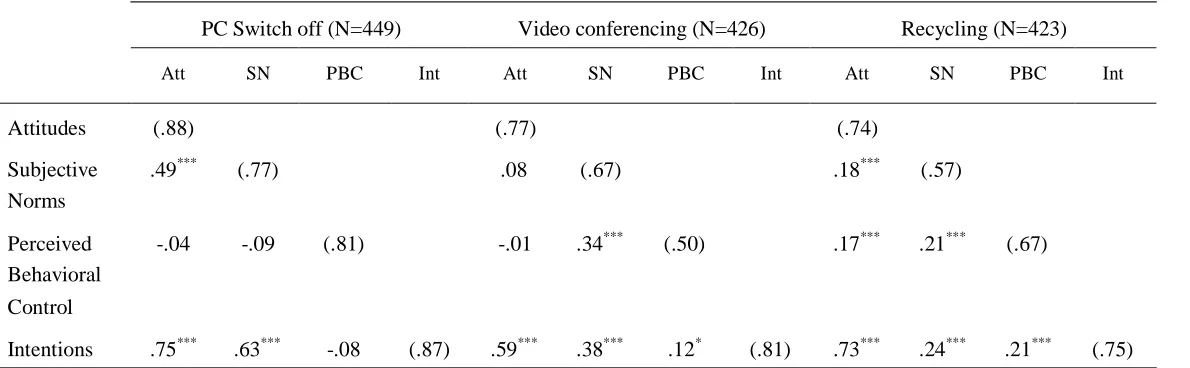
42 43
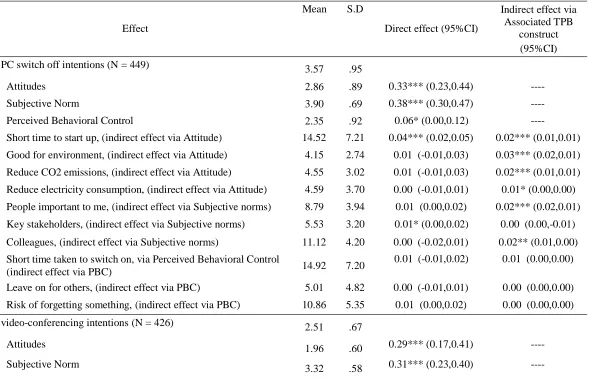
antecedents beliefs product variables given in the first two data columns of table 2.
45
46 ***INSERT TABLE ONE HERE***
47 48
3.1 PC switch off behavioral intention path analysis 49
50
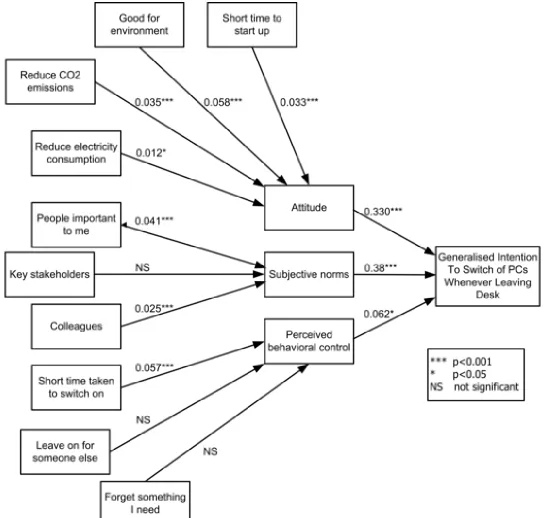
51 Figure 2 illustrates the partially mediated path analysis model for the PC switch off
52
53 measure (N=423). The chi-square statistics for this model was
χ2 (20) = 161.08, p < .001; the fit
54 55
56 indices indicated adequate fit (CFI = .90, RMSEA = .13; SRMR = .06), meeting two of the three
5
22
27
44 4
fit index cut-offs recommended by Hu and Bentler (1999), but falling short of the recommended
6
7 cut-off for the RMSEA.
8 9
The estimated path coefficients from the TPB constructs to PC switch off intentions were
10 11
12 all statistically significant: attitudes (B = .33; 95%CI = .23,.33; p < .001), subjective norms (B =
13 14
.38; 95%CI = .30,.47; p < .001), and perceived behavioral control (B = .06; 95%CI = .00,.12; p <
15 16
17 .05). Together these TPB constructs explain 61% of the variance in PC switching off intentions,
18
19 with antecedent beliefs together explaining an additional 7%. These findings give strong support
20 21
to our first hypothesis. Six of the 10 indirect effects of antecedent beliefs upon PC switch off
23
24 intentions were also statistically significant (see table 2), supporting hypothesis 2. However, two
25 26
direct effects were also statistically significant at the p < .05 level at least, and a fully mediated
28
29 model that excluded them produced a weaker fit to the data (χ2 (30) = 242.77; ∆χ2 (10) = 81.69, p
30 31
< .001), indicating that the collective mediation effect was only partial.
32 33
34 However, the partial nature of this mediation is primarily confined to the antecedent
35
36 behavioral belief that switching off one
‟s PC is acceptable because they have a short start up
37 38
39 time, which had the strongest direct effect upon behavioral intentions (B = 0.04; 95% CI =
40
41 .02,.05; p < .001). The other significant antecedent effects were primarily indirect i.e. operating
42 43
via the mediating TPB constructs, with the strongest being that of behavioral belief “good for the
45
46 environment” via Attitudes; and normative belief “People important to me” via Subjective
47 48
Norms.
49 50
51 ***INSERT FIGURE 2 HERE***
52 53 54 55
56 3.2 Video-conferencing behavioral intention path analysis 57
5
22
27
44 4
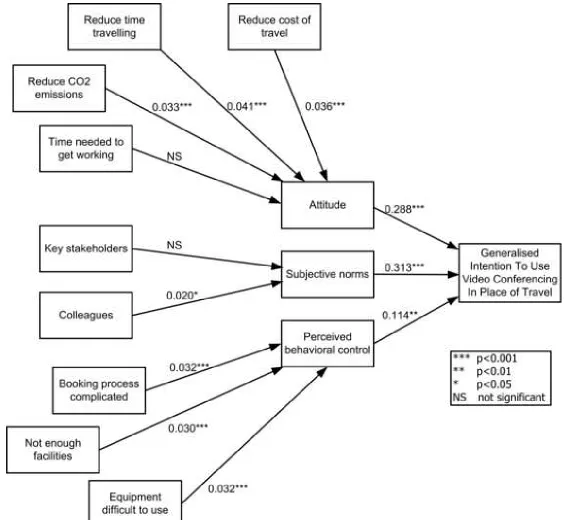
Figure 3 illustrates the partially mediated path analysis model for the video-conferencing
6
7 measurement scenario. The chi-square for this model was χ2 (18) = 79.33, p < .00; the fit indices
8 9
indicated an adequate fit to the data (CFI = .93, RMSEA = .08; SRMR = .03).
10 11
12 The path coefficients from the TPB constructs to video-conferencing intentions were all
13 14
statistically significant: attitudes (B= .29; 95% CI = .17,.41; p < .001), subjective norms (B = .31;
15 16
17 95% CI = .23,.40; p < .001), and perceived behavioral control (B = .11; 95% CI = .04,.19; p <
18
19 .01). Together the TPB constructs explain 46% of the variance in videoconferencing intentions,
20 21
(with the 9 antecedent beliefs considered uniquely explaining an additional 9%). These findings
23
24 support our first hypothesis. Seven of the 9 indirect effects of antecedent beliefs upon
25 26
videoconferencing intentions were statistically significant at the p < .05 level at least (see table
28
29 2), supporting hypothesis 2. However, two direct effects were also statistically significant and a
30 31
fully mediated model that excluded them again produced a weaker fit to the data (χ2 (24) =
32 33
34 164.45; ∆χ2 (9) = 85.11 , p < .001), indicating that the collective mediation effect of antecedent
35
36 beliefs by the TPB constructs was partial.
37 38
39 The antecedent beliefs with significant direct effects upon video-conferencing intentions
40
41 were both control beliefs regarding complicated booking processes (B = .02; 95%CI =.01,.03; p
42 43
<0.01) and lack of facilities (B = .07; 95%CI = -.08,-.05; p < .001). The antecedent beliefs with
45
46 the strongest indirect effects on video conferencing intentions were behavioral beliefs regarding
47 48
time and cost of traveling, and time needed to get working, all three operating via Attitudes.
49 50 51 52
53 ***INSERT FIGURE 3 HERE***
54 55 56 57
5
22
27
44 4
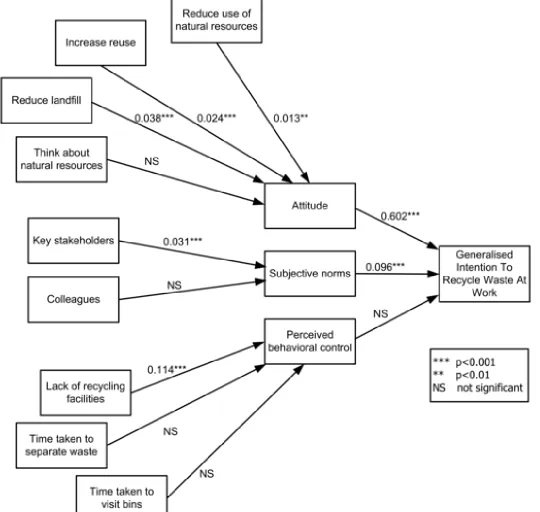
Figure 4 shows the partially mediated path analysis model for the recycling intentions
6
7 measurement scenario. The chi-square statistic for this model was χ2 (18) = 106.28, p <.001; with
8 9
the fit indices indicating an adequate fit (CFI = .92, RMSEA = .11; SRMR = .04), satisfying two
10 11
12 of the three fit indices recommended by Hu and Bentler (1999).
13 14
Two of the path coefficients from the TPB constructs to recycling intentions were
15 16
17 significant: those from attitudes (B = .60; 95%CI = .50,.70; p < .001), and subjective norms (B =
18
19 .10; 95%CI = .04,.16; p < .001). Together the TPB constructs explain 53% of the variance in
20 21
recycling intentions, with antecedent effects together explaining an additional 3%. These findings
23
24 partially support our first hypothesis. Four of the 9 indirect effects of antecedent beliefs upon
25 26
recycling intentions were statistically significant at the p < 0.05 level at least (see table 2),
28
29 supporting hypothesis 2. However, two direct effects were also statistically significant, albeit at
30 31
only the p < 0.05 level and not at more stringent levels, and a fully mediated model that excluded
32 33
34 them again produced a weaker fit to the data (χ2 (27) = 149.56; ∆χ2 (9) = 43.38, p < 0.001),
35
36 indicating that the collective mediation effect of antecedent beliefs by the TPB constructs was
37 38
39 again only partial.
40
41 The antecedent beliefs with significant direct effects upon recycling intentions were the
42 43
behavioral belief of thinking about natural resources (B = .01; 95%CI =.00,.02; p <0.05) and the 45
46 control belief of time taken to separate waste (B = .01; 95%CI = -00,.02; p < .05). The antecedent
47 48
beliefs with the strongest indirect effects on recycling intentions were again behavioral beliefs,
49 50
51 specifically reducing use of natural resources, increasing re-use of materials, and reducing waste
52
53 going to landfill, all via Attitudes.
5
22
27
44 4
4. Discussion
6
7 The present study developed a questionnaire which comprised three separate measures
8 9
based on the theory of planned behavior (TPB; Ajzen, 1985, 1991), where each measure was
10 11
12 designed to investigate a different environmental behavioral intention in the workplace. Overall,
13 14
the TPB constructs were found to account for 61% of variance in employee intentions to switch
15 16
17 their computer off when they left their desk for more than an hour at a time, 46% of variance in
18
19 intentions to use video-conferencing in place of traveling to meetings, and 53% of variance in
20 21
intentions to recycle as much waste as possible at work. Although the TPB has been used in
23
24 previous research to investigate intentions towards environmental behaviors (e.g. Bamberg &
25 26
Schmidt, 2003; Chan, 1998; Trumbo & O‟Keefe, 2001) only two studies have considered
28
29 environmental behavior in workplace settings (Laudenslager et al, 2004; Fielding et al, 2006).
30 31
The variance explained by the core TPB constructs in behavioral intentions as measured by our
32 33
34 measures compares favorably to previous research (which ranges from 10% [Clark & Finley,
35
36 2007] to 81% [Kaiser & Gutscher, 2003] in variance explained). One possible explanation for the
37 38
39 relatively high variance explained in this study could relate to the development process which
40
41 elicited salient behaviors and beliefs that were relevant to the target population. In Laudenslager
42 43
et al‟s (2004) study, also examining three different behaviors in a workplace setting, they
45
46 reported that the core TPB constructs accounted for variance in intentions ranging from 21% to
47 48
35% across three behaviors. The relatively lower variances accounted for in their study may be
49 50
51 because the authors did not develop their own measure relevant to the target population and
52
53 instead based their questionnaire items on a measure previously developed by Taylor and Todd
54 55
56 (1997), designed to investigate consumer attitudes to home composting behavior. Thus the
57
58 present study illustrates the benefits of engaging the target population when conducting research
5
22
27
44 4
based upon the TPB, ensuring that the behaviors and beliefs are as relevant to the target
6
7 population as possible.
8 9
The present study is also unique because it explored the specific antecedent beliefs which
10 11
12 were significant in influencing individual behavioral intentions, mediated by the TPB constructs.
13 14
Exploring antecedent beliefs is rare in previous research applying TPB to environmental
15 16
17 behavior, and although there are some notable exceptions (Bamberg & Schmidt, 2003; Wall,
18
19 Devine-Wright & Mill, 2007); the use of antecedent beliefs has not previously been explored in
20 21
organizational contexts. This is important because although previous research may explain
23
24 whether the TPB accounts for variance in intentions, it cannot explain why the variance in 25
26
intentions exists. In addition, exploring antecedent beliefs is likely to offer particular utility to
28
29 employers since it indicates aspects around which interventions can be designed to increase
30 31
uptake of the environmental behaviors concerned.
32 33
34 Whilst most of the antecedent beliefs were significant in influencing behavior intentions
35
36 mediated via the TPB constructs, we note that in each of the three scales at least one antecedent
37 38
39 construct was found to have a small but significant direct relationship to the behavioral intention.
40
41 This represents a deviation from the TPB as conceptualized by Ajzen (which predicts that this
42 43
relationship is mediated by the associated core construct). However other research (e.g. Dunn et
45
46 al, 2011; McKnight et al, 2002) has also found direct unmediated links between antecedent
47 48
factors and behavioural intentions. Thus, although the TPB does not explicitly predict these
49 50
51 unmediated relationships it is perhaps not surprising that they were identified. For example, it
52
53 seems plausible that the belief regarding the length of time a computer will take to start up may
54 55
56 directly influence the intention to switch it off. There is insufficient evidence in this study to
5
22
27
44 4
draw any firm conclusions regarding the theoretical underpinning of these unmediated
6
7 relationships; however this would be an interesting area for future research.
8 9
4.1 PC Switch off measure 10
11
12 Of the three behaviors considered in this study, the TPB constructs accounted for the
13 14
greatest variance in behavioral intentions to switch off their computers. Although all three TPB
15 16
17 constructs significantly influenced the intentions, the attitude and subjective norm constructs had
18
19 the strongest effects. One reason for the finding that TPB constructs accounted for the greatest
20 21
variance in intentions to switch off computers, could be that all staff experience the behavior
23
24 equally; whereas for both the video-conferencing and recycling the employee experience and
25 26
opportunity to undertake the behavior may have varied. There has been little previous research
28
29 investigating behaviors relevant to energy consumption using the TPB. Laudenslager et al (2004)
30 31
found that the TPB accounted for 26% of variance in intention to conserve energy, but did not
32 33
34 explore specific behaviors which may underlie this intention. In an organizational setting,
35
36 switching off personal computers to conserve energy may be an important behavior to consider.
37 38
39 Findings showed that the TPB constructs mediated the relationship between the
40
41 antecedent beliefs and the intention to switch off PCs. From a practical perspective, these
42 43
antecedent beliefs were important as they provided information about what kind of interventions
45
46 could be implemented in the host organization. For example, the PC start-up time was a
47 48
significant factor and this was useful for the host organization because it provided information
49 50
51 about how to ensure that employees would switch off their computers when away from their
52
53 desks. Indeed, the organization has since taken steps to accelerate the start-up process of PCs. In
54 55
56 addition, the antecedent normative belief of “people important to me”, and the behavioral beliefs
57
58 of “reducing CO2 emissions” and “doing something good for the environment” influenced the
5
22
27
44 4
core TPB constructs. These findings could be useful in (for example) ensuring that informational
6
7 campaigns target the beliefs found to be relevant within the target population. In addition, the
8 9
results detailing the antecedent beliefs which were not found to be significant predictors of
10 11
12 intention are also of interest, and illustrate the benefit of applying a rigorous evidence-based
13 14
approach to identifying barriers and facilitators of behavior (Francis et al, 2004). For example,
15 16
17 during the one-to-one interviews, some respondents reported that employees might need to leave
18
19 their PCs switched on because another member of staff might need to use it. This belief was
20 21
explored by the measure but was not found to be significant. This indicates that beliefs not
23
24 accounting for variance in intentions are just as important because they help organizations direct
25 26
efforts away from intervention targets less likely to result in behavioral change.
28
29 4.2 Video-conferencing measure 30
31
No previous research has investigated intentions towards the use of video-conferencing,
32 33
34 and this may be a particularly useful behavior to explore in organizational settings. This study
35
36 found that 46% of the variance in behavioral intentions to use video-conferencing was explained
37 38
39 by the TPB constructs, with all three constructs found to be significant predictors, but with
40
41 attitude and subjective norms having the biggest direct effects. It should be noted however that
42 43
one issue that could have influenced the findings was that an individual‟s job might have
45
46 influenced the extent to which they would need to use the facility as part of their role. For
47 48
example, responses to intention-based items such as “I intend to make more use of video-
49 50
51 conferencing in future” may simply reflect that their job does not require video conferencing.
52
53 Findings supported the hypothesis that the TPB constructs would mediate the relationship
54 55
56 between the antecedent beliefs and intention to use video-conferencing facilities. From a practical
57
58 perspective, these antecedent beliefs were important as they provided information about what
5
22
27
44 4
kind of interventions could be implemented. With regards to the perceived behavioral control
6
7 factor, findings indicated that the three antecedent control belief variables were significant
8 9
predictors – these included perceptions that the booking process was complicated, perceptions
10 11
12 that there weren‟t enough facilities available and perceptions that the equipment was difficult to
13 14
use. These results were useful because it provided the host organization with several
15 16
17 opportunities to improve perceptions around video-conferencing. Following this research, the
18
19 location of existing facilities was publicized more widely, and additional facilities were installed
20 21
and the booking process has been simplified. In addition, the findings relating to the behavioral
23
24 beliefs concerning the time spent traveling and the saving in travel cost were used in
25 26
interventions so that steps taken to promote video-conferencing included information about the
28
29 time and cost savings of using video-conferencing in preference to traveling to another location.
30 31
This further illustrates the utility of including antecedent beliefs in the present research.
32 33
34 4.3 Recycling measure 35
36 The core TPB constructs accounted for 53% of the variance in behavioral intentions
37 38
39 towards recycling. This compares favorably to previous studies which have found the TPB to
40
41 account for 35% of variance to intentions to recycle in a workplace setting (Laudenslager et al.,
42 43
2004) and 44% (Chan, 1998), 29% (Knussen et al, 2004) and 33% (Mannetti, Pierro & Livi,
45
46 2004) of variance in intentions to recycle in a domestic setting. For this behavioral intention in
47 48
this context, attitudes and subjective norms were significant predictors, whilst perceived
49 50
51 behavioral control was not. As theorized by Ajzen (1988, 1991), the relative importance of the
52
53 TPB constructs may vary from one behavior and one population to another. Nevertheless, it is
54 55
56 possible that this finding could be explained by the fact that the availability of recycling facilities
57
58 differed between the locations surveyed (ranging from comprehensive facilities to recycle a wide
5
22
27
44 4
range of materials to recycling facilities for paper only). This may have led to variation in the
6
7 extent to which employees believed that they had control over their ability to recycle.
8 9
Again, findings indicated that the TPB constructs mediated the relationship between the
10 11
12 antecedent beliefs and the intention to recycle as much waste as possible. Practically, this
13 14
information was useful because it helped the organization implement targeted interventions. For
15 16
17 example, the control belief regarding the lack of recycling facilities was a significant predictor of
18
19 perceived behavioral control so that the host organization may be able to improve recycling
20 21
behavior by installing additional facilities. In addition, behavioral beliefs around reducing waste
23
24 to landfill, and reducing the use of resources can be used in informational campaigns about
25 26
recycling to target these beliefs.
28
29 4.4 Theoretical and practical implications 30
31
The study findings have a number of theoretical and practical implications. From a
32 33
34 theoretical perspective, the research demonstrates the value of engaging the target population
35
36 throughout the development process to ensure that the behaviors targeted were relevant to the
37 38
39 organization. In addressing these specific behaviors, such as “intentions to switch off personal
40
41 computers” rather than more general behaviors such as “intentions to conserve energy”, the TPB
42 43
constructs explained a significant proportion of the variances in behavioral intentions. Secondly,
45
46 this study demonstrates the importance of investigating the antecedent beliefs of the three TPB
47 48
constructs. This was particularly important because this not only answers the question of whether
49 50
51 the TPB constructs account for variance in behavioral intentions, but also to explain why this is
52
53 so. Theoretically, this is important because it enables researchers to understand more clearly why
54 55
56 employees engage (or not) in particular environmental behaviors. Furthermore, this study is the
57
58 one of the first applications of the TPB to environmental behavior in an organizational setting
5
22
27
44 4
which has developed a measure through engagement with the host organization. Our research
6
7 suggests that the TPB can usefully be applied in organizational settings to identify how
8 9
employees can contribute to an organization‟s efforts to become more ecologically sustainable.
10 11
12 From a practical point of view, the findings are important because the results have been
13 14
useful to the host organization. The antecedent variables in particular may indicate targets for
15 16
17 specific practical interventions designed to improve pro-environmental behavior. For example,
18
19 the participating organization has implemented a number of changes based upon the findings of
20 21
this study, such as the projects to accelerate the start-up process of PCs and to simplify the video-
23
24 conferencing booking system as mentioned earlier. Additionally, the organization is taking steps
25 26
to implement all the key findings (outlined in the previous section) in an environmental
28
29 management process (Daily & Huang, 2001). This also shows the value and importance of
30 31
developing a bespoke measure, and shows that the TPB can be an important tool that
32 33
34 organizations can use to investigate the specific barriers to and facilitators of pro-environmental
35
36 behavior at work, and specifically how employees
‟ individual behavior can contribute to an
37 38
39 organization‟s wider ecological objectives.
40
41 4.5 Limitations and recommendations for future research 42
43
There are some limitations of the present research that should be noted. First, one
45
46 consequence of developing a questionnaire based on output from the target population is that the
47 48
measures may only be as good as the outcomes that contributed to its development. Thus the
49 50
51 study may identify some factors which significantly impact behavior but it may not identify all
52
53 the factors which do so. In addition, in the interests of questionnaire brevity some beliefs
54 55
56 identified during the development stage were omitted from the measures. Although care was
57
58 taken to omit those beliefs mentioned least frequently in the interviews, they may have proven to