This is a repository copy of The influence of synoptic weather regimes on UK air quality: Analysis of satellite column NO2.
White Rose Research Online URL for this paper: http://eprints.whiterose.ac.uk/84677/
Version: Accepted Version
Article:
Pope, RJ, Savage, NH, Chipperfield, MP et al. (2 more authors) (2014) The influence of synoptic weather regimes on UK air quality: Analysis of satellite column NO2. Atmospheric Science Letters, 15 (3). 211 - 217. ISSN 1530-261X
https://doi.org/10.1002/asl2.492
[email protected] https://eprints.whiterose.ac.uk/
Reuse
Unless indicated otherwise, fulltext items are protected by copyright with all rights reserved. The copyright exception in section 29 of the Copyright, Designs and Patents Act 1988 allows the making of a single copy solely for the purpose of non-commercial research or private study within the limits of fair dealing. The publisher or other rights-holder may allow further reproduction and re-use of this version - refer to the White Rose Research Online record for this item. Where records identify the publisher as the copyright holder, users can verify any specific terms of use on the publisher’s website.
Takedown
If you consider content in White Rose Research Online to be in breach of UK law, please notify us by
The influence of synoptic weather regimes on UK air quality:
Analysis of satellite column NO
2R.J. Pope1, N.H. Savage2, M.P. Chipperfield1, S.R. Arnold1, T.J. Osborn3
1
Institute for Climate and Atmospheric Science, School of Earth and Environment, University of Leeds, Leeds, UK, LS2 9JT
2
Met Office, Exeter, UK, EX1 3PB
3
Climatic Research Unit, School of Environmental Sciences, University of East Anglia, Norwich, UK, NR4 7TJ
Corresponding Author: Richard Pope - Tel: 0113 3436473 Email: [email protected]
Resubmitted to Atmospheric Science Letters
Short title: Synoptic weather influence on column NO2
Abstract
Groupings of Lamb Weather Types (LWTs) are used to assess the influence of synoptic meteorology on UK tropospheric column NO2. Composite satellite maps using daily 2005-2011 data show significant NO2 anomalies for each group. Hence, despite large day-to-day variability and significant uncertainty in individual retrievals, the satellite data can be used to determine national-scale column NO2 variations under different meteorological conditions. Under cyclonic conditions, NO2 is reduced, while anticyclonic conditions aid its
accumulation, especially during winter, consistent with trapping of surface emissions and slower photochemical processing. This composite dataset can be used to test seasonal simulations of air quality models.
Keywords: Lamb Weather Type, OMI NO2, Air Quality.
1. Introduction
Regional weather exerts a strong influence on local air quality (AQ) through aiding both the accumulation and dispersal of emitted pollutants, and controlling their transport on a regional scale. Models have been developed to predict AQ, but need to be evaluated against
observations. Satellite data provide an important source of data for such evaluation, as
improve model representation of such features). Here we analyse a long data record (2005-2011) of satellite tropospheric column NO2 over the UK, to determine the influence of specific climatological patterns of meteorology on regional NO2 distributions.
Lamb Weather Types (LWTs) provide a useful tool to classify synoptic meteorology over the UK (Jones et al., 2013). They are an objective description of the daily midday atmospheric circulation over the UK based on mean sea level pressure reanalysis data. Many studies have investigated the link between surface observations of atmospheric chemistry and synoptic meteorology by using LWTs. For example, Davies et al., (1991) used LWTs with surface station observations of atmospheric/rainwater chemistry data. Lesniok et al., (2010) used the Niedzweidz's Manual Classification, similar to the LWTs, to study the influence of synoptic regimes on surface NO2 in Upper Silesia, Poland. They found that anticyclonic (cyclonic) conditions enhance (reduce) NO2 concentrations increasing (reducing) pollution limit exceedances.
O'Hare et al., (1995) and Demuzere et al., (2009) investigated LWTs and rural surface ozone observations in the UK and Netherlands, respectively. Anticyclonic conditions, through primary pollutant accumulation, were found to enhance surface ozone concentrations. However, cyclonic-induced tropospheric folding enhances free troposphere ozone incursion resulting in peak UK surface ozone concentrations.
Other studies have looked at the connection between meteorology and NO2 tropospheric columns. Beirle et al., (2011) used OMI column NO2 and wind forecasts (below 500m) to analyse NO2 transport from the isolated megacity Riyadh, Saudi Arabia, detecting leeward NO2 plume transport. Hayn et al., (2009) performed a similar analysis of wind direction and column NO2 over Johannesburg, South Africa. Zhou et al., (2012) found significant impacts of wind speed and precipitation on OMI column NO2 over western Europe. Savage et al., (2008) investigated the interannual variability (IAV) of satellite NO2 columns over Europe finding that meteorology influences NO2 IAV more than emissions.
van der A et al., (2008) used GOME and SCIAMACHY data, 1996-2006, to look at column NO2 seasonal patterns and trends. Over Europe, the peak industrial column NO2 occurs during winter. They infer that reduced photolysis (increased NO2 lifetime), not increased NOx
emissions, are the main cause. The UK is the exception as the meteorological variability leads to peak NO2 columns in July. However, Zhou et al., (2012) find that days with peak column NO2 over the UK are in spring.
To our knowledge, LWTs have not previously been used to investigate synoptic patterns in fields of satellite observations of atmospheric chemistry. The aim of this paper is to
investigate the influence of UK surface circulation patterns on atmospheric trace gas
2. Data
2.1. Lamb Weather Types
Lamb Weather Types were originally derived using a manual method of classifying the atmospheric circulation patterns (mostly using sea level pressure) according to the wind direction and circulation type over the UK (Lamb 1972). Jenkinson and Collison (1977) created an automated classification scheme based on the mean sea level pressure at sixteen points over Western Europe (centred on UK). From the pressure field at these points the direction, strength and vorticity of the mean flow over the UK are calculated. Each day is then assigned both a vorticity type and a wind flow direction. Three vorticity types are used (neutral vorticity, cyclonic and anticyclonic) and eight wind flow directions (N, NE, E, SE, S, SW, W and NW) unless the flow vorticity is much stronger than the flow strength, when the day is classified solely as cyclonic or anticyclonic. There is also an unclassified LWT. Table 1 summarises the LWT codes. For more details of the classification scheme see Jones et al., (2013).
[image:4.595.103.493.445.600.2]In this study we use the dataset of Jones et al., (2013) which extends the objective LWT dataset by using daily midday (12.00 UT) grid-point mean sea level pressure data from NCEP/NCAR reanalysis (Kalnay et al., 1996). We obtained the data from the Climatic Research Unit (CRU) at the University of East Anglia (www.cru.uea.ac.uk/cru/data/lwt/).
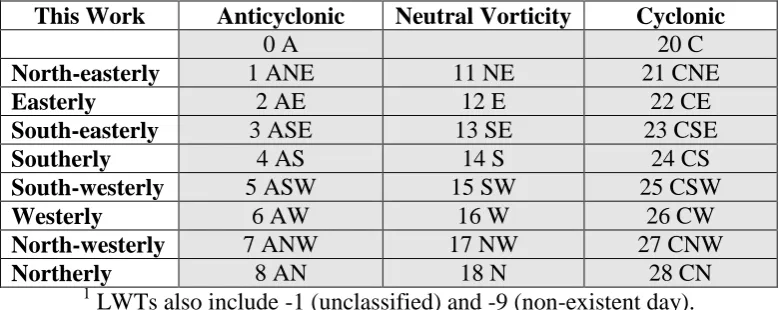
Table 1. The shaded region shows the 27 basic Lamb Weather Types with their number
coding1. In this work these LWTs are grouped into 3 circulation types and 8 wind directions, indicated in the outer row and column.
This Work Anticyclonic Neutral Vorticity Cyclonic
0 A 20 C
North-easterly 1 ANE 11 NE 21 CNE
Easterly 2 AE 12 E 22 CE
South-easterly 3 ASE 13 SE 23 CSE
Southerly 4 AS 14 S 24 CS
South-westerly 5 ASW 15 SW 25 CSW
Westerly 6 AW 16 W 26 CW
North-westerly 7 ANW 17 NW 27 CNW
Northerly 8 AN 18 N 28 CN
1
LWTs also include -1 (unclassified) and -9 (non-existent day).
It would likely prove difficult to find statistically significant associations between the column NO2 patterns and each individual LWT because their occurrence probability is too low. Therefore, we merged the LWTs into 11 classes, similar to O'Hare et al., (1994) and Tang et al., (2011), to increase the amount of data in each category (Table 1). There are 3 synoptic classes: neutral vorticity (LWTs 11-18); cyclonic (20-28) and anticyclonic (0-8). There are 8 flow directions: NE, E, SE, NW, W, SW, N and S (e.g. the south-westerly type is a
LWTs 0 or 20 as they have no flow direction) e.g. LWT 27 is in the Cyclonic and North-westerly groups.
For the 7-year (2556-day) period 2005-2011, the percentage occurrence was calculated for each of the 11 classes. The relative occurrence of the synoptic conditions was: neutral vorticity 38.9%; cyclonic 26.1% and anticyclonic 33.7%. The most frequent wind flow directions were the W and SW directions at 16.7% and 14.4%, respectively.
2.2 OMI NO2 Tropospheric Column Data
OMI is mounted on NASA's EOS-Aura satellite and has an approximate London daytime overpass at 13.00 local time. It is a nadir viewing instrument with a pixel size of 312 km2. We have taken the DOMINO tropospheric column NO2 product, version 2.0, from the TEMIS (Tropospheric Emissions Monitoring Internet Service) website,
http://www.temis.nl/airpollution/no2.html (Boersma et al., 2011). We have binned NO2 swath data from January 1, 2005 to December 31, 2011 onto a daily 13.00 0.25º x 0.25º grid
between 43ºN - 63ºN, 20ºW - 20ºE. All satellite retrievals have been quality controlled, and retrievals/pixels with cloud cover greater than 20% and poor quality data flags (flag = -1) were removed. The product uses the algorithm of Braak, (2010) to identify OMI pixels affected by row anomalies and sets the data flags to -1. These are filtered out in this study. To obtain better spatial coverage, a time window for the OMI retrievals between 11.00 and 15.00 local time, was applied. Even though the LWTs are based on meteorological reanalyses at 12.00 UT, we consider this temporal difference to be within an acceptable range.
3. Results
Composite maps of OMI tropospheric column NO2 were derived for each of the 11 synoptic and wind direction classes for both winter (October-March) and summer (April – September). Figure 1 shows these composites for the cyclonic and anticyclonic conditions and Figure 2 shows the anomaly of each composite from the 7-year seasonal average. We focus primarily on the influences of cyclonic and anticyclonic weather patterns, as they have greater
occurrence, and are therefore more statistically significant than the wind direction composites.
more active over continental Europe in summer. Under anticyclonic conditions, over the UK and Netherlands source regions the summer peak is 16 x 1015molecules/cm2, while in winter the NO2 concentrations reach 20 x 1015molecules/cm2.
McGregor et al., (1995) and Lesniok et al., (2010) noted that air mass stability (instability) under anticyclonic (cyclonic) conditions leads to reduced (increased) transport of NO2 from sources. This is seen in Figure 1 where the NO2 concentrations are higher under anticyclonic conditions. In winter the NO2 concentrations over South East England and Netherlands range from 10-16 x 1015molecules/cm2 and 16-20 x 1015molecules/cm2 in cyclonic and anticyclonic conditions, respectively. The same occurs in summer, but with lower NO2 concentrations at 13 x 1015 (cyclonic) and 16 x 1015 molecules/cm2 (anticyclonic).
To quantify the differences between the synoptic regimes, we subtracted the 7-year seasonal average (of all weather types) from the winter and summer cyclonic and anticyclonic
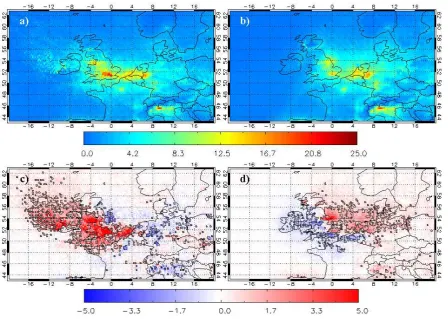
composites (Figure 2). We use the Wilcoxon Rank Test (WRT) to examine the significance of the differences, at the 5% significance level (p < 0.05), in the composite-total period averages. The WRT is the non-parametric counterpart of the Student T-Test and so relaxes the constraint on normality of the underlying distributions (Pirovano et al., 2012). In Figure 2 areas where the anomalies are significant are outlined with black polygons. In the cyclonic case a significant positive-negative dipole exists, with negative anomalies over the southern UK and positive anomalies over the North Sea. The higher winter NO2 concentrations lead to an intense dipole, with maximum positive anomalies > 5 x 10¹⁵ molecules/cm2 and the lowest negative anomalies < -5 x 10¹⁵ molecules/cm2. In summer, these anomalies peak at similar values but their spatial extent is much less. Potential reasons why the area of the anomaly is reduced in summer include both the more rapid removal of NO2 giving less accumulation under stagnant conditions and lighter winds in the summer causing slower transport from source regions. Typically, cyclonic conditions are indicative of westerly and south-westerly flow. Therefore, the anomalies potentially reveal transport of NO2 off the UK mainland into the North Sea. In the more stable anticyclonic conditions, the inverse of the cyclonic anomaly dipole exists with positive anomalies, 4-5 x 10¹⁵molecules/cm2, over the UK and negative anomalies, -3 x 10¹⁵molecules/cm2, over the North Sea. This occurs for both seasons, but with larger spatial patterns in winter. It is probable that the anomaly pattern occurs as less NO2 is transported out to the North Sea and more remains over the UK.
We averaged all OMI pixels within 6ºW - 2ºE and 59ºN - 50ºN (see Figure 1) to form a UK-average timeseries. Figures 3a and 3b show the mean annual cycles and their anomalies for the three synoptic classes. The anticyclonic column NO2 seasonal cycle is well pronounced with maximum (minimum) winter (summer) concentrations of approximately 7 (3) x 1015 molecules/cm2. The cyclonic column NO2 cycle is less pronounced with similar
conditions. Overall, the largest relative differences are in winter, likely due to a combination of more intense winter cyclonic and anticyclonic dynamics and reduced photochemical processes. In winter, increased poleward momentum flux results in larger atmospheric instabilities. Therefore, the more intense cyclones further reduce column NO2 above source regions in winter. However, winter anticyclones are associated with cold denser air masses enhancing atmospheric blocking and prolonged stable conditions, therefore, accumulating NO2 more efficiently. Photochemically, under anticyclonic conditions, in summer stronger photolysis converts more NO2 to NO, but in winter reduced solar intensity and cloudier conditions limit NO2 to NO conversion. The neutral vorticity conditions typically have similar concentrations to the cyclonic conditions in summer and anticyclonic conditions in winter over the study period.
We also find that the influence of the wind directions on the OMI NO2 fields can be
significant. Note that due to the lower frequency of each of the eight wind directions, these are not seasonal composites but use all seven years of data regardless of season. Two examples of the wind-induced NO2 transport are shown in Figure 4. Figure 4a shows south-easterly flow off continental Europe, where NO2 (up to 20 x 1015molecules/cm2) is
transported away from London and Lancashire towards the Midlands and the Irish Sea, respectively. In Figure 4b, the south-westerly flow is transporting NO2 (up to 13 x
1015molecules/cm2) away from London and the M62 corridor out into the North Sea. The transport impact from the south-easterly flow is much greater, but since these classes can contain different proportions of each vorticity type, this might account for the greater transport when compared with the south-westerly flow. Figures 4c and 4d show the
anomalies in NO2 for these two flow directions with respect to the 7-year OMI average. The significant positive anomalies suggest south-westerly flow is transporting up to5 x
1015molecules/cm2 away from the source regions. In Figure 4d, positive (negative) anomalies, over (under) +(-) 5 x 10¹⁵molecules/cm2 show where the south-westerly flow has transported NO2 away from the source regions out into the North Sea.
Finally, we have also investigated the link between the winter North Atlantic Oscillation (NAO) and column NO2 data using the NAO Index from CRU (Jones et al., 1997; available from www.cru.uea.ac.uk/cru/data/nao). However, we could not find any significant spatial differences in the NO2 columns between the positive and negative NAO phases.
4. Conclusions
more intense winter cyclonic conditions, which reduce column NO2 concentrations and has more impact than NO2 loss in summer from enhanced photolysis. The influence of transport of NO2 by wind flow directions can also be seen in the OMI NO2 data, with good examples being the south-easterly and south-westerly flow directions. The spatial patterns in the NO2 fields associated with these transport regimes are significantly different at a 5% confidence level using the Wilcoxon Rank Test.
These statistically significant meteorology-atmospheric chemistry relationships, seen by OMI, can potentially be used as a model validation tool. This dataset will allow progress beyond simply using the satellite data for operational model validation (calculation of means and biases, see Dennis et al., (2010)) and can be used to test the model’s ability to reproduce the influence of meteorology on NO2 (dynamic model evaluation). For chemistry-climate models this can also be used to evaluate the model under each of the synoptic regimes, rather than just using averages over seven or so years. For further work, we plan to test these same relationships in the Met Office Air Quality in the Unified Model (AQUM) (Savage et al., 2012) and further investigate the processes controlling the LWT-NO2 column relationships. In particular, we will explore the relative importance of transport processes versus difference in photochemistry between the classes.
Acknowledgements
We acknowledge use of OMI tropospheric NO2 column data from www.temis.nl and LWT data from www.cru.uea.ac.uk. This work was supported by the NERC National Centre for Earth Observation (NCEO).
References
Boersma KF, Eskes HJ, Dirksen RJ, van der A RJ, Veefkind JP, Stammes P, Huijnen V, Kleipool QL, Sneep M, Claas M, Claas J, Leitão J, Ritcher A, Zhou Y, Brunner D. 2011. An improved tropospheric NO2 column retrieval algorithm for the Ozone Monitoring Instrument. Atmospheric Measurement Techniques 4: 1905-1928.
Beirle S, Boersma BF, Platt U, Lawrence MG, Wagner T. 2011. Megacity Emissions and Lifetimes of Nitrogen Oxides Probed from Space. Science 333: 1737.
Braak R. 2010. Row Anomaly Flagging Rules Lookup Table. KNMI Technical Document TN-OMIE-KNMI-950.
Demuzere M, Trigo RM, Vila-Guerau de Arellano J, van Lipzig NPM. 2009. The impact of weather and atmospheric circulation on O3 and PM10 levels at a rural mid-latitude site. Atmospheric Chemistry and Physics 9: 2695-2714.
Dennis R, Fox T, Fuentes M, Gilliland A, Hanna S, Hogrefe C, Irwin J, Trivikrama.Rao S, Scheffe R, Schere K, Steyn D, Venkatramh A. 2010. A framework for evaluating regional – scale numerical photochemical modelling systems. Environmental Fluid Mechanics 10: 471-489.
Hayn M, Beirle S, Hamprecht FA, Platt U, Menze BH, Wagner T. 2009. Analysing spatio-temporal patterns of the global NO2-distribution retrieved from GOME satellite observations using a generalised additive model. Atmospheric Chemistry and Physics 9: 6459-6477.
Huijnen V, Eskes HJ, Poupkou A, Eblern H, Boersma KF, Foret G, Sofiev M, Valdebnito A, Flemming J, Stein O, Gross A, Robertson L, D’Isidoro MD, Kioutsioukis I, Friese E,
Amstrup B, Bergstrom R, Strunk A, Vira J, Zyryanov D, Melas D, Peuch V H, Zerefos C. 2010. Comparisons of OMI NO2 tropospheric columns with an ensemble of global and European regional air quality models. Atmospheric Chemistry and Physics 110: 3273-3296.
Jenkinson AF, Collison FP. 1977. An initial climatology of gales over the North Sea. Synoptic Branch Memorandum No. 62, Met Office, Exeter.
Jones PD, Jónsson T, Wheeler D. 1997. Extension to the North Atlantic Oscillation using early instrumental pressure observations from Gibraltar and South-West Iceland.
International Journal of Climatology 17: 1433-1450.
Jones PD, Harpham C, Briffa KR. 2013. Lamb weather types derived from reanalysis products. International Journal of Climatology 33: 1129-1139.
Kalnay E, Kanamitsu M, Kistler R, Collins W, Deaven D, Gandin L, Iredell M, Saha S, White G, Wollen J, Zhu Y, Chelliah M, Ebisuzaki W, Higgins W, Janowiak J, Mo KC, Ropelewski C, Wang J, Leetmaa A, Reynolds R, Jenne R, Joseph D. 1996. The NCEP/NCAR 40 year reanalysis project. Bulletin of the American Meteorological Society 77: 437–471.
Lamb HH, 1972. British Isles Weather types and a register of daily sequence of circulation patterns, 1861-1971. Geophysical Memoir 116, HMSO, London, 85.
Le niok M, Małarzewski Ł, Nied wied T. 2010. Classification of circulation types for Southern Poland with an application to air pollution concentrations in Upper Silesia. Physics and Chemistry of the Earth 35: 516-522.
McGregor GR, Bamzelis D. 1995. Synoptic Typing and its Application to the Investigation of Weather Air Pollution Relationships, Birmingham, United Kingdom. Theoretical and Applied Climatology 51: 223-236.
O’Hare GP, Wilby R. 1995. A review of Ozone Pollution in the United Kingdom and Ireland with an Analysis Using Lamb Weather Types. The Geographical Journal 161: 1-20.
transport model formulation on model performance at European scale. Atmospheric Environment 53: 93-109.
Savage NH, Pyle JA, Braesicke P, Wittrock F, Richter A, Nüß H, Burrows JP, Schultz MG, Pulles T, van het Bolscher Maarten. 2008. The sensitivity of Western European NO2 columns to interannual variability of meteorology and emissions: a model-GOME study. Atmospheric Science Letters 9: 182-188.
Savage NH, Agnew P, Davis LS, Ordóñez C, Thorpe R, Johnson CE, O’Connor MO, Dalvi M. 2013. Air quality modelling using the Met Office Unified Model (AQUM OS24-26): model description and initial evaluation. Geoscientific Model Development 6: 353-372.
Tang L, Rayner D, Haeger-Eugensson M. 2011. Have Meteorological Conditions Reduced NO2 Concentrations from Local Emission Sources in Gothenburg? Water Air Soil Pollution
221: 275-286.
van der A RJ, Eskes HJ, Boersma KF, van Noije TPC, Van Roozendael M, De Smedt I, Peters DHMU, Meijer EW. 2008. Trends, seasonal variability and dominant NOx sources derived from a ten year record of NO2 measured from space. Journal of Geophysical Research 113: doi:10.1029/2007JD009021.
Zhou Y, Brunner D, Hueglin C, Henne S, Staelhelin J. 2012. Changes in OMI tropospheric NO2 columns over Europe from 2004 to 2009 and the influence of meteorological variability. Atmospheric Environment 46: 482-495.
Figures
Figure 2. Anomalies of OMI column NO2 composites compared to seasonal 7-year average (x1015 molecules/cm2) for (a) summer cyclonic, (b) winter cyclonic, (c) summer anticyclonic and (d) winter anticyclonic conditions. Black boxes indicate where the anomalies are
Figure 3. OMI NO2 columns (x 1015 molecules/cm2) averaged over the UK (see text) under neutral vorticity, cyclonic and anticyclonic conditions for (a) mean annual cycle of monthly means, including black line for all conditions, and (b) anomaly of monthly means with