Quantum and classical entropic uncertainty relations
Kamil Korzekwa, Matteo Lostaglio, David Jennings, and Terry Rudolph Department of Physics, Imperial College London, London SW7 2AZ, United Kingdom
(Received 25 March 2014; published 29 April 2014)
How much of the uncertainty in predicting measurement outcomes for noncommuting quantum observables is genuinely quantum mechanical? We provide a natural decomposition of the total entropic uncertainty of two noncommuting observables into a classical component and an intrinsically quantum mechanical component. We show that the total quantum component in a state is never lower or upper bounded by any state-independent quantities, but instead admits “purity-based” lower bounds that generalize entropic formulations such as the Maassen-Uffink relation. These relations reveal a nontrivial interplay between quantum and classical randomness in any finite-dimensional state.
DOI:10.1103/PhysRevA.89.042122 PACS number(s): 03.65.Ta,89.70.Cf,03.67.Mn
I. INTRODUCTION
Quantum phenomena are notoriously unpredictable. While classical uncertainty arises from ignorance, quantum uncer-tainty is hardwired in, such that even for a single fixed measurement and a pure quantum state of maximal knowledge we typically can only make probabilistic predictions. The sit-uation worsens when we consider two potential measurements of a system that do not commute—there exist fundamental constraints on our ability to make predictions about either possible set of outcomes. The most celebrated such constraint is the Heisenberg-Robertson uncertainty relation [1], which bounds the product of the variances in the two possible measurement outcomes in terms of the expectation of the commutator of the observables. A weakness of this formulation is that it typically depends on the particular quantum state of the system to be measured, and as such the bound can be trivial if the state lies in the kernel of the commutator.
A different approach, pioneered by Deutsch [2] and strengthened by Maassen and Uffink [3], is to lower bound in a state-independent manner the sum of the Shannon entropies of the measurement outcome probability distributions. Such an entropic uncertainty relation (EUR) is particularly interesting within the context of mutually unbiased measurement bases (MUBs) (see Ref. [4], and references therein for extensions and generalizations).
Quantum states are typically mixed, which means that some of our inability to make perfect predictions is actually classical. The original EUR does not separate the uncertainty that arises from this classical ignorance and the “genuinely quantum” uncertainty. Our goal here is to do such a sepa-ration, something considered for Heisenberg-Robertson-type uncertainty relations in Ref. [5], where it was shown that quantum-only uncertainties satisfy a similar bound to the full uncertainty. Here we will show that this is not possible for additive decompositions of EURs into quantum and classical parts, if we wish to retain the state-independence of the bound. However, we show that splitting the uncertainty can be done, and a bound on the sum of the quantum uncertainties achieved, if we impose only the weak constraint that the purity of the set of states under question is fixed. This leads us to introduce “purity-based bounds.” In this paper we develop certain purity-based entropic bounds and compare them with recently introduced majorization bounds. We also show that
nonlinearity inS(ρ) is a general feature of strong purity-based bounds. Finally, we analyze the structure of states minimizing the total uncertainty for fixed purity and show that it displays nontrivial structure.
II. ENTROPIC UNCERTAINTY RELATIONS The basic idea underlying entropic uncertainty relations is extremely simple. Given a nondegenerate observableOacting on ad-dimensional Hilbert space,
O= d
i=1
oi|oioi|, (1)
the projective measurement of O in the stateρ gives rise to a distributionpi(O,ρ)=Tr(|oioi|ρ). The entropic measure of uncertainty aboutOin a stateρis then the Shannon entropy of the distribution,
HO(ρ) := − d
i=1
pi(O,ρ) ln[pi(O,ρ)], (2)
whose use as a measure of uncertainty is well established in classical and quantum information theory.
Given two, possibly noncommuting observablesAandB with eigenbases {|ai} and {|bj}, we ask: is there a lower bound to the combined uncertaintyHA(ρ)+HB(ρ) in the state ρ? A definitive answer was first given by Deutsch [2], then later strengthened to provide us the celebrated Maassen-Uffink relation [3],
HA(ρ)+HB(ρ)−2 lncAB, (3)
where cAB=maxij|ai|bj| yields the state-independent lower bound.
This relation has been improved in many respects. A tighter relation for observables fulfillingcAB>1/
√
of overlap between observables, where one looks at all
|ai|bj|[11].
III. SPLITTING TOTAL UNCERTAINTY INTO QUANTUM AND CLASSICAL PARTS
While intuitive and operationally meaningful, the entropic measureHO(ρ) quantifies total uncertainty and, as such, does not carry information about its origin (classical or quantum). For example, in the d =2 case the Pauli observable Z has maximal uncertainty HZ =ln 2 in both the states |++| and I/2. However, it is evident that in the former case the uncertainty is entirely quantum mechanical, whereas in the latter it is entirely classical. As such, the entropic measure of the sum of the Shannon entropies provides only a blunt quantification of quantum uncertainties that deserves a finer analysis. The idea of a classical-quantum decomposition has been also applied to measures of correlations, see, e.g., Refs. [12–14]. We will shortly see how our framework can be related to some of these results.
A. The Luo criteria for measurement uncertainties Obviously there is no single correct way to decompose the total measurement uncertainty of the observable O in a state ρ into quantum and classical components. However, it is quite straightforward to establish natural criteria that such a decomposition should obey. Such a set of conditions was recently formulated by Luo [15], and represents the minimal conditions that any quantum uncertainty measure Q(O,ρ) and any classical uncertainty measureC(O,ρ) should satisfy. Specifically, they demand that:
(1) If a stateρis pure, thenC(O,ρ) should vanish. (2) If [ρ,O]=0, then the state is diagonal in the eigenbasis of the observableOand soQ(O,ρ) should vanish.
(3) Classical mixing increases the classical, but not the quantum, uncertainty, and so Q(O,·) should be convex and C(O,·) should be concave in their second arguments. To this criteria we add further conditions specific to an entropic scenario:
(4) 0Q(O,ρ),C(O,ρ)HO(ρ).
(5) Q(O,·) and C(O,·) are functions of the probability distribution over the measurement outcomes of observableO and not of its eigenvalues.
The relative merits or weaknesses of these conditions can certainly be debated, but in what follows we simply use them as a guide for our entropic decomposition and leave extensions to future work.
B. Classical and quantum decomposition for entropic uncertainty relations
We wish to develop a meaningful decomposition into classi-cal and quantum entropic measures of uncertainty suitable for extending the Maassen-Uffink relation, which respects the Luo criteria. In light of these criteria, we observe that the central measurement entropy for nondegenerate observables can be expressed asHO(ρ)=S(DO(ρ)), whereS(ρ)= −Tr[ρlnρ] is the von Neumann entropy of a quantum stateρ, andDO(·)
is the dephasing map,
DO(ρ)= d
i=1
oi|ρ|oi |oi oi|, (4)
which sends to zero all the off-diagonal terms when the density matrix is written in the eigenbasis of O (an extension to degenerate observables can be found in Appendix A). The projective measurement ofOis a repeatable measurement, and so it is reasonable to demand that a second measurement ofO (in which the prior classical outcome of the first measurement is discarded) should not reveal any quantum uncertainty in the state and be entirely classical.
In light of this, we takeQ(O,ρ) :=S(ρ||DO(ρ))as the ap-propriate measure of quantum uncertainty for the measurement ofOin the stateρ. The following geometrical characterization of Q as a “distance” from the manifold of classical states further justifies our definition:
Q(O,ρ) :=S(ρ||DO(ρ))=min
σ∈IS(ρ||σ), (5) where I is the set of states diagonal in the eigenbasis of O (this is a direct application of Theorem 4 of Ref. [16]). Moreover, if we take C(O,ρ) :=S(ρ) as our measure of classical uncertainty [17], we obtain anadditivedecomposition of the total entropic uncertainty,
HO(ρ)=Q(O,ρ)+C(O,ρ). (6)
To prove the equality in Eq. (6), we note that
−Tr (ρln[DO(ρ)])= −Tr (ρDO{ln[DO(ρ)]})
= −Tr (DO(ρ) ln[DO(ρ)])=S(DO(ρ)), so that
Q(O,ρ)=S(ρ||DO(ρ))= −S(ρ)−Tr (ρln[DO(ρ)])
= −S(ρ)+S(DO(ρ)).
It is relatively straightforward to check that these measures conform to the Luo criteria, using well-known properties of the von Neumann entropy. Convexity ofQfollows immediately from the joint convexity of relative entropy.
In addition to providing an additive decomposition, our choice of quantum uncertaintyQ(O,ρ) has a natural inter-pretation as a measure of the superpositions present in ρ with respect to the eigenbasis ofO [18], and more recently has provided monotones within the resource theories of coherence [19] andU(1)-asymmetry [20]. Moreover, within the quantum memory approach our choice ofQ(O,ρ) corre-sponds to quantum side information introduced by the system E purifying ρ; i.e., it is equivalent to conditional entropy H(O|E), as discussed in Ref. [21]. Q can be also related to discord-like quantities. In a bipartite system, the minimum ofQover all maximally informative local observables [22] is equal to the von Neumann entropy of entanglementE(ρ12) := S(Tr2(ρ12)):
Q(1)(|ψ12ψ|) :=min O1
Q(O1⊗I2,|ψ12ψ|)=E(ρ12).
Note that our measure of classical uncertainty does not depend on the choice of the observable. This is due to the fact that we are considering here nondegenerate observables, projective measurements of which are perfectly sharp. In this situation any classical uncertainty can only be due to the fact that we are sampling a mixed state. A similar situation would be true for perfectly sharp measurements in classical physics. However, similarly to coarse-grained measurements in classical physics, the projective measurements of degenerate observables in quantum physics can be the source of classical uncertainty dependent on the degeneracy. We analyze this extension in AppendixA.
Whereas the Maassen-Uffink relation bounds the total entropic uncertaintyHA+HB, we would now like to establish a finer set of conditions on the quantum component of the total uncertainty. However, before we do this we show, using Luo’s criteria, thatQ(A,·)+Q(B,·) is entirely unconstrained over the set of all states, i.e., no state-independent lower (or upper) bound is possible for the total quantum uncertainty ofAand Bin the stateρ.
C. No nontrivial state-independent bound for quantum or classical uncertainties
While we are interested in a particular quantum-classical splitting, the following argument applies more generally. In Ref. [10], Friedland et al. characterized the most general uncertainty function, i.e., the most general U :p−→R+
invariant under relabelings of the probability vector p and monotonically increasing underrandom relabelings.1In other
words,Uis required to preserve the majorization ordering and is then a Schur-concave function.
We start by giving a general result on the total uncertainty of the measurement outcomes of two observables. Letp(A,ρ) andp(B,ρ) denote vectors of probability outcomes ofAand B, respectively, in stateρ andUmax=maxpU(p). Then, the following lemma holds,
Lemma 1. For every pair of nondegenerate observables A andB there exists a pure state |ψ∗ that simultaneously maximizes the total uncertainty of both observables,
U[p(A,|ψ∗)]=U[p(B,|ψ∗)]=Umax.
Proof. For every pair of observables A, B there exists a pure state |ψ∗, which is unbiased in eigenbases of both observables [24]:
p(A,|ψ∗)=p(B,|ψ∗)= {1/d, . . . ,1/d}.
The uniform distribution,{1/d, . . . ,1/d}, is majorized by all other distributions. Hence, asUis Schur-concave, one gets
∀q U(q)U[p(A,|ψ∗]=U[p(B,|ψ∗] :=Umax. Suppose we now want to split the general measure of total uncertainty U into the sum of classical and quantum uncertainty components,
U =Q+C, (7)
1For every q∈[0,1] and every permutationπ, U(p)U[qp+
(1−q)πp].
where we have two nonnegative real-valued functions Q: (A,ρ)→R+, thequantum uncertainty, andC : (A,ρ)→R+, theclassical uncertainty. Given the additive splitting, defined by Eq. (7), we could wonder if we can find a state-independent upper or lower bound onQ(A,·)+Q(B,·) orC(A,·)+C(B,·) only. From the previous lemma we immediately infer this is impossible, if one demands the Luo criteria of the quantum and classical uncertainties. Specifically we have the following,
Theorem 1. No additive splitting admits a nontrivial state-independent bound forQ(A,·)+Q(B,·) orC(A,·)+C(B,·) if Luo’s criteria 1 and 2 are satisfied. In other words there are noA,B,c(A,B)>0 andd(A,B)<2Umaxsuch that
∀ρ c(A,B)< Q(A,ρ)+Q(B,ρ)< d(A,B). Proof.Let us fix general nondegenerate observablesAand B. From Theorem 1 there is always a pure state|ψ∗ achiev-ing U[p(A,|ψ∗]=U[p(B,|ψ∗]=Umax. But from Luo criterion 1,Cvanishes on pure states, so
Q(A,|ψ∗)+Q(B,|ψ∗)=2Umax.
The maximally mixed state is diagonal in any basis; therefore, from Luo criterion 2,
Q(A,I/d)+Q(B,I/d)=0.
Given the additive splitting and that the sum of Q’s is unconstrained, then we also deduce that there is also no constraint on the sum of classical components. In particular this implies that, in the case of EUR and the splitting proposed in this paper,
0Q(A,ρ)+Q(B,ρ)2 lnd,
and only the total uncertainty has a state-independent lower bound. To account for this we instead develop bounds that are conditioned on fixed values of classical measurement uncertainty. For our choice of classical and quantum uncer-tainties, this will lead us to a refinement of EUR in terms of “purity-based” lower bounds.
IV. QUANTUM UNCERTAINTY RELATIONS AND PURITY-BASED LOWER BOUNDS
We now establish concrete lower bounds on the total quantum uncertainty for the measurement of two observables AandB in a stateρ. As discussed, we seek bounds that are conditional on the degree ofclassicaluncertainty in the state. Schematically, we would like to obtain entropic relations for the total quantum uncertainty of the form
Q(A,ρ)+Q(B,ρ)f(A,B,“purity ofρ”). (8) In this work we focus on the case whereQ(A,·) andQ(B,·) are the entropic quantum uncertainties of Eq. (5) and the purity is measured by the von Neumann entropy,
Q(A,ρ)+Q(B,ρ)f(A,B,S(ρ)). (9) We may additionally require any purity-based bound to satisfy the following two desiderata:
(1) Being at least as strong as the Maassen-Uffink bound:
The second desideratum captures the classical feature of the maximally mixed state, namely that it should not exhibit any quantum uncertainty, consistently with the vanishing of all coherences. We will refer to purity-based bounds satisfying properties 1 and 2 asstrong purity-based bounds(SPB).
In what follows we derive several relations having the form of Eq. (9). However, the following general restriction on the nonlinear nature of all strong purity-based bounds holds:
Theorem 2 (No linear SPB). For all d >2 all strong purity-based bounds are nonlinear inS(ρ).
The proof is based on direct construction of a counterexam-ple for the weakest SPB and is given in AppendixB. Notice that sinceHO(ρ)=Q(O,ρ)+S(ρ), the same conclusion applies to the usual entropic uncertainty relations. As all bounds proposed so far in the literature are, to our knowledge, linear inS, they are inevitably either weaker than Maassen-Uffink for at least some states and observables, or they are not tight for the maximally mixed state.
A. Mutually unbiased observables
Since the quantum uncertainty measure is the relative entropy between the state ρ and its dephased output state following the projective measurements, we can make use of certain well-known entropic properties to develop meaningful lower bounds on the total quantum uncertainty in a state. This approach is similar to the one used in Ref. [21], where uncertainty relations in the presence of quantum memories are studied.
We define the states ρA=DA(ρ) and ρB=DB(ρ) to shorten the notation, and so have that
Q(A,ρ)+Q(B,ρ)=S(ρ||ρA)+S(ρ||ρB)
S(ρB||DB(ρA))+S(ρ||ρB), where the second line follows from the fact that the relative entropy is contractive under CP maps. Specializing to the projective/dephasing map we see that
S(ρB||DB(ρA))= −S(ρB)−Tr (ρBln[DB(ρA)])
= −S(ρB)−Tr(ρln[DB(ρA)]), which implies that
S(ρB||DB(ρA))+S(ρ||ρB)= −S(ρ)−Tr (ρln[DB(ρA)]). This finally gives us
Q(A,ρ)+Q(B,ρ)−S(ρ)−Tr (ρln[DB(ρA)]), (10a)
Q(A,ρ)+Q(B,ρ)−S(ρ)−Tr (ρln[DA(ρB)]), (10b) where the second inequality is obtained just by inverting the roles ofAandB.
For the special case of the observables A and B being mutually unbiased, we have that DA(ρB)=DB(ρA)=I/d, which implies
Q(A,ρ)+Q(B,ρ)lnd
1−S(ρ) lnd
. (11)
For this, we find that we can factor out a “purity” factor of [1−S(ρ)lnd] that accounts for the contribution from the classical
uncertainty in the state. This bound turns out to be an optimal one. Let us also note that Eq. (11) implies a refinement of the Maassen-Uffink relation for mutually unbiased bases:
HA(ρ)+HB(ρ)lnd+S(ρ), (12)
which agrees with the result found in Ref. [7] for the case of a trivial quantum memory.
B. Purity-based bounds for arbitrary observables Beyond the case of mutually unbiased observables we see that the right-hand sides of inequalities Eqs. (10a) and (10b) may be written as
−S(ρ)− d
i=1
pi(B,ρ) ln ⎡ ⎣d
j=1
|cij|2pj(A,ρ) ⎤ ⎦,
−S(ρ)− d
i=1
pi(A,ρ) ln ⎡ ⎣d
j=1
|cij|2pj(B,ρ) ⎤ ⎦,
wherecij = ai|bj. One can obtain a convenient lower bound if one replaces the terms|cij| by their maximum valuecAB, which provides the relation
Q(A,ρ)+Q(B,ρ)−2 lncAB
1+ S(ρ) 2 lncAB
. (13)
Let us again note that Eq. (13) implies a refinement of Maassen-Uffink uncertainty relation for arbitrary observables given by Eq. (3),
HA(ρ)+HB(ρ)−2 lncAB+S(ρ). (14)
The above derivation of Eq. (14) is much simpler than the one given in Ref. [7], which employs smooth entropies. In addition, upon finishing this manuscript we became aware of the recent paper by Rudnickiet al.[11], where majorization-based improvements over the term −2 lncAB have been proposed.
C. Strong purity-based lower bounds
In contrast to the MUB case, the bound given by Eq. (13) has the disadvantage of having a purity factor that is not independent from the observables A and B. We might conjecture that a stronger bound holds, where the purity factor is independent of the observables, just like for the mutually unbiased observables [Eq. (11)],
Q(A,ρ)+Q(B,ρ)−2 lncAB
1−S(ρ) lnd
. (15)
We see that this bound would be a linear SPB. Hence by Theorem2, it cannot hold for any dimensiond >2.
The cased =2 is special, because an SPB exists and is given by
Q(A,ρ)+Q(B,ρ)−2 lncAB
1−S(ρ) ln 2
. (16)
FIG. 1. (Color online) Sum of classical vs. sum of quantum uncertainties plotted for 105random qubit states. The green line is
the Maassen-Uffink bound. The red line is our strong purity-based bound. The black and purple lines are two of the recently proposed strong majorization bounds [11]. The bounds are shown for (a)Aand
Bmutually unbiased; (b) Eigenstates ofAandBseparated by angle
γ=π/3 on the Bloch sphere, corresponding tocAB≈0.8660.
bounds we plot the sum of classical uncertainties,C(A,ρ)+ C(B,ρ)=2S(ρ), versus the sum of quantum uncertainties, Q(A,ρ)+Q(B,ρ), for random quantum states ρ (we will refer to such plots as QC uncertainty plots). In Fig. 1 this data is presented for qubit systems, together with our bound, the Maassen-Uffink bound, and the strong majorization bounds of Ref. [11]. As can be seen, for high-purity states the majorization bounds outperform Eq. (16), whereas for low-purity states our bound outperforms the majorization bounds. None of the bounds are, however, optimal as they are linear in the von Neumann entropy, whereas numerics show that the minimum uncertainty curve in theQ(A,·)+Q(B,·) versus 2S(·) plane is nonlinear (apart from the case ofAand B being mutually unbiased). An interpolation between the majorization bounds of Ref. [11] and our strong purity-based bound, Eq. (16), appears to be the best currently available estimate of the total uncertainty valid for allcABand allS(ρ). Let us also note that the discussed relation for qubits im-plies, in terms of total uncertainties, the following strengthened version of the Maassen-Uffink bound:
HA(ρ)+HB(ρ)−2 lncAB+2S(ρ)
1+lncAB ln 2
. (17)
V. MINIMAL UNCERTAINTY STATES WITH FIXED PURITY
As demonstrated, the purity-based bounds on the sum of quantum uncertainties are nonlinear in the von Neumann entropyS. Therefore, in order to get more insight into their form, we will now focus directly on the states with fixedSthat minimizeQ(A,ρ)+Q(B,ρ). We will refer to them as minimal uncertainty states (MUS) with fixed purity (these are the states that form the optimal curve in the QC uncertainty plots). We restrict our considerations to the case ofd =2 and show that even in this simplest scenario general MUS have nontrivial structure that is independent of the pure MUS withS(ρ)=0. Hence, we will show that finding the optimal pure state is not enough to construct an optimal state with fixedS >0.
A general qubit observable has the form O=α1I+ α2o·σ, whereσ denotes the vector of Pauli operators andois the Bloch vector. However, as entropic uncertainty measures depend only on the eigenstates of observables and not on their
eigenvalues, we can restrict our considerations to observables A=a·σ andB=b·σ. Without the loss of generality one can choose
a=(0,0,1), b=(sinγ ,0,cosγ),
and it is enough to restrict to γ ∈[0,π/2], as for entropic quantitiesa and−aare indistinguishable. In this setting one hascAB=cosγ.
The form of minimal uncertainty pure states for qubits has been studied previously [26,27] and shown to exhibit the following dependence onγ. Forγ < γc(whereγc≈1.17056 was found numerically, see Ref. [27] for details), the optimal state is represented by the Bloch vector
c<=(sinγ /2,0,cosγ /2); (18) i.e., it lies in the middle between the eigenstates of A and B on the Bloch sphere. Forγ > γc a parametric bifurcation occurs—the number of optimal states doubles and they are represented by the Bloch vectors
c>=(sinγ /2±β,0,cosγ /2±β), (19) whereβis a nonelementary function ofγ that increases from β =0 forγ =γctoβ =γ /2 forγ =π/2. In the Bloch sphere picture when γ exceeds γc the two optimal states start to move away from the vector lying symmetrically between the eigenstates of AandB and move toward these eigenstates, eventually overlapping with them forγ =π/2, i.e., forAand Bbeing mutually unbiased.
One might suspect that the general MUS with fixed purity can be obtained just by mixing the pure MUS with the maximally mixed state. Interestingly, however, we will show
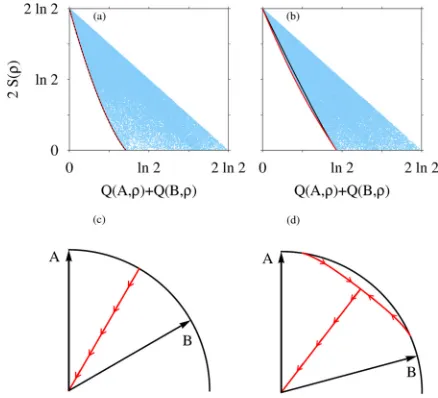
FIG. 2. (Color online) (a, b) Sum of classical vs. sum of quantum uncertainties plotted for 105 random qubit states. The red line
represents the numerically optimized MUS with fixed purity, whereas the black line represents the mixture of pure MUS with maximally mixed state. In (a) the eigenstates of A and B are separated by
γ =60o< γ
c, in (b) the eigenstates of A and B separated by
γ =75o> γ
c. (c, d) The trajectory, parametrized by S∈[0,ln 2],
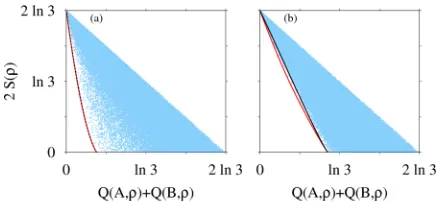
[image:5.608.63.285.69.169.2] [image:5.608.324.543.440.639.2]FIG. 3. (Color online) Sum of classical vs. sum of quantum uncertainties plotted for 105 random qutrit states. The red line
represents the numerically optimized MUS with fixed purity, whereas the black line represents the mixture of pure MUS with maximally mixed state. ObservablesAandBchosen so that the eigenstates of
Bare connected with the eigenstates ofAby rotation around (1,1,1) axis by angle (a)α=π/6, corresponding tocAB≈0.9107 and (b)
α=π/3, corresponding tocAB≈0.6667.
that this is not the case, which supports the claim that MUS with fixed purity are not just a trivial extension of pure MUS. The behavior of qubit MUS with fixed purity is shown in Fig.2. It is easy to see that a qubit MUS, independently of their purity, must lie in the plane spanned byaandb, thus having the form
c=r(sinθ,0,cosθ), (20)
where r∈[0,1]. A direct inspection shows that forγ < γc, when a pure MUS is represented by the Bloch vectorc<, the general MUS with fixed purity is given byrc<, i.e., the same Bloch vector, just shorter [see Figs.2(a)and2(c)]. Hence, in this regime the general MUS is obtained by mixing the pure MUS with maximally mixed state. However, forγ > γcthis is no longer the case, as for a givenc>decreasing the purity decreasesβ, and the MUS states flow toward therc<solution [see Figs.2(b)and2(d)]. Numerical investigations performed for qutrits suggests that this nontrivial structure of the MUS is a general feature, not only limited to qubits; see Fig.3.
Finally, we would also like to make a short comment on the states that are the opposite of MUS with fixed purity—the maximal uncertainty states with fixed purity. As can be seen in Figs.1–3, these states form a straight line in QC uncertainty plots, connecting maximally mixed state and the pure state
|ψ∗, which is unbiased in eigenbases of both observables (see Lemma 1). Thus, the states of fixed purity that maximize the sum of quantum uncertainties have a particularly simple form:pI/d+(1−p)|ψ∗ ψ∗|. Note that this means that for every fixed purity there exists a state that maximizes the sum of total uncertainties, i.e., for whichHA+HB =2 logd.
VI. DISCUSSION AND OUTLOOK
Entropic uncertainty relations are powerful relations that capture the inevitable trade-off in our ability to prepare a quantum system in a state that has highly peaked distributions for two noncommuting observables. Obviously the issue of “classical noise” arises due to imperfect experimental preparations. However, a similar scenario arises if we prepare a pure entangled state and are interested in the uncertainties of two observablesAandBon a particular subsystem. How should we then cleanly separate the uncertainty that arises due to the intrinsic noncommutativity of the observables from
that which does not? In this work, we have proposed a natural decomposition of the total uncertainties into measures that respect basic desiderata one would require. We showed, very generally, that any measure of total quantum uncertainty will not have state-independent constraints but instead could be bounded relative to the degree of purity present in the state. The particular measure of quantum uncertainty in a state we consider isS(ρ||DA(ρ))+S(ρ||DB(ρ)), namely the sum of the relative entropies to the state dephased in the eigenbases ofAandBand the measure of purity is taken to be S(ρ). The entropic decomposition into classical and quantum components leads to “purity-based bounds.” We moved the first steps toward a study of the highly nontrivial structure of minimal uncertainty states in the presence of classical uncertainty and we presented a general result about the nonlinearity of all purity-based bounds on the sum of quantum uncertainties that are at least as good as Maassen-Uffink relation and that reduce to zero for the maximally mixed (classical) state. These bounds provide generalizations to the traditional entropic relations, stressing the role that classical noise plays into them and opening up a new direction that remains largely unexplored.
ACKNOWLEDGMENTS
We would like to thank T. Tuffarelli and G. McConnell for very useful discussions as well as Ł. Rudnicki and P. Coles for their comments on the first version of our manuscript. This work was supported by EPSRC. D.J. is supported by the Royal Society. T.R. is supported by the Leverhulme Trust.
APPENDIX A: EXTENSION TO GENERAL PROJECTIVE MEASUREMENTS 1. Classical-quantum uncertainty splitting
The classical-quantum uncertainty splitting can be extended to general degenerate observables. The corresponding pro-jective measurement is no longer sharp (rank-1), and so it is natural to demand that the classical uncertainty should reflect this degeneracy. Intuitively, the more a measurement coarse-grains the Hilbert space, the smaller the classical uncertainty will be.
Consider a state ρ and a projective measurement {i}. Define
ρi= iρi
pi ,
wherepi=Tr[iρi]. Let us also define the measurement map
ρ−→D(ρ)= i
piρi =
i
iρi,
which associates to each state the post-measurement state (without post-selection). The relative entropy between the initial state and the post-measurement state is given by
S(ρ||D(ρ))= −S(ρ)−Tr[ρlnD(ρ)]
= −S(ρ)−Tr[D(ρ) lnD(ρ)]
[image:6.608.62.281.69.170.2]Given that{ρi}have orthogonal support one has
S(D(ρ))=S i
piρi
=H(ρ)+
i
piS(ρi).
Substituting this in Eq. (A1) one obtains
S(ρ||D(ρ))= −S(ρ)+H(ρ)+ i
piS(ρi),
which gives the final splitting
H(ρ)=Q(ρ)+C(ρ), (A2)
with
Q(ρ)=S(ρ||D(ρ)), (A3a)
C(ρ)=S(ρ)− i
piS(ρi). (A3b)
Notice that the classical uncertainty is now a function of the measurement{i}. This is because the uncertainty depends on degeneracy of the measured observable, so on the coarse-graining (sharpness) of the corresponding measurement and in general it will be lower than the von Neumann entropy, which is the uncertainty for a perfectly discriminating measurement. Consider, for example, the qutrit state
ξ =12(|0 0| + |1 1|),
and the projective measurement
1= |0 0| + |1 1|, 2= |2 2|.
Even though the von Neumann entropy ofξ is nonzero, the classical uncertainty of such{i}measurement onξ should vanish (as outcome associated with1has probability 1) and, as can be easily checked with the definition given by Eq. (A3b), it does vanish.
2. Luo’s axioms for degenerate observables
Let us check that the introduced quantities satisfy the basic criteria we imposed. We add a proof when the property is not a trivial extension of the nondegenerate case.
(1) Cvanishes on pure states.
(2) Q(ρ)=0 if and only if the measurement is classical; i.e., [ρ,i]=0∀i. This generalizes Luo axiom 2.
(3) Q is a convex function as it is defined in terms of relative entropy. To show thatCis a concave function simply note thatHis a concave function and taking into account the additive splitting, Eq. (A2), together with convexity ofQ, it is easy to prove thatCmust be concave.
(4) 0C(ρ)H(ρ): it suffices to observe that our C(ρ) is equal to the QC-mutual information introduced by Sagawa [28] and independently by Groenewold [29] and Ozawa [30]. This quantity is known to satisfy the bounds given. Our measure of classical uncertainty C enters the second law of thermodynamics with feedback control, measuring the amount of extra work that can be extracted from a system using feedback [28,31].
Another property that is not among Luo axioms, but that supports our interpretation ofCis the following (for a proof, see Ref. [31]). If a measurement is a refinement of a
measurement, then
∀ρ C(ρ)C(ρ). (A4)
In other words, C(ρ) decreases under coarse-graining, as expected.
APPENDIX B: NO LINEAR SPB THEOREM The proof proceeds in three steps: first, we construct the weakest linear bound satisfying desiderata 1 and 2. A violation of this bound will imply the violation of any other bound with the same properties. Second, we produce counterexamples for dimension 3,4,5, i.e., construct observablesAandBas well as statesρ3,ρ4, andρ5for which the weakest bound is violated. Third, we show that these already imply that a counterexample exists in any dimensiond >5.
Step 1. All bounds linear inSwill have the form
f(A,B,S(ρ))=a+bS(ρ), (B1) for somea,b∈R. Assumption 2 implies
f(A,B,lnd)=a+blnd =0⇒b= −a/lnd, (B2) hence
f(A,B,S(ρ))=a
1−S(ρ) lnd
. (B3)
Assumption 1 impliesa −2 lncAB,
f(A,B,S(ρ))−2 lncAB
1−S(ρ) lnd
:=fw(A,B,S(ρ)),
(B4) where fw denotes the weakest linear bound satisfying the requirements 1 and 2. Notice that for anyd >2,
fw(A,B,S(ρ))−2 lncAB
1−S(ρ) ln 3
. (B5)
Step 2. Let |ai and |bi denote the eigenstates of ob-servables AandB acting on ad-dimensional Hilbert space. Assume that these two bases are linked by a rotation Rd = exp(θdSd), where Sd is the d-dimensional skew-symmetric matrix such that|Sij| =1−δij andθd are real numbers. We choose
θ3=4π/7, θ4 =π/2, θ5=π. (B6) The following states, written in the |aibasis, violate the bound of Eq. (B4) in dimensionsd =3,4,5, respectively:
ρ3 = ⎡
⎣−00.61.15 −00.26.15 0.008 0 0.08 0.13 ⎤ ⎦,
ρ4 = ⎡ ⎢ ⎣
0.08 0.03 0.04 −0.03 0.03 0.06 −0.03 0 0.04 −0.03 0.08 −0.03
−0.03 0 −0.03 0.78 ⎤ ⎥ ⎦,
ρ5 = ⎡ ⎢ ⎢ ⎢ ⎣
0.19 0.05 −0.06 −0.02 −0.05 0.05 0.49 −0.11 0 0
−0.05 −0.11 0.22 −0.03 0.02
−0.02 0 −0.03 0.05 0
−0.05 0 0.02 0 0.05
Step 3. We will now show that the existence of the counterexample in dimension 3 immediately implies the existence of counterexamples in any dimension d >5. Hence our counterexamples ford =3,4,5 immediately imply the result for alld >2.
Fix ad-dimensional Hilbert spaceHand consider the 3-dimensional subspaceH3spanned by{|ai}and{|bi}given by the counterexample of Step 2. We can complete{|ai}and
{|bi}to a basis inH=H3⊕H⊥3 by choosing
ai|bj = 1
√
d−3, ∀i,j =4, . . . ,d. (B7)
This can be done asH⊥3 is ad−3-dimensional Hilbert space and one can always find two mutually unbiased bases as long as d >4. Let us callcAB(3) =max3i,j=1|ai|bj| =0.6851. Notice that
c(d)AB:=maxd
i,j=1|ai|bj| =max
c(3)AB,1/√d−3=cAB(3),
for all d6. Exploiting this construction and Eq. (B5) it is easy to see thatρ3(seen now as a quantum state inH) violates the bound of Eq. (B4) in any dimensiond >5.
APPENDIX C: STRONG-PURITY BASED BOUND FOR QUBIT
We prove Eq. (15) in the cased =2. As explained in Sec.V, without loss of generality we can restrict our considerations to two single qubit observables given byA=a·σ, andB=
b·σ, whereσ =(X,Y,Z) denotes the vector of Pauli matrices andaandbare the Bloch vectors. Without loss of generality we may assume thata=(0,0,1) andb=(sinγ ,0,cosγ), where γ ∈[0,π/2] (extending the range overπ/2 is unnecessary, as for the entropic quantitiesaand−aare indistinguishable). A general qubit state can now be written as
ρ= I+r·σ
2 , (C1)
with
r=r(sinαcosϕ, sinαsinϕ,cosα), (C2)
r ∈[0,1],α∈[0,π], andϕ∈[0,2π]. All three Bloch vectors
a,b, andr are depicted on the Bloch sphere in Fig.4. The probability distributions of the outcomes ofAandBin a state
FIG. 4. (Color online) The orientation of the Bloch sphere.
ρare given by
pA=
1+rcosα
2 ,
1−rcosα 2
, (C3a)
pB =
1+rcosβ
2 ,
1−rcosβ 2
, (C3b)
where cosβ =cosϕsinαsinγ +cosαcosγ. Introducing the binary entropy,
H2(p)= −plnp−(1−p) ln(1−p),
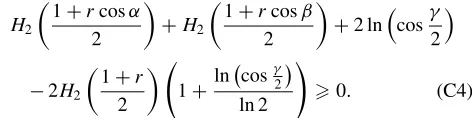
the improved entropic uncertainty relation, Eq. (15), for a qubit reduces to
H2
1+rcosα 2
+H2
1+rcosβ 2
+2 ln
cosγ 2
−2H2
1+r 2
1+ln
cosγ2 ln 2
0. (C4)
In order to prove that the above inequality always holds let us first denote its left-hand side by F(α,β,γ ,r). We will find its minimum and show that it is greater or equal to zero. Computing the derivative with respect tor,
∂
∂rF(α,β,γ ,r)= −tanh
−1(rcosα) cosα
−tanh−1(rcosβ) cosβ
+2 tanh−1(r) 1+ln
cosγ2 ln 2
,
we will show this is always nonnegative. Using the Taylor series representation of tanh−1 one finds that the above derivative is given by
∞
n=0 r2n+1 2n+1
2−cos2n+2α−cos2n+2β+ 2 ln 2ln
cosγ
2
.
Now let us denote the coefficient in parentheses standing by thenth term byanand note that
∀n a0an.
Therefore, if we can show thata00 then all the coefficients are positive and, taking into account the positivity ofr, the considered derivative is positive for allα,β, andγ. It is easy to see, using the explicit dependence of cosβonα,γ, andϕ, that
a0 sin2α+ 2 ln 2ln
cosγ
2
+min +,−sin
2(α±γ). (C5)
Introducingδ=α±γ /2 one gets that fora00 to be true one has to prove that
1−cos 2δcosγ + 2 ln 2ln
cosγ
2
0. (C6)
The minimum of the left-hand side of the above inequality is achieved forδ =0, hence it is enough to prove that
2 sin2γ 2 +
2 ln 2ln
cosγ
2
[image:8.608.321.557.223.282.2]which can be easily done. Therefore, we have proven that
∀α,β,γ ∂
∂rF(α,β,γ ,r)0, (C7) and it is easy to see that
∀α,β,γ F(α,β,γ ,0)=0. (C8)
Hence,
∀α,β,γ ,r F(α,β,γ ,r)0, (C9)
so that the conjectured bound for qubit holds.
[1] H. P. Robertson,Phys. Rev.34,163(1929). [2] D. Deutsch,Phys. Rev. Lett.50,631(1983).
[3] H. Maassen and J. B. M. Uffink,Phys. Rev. Lett. 60, 1103 (1988).
[4] S. Wehner and A. Winter,New J. Phys.12,025009(2010). [5] S. Luo,Phys. Rev. A72,042110(2005).
[6] J. I. de Vicente and J. S´anchez-Ruiz,Phys. Rev. A77,042110 (2008).
[7] M. Berta, M. Christandl, R. Colbeck, J. M. Renes, and R. Renner, Nat. Phys.6,659(2010).
[8] P. J. Coles and M. Piani,Phys. Rev. A89,022112(2014). [9] Z. Puchała, Ł. Rudnicki, and K. ˙Zyczkowski,J. Phys. A 46,
272002(2013).
[10] S. Friedland, V. Gheorghiu, and G. Gour,Phys. Rev. Lett.111, 230401(2013).
[11] Ł. Rudnicki, Z. Puchała, and K. ˙Zyczkowski,arXiv:1402.0129. [12] H. Ollivier and W. H. Zurek,Phys. Rev. Lett.88,017901(2001). [13] L. Henderson and V. Vedral,J. Phys. A34,6899(2001). [14] S. Luo,Phys. Rev. A77,042303(2008).
[15] S. Luo,Theor. Math. Phys.143,681(2005).
[16] G. Gour, I. Marvian, and R. W. Spekkens,Phys. Rev. A80, 012307(2009).
[17] S. Luo, N. Li, and X. Cao, Period. Math. Hungar. 59, 223 (2009).
[18] J. ˚Aberg,arXiv:quant-ph/0612146.
[19] T. Baumgratz, M. Cramer, and M. B. Plenio,arXiv:1311.0275. [20] G. Gour and R. W. Spekkens, New J. Phys. 10, 033023
(2008).
[21] P. J. Coles, R. Colbeck, L. Yu, and M. Zwolak,Phys. Rev. Lett.
108,210405(2012).
[22] D. Girolami, T. Tufarelli, and G. Adesso,Phys. Rev. Lett.110, 240402(2013).
[23] K. Modi, A. Brodutch, H. Cable, T. Paterek, and V. Vedral,Rev. Mod. Phys.84,1655(2012).
[24] K. Korzekwa, D. Jennings, and T. Rudolph,arXiv:1311.5506. [25] T. Tufarelli (private communication).
[26] J. S´anches-Ruiz,Phys. Lett. A244,189(1998).
[27] G. Ghirardi, L. Marinatto, and R. Romano,Phys. Lett. A317, 32(2003).
[28] T. Sagawa and M. Ueda, Phys. Rev. Lett. 100, 080403 (2008).