Submitted: March 3, 2014 Accepted: June 9, 2014
18 Journal of Health Informatics in Developing Countries
www.jhidc.org Vol. 8 No. 2, 2014
Preparedness for e-Health in developing
countries: the case of Ghana
Salifu YUSIF1 and Jeffrey SOAR2
School of Management & Enterprise, Faculty of Business, Education, Law and Arts, University of Southern Queensland,
Toowooomba, Australia
Abstract. As Ghana embarks on a national e-Health initiative there is the need to
explore its preparedness in terms of socioeconomic and development, technology infrastructure and operational preparedness, and skills and human resources. This paper reports on a literature review as part of a research program, which aims to inform the development of an effective roadmap for the successful implementation of the national e-Health initiative in Ghana. The literature was searched for factors of e-Health adoption in developing countries; and realization of the anticipated benefits through IEEE, Medline, Google scholar and Google search engines. Sixteen (16) articles were reviewed were from 176 related articles that were found. The literature review found the two highest priority objectives in in e-Health Africa: providing health education for health professionals (identified in 7 of the 16 projects reported on in the literature) and improvement of primary health care services 9 of the 16 projects). Six (6) or 39% each of the 16 projects reported a lack of skills and Human Resources Socioeconomic issues, and Technology infrastructure problems reported in 22% or the remaining four (4) projects. The paper concluded that the effects of these challenges could lead to Ghana like many other developing countries struggling to adopt e-Health, its inability to realize the potential benefits of e-Health and its ability to institutionalize and sustain e-Health.
Keywords: e-Health; Telehealth; ICT; HIT; Telecommunication; Ghana; developing countries.
1. Introduction and Objectives
Health is seen as a major key for development and many developing country governments are interested in investing in ICT-based Health Information Systems (HIS) to improve health services (S. Khan, Shahid, Hedstrom, & Anderson, 2012). ICT has the potential to make an significant contribution to improving health and healthcare in developing countries (Chetley, Davies, Trude, McConnell, & Ramirez, 2006). The experience to date has been disappointing when initial high hopes confront the chaotic and sometimes corrupt health systems in many countries (Lucas, 2008). Initial small-scale or pilot success does not guarantee sustainable and institutionalised large-small-scale adoption and realisation of benefits. More 80 per cent of non-OECD member states suggested that Electronic Health Records, Patient Information Systems, Hospital
19 Information Systems, National Electronic Registries, National Drug Registries, Decision Support Systems, and Geographical Information Systems would be ‘very or extremely useful’ (WHO, 2006b). In contrast, the Institute for Public Policy Research in one study in UK (Bend, 2004, p. 11), found that ‘‘given the number and size of the projects and evaluations that we have examined, we have found a surprisingly small amount of convincing evidence that ICT can deliver greater public value in health”. This means that technology also has a ability to produce impractical expectations, convincing even serious observers that it is ‘‘revolutionizing every sphere of human interaction and communication’’ (Ojo, 2006).
Long-term outcomes typically depend on factors such as vigour of sophisticated equipment and availability of technical staff to operate and maintain that equipment as well as adequate funding to finance usual operating expenses, maintenance costs and frequent upgrades that seem to be an intrinsic feature of ICT systems. Hence the reason most health information technology initiatives fall into the “pilot project” group, characterised by limited records and high dependency on external technical and financial support.
The introduction of Ghana’s national health insurance scheme (NHIS) in 2005 has done little to improve access to health care services in the country (Oxfarm, 2011). The doctor-to-patient ratio for Ghana is 1:13,000 nationally, which falls far below the world standard of 1:5,000. In some regions of Ghana the ratio is much worse with only one doctor for every 93,000 of the population (Mitchell, 2013). In an effort to address the problem of medical staff shortage for the general population, the Novartis Foundation for Sustainable Development (NFSD), in cooperation with the Ministry of Health (MoH) Ghana, Ministry of Communications Ghana and other organizations initiated a telemedicine project in Bonsaaso Cluster, Ghana. Airtel and Ericsson Ghana technically support the project. The goal of this telemedicine project is to improve access to primary healthcare by using ICTs to overcome geographical barriers (Novartis Foundation, 2010). Other e-Health/telemedicine projects in Ghana include those run by Grameen Foundation for Ghana, E-Health Ghana Foundation, Rotary Ghana Limited and Sene personal digital assistant (PDA) Project. Following this effort by NFSD and other organizations, the MoH announced its plans to begin the first mainstream e-health infrastructure implementation in Ghana. It is aimed at enhancing telemedicine in Ghana for the facilitation of analysis and results of medical information, and reducing congestion at health centers (GBN, 2012). The objective of this paper is to review some notable factors: socioeconomic, skills and human resources and technology infrastructure and operational issues that impact e-Health in most developing countries and apply them in the context of Ghana in terms of their implications on e-Health adoption and institutionalization in Ghana.
1.1 Background
1.1.1 Healthcare Systems and Healthcare Situation in Ghana
20 self-medication (Australian Red Cross & ACCORD, 2009). Access to quality health care is a fundamental human right but the numerous challenges faced by the modern health care system makes this a reality for only a section of the Ghanaian populace (ACDEP & CORDAID, 2007).
For a population of about 25 million people (WHO, 2011a) there are only 1,439 health care facilities (IRIN 5 August, 2008). Nation-wide the geographical coverage (measured as the proportion of the population living within a defined radius of facilities) of health facilities (public and private) varies, and is lower in the northern part of the country (Ministry of Health, 2007). Ghanaians on average live about 16 km from a healthcare facility where they can consult a doctor, but half of the population lives within a 5 km radius, which corresponds to a 1 hour walking distance. Difficulty in accessing health care facilities and an inability to pay for health insurance have led to an increase in self-medication for which most patients spend the equivalent of $1.50 on occasion compared to visiting a private doctor at the cost of $10 (Van den Boom et al. 2004). The GDP per capita in Ghana is a little over US$4 per day so healthcare costs can be a challenge for many Ghanaians (WHO, 2011b).
1.1.2 Telecommunication and Internet availability in Ghana
Key infrastructure for health services in any country includes telecommunication and Internet access. Using Internet cafés is the most common means Ghanaians use to access the Internet in Ghana (Alison Gillwald, 2005). Ghana’s internet penetration increased from 5.2 per cent in 2010 to about 10 per cent in 2011, an increase of about five per cent in just one year and total mobile voice subscriber base standing at 24,438,983 which is 98 per cent of the estimated Ghanaian population, according to The National Communication Authority (Times, 2012). With Broadband envisage to cover most part of Ghana by 2017, it is hoped that SAT3 fibre optic availability belonging to Ghana’s electricity provider will lower the cost of subscription (A Gillwald, 2005). In Ghana, the development of the ICT4AD policy, and provision of an enabling environment have contributed to massive ICT infrastructure investments and availability of broadband for national development (ITU, MoC Ghana, NCA, & EPA, 2012) (refer to appendices 2 and 3).
1.2 The Technology of e-Health (Telemedicine)
Information and communication technologies (ICTs) are powerful instruments with potential to help strengthen health systems offering innovations ranging from electronic health records to transmission of clinical data (Schweitzer & Synowiec, 2010). Health-care systems continue to be under pressure to reduce costs, improve quality and at the same time to improve the quantity of services (Lamminen, Forsvik, Vopio, & Ruohonen, 2011). e-Health offers great promise in low and middle-income countries (LMICs) whose health systems face severe financial, infrastructural, technical and human resource constraints (Schweitzer & Synowiec, 2010).
21 2. Methodology
Using IEEE Xplore, Medline bibliographic and search engines, a literature search was performed for peer-reviewed journal articles on e-health and telemedicine in developing countries. Given the lack of articles from developing countries in indexed publications and other documents examined, such as references within retrieved articles, Internet search engines such as Google and Google Scholar were also used. Because the objective of the review is to look at preparedness of e-health/telemedicine, every category of e-health/telemedicine was included. The following keywords were used in the search: Telemedicine, Telehealth, e-Health, Ghana, Developing Country Challenges Telecommunication, Preparedness, Healthcare Situation, Africa. 176 relevant studies relating to healthcare situation, telecommunication in Ghana, e-Health/telemedicine projects in Africa and otherdeveloping countries were considered. Bearing in mind that the search was not exhaustive. 94 out of the 176 were further scrutinized and a total of 16 e-Health projects with explicit objectives and challenges in Africa (see Jahangirian and Taylor 2013) analyzed. As opposed to Jahangirian and Taylor whose e-Health African profiling did not focused on objectives and challenges, stated objectives and challenges are requirements for the inclusion of an Health/telemedicine project. The following table presents a summary of the 16
Submitted: March 3, 2014 Accepted: June 9, 2014
0 Journal of Health Informatics in Developing Countries
www.jhidc.org Vol. 8 No. 2, 2014
Table 1: e-Health Projects in Africa
No Title of Project African Country Funding bodies Year started Core Objective Challenges
1 South African National
Telemedicine System (Gulube & Wynchank, 2001)
South Africa S.A. Gov’t 1998 Improve primary health services and health education in the rural areas of South Africa
Low usage of the telemedicine system, which raises questions about its cost-effectiveness. Technical and organizational challenges of introducing telemedicine.
2 Global Development Learning Network (GDLN)
(Assie-Lumumba, 2008)
Mauritania, Senegal, Burkina Faso, Ivory Coast, Ghana, Benin,
Uganda, Kenya, Ethiopia,
the World Bank, all participating institutes
1996 Worldwide exchange of learning
activities, through courses, seminars and discussions on key development issues (facilitate rapid and simultaneous dissemination of knowledge to audiences in various socio-geographic spaces and the expansion of the opportunity for tertiary education in developing countries)
Lack of access to finance; Lack of skills and the necessary technologies—pricing strategies, promotion strategies, distribution strategies
3 (R´eseau en Afrique Francophone pour la T´ el ´em´edecine)
(Geissbuhler, Bagayoko, & Ly, 2007) Mali, Senegal, Mauritania, Morocco, Cameroon, Burkina-Faso, Tunisia, Ivory Coast, Madagascar, Niger, Burundi, Congo- Brazzaville, Algeria, Chad, and Benin
the State of Geneva (through the Department of International Solidarity), Swiss Confederation, Geneva University hospitals, Eagle F., Nestle´ F., Digital Solidarity Fund, Re´seau Universitaire International Geneva
2001 Webcasting of interactive courses. These sessions put the emphasis on knowledge sharing across care professionals, usually in the form of presentations and dialogs between experts in different countries; visioconferences, teleconsultations based on the iPath system, collaborative knowledge bases development, and support for medical laboratories. Quality control, and the evaluation of the use of telemedicine in rural areas (via satellite connections) in the context of multisectorial development
1 4 e-Government as a priority area
in its first National IT Policy and Action (F. Khan, Khan, & Zhang, 2010)
Toward achieving good governance while increasing the ability of citizens and businesses to access public services in an effective and cost-efficient manner
Lack of Government Information Infrastructure (GII), which is a network that connects all government agencies
5 WelTel
(Lester et al., 2010)
Kenya, Ethiopia US Centres for Disease Control and Prevention (CDC), PEPFAR, Canadian International Development Research Centre (IDRC)
2006 Improve delivery of health services – HIV medication management reminder
Lack of enough health centres (local clinics and regional hospitals) and ICT infrastructure and ICT knowledge
6
(Nabiev et al., 2010)
ICT4MPOWER
Uganda SPIDER (Swedish
Program for ICT4D in Developing Regions),
The Ministry of ICT Uganda
Communications Commission (Cucchietti)
2009 Facilitate health care delivery and health services by means of ICT. Village health team (VHT), rural clinics and hospitals will get access to a low-cost
infrastructure for the entry of population based health information from home visits and patient data from health units, and this information will be uploaded to a central server cluster (presently via GPRS) and merged into an Electronic Health Record (EHR) for the follow-up of each patient.
Expensive to maintain pool of technical staff to address various technical support issues locally;
Expensive to provide 24/7 support and monitoring;
Expensive to sustain knowledgeable technical staff locally;
Difficult to cope with turnover of technical staff;
Difference in quality of maintenance procedure at health units;
Difficult to sustain in the long run. 7 SMS for Life
(Barrington, Wereko-Brobby, Ward, Mwafongo, & Kungulwe, 2010)
Tanzania Novartis, The Roll Back Malaria Partnership, Medicine for Malaria Venture, Swiss Agency for Development, Vodacom Tanzania, PSI Tanzania, IBM, Vodafone and the Ministry of Health in Tanzania
2009 Improve access to essential malaria medicines in rural areas.
2 8 (Malacarne et al., 2004)
INteractive TeleConsultation Network for Worldwide HealthcAre Services (INCAS)
Congo, Nigeria and Angola
CEFRIEL (Centre of Excellence For Research, Innovation, Education and Industrial Labs partnership) and ENI (Ente Nazionale Idrocarburi)
1999
Provide support to the expatriate doctor with the diagnoses and treatment of routine complaints; contribute to the general improvement of healthcare in remote areas.
Some patients refused teleconslultation and chose to be treated at the referral site – trust (acceptance)
9 (SatelLife, 2007)
Uganda Health Information Network (UHIN)
Uganda Doris Duke
Foundation
2002 Use technology to allow the Ministry of Health to collect critical health information more effectively and deliver this information along with health education and other resources to workers in the field
Operating in only 5 districts after 7 years of operation – lack of sustainability
10 OpenMRS
(Seebregts et al., 2009)
Botswana, Ethiopia, Gabon, Ghana, S. Africa, Lesotho, Mali,
Zanzibar, Nigeria, Rwanda,
Congo, Senegal, Sierra Leone, Malawi, Gambia, Kenya, Zimbabwe, Mozambique, Uganda, Tanzania IDRC, The Rockefeller Foundation, The Fogarty International Centre, WHO, CDC, Google,
Regenstrief Foundation, Partners in Health
2004 Develop an open Implementers Network for OpenMRS to provide regional support for the growing number of OpenMRS implementations in Africa and to include African developers and implementers in the future growth of OpenMRS.
There are technological incompatibilities of the PDAs devices and software depending on the models as well as the manufacturers. Unstable power supply requires alternative sources of electricity, which are usually very expensive in terms of initial costs and/or operation. Some areas do not have the presence of Internet and cellular network coverage, which limits the number of health centers that can access and use this service to only those in areas with such coverage.
Understanding needs and workflow. Support for equipment, power supplies and software. Data management and quality control Data management and quality control. Evaluation. Training – IT, programming, data management, users, researchers
11 Episurveyor
(Richards, 2009) Uganda, Benin, Cameroon, the Democratic Republic of Congo, Ethiopia, Ghana, Madagascar,
World Bank, the United Nations Foundation, the Vodafone Foundation,
2003 Allow health care workers create their own data collection forms, download them onto cell phones, and text data back to a central database
3 Rwanda, Senegal,
Kenya and Zambia
DataDyne.org delivery
12 I-NETWORK Uganda Provide a platform for information and
knowledge sharing for those interested in the use of ICT in the health sector, especially health workers themselves
Abuse of network for the promotion of self-interest
13 Pan African e-Network Benin, Burkina Faso, Cape Verde, Ivory Coast, Gambia, Ghana,
Guinea, Guinea-Bissau, Liberia, Mali, Niger, Nigeria, Senegal,
Sierra Leone and Togo, Comoros, Djibouti, Eritrea, Ethiopia, Kenya, Madagascar, Mauritius, Rwanda, Seychelles, Somalia, Sudan, Tanzania, Uganda; Botswana, Lesotho, Malawi, Mozambique, Namibia, Libya, Egypt, Swaziland, Zambia, Zimbabwe, Sao Tome and Principe, Burundi, Congo, Cameroon, Chad, DR of Congo , Gabon, Sao Tome, Mauritania
Indian Government and African Union
2007 Assist Africa in capacity building by way of imparting quality education to 10,000 students in Africa over a 5-year period in various disciplines from some of the best Indian
Universities/Educational Institutions. Besides, this would provide Tele-Medicine services by way of on line medical consultation to the medical practitioners at the Patient End Location in Africa by Indian Medical specialists in various disciplines/specialties selected by African Union for its Member States.
Difficulty of evolving government-to-government model into a sustainable model of private-public partnership, which is cost effective and affordable for the common man.
14 Click Diagnostics Botswana, Kenya, Uganda, Ghana, Egypt, S. Africa,
Click Diagnostics Inc.
Address the Lack of medical specialists in under-served regions and the lack of real-time health data needed for strategic interventions by the government and NGOs
4 local ownership and involvement; not enough sharing of experiences, adoption of best practices and implementation of collaborative approaches.
Phones-for-Africa
(US-PEPFAR, 2007)
Rwanda and Nigeria a Public-Private Partnership (PPP) consisting US President’s Emergency Plan for AIDS Relief (US-PEPFAR), Accenture Development Partners, GSM Association Development Fund, Motorola, MTN, and Voxiva
2007 Provide community health workers with
cell phones and mobile applications to track and report vital events in a village (such as births, maternal and child deaths);
Encourage and track pregnant women seeking antenatal care and prevention of mother-to-child transmission services; Monitor orphans and vulnerable children and patients receiving home-based care; and
Improve distribution of medicines, bed nets, and contraceptives.
Train new health care workers to strengthen the most vital part of a health system – its people on the front lines; and leverage our HIV/AIDS investments to strengthen overall health systems.
Mozambique Health Information Network (MHIN)
Mozambique IDRC 2006 Support health data collection and
reporting through a two–way communications system utilizing the existing cellular telephone network and low-cost, simple-to-use, and energy-efficient handheld computers (also known as Personal Digital Assistants or PDAs.)
Submitted: March 3, 2014 Accepted: June 9, 2014
0 Journal of Health Informatics in Developing Countries
www.jhidc.org Vol. 8 No. 2, 2014
3. Discussion
3.1.Objectives of e-Health projects in Africa
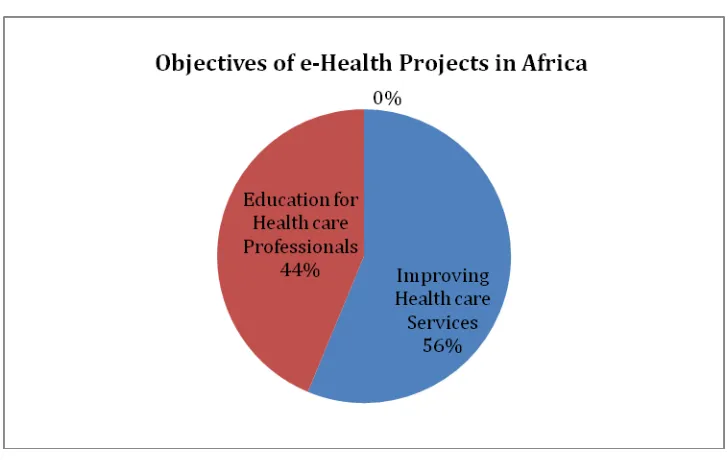
[image:10.595.118.482.378.608.2]A further review of the core objectives of the 16 identified and selected e-Health projects revealed 7 projects, representing 44 per cent of the 16 e-health projects were aimed at providing “Health education” for health professionals especially those in the rural/remote of project beneficiary countries to keep them updated on current practice issues, continually and professionally develop them and keep them in contact with their counterparts. The other 9 projects, representing 56 per cent of the total 16 projects were aimed at improving primary health care services such as HIV medication management, patient data collection, real time patient diagnosis and Monitor orphans and vulnerable children and patients receiving home-based care; and Improve distribution of medicines, bed nets, and contraceptives. The figure below represents some common objectives of e-Health projects in Africa
Figure 1: Objectives of e-Health Projects in Africa
Source: Developed for this study
3.2.Challenges of e-Health projects in Africa
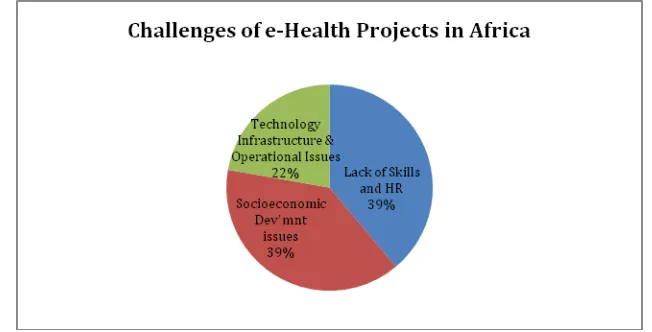
1 economies, the evidence is less robust in developing economies (Garg et al., 2005; Goldzweig, Towfigh, Maglione, & Shekelle, 2009). Socioeconomic development constraints; technology infrastructure and operational issues; and skills and human resource (EU Commission, 2011; Rodrigues, 2003a) appeared to be the major challenges of most e-Health projects in Africa.
All the selected e-Health projects were funded by mostly governments/agencies from developed countries. Some e-Health projects acknowledged that it was:
• Expensive to maintain pool of technical staff to address various technical support issues locally;
• Expensive to provide 24/7 support and monitoring;
• Expensive to sustain knowledgeable technical staff locally;
• Difficult to cope with turnover of technical staff;
• Difference in quality of maintenance procedure at health units;
• Difficult to sustain in the long run.
Figure 2: Common challenges of e-Health projects in Africa
Source: developed for this study
3.2.1. Socioeconomic Constraints and Development
Six (6) or (39%) of the 16 projects, faced socioeconomic challenges ranging from lack health care facilities, through low participation to unacceptable telemedicine services by patients.
[image:11.595.133.459.354.520.2]2 McIntyre, Thiede, Dahlgren, & Whitehead, 2006). There is growing evidence of households being pushed into poverty or forced into deeper poverty when faced with substantial medical expenses, particularly when combined with a loss of household income due to ill-health (McIntyre et al., 2006). To deal with this problem of poor health care accessibility, in August 2003, Ghana passed the National Health Insurance Act, which decreed that all Ghanaian districts establish community-based health financing schemes, funded by sales taxes, contributions of formal sector worker (official employees with operative work contract) and voluntary payments by informal sector workers (Baltussen, Bruce, Rhodes, Narh-Bana, & Agyepong, 2006). The national healthcare insurance scheme (NHIS) has increasingly placed the burden of paying for health care on individuals experiencing poor health (McIntyre et al., 2006). Poverty in most developing countries including Ghana is linked to lack of universal access to education. Unequal access to education among males and females appear to be universal in the developing world. Females in Africa seem to suffer ever more discrimination in terms of access to education (Shabaya & Konadu-Agyemang, 2004).
As many sector reports and health sector assessments consistently demonstrate, health systems in numerous developing countries suffered from grossly inefficient and inequitable resource allocation, declining quality, and demoralized work forces (Berman & Bossert, 2000).
The digital divide includes insufficient telecommunications infrastructure, limited markets for information technologies (IT), high telecommunication tariffs, inappropriate or weak policies, organizational inefficiency and lack of locally created content (Curioso, 2006).
3.2.2. Technology Infrastructure and Operational issues
Lack of necessary technologies – technical incompatibilities; limited network coverage areas which limits the number of health centres that could participate in some of the mHealh projects coupled with pricing, promotion and distribution strategies became major challenges. Out of the 16 projects reviewed, 4, representing 22 per cent suffered a lack of technology infrastructure. Still with the lack of necessary technologies, in some cases there was a lack of Government Information Infrastructure (GII), which is a network that connects all government agencies including healthcare facilities. Projects that suffered from this were e-Government projects of which e-Health/Telemedicine was a part.
WeTel, an mHealth projects in Kenya and Ethiopia aimed at improving HIV medication management suffered from a lack of health centers (local clinics and regional hospitals) and few health professionals
Technology is one potential mechanism for achieving improvements in the processing of information within the health system (Ibrahim, 2009).
3 Nigeria overtook South Africa as the region’s biggest telecommunications market in 2008 (WHO, 2011a). The role of ICT in achieving the Millennium Development Goals (MDGs) was recognized at the World Summit on the Information Society, as reflected in the Geneva Declaration of Principles (UN & ITU, 2003). Despite these encouraging trends, as at the end of 2010, nearly 80 per cent of developing countries’ populations were not yet using the Internet, and even fewer via a broadband connection (ITU, 2011).
Perhaps the greatest challenge is to generate evidence that e-Health can improve health system performance, help build human capital for health, improve access to knowledge, and lead to better outcomes for patients (WHO, 2006a). Other challenges include lack of independent regulation, noncompetitive telecommunication markets, and low levels of privatization of operators (IEC World Bank, 2011). Moreover, the difficulties of achieving technology transfer in developing countries are among the principal reasons for the difficulties of achieving sustained growth (Steinmueller, 2001).
Poor telecommunications infrastructure, limited number of Internet service providers, lack of access to international bandwidth continue to be major impediments to the diffusion of Internet applications to the point-of-care in developing countries (Curioso, 2006). Besides achieving reliable transaction delivery, an e-Health architecture that is technologically successful must provide superior client service, customization of products and services, interactivity, and maximum convenience (Rodrigues, 2003b). These challenges call for the need for participatory models of research and evaluation that engage local stakeholders in the development, design, and implementation of contextually meaningful research questions, processes, and outcomes in ICT and e-Health (WHO, 2010).
With the promise to help manage resources, increase efficiency, increase work productivity and reduce workload, Information and Communication Technologies (ICTs) are introduced to organizations with the promise being magnified in the context of developing countries considering the existing conditions and inefficiencies (Kimaro, 2006). The use of ICTs can help the healthcare services in developing countries to potentially plan, monitor, control and improve healthcare delivery (World Health Organization, 2005). A lack of well-trained ICT professionals, insufficient awareness and experience in the use of ICTs remain important challenges in a developing country.
4
3.2.3. Lack of skills and human resources
A central goal of human resource development involves increasing the knowledge, skills, capacities of all people in societies and the promotion of their well-being through economic growth and development (Bada & Madon, 2006). Against this backdrop, Oyelaran-Oyeyinka and Lal (2006) found in their study that technological progress requires skills upgrading through explicit learning of the new technologies; and finally, firm performance is highly associated with learning capabilities, levels of technology, and a host of firm-level knowledge, skills, and experience. Changes in ICT and their applications have placed new demands on the stock of human capital required to function effectively in the changing global technological and business environment (Bada & Madon, 2006). ICTs, particularly in the healthcare sector remain underused by healthcare professionals as they lack knowledge on the best strategies to integrate them into their practice (Gagnon et al., 2009).
[image:14.595.144.315.494.632.2]One of the challenges of implementing health information and communication technology is the need for a skilled workforce that understands health care, information and communication technology, and the people and organizational challenges involved (Hersh, Margolis, Quirós, & Otero, 2010). It is one of the two most frequent challenges among the 16 selected e-Health projects in Africa representing a staggering 39 per cent (6 out of the 16 projects) of the total e-Health projects reviewed. The lack of IT skills in some cases lead to low acceptance rate of e-Health projects by health professionals and administrators. The lack of skills could also be linked to low usage of some telemedicine system, which raises concerns about cost-effectiveness of the telemedicine.
Figure 3: Factors that could influence e-Health adoption in Ghana
5
3.3. Implications of challenges on e-Health Projects in Africa
Three major challenges were found and discussed below:
The struggle of e-Health adoption in developing countries: Developing countries have struggled to introduce e-Health/telemedicine on large scales this construct measures the socioeconomic and development, technological infrastructure and operations and skills and human resources impact in the context of Ghana’s preparedness as perceived by key stakeholder groups.
State of e-Health initiatives in developing countries: E-Health initiatives in developing countries rarely mature to become institutionalized programs amid socioeconomic and development, technological infrastructure and operations and skills and human resources to supporting the sustainability of the initiative as perceived by key stakeholder groups.
Realization of potential benefits: there is increasing evidence, documented by systematic reviews, that information and communication technology can improve the quality and safety of health care while reducing its cost in the developed economies The same cannot be said of developing economies as there is – less robust evidence (Hersh et al., 2010).
Figure 4: Results of the influence of socioeconomic, technological and skills and human resource
6 4. Conclusion and recommendation
The Literature reviewed unearthed some important findings about e-Health adoption in developing countries with focus on the impact of socioeconomic and development constraints; technology and operational issues and skills and human resources. The impact of these factors could be so severe that most developing countries have struggled and continued to struggle to adopt e-Health; could not be sure of realizing the potential benefits of e-Health and possibly lack the ability to institutionalize e-Health after adoption. Seeking to overcome HIS failures in developing countries, various works have addressed the factors associated with these results (Joia & Fornazin, 2014).
It is therefore recommended that developing countries begin to look seriously into socioeconomic and cultural issues, review and make technology-growth enabled environment. It is important to identify and develop the skills, training, and competencies consistent with local cultures, languages, and health systems that will be needed to realize the full benefits of these technologies (Hersh et al., 2010). This means that universal access to education will be crucial. In moving forward, it becomes imperative that developing nations start initiatives that address the above identified problems that has the potential to impact negatively any e-Initiative
4.1. Importance of this paper to developing countries
This paper highlights some of the primary challenges of developing countries, which unfortunately happen to be the engine of any economic development and core drivers of successful Initiatives. There is invaluable knowledge to gain from the lessons of e-commerce, e-government, and e-health achievements and failures in developed countries through careful examination of those experiences. Relating these lessons to the characteristics of the health sector, organizational preparedness, and technological infrastructure of developing countries will be helpful in the selection of appropriate e-health design and deployment strategies (Rodrigues, 2003b). Like Ghana, many developing countries are taking the initiative to implement e-Health/Telemedicine. This paper has unearthed the potential implications of poor technology infrastructure, socioeconomic and development constraints and lack of ICT/IT skills and human resources on any e-Initiative; ranging from e-Government to e-Health.
References
ACDEP, & CORDAID. (2007). Survey on the practice of traditional medicine in the operational area of eight ACDEP member primary health care programmes in the Upper East and Northern regions of Ghana: ACDEP.
Assie-Lumumba, N. (2008). The Global Development Learning Network (GDLN) and Tertiary Education in Africa: Opportunities and Predicaments of Centralized Knowledge Broadcasting Programs on the World Scale. Perspectives on Global Development and Technology, 7(3-4), 3-4.
Australian Red Cross, & ACCORD. (2009). Health care in Ghana.
Bada, AO, & Madon, S. (2006). Enhancing human resource development through information and communications technology. Information Technology for development, 12(3), 179-183.
Baltussen, RMPM, Bruce, E, Rhodes, G, Narh-Bana, SA, & Agyepong, I. (2006). Management of mutual health organizations in Ghana. Tropical medicine & international health, 11(5), 654-659. Barrington, J, Wereko-Brobby, Ol, Ward, P, Mwafongo, W, & Kungulwe, S. (2010). SMS for Life: a pilot
7 Bend, J. (2004, p. 11). Public value and e-Health. London, UK: Institute for Public Policy Research, . Berman, P.A, & Bossert, T.J. (2000). A Decade of Health Sector Reform in Developing Countries:What
Have We Learned? Paper presented at the Appraising a Decade of Health Sector Reform in
Developing Countries, Washington, D.C. USA. http://www.harvardschoolofpublichealth.org/ihsg/publications/pdf/closeout.PDF
Chetley, A, Davies, J, Trude, B, McConnell, H , & Ramirez, R (2006). Improving health, connecting people: The role of ICTs in the health sector of developing countries. A framework paper. Infodev. Retrieved 20-04-2014, from http://www.popline.org/node/185203
Cucchietti, Flavio. (2012). The case of Ghana.
Curioso, W.H. (2006). New Technologies and Public Health in Developing Countries: The Cell Preven Project The Internet and Health Care: Theory, Research, and Practice. 10 Industrial Avenue, Mahwah, New Jersey 07430: Lawrence Erlbaum Associates.
EU Commission. (2011). European countries on their journey towards national eHealth infrastructures eHealth Strategies Report
Eysenbach, G. (2001). What is e-health? J Med Internet Res. Retrieved 14 December 2013, 3, from http://www.jmir.org/2001/2/e20/
Frempong, Godfred. (2007). Trends in ICT usage by Small and Medium Scale Enterprises in Ghana. ATDF Journal, 4(1).
Gagnon, MP, Légaré, F, Labrecque, M, Frémont, P, Pluye, P, Gagnon, J, . . . Turcot, L. (2009). Interventions for promoting information and communication technologies adoption in healthcare professionals. Cochrane Database Syst Rev, 1.
Garg, AX, Adhikari, NKJ, McDonald, H, Rosas-Arellano, MP, Devereaux, PJ, Beyene, J, . . . Haynes, RB. (2005). Effects of computerized clinical decision support systems on practitioner performance and patient outcomes: a systematic review. Jama, 293(10), 1223-1238.
GBN. (2012). Ghana sourcing $163m funding for e-health infrastructure. Retrieved 20 December 2012, 2012, from http://www.ghanabusinessnews.com/2012/10/03/ghana-sourcing-163m-funding-for-e-health-infrastructure/
Geissbuhler, A, Bagayoko, CO, & Ly, O. (2007). The RAFT network: 5 years of distance continuing medical education and tele-consultations over the Internet in French-speaking Africa. International Journal of Medical Informatics, 76(5), 351-356.
Gillwald, A. (2005). Towards an African e-Index. Household and Individual ICT Access and Usage in 10 African Countries. Johannesburg: The Link Centre. Retrieved April, 24, 94-105.
Gillwald, Alison. (2005). Towards an African e-Index: Household and individual ICT access and usage across 10 African countries: LINK Centre, Wits University, School of Public and Development Management.
Goldzweig, CL, Towfigh, A, Maglione, M, & Shekelle, PG. (2009). Costs and benefits of health information technology: new trends from the literature. Health Affairs, 28(2), w282-w293.
Gulube, S.M. , & Wynchank, S. . (2001). Telemedicine in South Africa: success or failure? Journal of Telemed and Telecare, 7(suppl 2), 47-49.
Hersh, W, Margolis, A, Quirós, F, & Otero, P. (2010). Building a health informatics workforce in developing countries. Health Affairs, 29(2), 274-277.
Ibrahim, M. (2009). Health systems, information flows, and technology choices: the promise of eHealth in Africa Health Systems for Outcomes: World Bank.
IEC World Bank. (2011). Capturing Technology for Development: An Evaluation of World Bank Group Activities in Information and Communication Technologies. (Vol. 1). Washington, DC: The World Bank Group.
IRIN 5 August. (2008). Integrated Regional Information Network: Ghana: Race Against Time To Cut Maternal Mortality. Retrieved 29 December 2012, from http://www.irinnews.org/Report/79645/GHANA-Race-against-time-to-cut-maternal-mortality ITU. (2011). Measuring the Information Society Retrieved from
http://www.itu.int/net/pressoffice/backgrounders/general/pdf/5.pdf
ITU, MoC Ghana, NCA, & EPA. (2012). Information and communication technologies (ICTs) and climate change adaptation and mitigation: The case of Ghana. Geneva - Swtizerland: ITU and MoC Ghana.
Jahangirian, M, & Taylor, SJE. (2013). Profiling e-health projects in Africa: trends and funding patterns. Information Development, 0266666913511478.
Joia, LA, & Fornazin, M. (2014). Health information systems and democracy: contributions from the Brazilian Sanitary Movement. EHUSDC, 62(5), 1-18.
8 Khan, SZ, Shahid, Z, Hedstrom, K, & Anderson, A. (2012). Hopes and fears in implementation of electronic
health records in Bangladesh. EJHISDC, 54(8), 1-8.
Kimaro, HC. (2006). Strategies for developing human resource capacity to support sustainability of ICT based health information systems: a case study from Tanzania. The Electronic Journal of Information Systems in Developing Countries, 26.
Lamminen, Johanna, Forsvik, Heikki, Vopio, Ville, & Ruohonen, Keijo. (2011). Teleconsultation: changes in technology and costs over a 12-year period. Journal of Telemedicine and Telecare, 17(8), 412-416.
Leive, A, & Xu, K. (2008). Coping with out-of-pocket health payments: empirical evidence from 15 African countries. Bulletin of the World Health Organization, 86(11), 849-856C.
Lester, RT, Ritvo, P, Mills, EJ, Kariri, A, Karanja, S, Chung, MH, . . . Najafzadeh, M. (2010). Effects of a mobile phone short message service on antiretroviral treatment adherence in Kenya (WelTel Kenya1): a randomised trial. The Lancet, 376(9755), 1838-1845.
Lucas, H. (2008). Information and communication technology for future health information systems in developing countries. Social Science & Medicine, 66(10), 2122-2132.
Malacarne, M, Lesma, A, Madera, A, Malfatti, E, Castelli, A, Lucini, D, . . . Pagani, M. (2004). Preliminary experience of shared clinical management between Milan and Pointe Noire using the INteractive TeleConsultation Network for Worldwide HealthcAre Services (INCAS): telemedicine between Milan and Africa. Telemedicine Journal & e-Health, 10(4), 437-443.
McIntyre, D, Thiede, M, Dahlgren, G, & Whitehead, M. (2006). What are the economic consequences for households of illness and of paying for health care in low-and middle-income country contexts? Social science & medicine, 62(4), 858-865.
Ministry of Health, Ghana. (2007). Health sector 5 year programme of work, 2002-2006: Independent Review of POW-2006.
Mitchell, R.M.F. (2013). Backgound. Retrieved 29 December 2012, 2012, from http://www.robertmitchellfoundation.org/
Nabiev, R, Eshonkhojaeva, S, Rakhimi, N, Blom, R, Munabi, I, Mukooyo, E, & Smedman, L. (2010). Framework for low-cost maintenance of computer infrastructure applicable in low and middle income countries. Paper presented at the e-Health Networking Applications and Services (Healthcom), 2010 12th IEEE International Conference on.
Novartis Foundation. (2010). Telemedicine project in Ghana (pp. 4). Ghana.
OECD, Observer. (2003). Poverty and Health in Developing Countries: Key Actions. Policy brief.
Ojo, T. (2006). Communication networking: ICTs and health information in Africa. Information Development. 22(2), 94-101.
Oxfarm. (2011). Oxfam’s response to the Ghana National Health Insurance Authority’s criticisms of joint NGO
report: ‘Achieving a Shared Goal: Free Universal Health Care in Ghana’.
Oyelaran-Oyeyinka, B, & Lal, K. (2006). SMEs and new technologies: learning e-business and development: Palgrave Macmillan.
POST. (2005). ICT in developing countries. Postnote, 261.
Richards, J. (2009). Texting it in. Stanford Social Innovation Review, 7(2), 57-58.
Rodrigues, R.J. (2003a, 12-18 October, 2003). Deploying e-Health Solutions in Latin America and the Caribbean: Development and Policy Issues. Paper presented at the ITU Telecom World 2003, Geneva, Switzerland.
Rodrigues, R.J. (2003b). Opportunities and challenges in the deployment of global e-health. Int. journal of healthcare technology and management, 5(3/4/5).
SatelLife. (2007). Uganda Health Information Network
(UHIN): Best practices. 06 January 2014, from http://web.idrc.ca/uploads/user-S/12759249551UHIN_Best_Practices.pdf
Schweitzer, J., & Synowiec, C. (2010). The economics of health. Retrieved 25 December 2012, 2012, from http://www.resultsfordevelopment.org/sites/resultsfordevelopment.org/files/Economics of eHealth.final_.3Nov1010_0.pdf
Seebregts, CJ, Mamlin, BW, Biondich, PG, Fraser, HSF, Wolfe, BA, Jazayeri, D, . . . Musinguzi, N. (2009). The OpenMRS implementers network. International Journal of Medical Informatics, 78(11), 711-720.
Shabaya, J, & Konadu-Agyemang, K. (2004). Unequal access, unequal participation: some spatial and socio‐economic dimensions of the gender gap in education in Africa with special reference to Ghana, Zimbabwe and Kenya. Compare, 34(4), 395-424.
9 Tettey, M.J. (2002). ICT, Local Government Capacity Building, and Civic Engagement: An Evaluation of the Sample Initiative in Ghana. Perspectives on Global Development and Technology, 1(2), 165-192.
Times, The Ghanaian. (2012). Ghana Lauded For Internet Penetration. Retrieved 20 March 2013, 2013, from http://www.ghana.gov.gh/index.php/news/features/18257-ghana-lauded-for-internet-penetration
UN, & ITU. (2003). Paper presented at the World summit on the information society, Geneva. Declaration of principles retrieved from http://www.itu.int/dms_pub/itu-s/md/03/wsispc3/td/030915/S03-WSISPC3-030915-TD-GEN-0006!R1!PDF-E.pdf
US-PEPFAR. (2007). PEPFAR and mobile phone industry leaders join forces: New public-private partnership leverage technology to connect healthcare systems: US State Department.
Van den Boom, GJM, Nsowah-Nuamah, NNN, & Overbosch, GB. (2004). Healthcare provision and self-medication in Ghana.
WHO. (2006a). Building foundation for eHealth. Retrieved 24 December 2012, 2012, from http://www.who.int/goe/publications/bf_FINAL.pdf
WHO. (2006b). eHealth tools and services: Needs of the member states. Report of the WHO Global Observatory for eHealth. Retrieved 20-04-2014, from http://www.who.int/kms/initiatives/ tools_and_services_final.pdf
WHO. (2010). Telemedicine opportunities and developments in Member States: report on the second global survey on eHealth 2009 Global Observatory for eHealth Series. Geneva, Switzerland: WHO. WHO. (2011a). The determinants of health expenditure: a country panel data analysis. Working paper. WHO. (2011b). World Development Indicators. Retrieved 26 December 2012, 2012, from
http://data.worldbank.org/country/ghana