EFFICACY OF PLAY BASED OCCUPATIONAL
THERAPY IN ATTENTION DEFICIT
HYPERACTIVITY DISORDER
A PROJECT WORK SUBMITTED IN PARTIAL FULFILLMENT
OF THE REQUIREMENTS FOR THE DEGREE OF
MASTER OF OCCUPATIONAL THERAPY
(ADVANCED O.T. IN PAEDIATRICS)
Submitted by
Reg. No. 411613051
JKK MUNIRAJAH MEDICAL RESEARCH FOUNDATION COLLEGE
OF OCCUPATIONAL THERAPY
KOMARAPALAYAM - 638183
Affiliated to
THE TAMILNADU DR. M.G.R. MEDICAL UNIVERSITY,
CHENNAI-600032
EFFICACY OF PLAY BASED OCCUPATIONAL
THERAPY IN ATTENTION DEFICIT
HYPERACTIVITY DISORDER
A PROJECT WORK SUBMITTED IN PARTIAL FULFILLMENT OF THE REQUIREMENTS FOR THE DEGREE OF
MASTER OF OCCUPATIONAL THERAPY
(ADVANCED O.T. IN PAEDIATRICS)
Submitted By
Reg. No. 411613051
JKK MUNIRAJAH MEDICAL RESEARCH FOUNDATION
COLLEGE OF OCCUPATIONAL THERAPY
KOMARAPALAYAM-638183.
Affiliated to
THE TAMILNADU DR. M.G.R. MEDICAL UNIVERSITY,
CHENNAI-600032
MAY– 2018
PRINCIPAL EXTERNAL EXAMINER
ACKNOWLEDGEMENT
I am deeply indebted to the ALMIGHTY for his abundant grace and unseen
guidance bestowed upon me in all my endeavours.
I express my sincere thanks to Dr. J.K.K.MUNIRAJAHH, M. Tech
(Bolton), Correspondent J.K.K. MMRF College of Occupational Therapy for
granting me this opportunity to complete my Masters’ in Occupational Therapy in
his prestigious institution.
I express my deep sense of gratitude to Mr. T. JEGADEESAN, M.O.T,
M.Sc. (Psy), Principal, JKKMMRF College of Occupational Therapy for his
valuable guidance, encouragement and concern at every point which has been the
driving force to complete this dissertation.
My special thanks to my Clinical Guide Dr. VANATHI BALACHANDRAN,
MD, PAEDIATRICS, Assistant Professor, JKKMMRF College of Occupational
Therapy.
My sincere thanks to Mr. K. DHANAPAL, Statistician, JKKMMRF
College of Occupational Therapy for his valuable guidance.
It is my great pleasure and privilege to record my sincere thanks to The
Director, Occupational Therapy Foundation, Erode, for her support to make the
study a great success.
I extend my thanks to All the College Staffs, Department Faculty
Members, Office Staffs and Librarian, JKKMMRF College of Occupational
I express my thanks to all the parents and children who participated in this
study.
Finally, I take this opportunity to thanks my batch mates, friends, parents,
TABLE OF CONTENTS
S.
NO.
CONTENT
PAGE
NO.
Abstract
I
Introduction
1-5
II
Aim and Objectives
6
III
Hypothesis
7
IV
Related Literature
8-20
V
Review of Literature
21-26
VI
Methodology
27-31
VII
Data Analysis and Interpretation
32-40
VIII
Discussion
41-43
IX
Conclusion
44
X
Limitations and Recommendations
45
XI
References
46-53
LIST OF TABLES
TABLE NO.
LIST OF TABLES PAGE
NO.
1. Description of the scale (VABS II) 29
2. Intervention sessions 31
3. Adaptive Behaviour composite 32
4.
Comparison between pre-test mean scores of
adaptive behaviour composite for control group and experimental Group
33
5.
Comparison between pre and post mean scores of
adaptive behaviours composite for control group
34
6.
Comparison between pre-and post test mean scores
of adaptive behaviour composite for
experimental Group.
35
7.
Comparison of post test mean scores of adaptive
behaviour composite for control group
experimental Group
36
8.
Comparison between pre and post test mean scores
of domains for experimental Group 37
9.
Comparison of post test mean scores domains of
for experimental and control group
LIST OF GRAPHS
S.
NO. LIST OF GRAPHS
PAGE NO.
1
Comparison between pre-test mean scores of
adaptive behaviours composite for control group and experimental group.
33
2 Comparison between pre and post mean scores of adaptive behaviours composite for control group
34
3
Comparison between pre-and post test mean scores
of adaptive behaviour composite for
experimental group.
35
4
Comparison of post test mean scores of adaptive
behaviour composite for control group
experimental group
36
5 Comparison between pre and post test mean scores
of domains for experimental group 38
6 Comparison of post test mean scores domains of for experimental and control group
“
Play is the highest expression of human development in
childhood, for it alone is the free expression of what is in a
child
’
s soul.
”
ABSTRACT
OBJECTIVE
The purpose of the study is to examine the Efficacy of Play Based
Occupational Therapy (PBOT) interventions in Adaptive Behavior of children with
Attention Deficit Hyperactivity Disorder (ADHD).
METHODS
A total of 30 male and female subjects in the age group of 4 to 8 years
participated in the study who were allocated as 15 in the experimental group and 15
in the control group.
RESULTS
Post-test data of the control and experimental groups in terms of mean values
are 73.20 and 85.40 respectively. The “t” value is2.2794 and the “p” value is 0.0305
which is lesser than 0.05 indicating a significant statistical difference in the
experimental group when compared to the control group with regard to Efficacy of
Play Based Occupational Therapy interventions.
CONCLUSION
Play Based Occupational Therapy has a significant effect on improving
1
INTRODUCTION
Attention Deficit Hyperactivity Disorder (ADHD) is a widely discussed issue
in western contexts and developed countries. In contrast, limited information is
available about ADHD in eastern contexts and developing countries. In India in
particular, the only available information is about the medical perspective of ADHD;
little or no attention is given to social or educational perspectives.33
The Keralian mainstream schools showed that 3% of the children had ADHD,
more with inattention than hyperactivity characteristics, a higher number being from
lower socio-economic backgrounds and teachers using coercive methods of physical
punishments and interpreting the children's ADHD characteristics as a result of their
lack of interest in learning.33
A cross sectional study of primary school children in Coimbatore district found
a prevalence of 11.32% which was higher among the males (66.7%) than females
(33.3%). The prevalence among lower socio-economic group was16.33% and among
middle socio-economic group was 6.84%. The prevalence was highest in the age
group of 9 and 10years.54
A cross sectional study among school going children in Bengaluru (5 to 12
years) found a prevalence of 1.3%. Male to female ratio was 1.6:1, children in
hyperactivity type were 34.1%, inattention was 9.8% and combined type was 56.1%.48
ADHD can lead to considerable secondary problems in the children such as
low academic achievement, retention in grade, conduct and emotional problems and
2
Deficits in executive functions (response inhibition, working memory,
cognitive flexibility and design fluency) may be a central feature of ADHD.46
Impact of co-occurring ADHD on the health-related quality of life (HRQoL) of
children with specific learning disability (SpLD) was significantly poorer in four
domains: emotional impact on parents, general behavior, time impact on parents,
self-esteem and in overall psychosocial functioning.34
Comorbidities definitely influence the level of self-esteem (especially social
domain) in children with ADHD when the severity of ADHD is higher and duration is
longer.44
Many children with ADHD (5 to 12 years) may have various kinds of
communication difficulties, even if they do not have a diagnosed language disorder.53
Symptoms of inattention and hyperactivity frequently co-occur with language
difficulties. Impairments in executive function give rise to both behavioural and social
communication problems, and additional or alternative deficits in other cognitive
abilities.27
Early identification and treatment prevents or minimizes many of the negative
effects of the disorder. The evaluation and management of a child with ADHD
involves a multi- disciplinary team effort.45
Healthcare providers have used a variety of interventions in children identified
with ADHD, such as psychotropic medication, behavioral interventions in the schools,
3
Multimodal intervention was found to be promising in the treatment of ADHD
in children of 5 to 10 years.30
Multimodal intervention i.e. medication along with behavioral modification
therapy, occupational therapy and Cognitive Behavior Therapy (CBT) given to
children with ADHD was found effective in treating them.38
Many practitioners utilize different interventions. One such intervention is play
therapy. Practitioners have utilized play therapy with children and found it to be
effective in improving children’s behavioral problems, social adjustment, and
self-concept.21
Play therapy is an intervention designed to meet the development needs
(communication and growth) of children through which they most naturally express
their inner selves.10
Various theoretical approaches to play therapy have found that humanistic
(child-centered play therapy being more effective and being a common approach) and
non-humanistic approaches are effective.21
Play therapy treatments have been utilised as the primary intervention or as an
adjunctive therapy for multiple mental health conditions and concerns such as anger
management, grief and loss, divorce and family dissolution, crisis and trauma, and for
modification of behavioural and emotional disorders, such as anxiety, depression,
ADHD, autism or pervasive developmental, academic and social developmental,
4
OPERATIONAL DEFINITIONS
Adaptive Behavior
Adaptive Behavior is an ability to cope with environmental changes, to learn
new everyday skills and to demonstrate independence. It is a composite of various
domains as follows
• Communication which evaluates receptive, expressive and written ability
• The Daily Living Skills measures personal behavior as well as domestic and
community interaction skills
• The Socialization covers play, leisure time, interpersonal relationships and
various coping skills
• The Motor skills measures both gross and fine motor skills
Play Based Occupational Therapy
Play is considered to be a child’s primary occupation which is essential in
developing daily competence that can promote appropriate motor skills, stimulate
imagination and enhance social skills. Play is used in Occupational Therapy in one
of the two ways; as an explicit goal being addressed or as a modality to improve a
specific skill or competency. Using this technique, therapists provide the child with
challenges, with the intent to enhance particular skills in an environment which is
5
NEED FOR THE STUDY
A vast literature supporting the efficacy of stimulant medication in the
treatment of attention-deficit/hyperactivity disorder (ADHD) are available, however
there is a clear need for effective psychosocial treatments to be identified.24
Play therapy is one such statistically viable intervention for children with
various emotional and behavioral difficulties.47
Play therapy is the strategic use of play within the therapeutic context to
promote specific therapeutic outcome.5 Play based activities help to improve frontal
lobe functions and there by inhibit the increased motor activities which ultimately
6
AIM AND OBJECTIVES
AIM
The aim of the study is to examine the Efficacy of Play based Occupational
Therapy in Adaptive Behavior of children with Attention Deficit Hyperactivity
Disorder.
OBJECTIVES
To assess the Adaptive Behavior of the children with ADHD
To examine the effect of Play Based Occupational Therapy interventions in
7
HYPOTHESIS
ALTERNATIVE HYPOTHESIS:
Play Based Occupational Therapy will have significant effect on improving
Adaptive Behaviors in children with ADHD.
NULL HYPOTHESIS:
Play Based Occupational Therapy will have no significant effect on
8
RELATED LITERATURE
DEFINITION
Attention deficit hyperactivity disorder is one of the most common mental
disorder affecting children. ADHD also affects adults. Symptoms of ADHD include
inattention (not being able to keep focus), hyperactivity (excess movement that is not
fitting to the setting) and impulsivity (hasty act that occurs in the moment without
thought). (American Psychiatric Association)
ADHD is a neurobehavioral disorder that affect 3-5 percent of all the
American children. It interferes with a person’s ability to stay at task and to exercise
age appropriate inhibition (cognition alone or both cognition and behavioral). Some
of the warning signs of ADHD include, failure to listen to instructions, inability to
organize one self and school work, fidgeting with hands and feet, talking too much,
leaving project, chores and homework unfinished and having trouble paying
attention to responding details. (National institute of Neurological disorder and
Stroke)
Neurodevelopmental disorders, including ADHD have undergone
considerable diagnostic evolution in the past decade. In the United States, the current
system in place is the Diagnostic and Statistical Manual of Mental Disorders, Fifth
Edition (DSM-5), whereas worldwide, the International Statistical Classification of
Diseases and Related Health Problems, Tenth Revision (ICD-10) serves as a general
9
In the tenth edition of ICD-10the signs of ADHD are given the name
"hyperkinetic disorders"(HKD). When conduct disorder is present, the condition is
referred to as "hyperkinetic conduct disorder". Otherwise the disorder is classified as
"disturbance of activity and attention", "other hyperkinetic disorders" or
"hyperkinetic disorders, unspecified", "hyperkinetic syndrome."
The DSM-5 categorizes patients with ADHD by three main presentations:
combined type, predominantly inattentive type and predominantly
hyperactive-impulsive type, whereas the ICD-10 characterizes HKD by its ‘cardinal features’ of
impaired inattention and overactivity.
11
PREVALENCE
In India: The prevalence of ADHD among primary school children was
found to be 11.32%, higher among males(66.7%) when compared to females
(33.3%), in a study was conducted with the sample size of 770 children in the age
group of 6-11 years.54
Although there is no global censes, meta-analysis have estimated the
world-wide ADHD/HKD prevalence between 5.29% and 7.1%in children and adolescents
and at 34% (range 1.2 to 7.3%) in adults. The prevalence of ADHD in very young
children (Age <6years) (or) later in adult life (Age >44 years) is less well studied.
United States: National Health Interview Survey (NHIS) 2011-2013 found the
following 9.5% of children aged 4 to 17 years were diagnosed with ADHD.
By age group:
2.7% of children aged 4 to 5
9.5% of children aged 6 to 11
12
By Gender:
13.3% of boys
5.6% of girls
By Race/Ethnicity:
11.5% Non-Hispanic white children
8.9% Non-Hispanic Black children
6.3% Hispanic children
PATHOPHYSIOLOGY
The exact pathophysiology of ADHD is not clear, however abnormalities in
the functioning of the neurotransmitters, brain structure and cognitive function are
associated factors.
Neurotransmitters:
Neurotransmitters such as dopamine and noradrenaline have been suggested
as key players in the pathophysiology of the ADHD. A deficiency of neural
transmission may be linked to the pathophysiology and the symptoms of the
depressed dopamine activity have been associated with the condition.
Brain Structure:
The frontal and prefrontal region of the brain and possibly the parietal lobe
and the cerebellum and deformation of the basal ganglia nuclei in children with
13
tended to have altered activation of the brain when performing certain tasks. In
general, children with more severe deformations tend to have worse symptoms.
Cognitive Function:
ADHD is also linked to some neurophysiological deficits and abnormalities
in cognitive function, usually seen in the resting brain but the
Default-Mode-Network (DMN) activity may be involved, that is key in the region of the brain used
to process tasks. As a result, affected individuals are likely to have difficulties in
regulating and maintaining attention.
Cognitive top-down executive function control is particularly important when
individual is performing complex tasks that have high adaptation and effort
demands. Abnormalities in this function may include slow or variable reaction times
when performing certain tasks and an increase in the number of errors made.
CAUSES
ADHD is not a single pathophysiological entity and appears to have a
complex etiology. Multiple genetic and environmental factors act together to create a
spectrum of neurophysiological lability.
1. Genetic Factors: Genetic factors are important in ADHD, but the mechanism
of action is not completely understood. Twin, family and adoption studies of
ADHD supported a strong genetic contribution of the disorder, with heredity
range from 60 to 90%.A large majority of ADHD cases may arise from a
combination of various gene including DRD4, DRD5, SLC6A3, SNAP-25 and
14
2. Environmental factors:
Prenatal factors are associated with the maternal life style during pregnancy.
e.g., prenatal alcohol exposure is known to induce brain structural anomalies
especially in the cerebellum. Children become hyperactive, disruptive,
impulsive and have an increased risk of psychiatric disorder. Maternal smoking
is associated with hyperactivity in children. This may be due to an effect on
nicotine receptor, which modulate dopaminergic activity.
Perinatal complications such as very low birth weight and maternal
complications are also reported
Postnatal complications such as malnutrition and imbalance in essential fatty
acids (Omega-3 and Omega-6), iron deficiency, food additives and lead
contamination also have significant effects.
3. Gene-Environmental Interaction:
Recent studies have focused on the joint effect of gene variants (DRD4, DAT1)
and prenatal substance exposure on subtypes of ADHD children,
demonstrating that smoking during pregnancy is associated with the combined
ADHD type in generally susceptible children
4. Diets: Studies have found that malnutrition is also correlated with attention
deficit. Many studies point to synthetics, preservatives and artificial coloring
agents aggravating ADD & ADHD symptoms in those affected.
5. Brain Injuries: Some children who have suffered accidents leading to brain
15
small percentage of children with ADHD have been found to have suffered a
traumatic brain injury.
6. Sugar: Dr Benjamin Feingold, Lendon Smith, and Doris Rapp have been
advocates of sugar, food allergy and food additives causing ADHD
7. Social factors: There is non-compiling evidence that social factors alone can
create ADHD. ADHD does not stem from the home environment, but from
biological causes. Some studies showed it may due to dysfunction in family
life or inadequate educational system. Research has found no evidence that
ADHD is caused by poverty or poor parenting.
MANAGEMENT
The therapeutic approach to ADHD has been shifting. For children 6 years of
age and older, the American Academy of Paediatrics (AAP) recommends both
behaviour therapy and medication as good options, preferably both together. For
children under 6 years of age with ADHD, behaviour therapy is recommended as the
first line of treatment, before medication is tried. Good treatment plans will include
close monitoring of whether and how much the treatment helps the child’s
behaviour, and making changes as needed along the way.
In some cases, environmental restructuring and behavioural therapy alone has
been effective. Developments in Behavioural Parent Training (BPT) and
Behavioural Classroom Management (BCM) have also proven useful. Furthermore,
behavioural psychotherapy often is successful when used in conjunction with an
effective medication regimen. The medications of choice are stimulants and for
16
related areas of functioning, such as social skills and academic performance,
medications combined with behavioural treatments may be indicated.
ADAPTIVE BEHAVIOUR
Adaptive behavior reflects an individual’s social and practical competence to
meet the demands of everyday living. Behavior patterns change throughout a
person's development, across life settings and social constructs, changes in personal
values, and the expectations of others. It is important to assess adaptive behavior in
order to determine how well an individual function in daily life: vocationally,
socially and educationally.
Two major concepts of Adaptive behaviour
1. Adaptive behaviour is the degree to which the individual is able to maintain
himself independently
2. Adaptive behaviour is the degree to which he or she meets satisfactorily the
culturally imposed demands of personal and social responsibilities.
Three major domains of Adaptive behavior
1. Conceptual Domain: Language, Memory, Reading and Writing
2. Practical Domain: Activities of daily living and Occupational performance
17
In education, adaptive behavior is defined as that which (1) meets the needs
of the community of stakeholders (parents, teachers, peers, and later employers) and
(2) meets the needs of the learner, now and in the future. Specifically, these
behaviors include things as effective speech, self-help, using money, cooking, and
reading16.
ADAPTIVE BEHAVIOUR IN CHILDREN WITH ADHD
Significant social adaptive dysfunction in children with ADHD warrants that
the evaluation should include assessment of adaptive skills, and treatment planning
should include the identification of social and adaptive deficiencies when therapeutic
goals are established49
Children with ADHD less frequently apply the strategies "Cognitive Problem
Solving," "Problem-Oriented Acting," "Mood Enhancement," "Reevaluation," and
"Distraction” which reveals differences in terms of adaptive emotion regulation, and
seeking social support. Children with and without ADHD specifically differ in their
application of problem-oriented emotion-regulation strategies, especially those with
co-occurring problems infrequently apply adaptive emotion regulation strategies51
PLAY
Play therapy is a systematic use of theoretical models to establish an
interpersonal process wherein trained play therapists use the therapeutic power of
play to help the client resolve psychosocial difficulties and achieve optimal growth
18
Play therapy is the strategic use of play within the therapeutic context to
promote specific therapeutic outcomes.5 Play based activities help to improve frontal
lobe functions and there by inhibits the increased motor activities which ultimately
facilitate socially appropriate behavior32
STAGES OF PLAY DEVELOPMENT
Takata’s Taxonomy of Play:
1. Sensorimotor epoch (0 to 2 years): play is autotelic with sensation and motion.
Eg: Peekaboo, pat-a-cake, hide and chase, and imitation with care givers;
dropping objects, container play, exploration of object properties, practice of
new motor skills, simple problem solving.
2. Symbolic Play epoch (2 to 4 years): symbolic and constructive play begins
make-believe and pretend play, experiences represented in play. Then there is a
shift from solitary to parallel play. Building simple constructions that represent
another object or situation.
3. Dramatic, complex constructive and pregame epoch (4 to 7 years): A shift
from parallel play to associative play begins, social participation is expanded
where the child enacts daily experiences, social roles, and fairy tales and myths.
Hand dexterity, creativity and verbal skills develop.
4. Games epoch (7 to 12 years): A fascination with rules of games develop where
the child, masters rules and makes up new ones, takes risks, is concerned with
19
5. Recreational epoch (12 to 16 years): Team work and cooperation begins, where
the child engages in games that challenge skills, is competitive and realistic.
THE THERAPEUTIC NATURE OF PLAY
Axline summarized her concept of play therapy stating, “A play experience
is therapeutic because it provides a secure relationship between the child and the
adult, so that the child has the freedom and room to state himself in his own terms,
exactly as he is at that moment in his own way and in his own time.3”
A comprehensive literature review of 82 play therapy research studies from
1942–2000 summarizes an emphasis on the effectiveness of play therapy with
positive outcomes noted with each of the research areas, self-concept, behavioral
adjustment, social skills, emotional adjustment, intelligence, and anxiety/fear as
topics of most significance regarding the efficacy of play therapy25
The establishment of the Association for Play Therapy (APT) in 1982 was a
major advancement in the field of play therapy. The Center for Play Therapy, which
has become the largest play therapy training program in the world, was established
in 1988 in the University of North Texas.47
TECHNIQUES OF PLAY THERAPY
1. Psychoanalytic Play Therapy: Anna Freud and Melanie Klein wrote
extensively about how they incorporated play into their psychoanalytic technique
where the primary goal is to help the child develop an insight and work through
20
2. Release or structured Play Therapy: This is in contrast to the non-structured
and non-directive approaches to play therapy, where a directive and active role in
planning the play therapy process is assumed.
3. Client-centered Play Therapy: Axiline created a child or client centered play
therapy based on Rogers’s non directive therapy principles which emphasizes the
facilitative role of the therapist including the qualities of genuineness,
unconditional positive regard and empathic understanding.
4. Family Play therapy or Filial Therapy: Developed by Bernard and Louise
Guerneyin the early 1960s which combines elements from play and family
therapies in addition to the methods of adult education. This technique includes
parents, children and a therapist together in a pre-planned play situation.
5. Sand Play Therapy: Lowenfeld’s Sand tray or Sand box Therapy is a form of
experiential workshop that explores deep emotional issues which is suitable for
children and adults and allows them to reach a deeper insight into and resolution
of a range of issues in their lives such as deep anger, depression, abuse or grief.
6. Cognitive-behaviour Play Therapy: Knell introduced the concept of
cognitive-behavioural play therapy (CBPT) in which cognitive and cognitive-behavioural
21
REVIEW OF LITERATURE
Sarah K. Nielsen et.al (2017)55 This systematic review examined evidence published in 2005–2015 for occupational therapy interventions for children with
ADHD. 590 abstracts with 17 full-text articles were reviewed. Fourteen articles were
included in the final analysis. Occupational therapy interventions focused on play,
sensory, motor, and cognitive skills. While the interventions yielded good results,
there were limitations in study design, interventions, and outcome measures
suggesting future research to include larger sample size, randomization, control
groups, and interventions.
El-Nagger et.al, (2017)41 conducted a study to evaluate the effect of play therapy on children with ADHD. The sample size was 40 pre-school and school
children with ADHD. Conner’s Abbreviated parents and teachers rating scale,
Children’s Symptom Inventory (CSI-4) parents and teachers form scale and
Vanderbilt ADHD parent and teachers rating scale were used to collect data. The
result revealed that play therapy had a positive effect on all the three ADHD
symptoms and also emotional and behavior disturbances.
Balboni et.al, (2017)29 conducted a study to identify the subsets of the VABS II that can discriminate children with ADHD or SLD from peers with typical
development. The study compared 24 ADHD children, 61 elementary students with
SLD and a control group. The results revealed that children with ADHD are different
from the control group in the areas of listening, attention, expressing complex ideas
22
Zakershoshtari et.al (2016)39 conducted a study to investigate the effectiveness of play therapy on reduction of the symptoms of ADHD children. The
sample size was 20 children screened with Conner’s rating scale. The result showed
that there is a significant difference between the mean scores in pre-and post-tests.
Drewes, Athena & Schaefer, Charles (2015)15 This article explores the mechanism of change underlying play therapy in order to understand the specific
forces that cause therapeutic improvement in client. Based on the reviews and the
experience of the clients the author identified 20 core therapeutic powers of play.
Among those, these therapeutic powers are changing agents that includes client’s
attachment formation, self-expression, emotional regulation, resiliency, self-esteem
and stress management. The therapeutic powers of play transcend particular models
of play therapy by defining treatment in terms of cross-cutting principles of
therapeutic change seen within the client's treatment.
Shelby, Janine et.al (2015)14 examined the complexities of contemporary play therapy, including what it is, why it has been difficult to define, and how these
issues pose challenges to play therapy researchers. It also examines play therapy's
evidentiary base, and addresses the key points. Play therapy's heterogeneity and the
dearth of empirical work to identify common elements and key ingredients pose
ongoing challenges for researchers as well as for therapists. Nevertheless, there is
research to support several uses of play therapy. When dyadic treatments are
included, the research merits increased confidence. Play therapy research has made
substantial methodological advances in the past decade, and play therapy's empirical
23
Miranda, Ana & Berengure et.al (2014)40 conducted a study to examine the adaptive functioning in daily lives of adults with and without ADHD. The
sample size was77 children of 17 to 24 years age group (40 with the clinical
diagnosis of ADHD in childhood and 37 were control group). Weiss Functional
Impairment Scale, Weiss Symptom record and Conner’s Adult ADHD Rating Scale
was used to collect data. The result revealed ADHD symptomatology as a whole
predicted significant difference in the family environment, self-concept, life skills
and academic functioning. The comorbidities mainly affected the family and risky
activity domains (dangerous driving, illegal behaviors, substance misuse and
sexually inappropriate behavior.
Lindbland, Ida & Svensson et.al (2013)36 conducted a study to compare adaptive functioning in children with Mild intellectual disability (33) and ADHD
(27). Adaptive behaviour Assessment system (ABAS-II) was used to collect data.
The results revealed that the ADHD group had lower adaptive functioning (more
significant in children older than 12 years) but the difference was not significant at
total group levels.
Choi, Jin-Ah et.al (2012)23 analyzed the research literature on play therapy intervention for children with ADHD. 39 studies from 1995 to 2010 were included.
The results revealed, that the most commonly studied subjects were elementary
school children with ADHD tendency, intervention duration 11 to 15 sessions of
Game play therapy, CBPT, Child centered play therapy and Sand play therapy were
mostly used amongst which the Game play therapy and CBPT are effective to reduce
24
Barzegary et.al (2011)18 A study examining effect of play therapy on ADHD using randomized sampling, among ADHD boys placed in 2 groups
(experimentation and control group). CSI-4 questionnaire was performed by parents
as pre and post- test. Using of covariance analysis, results showed that there is
significant difference between control and experimental group.
Wilkes-Gillanet.al (2011)55 A study aimed to examine the efficacy of a new intervention designed to improve the play and social skills of children with ADHD
and their playmates within the natural context of play included children (aged 5-11
years) diagnosed with ADHD. The intervention involved seven weekly
video-recorded free-play sessions; video feed-forward/feedback and therapist- and
peer-modelling were used to promote social play. The Test of Playfulness was used as a
pre-/post-test measure. Results support the use of play, video feed-forward/feedback
techniques, therapist- and peer-modelling and parent involvement as an effective
means to develop the social play skills of children with ADHD. Further larger-scale
research is required.
Berhannu et.al (2011)20 conducted a study to investigate if play therapy can facilitate the self-healing process, to improve academic performance, increase the
attention level and to ensure self-esteem and self-confidence of children under
difficult circumstances. The Goodman’s Strengths and Difficulties Questionnaire
were used to obtain data from 17 samples. The result revealed there is a significant
difference between the pre-and the post test.
25
old male and female children. 80 boys and girls were allocated to experimental and
control group. The results authenticated that play therapy as an effective therapeutic
procedure is a conceivable intervention for children experiencing a broad range of
problems such as ADHD and anxiety involving no any significant risk.
Cordier et.al (2009)55; conducted a study to propose a model to depict that interactive process between the characteristics of ADHD and factors promoting play.
The sample size was 350 children (n = 112 ADHD paired with 112 playmates
compared with 126 typically developing children). The finding suggests difficulties
in the social play and lack of interpersonal empathy of the play in children with
ADHD. The revised model emphasises the importance of interpersonal empathy and
consideration for including playmates in the intervention process.The principles
emphasise the importance of capturing the motivation of children with ADHD,
counteracting the effects of lack of interpersonal empathy, and considerations for
including playmates in the intervention process.
Jaak Panksepp et.al (May 2007)32 found that the diagnosis of attention deficit hyperactivity disorders (ADHD) has been increasing at an alarming rate,
paralleled by the prescription of highly effective psychostimulants that affect the
growing brain and diminishing availability of opportunities to engage in natural
self-generated social play.
Clark, Cheryl & Prior et.al (2002)22 conducted a study to find if specific domains of adaptive behaviours and academic achievement depend on executive
function capacities. Executive function deficits have been found to be associated
26
only, co-morbid ADHD and ODD/CD, ODD/CD only, and a normal community
control group, socialisation and communication skills with the VABS, along with
reading ability, and executive functioning were assessed. Poorer adaptive
communication skills were specifically associated with ADHD and the social
competence of adolescents with ADHD was as low. The verbal ability predicted
communication and reading scores, with executive function abilities contributing
significant variance to the prediction in the adaptive behaviour, communication, and
socialisation domains.
Stein, Mark & Szumowski et.al (1995)37 conducted a study to examine theadaptive function using VABS II in children with ADHD, ADD, and a psychiatric
comparison group of children with PDD/mild MR. The results revealed that the
adaptive functioning was well below average for all three clinic groups (The
PDD/MR group had the lowest adaptive functioning scores, although not statistically
different from the other groups). He found the level of adaptive functioning relative
to IQ in the areas of Socialization, Communication and Daily Living was
significantly lower for the ADD and ADHD groups that explains the poor long-term
prognosis of ADHD, which recommends the requirement of increased attention to
the assessment and treatment of adaptive functioning in individuals with ADHD and
27
METHODOLOGY
Research design
Quasi experimental design
Occupational Therapy Intervention
Control group (Pretest) --- Post Test
OT Intervention + Play Based OT
Experimental group (Pretest) --- Post Test
Variables under the study
Independent Variable : Play Based Occupational Therapy
Dependent Variable : Adaptive Behavior of ADHD children
Study Duration
Duration of the study is 1 year.
Study Setting
The study was conducted at “Occupational Therapy Foundation”, Erode.
Sample size: (30 subjects)
15 subjects for control group.
15 subjects for experimental group.
Sampling technique:
28
Inclusion Criteria
Children diagnosed with ADHD
Children between the age group of 4-8 years.
Children of both genders
Exclusion criteria
ADHD children who are speech and hearing impaired.
Children with physical and mental challenges (e.g., cerebral palsy, and
mental retardation).
Children who are receiving other forms of therapy such as Behavior therapy,
29
MEASUREMENT TOOL
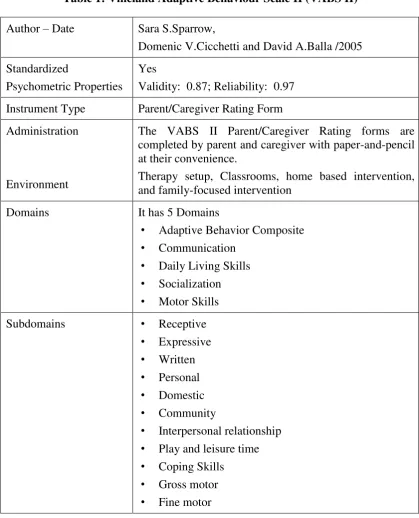
Vineland Adaptive Behaviour Scale II (VABS II)
[image:38.595.102.522.200.718.2]Description of scale
Table 1: Vineland Adaptive Behaviour Scale II (VABS II)
Author – Date Sara S.Sparrow,
Domenic V.Cicchetti and David A.Balla /2005
Standardized
Psychometric Properties
Yes
Validity: 0.87; Reliability: 0.97
Instrument Type Parent/Caregiver Rating Form
Administration
Environment
The VABS II Parent/Caregiver Rating forms are completed by parent and caregiver with paper-and-pencil at their convenience.
Therapy setup, Classrooms, home based intervention, and family-focused intervention
Domains It has 5 Domains
• Adaptive Behavior Composite
• Communication
• Daily Living Skills
• Socialization
• Motor Skills Subdomains • Receptive
• Expressive
• Written
• Personal
• Domestic
• Community
• Interpersonal relationship
• Play and leisure time
• Coping Skills
• Gross motor
30
PROCEDURE
For the current study a total of 30 subjects were selected using convenient
sampling. The subjects were selected from the age group of 4-8 years.
The 30 subjects were then divided into two groups, a control group and an
experimental group using lottery method. Both the groups consisted of 15 subjects
each.
The control group receives only Occupational Therapy Management and the
experimental group receives Play Based Occupational Therapy (PBOT) along with
Occupational Therapy Management.
The pre-test data from both the groups was collected usingVABS II before
the intervention phase was initiated. VABS II was used to assess the Adaptive
Behaviour in children who were selected.
PBOT for the experimental group was initiated after the completion of
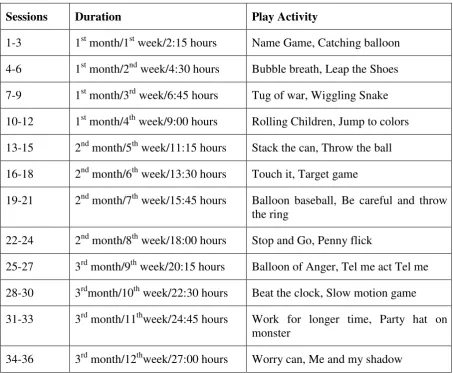
Occupational Therapy intervention. A total of 24 play activities were chosen. Two
play activities were repeated in three consecutive sessions followed by the next two
activities in the subsequent sessions. The group was given intervention for 3 months
duration in which each session lasted for 45 minutes. A total of 36 sessions were
held (3 sessions per week i.e., 12 sessions per month).
Post test data was collected using the VABS II after the completion of the
31
INTERVENTION SESSIONS
Experimental group
First session - 45 minutes
Weekly - 3 sessions
Monthly - 12 sessions
[image:40.595.95.549.319.692.2]Total - 36 sessions
Table 2: Intervention sessions
Sessions Duration Play Activity
1-3 1st month/1st week/2:15 hours Name Game, Catching balloon
4-6 1st month/2nd week/4:30 hours Bubble breath, Leap the Shoes
7-9 1st month/3rd week/6:45 hours Tug of war, Wiggling Snake
10-12 1st month/4th week/9:00 hours Rolling Children, Jump to colors
13-15 2nd month/5th week/11:15 hours Stack the can, Throw the ball
16-18 2nd month/6th week/13:30 hours Touch it, Target game
19-21 2nd month/7th week/15:45 hours Balloon baseball, Be careful and throw the ring
22-24 2nd month/8th week/18:00 hours Stop and Go, Penny flick
25-27 3rd month/9th week/20:15 hours Balloon of Anger, Tel me act Tel me
28-30 3rdmonth/10th week/22:30 hours Beat the clock, Slow motion game
31-33 3rd month/11thweek/24:45 hours Work for longer time, Party hat on monster
32
[image:41.595.120.506.139.610.2]DATA ANALYSIS & INTERPRETATION
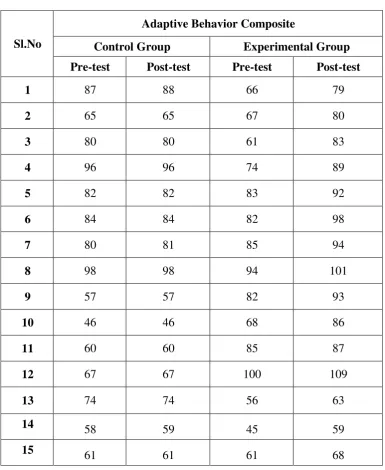
Table 3: Vineland Adaptive Behavior Scale II
Sl.No
Adaptive Behavior Composite
Control Group Experimental Group Pre-test Post-test Pre-test Post-test
1 87 88 66 79
2 65 65 67 80
3 80 80 61 83
4 96 96 74 89
5 82 82 83 92
6 84 84 82 98
7 80 81 85 94
8 98 98 94 101
9 57 57 82 93
10 46 46 68 86
11 60 60 85 87
12 67 67 100 109
13 74 74 56 63
14 58 59 45 59
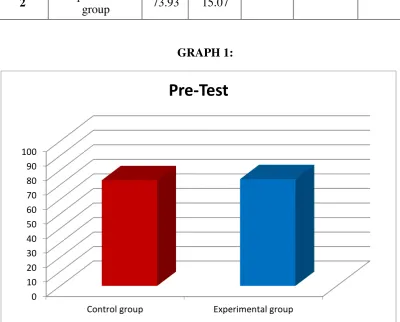
33 0 10 20 30 40 50 60 70 80 90 100
Control group Experimental group
Pre-Test
TABLE: 4
COMPARISON BETWEEN PRE-TEST MEAN SCORES OF ADAPTIVE
BEHAVIORS’ COMPOSITEFOR CONTROL GROUP (CG) AND
EXPERIMENTAL GROUP (EG).
Sl. No Pre-Test Mean SD Table Value
Calculated
“t” Value
“P” Value
1 Control group 73.00 15.29
2.048 0.1684 0.8675
2 Experimental
group 73.93 15.07
GRAPH 1:
Table 4 shows the comparison of pre-test data between the control and
experimental group. Pre-test mean values obtained were 73.00 and 73.93
respectively. The calculated “t” value is 0.1684 and “p” value is 0.8675 which is
[image:42.595.107.508.289.611.2]34
TABLE 5:
COMPARISON BETWEEN PREAND POST MEAN SCORES OF
ADAPTIVE BEHAVIORS’ COMPOSITE FOR CONTROL GROUP
Sl. No CONTROL
GROUP Mean SD
Table Value
Calculated
“t” Value
“P” Value
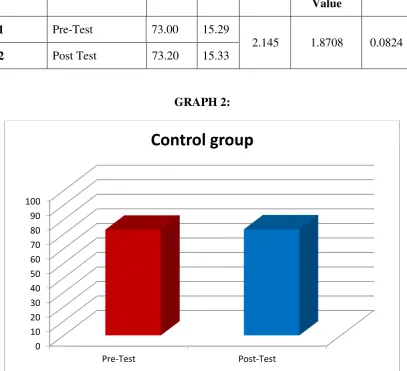
1 Pre-Test 73.00 15.29
2.145 1.8708 0.0824
2 Post Test 73.20 15.33
GRAPH 2:
Table 5 shows the comparison between the pre and posttest data of the
control group. The mean values obtained are 73.00 and 73.20 for pre and post-test
respectively. The calculated “t” value is 1.8708 and “p” value is 0.0824 which is
[image:43.595.110.518.236.607.2]35
TABLE 6 :
COMPARISON BETWEEN PRE-AND POST TEST MEAN SCORES OF
ADAPTIVE BEHAVIOR COMPOSITE FOR EXPERIMENTAL GROUP.
Sl.No Experimental group
Mean SD Table Value
Calculated “t” Value
“P” Value
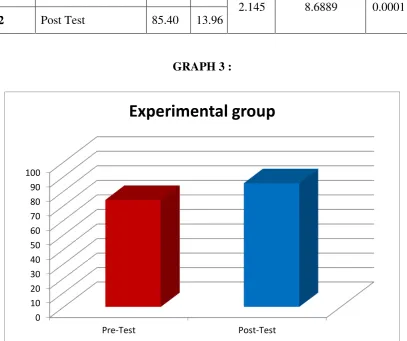
1 Pre-Test 73.93 15.07
2.145 8.6889 0.0001
2 Post Test 85.40 13.96
GRAPH 3 :
Table 6 shows the comparison between the pre and post test data of the
experimental group. The mean values of pre and post test data are 73.93 and 85.40
respectively. The calculated “t” value is 8.6889 and table “t” value 2.145 at 95%
confidence interval and 14df. The “p” value is 0.0001 which is lesser than 0.05
[image:44.595.110.518.238.579.2]36
TABLE 7:
COMPARISON OF POST TEST MEAN SCORES OF ADAPTIVE
BEHAVIOR COMPOSITEFOR CONTROL GROUP EXPERIMENTAL
GROUP
Sl. No
ADAPTIVE BEHAVIOR COMPOSITE
Mean SD Table Value
Calculated
“t” Value
“P” Value
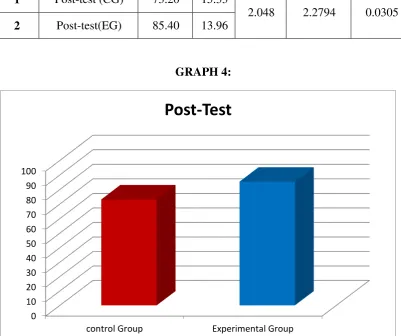
1 Post-test (CG) 73.20 15.33
2.048 2.2794 0.0305
2 Post-test(EG) 85.40 13.96
GRAPH 4:
Table 7 shows the comparison of post test data between the control and
experimental group. The mean values obtained are 73.20 and 85.40 for CG and EG
respectively. The obtained “t” value is 2.2794 and the table “t” value is 2.048 at 95%
confidence interval and 28df. The “p” value is 0.0305 which is <0.05 indicating a
significant difference between the groups. 0 10 20 30 40 50 60 70 80 90 100
control Group Experimental Group
[image:45.595.109.511.268.604.2]37
TABLE- 8:
COMPARISON BETWEEN PREAND POST TEST MEAN SCORES OF
DOMAINS FOR EXPERIMENTAL GROUP
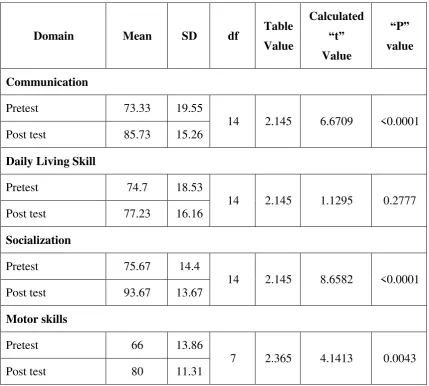
Domain Mean SD df Table Value
Calculated
“t” Value
“P” value
Communication
Pretest 73.33 19.55
14 2.145 6.6709 <0.0001 Post test 85.73 15.26
Daily Living Skill
Pretest 74.7 18.53
14 2.145 1.1295 0.2777 Post test 77.23 16.16
Socialization
Pretest 75.67 14.4
14 2.145 8.6582 <0.0001 Post test 93.67 13.67
Motor skills
Pretest 66 13.86
[image:46.595.94.524.173.559.2]38
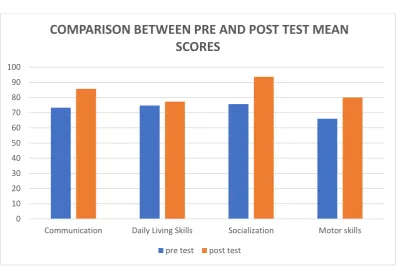
[image:47.595.109.513.92.362.2]GRAPH 5 :
Table 8 shows the comparison between pre and post test mean scores of the
Domains (Experimental group). The following values are obtained for the pre and
post test data respectively: 73.33; 85.73, 74.7;77.23, 75.67; 93.67, 66; 80. The
calculated “t” value of Communication, Daily living skills, Socialization and motor
skills are 6.6709, 1.1295, 8.6582 and 4.1413 respectively at 95% confidence interval
and the “p” values are <0.0001, 0.2777, <0.0001 and 0.0043. Significant differences
are obtained in the Socialization, Communication and Motor skills. There is no
significant change in the Daily living skills domain.
0 10 20 30 40 50 60 70 80 90 100
Communication Daily Living Skills Socialization Motor skills
COMPARISON BETWEEN PRE AND POST TEST MEAN
SCORES
39
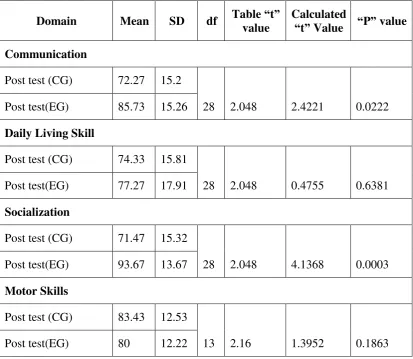
TABLE- 9: COMPARISON OF POST TEST MEAN SCORES DOMAINS OF
FOR EXPERIMENTAL AND CONTROL GROUP
Domain Mean SD df Table “t” value
Calculated
“t” Value “P” value
Communication
Post test (CG) 72.27 15.2
28 2.048 2.4221 0.0222 Post test(EG) 85.73 15.26
Daily Living Skill
Post test (CG) 74.33 15.81
28 2.048 0.4755 0.6381 Post test(EG) 77.27 17.91
Socialization
Post test (CG) 71.47 15.32
28 2.048 4.1368 0.0003 Post test(EG) 93.67 13.67
Motor Skills
Post test (CG) 83.43 12.53
[image:48.595.106.520.146.505.2]40
[image:49.595.112.508.112.375.2]GRAPH 6 :
Table 9 shows the comparison between posttest mean scores of the domains
(Control group and Experimental group) which are 72.27;85.73, 74.33;77.27,
71.47;93.67, 83.43;80 respectively. The calculated ‘t value of Communication, Daily
living skills, Socialization and Motor skills are 2.4221,0.4755, 4.1368, 1.3952
respectively at 95% confidence. The “p” values are 0.0222, 0.6381, 0.0003, 0.1863.
Therefore, significant differences are evident in the Socialization and
Communication domains.
0 10 20 30 40 50 60 70 80 90 100
Communication Daily Living Skills Socialization Motor Skills
COMPARISON OF POST TEST MEAN SCORES
DOMAINS
41
DISCUSSION
The purpose of this study was to examine the Efficacy of Play based
Occupational therapy in ADHD children. The aim of the study was to understand the
Effect of Play based Occupational therapy in Adaptive Behaviour of children with
Attention Deficit Hyperactivity Disorder.
Participants were 30 male and female children who met the selection criteria
who were then allocated to two groups (control and experimental) consisting of 15
children each.
The mean age of control group was 6.5 years and 6 years in experimental
group. Pre-test for both the groups was done using Vineland Adaptive Behaviour
Scale II (VABS). Subsequently the control group received Conventional
Occupational Therapy and the experimental group received Play Based Intervention
along with Conventional Occupational Therapy.
The duration of intervention was 45 minutes per session. A total of 36 sessions
were conducted over a 3-month intervention period with12 sessions in a month.
A post- test was conducted using VABS II. Analysis of results after the completion
of 36 sessions were done using paired and unpaired ‘t’ tests.
The comparison of pre-test data for both Experimental and Control group
(Table 4) shows the mean scores73.00 and 73.93. Unpaired ‘t’ test value was 0.1684
and the P value was greater than 0.05, Hence there is no significant difference in the
mean values of two groups showing homogeneity in terms of Adaptive Behavior of
42
The comparison of pre and post test scores in the control group (Table 5)
shows the mean scores of 73.00 and 73.20 respectively. The paired t test value was
1.8708 and the P value was greater than 0.05 indicating no significant difference.
The comparison of pre and post test scores in the experimental group
(Table6) shows the mean scores 73.93 and 85.40 respectively. The paired t test value
was 8.6889 and the P value was 0.0001 which is lesser than 0.05, Hence there is a
significant difference in the mean value of the pre and post test data of the
experimental group. These results are supported by a study conducted to evaluate the
effect of play therapy on children with ADHD where the sample size was 40
preschool and school children with ADHD. The result revealed that play therapy had
a positive effect on the symptoms of ADHD and also in emotional and behaviour
disturbances (El-Nagger et.al 2017)
The comparison of post-test scores for both experimental and control group
(Table 7) shows the mean scores of 73.20 and 85.40 respectively. The ‘t’ value
obtained was 2.2794 while the table value was 2.048 (calculated t value > table
value) and the P value was 0.0305 which is lesser than 0.05 level of significance.
Hence the Null Hypothesis which states that “Play Based Occupational Therapy will
have no significant effect on improving Adaptive Behaviors in children with
ADHD” is rejected.
The above is supported by a study conducted to examine the Efficacy of Play
Therapy on Attention Deficit Hyperactivity Disorder (ADHD), Anxiety and Social
43
procedure is a conceivable intervention for children experiencing a broad range of
problems such as ADHD and anxiety (F, Naderi et.al 2010).
In the experimental group the domains on VABS II such as Communication,
Daily living skills, Socialization and Motor skills were also analyzed using paired ‘t’
test. The pre and post test mean values of Communication, Daily living skills,
Socialization and Motor skills were 73.33:85.73, 74.7;77.23, 75.67;93.67 and 66;80
respectively. The P values were <0.0001, 0.2777, <0.0001 and 0.0043. The findings
shows that play based intervention has produced significant positive changes in
Socialization, Communication and also in Motor skills. However, the Daily living
skills domain did not show any significant differences.
Unpaired ‘t’ test on the post test results in the experimental and control group
domains including Communication, Daily living skills, Socialization and Motor
skills gave the following results. The post test means of both control and
experimental group (Table 9) shows 72.27;85.73, 74.33;77.27, 71.47;93.67, 83.43;80
respectively. The P values were 0.0222, 0.6381, 0.0003 and 0.1863.This finding
shows that play therapy contributes significantly in improving the Socialization and
Communication aspects with a higher level of improvement in Socialization when
compared to Communication. However, there is no significant difference in Motor
and Daily living skills.
In view of the above findings it is understood that Play based Occupational
Therapy can bring about a significant improvement in the Adaptive Behavior of
44
CONCLUSION
From this study it is concluded that there is a significant improvement in
Adaptive Behavior of the children with ADHD through Play based Occupational
45
LIMITATIONS AND RECOMMENDATIONS
LIMITATIONS
A smaller sample size.
Duration of therapy was shorter.
The age group was restricted to 4 to 8 years of age.
RECOMMENDATIONS
A larger sample size and longer duration of intervention could be considered.
Variation in the age groups could be evaluated.
Effect of different co-morbid conditions could be compared.
Specific play therapy techniques should be designed which are inexpensive,
enjoyable, easy to implement home and school based activities.
Parent and teacher educational and training programs should be emphasized to
increase the awareness and efficacy of play therapy which would encourage them
46
REFFERENCES
Books
1. Attention deficit hyperactive disorder (ADHD); pediatric diagnosis and
treatment guideline.
2. Attention deficit hyperactive disorder: diagnosis and management of ADHD
children, young people and adults; Stephen V Faraone.
3. Axline VM. Play Therapy. New York: Ballantine Books, 1947.
4. Bhatia, M.S., Short text book of psychiatry: 4th edition.
5. Dale-Elizabeth Pehrsson, Ed.D. and Mary E. Aguilera, M.A. Play Therapy:
Overview and Implications for Counselors. Professional Counseling Digest
2007.
6. Diagnostic and statistical manual of mental disorders- 5th edition.
7. Early Intervention Games: Barbara Sher, 2nd Edition.
8. Frame of reference for pediatric occupational therapy 2nd edition; Paula Kramer/
Jim Hinojo.
9. ICD-10 Classification of Mental and Behavioral Disorders.
10. Landreth, Garry L. Play therapy: the art of the relationship. Routledge
47
11. Occupational Therapy for Children and Adolescents; 7th edition; Jane
Case-Smith.
12. Occupational therapy for children; 2nd edition; Pat Nuse Pratt, Anne Stevens
Allen.
13. Play for Children with Special Needs: 2nd edition; Christine Macintyre.
14. Play Therapy Research: Issues for 21st Century ProgressKevin J. O'Connor
PhD, Shelby, Janine.
15. The Therapeutic Powers of Play; Drewes, Athena & Schaefer, Charles.
16. VABS II Manual: 2nd edition Sara S. Sparrow, Domenic V. Cicchetti.
Journals
17. Barkley RA, Fischer M, Edelbrock CS, Smallish L. The adolescent outcome of
hyperactive children diagnosed by research criteria: 1. An 8-year prospective
follow-up study. Journal of American Academy of Adolescent Psychiatry
1990; 29: P-546-557.
18. Barzegary.L.Zamini.S, The Effect of Play therapy on Children with ADHD:
WCPCG:Dec-2011, p-2017-2018.
19. Bratton, Sue & Ray, Dee. (2000). What the research shows about play therapy.
48
20. Berhanu Nigussie,Worku, Effectiveness of Play Therapy on self-healing and
enhancing Life-skills of the Children under difficult circumstances. Ethiopia
journal of education and science, Vol. 6 p-54.
21. Bratton, S.C. Ray, D Rhine, T, Jones, The efficacy of play therapy with
children: A meta-analytic review of treatment outcomes. Professional
Psychology: Research and Practice, Vol- 36, 2005, p- 376-390
22. Cheryl Clark, Margot Prior, Glynda J. Kinsella, The relationship between
executive function abilities, adaptive behavior, and academic achievement in
children with externalizing behavior problems, Vol-43, Issue-3, Oct-2002,
P-785-796.
23. Choi, Jin-Ah, Literature Review of Play therapy Intervention for children with
ADHD, Vol-50, Issue-5, 2012, p-125.
24. Chronis AM1, Jones HA, Raggi VL. Evidence-based psychosocial treatments
for children and adolescents with attention-deficit/hyperactivity disorder.
Clinical Psychology Review. 2006 Aug;26(4):486-502.
25. Dee C. Ray, Schottelkorb, Mei-Hsiang Tsai, Play Therapy with Children
Exhibiting Symptoms of Attention Deficit Hyperactivity Disorder April.
International Journal of Play Therapy 2007, Vol. 16, No. 2,p- 95–111.
26. DuPaul, G., & Stoner, G. (2003). ADHD in the schools assessment and
49
27. Erin Hawkins, Susan Gathercole, Duncan Astle, The CALM Team, and Joni
Holmes Paul E. Engelhardt, Language Problems and ADHD Symptoms: How
Specific Are the Links?Brain Science. Vol-6, Issue-4, 2016 Dec, p- 50.
28. Fischer M, Barkley RA, Edelbrock, CS, Smallish L. The adolescent outcome
of hyperactive children diagnosed by research criteria: II Academic,
attentional, and neuropsychological status. J Consult Child Psychology Vol-58,
1990; p- 580-588.
29. Giuilia Balboni, Oriana, Carmen Belachi, Bonichini. Vineland-II adaptive
behavior profile of children with ADHD or Specific Learning Disorders
Research in Developmental Disabilities. Vol:61, February 2017, p - 55-65.
30. Gopalan Rejani & Oommen Anna & Srinath Shoba & Kapur Malavika.
Efficacy of Multimodal Intervention for Children with Attention Deficit
Hyperactivity Disorder (ADHD), An Indian Study. Journal of Behavioral and
Brain Science. Vol-2, 2012, p-117-127.
31. George J. DuPaul, Asha K, Jitendra, Children with ADHD. Isthe gender
difference in the school functioning? School psychology review, Volume-35,
Issue-2, 2006, P-292-308.
32. JaakPanksepp PhD, Can PLAY Diminish ADHD and Facilitate the
Construction of the Social Brain? Journal of Canadian Academy of Child
50
33. Jament, J. Attention deficit hyperactivity disorder (ADHD) within a South
Indian (Keralian) mainstream school context. Doctoral thesis, The University
of Northampton (2009).
34. Karande Sunil & Bhosrekar Kirankumar (2009). Impact of
attention-deficit/hyperactivity disorder on health-related quality-of-life of specific
learning disability children. Indian journal of pediatrics. Vol-76. Issue24,
p-1119.
35. Kimberley Docking and Natalie Munro, The University of Sydney, Australia
Reinie Cordier James Cook University, Townsville, Australia Prudence Ellis,
Child Language Teaching and Therapy. 2013 Article 292 Child Language
Teaching and Therapy- 29.
36. Linalda, Svensson, Landgren. M, Nasic.S,Tideman.E, Mild intellectual
disability(MID) and ADHD; A comparative study of school age children’s
adaptive ability, Acta Pediatric journal, Vol-102, Issue-10, Aug 2013, P-31.
37. Mark A. Stein/Emily Szumowski Tomas. A Blondis. Nancy Adaptive skills
dysfunction in ADD and ADHD children,The Journal of Child Psychology and
Psychiatry, Volume 35,Issue-4, May-1995, p-663-670.
38. Mhtare, Priti&Gajre, Mona &Karia, Sagar & Chheda, Nidhi & Saroj, Dinesh &
Desousa, Avinash. Effect of multimodal therapy on children with attention
deficit hyperactivity disorder. International Journal of Contemporary
51
39. Maryam Zakershoshtari & Zahra Dasht Bozorg, The Effectiveness of Play
Therapy on Reduction of the Symptoms of Attention Deficit Hyperactivity
Disorder (ADHD) in Children, Asian Social Science; Vol. 12, No. 6; 2016.
40. Miranda, Ana , Berengure, Influence of the symptoms of ADHD and comorbid
disorders on functioning in the adulthood, Vol-26, Issue-4, 2014, p-121.
41. Nahed Saied, El Nagger, Effect of play therapy on Children with ADHD,
Journal of Nursing Education and Practice,Vol-7, Issue-5,jan 2017, p-104.
42. F, Naderi, A, Heidarie. L, Bouron. P, Asgari. The Efficacy of Play Therapy on
ADHD, Anxiety and Social Maturity in 8 to 12 Years Aged Clientele Children
of Ahwaz Metropolitan Counseling Clinics. Journal of Applied Sciences,
Vol10, Issue 3, 2010, p-189-195.
43. Ordier.R, Bundy.A, Hocking.C, Einfields, A model for Play based intervention
for children with ADHD, Australian Journal of Occupational Therapy,
vol-56,Issue-5,Oct-2009,P-40.
44. Pradeep Palaniappan, Impact of Comorbidities on Self-Esteem of Children
with Attention Deficit Hyperactivity Disorder. The International Journal of
Indian Psychology, Volume 3,Issue 3, 2016, p-2349-3429.
45. Pratibha Singhi, Prahbhjot Malhi, Attention Deficit Hyperactivity Disorder in
School Aged Children: Approach and Principles of Management, Indian
52
46. Preeti Sinha, MD, Rajesh Sagar, MD, Manju Mehta, PhD. Executive Function
in Attention Deficit/Hyperactivity Disorder. Journal of Indian Association of
Child Adolescent. Mental Health 2008; Vol- 4,Issue-2, p-44-49.
47. Raman, Vijaya & Singhal, Meghna. (2015). Play therapy with children: Its
relevance and utility in the Indian context. Journal of Indian Association for
Child and Adolescent Mental Health. 11. 121-157.
48. Ramya H, Goutham A, Lakshmi V Pandit, Prevalence of attention deficit
hyperactivity disorder in school going children aged between 5-12 years in
Bengaluru. Current Pediatric Journal, Vol-21, Issue-2, 2017, p-321-326.
49. Roizen NJ1, Blondis TA, Irwin M, Stein M. Adaptive functioning in children
with attention-deficit hyperactivity disorder. Arch Pediatric Adolescent
Medicine.1994 Nov; 148(11):1137-42.
50. Sasah K. Nielsen, Kamela Kelsch, Kaci Miller. Occupational therapy
intervention for Children with Attention Deficit Hyperactivity Disorder: A
systematic Review; Occupational therapy in Mental Health. Vol: 33,
2017-Issue-1.
51. Schmitt, Kathri