City, University of London Institutional Repository
Citation:
Borsato, R., Ohlsson Sax, O., Sfondrini, A. and Stefanski, B. (2014). Towards the All-Loop Worldsheet S Matrix for AdS3 × S3 × T4. Physical Review Letters (PRL), 113, p. 131601. doi: 10.1103/PhysRevLett.113.131601This is the published version of the paper.
This version of the publication may differ from the final published
version.
Permanent repository link:
http://openaccess.city.ac.uk/4788/Link to published version:
http://dx.doi.org/10.1103/PhysRevLett.113.131601Copyright and reuse: City Research Online aims to make research
outputs of City, University of London available to a wider audience.
Copyright and Moral Rights remain with the author(s) and/or copyright
holders. URLs from City Research Online may be freely distributed and
linked to.
Towards the All-Loop Worldsheet
S
Matrix for
AdS
3×
S
3×
T
4Riccardo Borsato,1,* Olof Ohlsson Sax,2,† Alessandro Sfondrini,1,3,‡ and Bogdan Stefański, Jr.4,§
1
Institute for Theoretical Physics and Spinoza Institute, Utrecht University, 3508 TD Utrecht, Netherlands
2
The Blackett Laboratory, Imperial College, London SW7 2AZ, United Kingdom
3
Institut für Mathematik and Institut für Physik, Humboldt-Universität zu Berlin, Zum Großen Windkanal 6, 12489 Berlin, Germany
4
Centre for Mathematical Science, City University London, Northampton Square, London EC1V 0HB, United Kingdom (Received 21 April 2014; published 22 September 2014)
We obtain the all-loop worldsheetSmatrix for fundamental excitations on AdS3×S3×T4by studying the off-shell symmetry algebra of the superspace action in light cone gauge. The massless modes, unaccounted for in earlier works, are automatically included in our treatment. Their exact dispersion relation is found to be nonrelativistic, of giant-magnon form, and their scattering is naturally well defined. This opens the way to a complete investigation of AdS3=CFT2 integrability.
DOI:10.1103/PhysRevLett.113.131601 PACS numbers: 11.25.Tq, 11.55.Ds
Introduction.—Recent years have witnessed remarkable progress in understanding the gauge-string correspondence using integrability methods; see Refs. [1–3] for reviews. Given the power of these methods to study nonprotected quantities at any value of the coupling, it is particularly interesting to apply them to the AdS3-CFT2 dual pairs. Such pairs were amongst the first examples of holography [4]. They feature the infinite-dimensional Virasoro sym-metry algebra, allow for black-hole solutions[5], and play an important role in string-theoretical black-hole microstate counting[6].
In string theory, AdS3×S3×T4emerges from the near-horizon limit of a system of D1- and D5-branes. As a result, the gauge theory has fundamental as well as adjoint matter fields. The dual pair has an infinite-dimensionalN ¼ ð4;4Þ
superconformal symmetry [7–10]. The background pre-serves relatively little supersymmetry—16 supercharges— and can be supported by a mixture of Ramond-Ramond (RR) and Neveu-Schwarz-Neveu-Schwarz (NSNS) fluxes. While the pure-NSNS background can be studied by worldsheet conformal field theory (CFT) techniques [11,12], it is the pure-RR one that naturally emerges from the near-horizon limit of D-branes and so is expected to give the description of the dual gauge theory in the strongly coupled planar limit. The RR and NSNS descriptions are related by the nonperturbative and nonplanar string-theoryS
duality. Therefore, directly understanding the RR back-ground is an important goal in the study of AdS3=CFT2.
Classical integrability for string theory on AdS3×S3×
T4 was established in Refs.[13–15]. As was observed in Ref.[13], the presence of flat directions in this background gives rise to massless string modes, which, at first sight, cannot be analysed using integrability methods. Classically, this was addressed only recently[16], while so far quantum integrability of the worldsheet theory was probed only for massive modes [17–21]; see however Ref. [22] for a description of massless modes in the weakly coupled spin
chain. Massless modes are notoriously problematic for integrable scattering[23,24]. In this Letter we show how to incorporate massless modes of pure-RR AdS3×S3×T4
strings into the integrability machinery by presenting the complete all-loop S matrix for fundamental worldsheet excitations.
In 1þ1 dimensions, quantum integrability manifests itself as factorization of the S matrix—any scattering
process decomposes into sequences of two-body ones [25]. Consistency of this decomposition requires a cubic identity for the two-body S matrix S, the celebrated Yang-Baxter equation. Once S is known, the energy spectrum of the theory can be found by Bethe ansatz techniques. Here, the observable is the energy spectrum of closed AdS3×S3×T4 strings in the planar limit. Therefore, we consider the nonlinear σ model (NLSM) from the (1þ1)-dimensional worldsheet into AdS3×S3×
T4, and compute its worldsheetSmatrix.
To this end, we first study the symmetries of the light cone gauge-fixed NLSM, in a limit where the closed-string worldsheet cylinder decompactifies to a plane and S is well defined. Unlike what happens in AdS5×S5[26,27], we cannot use the coset description, since after gauge fixing massless fermions do not have a conventional quadratic kinetic term. Instead we will work with the Green-Schwarz action[28]. In this way we find the algebraAof“off-shell” symmetries—i.e., the ones of S—and use it to obtain the all-loop kinematics andSmatrix. We see in particular that massless modes are nonrelativistic, with a giant-magnon dispersion relation[29]. This facilitates our treatment and distinguishes it from the relativistic case[23]—in particular, noad hocscaling limit needs to be taken. The more technical details of our analysis will be presented elsewhere[30].
Off-shell symmetry algebra.—To find the algebra A we decompactify the worldsheet and take the theory off shell by relaxing the level matching condition. The super-isometries of the AdS3×S3×T4string theory background
form the algebrapsuð1;1j2ÞL ⊕psuð1;1j2ÞR[31], where
the labels L and R refer to the left- and right-moving symmetries of the dual CFT2. Only those charges that commute with the gauge-fixed Hamiltonian H sit in A. This gives eight supercharges and four central elementsH, M, C, and C¯, as well as an soð4Þ ¼suð2Þ•⊕suð2Þ∘
algebra, which arises in the decompactified theory because the winding modes on the torus decouple. The chargeMis a combination of angular momenta on AdS3 andS3. The relaxed level matching condition yields the additional central chargesCandC¯, which are not part of the isometry algebra and hence must vanish for physical on-shell states. At vanishing winding such states satisfy Pjphysi ¼0, where Pis the worldsheet momentum operator.
To proceed we need to gauge fix the theory. We first impose the light coneκ gauge
ðΓ0þΓ5ÞθI ¼0; I¼1;2; ð1Þ
where X0¼t andX5¼ϕparametrize the global time in AdS3 and a great circle along S3, respectively, θI are
(9þ1)-dimensional Majorana-Weyl fermions of type IIB string theory, and Γ are 32×32 Dirac Gamma matrices. Thisκgauge guarantees a conventional kinetic term for the fermions, but is not compatible with the coset action[13]. We therefore have to work with the superspace action [28,32,33]. To determine the structure of Ait is sufficient to consider terms at most quadratic in the fermions, for which explicit expressions are given in Ref. [32].
Before κ-gauge fixing, the string theory action on AdS3×S3×T4 is invariant under constant shifts of 16 (suitably defined) fermions. The supercharges can be found using the Noether procedure. Upon fixing the light coneκ gauge, half of the shifts breaks the gauge-fixing condition (1) and need to be combined with a compensating κ transformation, just like in flat space [34]. The eight supercharges inA are of this kind.
To fix the bosonic gauge symmetry we work in the first-order formalism. Introducing the light cone coordinates
X¼12ðϕtÞand the conjugate momentaPwe impose the uniform light cone gauge [1,35]
Xþ ¼τ; P−¼const; ð2Þ
whereτis the worldsheet time. The Virasoro constraints are used to determine X− andPþ as nonlocal expressions in terms of the physical transverse fields. They are related to H andPby
H¼− Z þ∞
−∞ dσPþ; P¼2
Z þ∞
−∞ dσ∂σX
−: ð3Þ
To carry out this procedure explicitly we need to redefine the fermions θI to make them neutral under the U(1) isometries generated by t and ϕ translations [36]. This yields a nonlocal piece in the supercharges. The super-charges’ dependence on the massless fields Xμ, on
the conjugate momentaPμ, and on the massless fermions
χI is
Qμ¼
Z þ∞
−∞ dσe
þΓ34X−
ðPμχ1−∂σXμχ2Þ;
~
Qμ¼
Z þ∞
−∞ dσe −Γ34X−
ðPμχ2−∂σXμχ1Þ; ð4Þ
where μ¼6;7;8;9 runs over the T4 directions. This gives us eight real supercharges. We can combine them into twosuð2Þ• doubletsQaL andQRa and their complex
conjugatesQ¯La¼ ðQaLÞ†andQ¯aR ¼ ðQRaÞ†. TheLandR
labels indicate which psuð1;1j2Þ superisometry algebra the charges originate from. The supercharges satisfy the psuð1j1Þ4
c:e: algebra
fQLa;Q¯bLg ¼
1
2δbaðHþMÞ; fQLa;QbRg ¼δbaC; fQa
R;Q¯Rbg ¼
1
2δabðH−MÞ; fQ¯aL;Q¯Rbg ¼δabC¯; ð5Þ
The central chargeC and its conjugate C¯ arise from the nonlocal exponential factor in Eq.(4)and are related to the worldsheet momentum by
C¼ihζ
2 ðeiP−1Þ; ð6Þ
where the phase ζ¼e2iX−ð−∞Þ depends on the boundary
conditions for the fieldX−[27]andhis the string tension. For a single excitation,ζ can be absorbed by a rescaling, but for multiexcitation states the relative phases are relevant, as we will see later.
Representations.—The fundamental excitations of the string—eight bosons and eight fermions—arrange them-selves into short multiplets of the off-shell symmetry algebraA, satisfying the shortening condition
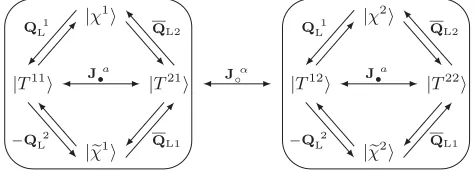
H2¼M2þ4 ¯CC: ð7Þ SinceCvanishes at zero momentum, the eigenvaluemofM plays the role of a mass. There are two bosonic and two fermionic excitations with massm¼þ1, and we refer to them as left-flavored because on shell they transform only under the left supercharges. Similarly, there are four right flavored excitations withm¼−1, and eight massless excitations with
m¼0. The corresponding multiplets are depicted in Figs.1 and2. There we see fourpsuð1j1Þ4c:e: bifundamental repre-sentations (where the subscript c.e. stands for centrally extended), supplemented by the action of suð2Þ• and suð2Þ∘, the latter acting on massless excitations only.
The algebra (5) can be obtained from two copies of psuð1j1Þ2
c:e:. This consists of four conjugate supercharges
¯
qL;R¼ ðqL;RÞ†, satisfying
fqL;q¯Lg ¼
1
2ðhþmÞ; fqL;qRg ¼c; fqR;q¯Rg ¼
1
2ðh−mÞ; fq¯L;q¯Rg ¼c¯: ð8Þ
We can then set Q1L¼qL ⊗1, Q2L¼1⊗qL for the
left flavor, QR1¼qR⊗1, QR2¼1⊗qR for the right,
and similarly for their conjugates. The bifundamental representations of psuð1j1Þ4c:e: can be obtained from the fundamental representations of psuð1j1Þ2c:e:. One such representation, which we denote byϱL¼ ðϕLjψLÞ, is
qLjϕLpi ¼apjψLpi; q¯LjψLpi ¼ap¯ jϕLpi;
qRjψLpi ¼bpjϕLpi; q¯RjϕLpi ¼bp¯ jψLpi; ð9Þ
where the representation coefficients depend on the exci-tation momentum p. Another representation, ϱR can be obtained by exchanging the action of left and right generators. Two more representations ϱ~L, ϱ~R, can be obtained by exchanging bosons and fermions.
Using this, the left and right representations of Fig.1are given byϱL⊗ϱLandϱR ⊗ϱRrespectively. On the former, the central charges are
H¼ ðapap¯ þbpbp¯ Þ1; C¼apbp1;
M¼ ðapap¯ −bpbp¯ Þ1; C¯ ¼ap¯ bp¯ 1; ð10Þ while on the latter one should exchangeap↔bp, flipping the sign of M. We then see that whole massive module is invariant under relabeling L↔R, resulting in a Z2 left-right (LR) symmetry [17,19].
The two masslesspsuð1j1Þ4c:e:modules have a fermionic highest weight, and up to a change of basis they can
equivalently be given by ϱL⊗ϱ~L or ϱR⊗ϱ~R [37], provided that all representation parameters satisfy
apa¯p¼bpb¯p, i.e., that M vanishes. This is not only a
semiclassical input, but a consistency condition: suð2Þ∘
invariance requires M to take the same value on both modules, while crossing invariance requires M to take opposite values.
The explicit form (6) of C;C¯ and the shortening condition(7)yield the dispersion relation [38,39]
Ep¼
ffiffiffiffiffiffiffiffiffiffiffiffiffiffiffiffiffiffiffiffiffiffiffiffiffiffiffiffiffiffi
m2þ4h2sin2p
2
r
: ð11Þ
In particular, for massless excitations the dispersion
Ep¼2hjsinðp=2Þj is nonanalytic. This can be resolved
by treating worldsheet left and right movers separately, as typical for massless two-dimensional excitations. One may worry that masslessness is spoiled by quantum corrections, as in other integrable models, e.g., Ref. [40]. This is impossible unless some symmetry is broken, since a dynamical mass would correct the eigenvalue ofM.
We can construct the two-particle representations, on which theSmatrix acts, out of pairs of one-particle ones. This introduces a nonlocal momentum dependence through the phase ζ [26,27]. In a Hopf-algebra language, this amounts to defining a deformed coproduct[19,27].
All-loopSmatrix.—The two-bodySmatrixSðp; qÞmust be invariant underA. Furthermore, it must satisfy braiding and physical unitarity, crossing symmetry, and the afore-mentioned Yang-Baxter equation [1,3]. Here these con-ditions are restrictive enough to fix S up to few scalar factors denoted by σ, which must obey nontrivial constraints.
Scattering processes involving massless particles may appear ill defined. In relativistic theories indeed massless wave packets travel at the speed of light, and in 1þ1 dimension naively cannot scatter if they move in the same direction [23]. Here, instead, the nonrelativistic dispersion (11) at zero mass yields the group velocity ∂Ep=∂p¼ 2hcosðp=2Þ. Therefore, massless wave pack-ets with different momenta generically scatter.
The two-body S matrix naturally decomposes into the massive (••), mixed (•∘;∘•), and massless (∘∘) sectors, depending on the masses of the excitations scattering,
S¼
S•• S∘• S•∘ S∘∘
: ð12Þ
In each sector it further breaks into several blocks, each scatteringpsuð1j1Þ4c:e:irreducible representations. Some of the scalar factors multiplying each block are then related by LR orsuð2Þ∘ symmetry. Exploiting the bifundamental
nature of the representations, we write the blocks as graded tensor products of suð1j1Þ2c:e:-invariant S matrices. These were computed in Ref.[17]for the representationsϱL;ϱR
at any value of the mass. We denote them by SLL, FIG. 1. Each of the two (left and right) massive
psuð1j1Þ4
c:e: multiplets consists of two bosons Y, ZL;R and
of two fermions ηL;Ra , the latter carrying the fundamental
[image:4.612.59.290.51.134.2]suð2Þ• index a. For clarity we only indicate the supercharges that do not vanish on shell.
FIG. 2. The two massless psuð1j1Þ4c:e: multiplets, in the
representation ðϱL⊗ϱ~LÞ⊕2. Overall we have four bosons Taα
[image:4.612.56.293.578.667.2]SRR;SRL;SLR. The remaining S matrices involving ϱL~ are obtained from these by a similarity transformation exchanging the boson and the fermion, yielding, e.g.,SLL~ .
Massive sector: We have four blocks
S••¼
σ••SLL⊗ˆ SLL σ~••SRL⊗ˆ SRL
~
σ••SLR⊗ˆ SLR σ••SRR⊗ˆ SRR
; ð13Þ
where ⊗ˆ denotes the graded tensor product. On the diagonal we have left-left and right-right scattering. Owing to LR symmetry the corresponding S matrices coincide. On the antidiagonal we have opposite-flavor S
matrices, also related by LR symmetry. There are then just two independent scalar factors in the massive sector:σ••and
~
σ••. This agrees with Ref. [19], where the massive sector was studied in a spin-chain framework [41].
Mixed sector: This involves massive-massless and massless-massive scattering. In the former case we find
S•∘ ¼σ•∘½ðSLL⊗ˆ SLL~Þ⊕ðSRL⊗ˆ SRL~Þ⊕2: ð14Þ
The direct sum inside the square brackets corresponds to scattering with either of two psuð1j1Þ4c:e: massive modules—left or right. These two S matrices are then identified after imposing LR symmetry, which is possible because the second excitation is massless. Since scattering can occur with two differentpsuð1j1Þ4c:e:massless modules we have two copies of the expression inside the square brackets. These must be equal bysuð2Þ∘symmetry. Owing
to these symmetries we are left with a single undetermined scalar factorσ•∘. Similar considerations apply to massless-massive scattering, yielding
S∘•¼σ∘•½ðSLL⊗ˆ SLL~ Þ⊕ðSLR⊗ˆ SLR~ Þ⊕2; ð15Þ
where we have another scalar factor σ∘•.
Massless sector: Here the Smatrix factorizes as
S∘∘¼σ∘∘Ssuð2Þ⊗ðSLL⊗ˆ SL~L~Þ; ð16Þ
where the factors in brackets are fixed by thepsuð1j1Þ4c:e: invariance. We have a single scalar factor σ∘∘ and an suð2Þ∘-invariant Smatrix
Ssuð2Þðp; qÞ ¼1þiðwp1 −
wqÞ½Πþiðwp−wqÞ14; ð17Þ
withΠthe permutation operator andwp a real function of
the momentump. This is the Heisenberg-modelSmatrix, where wp plays the role of a generalized rapidity.
Unitarity: TheSmatrix satisfies braiding and physical unitarity, which result in constraints on the scalar factors. These are solved by takingσ••;σ~••, andσ∘∘to be exponen-tials of antisymmetric phases in a suitable normalization, and by simply relatingσ•∘ to σ∘•.
Crossing symmetry: The crossing transformation maps a representation to its conjugate, flipping the sign of all central charges including momentum and energy. This requires analytic continuation to an unphysical channel [1,3,42]. It is defined through the charge conjugation matrix C, which decomposes on the representations, C¼C•⊕C∘. The massive-sector block C• was given in Ref.[19], and yieldsC∘by a similarity transformation and by requiring compatibility with suð2Þ∘ [30]. Such
trans-formation is momentum dependent, so that C∘p depends discontinuously on the worldsheet chirality through sgn½sinðp=2Þ—a signature of the massless modes. Crossing invariance ofS requires
ð1⊗C−q1Þ·St2ðp;qÞ¯ ·ð1⊗CqÞ·Sðp; qÞ ¼1⊗1; ð18Þ
with t2 meaning transposition in the second space and q¯
analytic continuation. This matrix equation results in five equations for the scalar factors. Two of them constrainσ•• andσ~••, and were solved in Ref. [43]. Each of the other three equations involves one of the remaining scalar factors σ•∘
;σ∘•, andσ∘∘. Crossing also constrains the function wp, setting wp¯ ¼wp−i.
Outlook.—In this Letter we have determined, up to a number of phases, the complete all-loop S matrix for fundamental excitations of pure-RR AdS3×S3×T4
strings. An immediate next step is solving the crossing equations for σ∘•;σ•∘ and σ∘∘ as done for σ•• and σ~•• in Ref. [43]. This will likely present us with new analytic structures and may require further insights from perturbative calculations. It would be also interesting to write down the Bethe-Yang equations for the asymptotic spectrum and to see how theN ¼ ð4;4Þsymmetry is realized there. Finding the bound-state spectrum andSmatrix would then lead to the string hypothesis and mirror thermodynamical Bethe ansatz for the exact spectrum. The success of the integra-bility approach on the AdS3side strongly suggests that an analogous description should exist for the CFT2. It would be important to uncover it, perhaps building on Ref.[44].
It should be possible to extend this approach to consider orbifolds and integrable deformations of this background— as it was successfully done for AdS5× S5. This might lead to new insights into AdS3black holes[5,6]and their integra-bility properties[45]. The methods presented in this Letter can also be applied to AdS3×S3×S3×S1 superstrings [8,17,18], whose dual CFT remains elusive[46,47]. There, higher spin theories were recently considered [48], and integrability may help investigating their relation with strings. In Ref. [12] it was shown that the slð2; RÞ Wess-Zumino-Witten model contains, in addition to conventional discrete representations, continuous representations. These describe so-called long strings[49,10]in string theory on AdS3×M7with NSNS flux. It would be very interesting to understand the way such states appear in the RR back-ground presently studied. Because of type IIB S duality we expect these states to be nonperturbative in the RR
background. Semiclassically, the long string states are D-strings living at the boundary of AdS3 and it would be very interesting to see whether the integrability tech-niques developed in this Letter can be extended to study the spectrum of open string states ending on such D-strings, and how integrability and continuous representations can be combined together.
Another interesting direction is to consider backgrounds with mixed RR and NSNS fluxes[15,20,21]. This may offer new insights on the relation between the infinitely many conserved charges from integrability with the Virasoro ones appearing in the worldsheet CFT—perhaps along the lines of what happens in relativistic models[24]—as well as on howSduality is implemented.
We are confident that there will be significant develop-ment in these directions in the near future.
We thank G. Arutyunov, C. Hull, and K. Zarembo for their comments on the manuscript. R. B. and A. S. acknowledge support by the Netherlands Organization for Scientific Research (NWO) under the VICI Grant No. 680-47-602. Their work is part of the ERC Advanced Grant Research Programme No. 246974, and of the D-ITP consortium, a program of the NWO that is funded by the Dutch Ministry of Education, Culture and Science (OCW). The work of O. O. S. was supported by the ERC Advanced Grant No. 290456. The work of A. S. is also funded by the European Union, Grant Agreement No. 317089. B. S. acknowledges funding support from an STFC Consolidated Grant ST/J00037X/1.
*
†o.olsson‑[email protected]
‡[email protected]‑berlin.de
[1] G. Arutyunov and S. Frolov,J. Phys. A42, 254003 (2009). [2] N. Beisertet al.,Lett. Math. Phys.99, 3 (2012).
[3] A. Sfondrini,arXiv:1406.2971.
[4] J. D. Brown and M. Henneaux,Commun. Math. Phys.104, 207 (1986).
[5] M. Banados, C. Teitelboim, and J. Zanelli,Phys. Rev. Lett.
69, 1849 (1992).
[6] A. Strominger and C. Vafa,Phys. Lett. B379, 99 (1996). [7] J. M. Maldacena,Int. J. Theor. Phys.38, 1113 (1999). [8] S. Elitzur, O. Feinerman, A. Giveon, and D. Tsabar,Phys.
Lett. B449, 180 (1999).
[9] F. Larsen and E. J. Martinec,J. High Energy Phys. 06 (1999) 019.
[10] N. Seiberg and E. Witten,J. High Energy Phys. 04 (1999) 017.
[11] A. Giveon, D. Kutasov, and N. Seiberg, Adv. Theor. Math. Phys.2, 733 (1998).
[12] J. M. Maldacena and H. Ooguri,J. Math. Phys. (N.Y.)42, 2929 (2001).
[13] A. Babichenko, B. Stefański, and K. Zarembo, J. High Energy Phys. 03 (2010) 058.
[14] P. Sundin and L. Wulff,J. High Energy Phys. 10 (2012) 109.
[15] A. Cagnazzo and K. Zarembo, J. High Energy Phys. 11 (2012) 133.
[16] T. Lloyd and B. Stefański,J. High Energy Phys. 04 (2014) 179.
[17] R. Borsato, O. Ohlsson Sax, and A. Sfondrini, J. High Energy Phys. 04 (2013) 113.
[18] R. Borsato, O. Ohlsson Sax, and A. Sfondrini, J. High Energy Phys. 04 (2013) 116.
[19] R. Borsato, O. Ohlsson Sax, A. Sfondrini, B. Stefański, and A. Torrielli,J. High Energy Phys. 08 (2013) 043.
[20] B. Hoare and A. Tseytlin,Nucl. Phys.B873, 395 (2013). [21] B. Hoare, A. Stepanchuk, and A. Tseytlin, Nucl. Phys.
B879, 318 (2014).
[22] O. Ohlsson Sax, B. Stefański, and A. Torrielli, J. High Energy Phys. 03 (2013) 109.
[23] A. B. Zamolodchikov and A. B. Zamolodchikov, Nucl. Phys.B379, 602 (1992).
[24] P. Fendley and H. Saleur,arXiv:hep-th/9310058.
[25] A. B. Zamolodchikov and A. B. Zamolodchikov, Ann. Phys. (N.Y.)120, 253 (1979).
[26] G. Arutyunov, S. Frolov, J. Plefka, and M. Zamaklar,
J. Phys. A 40, 3583 (2007).
[27] G. Arutyunov, S. Frolov, and M. Zamaklar,J. High Energy Phys. 04 (2007) 002.
[28] M. T. Grisaru, P. S. Howe, L. Mezincescu, B. Nilsson, and P. Townsend,Phys. Lett. 162B, 116 (1985).
[29] D. M. Hofman and J. M. Maldacena,J. Phys. A39, 13095 (2006).
[30] R. Borsato, O. Ohlsson Sax, A. Sfondrini, and B. Stefański,
arXiv:1406.0453.
[31] Theuð1Þ4shift isometries along theT4directions will play no role in this Letter.
[32] M. Cvetic, H. Lu, C. Pope, and K. Stelle,Nucl. Phys.B573, 149 (2000).
[33] L. Wulff,J. High Energy Phys. 07 (2013) 123.
[34] M. B. Green and J. H. Schwarz,Phys. Lett.136B, 367 (1984). [35] G. Arutyunov and S. Frolov,J. High Energy Phys. 02 (2005)
059.
[36] L. F. Alday, G. Arutyunov, and S. Frolov,J. High Energy Phys. 06 (2006) 018.
[37] Taking the same form for bothpsuð1j1Þ4c:e:modules makes the suð2Þ∘ invariance more manifest, while having two different forms makes crossing symmetry and the comple-tion of LR symmetry in the massless sector more explicit. [38] J. R. David and B. Sahoo,J. High Energy Phys. 07 (2008) 033.
[39] J. R. David and B. Sahoo,J. High Energy Phys. 10 (2010) 112.
[40] D. J. Gross and A. Neveu,Phys. Rev. D10, 3235 (1974). [41] In particular our scalar factorsσ••;σ~••are directly related to
σ;σ~ there.
[42] R. A. Janik,Phys. Rev. D73, 086006 (2006).
[43] R. Borsato, O. Ohlsson Sax, A. Sfondrini, B. Stefański, and A. Torrielli,Phys. Rev. D88, 066004 (2013).
[44] A. Pakman, L. Rastelli, and S. S. Razamat,J. High Energy Phys. 05 (2010) 099.
[45] J. R. David and A. Sadhukhan,J. High Energy Phys. 08 (2011) 079.
[46] S. Gukov, E. Martinec, G. W. Moore, and A. Strominger,
Adv. Theor. Math. Phys.9, 435 (2005). [47] D. Tong,J. High Energy Phys. 04 (2014) 193.
[48] M. R. Gaberdiel and R. Gopakumar,J. High Energy Phys. 09 (2013) 036.