The 2009 UNESCO Framework for Cultural Statistics establishes a conceptual model for defining culture for statistical purposes. It is a tool for organizing and collecting comparable cultural data. As a classification instrument, it applies taxonomies of activities, goods and services from recognized international standard classifications to cultural statistics.
The 2009 framework was developed through extensive consultations with Member States, experts on cultural statistics and policies, as well as representatives from international organizations. It reflects global changes in technology, our understanding of fundamental cultural issues, advances in measurement, and transformations in cultural policy priorities that have occurred since the 1986 version.
This instrument will serve as a stimulus for the improved measurement of cultural phenomena and the promotion of cultural statistics worldwide to support effective evidence-based policymaking. Ultimately, it will lay the foundations for new methodologies, data collections and indicators developed by the UNESCO Institute for Statistics (UIS), as well as for UNESCO actions in the field of culture.
The UNESCO Institute for Statistics (UIS) is the statistical office of the United Nations Educational, Scientific and Cultural Organization (UNESCO) and is the UN depository for internationally comparable statistics in the fields of education, science and technology, culture and communication.
20
09
U
NE
SC
O F
ra
m
Ew
Or
k F
Or
C
Ul
tU
ra
l S
ta
tiS
tiC
S
UN
ES
CO
iN
St
it
2009 UNESCO FramEwOrk FOr CUltUral StatiStiCS
26952695
UNESCO Institute for Statistics P.O. Box 6128, Succursale Centre-Ville Montreal, Quebec H3C 3J7
Canada
UNESCO
The constitution of the United Nations Educational, Scientific and Cultural Organization (UNESCO) was adopted by 20 countries at the London Conference in November 1945 and entered into effect on 4 November 1946. The Organization currently has 193 Member States and 7 Associate Members.
The main objective of UNESCO is to contribute to peace and security in the world by promoting collaboration among nations through education, science, culture and communication in order to foster universal respect for justice, the rule of law, and the human rights and fundamental freedoms that are affirmed for the peoples of the world, without distinction of race, sex, language or religion, by the Charter of the United Nations.
To fulfil its mandate, UNESCO performs five principal functions: 1) prospective studies on education, science, culture and communication for tomorrow's world; 2) the advancement, transfer and sharing of knowledge through research, training and teaching activities; 3) standard-setting actions for the preparation and adoption of internal instruments and statutory recommendations; 4) expertise through technical co-operation to Member States for their development policies and projects; and 5) the exchange of specialized information.
UNESCO is headquartered in Paris, France.
UNESCO Institute for Statistics (UIS)
The UNESCO Institute for Statistics (UIS) is the statistical office of UNESCO and is the UN depository for global statistics in the fields of education, science and technology, culture and communication.
The UIS was established in 1999. It was created to improve UNESCO's statistical programme and to develop and deliver the timely, accurate and policy-relevant statistics needed in today’s increasingly complex and rapidly changing social, political and economic environments.
The UIS is based in Montreal, Canada.
Published in 2009 by:
UNESCO Institute for Statistics P.O. Box 6128, Succursale Centre-Ville Montreal, Quebec H3C 3J7
Canada
Tel: (1 514) 343-6880 Fax: (1 514) 343-5740
Foreword
The 2009 UNESCO Framework for Cultural Statistics (FCS) is a collaborative effort by the UNESCO Institute for Statistics (UIS) and the UNESCO Culture Sector. Based on the 1986 Framework for Cultural Statistics, this revised version of UNESCO’s cultural statistics methodology takes into account new concepts that have emerged since 1986 in the field of culture, including those related to new technologies – which have so drastically transformed culture and the ways it is accessed – intangible heritage, and evolving cultural practices and policies.
Culture plays a key role in all societies around the world, influencing various facets of peoples’ lives, from leisure to professional activities. The role of culture in development has also recently emerged as an important policy issue. However, preserving and respecting the specificity of each individual culture as well as the distinctive qualities of other cultures is the challenge that must be met globally.
In order for evidence-based policies to be formulated and for their impacts to be measured and evaluated, reliable information is needed. With this in mind, UNESCO recognized the need to update its 1986 Framework for Cultural Statistics, which was based on a formal and static notion of culture that does not reflect the current more inclusive approach and the priorities of developing countries. In addition, the new framework provides a conceptual foundation and methodology to enable the production and dissemination of internationally comparable cultural statistics.
This revised version is the result of a comprehensive four-year global consultation. A large number of individual experts, scholars, statisticians, UNESCO Member States and international organisations contributed to its development. The numerous and varied input from the different participants proved invaluable to the creation of this methodology, providing new and diverse perspectives on culture and cultural statistics. The 2009 FCS has been designed as a methodology for international and national application. Its main goal is to facilitate international comparisons through a common understanding of culture and the use of standardized definitions and international economic and social classifications.
Through this project, UNESCO hopes to encourage investment in cultural statistics. Data and statistics are urgently needed by Member States, international agencies and non-governmental organisations to better measure the impact and relevance of cultural policies and programmes. We trust that the 2009 Framework for Cultural Statistics will contribute to the improved measurement of the economic and social impacts of culture.
Hendrik van der Pol Françoise Rivière
Acknowledgements
The 2009 UNESCO Framework for Cultural Statistics (FCS) was prepared by José Pessoa and Lydia Deloumeaux of the UNESCO Institute for Statistics (UIS) under the overall direction of Simon Ellis. It is based on an initial report produced for the UIS by the consultancy team of Richard Naylor and Paul Owens (BOP Consulting), Andy Pratt (London School of Economics) and Calvin Taylor (University of Leeds).
The FCS is the result of a global consultation process involving many scholars,
statisticians and experts in the field of cultural statistics and policy, including representatives from many Ministries of Culture, National Statistical Offices and international partner agencies. The UIS wishes to thank all those persons who contributed to its development and would like to acknowledge the contributions from colleagues of the UNESCO Culture Sector.
Abbreviations
ANZSCO Australian and New Zealand Standard Classification of Occupations
ANZSIC Australian and New Zealand Standard Industrial Classification
BIMSTEC Bay of Bengal Initiative for Multi-Sectoral Technical and Economic Cooperation
BOP Balance of Payments
COFOG Classification of the Functions of Government
COICOP Classification of Individual Consumption by Purpose
COPNI Classification of the Purposes of Non-profit Institutions
CPA Classification of Products by Activity, EU
CPC Central Product Classification
CS Collective Services
DCMS Department of Culture, Media and Sport, United Kingdom
EBOPS Extended Balance of Payments Services Classification
FCS UNESCO Framework for Cultural Statistics
ICATUS UN Trial – International Classification of Activities for Time-Use Statistics
ICH Intangible Cultural Heritage
ICT Information and Communication Technologies
IIFB International Indigenous Forum on Biodiversity
ILO International Labour Organization
IS Individual Services
ISCED International Standard Classification of Education
ISCO International Standard Classification of Occupations
ISIC International Standard Industrial Classification
LEG European Union Leadership Expert Group on Cultural Statistics
MDG Millennium Development Goals, United Nations
NSO National Statistical Office
OECD Organisation for Economic Co-operation and Development
NACE Classification of Economic Activities in the European Community
NAICS North American Industry Classification System
NAPCS North American Product Classification System
NEPAD New Partnership for Africa’s Development
SIC Standard Industrial Classification
SITC 4 Standard International Trade Classification, Revision 4
SNA System of National Accounts
TSA Tourism Satellite Account
UIS UNESCO Institute for Statistics
UNCTAD United Nations Conference on Trade and Development
UNPFII United Nations Permanent Forum on Indigenous Issues
UNSD United Nations Statistics Division
UNWTO World Tourism Organization
WIPO World Intellectual Property Organization
WTO World Trade Organization
n.e.s. Not elsewhere specified
n.e.c. Not elsewhere classified
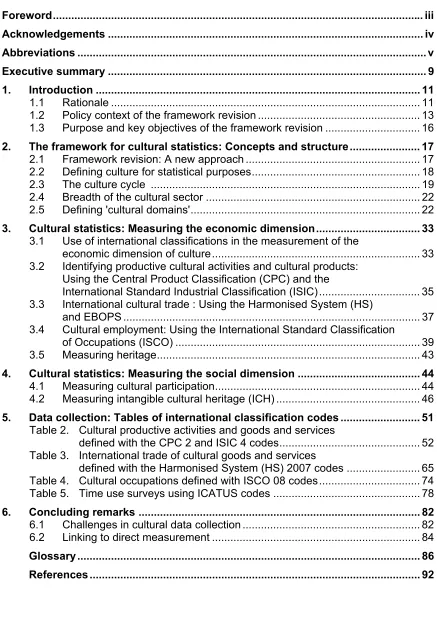
Table of contents
Page
Foreword... iii
Acknowledgements ... iv
Abbreviations ... v
Executive summary ... 9
1. Introduction ... 11
1.1 Rationale ... 11
1.2 Policy context of the framework revision ... 13
1.3 Purpose and key objectives of the framework revision ... 16
2. The framework for cultural statistics: Concepts and structure... 17
2.1 Framework revision: A new approach ... 17
2.2 Defining culture for statistical purposes... 18
2.3 The culture cycle ... 19
2.4 Breadth of the cultural sector ... 22
2.5 Defining 'cultural domains'... 22
3. Cultural statistics: Measuring the economic dimension... 33
3.1 Use of international classifications in the measurement of the economic dimension of culture... 33
3.2 Identifying productive cultural activities and cultural products: Using the Central Product Classification (CPC) and the International Standard Industrial Classification (ISIC)... 35
3.3 International cultural trade : Using the Harmonised System (HS) and EBOPS ... 37
3.4 Cultural employment: Using the International Standard Classification of Occupations (ISCO) ... 39
3.5 Measuring heritage... 43
4. Cultural statistics: Measuring the social dimension ... 44
4.1 Measuring cultural participation... 44
4.2 Measuring intangible cultural heritage (ICH) ... 46
5. Data collection: Tables of international classification codes ... 51
Table 2. Cultural productive activities and goods and services defined with the CPC 2 and ISIC 4 codes... 52
Table 3. International trade of cultural goods and services defined with the Harmonised System (HS) 2007 codes ... 65
Table 4. Cultural occupations defined with ISCO 08 codes... 74
Table 5. Time use surveys using ICATUS codes ... 78
6. Concluding remarks ... 82
6.1 Challenges in cultural data collection ... 82
6.2 Linking to direct measurement ... 84
Glossary ... 86
Executive summary
Purpose of the 2009 UNESCO Framework for Cultural Statistics (FCS)
The Framework for Cultural Statistics (FCS) is a tool for organizing cultural statistics both nationally and internationally. It is based on a conceptual foundation and a common understanding of culture that will enable the measurement of a wide range of cultural expressions irrespective of the particular economic and social mode of its production. Through its standard definitions, it will also allow for the production of internationally comparable data.
The framework is the result of an extensive global consultation process. It builds upon the 1986 FCS (UNESCO, 1986) by introducing the creative/cultural debate, taking into account the effects of globalisation on the production and dissemination of cultural products and reflects current practices and intellectual property issues.
The measurement of the economic dimension of culture is more fully developed in the FCS due to the greater availability of economic data and the existence of the many international classification systems in use. However, equally important is the social dimension of culture, including culture participation and intangible cultural heritage. Although initial elements for their measurement are proposed, further work is required. The FCS is a classification instrument that incorporates the use of currently available international classification systems such as the International Standard Industrial Classification (ISIC) for cultural production activities, the Central Product Classification (CPC) for cultural goods and services, the International Standard Classification of Occupations (ISCO) for cultural employment; the Harmonised Commodity Description and Coding System (HS) for international flows of cultural goods, and the UN Trial International Classification of Activities for Time-Use Statistics (ICATUS) for cultural participation. The result is a tool and methodology designed for use at the international and national levels as a basis for organizing the collection and dissemination of cultural statistics. It attempts to reflect the widest range possible of activities related to the production, distribution and use of culture.
Defining culture
The Cultural Domains defined in FCS represent a common set of economic (such as the production of goods and services) and social (such as participation in culture activities)
activities that traditionally have been regarded as being “cultural”. In addition, Related
Domains consist of other economic and social activities that may be considered “partially cultural” or that are more often regarded as being “recreational or leisure” rather than “purely cultural”.
Although, as a starting point, most of the current standards used for constructing these definitions are based on an economic perspective, the interpretation of the resulting domain is not limited solely to the economic aspects of culture but extends to all aspects of that domain. Thus, the definition for the measurement of ‘performance’ includes all performances, whether these are amateur or professional and take place in a formal concert hall or in an open space in a rural village.
In addition, the framework emphasizes three “transversal” domains that are measured across a range of sectoral domains. The Education and Training, Archiving and Preserving, and Intangible Cultural Heritage domains are categorized as transversal cultural domains; the inclusion of each of these three dimensions is critical to measuring the full breadth of cultural expression.
Measuring culture: A pragmatic approach
The capacity of countries to collect and disseminate statistics on culture will vary greatly depending upon their respective policy priorities, statistical expertise, and human and financial resources. The framework is designed explicitly to be flexible and adaptable at the national level.
The framework is also built upon the concept of the Culture Cycle model of the cultural
sector, which helps us to understand the relationships between the different cultural processes. The cycle illustrates the totality of practices, activities and necessary resources that are required to transform ideas into cultural goods and services that, in turn, reach consumers, participants or users.
The framework includes all current relevant international statistical classification systems and standards in order to maximise data comparability and the potential for using existing surveys to measure culture. These classification systems provide countries with a comprehensive framework to collect and disseminate cultural data. It also serves as a guide to measuring cultural activities, goods and services using standard economic statistics and household surveys, such as labour force surveys and censuses. Countries with no national cultural framework will be able to use the basic fundamental structure of the FCS. Countries with greater statistical capacity may be able to collect more elaborate statistics using more finely tuned, or dedicated, statistical instruments that reflect their policy priorities in culture.
1. Introduction
This framework replaces the 1986 UNESCO Framework for Cultural Statistics (FCS)
(UNESCO, 1986). Since the development of the first UNESCO FCS, many different approaches to defining or measuring culture have emerged while social and technological changes have transformed the place of culture in the world.
An international cultural statistical framework would like to maximise international comparability where relevant and feasible to do so. At the national level, there are also demands for data to establish evidence-based policy to inform countries about their status compared to other nations in the region or in the world.
The framework provides the conceptual foundations for evaluating the economic and social contributions of culture. It is a tool to help Member States organize the collection and dissemination of their cultural statistics. It will enable the production of both national and cross-national data on cultural statistics for use by UNESCO, many international agencies and the global community of data users.
This new framework aims to be flexible and not proscriptive, but promotes comparability. The FCS is intended to help countries build their own cultural framework by selecting the major domains that form part of their cultural statistics. In addition, each country, by adopting the relevant FCS definitions by domain, will permit the international comparability of their own data.
1.1 Rationale
Since 1986, there has been a transformation in the perception of the role of culture in the economic and social realm. The importance of the link between culture and development is receiving greater recognition from aid agencies and specialists. Culture is seen increasingly as both a means for development, i.e. as a means to the end of promoting and sustaining economic progress, and as an effect of development, i.e. as giving meaning to our existence. It can generate revenues through tourism, crafts and artefacts and contribute to the sustainable development of a region and a country. It is acknowledged that culture influences people’s behaviour, their contribution to the process of economic development, their social development and their well-being (UNESCO, 1995).
The potential impact of culture on the economic and social development of countries can be summarized as follows:
• Community cultural assets are well suited to support sustainable local development,
• Culture offers opportunities for women and youth to participate in productive activities contributing to gender equality, self esteem and social awareness. Culturally sensitive policies can help to preserve traditional practices and address the needs of socially disadvantaged groups such as women or indigenous peoples. Women are owners of knowledge and transmit cultural values and guardians of cultural particularisms (UNESCO, 1995).
• Several cultural industries are predominantly made up of small businesses or family
businesses that are well-suited for locally based development.
Some reasons for the increasing importance of culture reflect long-term underlying trends; others are contingent on events that are more recent. In many regions of the world, there has been an increase in wealth and disposable income, which has led to increased discretionary spending on cultural activities and products. This means that culture is an essential part of the cycle of economic reproduction rather than a luxury, or a preference product, acquired through the allocation of surplus resources. Cultural consumption has grown, the range of products has expanded, and a ‘product’ now mediates most cultural experiences.
These long-term trends have been intensified by two more recent and related phenomena:
• Cultural industries that were previously separate due to analogue systems of
production (films, TV, photography and printing) have now converged in a digital format where, in many cases, they are no longer distinguishable. Digital technology has drastically changed the mode of production and dissemination of cultural productions. This is especially the case with the Internet, which is used increasingly to disseminate these various cultural products, sometimes through the same medium.
• Globalisation has lead to an internationalisation of flows of goods and services as
well as a global exchange of ideas, people and capital. Multiculturalism and interculturality have created new products, new practices and multiple identities. By comparison with the pre-digital era, new technologies have enabled the rapid commercial exploitation of ‘one-off’ cultural production, such as a song. This transformation has led to a shift in the balance of economic power between cultural activities that are digitally reproducible – and potentially commercially tradable – and those that are not, which are generally more difficult to trade (Barrowclough and Kozul-Wright, 2006).
Existing cultural policy frameworks are based on the status quo balance of power, preferences and resources of the pre-digital era. New forms of cultural production present a significant challenge to such frameworks – particularly in fields such as heritage conservation, intellectual property and diversity – and make them less effective at meeting their objectives. For example, while some forms of musical expressions may become commercially stronger, other cultural forms that do not benefit from digital reproduction and distribution may require further public investment if the cultural status quo is to be preserved. Equally, these changes may provoke a reassessment of the status quo.
New forms of cultural production have also generated a new sphere of cultural policy action that focuses on a distinct sub-group of activities – cultural industries – sometimes
also referred to as creative industries (see Section 2.2). The notion of cultural industries
is usually used to signify the commercial dimension of the culture sector. However, this framework encourages a more comprehensive approach with the adoption of the notion of a strong and vibrant inter-dependency between all the activities of the cultural sector, public or private. For example, practitioners may move between publicly- and privately-funded – or indeed paid and unpaid – work on a weekly basis, making it very difficult to position them in the public or private domain. If the focus is on practice, it is hoped that the framework will capture the fluidity of boundaries and appreciate the mutually reinforcing elements of both.
These transformations in the creation, production, distribution and consumption of culture mean that the cultural sector has grown in relative and absolute terms, often outstripping traditional areas of the economy. Due to the rapid rate of change, and the innovative and novel character of cultural production, more and better data are required to appreciate fully the extent and depth of such changes. As will be noted below, the cultural sector has not grown uniformly. This has created a number of community sensibilities and tensions between the commercial and the non-commercial, the traditional and the modern, and the international and the indigenous.
1.2 Policy context of the framework revision
Since the 1986 FCS (UNESCO, 1986), culture has grown in importance in public policy, which can be explained by:
• The increase in the international trade in cultural products globally. This has major
implications for intellectual property rights in the strict sense (their creation, ownership and exploitation) and for the wider question of cultural identity and its ownership (e.g. intangible heritage).
• The growth and concentration of market power in a few multinational
• The legal and policy institutions of cultural regulation and promotion were developed before the growth of cultural industries. As such, these institutions are ill equipped to meet present challenges. A key part in developing appropriate policy responses is having a robust evidential base. Cultural mapping documents that draw on statistical sources to analyse the cultural sector are a vital part of this process.
• Cultural policy developed as ‘cultural industries’ policy allows for the development of
a sectoral and economic perspective. A consequence of this is that cultural policy should consider the cultural industries.
• There are complex inter-dependencies between the public and private spheres that
go beyond simple dualism. For example, a number of commercial cultural activities will have an impact upon cultural policy aspirations. Frameworks that are limited to a dualism approach will become increasingly inadequate.
• At the regional level, the two initiatives demonstrate political willingness to invest in
cultural industries, as a means for poverty alleviation:
− The Paro Initiative (BIMSTEC, 2006) of the BIMSTEC countries states:
“Cultural industries have the capacity to contribute to poverty reduction and have proven to be a powerful instrument for social reorganisation and the vitalization of local communities, especially among the poorer groups of society, both in rural communities and in the urban slums.”
− The Nairobi Plan of Action on the Cultural and Creative Industries in Africa
Since 1986, a very significant development has been the growing awareness of, and need for, active policy on cultural diversity. The 2005 UNESCO Convention on the Protection and Promotion of the Diversity of Cultural Expressions also reflects this development (UNESCO, 2005a). Considering the growing importance of creative assets in the economy, culture diversity is central to creativity and innovation. As stated by David Throsby (2005) “… the principles of maintaining cultural diversity would derive from the proposition that the diversity of ideas, beliefs, traditions and other artistic and cultural manifestations yields a flow of cultural services which is quite distinct from the services provided by the individual components... cultural diversity makes an important contribution to artistic and cultural dynamism which, in turn, has flow-on effects in the economy”.
Cultural diversity is a multi-faceted policy area with a number of different roots, and with different emphasis and articulation at different territorial levels: intra-state, inter-state or transnational. In this latter context, the drive towards active policy on cultural diversity has a number of inter-connected aspects:
• In general, there has been a growing demand for cultural products originating in the
developing world or, in some cases, a hybridisation of these products with those from the developed world. However, developing countries are often poorly positioned to negotiate financial returns on their cultural exports that will be comparable with those received by developed nations; this is partly due to a lack of local institutional capacity but also to the absolute power of an oligopolistic industrial sector;
• The blurring of boundaries between (largely Western) notions of high and low
culture, and between the West and ‘the rest’; and
• The commercialisation of craft production and its role in strategies of economic
development in the developing world.
The 1986 FCS (UNESCO, 1986) was conceived by UNESCO Member States who were largely from the developed world. This updated FCS takes into account the needs of developing countries. In particular, it considers the appropriateness and feasibility of incorporating elements such as intangible cultural heritage and the informal economy, as well as dealing with the issues of cultural diversity. Some cultural activities, such as craft production and the role of education, were either omitted or not given enough emphasis in the 1986 framework.
1.3 Purpose and key objectives of the framework revision
This framework establishes a conceptual foundation that provides a common understanding that will enable international comparison of a full range of activities in the production, circulation and use of culture. To do this, the framework encompasses the following guiding principles:
• Establishes a conceptual foundation which captures the full range of cultural
expression, irrespective of the particular economic and social mode of its production;
• Addresses the breadth of cultural expression (cultural forms, practices, products and
processes), including their new forms of production and consumption (cultural industries and the cultural component of intellectual property) and cultural practices not associated to cultural industries (intangible heritage);
• Where possible, uses categories translatable into international classifications, such
as the Central Product Classification (CPC), the Harmonised Commodity Description and Coding System (also called the Harmonised System (HS)), the International Standard Industrial Classification (ISIC) and the International Standard Classification of Occupations (ISCO); and
• Assists countries in developing their own locally sensitive frameworks but with
2. The framework for cultural statistics: Concepts and
structure
2.1 Framework revision: A new approach
The challenge faced by a new framework for cultural statistics is to develop an approach that goes beyond some of the oppositions and dichotomies that are characteristic of debates in cultural policy, specifically about how to measure culture. The approach used here aims to address the tension created by three regularly occurring cultural policy dichotomies:
i) Scope of culture (economic-social). This approach is based on an understanding of how cultural meaning is created and transmitted. This focus on the production and distribution of culture necessarily entails understanding how meaning is embedded within social and economic processes. Culture is not removed or separate from society and the economy. Many elements of culture, including those that are outside the market sphere, can be tracked through indicators such as those on participation, time use or social capital. Many other elements of the production and transmission of culture involve an economic transaction, which is measurable. ii) Governance mode (public-private). This approach is agnostic as to the funding
and governance arrangements (private sector, public sector or civil society) for cultural production and transmission. Three sources of finance for culture are: a) public (mainly from government or public institutions), which results in direct (subsidies and grants) or indirect (tax exemptions); b) private (from the market); and c) non-profit organisations or donors. Current data do not provide a clear picture of these three different sources of financing for culture. The Task Force on Cultural Expenditure and Finance recognised the extreme difficulty of obtaining comparable and harmonised data on public finance for culture in European countries (European Commission, 2001). The different structures of public finance (centralised or not) and methodologies used among different countries made the comparison extremely difficult.
In the Framework, the emphasis is on the relationships, connections and exchanges that cut across these lines in the cultural sector.
iii) Degree of institutionalisation (formal-informal). This approach recognises that
cultural production and distribution take place in the formal and informal economy and the social realm. Informal cultural production is a characteristic of the developed world and the developing world. However, if cultural production takes place within the informal economy or non-monetary realm, it may be estimated. The approach here aims to do justice to the entire process of cultural creation, expression and
The increasing specialisation of the division of labour in many cultural industries has led to a fine-grain distinction of tasks between ‘making’ culture and its ‘use’. However, in other industries, such as the crafts sector, these distinctions are less pronounced as ‘craft producers’ may conceive, make and exhibit/sell their artefacts, thus conflating or erasing the division of labour. As such, craft producers may occupy several steps in the cultural production cycle.
The logic behind the framework revision comprises three components:
• Sectoral breadth (including domains considered as cultural) and depth (including performers, artists, and support workers and products without which performers and artists could not operate);
• The desire to move to a system of direct metrics; and
• The ability to make international comparative assessments. At the same time, it
is important not to impose a ‘one size fits all’ framework. It needs to be sensitive to regional or national specificity and variety as well as be suitable for comparison. 2.2 Defining culture for statistical purposes
The perception of culture that underlies the revision of the Framework for Cultural Statistics draws from the definition in UNESCO’s Universal Declaration on Cultural Diversity, namely that “Culture should be regarded as the set of distinctive spiritual, material, intellectual and emotional features of society or a social group, and that it encompasses, in addition to art and literature, lifestyles, ways of living together, value systems, traditions and beliefs” (UNESCO, 2001). This definition of culture is very closely related to the ways in which societies, groups and communities define their identity.
In order for the FCS to arrive at a definition of culture for statistical purposes, two main aspects were considered:
• Creative-Cultural debate: Many countries have used the term ‘creative’ to describe these industries, but many industries within a creative ‘sector’ may not be creative. The definition and measurement of creativity is in itself subject to much debate. Creative industries usually cover a broader scope than traditional artistic domains with the inclusion, for example, of all ICT industries or research and development. The framework addresses this issue by allowing the inclusion of some specific creative industries (design and advertising) as a separate domain.
2.3 The culture cycle
The culture cycle captures all of the different phases of the creation, production, and dissemination of culture. In this approach, culture can be viewed as resulting from a cognate set of processes. These activities may or may not be institutionalised, and they may or may not be governed by the state. The broad conception of a sector that includes non-formal, amateur and activities unrelated to the market is termed a ‘domain’ in order to indicate that the concept covers social and non-market related activity, as well as economic, market-related activity.
The development of a perspective based on domains allows the processes of the production and distribution of culture to be mapped across the production cycle. As the analysis of country and regional classifications in the initial BOP Consulting Study (UNESCO-UIS, 2006a) demonstrates, a number of UNESCO Member States already use the concept of the culture cycle. However, in some of these contexts, it is a latent concept and/or it is not consistently applied. The culture cycle approach is an aid for conceptualising how cultural production and activities actually take place and goes beyond a simple grouping of domains.
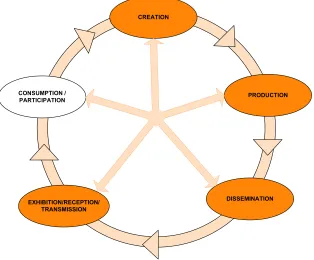
The challenge for a robust and sustainable cultural statistical framework is to cover the contributory processes that enable culture to be created, distributed, received, used, critiqued, understood and preserved. A number of approaches have been developed that allow a fuller extension of the universe of activities that are required for the production and distribution of culture. These tend to resolve into a five-stage production cycle (Figure 1), though clearly different cultural forms have different production cycles and not all will require equal inputs at every stage.
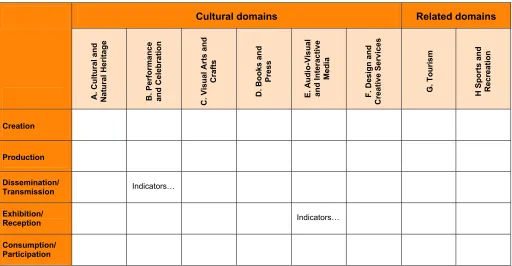
Like the 1986 FCS (UNESCO, 1986), the culture cycle includes five stages, which are presented slightly differently in a cyclical rather than a hierarchical model to reinforce the idea that the relationships can be complex and occur more as a network.
1. Creation: the originating and authoring of ideas and content (e.g. sculptors, writers, design companies) and the making of one-off production (e.g. crafts, fine arts). 2. Production: the reproducible cultural forms (e.g. TV programmes), as well as the
specialist tools, infrastructure and processes used in their realisation (e.g. the production of musical instruments, the printing of newspapers).
4. Exhibition/Reception/Transmission: refers to the place of consumption and to the provision of live and/or unmediated cultural experiences to audiences by granting or selling access to consume/participate in time-based cultural activities (e.g. festival organisation and production, opera houses, theatres, museums). Transmission relates to the transfer of knowledge and skills that may not involve any commercial transaction and which often occurs in informal settings. It includes the transmitting of intangible cultural heritage from generation to generation.
5. Consumption/Participation: the activities of audiences and participants in consuming cultural products and taking part in cultural activities and experiences (e.g. book reading, dancing, participating in carnivals, listening to radio, visiting galleries).
Figure 1. Culture cycle
PRODUCTION CONSUMPTION /
PARTICIPATION
CREATION
DISSEMINATION EXHIBITION/RECEPTION/
TRANSMISSION
The term culture cycle is helpful as it suggests the inter-connections across these
For some cultural activities, the process can start at any stage of the culture cycle, while some phases maybe combined or do not exist as, for example, in the case of heritage where creation may be said to have occurred in the past. Most of the activities related to heritage activities occur in the phases “Exhibition and Transmission” and “Consumption/Participation”.
The network structure of the cycle emphasises the new forms of production that are mostly associated with new technologies. These new technologies have created interrelationships between the different functions and, in time, these new forms of culture processes may merge these functions. For example, people can create and consume at the same time through technology such as YouTube or blogs.
The culture cycle shows how cultural production has its origins in the social realm. The culture cycle approach is agnostic as to the motivation for cultural production – be it profit or the transmission of cultural values. Since cultural activities, and actors, move continuously between market and non-market activities, one must acknowledge the part played by both as well as the difficulties in measuring them.
The culture cycle is not concerned with making judgements on how 'cultural' any particular aspect of the cycle is. Rather, what is important is to understand and being able to track the totality of activities and necessary resources that are required to transform ideas into cultural goods and services that, in turn, reach consumers, participants or users. The artefact (whether painting, craft object or performance) is meaningless without a value system and a production system that gives it value/ meaning. For example, a country will want a particular site recognised, as being of national or outstanding cultural heritage and it will want to mobilise the assets of tourism, transport, preservation and hotels to capture the value of paying guests.
The culture cycle also has a spatial dimension. Some activities may be clustered in one place, region or country, while others may be articulated across the world. The exact nature of this articulation is known only through empirical enquiry, and this has important implications for both the regulation of the cultural sector and where the benefits (economic and social) accrue. An equally important spatial component of culture is dislocation, whereby people become separated from their original cultural milieu through migration. Globalisation has increased the potential for such dislocation, as well as the problems of cultural assimilation, disagreement and the sense of the exotic or foreign that may result.
The empirical data (quantitative and qualitative) that can be used to animate the cycle (as derived, in part, from the cultural statistical framework) are not always readily available for all countries. For those countries that have invested in information gathering, the model has revealed that the scale of the contribution of culture has been substantial. True worth though – and information upon which policy may be developed – will only be gauged when comparative information is available country to country, region to region.
2.4 Breadth of the cultural sector
A review of selected cultural statistics frameworks from around the world (UNESCO-UIS, 2006a) shows that there is a consensus around the idea that culture is the result of a group of identifiable constituent activities. However, it also shows that this can be obscured partly by:
i) A lack of agreement in identifying how these activities should be grouped together at a higher level as domains; and
ii) Little shared understanding as to what functions should be included in the analysis of the cultural sector.
In part, divergence related to the former (i) is a genuine reflection of local differences in culture. However, it is also related to (ii) the lack of a fully developed underlying model or logic for the analysis. This is the root cause of the latter.
However, applying a consistent and logical approach is not the only requirement in revising the framework for cultural statistics. Consideration should also be given to more pragmatic issues related to:
• Implementation – the ability to implement the definition of cultural domains within statistical classification systems, whether this is the Central Product Classification (CPC) or the International Standard Industrial Classification (ISIC), International Standard Classification of Occupations (ISCO) or another international classification.
• Politics – ensuring that the framework will be used (and therefore be useful) will require support and ratification from countries, many of whom have cultural institutions that represent powerful interests and that have to be able to ‘see themselves’ within the framework.
2.5 Defining 'cultural domains'
Cultural goods convey ideas, symbols and ways of life, some of which may be subject to copyrights. Cultural services do not represent material cultural goods in themselves but facilitate their production and distribution. For example, cultural services include licensing activities and other copyright-related services, audio-visual distribution activities, promotion of performing arts and cultural events, as well as cultural information services and the preservation of books, recordings and artefacts (in libraries, documentation centres, and museums). Most of these goods and services are subject to copyright.
Cultural activities embody or convey cultural expressions, irrespective of the commercial value they may have. These activities may be an end in themselves or they may contribute to the production of cultural goods and services (UNESCO-UIS, 2005).
Unlike the 1986 Framework (UNESCO, 1986), the definition of cultural domains is based on a hierarchical model that is comprised of cultural domains and related domains. The cultural domains include cultural activities, goods and services that are involved in all of the different phases of the culture cycle model. The related domains are linked to the broader definition of culture, encompassing social and recreational activities. Domains are mutually exclusive so, for example, music is placed in a single category. Contrasting with the previous framework, intangible cultural heritage is now a transversal dimension whereas it was partially covered by the category “community services” in the 1986 FCS.
The FCS cultural domains, represented by Figure 2, represent a common set of
culturally productive industries, activities and practices that can be grouped under the following headings:
y A: Cultural and Natural Heritage;
y B: Performance and Celebration;
y C: Visual Arts and Crafts;
y D: Books and Press;
y E: Audio-visual and Interactive Media; and
y F: Design and Creative Services
y Intangible Cultural Heritage (transversal domain)
These domains are considered to be cultural. They also represent the minimum set of core cultural domains for which UNESCO would encourage countries to collect comparative data. This allows for a specification of the breadth of the cultural sector but also gives a sense of its structure.
In addition, three other transversal domains are included for their key role in the culture cycle for the production, transmission of culture. They are transversal because they can be applied to all of the cultural and related domains:
• Education and training
• Archiving and preservation
Figure 2. Framework for cultural statistics domains
RELATED DOMAINS
A. CULTURAL and NATURAL
HERITAGE
- Museums (also virtual)
- Archeological and Historical Places - Cultural Landscapes - Natural Heritage
B. PERFORMANCE
and CELEBRATION
- Performing Arts - Music
- Festivals, Fairs and Feasts
C. VISUAL ARTS and CRAFTS
- Fine Arts - Photography - Crafts
D. BOOKS and PRESS
- Books
- Newspaper and Magazine - Other printed matter - Library (also virtual) - Book Fairs
E. AUDIO-VISUAL and INTERACTIVE
MEDIA
- Film and Video - TV and Radio (also Internet live streaming) - Internet podcasting - Video Games (also Online) CULTURAL DOMAINS
F. DESIGN and CREATIVE SERVICES
- Fashion Design - Graphic Design - Interior Design - Landscape Design - Architectural Services - Advertising Services
INTANGIBLE CULTURAL HERITAGE
(oral traditions and expressions, rituals, languages, social practices)
EDUCATION and TRAINING
ARCHIVING and PRESERVING
G. TOURISM
- Charter travel and tourist services
- Hospitality and accommodation
H. SPORTS and RECREATION
- Sports - Physical fitness and well being - Amusement and Theme Parks - Gambling
EQUIPMENT and SUPPORTING MATERIALS
INTANGIBLE CULTURAL HERITAGE
EDUCATION and TRAINING
ARCHIVING and PRESERVING
In order to avoid double counting, each activity can only be classified once within the framework, even though there are instances where activities logically span more than one domain. For instance, music would fall under both 'Performance and Celebration' and 'Audio-visual', as it consists of live music (Performance) and recorded music (Audio-visual). However, the FCS prioritises the subject rather than the form in which the cultural content can appear. In addition, much of the domain cannot be separated discretely within statistical classifications from other performing arts activities.
Cultural domains
The FCS cultural domains are defined as follows: A. Cultural and Natural Heritage
The domain Cultural and Natural Heritage includes the following activities: Museums,
Archaeological and Historical Places (including archaeological sites and buildings), Cultural Landscapes, and Natural Heritage.
Cultural Heritage includes artefacts, monuments, and groups of buildings and sites that have a diversity of values including symbolic, historic, artistic, aesthetic, ethnological or anthropological, scientific and social significance.
Cultural Landscapes represent combined works of nature and by humans, and they express a long and intimate relationship between people and their natural environment (UNESCO, 2007).
Natural Heritage consists of natural features, geological and physiographical formations and delineated areas that constitute the habitat of threatened species of animals and plants and natural sites of value from the point of view of science, conservation or natural beauty. It includes nature parks and reserves, zoos, aquaria and botanical gardens (UNESCO, 1972).
Activities related to cultural and natural heritage encompass the management of sites and collections that have historic, aesthetic, scientific, environmental and social significance. Preservation and archiving activities undertaken in museums and libraries are also part of this category.
B. Performance and Celebration
Performance and Celebration include all expressions of live cultural events.
Performing Arts includes both professional and amateur activities, such as theatre,
dance, opera and puppetry. It also includes the celebration of cultural events – Festivals,
Feasts and Fairs – that occur locally and can be informal in nature.
Music is defined in this domain in its entirety, regardless of format. As such, it includes live and recorded musical performances, music composition, music recordings, digital music including music downloads and uploads, and musical instruments.
C. Visual Arts and Crafts
Visual Arts are art forms that focus on the creation of works, which are visual in nature. They are intended to appeal to the visual sense and can take many forms. Although, it is acknowledged that some contemporary visual arts may include multidisciplinary art
forms such as 'virtual art’; these art forms are included in domain E, Audio-visual and
Interactive Media.
The Visual Arts and Crafts domain includes Fine arts such as paintings, drawings,
sculpture; Crafts; and Photography. Commercial places where the objects are exhibited,
such as commercial art galleries, are also included in this domain.
The FCS adopts the International Trade Center (ITC) and UNESCO definition of Crafts, or artisanal products, described as “those produced by artisans, either completely by hand or with the help of hand-tools or even mechanical means, as long as the direct manual contribution of the artisan remains the most substantial component of the finished product. The special nature of artisanal products derives from their distinctive features, which can be utilitarian, aesthetic, artistic, creative, culturally attached, decorative, functional, traditional, religiously and socially symbolic and significant” (UNESCO and ITC, 1997).
UNESCO (UNESCO and ITC, 1997) has identified six broad categories of artisanal products based on the materials used: Baskets/wickers/vegetable fibre-works; Leather; Metal; Pottery; Textiles and Wood. The guide also identifies complementary categories comprising materials in craft production that are either very specific to a given area, or rare, or difficult to work, such as stone, glass, ivory, bone, shell, mother-of-pearl, etc. Extra categories are also identified when different materials and techniques are applied at the same time and refer to decorations, jewellery, musical instruments, toys, and works of art. Many crafts objects are produced industrially; nevertheless, FCS considers the products, which have a traditional character (pattern, design, technology or material)
as part of the FCS. Contemporary crafts are not in Visual Arts and Crafts, but are
D. Books and Press
This category represents publishing in all its various formats: Books, Newspapers, and
Periodicals. This category remains the same as in FCS 1986 (UNESCO, 1986) but it
also includes the electronic or virtual forms of publishing such as online newspapers,
e-books and the digital distribution of e-books and press materials. Libraries, both physical
and virtual, are included in this domain as are Book fairs.
Printing is not normally included in cultural classifications, or in definitions of cultural
industries, and is not a cultural activity in its own right. However, according to the production cycle model, printing would be included as part of the production function of the publishing industry. In this way, the FCS includes printing activities that have a predominantly cultural end use. The difficulty arises when attempting to distinguish between these printing activities using the existing statistical classification systems. Generally, printing activities related to the publishing industry are included within the Books and Press domain as a production function of publishing, while Other printed matter – the printing of business supply catalogues or ‘quick’ printing – is excluded. FCS recommends placing these related printing activities in equipment and supporting materials.
E. Audio-visual and Interactive Media
The core elements of this domain are Radio and Television broadcasting including
Internet live streaming, Film and Video, and Interactive Media. Interactive Media cover
video games and new forms of cultural expressions that mainly occur through the Web
or with a computer. It includes online games, web portals, websites for activities, which
relates to social networks such as Facebook, and Internet podcasting such as YouTube. However, Internet software and computers are considered to be infrastructure or tools and, for the production of interactive media content and should be included in the
transversal domain Equipment and Supporting Materials.
Interactive media and software are important fields of activity. While many interactive
media products and services have a cultural end use (computer and video games, interactive web and mobile content), the same cannot be said for the software industry. Interactive Media is considered by the FCS to be part of the Audio-visual and Interactive media domain. In practice, this will depend on the classification system used and its ability to separate interactive media activities discretely from mainstream software and telecommunications activities. The Central Product Classification (CPC) allows for some, but not all, interactive media activities to be identified. When activities cannot be identified discretely in the CPC, or in other classification systems, these activities should
be included as part of the transversal domain Equipment and Supporting Materials.
Interactive Media can be defined as being interactive when either (1) two or more objects have an effect on one another; (2) the user can effect a change on an object or within the environment (users playing video games); (3) they involve active participation of a user; or (4) there is two way effect as opposed to a one way or simple cause-effect (Canadian Heritage, 2008).
F. Design and Creative Services
The Design and Creative Services domain did not exist in the 1986 FCS (UNESCO,
1986). This domain covers activities, goods and services resulting from the creative,
artistic and aesthetic design of objects, buildings and landscape.
The domain includes Fashion, Graphic and Interior Design, Landscape Design,
Architectural and Advertising Services. Architecture and Advertising are part of the core cultural domains, but only as services. The primary purpose of architectural and advertising services is to provide a creative service, or an intermediary input, into a final product that is not always cultural. For example, the final product of creative advertising services may be a commercial advertisement, which is not a cultural product itself, but is generated by some creative activity. In order to avoid double counting, decisions are made to categorize some design activity into other categories rather than in domain F. For example, all buildings that are included as part of heritage are already considered in
the domain A, Cultural and Natural Heritage, while Interactive design media content is
included in Domain E, Audio-visual and Interactive Media.
Transversal domains
Although these domains can stand alone as independent domains, they are considered transversal because they can be applied across the other cultural domains.
The Intangible Cultural Heritage domain is considered entirely cultural while the
remaining transversal domains namely Archiving and preserving, Education and Training
and Equipment and Supporting Materials are partially cultural because these domains contain elements and activities that are cultural and thus are of interest and importance to culture and the FCS.
Intangible Cultural Heritage (Transversal cultural domain)
The UNESCO Convention for the Safeguarding of the Intangible Cultural Heritage (UNESCO, 2003b), defines Intangible Cultural Heritage (ICH) as the “practices, representations, expressions, knowledge, skills – as well as the instruments, objects, artefacts and cultural spaces associated therewith – that communities, groups and, in some cases, individuals recognize as part of their cultural heritage” (Art. 2).
The ICH is traditional and living at the same time. It is “transmitted from generation to generation”, and “constantly recreated by communities and groups in response to their environment, their interaction with nature and their history, and provides them with a sense of identity and continuity” (Art. 2).
Intangible heritage cannot be considered as a discrete domain of cultural activity or production, but rather it can manifest itself across all the FCS cultural domains. For example, ICH can be reflected in crafts or performing arts. For this reason, it is
presented as a transversal domain (see Figure 2). Several non-exhaustive cultural
practices and activities in which intangible cultural heritage can be manifested include: a) oral traditions and expressions, including language as a vehicle of the intangible cultural heritage; b) performing arts; c) social practices, rituals and festive events; d) knowledge and practices concerning nature and the universe; and e) traditional craftsmanship.
Behind this new domain of ICH lay many years of research undertaken by UNESCO on the functions and values of cultural expressions and practices. It paves the way for new approaches to understanding, protecting and respecting our cultural heritage – involving the recognition of communities and groups as those who identify, enact, recreate and transmit the intangible heritage.
Archiving and Preserving (Transversal domain)
Archiving represents the collection and repository of cultural forms (movable objects and intangible) for the purposes of preserving for posterity, exhibition and re-use (e.g. the preservation of historic sites and buildings, sound archives and picture libraries). Preserving relates to the conservation or preservation and management of particular cultural and natural properties.
Archiving and preserving activities can take place in each of the cultural domains (an author’s manuscript, the first performance of a work, a concert/exhibition programme). Archival material is also a reference point, which can serve as inspiration for new creation. The archiving and preservation components of fine arts, crafts, design, architecture, publishing and audio-visual industries can serve in turn as creative inspiration for new production. For example, historic houses preserve (and exhibit) architecture; museums and galleries conserve (and exhibit) paintings, sculpture, jewellery and a wide array of other artefacts whose value resides principally in their design attributes (e.g. everything from furniture to cars); while archives preserve original documents such as manuscripts, photographs, books, films and radio recordings.
Education and Training (Transversal domain)
FCS does not consider Education in its entirety, but only when it is a means of
Education and Training in culture help an individual to acquire skills to create and make cultural goods. It teaches people to appreciate the outcome of the consumption of cultural goods and services or the social benefit of a participation in a cultural activity. Education serves also for the transmission of intangible culture in a formal or informal system that forms the identity of a community. Education and training, thus, play an important part in all cultural domains and in all parts of the culture cycle.
When using the education variable, it is recommended that countries use the International Standard Classification of Education (ISCED97) (UNESCO-UIS, 2006d) during data collection or map the data to the ISCED97 classification system during data processing in order to allow for international comparability. Countries should also use the classification structure for the fields of education in ISCED97.
Equipment and Supporting Materials (Transversal domain)
This domain covers the “tools of cultural products and activities”. Cultural products (goods and services) defined in the different domains are those directly associated with cultural content, while equipment and supporting materials are related to the supporting industries, as well as ancillary services (even if only partially cultural in content), that facilitate or enable the creation, production and distribution of cultural products. The Internet is a major tool for the transmission, production and dissemination of cultural goods and services and is, therefore, included in this domain. Computers and IT equipment are also included because they are the tools by which the Internet is created, disseminated and transmitted and the means through which many interactive media is generated.
The reason for distinguishing this category from the products and activities included in the domains A to F is to be able to identify elements that are not essentially cultural but that can be used for the production or execution of a cultural good or activity and that are necessary for the existence of these cultural products.
Research in the field of culture is allocated in each domain with its respective code. Related domains
Sports and Recreation and Tourism are not always considered cultural activities, however, they do contain cultural elements. In other words, they represent activities that may have a cultural character but their main component is not cultural. As such, they
exist in the FCS as Related domains.
G. Tourism
Ideally, the FCS would refer to the cultural dimensions of tourism such as Cultural tourism, Spiritual tourism and Eco-Tourism activities. Although there is no international accepted definition of cultural tourism, the FCS proposes the following: “customised excursions into other cultures and places to learn about their people, lifestyle, heritage and arts in an informed way that genuinely represents their values and historical context including the experiencing of the difference” (Steinberg C, 2001). It can also take the
form of Spiritual tourism or Ecological tourism. These activities are considered as
cultural domains and counted in the domains A, B, C or in Intangible cultural heritage. For example, a tourist visiting a site or attending a concert is already included in the cultural domains.
Tourism statistics, following the TSA approach, measure the demand of visitors for goods and services (international or domestic). It includes expenditure on travel, accommodation and other expenses. However, it should also cover the non-monetary data that focus on numbers of visitors and the purpose of visits. Therefore, to avoid double counting, tourism activities are included within this domain (e.g. tourist guides and tour operators) as well as those activities outside of the cultural sector in which tourists are likely to account for the bulk of activity (e.g. accommodation).
H. Sports and Recreation
Sports
Sport is considered in the FCS in its broader definition as it includes organized and/or
competitive sports as well as Physical fitness and well-being and physical recreation
activities. Both professional and amateur sports are reflected in the FCS.
For some countries, particular sports are closely related to their cultural identity, as sport may be associated with social structures and traditions. An example might be sumo wrestling in Japan. In other countries, sports may be no more than a recreational past time, or most commonly undertaken for little more than physical exercise. Moreover, the same sport may have very different associations in different countries. In some classifications (European Commission, 2002), spectator attendance in sports events or watching sports events on TV are perceived as the cultural activity, while professional sport may not necessarily be viewed as being cultural. These strong differences of approach, and a common interpretation that it is participation and not sport as a ‘product’ or ‘sector’, which is ‘cultural’, have led us to consider sport as a related activity.
Recreation
This domain also includes Recreation, which is defined as an activity undertaken for
pleasure or relaxation that diverts, amuses or stimulates. It includes Gambling, Amusement and Theme parks, and other leisure activities. It excludes physical
Gambling
Gambling consists of units engaged mainly in providing gambling services such as casinos, bookmaker-betting facilities on racetracks, bingo halls, video gaming terminals, lottery agencies and off-track betting agencies (ABS, 2001).
In some countries like the United Kingdom, gambling through lotteries, for example, is a major source of funding of culture. This explains why gambling is part of the FCS but included in a related domain.
Amusement and Theme Parks
3. Culture statistics: Measuring the economic dimension
This section explores how to measure some economic aspects of cultural activities by using existing international classification systems. The economic aspects of culture covered in the FCS represent all activities, services and goods produced by cultural industries through industrial or artisanal processes. The result of this approach can be found in the definition of each domain by cultural activity, good and services, or occupation through codes linked to the functions of the culture cycle. This is illustrated in the Section 5, which contains the lists of all relevant codes by their respective classifications.
3.1 Use of international classifications in the measurement of the economic dimension of culture
This section focuses on how existing data collection instruments can be used to collect cultural statistics. These data collection instruments consist of existing international classification systems, which will allow for the production and analysis of internationally comparable data in culture. Most of these international classifications provide a comprehensive framework within which economic data can be collected and reported in a format that is designed for the purposes of economic analysis, decision taking and policy-making.
Existing administrative data and sample surveys (individual, business and household) can be used to produce a wide range of cultural data that can help to measure the contribution of culture to the national economy in terms of Gross Domestic Product (GDP) and of trends in both cultural employment and cultural consumption. Economic data, on cultural production and employment, is produced currently by most national statistical offices by re-aggregating common economic statistics from existing economic
surveys using the standard international statistical classifications (see Section 5). Data
are typically collected from business and enterprise surveys, household expenditure surveys, business registers, earnings surveys, labour force surveys; and censuses. While these data collection instruments may not have been designed specifically for the collection of cultural information, they nonetheless can allow for an analysis of selected cultural and related activities.
This section currently incorporates the use of four international economic classifications. A detailed list is provided in Section 5 of this report:
i) International Standard Industrial Classification (ISIC 4) – for the identification of cultural productive activities or industries (Section 5, Table 2);
ii) Central Product Classification (CPC 2) – for the identification of cultural goods and services, (Section 5, Table 2);
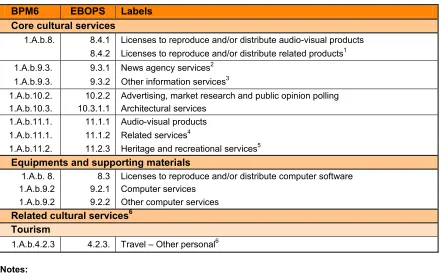
iii) Harmonised Commodity Description and Coding System 2007 (HS 2007) (Section 5, Table 3) and the Extended Balance of Payments (EBOPS) (Section 3, Table 1) – for the identification of international trade of cultural goods and services;