City, University of London Institutional Repository
Citation
:
O'Sullivan, D., Wilk, S., Kuziemsky, C., Michalowski, W. and Farion, K. (2016). Is There a Consensus when Physicians Evaluate the Relevance of Retrieved Systematic Reviews?. Methods of Information in Medicine, 55(3), pp. 292-298. doi: 10.3414/ME15-01-0131This is the accepted version of the paper.
This version of the publication may differ from the final published
version.
Permanent repository link:
http://openaccess.city.ac.uk/13654/Link to published version
:
http://dx.doi.org/10.3414/ME15-01-0131Copyright and reuse:
City Research Online aims to make research
outputs of City, University of London available to a wider audience.
Copyright and Moral Rights remain with the author(s) and/or copyright
holders. URLs from City Research Online may be freely distributed and
linked to.
City Research Online: http://openaccess.city.ac.uk/ [email protected]
Is there a consensus when physicians evaluate the relevance of
retrieved systematic reviews?
Dympna O’Sullivan1,2, Szymon Wilk2,3, Craig Kuziemsky2, Wojtek Michalowski2,
Ken Farion2,4,5, Bartosz Kukawka3
1 School of Mathematics, Computer Science and Engineering, City University London
Northampton Square, London, EC1V 0HB, United Kingdom
2 MET Research Group, Telfer School of Management, University of Ottawa
55 Laurier Ave. E., Ottawa, Ontario, K1N 6N5 Canada.
3 Institute of Computing Science, Poznan University of Technology
Piotrowo 2, 60-965 Poznan, Poland
4 Division of Emergency Medicine, Children’s Hospital of Eastern Ontario
5 Departments of Pediatrics and Emergency Medicine, University of Ottawa
401 Smyth Rd., Ottawa, Ontario, K1H 8L1 Canada
Corresponding author:
Szymon Wilk
Institute of Computing Science, Poznan University of Technology Piotrowo 2, 60-965 Poznan, Poland.
Abstract
Background: A significant challenge associated with practicing evidence-based medicine is to provide
physicians with relevant clinical information when it is needed. At the same time it appears that the
notion of relevance is subjective and its perception is affected by a number of contextual factors.
Objectives: To assess to what extent physicians agree on the relevance of evidence in the form of
systematic reviews for a common set of patient cases, and to identify possible contextual factors that
influence their perception of relevance.
Methods: A web-based survey was used where pediatric emergency physicians from multiple academic
centers across Canada were asked to evaluate the relevance of systematic reviews retrieved
automatically for 14 written case vignettes (paper patients). The vignettes were derived from
prospective data describing pediatric patients with asthma exacerbations presenting at the emergency
department. To limit the cognitive burden on respondents, the number of reviews associated with each
vignette was limited to 3.
Results: 22 academic emergency physicians with varying years of clinical practice completed the survey. There was no consensus in their evaluation of relevance of the retrieved reviews and physicians’
assessments ranged from very relevant to irrelevant evidence, with the majority of evaluations being
somewhere in the middle. This indicates that the study participants did not share a notion of relevance
uniformly. Further analysis of commentaries provided by the physicians allowed identifying three
possible contextual factors: expected specificity of evidence (acute vs chronic condition), the
terminology used in the systematic reviews, and the micro environment of clinical setting.
Conclusion: There is no consensus among physicians with regards to what constitutes relevant clinical
evidence for a given patient case. Subsequently, this finding suggests that evidence retrieval systems
should allow for deep customization with regards to physician’s preferences and contextual factors,
including differences in the micro environment of each clinical setting.
Keywords: evidence-based medicine; review, systematic; information storage and retrieval; evaluation
1.Introduction
A large percentage of health professionals’ clinical practice relate to information
management [1]. A specific aspect of this practice is evidence-based medicine (EBM), described as
“an increasingly popular usage model for information within medical informatics” [2] that
advocates use of the best evidence to make optimal decisions about patient care [3]. This best
evidence usually comes from systematic reviews (e.g. from the Cochrane Library [4]), and is often
disseminated in the form of guidelines. Regardless of the source, providing evidence involves
identification of high quality scientific publications pertaining to a topic of clinical interest and
relevant for a clinical presentation and patient context. Difficulty in assessing how good an
information systems is [5], as well as a lack of quick and easy identification, appraisal, and
synthesis of best evidence [6] are often pointed out as reasons for low uptake of EBM [7],
especially outside academic centers [8].
While the biggest volume of research on EBM is related to its perceptions and use by
clinicians (see for example [9]), provision of the right type of information has been identified as a
significant challenge for the practice of EBM [10]. This challenge is closely associated with the fact
that evidence is often context-independent while the perceived relevance of evidence is influenced
by contextual factors [10]. Although it has been reported that various elements modify the relevance
of evidence [2], there is less research that has studied how physicians evaluate the relevance of
provided evidence for a specific clinical presentation and patient context. To address this void we
need a better understanding of whether there is some common ground in evaluating the relevance of
retrieved evidence, and subsequently how this common ground (or lack thereof), should contribute
to better information management by physicians.
Research described in this paper attempts to assess how physicians perceive the relevance of
evidence, in this case defined as systematic reviews from the Cochrane Library, for specific clinical
presentations (pediatric asthma exacerbations) and patient contexts. The evidence is provided
department (ED)). The hypothesis behind our research is that a consensus in evaluating the
relevance of retrieved evidence does not exist due to a number of contextual factors affecting how
physicians perceive this notion. To validate this hypothesis we have formulated the following
research questions:
To what extent do physicians agree on the relevance of retrieved systematic reviews for a
common set of vignettes?
What are the contextual factors that may influence the evaluation of relevance of retrieved
systematic reviews?
2.Related work
Research on evidence retrieval can be divided into three broad categories. The first category
includes research aimed at developing tools (e.g. algorithms, systems) for indexing and retrieval of
evidence from various sources (e.g. Medline or the Cochrane Library) [11,12]. The second category
is about integrating these tools with point of care clinical workflows [13,14]. The third category of
research is concerned with examining factors that affect the acceptance, uptake and use of these
tools [15,16].
Our work belongs to the first category. In principle, research from this category is more
concerned with the mechanics of indexing, retrieving and using evidence rather than the physicians’
perception of the relevance of the evidence for a specific clinical presentation [17]. Subsequently,
researchers often assume that relevance is an objective notion shared across the spectrum of
physicians [18]. In contrast, in our study we try to establish whether there is a consensus among
physicians with regards to their perception of the relevance of evidence. If such a consensus exists,
then we can say that the expert panels’ evaluations represent a “gold standard” for assessing how
well indexing and retrieval algorithms perform. Otherwise, any standard used for assessing the
quality of indexing and retrieval algorithms is dependent on how this standard was developed and
3.Material and methods
3.1.Study setting and population
The study described in this paper involved pediatric academic emergency physicians of
varying clinical experience – measured as years of practice as full time ED clinical staff – working
at major university hospitals across Canada. Prospective participants were sent email invitations to
participate and enrolled physicians could withdraw their consent at any time during the study.
3.2.Study design
The study design was approved by the Ethics Review Board at the Children’s Hospital of
Eastern Ontario (CHEO). The study was conducted in three phases: (1) preparation, (2) survey and
(3) analysis. It is important to stress that the overall purpose of this study was not to assess how well
some retrieval algorithms matched systematic reviews to vignettes, nor to evaluate objective
relevance (i.e. not related to any clinical context) of evidence, as in [19]. Instead, the purpose was to
examine how physicians subjectively evaluated the relevance of retrieved reviews for the vignettes,
and to check if and how these subjective relevance evaluations were consistent or not.
3.2.1.Preparation phase
In this phase we created vignettes that described pediatric patients presenting to the ED with
asthma exacerbations of different acuity. First, with a help of a senior ED physician we selected 14
representative patient cases from a set of 82 cases collected prospectively at CHEO [20]. The
selected cases were transformed into vignettes where each vignette included a brief textual
description of the patient state that highlighted available information, verified diagnosis (e.g.
severity of asthma exacerbation) and a therapy formulated according to the Canadian Academy of
Emergency Physicians clinical practice guideline.
Subsequently, each vignette was associated with three systematic reviews from the
Cochrane Library retrieved by an algorithm described in [11]. Specifically, we selected the three
number of reviews was limited in order to diminish the cognitive burden imposed on the
participating physicians and to reduce time they needed to complete the survey. For brevity, the
presentation of each systematic review was limited to Title, Abstract and Plain Language Summary
sections.
3.2.2.Survey phase
This phase started with a questionnaire, implemented via a web-based application, where the
participating physicians were asked to provide information on basic demographics and about their
experience with various clinical information systems. Before starting, all participants were given
instructions about how to use the web-based application which included an explanation of the
notions of relevance and non-relevance of documents (how well or not a document or set of
documents meets the information need of the physician)by providing examples of systematic
reviews not used in the study. Upon completing the questionnaire, the participants were requested to
evaluate the relevance of systematic reviews associated with the vignettes (participants were blind
to the ranks produced by the retrieval algorithm). Specifically, for each retrieved systematic review,
physicians were asked to provide an evaluation rank to indicate whether and how this review was
relevant for the patient case described in the vignette. Possible evaluation ranks were from 1 (most
relevant) to 3 (least relevant). There was also a rank X to indicate an irrelevant review. The ranks
1—3 had to be unique within a vignette, but more than one review could be marked as irrelevant. At
the same time we also asked physicians to give optional commentaries about the reviews associated
with each vignette. A sample screenshot from the web-based application is given in Appendix 1.
In order to minimize the influence of the presentation order of systematic reviews on
physicians’ evaluation ranks, this order was randomized (i.e. the review presented in first position
for one physician could be placed last for another), however, all physicians saw the same set of
three systematic reviews for a given vignette.
The physicians’ evaluations of the reviews were coded as triples following the schema
evaluation rank assigned by a physician. Each element of a triple is one of the X, N and Y codes,
where X indicates that a retrieved review was deemed irrelevant by a physician, N indicates a
relevant retrieved review that according to physician was incorrectly ranked by the algorithm, and
finally Y indicates a relevant retrieved review that was assigned the same rank by a physician and
the algorithm. For example, the YXN triple means that the first and third retrieved reviews were
found relevant by a physician, although she assigned another rank to the latter review than the
algorithm, and the second retrieved review was deemed irrelevant.
3.2.3.Analysis phase
In this phase we analyzed the coded responses of the physicians. We used two measures to
capture the match between algorithmic retrieval and physicians’ evaluation ranks. The first measure
is precision at k which gives the ratio of relevant documents among the top k retrieved results [22],
specifically, we used precision at 3. The second measure is group value function proposed in [21]
which is a function obtained by amalgamating preferences of physicians that takes into account not
only relevance of retrieved reviews as evaluated by physicians, but also considers position of an
evaluation in a triple – see Appendix 2.
Both measures were calculated for each physician-vignette pair, and then averaged by
physician over all vignettes. We calculated the Cohen’s kappa coefficients [23] to measure
agreement between pairs of physicians (i.e. we analyzed coded triples associated with paired
physicians) and then used these results to cluster physicians into groups. In particular, we defined
the distance between pairs of physicians as (1 – kappa), and we applied a hierarchical clustering
algorithm to create a cluster dendrogram [24].
We then used the dendrogram to drive the search for the most appropriate clustering.
Specifically, we cut the dendrogram at different levels to obtain groupings with varying numbers of
clusters (from 2 to the total number of participating physicians) and selected the clustering with the
and the largest number of clusters. We decided to maximize the number of clusters to obtain finer
groupings of physicians assuming that this should help with the interpretation of the results.
4.Results
4.1.Participating physicians and responses
Personalized email invitations were sent to 60 academic emergency physicians, 27 of them
consented to participate in the study, and later 1 physician withdrew her consent. 26 physicians
finished the survey, however, 4 of them did not complete all the evaluations and their responses
were excluded from the analysis. This resulted in 22 physicians included in the study (37%
participation rate), which is sufficient for this type of survey – see for example [15]). The
participating physicians demonstrated the entire spectrum of professional experience measured as
work years as full time staff members. Moreover, the majority of them (20 out of 22) had prior
experience with patient tracking systems and clinical decision support systems (including electronic
evidence).
Physicians’ evaluations of the retrieved reviews resulted in 308 (22 physicians times 14
vignettes) triples. All triples are presented in Appendix 3. Physicians also gave additional
commentaries expanding their evaluations. Specifically, we recorded 21 commentaries provided by
6 participants (selected comments are presented in Figure 3).
4.2.Analysis of responses
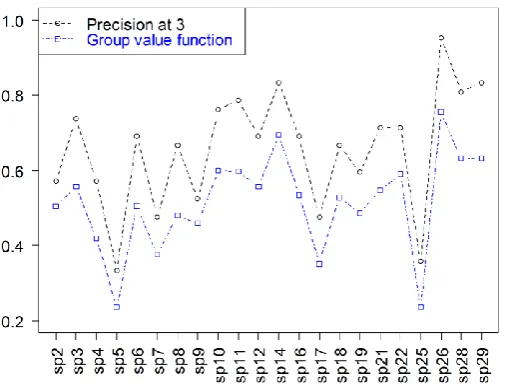
We started the analysis by computing values of precision at 3 and group value function (see
Figure 1 for overview and Appendix 4 for details). There is a group of physicians for whom the
precision at 3 is high (0.8 and higher) and this group includes sp14, sp26, sp28 and sp29 – these
high values indicate that physicians from this group considered most of the retrieved reviews as
relevant for the cases described in the vignettes. It is especially evident for sp26, where precision at
3 is equal to 0.95. On the other hand, there are two physicians – sp5 and sp25 – with very low
majority of the reviews as being irrelevant, revealing a lack of consensus with the previous group.
Values of the group value function are lower than those of precision at 3 (indeed this is expected by
the definition of the measures where precision at 3 takes into account only what is relevant and
what is not, whereas group value function adds ordering to reflect more or less relevance on higher
[image:10.595.171.424.216.408.2]and lower position), however they still confirm the divergent evaluations described above.
Figure 1. Precision at 3 and group value function averaged over vignettes
In the next step we conducted cluster analysis based on the inter-rater agreement captured by
values of Cohen’s kappa (see Appendix 5 for detailed results) – the best clustering was achieved by
cutting the dendrogram at the level corresponding to 4 clusters. The dendrogram and the resulting
Figure 2. Dendrogram and the associated clustering
The clusters are further expanded in Appendix 6 in the context of precision at 3 and group
value function measures. These clusters are as follows:
Cluster 1: includes a single physician whose evaluation ranks were very similar to the
retrieval ranks established by the algorithm (precision at 3 equal to 0.95 and group value
function equal to 0.76),
Cluster 2: includes 17 physicians for whom the match between evaluation and retrieval
ranks was moderate to good (precision at 3 ranging from 0.52 to 0.83 and group value
function ranging from 0.42 to 0.70),
Cluster 3: includes 3 physicians for whom the match between evaluation and retrieval ranks
was poor (precision at 3 ranging from 0.33 to 0.48 and group value function ranging from
0.24 to 0.38),
Cluster 4: includes a single physician for whom evaluation ranks poorly matched the
retrieval ranks (precision at 3 equal to 0.36 and group value function equal to 0.24).
The separation into clusters 3 and 4 may not be obvious at first glance, but it can be
attributed to differences in evaluation ranks provided by physicians from these two clusters
The results of the analysis show large disparities in the evaluations across the physicians,
ranging from evaluating systematic reviews as very relevant for the vignettes (sp26) to mostly
irrelevant (sp5 and sp25), with the majority of physicians being somewhere in between. These
results are also supported by the commentaries. Reading through these commentaries allowed us to
identify three contextual factors that might influence how the physicians perceived the relevance of
the retrieved systematic reviews:
1. Expected specificity of evidence: several physicians made comments that the retrieved evidence
while relevant for adult asthma, is less so for a pediatric population (Figure 3a and 3b), or while
relevant for chronic asthma, it was less appropriate for acute asthma managed in the ED (Figure
3c and 3d). Interestingly, for a number of physicians, this perceived lack of specificity for a
patient case was not an issue.
2. The terminology used in the reviews: as illustrated by a comment provided by a physician from
cluster 2, some terms used in the reviews (in this case “steroid-naive” – see Figure 3e) were not
commonly understood, which prevented evaluating a given review as relevant for a patient case.
3. The micro environment of clinical setting: while systematic reviews are population-based, some
physicians were looking for evidence better framed for the local context, specifically with
respect to treatment options (see commentaries on Figure 3f).
It is interesting to note that according to Spearman’s rank correlation (two-tailed test) [25]
we did not observe significant impact of professional experience of participating physicians on their
evaluations or commentaries. For example, correlation between experience and precision at 3 was
equal to -0.1 (p-value = 0.64), while correlation between experience and the number of provided
(a) aminophylline study is useful if you want to remind MD not to bother with it (maybe adult MDs would need this reminder?)… probably more helpful just to include positive studies which tell doc what to do
rather than what not to do [sp17]
(b) The first review talks way too much about adults and only has one small line at the bottom about kids,
which actually concludes LABAs shouldn't be used. Unless you take time to read the fine print, this
review could lead you to change management, which in this case is actually detrimental [sp7]
(c) None of these help me make an acute management decision for my patient. What's more, we don't usually
prescribe LABAs in the ED and so studies pertaining to this (especially in the setting where they are
potentially not as safe) are not useful to me [sp7]
(d) I would have thought that the retrieved SRs should have been about the ED emergent treatment of asthma
[sp9]
(e) I would like to understand the definition of "steroid-naive" inhaled versus systemic before I can decide on
the validity of this study with respect to this clinical vignette. [sp16]
(f) More interested in evidence on Magnesium than oral xanthines….would have expected review on
[image:13.595.51.522.75.350.2]addition of anticholinergic to beta agonist to appear here [sp12]
Figure 3. Selected comments by participating physicians
Overall, our results indicate that it is difficult to talk about an “objective” notion of the
relevance of evidence that is shared by all physicians participating in the study. Clearly, what is
relevant or irrelevant from a physician’s perspective is subjective and its perception is influenced by
contextual factors. While our analysis points to three of these factors, it is fair to state that the micro
environment of the clinical setting to some extent supersedes the factors of expected specificity of
evidence and the alignment of the review terminology with the terminology normally used in a
given setting.
5.Discussion
5.1.Main results
Analysis of quantitative data gathered during the study showed large differences in the how
physicians evaluated the relevance of systematic reviews. Assessments of the same reviews ranged
Analysis of the commentaries suggests that possible contextual factors include the micro
environment of clinical practice, combined in some cases with the need for evidence that is specific
for a patient case, and in others with the need for summaries using practice-specific terminology, as
opposed to more general terms used in the systematic reviews. All of these factors indicate that
physicians seem to ignore the fact that evidence in the form of a systematic review is
population-based, comes from a number of (randomized) clinical trials, and therefore is context-agnostic. Thus,
we can state that the results of this research support our hypothesis that there is no consensus among
physicians evaluating the relevance of evidence. This finding also implies that experts’ evaluations
that are normally used as a “gold standard” in assessing performance of information retrieval
algorithms are of limited reliability because for the same set of retrieved reviews one expert panel
may arrive at evaluations that are very different from what other panel might provide.
It is interesting to compare our findings with the research presented in [26], where the
authors describe the preparation of the OHSUMED test collection that has become one of the
standard benchmark sets for evidence retrieval algorithms. The OHSUMED collection includes
queries recording patient data and information needs together with relevant references (titles,
abstracts and MeSH keywords) retrieved from MEDLINE. While two reviewing physicians
checked only 11% of the included references (the remaining ones were checked by a single
reviewer), agreement between their assessments of relevance can be interpreted as moderate
according to [27] (associated kappa score was 0.41). In our study the average kappa score (over all
pairs of physicians) was 0.30, which is interpreted as fair agreement. This leads us to conclude that
physicians do not really agree about what constitutes relevant evidence in the context of specific
patient cases. Interestingly, such limited agreement is observed not only when evaluating the
relevance of documents. For example, according to results reported in [28] the inter-rater agreement
in assessing the quality of diagnostic studies was also fair (mean kappa equal to 0.22). Moreover,
the agreement for visual assessment of MRI images observed in the study described in [29] was
5.2.Limitations
The limitations of our research are as follows:
Physicians recruited for the study came from a single clinical specialty (emergency
medicine) that cannot be easily generalized to other practices. On the other hand it resulted
in a homogeneous cohort that was less susceptible to responder bias.
The study asked for the evaluation of pediatric asthma exacerbation cases presented in the
ED; such a setting has some unique characteristics that are not easily ported to typical
in-patient or out-in-patient practices.
The evidence associated with each vignette included only systematic reviews retrieved from
the Cochrane Library; while this library contains reviews of the highest quality, it is not used
uniformly across different clinical settings and retrieval of the evidence from other
repositories might result in more comprehensive assessment.
The number of reviews per vignette was limited to 3. Increasing the number of reviews (e.g.
from 3 to 5) might have resulted in better consistency across participants, however,
additional workload might negatively impact the number of completed surveys.
5.3.Implications
There are a number of possible implications of our study for medical informatics. First, our
findings suggest that clinical decision support systems with evidence retrieval functionality should
allow for customization with regard to physician’s preferences and contextual factors, especially the
micro environment of the clinical setting. Secondly, broader use of common terms and concepts in
describing results of studies on one hand, and in different settings when charting, etc. on the other
hand should help with addressing the problem of lack of familiarity with the terminology [30,31].
Finally, the problem of evaluating the relevance of evidence for a specific patient case can be
addressed by observing how well physicians perform a clinical task (for example, therapy
development) after being presented with evidence of diversified types (coming from large patient
Such factors are worthy of further investigation as part of a study to determine pertinent practical
features of tools for EBM. A possible approach is also advocated in [32] where the authors
postulate to go beyond classical methods of assessing the relevance of retrieved evidence and focus
instead on what they call “task-oriented” evaluation. Such evaluation should help discover
physician’s preferences with regard to the evidence characteristics, thus facilitating the
abovementioned customization of clinical decision support systems with evidence retrieval
functionality.
Acknowledgements
This research was supported by grants from the Natural Sciences and Engineering Research
Council of Canada (Collaborative Health Research Program), University of Ottawa Research Chairs
Program, and the Children’s Hospital of Eastern Ontario Research Institute.
We are gratefully acknowledging the participation of the emergency medicine physicians in
the study.
References
1. Shortliffe EH, Cimino JJ, editors. Biomedical Informatics. Computer Applications in Health Care and Biomedicine. 4th ed: Springer; 2014.
2. Cohen AM, Stavri PZ, Hersh WR. A categorization and analysis of the criticisms of Evidence-Based Medicine. Int J Med Inform 2004;73(1):35-43.
3. Sackett DL, Rosenberg WM, Gray JA, Haynes RB, Richardson WS. Evidence based medicine: what it is and what it isn't. BMJ 1996;312(7023):71-2.
4. Wiley InterScience. The Cochrane Library. In: Wiley InterScience; 2014.
5. Ammenwerth E. Evidence-based health informatics: How do we know what we know? Methods Inf Med 2015;54(4):298-307.
6. Montorti VM, Ebbert JO. TRIP database. Evid Based Med 2002;7:104.
7. Kho ME, Brouwers MC. The systematic review and bibliometric network analysis (SeBriNA) is a new method to contextualize evidence. Part 1: description. J Clin Epidemiol 2012;65(9):1010-5.
8. Gonzalez-Gonzalez AI, Dawes M, Sanchez-Mateos J, Riesgo-Fuertes R, Escortell-Mayor E, Sanz-Cuesta T, et al. Information needs and information-seeking behavior of primary care physicians. Ann Fam Med 2007;5(4):345-52.
10. Pope C. Resisting evidence: the study of evidence-based medicine as a contemporary social movement. Health 2003;7(3):267-282.
11. O'Sullivan D, Wilk S, Michalowski W, Farion K. Automatic indexing and retrieval of encounter-specific evidence for point-of-care support. J Biomed Inform 2010;43(4):623-31.
12. Gatta R, Vallati M, De Bari B, Pasinetti N, Cappelli C, Pirola I, et al. Information retrieval in medicine: an extensive experimental study. In: Bienkiewicz M, Verdier C, Plantier G, Schultz T, Fred ALN, Gamboa H, editors. HEALTHINF 2014 - Proceedings of the International Conference on Health Informatics. Angers, France: SciTePress; 2014. p. 447-452.
13. Timsina P, El-Gayar O, Nawar N. Information technology for evidence based medicine: Status and future direction. In: 20th Americas Conference on Information Systems (AMCIS 2014): Smart Sustainability: The Information Systems Opportunity. Savannah, GA; 2014. p. 1149-1157.
14. Wilk S, Michalowski W, O'Sullivan D, Farion K, Sayyad-Shirabad J, Kuziemsky C, et al. A task-based support architecture for developing point-of-care clinical decision support systems for the emergency department. Methods Inf Med 2013;52(1):18-32.
15. Hung SY, Ku YC, Chien JC. Understanding physicians' acceptance of the Medline system for practicing evidence-based medicine: a decomposed TPB model. Int J Med Inform 2012;81(2):130-42.
16. Ellsworth MA, Homan JM, Cimino JJ, Peters SG, Pickering BW, Herasevich V. Point-of-care
knowledge-based resource needs of clinicians. A survey from a large academic medical center. Appl Clin Inform 2015;6(2):305-317.
17. Shepperd S, Adams R, Hill A, Garner S, Dopson S. Challenges to using evidence from systematic reviews to stop ineffective practice: an interview study. J Health Serv Res Policy 2013;18(3):160-6.
18. Oliver D. Evidence based medicine needs to be more pragmatic. BMJ 2014;349:g4453.
19. Haynes RB, Cotoi C, Holland J, Walters L, Wilczynski N, Jedraszewski D, et al. Second-order peer review of the medical literature for clinical practitioners. JAMA 2006;295(15):1801-8.
20. Farion K, Wilk S, Michalowski W, O'Sullivan D, Sayyad-Shirabad J. Comparing predictions made by a prediction model, clinical score, and physicians: pediatric asthma exacerbations in the emergency
department. Appl Clin Inform 2013;4(3):376-391.
21. O'Sullivan D, Wilk S, Michalowski W, Slowinski R, Thomas R, Kadzinski M, et al. Learning the preferences of physicians for the organization of result lists of medical evidence articles. Methods Inf Med 2014;53(5):344-356.
22. Manning C, Raghavan P, Schutze H. Introduction to Information Retrieval. New York, NY: Cambridge University Press; 2008.
23. Sim J, Wright CC. The kappa statistic in reliability studies: use, interpretation, and sample size requirements. Phys Ther 2005;85(3):257-68.
24. Flach P. Machine Learning. The Art and Science of Algorithms that Make Sense of Data: Cambridge University Press; 2012.
25. Zou KH, Tuncali K, Silverman SG. Correlation and simple linear regression. Radiology 2003;227(3):617-22.
26. Hersh W, Buckley C, Leone TJ, Hickam D. OHSUMED: an interactive retrieval evaluation and new large test collection for research. In: Proceedings of the 17th Annual International ACM SIGIR Conference on Research and Development in Information Retrieval: Springer; 1994. p. 192-201.
27. Viera AJ, Garrett JM. Understanding interobserver agreement: the kappa statistic. Fam Med 2005;37(5):360-3.
29. Kapeller P, Barber R, Vermeulen RJ, Ader H, Scheltens P, Freidl W, et al. Visual rating of age-related white matter changes on magnetic resonance imaging: scale comparison, interrater agreement, and
correlations with quantitative measurements. Stroke 2003;34(2):441-5.
30. Carey TS, Melvin CL, Ranney LM. Extracting key messages from systematic reviews. J Psychiatr Pract 2008;14 Suppl 1:28-34.
31. Berges I, Bermudez J, Illarramendi A. Binding SNOMED CT terms to archetype elements. Establishing a baseline of results. Methods Inf Med 2015;54(1):45-
Is there a consensus when physicians evaluate the relevance of
retrieved systematic reviews? Online appendices
Appendix 1. Sample screen from the web-based survey application
1
2 3
Retrieval ranks, not presented to the participant
Appendix 2. Group value function
Marginal value
Code Position 1 Position 2 Position 3
Y 0.52 0.32 0.16
N 0.26 0.26 0.11
X 0.00 0.00 0.00
Group value function offers a thorough assessment of a triple that is richer than precision at 3. For
example, the two coded triples NXY and YXN have the same value of precision at 3 (it is 2/3 = 0.66),
while the group value function gives a better insight into ranking as it indicates that the latter triple
is “more preferred” than the former (0.26 + 0.00 + 0.16 = 0.42 for NXY vs. 0.52 + 0.00 + 0.11 =
Appendix 3. Coded triples representing relevance evaluations by physicians
Vignette
Participant 1 2 3 4 5 6 7 8 9 10 11 12 13 14
sp2 XXX XXX YXX NXN YNN NYN YXX NYN XXN NYN YXX NYN YXX YYX
sp3 XNN XXX XNN NXN YNN NYN YXX NYN XYX NYN YNN NYN NNY YXN
sp4 NNY XXX NXN XXN YXN XYN YXX XYN YXN XNX YXN XYN XXN NNN
sp5 XXX XXX XXX XXX NXX XNN YXX XNN NNX XNN NXX XNN XXX NXX
sp6 XNX YXN XXN XXN NXN NYN NNN NYN XXX NXN YNN NYN YYY YXN
sp7 XXN XXX XXY XXX YXY NYN YNX NNN XXY XYN YXX XYN XXY YXX
sp8 XXX NXN XYN NXN YNN XYN YNN XYN NXN XXN YNN XYY XYN YXN
sp9 NNY YXX XXX XXN YXX XYN YXX XYN XXX XNN YXX XYN YYY YNN
sp10 NNY YXN NXN NXN YNN XYN YYY XYN XXY XXN YYY XYN YYY YNN
sp11 NNY YXN NXN NXN YNN NYN YXX NYN XXX XYN YNN NYN NNN YNN
sp12 NNN XXX NXN NXN YXN NYN YYX NYN YXX NXN YYY XYN YXN YXN
sp14 NYN YXX NNN NNN YNN NNN YYX NYN YXX NXN YYY NYN YYY YXN
sp16 NNN YXX XXN NXN NXN NNN YYX NYN YXX NXN NNX NNN YXN YXN
sp17 XXN NXX XXN XXX YXX XNN YXX XNN XXY XNN YXY XNN XNN YXY
sp18 NYN XXX NNN YXN YNN NYN YXX XYN YNX NXN YXN XXN NXN YXN
sp19 XYN XXX YXN XXX YYY NNN YXX NYN YXX NYN YXX XYN NXN NXN
sp21 NXN YXX XXN NXN NXN NYN YXX NYN XXN NYN YYY NYN YNN YXN
sp22 NNN XNN NNN YNN YXX NYN YYX XYN YYY NYN YXX XYN XXN YXX
sp25 NNX XXX NXN XXX XXN NNX XNX NNX XXX NXX XXN XNX XNX XXN
sp26 YYY YNN NNN NNN YNN NNN YYY XYN YYY XNN YNN NNN NNY YNN
sp28 YNN YNN NNN NXN NXN NYN YNX NYN YNX XYN YXN XYN XNN YNN
sp29 NNY NXN NXN NXN YNN NYN YNX NYN NYX XYN YYY NYN NYN YXN
There are major differences between evaluations provided by different physicians for the same
vignette. For example, physician sp25 evaluated reviews retrieved for vignette 9 as XXX
(considered all of them to be irrelevant), while physician sp26 evaluated the same reviews as YYY
Appendix 4. Precision at 3 and group value function averaged over vignettes (95% CI)
Participant Precision at 3 Group value function
sp2 0.57 [0.37, 0.77] 0.50 [0.35, 0.65]
sp3 0.74 [0.57, 0.91] 0.56 [0.43, 0.69]
sp4 0.57 [0.43, 0.72] 0.42 [0.30, 0.54]
sp5 0.33 [0.18, 0.49] 0.24 [0.13, 0.34]
sp6 0.69 [0.52, 0.86] 0.51 [0.35, 0.66]
sp7 0.48 [0.31, 0.64] 0.38 [0.23, 0.52]
sp8 0.67 [0.53, 0.80] 0.48 [0.34, 0.62]
sp9 0.52 [0.35, 0.70] 0.46 [0.31, 0.61]
sp10 0.76 [0.64, 0.89] 0.60 [0.43, 0.76]
sp11 0.79 [0.62, 0.95] 0.60 [0.47, 0.73]
sp12 0.69 [0.55, 0.84] 0.56 [0.43, 0.68]
sp14 0.83 [0.70, 0.97] 0.70 [0.60, 0.79]
sp16 0.69 [0.56, 0.82] 0.53 [0.44, 0.63]
sp17 0.48 [0.36, 0.59] 0.35 [0.24, 0.46]
sp18 0.67 [0.51, 0.82] 0.53 [0.40, 0.66]
sp19 0.60 [0.41, 0.78] 0.49 [0.35, 0.62]
sp21 0.71 [0.56, 0.87] 0.55 [0.41, 0.68]
sp22 0.71 [0.56, 0.87] 0.59 [0.47, 0.71]
sp25 0.36 [0.23, 0.48] 0.24 [0.14, 0.34]
sp26 0.95 [0.89, 1.02] 0.76 [0.64, 0.87]
sp28 0.81 [0.72, 0.90] 0.63 [0.52, 0.74]
Appendix 5. Values of Cohen’s kappa for pairs of participants
Participant
Participant sp2 sp3 sp4 sp5 sp6 sp7 sp8 sp9 sp10 sp11 sp12 sp14 sp16 sp17 sp18 sp19 sp21 sp22 sp25 sp26 sp28 sp29
sp2 0.50 0.27 0.18 0.32 0.44 0.24 0.34 0.27 0.44 0.43 0.34 0.32 0.14 0.32 0.42 0.54 0.26 -0.05 0.08 0.19 0.34
sp3 0.50 0.23 0.03 0.47 0.38 0.30 0.34 0.28 0.61 0.49 0.47 0.38 0.22 0.51 0.43 0.55 0.30 0.09 0.29 0.37 0.50 sp4 0.27 0.23 0.20 0.15 0.26 0.30 0.56 0.44 0.45 0.49 0.19 0.21 0.32 0.45 0.38 0.31 0.35 0.11 0.20 0.38 0.32
sp5 0.18 0.03 0.20 0.00 0.34 0.07 0.29 0.01 -0.05 0.06 -0.01 0.17 0.44 0.10 0.27 0.07 0.12 -0.19 0.02 0.07 0.04 sp6 0.32 0.47 0.15 0.00 0.30 0.41 0.40 0.40 0.43 0.41 0.37 0.46 0.09 0.18 0.21 0.48 0.09 0.17 0.09 0.31 0.36
sp7 0.44 0.38 0.26 0.34 0.30 0.22 0.35 0.21 0.26 0.37 0.20 0.23 0.50 0.22 0.49 0.37 0.37 0.07 0.05 0.30 0.27 sp8 0.24 0.30 0.30 0.07 0.41 0.22 0.26 0.43 0.33 0.27 0.20 0.13 0.27 0.26 0.10 0.27 0.13 -0.09 0.15 0.25 0.41
sp9 0.34 0.34 0.56 0.29 0.40 0.35 0.26 0.58 0.49 0.40 0.32 0.34 0.39 0.29 0.27 0.41 0.26 -0.06 0.22 0.32 0.36 sp10 0.27 0.28 0.44 0.01 0.40 0.21 0.43 0.58 0.57 0.54 0.48 0.29 0.25 0.29 0.09 0.39 0.24 0.04 0.40 0.31 0.52
sp11 0.44 0.61 0.45 -0.05 0.43 0.26 0.33 0.49 0.57 0.48 0.38 0.37 0.19 0.40 0.32 0.55 0.22 0.11 0.38 0.52 0.68 sp12 0.43 0.49 0.49 0.06 0.41 0.37 0.27 0.40 0.54 0.48 0.67 0.67 0.25 0.60 0.50 0.64 0.49 0.24 0.11 0.44 0.56
sp14 0.34 0.47 0.19 -0.01 0.37 0.20 0.20 0.32 0.48 0.38 0.67 0.55 0.16 0.49 0.37 0.52 0.30 0.14 0.34 0.26 0.46 sp16 0.32 0.38 0.21 0.17 0.46 0.23 0.13 0.34 0.29 0.37 0.67 0.55 0.19 0.35 0.38 0.58 0.27 0.15 0.15 0.29 0.31
sp17 0.14 0.22 0.32 0.44 0.09 0.50 0.27 0.39 0.25 0.19 0.25 0.16 0.19 0.19 0.33 0.36 0.22 0.01 0.15 0.16 0.18 sp18 0.32 0.51 0.45 0.10 0.18 0.22 0.26 0.29 0.29 0.40 0.60 0.49 0.35 0.19 0.49 0.33 0.49 0.08 0.25 0.39 0.37
sp19 0.42 0.43 0.38 0.27 0.21 0.49 0.10 0.27 0.09 0.32 0.50 0.37 0.38 0.33 0.49 0.36 0.32 0.12 0.07 0.25 0.30 sp21 0.54 0.55 0.31 0.07 0.48 0.37 0.27 0.41 0.39 0.55 0.64 0.52 0.58 0.36 0.33 0.36 0.24 0.09 0.05 0.39 0.47
sp22 0.26 0.30 0.35 0.12 0.09 0.37 0.13 0.26 0.24 0.22 0.49 0.30 0.27 0.22 0.49 0.32 0.24 -0.03 0.25 0.44 0.30 sp25 -0.05 0.09 0.11 -0.19 0.17 0.07 -0.09 -0.06 0.04 0.11 0.24 0.14 0.15 0.01 0.08 0.12 0.09 -0.03 -0.04 0.12 0.09
sp26 0.08 0.29 0.20 0.02 0.09 0.05 0.15 0.22 0.40 0.38 0.11 0.34 0.15 0.15 0.25 0.07 0.05 0.25 -0.04 0.28 0.21 sp28 0.19 0.37 0.38 0.07 0.31 0.30 0.25 0.32 0.31 0.52 0.44 0.26 0.29 0.16 0.39 0.25 0.39 0.44 0.12 0.28 0.40
sp29 0.34 0.50 0.32 0.04 0.36 0.27 0.41 0.36 0.52 0.68 0.56 0.46 0.31 0.18 0.37 0.30 0.47 0.30 0.09 0.21 0.40
Appendix 6. Selected clustering of physicians in the context of precision at 3 and group value function
Physician sp5 from cluster 3 and sp25 from cluster 4 are very similar in terms of these two measures. However, a closer look at their coded triples (Appendix 3) reveals differences in
evaluations across vignettes. For example, reviews retrieved for vignette 1 were evaluated as XXX
by sp5 and as NNX by sp25, while for vignette 10 the evaluations were NNX for sp5 and XXX for
sp25. While these differences were compensated after averaging values of both measures over all vignettes, they were captured by the kappa coefficient (that indicated the lack of agreement between sp5 and sp25) and resulted in placing these two physicians in two different clusters.