City, University of London Institutional Repository
Citation: Lew, A. R. and Howe, M. L. (2016). Out of Place, Out of Mind: Schema-Driven
False Memory Effects for Object-Location Bindings. Journal of Experimental Psychology: Learning, Memory, and Cognition, 43(3), pp. 404-421. doi: 10.1037/xlm0000317This is the accepted version of the paper.
This version of the publication may differ from the final published
version.
Permanent repository link: http://openaccess.city.ac.uk/id/eprint/15967/
Link to published version: http://dx.doi.org/10.1037/xlm0000317
Copyright and reuse: City Research Online aims to make research
outputs of City, University of London available to a wider audience.
Copyright and Moral Rights remain with the author(s) and/or copyright
holders. URLs from City Research Online may be freely distributed and
linked to.
City Research Online: http://openaccess.city.ac.uk/ [email protected]
Running Head: FALSE MEMORIES FOR OBJECT-LOCATION BINDINGS
Out of Place, Out of Mind: Schema-Driven False Memory Effects for Object-Location Bindings
Adina R. Lew* Lancaster University, UK
Mark L. Howe City University London, UK
IN PRESS (Accepted June 21, 2016)
Abstract
Events consist of diverse elements, each processed in specialised neocortical networks, with temporal lobe memory systems binding these elements to form coherent event memories. We provide a novel theoretical analysis of an unexplored consequence of the independence of memory systems for elements and their bindings, one that raises the paradoxical prediction that schema-driven false memories can act solely on the binding of event elements despite the superior retrieval of individual elements. This is because if two, or more, schema-relevant elements are bound together in unexpected conjunctions, the unexpected conjunction will increase attention during encoding to both the elements and their bindings, but only the bindings will receive competition with evoked schema-expected bindings. We test our model by examining memory for object-location bindings in recognition (Study 1) and recall (Studies 2 and 3) tasks. After studying schema-relevant objects in
unexpected locations (e.g. pan on a stool in a kitchen scene), participants who then viewed these objects in expected locations (e.g. pan on stove) at test were more likely to falsely remember this object-location pairing as correct, compared to participants that viewed a different unexpected object-location pairing (e.g. pan on floor). In recall, participants were more likely to correctly remember individual schema-relevant objects originally viewed in unexpected, as opposed to expected locations, but were then more likely to misplace these items in the original room scene to expected places, relative to control schema-irrelevant objects. Our theoretical analysis and novel paradigm provide a tool for investigating memory distortions acting on binding processes.
Keywords: Schema; False memories; Source memory; Scene memory;
Out of Place, Out of Mind: Schema-driven False Memory Effects for Object-Location Bindings
Witnessed events involve interactions between agents, objects, locations, evoked emotions and actions, all within a temporal context. Current models of memory emphasize this distributed nature of event representations. These individual aspects of events are processed by different brain systems and retained as somewhat independent units, in addition to being bound together to form an episodic memory, a function attributed to the hippocampus within medial temporal lobe memory systems (Hardt, Einarsson, & Nader, 2010; Horner & Burgess, 2013, 2014; McClelland, McNaughton, & O’Reilly, 1995, Rolls & Treves, 1998).
Another fundamental aspect of remembering events is that they are processed within existing knowledge frameworks, including event schemas, which affect both the interpretation of the event and how attention is allocated (Bartlett, 1932; Graesser, Gordon & Sawyer, 1979; Graesser, Woll, Kowalski & Smith, 1980; Schank, 1982, 1999). When accurate memory for witnessed events is required, systematic distortions can occur due to these relations between established knowledge and the event that was experienced. A combination of lower levels of processing of schema-relevant stimuli (Schank, 1982, 1999), activations of neural representations of non-present schema-relevant items due to their associative links within schema knowledge structures during encoding (Gallo, 2010; Johnson, Hashtroudi, & Lindsay, 1993; Mitchell & Johnson, 2009), together with expectations that such items would have been present in the to-be-remembered material (Schacter, Israel, & Racine, 1999), all potentially lead to inaccurate memories. False positives for schema-relevant items can arise due to source confusions for activations (associatively activated as opposed to actually present in the to-be-remembered material), combined with lower
thresholds for accepting schema-relevant items as having been present. In addition, memory for details of schema-relevant items that were actually present may be poor due to low levels of processing for schema-relevant material (Mäntylä & Bächman, 1992; Pezdek, Whetstone, Reynolds, Askari, & Dougherty, 1989).
The converse of these processes occurs when a schema-irrelevant item is observed in that it attracts attention, leading to detailed processing and accurate memory, with the important caveat that the proportion of such schema-irrelevant items in stimuli should remain relatively low (Rojahn & Pettigrew, 1992). Moreover, metamemorial thresholds for accepting that schema-irrelevant items were present in to-be-remembered material are high, leading to low levels of false memories
metamemorial processes making schema-irrelevant items more memorable and less prone to false recollection and schema-relevant items more prone to false recollection.
An interesting aspect of the large literature investigating systematic memory distortions due to schemas has been a focus on memory for individual elements of a person description, narrative, scene or event, rather than how constituent elements are bound together, a gap we address in the present research using a novel paradigm. Consonant with distinctiveness effects, the findings across the domains of social stereotypes (Rojahn & Pettigrew, 1992; Stangor & McMillan, 1992), narratives (Bower, Black, & Turner, 1979; Graesser et al., 1979, 1980; Lampinen, Faries, Neuschatz, & Toglia, 2000, Nakamura & Graesser, 1985), room scenes (Brewer & Treyens, 1981; Lampinen et al., 2001; Mäntylä & Bächman, 1992; Pezdek et al., 1989), filmed events (Aizpurua, Garcia-Bajos, & Migueles, 2009; Garcia-Bajos & Migueles, 2003; Migueles & García-Bajos, 1999; Neuschatz, Lampinen, Preston, Hawkins, & Toglia, 2002; Tuckey & Brewer, 2003; Yamada & Itsukushima, 2013a, 2013b) and real events (Nakamura, Graesser, Zimmerman, & Riha, 1985) has been that although true memory performance for schema-relevant elements is high, false memories for relevant foils or intrusions are also high. In contrast, schema-irrelevant items show high levels of true memory combined with low levels of false memory, as long as the proportion of schema-irrelevant items is not too great, potentially attenuating schema evocation (Rojahn & Pettigrew, 1992).
When the focus of research attention is on the binding between elements, a hitherto unexplored consequence of the independence of memory for individual elements relative to binding of those elements (Horner & Burgess, 2013, 2014; McClelland et al., 1995, Rolls & Treves, 1998) could be that schema-driven false memory effects act solely on the binding between elements, as we elaborate below. In forensic contexts witnesses are not only required to recall individual aspects of an event, such as whether a particular person was present, but also where the person was, what they were doing, and with what objects (Howe & Knott, 2015). Whether
threatening language was used by a slight or burly individual in a group during a witnessed altercation, or whether a kitchen knife was seen on the floor, table or in its usual holder prior to a crime could be important within a legal context. Thus, it is of practical as well as scientific interest to understand how schemas can affect accuracy of memory for the binding between elements.
If the focus of interest is to isolate schematic distortion effects acting on the binding between elements, it is necessary to consider a situation where all the individual elements of that situation are schema-relevant and only the linkage between two or more elements is schema-unexpected. An example can be observed in the top panel of Figure 1 where a teapot is placed on a stool in a kitchen scene. In our proposed model, the unexpected linkage attracts attention (as predicted by
because of the evocation of the schematically-expected bindings that will necessarily involve the individual elements. However, memory for the unexpected binding may be impaired, due to competition from the evoked schematically-expected bindings (e.g., teapot on stool versus teapot on work-surface). A source memory error may occur because a strong but implausible memory trace is competing with a weaker, associatively evoked, but more plausible memory trace. This prediction differs from the traditional view of distinctiveness effects, whereby both memory for the
distinctive item and contextual detail should be enhanced, as no distinction is made between individual elements and their bindings (Lampinen et al., 2001; Schank, 1982, 1999).
In order to test for schema-driven effects acting specifically on the binding between elements, it is necessary to present target stimuli with schema-unexpected bindings at study and then in one test situation, present the schema-expected binding while in another to present a different schema-unexpected binding. Any difference in performance in terms of judging whether the binding between elements was present in the original material can be ascribed to schema-driven distortions. Whether the difference can be accounted for by the competition we suggest is occurring between actual and evoked bindings between elements and/or by guessing biases towards endorsing schema-expected bindings as correct is an issue that is addressed in depth in our series of studies.
We decided to operationalize the paradigm suggested by the analysis presented above using object-location bindings within schematic scenes. This is because the brain systems underlying independent object and location memory, as well as object-location bindings, are well defined (see reviews in Byrne, Becker, & Burgess, 2007; Knierim, Lee & Hargreaves, 2006; Lew, 2011; Postma, Kessels, & van Asselen, 2008; Torralba, Oliva, Castelhano, & Henderson, 2006). The
effectiveness of schematic rooms with respect to schema-driven distortions on object memory within the rooms has been robustly demonstrated (Brewer & Teyens, 1981; Friedman, 1979; Lampinen, et al., 2001; Mäntylä & Bächman, 1992; Pezdek et al., 1989). With regard to placement of items in schema-evoking scenes, studies by Mandler and Parker (1976) and Hess and Slaughter (1990), in which participants had to remember the spatial arrangement of items in a schematically logical or scrambled scene (e.g., of a kitchen), showed that errors tend to occur in the direction of schema-expected object placements, thus indicating schema-driven distortions for placement of items. In visual search paradigms, schematic scene knowledge guides visual attention during search for target items within scenes e.g. directing vision to floor areas when searching for shoes (Hollingworth, 2009; Torralba et al., 2006).
levels of true memories for schema-irrelevant items. Lampinen et al. (2001) found that memories for schema-relevant items, whether true or false, attracted more “know” as opposed to “remember” responses from participants, where a “know” response indicates a sense of familiarity but without distinctive details, thus indicating that high true memory performance for schema-relevant items does not necessarily reflect strong memory traces.
In the current research, we use photographs of schema-evoking rooms (bathroom, kitchen, living room, and office) that contain target objects that belong within the schema, as well as many other additional schema-relevant objects and features. The target schema-relevant objects are present either at expected or unexpected locations. Target schema-irrelevant objects are also present, that is objects that do not belong within the schema for the room scene (e.g., a doll in the kitchen scene, Figure 1 top panel). After study of the scene, and following a distractor task, a test scene is shown where target objects have either remained in place or have shifted location. Additionally, schema-relevant foil objects not present at study are added, either at schema-expected or schema-unexpected locations,
together with further schema-irrelevant objects. Participants have to indicate whether they think a target object was present in the place shown when originally presented. Two between-subjects conditions were used, with the only difference between
conditions being that in one condition, a target schema-relevant object originally in an unexpected location, e.g., teapot on a stool in the kitchen scene, is shifted to an
expected location at test, e.g., teapot on the work-surface, whereas in another condition it is shifted to a different unexpected location, e.g., teapot on foot-shelf of table (Figure 1).
The critical prediction we make following our analysis of schema-driven false memory effects targeted on the binding between elements is that performance will be reliably lower (more false memories) for objects shifted from unexpected to expected locations compared to objects shifted from unexpected to different, but still
unexpected, locations. Note that this prediction is different to that arising from distinctiveness effects as traditionally formulated which do not take into account the potential separation between elements and their bindings. The traditional prediction would be that the initial unexpected location for the object would lead to high levels of true memory for the original location in both conditions, due to the distinctive object-location combination being attended to.
Conversely, high levels of true memories combined with high levels of false memories are predicted for schema-relevant objects in expected locations.
Study 1
Method
Participants.
Participants were first year psychology students gaining partial course credit for research participation. There were 20 participants in the shift-to-expected condition (19 females, mean age = 19.2 years, range 18-29 years) and 20 in the shift-to-unexpected condition (16 females, mean age = 20 years, range 18-40 years). Because this is a novel paradigm, we based our sample size on prior piloting for the between-subjects comparison. For the within-subjects factors, a sample size of 40 is comparable to the samples used in prior research (Lampinen et al., 2001; Pezdek et al., 1989). The study was approved by the University Ethics Committee and
conformed to British Psychological Society and American Psychological Association ethical guidelines.
Stimuli.
The main stimuli used in the experiment were color digital photographs of 4 different room environments: bathroom, kitchen, living room, and office (each photograph was standardized to 1300 x 864 pixels). Associated with each room were 12 target objects (see Table 1). There were 12 possible versions of each photograph of each room, only one of which was viewed by each participant during initial study of each room photograph. Each version of each photograph used for initial study by participants had 2 possible associated test photographs. Figure S1 shows the exact scheme used to create the different versions of each room photograph, and the rationale for the different versions is explained in the Design section below. In order to familiarize participants to the requirements of the task, a single photograph of a 5th
environment, a seminar room, was used. An associated test photograph of this study image was constructed in which one of two target objects remained in place, the second object was moved, and a new target object was also added to this test image. Target objects were circled. The practice images were laminated, together with a laminated printed sheet containing the test question in large bold font i.e., “was this object in this place before”. This question remained next to the computer used to present the stimuli in the actual study so that participants did not have to remember the test question while responding in test phases. Other than the practice materials that were printed and laminated, the study was conducted using PsyScript (Slavin, 2003-14) running on a 15.4 inch MacBook Pro laptop. The stimuli and script are available on request from the authors.
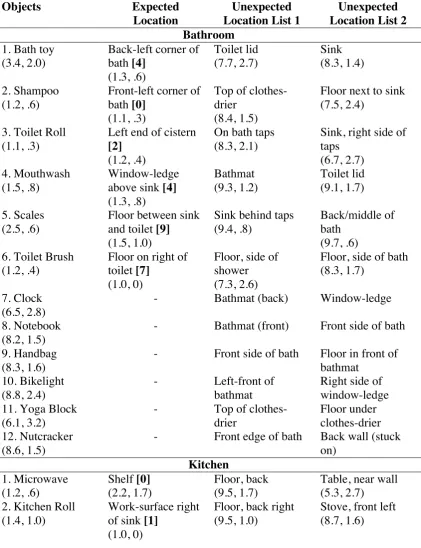
Two normative studies were conducted to check both the schema relevance of the target objects selected for each room scene and the expectedness of object
rated the schema-relevance of each of the 12 objects associated with each of the 4 rooms on a scale of 1 (very usual) to 10 (very unusual). The objects were
photographed individually in canonical orientations with background removed using GIMP (free picture editing software, http://www.gimp.org). The means and SDs of the ratings for each object are displayed in Table 1. The mean typicality ratings for all expected objects were below 3 and all typicality ratings for schema-irrelevant objects were above 5, the only exceptions being the doll and bed pillow for the living room, and the kettle for the office. For the bed pillow, the cause of the ratings may have been the confusability of the image with a cushion, which was not an issue when the object was seen in the living room context and relative size could be gauged. The effect of having these few objects with low atypicality ratings may be to weaken differences between types of objects, thus leading to more conservative effects.
In the second normative study, 12 undergraduate and postgraduate participants (9 females, mean age 20.5yrs, range 18-26 years) rated the expectedness of the
location of the schema-consistent objects on a scale of 1 (very usual) to 10 (very unusual). The means and SDs of these ratings are also presented in Table 1. All means for the schema-expected locations were between 1-3 and all means for the unexpected locations were above 5, the only exceptions being the paper lamp on the mantel-piece in the living-room scene and the desk-chair at the table in the office scene. The ratings for these 2 object-location pairings were still higher in terms of being considered more unusual than the ratings for the schema-expected locations however.
Design.
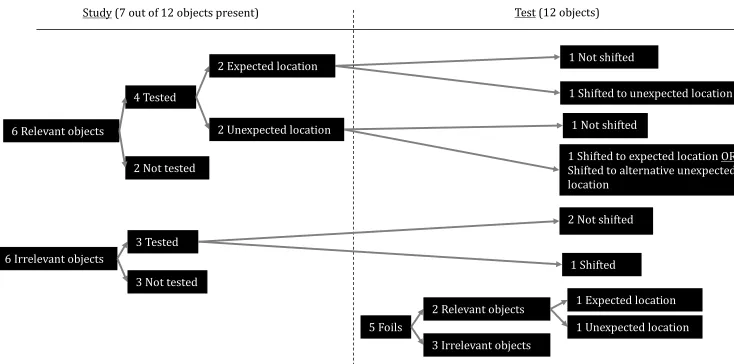
Figure 2 illustrates the design of Study 1 in terms of types of objects (schema relevant or irrelevant) present in each of 4 scenes (bathroom, kitchen, living room, office), whether they were target objects present during study, or foils only present during a recognition test, whether the target objects were studied in expected,
unexpected or irrelevant locations, and whether the target objects shifted or remained in place between study and test. A mixed design was employed. The between-subjects factor was that of condition, whereby in the shift-to-expected condition one schema-consistent object in each room that was initially in an unexpected location was shifted to an expected location. In the shift-to-unexpected condition, the same object was shifted to a different unexpected location. It was necessary to make this a between-subjects factor so that the same objects within the same contexts could be compared purely in terms of where they were moved to in test photographs, something which would not be possible in a fully within-subjects design.
distinctiveness effects to those obtained in prior research for schema-irrelevant objects (Lampinen et al., 2001; Pezdek et al., 1989). The proportion of Yes responses to the question, “was this object in this place before”, was used as the dependent variable and only the non-shifted objects were used in the analysis. Proportions were used for the total number of schema-relevant objects that were in expected locations across the 4 rooms, calculated out of a total possible 4. This was the same for the total number of relevant objects in unexpected locations and the total number of schema-relevant objects only present in test images, either at expected or unexpected
locations. However, there were 8 schema-irrelevant objects in total (2 per room) that did not shift between test and study images. There were 9 schema-irrelevant objects (3 per room) that were not present at study but were present in test images. The reason for this imbalance was so that we could have equal numbers of schema-relevant and schema-irrelevant target objects per room as in previous research (Lampinen et al., 2001; Pezdek et al., 1989). A 2(Condition) x 3(Location) x 2(Present at Study) mixed analysis of variance (ANOVA) on the dependent variable proportion of Yes responses (correct response for objects present at study, and incorrect for foils) was conducted to investigate true and false memories as a function of object type and location.
The second dependent variable was the proportion of correct responses to the question, “was this object in this place before”, where only shifted objects were analyzed. Note that the correct response was always “no”. To address the question of whether there was a difference across conditions in the proportion of correct
responses to shifts in schema-relevant objects originally in unexpected locations, a 2(Condition) x 3(Location) mixed ANOVA was performed on the proportion of correct responses for shifted objects.
For all analyses, tests of significance were 2-tailed, and a p-value of < .05 was used to reject the null hypothesis. The Greenhouse-Geisser correction for unequal variances was applied where relevant in all analyses.
As outlined in the Stimuli section, 12 different versions of each of the 4 room scenes were constructed to counterbalance which irrelevant objects were present (either those numbered 7.-9. or 10.-12. in Table 1), which unexpected locations were used (list 1 or 2 in Table 1), and which of the schema-relevant objects took the role of being in expected, unexpected or not present locations (2 objects in each of these roles in each photograph). Additionally, in order to counterbalance which of the 2 schema-relevant objects in each role remained in place (one version) or shifted (the second version; shifting from list 1 to list 2 locations or vice versa), each study version of the scene was paired with one of 2 test photographs. Finally, in test photographs, which irrelevant object shifted out of the possible 3 was counterbalanced, as well as which schema-relevant foil was located in an expected or unexpected location in the test photograph (see Figure S1 for exact scheme used to derive different scene versions).
are fruit-bowl and kitchen roll. The walking boots, bath towel and doll serve as the irrelevant target objects. In the test image, the toaster shifts from the work-surface to an unexpected location on the floor, the teapot shifts from the stool to an expected place on the work-surface and the bath towel shifts from the table rail to the back of the stool. The kitchen roll is added as a foil in an expected location (work-surface to the right of the sink), and the fruit-bowl is added as a foil in an unexpected location (foot-shelf of table). Three further irrelevant objects are also added as foils (pile of books, umbrella and hat). The only difference between test photographs in each condition was in the single schema-relevant object in each room initially seen in an unexpected location that then shifted to an expected location (shift-to-expected condition) or shifted to a different unexpected location (shift-to-unexpected) in the test photograph (Figure S1). In the example in Figure 2, the teapot would shift to the foot-shelf of table instead of the work surface in the shift-to-unexpected condition, with all other target objects and foils being the same between conditions.
Procedure.
The task consisted of a study phase, followed by a distractor task, followed by a recognition memory test. Participants were instructed that they would be presented with 4 scenes for 12 seconds each and then be tested on their memory for that scene. Following a 30s distractor task after the presentation of one of the scenes, participants were presented with a test scene, where objects would be highlighted in turn, and they would be required to press either the Y key for “Yes” or the N key for “No” in answer to the memory question, “was this object in this place before”. During training, it was made clear that a “no” answer could be based on lack of memory for the object itself or a judgement that the object had been present but in a different location. When participants were ready, they could press the return key to advance to the next scene. The process was rehearsed using the laminated and printed training image of a
seminar room in which a potted plant, desk, exercise machine, and kettle were used as target objects, each of which was circled in a test image. The task lasted
approximately 10 minutes in total. The distractor task was a reaction time task in which participants had to press any key in response to a target animal appearing on the screen (e.g., cat) amidst distractor animals (e.g., hippopotamus, giraffe, and frog). During presentation of test scenes, there was a 0.5s interval between the participant pressing the Y or N key and the next object being highlighted. Responses (Y or N key-presses) to the relevant image and circled target objects were recorded
automatically as part of the PsyScript program.
The order in which the four room scenes were presented was
Results
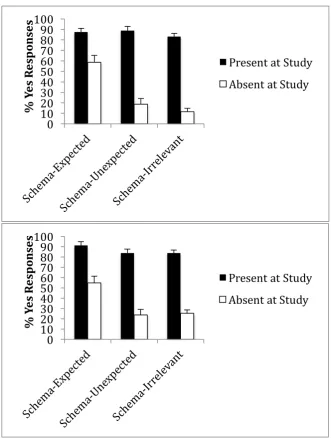
Accuracy of memory for non-shifted objects as a function of location. Figure 3 shows the means (and SEs) for percentage of Yes responses as a function of whether the objects were present at study and whether they were in
schema expected, unexpected, or irrelevant locations. In order to address the question of whether schema-relevant objects in unexpected locations demonstrate similar distinctiveness effects to those found in earlier research with schema-irrelevant objects (Brewer & Treyens, 1981; Lampinen et al., 1991; Mäntylä & Bächman, 1992; Pezdek et al., 1989), a mixed 2(Condition) x 2(Study: present, absent) x 3(Location: expected, unexpected, irrelevant) ANOVA was conducted on the proportion of Yes responses. Only the objects present at study that remained in their original locations, and the objects added in as foils in test photographs, were included in the analysis.
As expected, there was no significant main effect and no significant
interaction effects involving the between-subjects factor of condition. Participants in both conditions experienced the same stimuli in terms of non-shifted objects. There was a main effect of location, driven by the far higher false memory rates for schema-relevant objects in expected locations, F(1.6, 59.6) = 27.1, p < .0001, η2p = .42, and a main effect of study, whereby the proportion of Yes responses was far higher for objects present at study versus foils, F(1, 38) = 431.6, p < .0001, η2p = .92. As predicted, there was a significant interaction between location and study, F(1.6, 61.4) = 23.2, p < .0001, η2
p = .92. Planned contrasts demonstrated that this effect was due to the predicted higher level of false memories for schema-relevant objects presented in expected locations at test, relative to schema-relevant objects presented at
unexpected locations, t(39) = 5.8, p < .0001, mean difference = 35.6%, 95% CI [23.1, 48.2], d = .9, and also relative to schema-irrelevant objects, t(39) = 8.1, p < .0001, mean difference = 38.3%, 95% CI [29.8, 47.3], d = 1.3. There was no reliable difference between levels of false memories for schema-relevant objects in
unexpected locations and schema-irrelevant objects (p = .5). There were no reliable differences between levels of true memories for schema-relevant objects at expected or unexpected locations, or these objects and schema-irrelevant objects.
Accuracy of memory for shifted objects as a function of location.
Figure 4 shows the means (and SEs) for percentage of correct responses as a function of whether the objects were originally present at study in schema expected, unexpected, or irrelevant locations, before being shown in different locations in the test photograph. In order to address the question of whether schema-driven false memory effects are detectible for object-location bindings, a 2(Condition) x
difference between conditions at each location being in the comparison of objects that were originally in unexpected locations, t(38) = 2.3, p = 0.03, mean difference = 18.8%, 95% CI [35.6, 1.9], d = .7.
Discussion
Consistent with prior research using real schema-inducing room environments (Brewer & Treyens, 1981; Lampinen et al., 2001; Mäntylä & Bächman, 1992; Pezdek et al., 1989), we obtained high levels of both true and false memories for schema-consistent objects in expected locations, together with high levels of true memories coupled with low levels of false memories for schema-irrelevant items, as predicted by distinctiveness effects. Thus, the use of photographic stimuli did not act to reduce these effects (see also discussion in Pezdek et al., 1989). Our results also demonstrate that a schema-relevant object in an unexpected location seems to attract similar levels of attention as schema-irrelevant objects because there was no difference in the levels of true and false memories between consistent objects in unexpected locations and irrelevant objects. Despite this “pop-out” effect for schema-relevant objects in unexpected locations, there were higher levels of false memories for the location of these objects when seen in schema-expected locations at test, relative to seeing these objects in different unexpected locations. This result was predicted by our analysis of schema-driven false memory effects acting on binding between elements, due to evoked schema-expected bindings leading to source memory confusions, acting independently of memory for the elements in isolation.
An alternative account for the pattern of results obtained for the shifted objects cannot be ruled out however, one based on analyses of data utilizing an
adaptation of the source memory paradigm (Batchelder & Riefer, 1990; Johnson et al., 1993). Typically in these paradigms, participants study items linked to at least two different sources (e.g., two lists of behaviors associated with two different
individuals such as a skinhead and a priest; Sherman & Bessenoff, 1999) and are then required to identify items as old or new from a set including foils, followed by a judgement as to the source of the item if identified as old. Some studies (Bayen & Kuhlmann, 2011; Bayen, Nakamura, Dupuis, & Yang, 2000, Experiment 1; Konopka & Benjamin, 2009; Mather, Johnson, & De Leonardis, 1999) obtain a misattribution bias whereby stereotypically inconsistent pairings are misattributed to the consistent source (e.g., a prosocial behavior originally linked to the skinhead is misremembered as belonging to the priest) but often no schema-driven source misattribution bias is found (Bayen & Kuhlmann, 2011; Cook et al., 2003, Experiment 2; Hicks &
Cockman, 2003; Kleider, Pezdek, Goldinger & Kirk, 2008; Kuhlmann, Vaterrodt, & Bayen, 2012, Experiment 1). Bayen and Kuhlman (2011) argue that null effects are due to participants being aware of the equal probabilities during encoding. In studies where the equal probabilities are less transparent, a misattribution bias can be
participants do not have true recall, they guess in a positively biased manner towards expected conjunctions (e.g., endorsing that a priest was the source of a prosocial behavior).1
Following similar arguments in the recognition paradigm utilized in Study 1, it is possible that the level of true memory for object-location bindings across all the objects and locations was between 50-60% approximately, the level of accuracy obtained for the schema-relevant objects shifted from unexpected to expected
locations. Other responses constitute guesses, in the absence of actual memory for the original object-location pairing. If these guesses are not biased in terms of yes/no responses , then levels of “no” responses (the correct response to the question “was this object in this place before”) would be expected to be between 70-80%, i.e., approximately 50% true memory for the original correct object-location pairing, plus 25% guess for a correct “no” response. Both the shifted irrelevant objects, and the relevant objects shifted from one unexpected location to another, attracted 70-80% correct responses, which would be consonant with this veridical memory plus unbiased guessing account. In the case of seeing a schema-relevant object in an expected location at test however, a schema-driven bias towards guessing “yes” may occur, such that the level of correct “no” responses remains between 50-60%, due to veridical memory only. Although this account contains a schema-driven effect, it does not depend on evoked schematically-relevant object-location bindings competing with memory for the unexpected binding seen during learning.
In addition to the potential guessing biases outlined above, some of the items that were shifted at test will not have been processed during study, thus effectively being new stimuli for participants (e.g., approximately 15% failure to recognize old non-shifted objects, see Figure 3). There will be a bias to endorse these items as old if they are schema-relevant objects seen in schema-expected positions, relative to irrelevant objects or schema-relevant objects seen in unexpected positions, thus accounting for a portion of the difference between conditions.
In order to try to distinguish the competition with the evoked expected bindings account from the guessing account of the results of Study 1, in Study 2 we devised a recall version of the task. This version also addresses the problem of distinguishing object-location binding memory failures from object memory failures. In Study 2, exactly the same initial study stimuli were used as in Study 1, but then
1
In terms of understanding schema-driven false memory effects acting on binding between elements, the source-monitoring paradigm presents a fundamental limitation relative to the novel paradigm we utilize in the present research. The
participants were presented with a photograph of the room without any of the target objects present. The 12 target objects were presented as icons on a side bar and participants were asked to select the objects they thought had been present (i.e., an object recognition task), and then to drag those objects to their remembered locations in the room (i.e., a location recall task). If we are correct in our analysis of why participants show relatively high levels of false memories for unexpected object-location bindings, then there should be a robust difference in the level of correct placements of schema-relevant objects originally viewed in unexpected locations, relative to schema-irrelevant objects, and the greater erroneous placements of the schema-relevant objects should be largely in expected locations. This predicted lower level of correct placement of schema-relevant objects originally seen in unexpected locations should occur despite similar levels of object recognition such as those obtained for the irrelevant objects, given the similarity in distinctiveness effects obtained in Study 1 for the non-shifted objects between schema-relevant objects in unexpected places, and schema-irrelevant objects.
Predictions concerning the schema-relevant objects originally seen in expected locations are more tentative in terms of object recognition. It could be argued that there will be lower levels of recognition of objects that were originally in expected locations, relative to those in unexpected locations or schema-irrelevant objects, due to the lower level of processing they receive during study. Pezdek et al. (1989) did find higher levels of recognition for irrelevant objects relative to schema-relevant objects when tested from a written list of objects, half of which were originally seen in vivo in a room scene. It is possible that when the recognition task does not involve exact reinstatement of the initial learning situation (e.g., a change from seeing the real object in a room to seeing a written label), the lower level of processing occurring at encoding due to schematic consistency has similar effects on memory performance as that found with recall tests (i.e., poorer performance for schema-relevant items; see Rojahn & Pettigrew, 1992; Stangor & McMillan, 1992). In Study 2, when the objects are seen as icons in canonical orientations and the task is to drag the icons to remembered locations, there may be sufficient differences between the encoding and test situation to support a prediction of lower levels of recognition for schema-relevant objects originally viewed in expected locations relative to objects in unexpected locations, and schema-irrelevant objects. Finally, as was found in Study 1, it can also be predicted that there will be higher levels of false recognition for schema-relevant foils relative to schema-irrelevant foils (Lampinen et al., 2001; Pezdek et al., 1989).
expected location, although not necessarily in the location chosen in the photograph studied (e.g., the work-surface to the right of the sink). It follows from this prediction that the majority of placement errors should be in schema-expected locations.
If guessing biases can account for the findings of Study 1, then levels of recall for location should be similar across all categories of objects, with the majority of errors in the schema-relevant objects being in expected locations. Unlike in Study 1 where similar actual levels of recall of object-location pairings can be masked by guessing biases towards “yes” responses when objects are viewed in expected locations, when objects have to be placed in the correct location from multiple possibilities, guesses can be distinguished from true recall.
Study 2
Method
Participants.
Participants were either first year psychology students gaining partial course credit for research participation, or non-psychology students from different levels of study at the university gaining small monetary compensation for participation. There were 32 participants (26 females, mean age = 19.2 years, range 18-27 years), with a further two participants tested but excluded from the final sample due to technical problems; one with saving data and the other with a program freeze during testing. This sample size is comparable to recall studies in related research (Pezdek et al., 1989). The study was approved by the University Ethics Committee and conformed to British Psychological Society and American Psychological Association ethical
guidelines. Stimuli.
The stimuli used in this experiment were the color digital photographs used in Study 1, (i.e., the original study scenes for the bathroom, kitchen, living room, and office). Half the participants saw one set of schema-irrelevant objects during study (7.-9. in Table 1) and the other half saw another set (10.-12. in Table 1). Additionally, half the participants saw the unexpected locations from list 1 (see Table 1) and half saw the list 2 unexpected locations (Table 1). Which of the 3 versions of the scene they saw in terms of the objects taking the roles of being in expected or unexpected locations was randomly selected for each participant (Figure S1). Stimuli were presented using the same PsyScript program (Slavin, 2003-14) as Study 1. For the test phase however, a switch was made to a Keynote file that contained 4 slides, one of each room (photographs again standardized to 1300 x 864 pixels), without any of the 12 objects associated with that room being present. The photographs were all taken on the same day with the same camera tripod position and settings as the relevant room photographs used in Study 1. The individual photographs of all the objects (12 per room, see Table 1) used for the normative study of object schema-consistency, were turned into icons of width 64 pixels, with varying heights to
The order of placement was randomized prior to testing for each participant. Figure 1 (bottom panel) provides an example of a kitchen slide after one participant has clicked and dragged on remembered objects, after viewing the photograph in the top panel of Figure 1.
For the purposes of training participants on the requirements of the task, a practice printed and laminated photograph was used that depicted a garden scene with 3 target objects: a football on the grass (e.g., schema-relevant object in an expected location), a garden gnome on top of a fence (e.g., schema-relevant object in an
unexpected location), and a cardboard packing box (e.g., schema-irrelevant object). A laminated test photograph was also used that did not contain the 3 target objects, where these objects were cut out and laminated individually along with a 4th
object (e.g., a garden slide) added as a further object icon that served as a foil.
Following the training, the room photographs were presented in PsyScript running on a 15.4 inch MacBook Pro laptop. After 15s of the same distractor task described for Study 1, a change was made to the relevant Keynote slide by the
experimenter while the participant looked away to a fixation point on the wall behind them. Once the participant had finished clicking and dragging objects to their
remembered locations, PsyScript was used to present the next room, with the switch to Keynote repeated until all 4 rooms were presented.
Design.
As with Study 1, the main within-subject factor was the location (expected, unexpected, and irrelevant) in which an object was placed in the original study image. Whether the object was present at study, or only present at test as an individual icon, was also varied. In terms of those objects present at study, there were two dependent variables examined. The first was the percentage of correctly recognized objects and the second was the percentage of correctly placed objects. An analysis of erroneous placements was also made in terms of whether the placement was schema-expected (only applying to schema-relevant objects), a substitution error (e.g., a placement was made where another object had been in the original image), or neither of these
categories. Additionally, for both schema-relevant and schema-irrelevant foils presented as icons in test stimuli, the proportion of falsely recognized objects was analyzed to address the prediction that more schema-relevant objects would be falsely recognized than schema-irrelevant objects. Placements of falsely recognized objects were also analysed into categories of schema-expectedness (for schema-relevant objects), substitutions, or “other”.
and the middle section of the bath in the bathroom scene, and left and right sides of the sink and cistern. In the office scene, there was an extended desk surface along one wall that naturally segmented into a back, middle, and near sections based on an angular wall contour to accommodate windows. For areas that had less clear segmentation (e.g., floor areas) for a placement to be correct it had to be adjacent to the correct feature near a wall (e.g., the bin to the near section of desk), or if more centrally placed originally (e.g., walking boots on the floor in kitchen scene), the placement had to be between the correct features (e.g., between table and stove for the boots). All errors and their classifications are listed in Tables S1-S3. These can be cross-referenced with the correct locations listed in Table 1. Out of a total of 604 placements, there were 6 disagreements between coders (1%). In these instances, placements were borderline (e.g., the phone being placed on the boundary between front and middle desk segments). It was decided to retain the codings by ARL because they were more conservative with regard to the hypotheses in 4 out of the 6 instances (e.g., ‘phone placement coded as correct).
For all analyses, tests of significance were 2-tailed and a p-value of < 0.05 was used to reject the null hypothesis. The Greenhouse-Geisser correction for unequal variances was applied where relevant in all analyses.
Procedure.
The task consisted of a study phase, followed by a distractor task, followed by a memory test. Participants were aware that their memory for objects and their location in scenes would be tested. Participants were instructed that they would be presented with 4 scenes for 12 seconds each.. Following a 15s distractor task after the presentation of one of the scenes, participants were asked to turn and look at a marked spot on the wall behind them. They sat in a desk-chair so as to be able to swivel around quickly. While they were not looking, the experimenter changed programs to the relevant room slide and then asked participants to turn back to face the laptop. This program change process took between 10-17s. Because the order in which room scenes was presented by PsyScript was pseudo-randomized, the experimenter needed to sit adjacent to the participant in order to know which slide to change to for the memory test. Once participants were engaged in the test phase, the experimenter read until the participant signalled that they had finished and were ready to continue to the next presentation of the next room scene.
The task took approximately 15 minutes to complete. On completion of the task, participants were thanked and debriefed.
Results
Correct object recognition as a function of location.
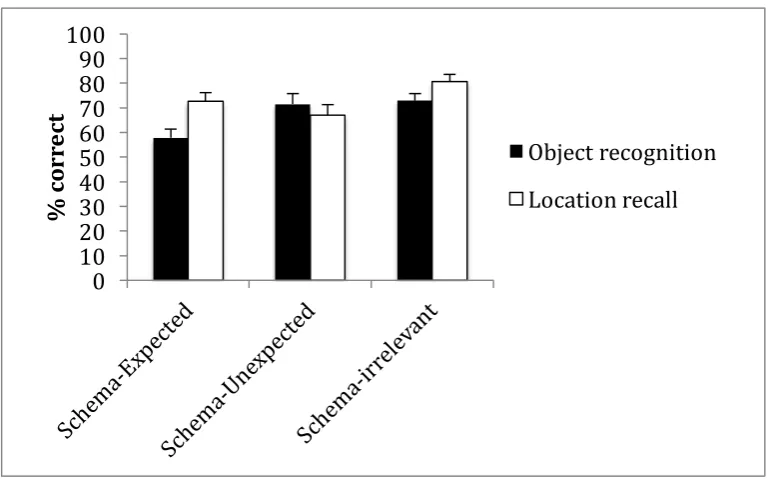
Figure 5 shows the means (and SEs) for percentage of correctly recognized objects as a function of whether they were in schema expected, unexpected, or irrelevant locations. In order to address the prediction that schema-relevant objects studied in expected locations will be less recognized than either relevant objects in unexpected locations, or irrelevant objects, a within-subject ANOVA with location as the factor was conducted. There was a significant effect of location, F(2, 62) = 10.44, p < .0001, η2
p = .25. Planned contrasts showed that the schema-relevant objects originally seen in expected places were more poorly recognized than schema-relevant objects seen in unexpected places, t(31) = 3.5, p = .001, mean difference = 13.7%, 95% CI [5.7, 21.6], d = .6, and than schema-irrelevant objects, t(31) = 4.6, p < 0.0001, mean difference = 15.1%, 95% CI [8.3, 21.9], d = .8. There was no difference in correct recognition levels for schema-consistent objects originally in unexpected locations and schema-irrelevant objects (p = .7).
Correct location recall as a function of study location.
Figure 5 also shows the means (and SEs) for the percentage of correctly placed objects following their correct recognition. In order to address the prediction that there would be fewer correct placements of schema-relevant objects studied in unexpected locations relative to schema-irrelevant objects, a within-subject ANOVA was conducted with location as the factor. There was a significant location effect, F(2, 62) = 5.05, p = .009, η2
p = .14. Planned contrasts indicated that the only reliable difference occurred in the comparison between schema-relevant objects studied in unexpected locations and schema-irrelevant objects, t(31) = -3.7, p = .001, mean difference = 13.6%, 95% CI = [6.0, 21.2], d = .6. The difference between placement of schema-relevant objects studied in expected locations and schema-irrelevant objects was not reliable (p = .3) and there was also no reliable difference relative to schema-relevant objects studied in unexpected locations (p = .06), although this was marginal. This relatively high level of correct placement of schema-relevant objects originally seen in expected locations went against predictions that performance would be poor due to low levels of attention to such consistent bindings, a point we return to in the discussion.
S2). Five of these errors to expected locations were also substitution errors. Of the remaining 11 errors to unexpected locations, 5 were substitution errors. There were 44 placement errors in total for the schema-irrelevant objects, 5 of which were substitution errors (Table S3).
False object recognition as a function of schema-relevance of foils.
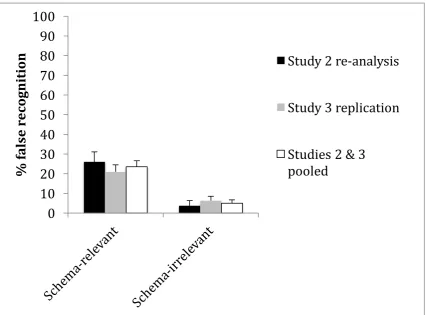
The mean proportion of false recognition of schema-relevant foils was 23.4% (SE = 4.1%) with the mean proportion for irrelevant foils being 3.6% (SE = 2.6%). This difference was significant, F(1, 31) = 36.46, p < .0001, , η2p = .54. The large majority of the falsely recognized relevant foils were placed in schema-expected locations (54/60). Otherwise, 3 placements were substitution errors and 3 placements were to unexpected locations.
Discussion
The results of Study 2 demonstrate the full paradoxical effect predicted by our analysis of potentially independent schema-driven false memory effects acting on individual elements of an event and the binding between elements. The effect of seeing a schema-relevant object in an unexpected location was to make the individual object more memorable, as evidenced by significantly higher recognition levels relative to schema-relevant objects seen in expected places. Despite this greater memorability for the object, levels of correct placement were significantly lower than for the irrelevant objects, as predicted by our analysis, but not by traditional
formulations of distinctiveness effects that do not distinguish between elements and their bindings (Schacter et al., 1999; Schank, 1982, 1999). The large majority of errors were placements to expected locations, as predicted by our account of competition between the actual object-location pairings, and evoked, schematically expected pairings. In addition, our results demonstrate that actual levels of true memory for object-location pairings are not equal across different categories of object, with those for irrelevant objects being higher. Therefore it is unlikely that the results of Study 1 can be accounted for by postulating equal levels of true memory across all location categories, with guessing biases leading to differences in results, or from biases to endorse non-recognized objects as old.
One possibility that needs to be considered is that because there is a tendency to falsely recognize schema-relevant foils compared to irrelevant foils, some of the objects that were classified as having been correctly recognized may have in fact been guesses. Therefore, differences in levels of correct placements between schema-irrelevant objects and both types of schema-relevant objects could be due to the noise introduced by this higher level of guessing towards schema-relevant objects generally. Although such guessing could make some contribution to the pattern of results
explained by schema-driven false memory effects acting independently on object-location bindings, despite superior object memory.
One unexpected result was the relatively high level of correct placement of schema-relevant objects originally viewed in expected places. Theoretically, we predicted that levels of correct placement would be lower than for schema-irrelevant objects due to low levels of processing and attention not only to the objects
themselves but to the schema-expected pairing of object with location. While a less counterintuitive prediction than that occurring for unexpected pairings, it is
nevertheless a novel prediction, as prior studies have focused on distinctiveness effects for individual schema-relevant objects rather than bindings, for example by introducing token changes in objects (Mäntylä & Bächman, 1992; Pezdek et al., 1989). It is therefore important to account for the finding of relatively good placement performance in the face of low levels of recognition of individual schema-relevant objects seen in expected locations.
One methodological possibility that could have accounted for the relatively high proportion of correct placements of schema-relevant objects originally seen in expected places was that the locations that were used in our stimuli may have matched preferred default places for those items (e.g., fruit bowl on table), such that even with no memory component involved, those objects would be likely to be placed in those locations. Although for most of the schema-consistent objects there were multiple possible expected locations, we wondered if for a few objects this would not be the case and, therefore, that guesses were inflating the proportion of correctly placed objects originally seen in expected locations. We addressed this issue in Study 3 by first of all asking a group of 12 participants to place the schema-relevant objects used in the study within the room photographs in locations they considered usual for those objects. No memory component was involved; this normative study allowed us to establish if there were default locations that matched those locations used in the stimuli in Studies 1 and 2. A small subset of objects were identified where there was a match between default placements and the locations used in Studies 1 and 2. We then reanalyzed the data from Study 2, completely excluding the objects where default placements matched those used in the memory stimuli. Our expectation here was that all of the same effects would be found as in the analysis reported for Study 2, except that the level of correct placements for schema-relevant objects seen in expected places would now be significantly lower relative to irrelevant objects, due to the exclusion of guesses scored as correct for objects where the default placement matched the placement in the memory stimuli (e.g., fruit bowl on table). We also replicated Study 2 with 32 new participants, to establish the reliability of results. The reanalysis of Study 2 data, the new data for the replication in Study 3, and the pooled results, are all presented, where in all datasets the 7 objects identified in the normative study were excluded when deriving the dependent measures.
Study 3 Method
Participants were either first year psychology students gaining partial course credit for research participation or students from different levels of study at the university gaining small monetary compensation for participation. There were 12 participants (9 females; mean age = 25.3 years, range 18-38 years) in the normative study investigating default placements of schema-consistent objects, and 32
participants (24 females; mean age = 20.0 years, range 18-26 years) in the replication of Study 2.
Stimuli.
In the normative study, the same Keynote slides utilized in Study 2 were used. The order in which the rooms were presented in the file was pseudo-randomized and the order in which the objects appeared as icons on the right of the room photographs was randomized for each participant. Only the 6 schema-consistent target objects used in Studies 1 and 2 were presented. The stimuli for the replication study were identical to those used in Study 2.
Design and Procedure.
In the normative study, participants were told that they would see some materials originally used in a memory study and that it was necessary to ascertain the locations at which certain objects would be placed in a room scene at a baseline level. They were then shown the first slide in the Keynote file in which the room
photograph with associated schema-relevant icons was displayed. They were asked to click on each of the 6 objects in turn and drag them to a location they thought was usual for that object. They were reassured that the size and orientation of the object would look odd and that the icons were simply markers for locations. They were asked to work their way sequentially through the 4 slides of the 4 different rooms and to signal to the experimenter when they had finished. On completion of the study, they were thanked and debriefed.
The number of times (out of a maximum of 12) that a participant placed an object in the same location as that used for the expected locations in Studies 1 and 2 is displayed in square brackets in Table 1. There were 7 objects where the majority of placements were at the same location as that used in Studies 1 and 2. These were the scales, toilet brush, fruit bowl, pan, TV, painting, and ‘phone.
In the replication study, the design and procedure was identical to that in Study 2, except that the seven objects listed above were excluded completely from analyses when deriving proportions of correct recognition, recall, and false
recognition. We also report a re-analysis of the Study 2 data excluding these objects, as well as a pooling of Study 2 and Study 3 data with these exclusions, to maximise the reliability and replicability of the results (a list of all placement errors for the replication study is provided in Tables S1-S3, where errors on the full set of objects are reported for completeness, although excluded objects are identified in italics). Results and Discussion
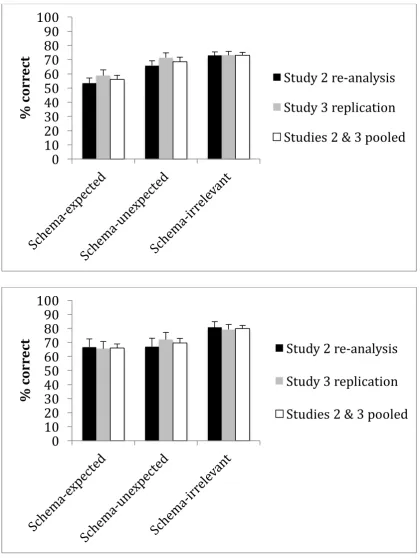
memory stimuli matched default placements. The higher level of recognition of schema-relevant objects in unexpected locations, as well as schema-irrelevant objects, relative to schema-relevant objects seen in expected locations was robustly replicated across the 3 datasets. For the pooled data set, a single factor ANOVA with the 3 levels of location was conducted on the proportion of correctly recognized objects, which showed a significant effect of location, F(2, 126) = 13.15, p < .0001, η2p = .17. The same pattern of results was obtained for the Study 2 reanalysis and Study 3
replication, with effect sizes of .23 and .13 respectively. Planned contrasts on the pooled data showed that the schema-relevant objects studied at expected locations were poorly recognized relative to the other two categories of objects (largest p = .001). There was no reliable difference between schema-relevant objects studied at unexpected locations and irrelevant objects (p = .18). The same pattern of effects was seen in the Study 2 and Study 3 data sets. Thus, as expected, the recognition data remains similar to the analysis using the full set of objects used in Study 2.
The bottom panel of Figure 6 displays the percentage of correctly recalled locations of objects in the Study 2 reanalysis, the Study 3 replication, and the pooled data, with full exclusion of the 7 objects where the schema-expected locations used in the memory stimuli matched default placements. In the pooled dataset there was a significant location effect, F(1.7, 108) = 5.76, p = .004, η2p = .09, Planned contrasts showed a significant difference between schema-relevant objects studied at expected locations and irrelevant objects, t(63) = 3.31, p = .002, mean difference = 13.79%, 95% CI [5.47, 22.12], d = .51, as well as schema-relevant objects studied at
unexpected locations and irrelevant objects, t(62) = 2.88, p = .006, mean difference 10.04%, 95% CI [3.06, 17.2], d = .41. There was no difference between the two schema-relevant object categories (p = .40). Although the pattern of results was similar for the Study 2 reanalysis and the Study 3 replication, the location effect was marginally significant in both cases (p = .06 and .09 respectively, with effect sizes of .23 and .10), due to lower power.
These results suggest that levels of correct placement of schema-relevant objects originally seen in expected locations that was found in Study 2 may have been somewhat inflated by the match between baseline preferences for placing certain of the objects used in the study and the expected locations that we selected in the
memory stimuli. The levels of correct placements found in Study 3 in the light of the baseline data obtained in the normative study are more in keeping with predictions that correct placement would be relatively lower than for irrelevant objects, due to lower levels of processing on schema-expected object-location pairings during study of the room scenes. An analysis of placement errors in the Study 3 replication (Tables S1-3) found that 87.5% (42/48) of erroneously placed schema-relevant objects viewed in expected locations were to alternative expected locations, similar to Study 2.
replication (Table S2) showed that 82.69% (43/52) of these errors were to schema-expected locations, again similar to Study 2. Thus, the prediction that memory for object location-binding for schema-relevant objects in unexpected locations would be relatively low due to competition from evoked consistent bindings, has been further supported in Study 3. Interestingly, there was also occasional evidence of errors where a schema-irrelevant object was substituted by a schema-relevant object more in keeping with a location (e.g., the computer was placed on the desk where in fact the climbing shoes had originally been viewed). It is possible in such cases that a location evokes an object during encoding, which can then compete with the schema-irrelevant object-location binding. Alternatively or additionally, there may be memory that an unspecified object was present at that location, and then a “best-guess” is made from the choice of objects available.
Finally, the levels of false memories for schema-relevant foils remained similar in the Study 2 reanalysis and Study 3 replication study (see Figure 7). For the pooled data, the difference between false recognition of schema-relevant versus irrelevant foils was significant, F(1, 63) = 48.5, p < 0.0001, ηp2 = .44. For the schema-relevant foils in the Study 3 replication, 97.9% (46/47) were to schema-expected locations (Table S3).
General Discussion
Since the founding work of Bartlett (1932) on the multiple effects of schemata on the processing and remembering of new information, robust schema-driven effects have been established. These effects, which we summarized using the term
guessing biases accounting for any differences in performance (Bayen & Kuhlmann, 2011).
A question arises as to the generality of our model positing independent distinctiveness effects for elements and their bindings. Because we suggest that the possibility of independent distinctiveness effects arises as a consequence of the action of temporal lobe memory systems acting to bind together different aspects of events stored in separate brain systems (Horner & Burgess, 2013, 2014; McClelland et al., 1995), it should be possible to demonstrate such effects over a range of types of material, beyond object-location bindings. Guided by our theoretical analysis and results, we re-examined findings from the literature using the source-monitoring paradigm where schematically relevant information is presented at encoding. If participants are not cognizant of the actual and equal probabilities of different sources being correct in such studies (Bayen & Kuhlmann, 2011), we would expect a pattern of results of greater recognition of items forming unexpected bindings as being “old” rather than “new”, but similar levels of accurate source memory, as obtained in our studies, between schema-expected and schema-unexpected bindings, assuming the recognition task did not directly reinstate encoding conditions (as in studies 2 and 3).
A study by Kleider and colleagues (Kleider et al., 2008) conformed to these design characteristics, and due to the inclusion of filler items specifically aimed at making the structure of the task less transparent, may have avoided artifacts due to participants being aware of the task structure (Bayen & Kuhlmann, 2011). In this study, participants watched short videos of two characters, a male handyman and a female homemaker, carrying out schema-expected actions, schema-unexpected actions, and neutral action fillers (e.g., drinking water). At test, after 2 minutes of distractor tasks, sets of actions that were originally performed by the expected or unexpected actor, together with foils, were presented in written form, so the
recognition context did not reinstate learning conditions. Participants had a higher hit rate in terms of old/new judgements for actions that had been performed by the schema-unexpected actor, but there was no difference in the accuracy of their source memory between correctly remembered actions performed by the schema-expected actor versus the schema-unexpected actor. The authors found it hard to account for these results within existing theoretical frameworks, but they are consistent with our model and findings.
Future research using a forced-choice recognition paradigm may be helpful for establishing whether the competition effects that we posit between the veridical unexpected, and associatively evoked expected, object-location bindings are occurring at the earliest stages of encoding, or following encoding of the veridical binding. Low performance when the veridical unexpected binding is present among foils may indicate interference at the level of encoding, rather than the more usual view of source memory errors as arising from associatively evoked items following encoding.2 Eye-tracking data on how attention is being allocated during initial study of scenes would also provide more direct evidence for the proposed difference in attentional
2
capture between schema-relevant objects in expected versus unexpected locations, as has been successfully demonstrated for relevant versus irrelevant items within scenes in prior research (e.g. Loftus & Mackworth, 1978). Such data may also help to corroborate whether objects were scanned, however briefly, during study, providing more confidence in correct judgements during recognition and recall tests.
There has been a recent increase in theory and research concerning the brain systems underlying the interaction between schematic knowledge and episodic memory (Preston & Eichenbaum, 2013; van Kesteren, Ruiter, Fernández, Henson, 2012), with the ventromedial prefrontal cortex identified as a key region mediating between cortical networks thought to underpin schematic knowledge on the one hand, and temporal lobe (especially hippocampal) areas underpinning specific event
memory on the other. In terms of understanding the neural basis of schema-driven memory distortions, Warren and colleagues (Warren, Jones, Duff, & Tranel, 2014) found that patients with ventromedial prefrontal cortex damage showed unimpaired true memory for lists of semantically-related words relative to controls, but lower levels of false memories for semantically-related critical lures. Because memory for items actually presented on these lists was not mediated via schemas activated during list presentation (i.e., in these lists, variation in associative strength from the list items themselves to the non-presented falsely remembered item is not correlated with true memory; see Roediger, Watson, McDermott, & Gallo, 2001), only false recall is mediated by schema activation. These findings are consistent with those of Aminoff, Schacter, and Bar (2008) who found that higher activation of left medial prefrontal cortex (as well as bilateral activation of retrosplenial and lateral parietal cortices) during encoding of items strongly associated with a context, was related to later false alarms to new items linked to the evoked context, relative to correct rejections of such items. In terms of schema-unexpected bindings, Straube and colleagues (Straube, Meyer, Green, & Kircher, 2014) found greater activation in anterior and posterior cingulate cortices, as well as anterior thalamic areas, congruent with heightened attention and surprise reactions, relative to schema-expected bindings, for correctly remembered unexpected sentence-gesture pairings.
These neuropsychological and imaging studies may be considered as preliminary steps to understanding the neural basis of schema evocation, as well as heightened attention to schema-mismatching stimuli. In the paradigms utilized in the present research, as well as studies such as Kleider et al. (2008), it would be expected that stimuli containing schema-unexpected bindings between elements would both highly activate cortical networks (schema evocation), ventromedial prefrontal areas, and lead to surprise “mismatch” reactions, potentially involving cingulate and thalamic areas. How the interplay between activations in these areas and temporal lobe systems results in either correct memory or schema-driven false memory could be informative in terms of further understanding schema-driven false memory effects, using suitably adapted paradigms for imaging research.
remembering unexpected conjunctions of objects and locations in the face of superior memory for the object itself, using naturalistic scenes. It is important to extend this work to the complex event stimuli used in applied forensic research (e.g., Aizpurua et al., 2009; Migueles & García-Bajos, 1999) in order to establish whether such
vulnerabilities could exist in potential misattributions of actions or dialogue in a schema-congruent fashion. Additionally, it is well known that jurors, once they have developed a schema for the evidence being presented in a trial, not only tend to remember schema-relevant information and ignore schema-irrelevant facts, but also frequently misremember “facts” not in evidence but that are schema-relevant (Huntley & Costanzo, 2003; Pennington & Hastie, 1993). Of course these errors involve both “objects” (evidentiary “facts” ranging from words allegedly heard in a conversation to a “smoking gun”) and their bindings, information that has been previously stored in memory and activated based on trial evidence. Whether these objects and their schematic bindings can be dissociated in jury research contexts as they were in our studies is a question for subsequent research.
In conclusion, in this research we extend the application of distinctiveness effects whereby schema-irrelevant items are better remembered that schema-relevant items, to include the idea that distinctiveness effects can act independently on
Acknowledgements
References
Aizpurua, A., Garcia-Bajos, E., & Migueles, M. (2009). False memories for a robbery in young and older adults. Applied Cognitive Psychology, 23, 174-187. doi: 10.1002/acp.1461
Aminoff, E., Schacter, D. L., & Bar, M. (2008). The cortical underpinnings of context-based memory distortion. Journal of Cognitive Neuroscience, 20, 2226-2237.
Bartlett, F. C. (1932). Remembering: A study in experimental and social psychology. Cambridge, UK: Cambridge University Press.
Batchelder, W. H. & Riefer, D. M. (1990). Multinomial processing models of source monitoring. Psychological Review, 97, 548-564.
Bayen, U. J. & Kuhlmann, B. G. (2011). Influences of source-item contingency and schematic knowledge on source monitoring: Tests of the probability-matching account. Journal of Memory and Language, 64, 1-17. doi:
10.1016/j.jml.2010.09.001
Bayen, U. J., Nakamura, G. V., Dupuis, S. E., & Yang, C.-L. (2000). The use of schematic knowledge about sources in source monitoring. Memory & Cognition, 28, 480-500.
Brewer, W. F. & Treyens, J. C. (1981). Role of schemata in memory for places. Cognitive Psychology, 13, 207-230.
Bower, G. H., Black, J. B., & Turner, T. J. (1979). Scripts in comprehension and memory. Cognitive Psychology, 11, 177-220.
Byrne, P., Becker, S., & Burgess, N. (2007). Remembering the past and imagining the future: A neural model of spatial memory and imagery. Psychological Review, 114, 340 –375. doi:10.1037/0033- 295X.114.2.340
Cook, G. I., Marsh, R. L., & Hicks, J. L. (2003). Halo and devil effects demonstrate valenced-based influences on source-monitoring decisions. Consciousness and Cognition, 12, 257-278. doi: 10.1016/S1053-8100(02)00073-9
Friedman, A. (1979). Framing pictures: The role of knowledge in automatized
encoding and memory for gist. Journal of Experimental Psychology: General, 108, 316-355.
Gallo, D. A. (2010). False memories and fantastic beliefs: 15 years of the DRM illusion. Memory & Cognition, 38, 833-848. doi: 10.3758/MC.38.7.833 Garcia-Bajos, E. & Migueles, M. (2003). False memories for script actions in a
mugging account. European Journal of Cognitive Psychology, 15, 195-208. doi: 10.1080/09541440244000102
Graesser, A. C., Gordon, S. E., & Sawyer, J. D. (1979).Recognition memory for typical and atypical actions in scripted activities: Tests of a script pointer + tag hypothesis. Journal of Verbal Learning and Verbal Behavior, 18, 319-332. Graesser, A. C., Woll, S. B., Kowalski, D. J., & Smith, D. A. (1980). Memory for
![Table [11]](https://thumb-us.123doks.com/thumbv2/123dok_us/1452668.97872/35.595.91.509.71.775/table.webp)