AMORTISED RESOURCE ANALYSIS WITH SEPARATION LOGIC
ROBERT ATKEY
University of Strathclyde, UK
e-mail address: [email protected]
Abstract. Type-based amortised resource analysis following Hofmann and Jost—where resources are associated with individual elements of data structures and doled out to the programmer under a linear typing discipline—have been successful in providing concrete resource bounds for functional programs, with good support for inference. In this work we translate the idea of amortised resource analysis to imperative pointer-manipulating languages by embedding a logic of resources, based on the affine intuitionistic Logic of Bunched Implications, within Separation Logic. The Separation Logic component allows us to assert the presence and shape of mutable data structures on the heap, while the resource component allows us to state the consumable resources associated with each member of the structure.
We present the logic on a small imperative language, based on Java bytecode, with procedures and mutable heap. We have formalised the logic and its soundness property within the Coq proof assistant and extracted a certified verification condition generator. We also describe an proof search procedure that allows generated verification conditions to be discharged while using linear programming to infer consumable resource annotations.
We demonstrate the logic on some examples, including proving the termination of in-place list reversal on lists with cyclic tails.
1. Introduction
Tarjan, in his paper introducing the concept of amortised complexity analysis [25], noted that the statement and proof of complexity bounds for operations on some data structures can be simplified if we think of the data structure as being able to store “credits” that are used up by later operations. By setting aside credit inside a data structure to be used by later operations, the cost of a sequence of operations can be amortised over time. In this paper, we propose a way to merge amortised complexity analysis with Separation Logic [19, 24] to formalise some of these arguments and to simplify the specification and verification of resource-consuming pointer-manipulating programs.
Separation Logic is built upon a notion of resources and their separation. The assertion
AB holds for some resource if it can be split into two separate resources that make A
true and B true respectively. Resource separation enables local reasoning about mutation of resources; if the program mutates the resource associated withA, then we know that B
1998 ACM Subject Classification: D.2.4, F.3.1.
Key words and phrases: resource bounded computing, amortised analysis, separation logic, java bytecode, program logic, resource models.
LOGICAL METHODS
lIN COMPUTER SCIENCE DOI:10.2168/LMCS-7 (2:17) 2011
c
R. Atkey
CC
is still true on its separate resource. Usually Separation Logic uses mutable heaps as its notion of resource. In this paper, we combine heaps with consumable resources to reason about resource consumption as well as resource mutation.
To see how Separation Logic-style reasoning about consumable resources is beneficial, consider the standard inductively defined list segment predicate from Separation Logic, augmented with an additional propositionRdenoting the presence of a consumable resource for every element of the list:
lsegpR, x, yq xy^emp
_
Dd, z. rx
data
ÞÑ dsrx
next
ÞÑ zsRlsegpz, yq
We will introduce the assertion logic properly in Section 4 below. We can represent a heap
H and a consumable resource r that satisfy this predicate graphically:
H
r
null a
R
b
R
c
R
d
R
So we have r, H|ùlsegpR, x,nullq, assumingx contains the address of the head of the list.
HererRRRR—we assume that consumable resources form a commutative monoid—
andr represents the resource that is available for the program to use in the future. We can split H and r to separate out the head of the list with its associated resource:
H1
r1
H2
r2
null a
R
b
R
c
R
d
R
This heap and resource satisfy r1r2, H1ZH2|ùrx
data
ÞÑ asrx
next
ÞÑ ysRlsegpR, y,nullq,
whereH1ZH2H,r1r2rand we assume thatycontains the address of thebelement.
Now that we have separated out the head of the list and its associated consumable resource, we are free to mutate the heap H1 and consume the resource r1 without affecting the tail
of the list. So the program can move to a new state where the head of the list has been mutated to Aand the associated resource has been consumed:
H1 H2
r2
null
A b
R
c
R
d
R
We do not need to do anything special to reason that the tail of the list and its associated consumable resource are unaffected.
specify amounts of resource that depend on the shape of data structures in memory. By the definition oflseg, we know that the amount of resource available to the program is linearly proportional to the length of the list, without having to do any arithmetic reasoning about lengths of lists. In Section 4.2 we describe some useful inductively defined predicates that maintain a close connection between shape and resources.
The association of resources with parts of a data structure is exactly the banker’s approach to amortised complexity analysis proposed by Tarjan.
Our original inspiration for this work came from the work of Hofmann and Jost [15] on the automatic heap-space analysis of functional programs. Their analysis associates with every element of a data structure a permission to use a piece of resource (in their case, heap space). This resource is made available to the program when the data structure is decom-posed using pattern matching. When constructing part of a data structure, the required resources must be available. A linear type system is used to ensure that data structures carrying resources are not duplicated since this would entail duplication of consumable re-source. This scheme was later extended to imperative object-oriented languages [16, 17], but still using a type-based analysis.
1.1. Contributions. We summarise the content and contributions of this work:
In Section 3, we define a program logic that allows mixing of assertions about heap shapes
and assertions about future consumable resources. Tying these together allows us to easily state resource properties in terms of the shapes of heap-based data structures, rather than in terms of extensional properties such as their size or contents. We have formalised the soundness proof of our program logic in the Coq proof assistant.
In Section 4 we present a syntax for our assertion logic, based on a combination of Boolean
Bunched Implications extended with pointer assertion primitives, as is usual for Separa-tion Logic, and affine intuiSepara-tionistic Bunched ImplicaSepara-tions to declaratively state properties of the consumable resource available to a program. We also discuss several useful induc-tively defined predicates for this logic that demonstrate tight connections between heap shapes and resources. We also discuss the advantages and disadvantages of this tight connection.
In Section 5, we define a restricted subset of the assertion logic that allows us to perform
effective proof search to discharge verification conditions, while inferring resource anno-tations. A particular feature of the proof search procedure we describe is that, given loop invariants that specify only the the shape of data structures, we can infer the necessary consumable resource annotations.
In Section 2 and Section 6, we demonstrate the logic on some examples, showing how
a mixture of amortised resource analysis and Separation Logic can be used to simplify resource-aware specifications, deal with relatively complex pointer manipulation and to prove termination in the presence of cyclic structures in the heap.
been refined for clarity and to better match the implementation. We have also included the merge-sort example in Section 2.2 from an invited TGC 2010 paper [2].
2. Motivating Examples
The example we gave in the introduction, where a program iterates through a list consuming resources as it proceeds, only demonstrates an extremely simple, albeit common, pattern. In this section, we give two more complex examples that serve to highlight the advantages of the amortised approach to specifying and verifying resource bounds. The first example, in Section 2.1, demonstrates how the integrated description of available consumable resources and heap structure helps with specification. The second example, in Section 2.2, shows how the amortised approach simplifies the problem of verifying the resource consumption of a pointer manipulating program. This example also shows a weakness of maintaining a tight connection between heap shape and consumable resources, which we discuss further in Section 4.3.
In each case we attempt to demonstrate how amortised reasoning is easier than the traditional approach of keeping a global counter for consumed resources as a “ghost” variable in the logic.
2.1. Functional Queues. We consider so-called functional queues [18, 8], where a queue is represented by a pair of lists. This example is a standard one for introducing amortised complexity analysis [21]. We verify an imperative implementation that performs mutations in-place on the underlying lists. The point of this example is to see how the amortised technique simplifies the specifications of the procedures operating on this data structure.
null
a b c d
e f
The top list represents the head of the queue, while the bottom list represents the tail of the queue in reverse. This structure represents the queuera,b,c,d,f,es. When we enqueue
a new element, we add it to the head of the bottom list. To dequeue an element, we remove it from the head of the top list. If the top list is empty, then we reverse the bottom list and change the top pointer to point to it, changing the bottom pointer to point to null, representing the empty list.
When determining the complexity of these operations, it is obvious that the enqueue operation is constant time, but the dequeue operation either takes constant time if the top list is empty, or takes time linear in the size of the bottom list in order to perform the reversal. If we were to account for resource usage by maintaining a global counter then we would have to expose the lengths of the two lists in specification of the enqueue and dequeue instructions. So we would need a predicatequeuepx, h, tq to state thatx points to
a queue with a head and tail lists of lengths h and t respectively. The operations would have the specifications (written as Hoare triples):
whererc is a ghost variable counting the total amount of resource consumed by the program,
and R is the amount of resource required to perform a single list node manipulation. The dotted minus t1 denotes the predecessor operation on natural numbers. Note that we
have had to give two specifications for dequeue for the cases when the head list is empty and when the head list has an element. The accounting for the sizes of the internals of the queue data structure is of no interest to clients of this data structure. These specifications complicate clients’ reasoning when using these queues.
Using amortised analysis, this specification can be drastically simplified. We associate a single piece of resource with each element of the tail list so that when we come to reverse the list we have the necessary resource available to reverse each list element. The queue predicate is therefore:
queuepxqDy, z.rx
head
ÞÑ ysrx
tail
ÞÑzslsegpe, y,nullqlsegpR, z,nullq
where lseg is the resource-carrying list predicate given above and eis the unit of the con-sumable resource monoid, representing no resource. The list holding the head of the queue has no resource associated with every element, while the list holding the tail of the queue does have a resource associated with every element, waiting to pay for the list reversal when it occurs. Diagrammatically, a queue with associated resources looks like this:
null
a b c d
e
R
f
R
The specifications of the operations now becomes straightforward:
tqueuepxqRRuenqueuetqueuepxqu tqueuepxqRudequeuetqueuepxqu
To enqueue an element, we require two elements of resource: one to add the new element to the tail list, and one to “store” in the list so that we may use it for a future reversal operation. To dequeue an element, we require a single element of resource to remove an element from a list. If a list reversal is required then it is paid for by the resources previously required byenqueue.
Once we have set the specification of queues to store one element of resource for every node in the tail list, we can use the resource annotation inference procedure presented in Section 5 to generate the resource parts of theenqueue and dequeuespecifications.
2.2. Merge-sort Inner Loop. We now describe a more complicated list manipulating program that shows the benefits of the amortised approach for verification. This example demonstrates the combination of reasonably complex pointer manipulation with resource reasoning. Most of the technical details arise from dealing with the heap-shape behaviour of the program; the resource bounds simply drop out thanks to the inference of resource annotations.
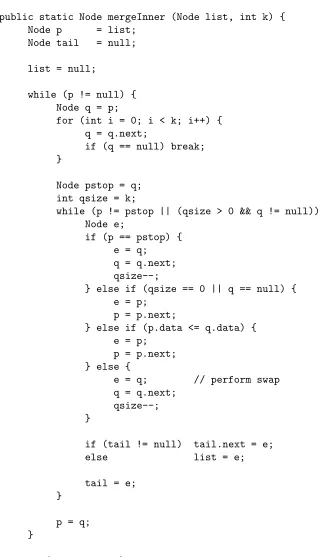
Consider the Java method declaration mergeInner shown in Figure 1 that describes the inner loop of an in-place merge sort algorithm for linked lists1. The method takes two arguments: list, a reference to the head node of a linked list; and k, an integer. The integer argument dictates the sizes of the sublists that the method will be merging in this
1Adapted from C code:
public static Node mergeInner (Node list, int k) {
Node p = list;
Node tail = null;
list = null;
while (p != null) { Node q = p;
for (int i = 0; i < k; i++) { q = q.next;
if (q == null) break; }
Node pstop = q; int qsize = k;
while (p != pstop || (qsize > 0 && q != null)) { Node e;
if (p == pstop) { e = q;
q = q.next; qsize--;
} else if (qsize == 0 || q == null) { e = p;
p = p.next;
} else if (p.data <= q.data) { e = p;
p = p.next; } else {
e = q; // perform swap
q = q.next; qsize--; }
if (tail != null) tail.next = e;
else list = e;
tail = e; }
p = q; }
if (tail == null) return null; else tail.next = null; return list;
[image:6.612.91.411.109.666.2]}
pass. The method steps through the list 2*kelements at a time, merging the two sublists of length k each time. The outer loop does the 2*k stepping, and the inner loop does the merging. To accomplish a full merge sort, mergeInner would be called log2n times with
doublingk, wherenis the length of the list.
Assume that we wish to account for the number of swapping operations performed by this method, i.e. the number of times that the fourth branch of the if statement in the inner loop is executed. We accomplish this in our implementation by inserting a special
consume instruction at this point.
The pre- and post-conditions of the method are as follows:
PrepmergeInnerq : listnull ^plsegpx,list,nullqR y
q
PostpmergeInnerq : lsegp0,retval,nullq
The precondition states that the first argument points to a list segment ending with
null, with x amount of resource associated with every element of the list, and y amount of additional resource that may be used. The actual values ofx and ywill be inferred by a linear program solver. The condition listnull is a safety condition required to prevent
a null pointer exception.
The outer loop in the method needs a disjunctive invariant corresponding to whether this is the first iteration or a later iteration.
plsegpo1,list,tailqrtail
next
ÞÑ?srtail
data
ÞÑ?slsegpo2,p,nullqR o3
q _ pplistnull ^tailnullqlsegpo4,p,nullqR
o5 q
The first disjunct is used on normal iterations of loop: the variable listpoints to the list that has been processed so far, ending attail; andppoints to the remainder of the list that is to be processed. We have annotated these lists with the resource variables o1 and
o2 that will contain the resources associated with each element of these lists. The second
disjunct covers the case of the first iteration, when list and tail are null and p points to the complete list to be processed. The resource annotation o4 will be filled in with the
amount of resource that is required for every element of the list to be processed. As one might expect, this will be equal to the value of x, the amount of resource required by the precondition of the method.
Moving on, we consider the first inner loop that advances the pointer qby k elements forward, thus splitting the list ahead of pinto ak-element segment and the rest of the list. The next loop will merge the firstk-element segment with thek-element prefix of the second segment. It is convenient for our implementation to split out this inner loop into another method2, with the following signature:
public static Node advance (Node l, int k)
The argumentlpoints to a linked list, and the method will advancekelements through the list (or until the end) and return a pointer to the split point. The specification of this method is:
Prepadvanceq : lsegpa0,l,nullq
Postpadvanceq : lsegpa0,l,retvalqlsegpa0,retval,nullq
Again, we have left the resource annotation on the elements of the list as a variablea0,
to be filled in by the linear solver. The appearance of the same variable in the pre- and post-condition implies that we expect this resource to be preserved by the method. The fact that we have had to explicitly mention the resources that must be preserved points to a limitation of the amortised method as we present it here. We discuss this issue further in Section 4.3.
Proceeding though our main method, the invariant of the inner loop is as follows, again as two disjuncts according to whether it is the first or later iteration of the outer loop:
plsegpi1,list,tailqrtail
next
ÞÑ?srtail
data
ÞÑ?s
lsegpi2,p,pstopqlsegpi3,q,nullqR i4
q
_ pplistnull^tailnullqlsegpi5,p,pstopqlsegpi6,q,nullqR i7
q
The first part of each disjunct is as before, stating thatlisttotailcontains the part of list that has been processed. Since we have now split the remainder of the list into two pieces we have two separate list segments referenced by pand qpointing to the parts of the list that are to be merged. The resource meta-variable i1 will indicate the amount of resource
associated with the list that has been processed; i2 and i5 are the amount of resource
associated with the “left-hand” pending list; andi3 andi4 are the resource associated with
the “right-hand” pending list.
At the end of the method, we null terminate the list and return. A superfluous null check on thisis required for our tool to prove memory safety. The fact that thisis non-null relies on the execution of the inner loop at least once, which requires thatk¡0. This
fact is not expressible in the logic of the implementation described in Section 5.
Running this example through our implementation produces the solution x1,y0
for the precondition’s resource annotations. This indicates that the input list needs to contain one element of resource for every list element. For the outer loop’s invariant, we obtaino2 o4 1 and all the others are 0. This indicates that the list we have processed has
had all its resources consumed, while the list remaining to be processed still has associated resources. This is as expected for a loop iterating through a list. The specification of
advance is completed by inferringa0 1, indicating that advancepreserves the resources
associated with the list. Finally the inner loop’s invariant has i2 i3 i5 i6 1 and
all others 0, indicating that the two list segments that are remaining to be processed have associated resources, while the processed segments do not.
The COSTA system [1] can deal with some uses of direct pointer manipulation, but accounts for the sizes of heap-based data structures by counting the length of the longest path from a given reference. Thus, it cannot deal with programs that demonstrate sharing on the heap; the Java method described above has, in its inner loop, three pointers all pointing to the same list.
One might also use Separation Logic to deal with sharing on the heap, and add informa-tion on the sizes of heap-based data structures to account for resource usage. So one would have a predicate lsegnpx, yq that describes a list segment of length n from x to y, along
with a ghost variable to track resource consumption as discussed in Section 2.1. We argue that the amortised approach described here is simpler due to the differences in reasoning between the global property of the length of a whole list, and the local property of each list element having an associated amount of resource to be used. For example, consider the specification of theadvance method using sized structures:
Prepadvanceq : lseg n
pl,nullq
Postpadvanceq : Dn1, n2. n1 n2 n^plseg n1
pl,retvalqlseg n2
pretval,nullqq
We have had to introduce two existential variables indicating the sizes of the lists returned by the method. These additional values have to then be related back to the length of the original list by the calling method, and thence to the resource consumption, requiring non-straightforward arithmetic reasoning. The amortised approach exploits the shape-reasoning already present in Separation Logic to account for resources.
3. A Program Logic for Heap and Resources
We now describe a simple programming language and a consumable-resource-aware logic for it. We define a “shallow” program logic where we treat pre- and post-conditions and pro-gram assertions as arbitrary predicates over heaps and consumable resources. In Section 4, we will layer on top of this a “deep” assertion logic where predicates are actually Separation Logic formulae augmented with atomic resource propositions.
At the end of this section, we consider a variant system that allows dynamic but fallible resource acquisition as well as resource consumption.
The development in this section has been formalised within the Coq proof assistant; thus the shallow embedding makes use of Coq’s own logic as the assertion logic. We also make minor use of Coq’s dependent types. Lemma 3.1 and Theorem 3.3 establishing the sound-ness of the program logic have been mechanically verified within Coq, as have Lemma 3.5 and Theorem 3.6 establishing soundness for the dynamic resource acquisition variant.
3.1. Semantic Domains. Assume an infinite setAof memory addresses. We model heaps as finite partial mapsHpAFqáfin V, whereFranges over field names andVA
K Z
represents the values that programs can directly manipulate: possibly null addresses and integers. We write dompHq for the domain of a heap and H1#H2 for heaps with disjoint
domains;H1ZH2 denotes union of heaps with disjoint domains.
Consumable resources are represented as elements of an ordered monoid pR,,, eq,
whereeis the least element. Example consumable resources includepN,¤, ,0qor pQ ¥0
,¤
, ,0q for representing a single resource that is consumed (e.g. time or space), or multisets
the asserter to assert that more resources are required by the program than are actually needed.
As is standard in the semantics of substructural logics [23], we make use of a ternary relation to describe the combination of separate entities. In our case, the entities are pairs of heaps and consumable resources:
Rxyz H1#H2^H1ZH2H3^r1r2r3
wherexpH1, r1q, y pH2, r2q, zpH3, r3q
We extend the order on resources to pairs of heaps and resources by pH1, r1qpH2, r2q iff
H1H2 andr1 r2.
3.2. A Little Virtual Machine. The programming language we treat is a simple stack-based virtual machine, similar to Java bytecode. We have removed the class-stack-based object system and virtual methods, but retained mutable heap and procedures. There are two types: intandref, corresponding to the two kinds of values inV. We assume a setPQpname
of procedure names, where a procedure’s name also determines its list of argument types and its return type. Programs are organised into a finite set of procedures, indexed by their name and individually consisting of lists of instructions from the following collection:
ι :: iconstz|ibinop op|pop|loadn|storen|aconst null
|binarycmpcmp offset |unarycmp cmp offset |ifnulloffset |goto offset
|newdesc |getfieldfnm |putfieldfnm |freedesc |consume r
|return|callpname
These instructions—apart from consume—are standard, so we only briefly explain them. Inside each activation frame, the virtual machine maintains an operand stack and a collec-tion of local variables, both of which contain values from the semantic domain V. Local variables are indexed by natural numbers. The instructions in the first two lines of the list perform the standard operations with the operand stack, local variables and program counter. The third line includes instructions that allocate, free and manipulate structures stored in the heap. The instructionconsumerconsumes the resourcer. Thedescargument to new and free describes the structure to be created on the heap by the fields and their types. The fourth line contains the procedure call and return instructions that manipulate the stack of activation frames.
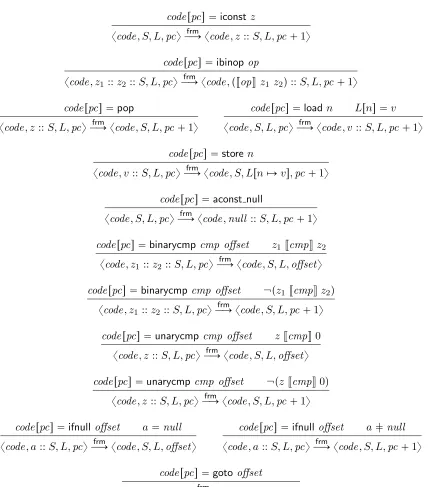
Individual activation frames are tuples xcode, S, L,pcy P Frm consisting of the list of
instructions from the procedure being executed, the operand stack and local variables, and the program counter. The first two lines of instructions that we gave above only operate within a single activation frame and have no effect on the heap or consumable resources, so we give their semantics as a small-step relation between frames: ÝfrmÑ FrmFrm defined
in Figure 2. The rules make use of semantic interpretations JopK and JcmpK of binary operations and binary relations on integers.
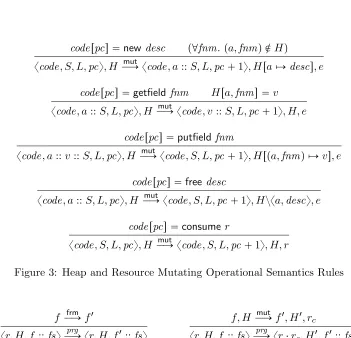
The third line of instructions contains those that manipulate the heap and consume resources. Their small-step operational semantics is modelled by a relation ÝmutÑ Frm
HFrm HR, which relates the before and after activation frames and heaps, and
For a descriptiondesc xfnm1 :τ1, ...,fnm
n:τny, we have writtenHraÞÑdescsto denote a
heap updated with pa,fnmiq ÞÑdefaultpτiq, where defaultpintq0 and defaultprefqnull.
For thefreeinstruction,Hzxa,descydenotes the removal of all elements with keyspa,fnm iq
inH.
coderpcsiconst z
xcode, S, L,pcy
frm
ÝÑxcode, z::S, L,pc 1y
coderpcsibinop op
xcode, z1 ::z2 ::S, L,pcy
frm
ÝÑxcode,pJopKz1 z2q::S, L,pc 1y
coderpcspop
xcode, z::S, L,pcy
frm
ÝÑxcode, S, L,pc 1y
coderpcsload n Lrnsv
xcode, S, L,pcy
frm
ÝÑxcode, v::S, L,pc 1y
coderpcsstoren
xcode, v ::S, L,pcy
frm
ÝÑxcode, S, LrnÞÑvs,pc 1y
coderpcsaconst null
xcode, S, L,pcy
frm
ÝÑxcode,null ::S, L,pc 1y
coderpcsbinarycmp cmp offset z1JcmpKz2
xcode, z1::z2::S, L,pcy
frm
ÝÑxcode, S, L,offsety
coderpcsbinarycmpcmp offset pz1 JcmpKz2q
xcode, z1 ::z2 ::S, L,pcy
frm
ÝÑxcode, S, L,pc 1y
coderpcsunarycmpcmp offset zJcmpK0
xcode, z ::S, L,pcy
frm
ÝÑxcode, S, L,offsety
coderpcsunarycmp cmp offset pzJcmpK0q
xcode, z::S, L,pcy
frm
ÝÑxcode, S, L,pc 1y
coderpcsifnulloffset anull
xcode, a::S, L,pcy
frm
ÝÑxcode, S, L,offsety
coderpcsifnulloffset anull
xcode, a::S, L,pcy
frm
ÝÑxcode, S, L,pc 1y
coderpcsgotooffset
xcode, S, L,pcy
frm
[image:11.612.95.523.187.674.2]ÝÑxcode, S, L,offsety
coderpcsnew desc pfnm.pa,fnmqRHq
xcode, S, L,pcy, H
mut
ÝÑxcode, a::S, L,pc 1y, HraÞÑdescs, e
coderpcsgetfieldfnm Hra,fnmsv
xcode, a::S, L,pcy, H
mut
ÝÑxcode, v::S, L,pc 1y, H, e
coderpcsputfield fnm
xcode, a::v::S, L,pcy, H
mut
ÝÑxcode, S, L,pc 1y, Hrpa,fnmqÞÑvs, e
coderpcsfree desc
xcode, a::S, L,pcy, H
mut
ÝÑxcode, S, L,pc 1y, Hzxa,descy, e
coderpcsconsumer
xcode, S, L,pcy, H
mut
[image:12.612.127.478.90.428.2] [image:12.612.105.513.401.511.2]ÝÑxcode, S, L,pc 1y, H, r
Figure 3: Heap and Resource Mutating Operational Semantics Rules
f ÝfrmÑf 1
xr, H, f ::fsy
prg
ÝÑxr, H, f 1
::fsy
f, H ÝmutÑf 1
, H1
, rc
xr, H, f ::fsy
prg
ÝÑxrrc, H 1
, f1
::fsy
coderpcsreturn
xr, H,xcode, v::S, L,pcy::xcode 1
, S1
, L1
,pc1 y::fsy
prg
ÝÑxr, H,xcode 1
, v ::S1
, L1
,pc1 y::fsy
coderpcscallpname prgrpnamescode 1
xr, H,xcode,args S, L,pcy::fsy
prg
ÝÑxr, H,xcode 1
,rs,xargsy,0y::xcode, S, L,pc 1y::fsy
Figure 4: Small-step Operational Semantics Rules
Note that all the rules in theÝmutÑrelation apart from theconsume instruction consume
no resources: e is the identity element of our resource monoid.
A state of the full virtual machine is a tuple xr, H,fsyPState, where r is the resource
consumed to this point,his the current heap, andfsis a list of activation frames. The small-step operational semantics of the full machine for some program prg is given by a relation
prg
ÝÑ StateState which incorporates the
frm
ÝÑ and
mut
ÝÑ relations and also describes how
thecallandreturninstructions manipulate the stack of activation frames. The rules defining this relation are presented in Figure 4. In the rule for the instructioncall, the operation denotes list concatenation, rs denotes the empty list and xy denotes the translation of a
list to a finite map from natural numbers in the obvious way.
Finally, we use the predicate sÓ H, r, v to indicate when a return instruction is to be
program terminates. TheH, r and v are the final heap, the total consumed resources and the return value of the program respectively.
3.3. Assertions. Every procedure pname in the program is annotated with a precondi-tion and a post-condiprecondi-tion. To allow for variables that are universally quantified over both the pre- and post-condition we make use of Coq’s dependent types to augment procedure specifications with a specific “environment” type. A procedure specification is a dependent triple:
xE:Type, P EV
HR, QEV
HRVy
PreconditionsP are predicates overEV
HR: environments, lists of arguments to
the procedure and the heap and available resource at the start of the procedure’s execution. Post-conditions are predicates over EV
HRV: environments, argument lists and
the heap, remaining consumable resource and return value.
Intermediate assertions in our program logic are predicates overEV
HRV
pNáVq: environments, argument lists, the heap, remaining consumable resource and the
current operand stack and local variable store. Intermediate assertions are the assertions that are attached to every instruction in the body of a procedure by our program logic and specify a sufficient precondition for safely executing that instruction and all of its successors. Note that each of the three different types of assertions talks about the remaining
consumable resources available to the program, not the resources that have already been consumed.
3.4. Program Logic. A proof that a given procedure’s implementation code matches its specificationxE, P, Qyconsists of a mapC from instruction offsets incode to assertions such
that:
(1) Every instruction’s assertion is suitable for that instruction: for every instruction offset
iincode, there exists an assertionA such that C$QtAuñi:coderis, and Crisimplies
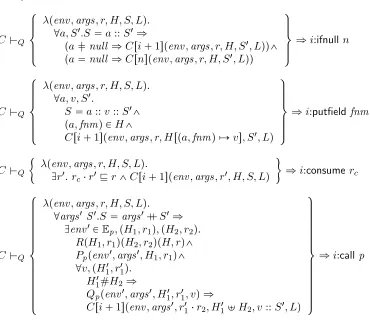
A. Figure 5 gives the definition of the judgementC$QtAuñi:ιfor a selected subset
of the instructionsι. The post-conditionQis used for the case of thereturninstruction. We explain the definition of this judgement in more detail below.
(2) The precondition implies the assertion for the first instruction: for all environments
env PE, arguments args, heapsH and consumable resourcesr, we have
Ppe,args, H, rqñCr0spenv,args, H, r,rs,xargsyq
where rs denotes the empty operand stack, and xymaps lists of values to finite maps
from naturals to values, as in the operational semantics in Figure 4.
When condition 1 holds, we write this as C $ code : Q, indicating that the procedure
implementation code has a valid proofC for the post-condition Q.
C$Qtλpenv,args, r, H, S, Lq. Cri 1spenv,args, r, H, z::S, Lquñi:iconstz
C$Q $ ' ' & ' ' %
λpenv,args, r, H, S, Lq.
a, S 1
.Sa::S 1
ñ
panull ñCri 1spenv,args, r, H, S 1
, Lqq^
panull ñCrnspenv,args, r, H, S 1
, Lqq
, / / . / /
-ñi:ifnulln
C$Q $ ' ' ' ' & ' ' ' ' %
λpenv,args, r, H, S, Lq.
a, v, S 1
.
Sa::v ::S 1
^ pa,fnmqPH^
Cri 1spenv,args, r, Hrpa,fnmqÞÑvs, S 1
, Lq , / / / / . / / / /
-ñi:putfield fnm
C$Q "
λpenv,args, r, H, S, Lq.
Dr 1
. rcr 1
r^Cri 1spenv,args, r 1
, H, S, Lq *
ñi:consume rc
C$Q $ ' ' ' ' ' ' ' ' ' ' ' ' & ' ' ' ' ' ' ' ' ' ' ' ' %
λpenv,args, r, H, S, Lq.
args 1
S1
.Sargs 1
S1 ñ Denv
1
PEp,pH1, r1q,pH2, r2q.
RpH1, r1qpH2, r2qpH, rq^
Pppenv 1
,args1
, H1, r1q^
v,pH 1 1, r
1 1q.
H1
1#H2ñ
Qppenv 1
,args1
, H1 1, r
1 1, vqñ
Cri 1spenv,args 1
, r1
1r2, H 1
1ZH2, v::S 1
, Lq , / / / / / / / / / / / / . / / / / / / / / / / / /
-ñi:callp
C$Qtλpenv,args, r, H, S, Lq.v, S 1
. Sv::S 1
[image:14.612.112.482.144.467.2]ñQpenv,args, r, H, vquñi:return
Figure 5: Program Logic Rules (Extract)
The rules for putfield and consume demonstrate heap and consumable resource con-sumption respectively. For putfield, the heap is judged to be satisfactory if it contains the address and field that are to be mutated. For resource consumption, we must “subtract” the consumed resource from the current resource that has been supplied. If the desired resource is not present then this instruction’s precondition will not hold.
The rule for the call instruction demonstrates how the heap and the consumable re-sources are dealt with similarly for the purposes of a frame rule. The current heap and consumable resources are split into two parts pH1, r1q and pH2, r2q, with the first part
be-ing handed off to the callee for it to be mutated. Finally, the precondition of the return
instruction is directly derived from the post-condition of the current procedure.
We say that an activation frame is safe if there is a proof for the code being executed in the frame such that the requirements of the next instruction to be executed are satisfied. Formally, a framef xcode, S, L,pcyis safe for environmentenv PE, argumentsargs, heap
H, resource r and post-condition Q, writtensafeFramepenv, f, H, r,args, Qq if 3
: (1) There exists a certificate C such that C$code :Q;
(2) Crpcsexists andCrpcspenv,args, r, H, S, Lq holds.
Safety of activation frames is preserved by steps in the virtual machine:
Lemma 3.1 (Intra-frame safety preservation).
(1) If
(a) safeFramepenv, f, H, r,args, Qq
(b) f ÝfrmÑf 1
then safeFramepenv, f 1
, H, r,args, Qq.
(2) If
(a) safeFramepenv, f, H1, r,args, Qq
(b) H1#H2 andH1ZH2H
(c) f, HÝmutÑf 1
, H1
, rc then there exists H1
1 and r 1
such that
(a) H1
1#H2 andH 1
1ZH2H 1
(b) rcr 1
r
(c) safeFramepenv, f 1
, H1 1, r
1
,args, Qq.
The second part of this lemma states that if we take a step that mutates the heap or consumes some resource, and the activation frame has been certified as safe for a sub-part of the heap, then the rest of the heap—H2—is unaffected by a single step of execution in
this activation frame, and the new state of the activation frame is safe for the mutated heap and new amount of consumable resources.
Remark 3.2. We pause for a moment to consider the relationship between our program logic and traditional Separation Logic. The second part of the previous lemma effectively states that execution steps for mutating instructions arelocal: for any other piece of heap that is present but not mentioned in its precondition, the execution of a mutating instruction will not affect it. This is usually expressed in Separation Logic by the frame rule that states if we know thattPuCtQuholds, thentPRuCtQRuholds for any other resource assertion
R. We do not have an explicit frame rule in our program logic; application of the rule is implicit in the rule for the call instruction (so, conflatingly, the frame rule is applied for new activation frames). We do not have access to the frame rule in order to modularly reason about the internals of each procedure, e.g. local reasoning about individual loops. This is partially a consequence of the unstructured nature of the bytecode that we are working with. It has not been a hindrance in small examples that we have verified so far, but may well become so in larger procedures with multiple loops that need invariants—see Section 2.2 for an example. In such cases it may be useful to layer a hierarchical structure, matching the loops or other sub-program structure, on top of the unstructured bytecode in order to apply frame rules and facilitate local reasoning inside procedures.
We have now handled all the instructions except the call and return instructions that create and destroy activation frames. To state soundness of our program logic for these we need to define what it means for a stack of activation frames to be safe. Intuitively, a stack of activation frames is a bridge between the overall argumentsargstop and post-conditionQtop
for the program and the argumentsargscur and post-conditionQcur for the current
activa-tion frame, with respect to the current heapH and available consumable resources r, such that, when the current activation frame finishes, its calling frame on the top of the stack is safe. We write this as safeStackEcur,Etoppfs, H, r,envcur,args
cur, Qcur,envtop,argstop, Qtopq.
The types Ecur and Etop refer to the environment types for the current and top-level pro-cedures respectively, and envcur PEcur,envtop PEtop are the specific elements being used.
Accordingly, we say that the empty frame stack is safe whenre,Hemp,envcur envtop,argscur argstop and Qcur Qtop. A non-empty frame stack fsxcode, S, L,pcy:: fs1
is safe when there existpH1, r1q,pH2, r2q,env,args,Q andC,A such that:
(1) RpH1, r1qpH2, r2qpH, rq;
(2) The code is certified: C $code :Q;
(3) The next instruction to be executed has preconditionA: CrpcsA;
(4) When the callee returns, the instruction’s precondition will be satisfied: for all v P
V, H1 2, r
1
2 such that H 1
2#H1 and Qcurpenvcur,args
cur, H
1 2, r
1
2, vq holds, Apenv,args, r 1 2
r1, H1
2ZH1, v::S, Lq holds as well.
(5) The rest of the frame stack fs will be safe when this activation frame returns:
safeStackpfs, H2, r2,env,args, Q,envtop,args
top, Qtopq.
Note how thesafeStack predicate divides up the heap and consumable resource between the activation frames on the call stack; each frame hands a piece of its heap and consumable resource off to its callees to use. This mirrors the formulation of the rule for call in the program logic in Figure 5.
Finally, we say that a statesxrc, H,fsyis safe for environmentenv, argumentsargs,
post-condition Qand maximum resourcermax, writtensafeStateps,env,args, Q, rmaxq, if:
(1) there exists anrfuture such that rcrfuturermax; and also
(2) rfuture and H split intopH1, r1q and pH2, r2q, i.e. RpH1, r1qpH2, r2qpH, rfutureq;
(3) there exists at least one activation frame: fs f ::fs 1
and environment envcur,
argu-ments argscur and post-conditionQcur; such that
(4) safeFramepf, H1, r1,envcur,args
cur, Qcurq; and
(5) safeStackpfs, H2, r2,envcur,args
cur, Qcur,env,args, Qq.
The key point in the definition of safeState is that the assertions of the program logic talk about the resources that will be consumed in thefuture of the program’s execution. Safety for a state says that when we combine the future resource requirementsrfuturewith resources
that have been consumed in the past,rc, then the total is less than the total resourcesrmax
that are allowed for the execution.
Theorem 3.3(Soundness). Assume that all the procedures in prg match their specifications.
(1) If
(a) safeStateps,env,args, Q, rmaxq; and
(b) sÝprgÑs 1 then safeStateps
1
,env,args, Q, rmaxq.
(2) If safeStateps,env,args, Q, rmaxq and s Ó H, r, v, then there exists an r 1
such that
Qpenv,args, H, r 1
, vq andrr 1
In the halting case in this theorem, the existentially quantified resource r1
indicates the resources that the program still had available at the end of its execution. We are also guaranteed that when the program halts, the total resource that it has consumed will be less than the fixed maximumrmax that we have set, and moreover, by item 1 of the theorem,
this bound has been observed at every step of the computation.
Remark 3.4. Though we assumed it above, the proof of soundness of the program logic does not require that the monoid of resources is commutative. This opens the way to considering non-commutative notions of resource, such as traces. However, constructing a usable proof-theory for a mixed commutative/non-commutative notion of resource (i.e. heaps and a putative non-commutative consumable resource) is hard. Also, the resource acquisition variant of the program logic that we describe in the next section requires commutativity.
3.6. Allowing for Resource Acquisition. The operational semantics and program logic described above assume a fixed total amount of resource that may be consumed by the program. The precondition of the main procedure of the program specifies the amount of resource that will be required for the entire run. In this section we consider the changes necessary to support dynamic but fallible acquisition of resources via a special acquire
instruction. We provide an example use of this additional capability in Section 3.7.
We assume that there is a capricious environment that entertains requests for additional resources from programs. Requests may be granted or denied. A program may request an additional resource using a special acquire instruction. To make things interesting, and to allow for the example in the next section, we make the resource requested by acquire
dynamic and correspondingly modifyconsume, removing its static argument:
ι::...|consume|acquire
For both instructions, we assume that the resource being consumed or requested is indicated by an integer value on the stack. For the acquireinstruction the intended semantics is that if the request is granted then a 1 is pushed on to the operand stack, otherwise a 0 is pushed. For the operational semantics, we modify the relation ÝmutÑ to have an additional
“ac-quired resources” component:
f, HÝmutÑf, H, rconsumed, racquired
For each of the existing heap mutating instructions except consume, the acquired resource is equal to the unit of the resource monoid, e. The operational semantics of consume is replaced by the following rule to reflect the dynamic resource identification:
coderpcsconsume
xcode, z::S, L,pcy, H
mut
ÝÑxcode, S, L,pc 1y, H,respzq, e
where we assume the existence of a function res : Z Ñ R that names certain consumable
resources in Rby integers. We do not assume that res is a monoid homomorphism. Two
outcomes of requesting more resource:
coderpcsacquire
xcode, z::S, L,pcy, H
mut
ÝÑxcode,1 ::S, L,pc 1y, H, e,respzq
coderpcsacquire
xcode, z::S, L,pcy, H
mut
ÝÑxcode,0 ::S, L,pc 1y, H, e, e
States of the virtual machine are modified to be four-tuples xrcon, rtot, H, f syof consumed
resources, total allowed resources, current heap and current activation frame stack. The invariant that is now to be maintained is that the rcon is always less than or equal to rtot.
The only rule from Figure 4 that is modified (apart from threading through the unchanged
rtot) is the rule incorporating ÝmutÑ into the relation:
f, H ÝmutÑf 1
, H1
, rc, ra
xr, rtot, H, f ::fsy
prg
ÝÑxrrc, rtot ra, H 1
, f1
::fsy
The halting predicate is extended to a five-place relation s Ó H, rcon, rtot, v, where rcon is
the total consumed resource of the execution andrtot is the total acquired resource.
Perhaps surprisingly, the assertions (pre- and post-conditions and instruction level as-sertions) are left unchanged, as are the rules of the logic from Figure 5 for the original set of instructions. We modify the rule for resource consumption to take into account the new dynamic nature:
C$Q $ &
%
λpenv,args, r, H, S, Lq.
z, S 1
. S z::S 1
ñDr 1
.
respzqr 1
r^Cri 1spenv,args, r 1
, H, S1
, Lq , .
-ñi:consume
and we add a new rule for resource acquisition:
C $Q $ &
%
λpenv,args, r, H, S, Lq. z, S
1
. Sz::S 1
ñ
Cri 1spenv,args, rrespzq, H,1 ::S 1
, Lq
^Cri 1spenv,args, r, H,0 ::S 1
, Lq
, .
-ñi:acquire
This exactly mirrors the pair of operational semantics rules. Anacquireinstruction is safe to run if it is safe the execute the next instruction either with additional available consumable resource and a 1 on the stack, or with no additional consumable resource and a 0 on the stack.
The definition of safe frame remains unchanged from above, and the statement of the second item of Lemma 3.1 is adjusted to account for the possibility of additional resources being acquired:
Lemma 3.5 (Intra-frame safety preservation (Resource Acquisition Variant)).
(2) If
(a) safeFramepenv, f, H1, r,args, Qq
(b) H1#H2 andH1ZH2H
(c) f, HÝmutÑf 1
, H1
, rc, ra then there exists H1
1 and r 1
such that
(a) H1
1#H2 andH1
1ZH2H 1
(b) rcr 1
rra
(c) safeFramepenv, f 1
, H1 1, r
1
The definition of the safeStack predicate remains the same as before, and the safeState
predicate is modified to be of the formsafeStateps,env,args, Qq: the originalrmax argument
is taken to be thertotfrom the state. The key safety property, as before, is that the consumed
resources, plus the future resources, is less than or equal to the total allowed resources. But now the total resources allowed may be increased during execution.
The new version of Theorem 3.3 is as follows:
Theorem 3.6 (Soundness (Resource Acquisition Variant)). Assume that all the procedures in prg match their specifications.
(1) If
(a) safeStateps,env,args, Qq; and
(b) sÝprgÑs 1 then safeStateps
1
,env,args, Qq.
(2) If safeStateps,env,args, Qq and s Ó H, rcon, rtot, v, then there exists an r 1
such that
Qpenv,args, H, r 1
, vq andrconr 1
rtot.
This theorem gives a comparable guarantee to Theorem 3.3, in that the (now dynamic) resource bound is respected at every step of the computation and at the end of execution. By inspection of the operational semantics, we can see that the resource bound may only be increased by successful execution of an acquireinstruction.
3.7. Resource Acquisition Example. To illustrate the utility of the language and logic extended with resource acquisition, we take the example of block booking as presented by Aspinall, Maier and Stark [4]. The scenario is that an application running on a mobile device has a list of telephone numbers that it wants to send SMS messages to. Permission must be sought from the user to send these messages, since sending incurs a monetary cost. It is not necessarily convenient to request permission from the user when the message is to be sent, so permission is requested in advance. We use the program logic extended with resource acquisition to bridge the gap between the acquisition of permission and its consumption, ensuring that no attempt is made to perform an operation that has not been authorised. In this scenario, the acquire instruction is implemented by actually requesting permission from the user.
Figure 6 shows the code for a method,requestPermissions, that loops through a list of telephone numbers, requesting permission for each one. We assume that the calls to the method acquire are compiled to instances of the acquire instruction. We have taken the liberty of assuming a value type of telephone numbers rather than re-using the int type. The result of the resource acquisition attempt is stored in thepermissionfield of the record for that telephone number.
The specification of the precondition of requestPermissionsis simply that there is a proper linked list on the heap, using the following inductively defined predicate:
lsegpx, yqpxy^empq_pDn, p, z. rx
number
ÞÑ nsrx
permission
ÞÑ psrx
next
ÞÑ zslsegpz, yqq
In the post-condition, we make use of another inductively defined predicate that states the resources available, dependent on the value of thepermission field:
lsegsendpx, yq pxy^empq
_pDn, z.rx
number
ÞÑ nsrx
permission
ÞÑ 1sR
sendpnq rx
next
ÞÑ zslsegpz, yqq
_pDn, z.rx
number
ÞÑ nsrx
permission
ÞÑ 0srx
next
class PhoneNumberNode {
public PhoneNumber number;
public boolean permission;
public PhoneNumberNode next; }
...
public static void requestPermissions (PhoneNumberNode phoneNumber) { while (phoneNumber != null) {
phoneNumber.permission = acquire (phoneNumber.number); phoneNumber = phoneNumber.next;
} }
Figure 6: Resource Acquisition Example
Thus when the permission field has the value 1, the list node is associated with the permission to send to that telephone number; and when thepermissionfield has the value 0, no such associated permission is available. We revisit this kind of conditionally-resource-carrying predicate in Section 4.2.
Re-interpreting theconsumeinstruction as sending an SMS message, a loop that sends messages to all telephone numbers that the user has approved now looks much like the simple list iteration example from the introduction, augmented with a dynamic check to ensure that permission has been sought and received.
4. Deep Assertion Logic
In the previous section we described a program logic but remained agnostic as to the exact form of the assertions save that they must be predicates over certain domains. This shallow approach makes the statement and soundness proof easier, but inhibits discussion of actual specifications and proofs in the logic. In this section we show how a combination of two variants of the logic of Bunched Implications (BI) [20, 22] can be used to provide a syntax for assertions in our program logic. We combine boolean BI with affine intuitionistic BI, for describing heaps and consumable resources respectively.
η, x |ù J iff always
η, x |ù t1't2 iff Jt1Kη 'Jt2Kη
η, x |ù emp iff xpH, rq and Htu
η, x |ù rt1
f
ÞÑt2siff xpH, rq and HtpJt1Kη,fqÞÑJt2Kηu
η, x |ù Rr
i iff xpH, rq and ri r andH tu
η, x |ù φ1^φ2 iff η, x|ùφ1 and η, x|ùφ2
η, x |ù φ1_φ2 iff η, x|ùφ1 or η, x|ùφ2
η, x |ù φ1φ2 iff exists y, z.st. Ryzxand η, y|ùφ1 and η, z |ùφ2
η, x |ù φ1Ñφ2 iff for ally. if xy and η, y|ùφ1 thenη, y|ùφ2
η, x |ù φ1—φ2 iff for ally, z. if Rxyz and η, y|ùφ1 thenη, z |ùφ2
η, x |ù v.φ iff for alla, ηrv ÞÑas, x|ùφ
η, x |ù Dv.φ iff exists a, ηrvÞÑas, x|ùφ
Figure 7: Semantics of assertions
Formulae are built from at least the following constructors:
φ :: J|t1't2|φ1^φ2 |φ1_φ2 |φ1Ñφ2 |emp|φ1φ2 |φ1—φ2 |x.φ|Dx.φ
|rt1
f
ÞÑt2s|Rr |. . .
Where'Pt,u. We can also add inductively defined predicates as needed, see Section 4.2
below. The only non-standard formula with respect to Separation Logic is Rr which
rep-resents the presence of some consumable resource r. The semantics of the assertion logic is given in Figure 7 as a relation |ù between environments and heap/consumable resource
pairs and formulae. We assume a sensible semanticsJKη for terms in a given environment.
As a consequence of having an ordering on consumable resources, and our chosen seman-tics of emp, and —, our logic contains affine intuitionistic BI as a sub-logic for reasoning
purely about consumable resources.
Proposition 4.1. If φ is a propositional BI formula with only Rr as atoms, then r|ùbiφ iff η,pr, hq |ùφ.
4.2. Inductively Defined Shape and Resource Predicates. We now present some inductively defined predicates that demonstrate how heap-resident data structures may have resources associated with their nodes. We have introduced the resource-aware lsegpredicate that describes a segment of a list with a resource associated to every element:
lsegpr, x, yqpxy^empq_pDd, z. rx
data
ÞÑ dsrx
next
ÞÑ zsR r
lsegpr, z, yqq
An alternative that we made use of in the block booking example in Section 3.7 is to only demand resources when the element data satisfies some predicate, for example when the integer stored in the node is not equal to zero:
lseg0pr, x, yq pxy^empq_pDd, z. rx
data
ÞÑ dsrx
next
ÞÑ zspd0ÑR r
qlseg 0
pr, z, yqq
predicates, we would be forced to reflect the whole list into the logic and state the resource requirement in terms of the number of non-zero elements:
lsegpl, x, yq^rlengthpfilterpλx.x0, lqq
Reasoning with such global list properties is obviously much harder than locally reasoning about each individual node as it is processed by the program.
The amortised approach is not limited to reasoning purely about singly-linked lists, the standard doubly-linked list and tree predicates of Separation Logic can be easily augmented with local resource annotations (we have omitted the data components of these predicates to save space):
dlsegpr, p, x, yqpxy^empq_pDz.rx
next
ÞÑ zsrx
prev
ÞÑ psR r
dlsegpr, x, z, yqq
treepr, xq pxnull ^empq
_pDy, z.rx
left
ÞÑysrx
right
ÞÑ zsR r
treepyqtreepzqq
These predicates all describe resources that are linear in proportion to the sizes of the data structures. Using the clever technique of Hoffmann and Hofmann [14], we can also present lists with associated resources that are polynomially proportional to the length of the list, by exploiting the presentation of polynomials using binomial coefficients. In their system, lists are annotated with resources that are lists of rational numbers xp1, ..., pny. The idea
is that a list of length nannotated with such a list has° k i1
n i
pi associated resource. We
can give such lists as an inductively defined predicate in our logic:
lsegp Ý Ñ
p , x, zqpxz^empq_pDy. rx
next
ÞÑ ysR p1
lsegp⊳p Ý Ñ
pq, y, zqq
where ⊳pÝÑ
pq pp1 p2, p2 p3, ..., pk1, pkq is the additive shift of a resource annotation
as defined by Hoffmann and Hofmann.
4.3. Heap and Resource Separation. In the logic of Section 4.1, we only made use of one kind of separating conjunction, φ1 φ2, that separates both heaps and consumable
resources. This allows the tight integration of the heap shapes of various data structures and consumable resources as shown in the previous section. Evidently, there are two other possible combinations that allow sharing of heap or resources. For example, separation of resources, but sharing of heap:
η, x |ùφ1 R
φ2iff xpH, rq and exists r1, r2.st.
r1r2 r
and η,pH, r1q|ùφ1 and η,pH, r2q|ùφ2
This definition looks like it might be useful to specify that we have a single data structure on the heap, but two resource views on it. A need for this kind of situation arose in the merge-sort example in Section 2.2. There, the auxiliary procedureadvance, that advances a pointer a certain number of elements through a list, was given the specification:
Prepadvanceq : lsegpa0,l,nullq
Postpadvanceq : lsegpa0,l,retvalqlsegpa0,retval,nullq
wherea0 was an amount of resource associated with every element of the list that was to be
preserved. Note that advance does not modify the list in any way and does not consume any resources. Evidently, this specification is satisfied for anya0. In the spirit of Separation
resources—because it does not consume or release any—and combine the specification later on with the fact that the list has some associated resources. So, we would like to give
advance the specification:
Prepadvanceq : lsegp0,l,nullq
Postpadvanceq : lsegp0,l,retvalqlsegp0,retval,nullq
since it does not require or yield any consumable resource, and then apply a putative resource-frame rule:
tPu C tQu
tP R
Ru C tQ R Ru
WhereRwould record that every element of the unmodified list hasa0 associated resource.
As with the normal frame rule of Separation Logic, this turns what would be a second-order universally quantified assertion into an unquantified assertion. This simplification is crucial for developing automated procedures for discharging verification conditions as in Section 5. For the present example, we can use linear programming to infer the instantiation of a0,
but for general complex composite resources, or for examples that require polymorphic recursion, this problem could become much harder.
Unfortunately, in order for this rule to be sound we must ensure thatC does not modify the heap in any way that would violate the resource associations. There is currently no way to enforce this within the logic. In the example, this manifests itself as the inability to guarantee that the list in the post-condition of advancehas exactly the same shape as the list in the precondition, which would be required to assign a resource to every element.
5. Automated Verification
In this section we describe a verification condition (VC) generation and proof search proce-dure for automated verification of programs against specifications in the program logic, as long as procedures have been annotated with loop invariants. The restricted subset of Sep-aration Logic that we use in this section is similar to the subset used by Berdine et al. [6], though instead of performing a forwards analysis of the program, we generate verification conditions by backwards analysis and then attempt to solve them using proof search. We develop our own proof search procedure rather than re-use an existing Separation Logic-inspired tool in order to incorporate a key feature of Hofmann and Jost’s amortised system: the use of linear programming to infer resource annotations [15]. In the system we present here, the proof search procedure generates linear constraints that can be solved by linear programming to infer resource annotations. A limitation of the VC-generate and solve tech-nique we use here is the potential for exponential blow-up of the verification conditions in the size of program. The forward symbolic execution approach deals with this by attempt-ing to prune unreachable paths as soon as possible and mergattempt-ing similar feasible paths usattempt-ing heuristics.
the restricted syntax as linear expressions over a collection of globally existentially quanti-fied meta-variables. We usey1, y2,and so on for resource variables to be inferred, andx1, x2,
etc. for logical variables. Resource variables cannot be quantified over inside formulae. The basic assertion of the proof search logic is of the form
ª
i
Dx. Πi|Σi |Θi
where we use the meta-variable S to stand for such assertions. They consist of a finite disjunction of clauses, each with a collection of existentially quantified variables and three collections of assertions. The first portion, Π, contains assertions about pure (non-heap and non-consumable resource) data, which are equalities and disequalities of the form:
P ::t1 t2 |t1t2
The terms that we allow in the data and heap assertions are either variables, or the constant
null. A collection ΠP1, ..., Pn is interpreted by translation into the logic of Section 4 as
the additive conjunction of the Pi. The second portion, Σ, contains assertions about the
heap, which are of the form:
X::rt1
f
ÞÑt2s|lsegpΘ, t1, t2q
Here we have made use of the inductively defined list segment predicate from Section 4.2. A collection ΣX1, ..., Xn is interpreted as the separating (or multiplicative) conjunction
of the Xi. The final portion Θ is a linear expression indicating an amount of consumable
resource. It is easily possible to generalise this to multiple resources by considering multiple named linear expressions. Given a valuation of the resource meta-variables yi, extended to
an interpretation JΘKthis is interpreted in the logic of Section 4 as the formula RJΘKr for some fixed resourcer. A whole composite Π|Σ|Θ is interpreted as Π^pΣR
JΘKr q.
Finally, we have the set of goal formulae that the verification condition generator will produce and the proof search will solve.
G :: SG|S—G|S|G1^G2 |P ÑG|x.G|Dx.G
Note that we only allow implications (Ñ and —) to appear in positive positions. This
means that we can interpret them in our proof search as adding extra information to the context.
5.2. Verification Condition Generation. Verification condition generation is performed for each procedure individually by computing weakest liberal preconditions for each instruc-tion, working backwards from the last instruction in the method. To resolve loops, we require that the targets of all backwards jumps have been annotated with loop invariants
The verification condition generation procedure has been formalised within the Coq proof assistant and proved sound with respect to the program logic in Section 3. By using Coq’s module system [12] we have abstracted the verification condition generator over the particular deep assertion logic used. We used Coq’s program extraction capabilities to extract the verification condition generator and instantiated it with the proof search logic described in this section.
5.3. Proof Search. The output of the verification condition generation phase is a collection of problems of the formS $G, which can each be reduced to a finite collection of sequents
of the form Π | Σ | Θ $ G. To discharge these proof obligations, we make use of the
I/O interpretation of proof search as defined for intuitionistic linear logic by Cervesato, Hodas and Pfenning [9], along with heuristic rules for unfolding the inductive list segment predicate. We augment the I/O model of resource accounting with an additional part that collects linear constraints that may be fed into a integer linear program solver, to automatically infer resource annotations.
We use the following judgement form for proof search goals that collect linear con-straints. Here C is a set of linear constraints over the resource meta-variables yi:
Π|Σ|Θ$GzC
The proof search procedure is defined by the rules shown in Figure 8, Figure 9, Figure 10 and Figure 11. These rules make use of several auxiliary judgements:
Π|Σ|Θ$ΣgoalzΣout,Θout,C Heap assertion matching
Θ$ΘgoalzΘout,C Resource matching
Π$K Contradiction spotting
Π$Π 1
Data assertion entailment
The backslash notation used in these judgements follows Cervesato et al., where in the judgement Θ $ ΘgoalzΘout,C, the proof context Θ denotes the facts used as input and
Θout denotes the facts that are left over (the output) from proving Θgoal. TheC component
collects the linear constraints that must hold for the judgement to give a valid separation logic entailment. A similar interpretation is used for the heap assertion matching judgement. We do not define the data entailment or contradiction spotting judgement explicitly here; we intend that these judgements satisfy the basic axioms of equalities and disequalities.
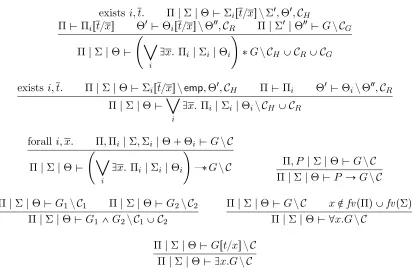
The rules in Figure 8 are the goal driven search rules. There is an individual rule for each possible kind of goal formula. The first two rules are matching rules that match a formula S against the context, altering the context to remove the heap and resource assertions that S requires, as dictated by the semantics of the assertion logic. We must search for a disjunctithat is satisfied by the current context. There may be multiple such
i, and in this case the search may have to backtrack. When the goal is a formula S, then we ask that the left-over heap is empty, in order to detect memory leaks. Note that the logical variablesx1, x2, ...may not occur in the constraint sets, so we do not need to handle
universally quantified constraints.
existsi, t. Π|Σ|Θ$Σirt{xszΣ 1
,Θ1
,CH
Π$Πirt{xs Θ 1
$Θirt{xszΘ 2
,CR Π|Σ 1
|Θ 2
$GzCG
Π|Σ|Θ$
ª
i
Dx. Πi|Σi|Θi
GzCH YCRYCG
exists i, t. Π|Σ|Θ$Σirt{xszemp,Θ 1
,CH Π$Πi Θ 1
$ΘizΘ 2
,CR
Π|Σ|Θ$ ª
i
Dx. Πi|Σi |ΘizCH YCR
foralli, x. Π,Πi |Σ,Σi |Θ Θi $GzC
Π|Σ|Θ$
ª
i
Dx. Πi |Σi|Θi
—GzC
Π, P |Σ|Θ$GzC
Π|Σ|Θ$P ÑGzC
Π|Σ|Θ$G1zC1 Π|Σ|Θ$G2zC2
Π|Σ|Θ$G1^G2zC1YC2
Π|Σ|Θ$GzC xRfvpΠqYfvpΣq
Π|Σ|Θ$x.GzC
Π|Σ|Θ$Grt{xszC
[image:26.612.101.515.125.402.2]Π|Σ|Θ$Dx.GzC
Figure 8: Goal Driven Search Rules
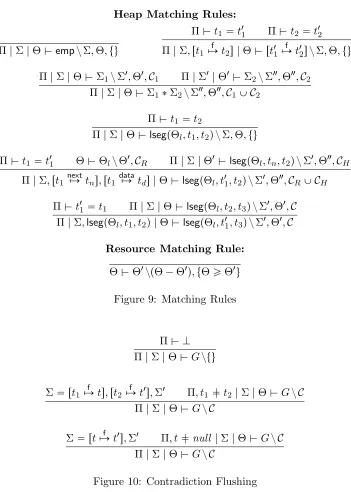
rules, there are three cases. Either the two pointers involved in the list are equal, in which case we are immediately done; or we have a single list cell in the context that matches the start pointer of the predicate we are trying to satisfy, and we have the required resources for an element of this list, so we can reduce the goal by one step; or we have a whole list segment in the context and we can reduce the goal accordingly. The resource matching rule is where linear constraints are actually generated; to match a resource we subtract the desired resource from the available resources and add a constraint to ensure that there was enough resource to do this. Note that this rule always succeeds during proof search, but may generate unsatisfiable constraints. Thus back-tracking may still be required.
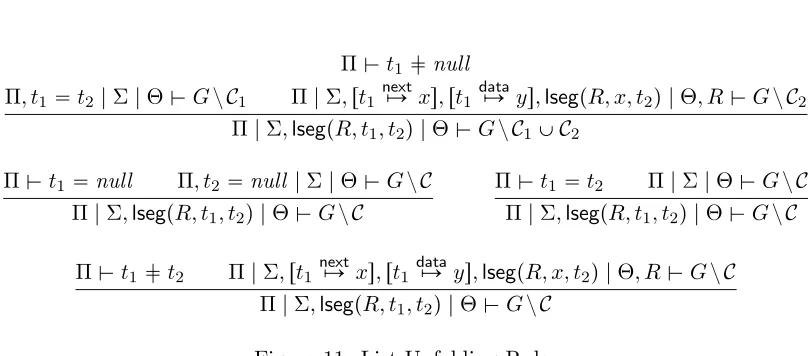
The final two sets of rules operate on the proof search context. The first set, shown in Figure 10, describe how information flows from the heap part of the context to the data part. If we know that two variables both have a points-to relation involving a field f, then we know that these locations must not be equal. Similarly, if we know that a variable does point to something, then it cannot be null. If any contradictions are found using these rules, then the proof search can terminate immediately for the current goal. This is provided for by the first rule in Figure 10.
Heap Matching Rules:
Π|Σ|Θ$empzΣ,Θ,tu
Π$t1 t 1
1 Π$t2 t 1 2
Π|Σ,rt1
f
ÞÑt2s|Θ$rt 1 1
f
ÞÑt 1
2szΣ,Θ,tu
Π|Σ|Θ$Σ1zΣ 1
,Θ1
,C1 Π|Σ 1
|Θ 1
$Σ2zΣ 2
,Θ2
,C2
Π|Σ|Θ$Σ1Σ2zΣ 2
,Θ2
,C1YC2
Π$t1 t2
Π|Σ|Θ$lsegpΘl, t1, t2qzΣ,Θ,tu
Π$t1t 1
1 Θ$ΘlzΘ 1
,CR Π|Σ|Θ 1
$lsegpΘl, tn, t2qzΣ 1
,Θ2
,CH
Π|Σ,rt1
next
ÞÑ tns,rt1
data
ÞÑ tds|Θ$lsegpΘl, t 1
1, t2qzΣ 1
,Θ2
,CRYCH
Π$t 1
1t1 Π|Σ|Θ$lsegpΘl, t2, t3qzΣ 1
,Θ1
,C
Π|Σ,lsegpΘl, t1, t2q|Θ$lsegpΘl, t 1
1, t3qzΣ 1
,Θ1
,C
Resource Matching Rule:
Θ$Θ 1
zpΘΘ 1
q,tΘ¥Θ 1
u
Figure 9: Matching Rules
Π$K
Π|Σ|Θ$Gz tu
Σrt1
f
ÞÑts,rt2
f
ÞÑt 1
s,Σ 1
Π, t1t2|Σ|Θ$GzC
Π|Σ|Θ$GzC
Σrt
f
ÞÑt 1
s,Σ 1
Π, tnull |Σ|Θ$GzC
[image:27.612.131.482.109.601.2]Π|Σ|Θ$GzC
Figure 10: Contradiction Flushing
the list segment is empty and one for when it is not. The other rules are similar; taking information from the data context and using it to refine the heap context.
Π$t1 null
Π, t1 t2 |Σ|Θ$GzC1 Π|Σ,rt1
next
ÞÑ xs,rt1
data
ÞÑ ys,lsegpR, x, t2q|Θ, R$GzC2
Π|Σ,lsegpR, t1, t2q|Θ$GzC1YC2
Π$t1 null Π, t2 null |Σ|Θ$GzC
Π|Σ,lsegpR, t1, t2q|Θ$GzC
Π$t1t2 Π|Σ|Θ$GzC
Π|Σ,lsegpR, t1, t2q|Θ$GzC
Π$t1 t2 Π|Σ,rt1
next
ÞÑ xs,rt1
data
ÞÑ ys,lsegpR, x, t2q|Θ, R$GzC
[image:28.612.103.507.106.284.2]Π|Σ,lsegpR, t1, t2q|Θ$GzC
Figure 11: List Unfolding Rules
the context is fully saturated, the proof search reduces the goal by using the goal-driven search rules and the process begins again.
Given a collection of verification conditions and a successful proof search over them that has generated a set of linear constraints, we input these into a linear solver, along with the constraint that every variable is positive and an objective function that attempts to minimise variables appearing in the precondition.
Theorem 5.1. The proof search procedure is terminating. Moreover, it is sound: ifΠ|Σ|
Θ$GzC and there is an valuation of they that satisfiesC, thenΠ^pΣR
JΘKr
q$Gunder this valuation using the translation of the proof search logic into the logic of Section 4 as defined in Section 5.1.
6. Examples of Automated Verification