R E S E A R C H
Open Access
Identification of wild-caught phlebotomine
sand flies from Crete and Cyprus using
DNA barcoding
Emmanouil Dokianakis
1, Nikolaos Tsirigotakis
1, Vasiliki Christodoulou
1, Nikos Poulakakis
2,3and Maria Antoniou
1*Abstract
Background:Phlebotomine sand flies (Diptera: Psychodidae) are vectors ofLeishmaniaspp., protozoan parasites responsible for a group of neglected diseases called leishmaniases. Two sand fly genera,Phlebotomusand
Sergentomyia, contain species that are present in the Mediterranean islands of Crete and Cyprus where the visceral (VL), cutaneous (CL) and canine (CanLei) leishmaniases are a public health concern. The risk of transmission of different Leishmaniaspecies can be studied in an area by monitoring their vectors. Sand fly species are traditionally identified using morphological characteristics but minute differences between individuals or populations could be overlooked leading to wrong epidemiological predictions. Molecular identification of these important vectors has become, therefore, an essential tool for research tasks concerning their geographical distribution which directly relates to leishmaniasis control efforts. DNA barcoding is a widely used molecular identification method for cataloguing animal species by sequencing a fragment of the mitochondrial gene encoding cytochrome oxidase I.
Results:DNA barcoding was used to identify individuals of five sand fly species (Phlebotomus papatasi,P. similis,P. killicki, Sergentomyia minuta,S. dentata) circulating in the islands of Crete and Cyprus during the years 2011–2014.Phlebotomus papatasiis a known vector of zoonotic CL in the Middle East and it is found in both islands.Phlebotomus similisis the suspected vector ofLeishmania tropicain Greece causing anthroponotic CL.Phlebotomus killickiwas collected in Cyprus for the first time.Sergentomyia minuta, found to present intraspecific diversity, is discussed for its potential as aLeishmania vector. Molecular identification was consistent with the morphological identification. It successfully identified males and females, which is difficult when using only morphological characters. A phylogenetic tree was constructed based on the barcodes acquired, representing their genetic relationships along with other species from the area studied. All individuals identified were clustered according to their species and subgenus.
Conclusions:Molecular identification of sand flies via DNA barcoding can accurately identify these medically important insects assisting traditional morphological tools, thus helping to assess their implication inLeishmaniatransmission.
Keywords:Sand fly,Phlebotomus,Sergentomyia, Leishmaniasis, DNA barcoding,cox1, Crete, Cyprus, Molecular systematics
Background
Sand flies (Diptera: Psychodidae) are small (body length < 3 mm) haematophagous insects and vectors of the
protozoan parasites Leishmania spp. In the Old World,
sand flies of the genus Phlebotomus are involved in an
epidemiological cycle where a female sand fly that feeds on a Leishmania-infected reservoir host can become
infected and transmit the parasite while feeding on its next target [1]. Leishmania spp. can cause a group of diseases called leishmaniases which, in the Mediterranean Basin appear in two forms: visceral (VL) and cutaneous (CL). There are estimations that leishmaniases are responsible for
20 to 30 thousand deaths worldwide each year [2]. The
known pattern of co-evolution between parasites and their vectors renders necessary the evolutionary study by means of species identification and the vectorial capacity of the sand flies in an area [3]. Monitoring sand flies in a region is, therefore, one of the most important steps towards predict-ing and controllpredict-ing the disease.
* Correspondence:[email protected]
1Laboratory of Clinical Bacteriology, Parasitology, Zoonoses and Geographical
Medicine, School of Medicine, University of Crete, Vassilika Vouton, P.O. Box 2208, GR-71003 Heraklion, Greece
Full list of author information is available at the end of the article
Crete and Cyprus, in the southeastern Mediterranean, are foci of both forms of leishmaniasis. In Crete, cases of VL and canine leishmaniasis (CanLei) (both caused by Leishmania infantum) are quite frequent while cases of
CL (caused by Leishmania tropica) are re-emerging [4].
Phlebotomus (Larroussius) neglectus is a proven vector of L. infantum which is abundant on the island [4–9]
but the vector ofL. tropica is not yet implicated.
More-over, Phlebotomus (Paraphlebotomus) similis has been
found in CL foci in Crete and it is the suspected vector of L. tropica, like its sister species Phlebotomus (Para-phlebotomus) sergenti elsewhere, since their systematic relationship implies similar vectorial capacity [10–12]. In
Cyprus,Phlebotomus(Larroussius)tobbiis the vector of
L. infantumcausing CanLei [13,14].Leishmania donovani, a recent introduction to Cyprus, causes both VL and CL and it was found in a CanLei case in a mixed infection with L. infantum[15,16]. Vectorial capacity of sand flies circu-lating in Cyprus and their role in theL. donovani transmis-sion cycle is yet to be determined [14]. Sand flies of the
genusSergentomyiaare present throughout Greece [17]
and Cyprus [14,18].Sergentomyia(Sergentomyia)minuta is the predominant species found in the Mediterranean having a doubtful taxonomic status presenting high levels of intraspecific diversity correlated with geographical dis-tribution [19]. Genus Sergentomyia is not deeply studied
for its implication in the transmission of Leishmaniabut
its species appear capable of feeding on rodents [20]. It is evident that proper identification of sand flies in an area can help assess the risk of spread of leishmaniasis. Although it is quite demanding, morphological identifi-cation is the traditional method that sand fly taxono-mists use. It requires careful preparation of specimens
after a field trip and a high degree of expertise [21].
Nevertheless, accurate results are achieved if taxonomic keys are updated regularly. Most keys are over 35 years old and do not correspond to intraspecies phenotypic plasticity although they are quite useful in initial species clustering. Moreover, the presence of subpopulations at early stages of genetic divergence, with no significant morphological changes compared to the main popula-tion, could be overlooked using traditional identification. This mechanism of speciation could lead to cryptic species
unknown to date [22]. Furthermore, for many sand fly
groups males or females, based on their morphology
alone, can be impossible to identify [23]. For example,
females of P. similis and P. sergenti are separated by
comparing slight differences in the pharynx which can be confusing even for an experienced taxonomist since the keys that are used for morphological identification are based on type-species individuals. There are closely
related species within the genusLutzomyiawhose females
are indistinguishable, leading to the usage of wing
mor-phometrics to solve these problems [24]. Wings of sand
flies are, however, quite delicate and often get lost dur-ing field sampldur-ings.
Molecular identification can tackle identification prob-lems. There are no prerequisites asked (i.e. gender, develop-mental stage) and can be fast and more reliable compared to morphology. DNA barcoding was created aiming to build a universal library of specific sequenced fragments of
the mitochondrial gene that encodes the cytochrome c
oxidase subunit 1 (cox1 or “barcode”) that will corres-pond to species, helping the scientific community to
answer systematic questions [25]. In sand fly taxonomy
research, DNA barcoding (i.e. identification via cox1
se-quencing) is the second most used molecular identifica-tion method. It is quite popular in the New World and it
advances rapidly in the Old World [23]. The method has
helped to reveal cryptic sand fly species [26] and it has also been used to distinguish female sand flies between closely related species [22]. In Greece, recently, two differ-ent studies used the method to successfully iddiffer-entify sand flies in VL/CL/CanLei foci [27,28].
This study presents the molecular identification of five
wild caughtPhlebotomusandSergentomyia sand fly
spe-cies from Crete and Cyprus based on DNA barcoding. A
phylogenetic analysis, based on cox1 sequences, showed
the systematic relationships of the sand flies caught with other sand flies circulating around the Mediterranean Basin. Furthermore, the publication of the sequences acquired through this study will help towards enriching the sand fly barcode library. Presence and possible vector-ial capacity status of these medically important insects is discussed concerning the studied areas. Since DNA barcoding can save time and win on accuracy when compared to morphological identification, it could ac-company traditional identification with morphological tools in order to verify questionable results. That way, possible mistakes or systematic discrepancies could be resolved and all individuals studied can be placed in their respective taxa.
Methods Sand flies
All individuals were sampled during the EU EDENEXT
project (FP7–261504) using methods already described
[9]. After dissection of the insect bodies and
Sand fly DNA extraction, PCR and sequencing
The Qiagen QIAamp DNA micro kit (Qiagen, Hilden, Germany) was used to extract sand fly DNA. Barcoding
region ofcox1 gene was amplified using primers LCO1490/
HCO2198 [31] under previously described conditions
[25, 32]. PCR products resulting from cox1
amplifica-tion were purified using Qiagen QIAquick PCR Purifi-cation kit. PCR primers were used in double stranded sequencing which was performed in CEMIA SA (Larisa, Greece). Sequencing results quality was checked by eye
and identity of all sequences was confirmed by BLAST™
queries. CodonCode Aligner™ (v. 3.7.1 CodonCode
Corporation (Centerville, MA, USA) software was used for editing the sequences.
Dataset
A dataset was created and used for phylogenetic analyses which included a total of 108 sequences. The set was
comprised of the 31 cox1 sequences from the present
study, 31 Larroussius cox1 sequences from Crete and
Cyprus [27], 45 cox1 sequences of related sand fly taxa
derived from GenBank™ and one Culex pipiens cox1
[image:3.595.56.542.101.547.2]se-quence as outgroup, also derived from GenBank™. The sequences were translated into amino acids using MEGA
Table 1List ofPhlebotomusandSergentomyiasandflies studied
Species Gender Collection site Collection date BLAST result (E-value) GenBank ID
1 Phlebotomus papatasi F Cyprus (S) October 2013 P. papatasi(0.0) MF968973
2 Phlebotomus papatasi F Cyprus (G) June 2011 P. papatasi(0.0) MF968974
3 Phlebotomus papatasi M Cyprus (G) June 2011 P. papatasi(0.0) MF968970
4 Phlebotomus papatasi M Cyprus (S) July 2013 P. papatasi(0.0) MF968971
5 Phlebotomus papatasi M Cyprus (S) July 2013 P. papatasi(0.0) MF968972
6 Phlebotomus papatasi F Crete October 2014 P. papatasi(0.0) MF968980
7 Phlebotomus papatasi F Crete June 2012 P. papatasi(0.0) MF968989
8 Phlebotomus papatasi F Crete June 2013 P. papatasi(0.0) MF968991
9 Phlebotomus papatasi F Crete July 2013 P. papatasi(0.0) MF968992
10 Phlebotomus papatasi M Crete May 2013 P. papatasi(0.0) MF968993
11 Phlebotomus papatasi M Crete June 2013 P. papatasi(0.0) MF968990
12 Phlebotomus similis F Crete June 2011 P. sergenti(0.0)a
MF968994
13 Phlebotomus similis F Crete July 2011 P. sergenti(0.0)a MF968995
14 Phlebotomus similis F Crete June 2011 P. sergenti(0.0)a MF968983
15 Phlebotomus similis F Crete May 2012 P. sergenti(0.0)a MF968984
16 Phlebotomus similis M Crete June 2011 P. sergenti(0.0)a MF968982
17 Phlebotomus similis M Crete July 2014 P. sergenti(0.0)a MF968985
18 Phlebotomus killicki F Cyprus (S) March 2014 P. killicki(0.0) MF968978
19 Phlebotomus killicki M Cyprus (S) March 2014 P. killicki(0.0) MF968979
20 Sergentomyia minuta F Crete July 2013 S. minuta(0.0) MF968997
21 Sergentomyia minuta F Cyprus (S) July 2013 S. minuta(0.0) MF968996
22 Sergentomyia minuta M Cyprus (S) July 2013 S. minuta(0.0) MF968988
23 Sergentomyia minuta M Cyprus (S) June 2013 S. minuta(0.0) MF968986
24 Sergentomyia minuta M Cyprus (S) June 2013 S. minuta(0.0) MF968981
25 Sergentomyia minuta M Cyprus (S) July 2013 S. minuta(0.0) MF969000
26 Sergentomyia dentata F Cyprus (S) July 2012 S. dentata(0.0) MF968999
27 Sergentomyia dentata F Cyprus (S) June 2013 S. dentata(0.0) MF968975
28 Sergentomyia dentata F Cyprus (S) May 2013 S. dentata(0.0) MF968987
29 Sergentomyia dentata M Cyprus (S) May 2013 S. dentata(0.0) MF968976
30 Sergentomyia dentata M Cyprus (S) July 2013 S. dentata(0.0) MF968977
31 Sergentomyia dentata M Cyprus (S) May 2013 S. dentata(0.0) MF968998
a
7.0 [33] and no stop codons were observed. Multiple se-quence alignments were performed using CLUSTALW
[34] as implemented in MEGA. Genetic distances were
calculated using Tamura-Nei model [35], also in MEGA.
Phylogenetic analyses
The optimal partitioning scheme (unpartition or codon partition) and the best-fit nucleotide substitution model for each partition were identified using the Partition Finder (PF) v.1.1.1 [36]. PF was ran two different times with the models of molecular evolution restricted to those that are available in either MrBayes or RAxML, using the greedy search algorithm, linked branch lengths in calculations of likelihood scores, and the Bayesian information criterion (BIC) for selecting among alternative partitioning strategies. The models that include both a parameter for among-site rate heterogeneity (G) and a parameter for invariant sites (I) were ignored, because the adding of a proportion of invariable sites creates a strong correlation, making it impossible to estimate both parameters reliably. Another drawback of the model is that the estimate of the propo-tion of invariable sites (p0) is very sensitive to the number and divergences of the sequences included in the data
[37]. Phylogenetic inference analyses were conducted
using Bayesian inference (BI), and maximum likelihood (ML) methods.
The BI analysis was performed in MrBayes (v.3.2.6; [38])
with four runs and eight chains per run for 107
genera-tions sampling every 100th generation. This generated an
output of 105trees. Several MCMC convergence
diagnos-tics were used to check for convergence and stationarity.
The first 25% of the trees (25% “burn-in” in Bayesian
terms) were discarded as a measure to sample from the stationary distribution and avoid the possibility of includ-ing random, suboptimal trees. A majority rule consensus Bayesian tree was then calculated from the posterior dis-tribution of trees, and the posterior probabilities were calculated as the percentage of samples recovering any particular clade [39], where probabilities higher than 95% were considered indicative of significant support.
ML analyses were conducted with RAxML v.8.1.21 [40]
using RAxMLGUI v.1.5 [41] under the models selected in
PF analyses where parameters were estimated independ-ently for each partition. The best ML tree was selected from 500 iterations and the confidence of the branches of the best ML tree was assessed based on 1000 thorough bootstrap replicates.
Results
Identification of wild-caught sand flies
Thirty one sand flies (16 females and 15 males) from Crete and Cyprus were identified by morphology: 11 individuals asP. papatasi, 6 asP. similis, 2 asP. killicki, 6 as S. minuta and 6 as S. dentata. No intraspecies
peculiarities were observed among the individuals
exam-ined. DNA barcoding resulted in cox1 sequences for
each sample and BLAST™queries confirmed their
iden-tity (Table1).
Sequence analysis
The dataset contained 636 bp ofcox1 sequences. Variable
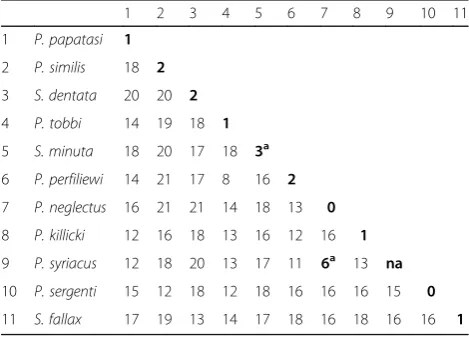
sites were 245 while parsimony informative sites were 217. The pairwise genetic distances ranged from 0 to 25%. After grouping obtained sequences, according to species
(Table2),Phlebotomusspp. individuals had mean genetic
distance between 6 and 21% while members of the genus Sergentomyia had less extreme distance range (13–17%). The highest intraspecific mean genetic distance (intraspe-cies delimitation), based on our dataset, was set as 3%.
This value was calculated among theS. minutaindividuals
analyzed. On the other hand, the respected lowest inter-specific value (interspecies delimitation) was set as 6%. This was assessed when calculating the distance between P. syriacusand its sister speciesP. neglectus.Phlebotomus papatasi sequences from Crete had 1% mean genetic
distance from the ones from Cyprus. As for theS. minuta
sequences, there was a 4% mean genetic distance between the sand flies from Greece and Cyprus and a 3.3% between S. minuta sequences from Crete and mainland Greece.
Intraspecies mean genetic distance of all S. minuta
[image:4.595.304.539.539.708.2]se-quences, regardless their origin, was less than 1%. The analysis of PF supported the partitioning of the dataset in the three codon positions. The nucleotide substitution model selected for each data partition were: for MrBayes SYM + I for the first codon position, HKY + I for the sec-ond and GTR + G for the third codon position, whereas GTR + G for each one of the codon positions for RAxML.
Table 2Among species genetic distances (in %) based on the Tamura-Nei model. Diagonal line in bold shows intraspecies distances
1 2 3 4 5 6 7 8 9 10 11
1 P. papatasi 1
2 P. similis 18 2
3 S. dentata 20 20 2
4 P. tobbi 14 19 18 1
5 S. minuta 18 20 17 18 3a
6 P. perfiliewi 14 21 17 8 16 2
7 P. neglectus 16 21 21 14 18 13 0
8 P. killicki 12 16 18 13 16 12 16 1
9 P. syriacus 12 18 20 13 17 11 6a 13 na
10 P. sergenti 15 12 18 12 18 16 16 16 15 0
11 S. fallax 17 19 13 14 17 18 16 18 16 16 1
Abbreviation: nanot applicable
a
Phylogenetic analyses
Maximum likelihood (-lnL = 4340.76), and Bayesian infer-ence analysis (arithmetic mean -lnL = 4352.85) produced similar topologies. Considering the Bayesian analysis, the MCMC convergence diagnostics (average standard deviation of split frequencies, the plot of the generation versus the log probability of the data, the average Po-tential Scale Reduction Factor, and the minimum value of minimum Estimated Sample Sizes) revealed no clues of non-convergence, indicating stationarity, that is, there should be no tendency of increase or decrease over time.
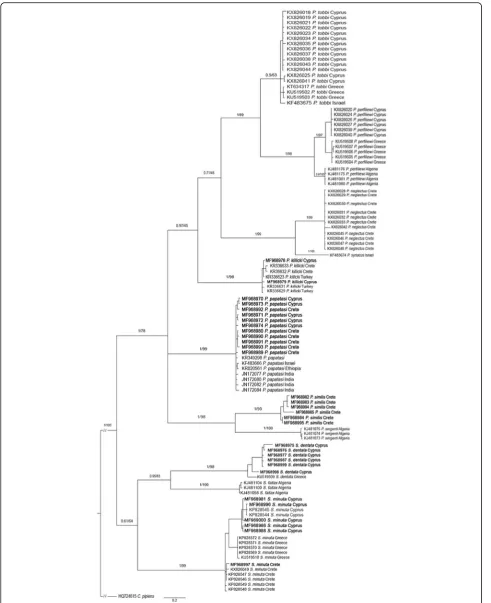
The Bayesian phylogenetic tree presented in Fig.1
demon-strates a clear separation between the two genera, Phlebo-tomus and Sergentomyia, and also the subgenera Phlebotomus, Paraphlebotomus,Transphlebotomus and Sergentomyia, respectively.
All species were separated with each one having its own branch. Sequences for all newly collected individuals clus-tered together with those already published for the respect-ive species of the same or different locality forming groups of the same subgenus. The phylogenetic groupings pro-vided by the tree, coupled with the aforementioned
sequen-cing queries against GenBank™, confirmed the molecular
and morphological identification of the sampled sand flies.
Discussion
The present study used DNA barcoding to identify 31 wild-caught sand flies, belonging to five species, from
Crete and Cyprus. The species identified areP. papatasi
(from both Crete and Cyprus),P. similis(from Crete),P.
killicki (from Cyprus), S. minuta (from both Crete and
Cyprus) and S. dentata (from Cyprus). After obtaining
the cox1 sequences necessary for DNA barcoding, a
lar-ger dataset ofcox1 barcodes was constructed in order to
place the new ones in a phylogenetic tree that would de-scribe the relationships between sand fly species around the Mediterranean Basin and conclusively verify their identity (Fig.1).
Phlebotomus papatasi is the vector of L. major that causes zoonotic CL in humans in many countries in Africa and Asia [42]. It can be found locally all around southern Europe but there are no studies of its vectorial role in Greece [12]. Given that P. papatasi has an established presence in Crete and mainland Greece [4,7,8, 43,44] as well as in Cyprus [14, 18], population monitoring should continue to determine whether it can act as the vector ofL. majorin these areas in case infected rodent reservoirs
are introduced. In the present study, P. papatasi
indi-viduals were well separated with high posterior
prob-ability (Fig.1) from other species groups and clustered
together with publishedcox1 barcodes of the same species. Phlebotomus papatasibelongs to the phylogenetically
dis-tinct subgenusPhlebotomus, members of which have been
quite often used in phylogenetic analyses [18,28,45,46]. In
a study where 22 populations of P. papatasi from 16
countries were subjected to phylogenetic analysis, it was shown that samples from Crete and Cyprus shared haplo-types implying close genetic relationships albeit their insular isolation [47]. The present study encountered two individuals that share a haplotype (data not shown). This fact, along with the 1% mean genetic distance between the
samples of P. papatasi from Greece and Cyprus of the
present study, adds more supporting information to that conclusion. Additionally, their clear morphological homo-geneity suggests that these two populations, most likely, do not constitute different taxa. All individuals analyzed in the present study represented a single clade although they were derived from quite diverse geographical locations (India, Ethiopia, Israel). This observation indicates that more studies are needed to investigate the possibility of cryptic or sibling taxa within this geographically diverse species group.
Phlebotomus similis is the sister species of P. sergenti, a proven vector of L. tropica [11, 48, 49]. Due to its abundance in CL foci in Greece, it is believed that this is the species transmitting L. tropica in the country [50]. Sand fly samplings in Greece, in the past, reported the
presence of P. sergenti. However, Depaquit et al. [11]
suggested that the species found is actuallyP. similisand
that this is the sole Paraphlebotomus species found in
the country able to transmit L. tropica. In fact, since
2002, no published sand fly samplings in Greece have reported P. sergenti[7, 16,27]. Additionally, sequencing analysis showed thatP. similisindividuals from this study
exhibit a 12% distance fromP. sergentisequences derived
from Algeria, separating these species in a clear manner. This is the first time thatcox1 sequences ofP. similisare
deposited in GenBank, a first step to start monitoring P.
similis populations to resolve their systematic status via
DNA barcoding. Molecular studies of the subgenus
Para-phlebotomus based on nuclear [51] and mitochondrial markers [45,46] have come to same topology conclusions as the present study.
Phlebotomus killickiwas recently described as a member
of the subgenusTransphlebotomusand it was found in
lo-cations in Crete and Turkey, sites 500 km apart, along with P. anatolicus [30]. In Cyprus, the presence of P. economidesiwas reported along with that ofP. mascittii
[14, 52] but its presence on the island should be
re-evaluated [30]. Phlebotomus economidesi was also found
in Turkey [30]. This is the first report of P. killicki in
Cyprus; where this species was found in sympatry withP.
species, P. canaaniticus, occurs in the Middle East [53]. Phlebotomus mascittii is the Transphlebotomus species presenting the widest geographical distribution compared with other species within that subgenus (from Germany and Austria [54,55] to Crete [4,7]).Transphlebotomus is a subgenus that is closely related to the subgenera AdleriusandLarroussius[56] which both contain Leish-mania vectors [57] and have being thoroughly studied [27, 58–60]. It is suggested that since populations of Transphlebotomus spp. sand flies are detected more often than before, more studies for their vectorial role should be conducted.
Sergentomyia minuta and S. dentataare known to be
present in mainland Greece [7, 44] as well as in the
islands of Crete [6–8] and Cyprus [14,18].Sergentomyia minutahas a doubtful taxonomic status and a quite unique intraspecific variability [19] which should be evaluated to-gether with its possible vectorial capacity. AllSergentomyia samples sequenced in this work clustered by genus, species and locality, respectively, confirming previous studies [28, 61]. The S. minuta clade (Fig. 1) presented a geo-graphical locality-based separation and the three sub-clades created suggest that speciation events could be underway. Genetic distances between the three sub-clades (Cyprus, mainland Greece, Crete) exceed 3% while all three intra-clade distances did not exceed 1%, evidence that supports the above-mentioned isolation based on this dataset. Of
particular note, Sergentomyia sp. individuals were caught
using sticky traps [9], mostly among rock pile wall forma-tions which provide resting and hiding places for lizards. This genus contains sand fly species that feed on reptiles and transmitSauroleishmania, a parasite infecting reptiles [10]. Such rock formations also provide a perfect nesting habitat for sand flies. Since sand flies are known to be weak flyers, they tend to reside close to their blood meal sources [1]. Given that, it is suggested thatS. minutapopulations, in their specific habitats, may have been isolating them-selves faster than other species thus creating such an intra-species diversity as the one demonstrated here (Fig.1). As this evidence underlines the possible existence of cryptic taxa, further samplings for individuals in those areas are be-ing conducted. The genetic isolation between individuals from Crete and Cyprus is not supported with morpho-logical findings indicating that further multigene molecular work, accompanied with morphospecies clustering, would provide further information on this interesting issue. There are an increasing number of studies that detectLeishmania
DNA in sand flies belonging to the genus Sergentomyia
[62–65] but detection of parasite DNA in sand flies is not sufficient evidence for a species to be classified as vector
[66]. A study in Senegal examined whether Sergentomyia
sand fly species were vectors of L. infantumin a CanLei
endemic focus where Phlebotomus species are absent or
significantly under-represented. It was concluded that S.
dubia and S. schwetzi are the possible vectors of the parasite in the studied area [67] based on accepted vec-torial criteria [68]. As a result, it appears that
Sergento-myia needs to be studied more thoroughly since there
are more taxonomic and vectorial capacity questions requiring answers [19,61].
Conclusions
This study constitutes the molecular identification of the sand fly species caught in two VL/CL/CanLei foci, Cyprus and Crete, in the southeastern Mediterranean, using DNA barcoding. It makes a contribution towards understanding the systematic status ofP. similis, the suspected vector ofL. tropicain Greece. This is the first time DNA barcoding has been applied to this important species and the derived barcodes are added to the GenBank database. The presence ofP. killickiis reported for the first time in Cyprus and pos-sible newly arising taxa within theS. minuta phylogenetic clade are demonstrated. Regarding theP. papatasi individ-uals caught in the two islands, it was shown that although the two populations are geographically unassociated, they show no morphological or DNA barcoding-based differ-ences. As more barcodes are added to the database, identifi-cation/clustering process of sand flies and their molecular systematics will be accurately resolved. Since sand fly spe-cies are quite important in the transmission ofLeishmania parasites as well as other pathogens, their geographical dis-tribution and vectorial capacity must be extensively evalu-ated. DNA barcoding helps towards that direction by putting the stepping stone to the comprehension of taxa.
Abbreviations
BI:Bayesian inference; BIC: Bayesian information criterion; CanLei: Canine leishmaniasis; CL: Cutaneous leishmaniasis;cox1: Cytochrome oxidase I; EU: European Union; ML: Maximum likelihood; PCR: Polymerase chain reaction; PF: Partition finder; VL: Visceral leishmaniasis
Acknowledgements
We would like to thank Dr Ana Aransay for her valuable help.
Funding
The study was partly funded by the University of Crete Research Account (ELKE code 3768) and partly by the EU FP7–261504 EDENext program. (http://www.edenext.eu). The contents of this publication are the sole responsibility of the authors and do not necessarily reflect the views of the European Commission.
Availability of data and materials
All sequences obtained from the study were deposited in the GenBank database under the accession numbers: MF968970–MF968974, MF968980, MF968989–MF968993 (P. papatasi); MF968982–MF968985, MF968994, MF968995 (P. similis); MF968978, MF968979 (P. killicki); MF968981, MF968986, MF968988, MF968996, MF968997, MF969000 (S. minuta); MF968975– MF968977, MF968987, MF968998, MF968999 (S. dentata).
Authors’contributions
Ethics approval and consent to participate
The study involved using adult sand flies, collected in previous studies, for molecular analyses. Local or regional ethics committee approval was not required for such work.
Consent for publication
Not applicable.
Competing interests
The authors declare that they have no competing interests.
Publisher’s Note
Springer Nature remains neutral with regard to jurisdictional claims in published maps and institutional affiliations.
Author details
1Laboratory of Clinical Bacteriology, Parasitology, Zoonoses and Geographical
Medicine, School of Medicine, University of Crete, Vassilika Vouton, P.O. Box 2208, GR-71003 Heraklion, Greece.2Biology Department, School of Sciences and Engineering, University of Crete, Vassilika Vouton, P.O. Box 2208, GR-70013 Heraklion, Crete, Greece.3Natural History Museum of Crete, School of Sciences and Engineering, University of Crete, Knossos Av, P.O. Box 2208, GR-71409 Heraklion, Crete, Greece.
Received: 19 September 2017 Accepted: 25 January 2018
References
1. Killick-Kendrick R. The biology and control of phlebotomine sand flies. Clin Dermatol. 1999;17(3):279–89.
2. World Health Organization (WHO). 2017.http://www.who.int/leishmaniasis/en/. Accessed Jul 2017.
3. Killick-Kendrick R. Some epidemiological consequences of the evolutionary fit between leishmaniae and their phlebotomine vectors. Bull Soc Pathol Exot Filiales. 1985;78(5 Pt 2):747–55.
4. Christodoulou V, Antoniou M, Ntais P, Messaritakis I, Ivovic V, Dedet J-P, et al. Re-emergence of visceral and cutaneous leishmaniasis in the Greek Island of Crete. Vector Borne Zoonotic Dis. 2012;12(3):214–22.
5. Léger N, Gramiccia M, Gradoni L, Madulo-Leblond G, Pesson B, Ferté H, et al. Isolation and typing ofLeishmania infantumfromPhlebotomus
neglectuson the Island of Corfu, Greece. Trans R Soc Trop Med Hyg.
1988;82(3):419–20.
6. Léger N, Pesson B, Madulo-Leblond G, Ferte H, Tselentis Y, Antoniou M. The phlebotomes of Crete. Biologia Gallo-Hellenica. 1993;20:135–43. 7. IvovićV, Patakakis M, Tselentis Y, Chaniotis B. Faunistic study of sandflies in
Greece. Med Vet Entomol. 2007;21(1):121–4.
8. Ntais P, Christodoulou V, Tsirigotakis N, Dokianakis E, Dedet J-P, Pratlong F, et al. Will the introduction ofLeishmania tropicaMON-58, in the Island of Crete, lead to the settlement and spread of this rare zymodeme? Acta Trop. 2014;132:125–30.
9. Alten B, Maia C, Afonso MO, Campino L, Jiménez M, González E, et al. Seasonal dynamics of phlebotomine sand fly species proven vectors of Mediterranean leishmaniasis caused byLeishmania infantum. PLoS Negl Trop Dis. 2016;10(2):e0004458.
10. Killick-Kendrick R. Phlebotomine vectors of the leishmaniases: a review. Med Vet Entomol. 1990;4(1):1–24.
11. Depaquit J, Ferté H, Léger N, Lefranc F, Alves-Pires C, Hanafi H, et al. ITS 2 sequences heterogeneity inPhlebotomus sergentiandPhlebotomus similis
(Diptera, Psychodidae): possible consequences in their ability to transmit
Leishmania tropica. Int J Parasitol. 2002;32(9):1123–31.
12. Ready PD. Leishmaniasis emergence in Europe. Euro Surveill. 2010;15(10):19505. 13. Léger N, Depaquit J, Ferté H, Rioux JA, Gantier JC, Gramiccia M, et al.
Phlebotomine sandflies (Diptera-Psychodidae) of the isle of Cyprus. II-isolation and typing ofLeishmania(Leishmania infantum) Nicolle, 1908 (zymodeme MON 1) fromPhlebotomus(Larroussius)tobbiAdler & Theodor, 1930. Parasite. 2000;7(2):143–6.
14. Mazeris A, Soteriadou K, Dedet JP, Haralambous C, Tsatsaris A, Moschandreas J, et al. Leishmaniases and the Cyprus paradox. Am J Trop Med Hyg. 2010;82(3):441–8.
15. Antoniou M, Haralambous C, Mazeris A, Pratlong F, Dedet J-P, Soteriadou K.
Leishmania donovanileishmaniasis in Cyprus. Lancet Infect Dis. 2008;8(1):6–7.
16. Antoniou M, Haralambous C, Mazeris A, Pratlong F, Dedet J-P, Soteriadou K.
Leishmania donovanileishmaniasis in Cyprus. Lancet Infect Dis. 2009;9(2):76–7.
17. Ntais P, Sifaki-Pistola D, Christodoulou V, Messaritakis I, Pratlong F, Poupalos G, et al. Leishmaniases in Greece. Am J Trop Med Hyg. 2013;89(5):906–15. 18. Ergunay K, Kasap OE, Orsten S, Oter K, Gunay F, Yoldar AZA, et al.
PhlebovirusandLeishmaniadetection in sandflies from eastern Thrace and
northern Cyprus. Parasit Vectors. 2014;7:575.
19. Depaquit J, Hadj-Henni L, Bounamous A, Strutz S, Boussaa S, Morillas-Marquez F, et al. Mitochondrial DNA intraspecific variability inSergentomyia
minuta(Diptera: Psychodidae). J Med Entomol. 2015;52(5):819–28.
20. Jaouadi K, Haouas N, Chaara D, Boudabous R, Gorcii M, Kidar A, et al. Phlebotomine (Diptera, Psychodidae) bloodmeal sources in tunisian cutaneous leishmaniasis foci: couldSergentomyia minuta, which is not an exclusive herpetophilic species, be implicated in the transmission of pathogens? Ann Entomol Soc Am. 2013;106(1):79–85.
21. Lewis DJ. Phlebotomid sand flies (Diptera: Psychodidae) of the oriental region. Bull World Health Organ. 1978;37:1–343.
22. Pinto I de S, das CBD, Rodrigues AAF, Ferreira AL, Rezende HR, Bruno RV, et al. DNA barcoding of Neotropical sand flies (Diptera, Psychodidae, Phlebotominae): species identification and discovery within Brazil. PLoS One. 2015;10(10):e0140636.
23. Depaquit J. Molecular systematics applied to phlebotomine sandflies: review and perspectives. Infect Genet Evol. 2014;28:744–756.
24. Giordani BF, Andrade AJ, Galati EAB, Gurgel-Gonçalves R. The role of wing geometric morphometrics in the identification of sandflies within the subgenusLutzomyia. Med Vet Entomol. 2017;4:373–80.
25. Hebert PDN, Cywinska A, Ball SL, deWaard JR. Biological identifications through DNA barcodes. Proc Biol Sci. 2003;270(1512):313–21.
26. Gajapathy K, Tharmasegaram T, Eswaramohan T, LBSL P, Jayanetti R, Surendran SN. DNA barcoding of Sri Lankan phlebotomine sand flies using cytochrome c oxidase subunit I reveals the presence of cryptic species. Acta Trop. 2016;161:1–7. 27. Dokianakis E, Tsirigotakis N, Christodoulou V, Poulakakis N, Antoniou M. DNA
sequencing confirms PCR-RFLP identification of wild-caughtLarroussius
sand flies from Crete and Cyprus. Acta Trop. 2016;164:314–20.
28. Chaskopoulou A, Giantsis IA, Demir S, Bon MC. Species composition, activity patterns and blood meal analysis of sand fly populations (Diptera: Psychodidae) in the metropolitan region of Thessaloniki, an endemic focus of canine leishmaniasis. Acta Trop. 2016;158:170–6.
29. Lewis DJ. A taxonomic review of the genusPhlebotomus(Diptera: Psychodidae). Bull Br Mus Nat Hist Entomol. 1982;45:121–209.
30. Kasap OE, Dvorak V, Depaquit J, Alten B, Votypka J, Volf P. Phylogeography of the subgenusTransphlebotomusArtemiev with description of two new species,Phlebotomus anatolicusn. Sp. andPhlebotomus killickin. sp. Infect Genet Evol. 2015;34:467–79.
31. Folmer O, Black M, Hoeh W, Lutz R, Vrijenhoek R. DNA primers for amplification of mitochondrial cytochrome c oxidase subunit I from diverse metazoan invertebrates. Mol Marine Biol Biotechnol. 1994;3(5):294–9. 32. Cohnstaedt LW, Beati L, Caceres AG, Ferro C, Munstermann LE.
Phylogenetics of the phlebotomine sand fly group Verrucarum (Diptera: Psychodidae:Lutzomyia). Am J Trop Med Hyg. 2011;84(6):913–22. 33. Kumar S, Stecher G, Tamura K. MEGA7: molecular evolutionary genetics
analysis version 7.0 for bigger datasets. Mol Biol Evol. 2016;33(7):1870–4. 34. Thompson JD, Higgins DG, Gibson TJ. CLUSTAL W: improving the sensitivity
of progressive multiple sequence alignment through sequence weighting, position-specific gap penalties and weight matrix choice. Nucleic Acids Res. 1994;22(22):4673–80.
35. Tamura K, Nei M. Estimation of the number of nucleotide substitutions in the control region of mitochondrial DNA in humans and chimpanzees. Mol Biol Evol. 1993;10(3):512–26.
36. Lanfear R, Calcott B, Ho SYW, Guindon S. Partitionfinder: combined selection of partitioning schemes and substitution models for phylogenetic analyses. Mol Biol Evol. 2012;29(6):1695–701.
37. Yang Z. Computational Molecular Evolution. 1st ed. Oxford: Oxford University Press; 2016.
38. Ronquist F, Teslenko M, van der Mark P, Ayres DL, Darling A, Höhna S, et al. MrBayes 3.2: efficient Bayesian phylogenetic inference and model choice across a large model space. Syst Biol. 2012;61(3):539–42.
39. Huelsenbeck JP, Ronquist F. MRBAYES: Bayesian inference of phylogenetic trees. Bioinformatics. 2001;17(8):754–5.
41. Silvestro D, Michalak I. raxmlGUI: a graphical front-end for RAxML. Org Divers Evol. 2011;12:335–7.
42. Maroli M, Feliciangeli MD, Bichaud L, Charrel RN, Gradoni L. Phlebotomine sandflies and the spreading of leishmaniases and other diseases of public health concern. Med Vet Entomol. 2013;27(2):123–47.
43. Depaquit J, Grandadam M, Fouque F, Andry PE, Peyrefitte C. Arthropod-borne viruses transmitted by phlebotomine sandflies in Europe: a review. Euro Surveill. 2010;15(10):19507.
44. Xanthopoulou K, Anagnostou V, Ivovic V, Djurkovic-Djakovic O, Rogozi E, Sotiraki S, et al. Distribution of sandflies (Diptera, Psychodidae) in two Ionian Islands and northern Greece. Vector Borne Zoonotic Dis. 2011;11(12):1591–4. 45. Bounamous A, Lehrter V, Hadj-Henni L, Delecolle J-C, Depaquit J. Limits of a rapid identification of common Mediterranean sandflies using polymerase chain reaction-restriction fragment length polymorphism. Mem Inst Oswaldo Cruz. 2014;109(4):466–72.
46. Maia C, Parreira R, Cristóvão JM, Afonso MO, Campino L. Exploring the utility of phylogenetic analysis of cytochrome oxidase gene subunit I as a complementary tool to classical taxonomical identification of phlebotomine sand fly species (Diptera, Psychodidae) from southern Europe. Acta Trop. 2015 Apr;144:1–8.
47. Depaquit J, Lienard E, Verzeaux-Griffon A, Ferté H, Bounamous A, Gantier J-C, et al. Molecular homogeneity in diverse geographical populations of
Phlebotomus papatasi(Diptera, Psychodidae) inferred from ND4 mtDNA and
ITS2 rDNA. Epidemiological consequences. Infect Genet Evol. 2008;8(2):159–70. 48. Volf P, Ozbel Y, Akkafa F, Svobodová M, Votýpka J, Chang KP. Sand flies
(Diptera: Phlebotominae) in Sanliurfa, Turkey: relationship ofPhlebotomus
sergentiwith the epidemic of anthroponotic cutaneous leishmaniasis. J Med
Entomol. 2002;39(1):12–5.
49. Ajaoud M, Es-sette N, Hamdi S, El-Idrissi AL, Riyad M, Lemrani M. Detection and molecular typing ofLeishmania tropicafromPhlebotomus sergentiand lesions of cutaneous leishmaniasis in an emerging focus of Morocco. Parasit Vectors. 2013;6:217.
50. Antoniou M, Gramiccia M, Molina R, Dvorak V, Volf P. The role of indigenous phlebotomine sandflies and mammals in the spreading of leishmaniasis agents in the Mediterranean region. Euro Surveill. 2013;18(30):20540. 51. Depaquit J, Ferté H, Léger N, Killick-Kendrick R, Rioux JA, Killick-Kendrick M,
et al. Molecular systematics of the phlebotomine sandflies of the subgenus
Paraphlebotomus(Diptera, Psychodidae,Phlebotomus) based on ITS2 rDNA
sequences. Hypotheses of dispersion and speciation. Insect Mol Biol. 2000;9(3):293–300.
52. Léger N, Depaquit J, Ferté H. Phlebotomine sandflies (Diptera-Psychodidae) of the isle of Cyprus. I-description ofPhlebotomus(Transphlebotomus)
economidesin. sp. Parasite. 2000;7(2):135–41.
53. Sawalha SS, Shtayeh MS, Khanfar HM, Warburg A, Abdeen ZA. Phlebotomine sand flies (Diptera: Psychodidae) of the Palestinian West Bank: potential vectors of leishmaniasis. J Med Entomol. 2003;40(3):321–8. 54. Melaun C, Krüger A, Werblow A, Klimpel S. New record of the suspected
leishmaniasis vectorPhlebotomus(Transphlebotomus)mascittiiGrassi, 1908 (Diptera: Psychodidae: Phlebotominae) - the northernmost phlebotomine sandfly occurrence in the Palearctic region. Parasitol Res. 2014;113(6):2295–301. 55. Obwaller AG, Karakus M, Poeppl W, Töz S, Özbel Y, Aspöck H, et al. Could
Phlebotomus mascittiiplay a role as a natural vector forLeishmania
infantum? New data. Parasit Vectors. 2016;9:458.
56. Depaquit J, Naucke TJ, Schmitt C, Ferté H, Léger N. A molecular analysis of the subgenusTransphlebotomusArtemiev, 1984 (Phlebotomus, Diptera, Psychodidae) inferred from ND4 mtDNA with new northern records of
Phlebotomus mascittiiGrassi, 1908. Parasitol Res. 2005;95(2):113–6.
57. World Health Organization (WHO). Control of the leishmaniases. World Health Organ Tech Rep. 2010;Ser xii–xiii:1–186.
58. Di Muccio T, Marinucci M, Frusteri L, Maroli M, Pesson B, Gramiccia M. Phylogenetic analysis ofPhlebotomusspecies belonging to the subgenus
Larroussius(Diptera, Psychodidae) by ITS2 rDNA sequences. Insect Biochem
Mol Biol. 2000;30(5):387–93.
59. Depaquit J, Bounamous A, Akhoundi M, Augot D, Sauvage F, Dvorak V, et al. A taxonomic study ofPhlebotomus(Larroussius)perfiliewi s.l. Infect Genet Evol. 2013;20:500–8.
60. Zahraei-Ramazani A, Kumar D, Mirhendi H, Sundar S, Mishra R, Moin-Vaziri V, et al. Morphological and genotypic variations among the species of the subgenusAdlerius(Diptera: Psychodidae,Phlebotomus) in Iran. J Arthropod Borne Dis. 2015;9(1):84–97.
61. Maia C, Depaquit J. CanSergentomyia(Diptera, Psychodidae) play a role in the transmission of mammal-infectingLeishmania? Parasite. 2016;23:55. 62. Berdjane-Brouk Z, Koné AK, Djimdé AA, Charrel RN, Ravel C, Delaunay P, et al.
First detection ofLeishmania majorDNA inSergentomyia(Spelaeomyia)darlingi
from cutaneous leishmaniasis foci in Mali. PLoS One. 2012;7(1):e28266. 63. Campino L, Cortes S, Dionísio L, Neto L, Afonso MO, Maia C. The first
detection ofLeishmania majorin naturally infectedSergentomyia minutain Portugal. Mem Inst Oswaldo Cruz. 2013;108(4):516–8.
64. Nzelu CO, Kato H, Puplampu N, Desewu K, Odoom S, Wilson MD, et al. First detection ofLeishmania tropicaDNA andTrypanosomaspecies in
Sergentomyiasand flies (Diptera: Psychodidae) from an outbreak area of
cutaneous leishmaniasis in Ghana. PLoS Negl Trop Dis. 2014;8(2):e2630. 65. Jaouadi K, Ghawar W, Salem S, Gharbi M, Bettaieb J, Yazidi R, et al. First
report of naturally infectedSergentomyia minutawithLeishmania majorin Tunisia. Parasit Vectors. 2015;8:649.
66. Seblova V, Sadlova J, Carpenter S, Volf P. Speculations on biting midges and other bloodsucking arthropods as alternative vectors ofLeishmania. Parasit Vectors. 2014;7:222.
67. Senghor MW, Niang AA, Depaquit J, Ferté H, Faye MN, Elguero E, et al. Transmission ofLeishmania infantumin the canine leishmaniasis focus of Mont-Rolland, Senegal: ecological, parasitological and molecular evidence for a possible role ofSergentomyiasand flies. PLoS Negl Trop Dis. 2016;10(11):e0004940.
68. Ready PD. Biology of phlebotomine sand flies as vectors of disease agents. Annu Rev Entomol. 2013;58:227–50.
• We accept pre-submission inquiries
• Our selector tool helps you to find the most relevant journal • We provide round the clock customer support
• Convenient online submission • Thorough peer review
• Inclusion in PubMed and all major indexing services • Maximum visibility for your research
Submit your manuscript at www.biomedcentral.com/submit