R E S E A R C H A R T I C L E
Open Access
Does long-term care insurance affect the length
of stay in hospitals for the elderly in Korea?: a
difference-in-difference method
Kyung-Rae Hyun
1, Sungwook Kang
2and Sunmi Lee
1*Abstract
Background:This study examines the effects of long-term care insurance (LTCI) on the length of stay (LoS) of senior citizens under the national health insurance of Korea.
Methods:The subjects include 3,903,448 people aged 65 and over as of July 1, 2008 when the LTCI was introduced in Korea. This study uses their panel data which traced the records of medical services and LTCI services for the same people from 2007 to 2010, and applies a difference-in-difference approach on LTCI users from levels 1, 2, and 3 who are the treatment group and non-LTCI users who are the control group.
Results:We found that the LoS of LTCI users is 1.27 days greater than that of non-LTCI users, but the LoS of level 1 and level 2 beneficiaries decreases by 8.35 and 2.84 days, respectively, whereas the LTCI does not reduce the LoS of level 3 beneficiaries.
Conclusions:The reason why there is an effect on the LoS of level 1 and 2 beneficiaries is that these groups could choose to utilize institutional care services provided by the LTCI, and out-of-pocket costs of institutions are lower than that of hospitals. However, the reason why there is no effect on the LoS of level 3 beneficiaries is that they are not permitted to use the institutional care services in the Korean LTCI policy. Therefore, we recommend a modification in the LTCI system that facilitates the use of long-term care institutional services by level 3 beneficiaries without conflicting Korea’s LTCI principle to promote home-based care services instead of the institutional care services.
Keywords:Long-term care insurance, Length of stay, Difference-in-difference
Background
The national health insurance (NHI) program of Korea provides coverage for the entire population under a compulsory health insurance scheme. Insurance benefits are provided to the insured and their dependents to cover the prevention and treatment of sickness. Health care expenditure as a percentage of GDP in Korea was approximately 7.1% in 2010, while the average annual in-crease rate in health care expenditure was 9.1% from 2000 to 2009, the greatest increase rate among 33 OECD countries [1]. The Korean government paid special at-tention to the aging population, which it believed may cause a sharp increase in health care expenditure. The
proportion of people aged 65 and over was 11.0% in 2010 [2], and this group accounted for 32.4% of all health care expenditure in Korea [3].
The number of chronic-care beds for the elderly popu-lation was insufficient in Korea until the early 2000s. The Korean government did not make preparations for augmenting the number of chronic-care beds even though the demand for chronic-care beds was expected to increase because of the aging population. Accordingly, as inappropriate hospitalizations in acute-care beds for seniors led to longer stays, this environment strained the Korean NHI system with higher costs for hospital treat-ment compared to nursing care services in residential areas. To overcome this situation, the Korean govern-ment introduced a new social insurance scheme for long-term care in July 2008, which was based on a pilot study conducted in several regions throughout the * Correspondence:[email protected]
1
Health Insurance Policy Research Institute, National Health Insurance Service, Mapo-gu, Seoul, South Korea
Full list of author information is available at the end of the article
country. Hence, there are two mandatory insurances in Korea; one is the NHI program, which provides medical care services; the other is the long-term care insurance (LTCI) program, which provides social services for the elderly with a few functional limitations. One of the aims of the LTCI program is to reduce the utilization of in-appropriate health care services by elderly patients within the NHI program. Therefore, it is important to analyze the effect of the LTCI program on hospitaliza-tions relating to the NHI program for the elderly popu-lation in Korea.
Many studies have evaluated the quantitative and qualitative aspects of the Korean LTCI program, such as changes in the scope of benefits [4-6], the economic bur-den and quality of life for beneficiaries and family care-givers [7-11], and job satisfaction rates for long-term care workers [12]. However, few studies have examined the ef-fects of the Korean LTCI program on the utilization of health care services covered by the Korean NHI program for seniors. There are a few studies suggesting the exist-ence of a relationship between long-term care and acute care based on results of other countries [13-16]. Forder [15] demonstrates that since home-based or institutional social services for the frail and elderly population could reduce the rate of admissions to hospitals, the LTCI program could facilitate more timely discharge from
hospitals. Tomita et al. [17] suggests that the use of
home-based and community-based services decrease the probability of hospitalization and institutionalization of the aged population by diminishing the functional or health-related risks.
Because six years have passed since the introduction of the LTCI program in Korea, it is time to evaluate the ef-fects of the LTCI program for the elderly under the NHI program. Therefore, the purpose of this study is to examine the effects of the LTCI program on the length of stay (LoS) in all clinics and hospitals for those aged 65 years and over who are under the NHI program in Korea. This paper pro-ceeds in the following manner: First of all, we describe the methodology and data in this study. Next, we describe the empirical results. Finally, we discuss the implications of the empirical results in the discussion section.
Methods Study design
This study uses the panel data from 2007 to 2010. Our panel data traced the records of medical services and LTCI services for the same people over four years and applies the difference-in-difference (DID) method to es-timate the effects of the LTCI program on the LoS for those aged 65 years and over before and after the intro-duction of the LTCI program [18,19]. Many studies have used the DID approach to measure the effects of policy changes or an introduction of a new policy [20-22]. The
DID method is a standard policy evaluation tool that ex-amines the effects of a policy intervention on a treatment group in comparison to a control group once a particular policy is initiated. The treatment group in this study con-sists of people aged 65 years or older who use the services offered by the LTCI program in Korea, while the control group consists of those aged 65 years or older who do not use the services provided by the LTCI program.
When conducting a policy analysis by using panel data, the DID method assumes that unobserved effects are the same for both the treatment group and the control group. Thus, the change in health care use in the treat-ment group before and after the introduction of the LTCI program, minus the corresponding change in the control group, provides an estimate of the impact of the LTCI pro-gram on health care use. The identifying assumption of the DID estimator is that time-varying factors affect both groups equally. This study examines four time periods from each individual, and the unobserved effects panel data model is as follows:
Hit¼ δ1þδ2D2þδ3D3þδ4D4þβ1LTCIitþβ2Zit þaiþuit
where Hit is a patient’s health care use, such as LoS, for
person i at time t. D2 is the year dummy for 2008 and D3 for 2009 and D4 for 2010. The binary variable LTCIit is
equal to one if person i at time t received benefits from LTCI, while Zit represents a variety of socio-economic
characteristics (e.g., age, sex, NHI premium, residence, health status, and medical services utilization). The unob-served effect is represented by ai. The unobserved effect ai
represents fixed factors that affect the functional condition in person i. Because LTCI eligibility is not determined ran-domly–LTCI users often have functional limitations–it is likely that LTCIitand aiare positively correlated. Thus,
we difference the equation to eliminate ai. This yields
ΔHit¼ δ2ΔD2þδ3ΔD3þδ4ΔD4þβ1ΔLTCIit þβ2ΔZitþΔuit
for t = 2, 3, and 4. Because age and sex inΔZitare
time-constant variables, they are eliminated.
The above equation contains the first differences in the year dummies, D2 and D3 and D4 but does not con-tain an intercept. This is inconvenient for cercon-tain pur-poses, including the computation of R-squared. Because we are not interested in time intercepts in the above equation, it is generally better to estimate the first-differenced equation with an intercept and a double time
period dummy (ΔD3,ΔD4) for the four periods. In other
words, the final structural equation becomes:
The regression of the above equation is conducted to determine the effects of the LTCI program on the LoS for LTCI users (treatment group) compared to non-LTCI users (control group). The estimate ofβ1measures a pre-post change in the LoS for the treatment group after the introduction of the LTCI program. Also, a more detailed policy analysis is performed by separating the treatment group according to the respectively approved level in the LTCI program.
Data
The dataset used in this study is the NHI and LTCI data-set developed by the Korean National Health Insurance Service (NHIS). The dataset include information of
sub-scriber’s qualification and medical usage which NHIS
constructed based on the ‘Article 15′ of the ‘Personal Information Protection Law’. The authors received per-mission to use data after deliberation of the Research Project Review Committee (RPRC) in accordance with the Research Project Management Guidelines of NHIS.
The NHI dataset is taken from 2007 to 2010, and the LTCI dataset is taken from July 2008 to December 2010. The NHI dataset used in this study contains socio-economic information like sex, age, monthly premium, classification of NHI, residence, health status, and medical services utilization. More specifically, we utilize the number of chronic diseases as proxy variable for health status and the number of physician visits as proxy variable for medical services utilization. The LTCI dataset used in this study contains information regarding the approved levels, such as level 1, level 2, and level 3, and the type of LTCI service.
The DID method can be used when the data is gener-ated from a natural experiment where the economic
en-vironment – sometimes summarized by an explanatory
variable – goes through an exogenous change, perhaps
inadvertently, due to a change in policy. A natural ex-periment occurs when some exogenous event, e.g., the introduction of LTCI, changes the environment in which individuals, families, firms, or cities operate. A natural experiment always has a control group (non-LTCI users), which is not affected by the policy change, and a treatment group (LTCI users), which is thought to be af-fected by the policy change. Hence, we eliminated some data that is not produced in a natural experiment.
The subjects of this study are 4,507,821 people aged 65 and over as of July 1, 2008 when the LTCI program was introduced in Korea. We excluded 357,684 people who died from July 1, 2008 to December 31, 2010 and 144,234 recipients subsidized by the Medical Aids pro-gram. Because these individuals tend to overuse health care services, they are not suitable for inclusion in the control group. Furthermore, we eliminated 102,455 people (switchers) whose approved level was changed in the LTCI program within one year and people
(non-users) who did not use LTCI services even though they received approval for their level by the local needs-assessment-committees in the LTCI programs. Because it is difficult to analyze the effect of government policy during the post-LTCI period, switchers and non-users are not suitable for inclusion in the treatment group. Based on the above exclusion criteria, the number of subjects in this study is 3,903,448 individuals. To make policy analysis with the panel data, we traced the records of their medical services and LTCI services.
Ethics statement
This research was directly performed by Health Insurance Policy Research Institute of NHIS as the investigative re-search in connection with the health insurance legislated in the‘National Health Insurance Act Article 14’. Accord-ing to the ‘Bioethics and Safety Act Enforcement Regula-tions Article 2’, researches that nation carried out directly or commissioned to review and evaluate public welfare and service programs are exempt from ethical approval of a regional Institutional Review Board (IRB). Therefore, neither ethical approval of an IRB nor written informed consent was required for this study according to the rele-vant legislation because this study was directly performed by Korean public single insurer, NHIS, to evaluate Korean NHI and LTCI.
Results
Table 1 shows the characteristics of the subjects in 2007. The classification of NHI, monthly premiums for NHI, and the subject’s residence are taken from the last day of 2007. We deflated the nominal monthly premium by using the consumer price index (CPI) of Statistics Korea (2010 = 100). The number of chronic diseases indicates primary diseases recorded in the NHI dataset which in-clude hypertensive diseases, diabetes mellitus, heart dis-eases, cerebrovascular disdis-eases, neoplasms, liver disdis-eases, and chronic kidney diseases. The level of LTCI in the treat-ment group refers to the approved level of the LTCI benefi-ciary who remained at the same level from 2008 to 2010.
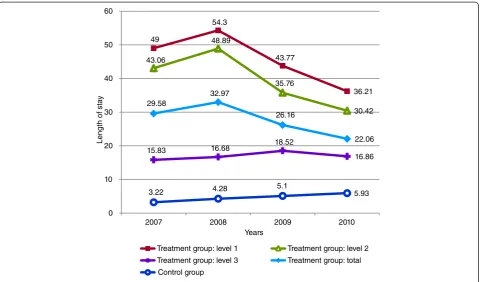
Figure 1 shows the LoS of LTCI users and non-LTCI users. The LoS of LTCI users (treatment group) is longer than that of non-LTCI users (control group). Within the treatment group, the LoS is the longest among level 1 beneficiaries. The LoS of the control group increased
[image:4.595.58.538.100.338.2]over 4 years from 3.22 days in 2007 to 5.93 days in 2010, while the LoS of the treatment group increased from 29.58 days in 2007 to 32.97 days in 2008 and then de-creased to 22.06 days in 2010. The fluctuations in the LoS of the total LTCI users corresponds to the fluctuations in Table 1 Characteristics of subjects in 2007
Treatment group Control group Total
Level 1 Level 2 Level 3 Subtotal
Sex
Male 1,445 (23.5%) 1,165 (21.4%) 3,288 (24.2%) 5,993 (23.3%) 1,610,861 (41.5%) 1,616,854 (41.4%)
Female 4,700 (76.5%) 4,283 (78.6%) 10,319 (75.8%) 19,699 (76.7%) 2,266,895 (58.5%) 2,286,594 (58.6%)
Age(years, ±S.D.*) 76.96 (±7.42) 78.27 (±7.30) 77.13 (±7.02) 77.34 (±7.20) 71.31 (±5.84) 71.35 (±5.87)
NHI classification
Employee 4,215 (68.7%) 3,762 (69.1%) 9,356 (68.8%) 17,658 (68.8%) 2,565,730 (66.3%) 2,583,388 (66.3%)
Self- employed 1,925 (31.4 %) 1,682 (30.9%) 4,250 (31.2%) 8,024 (31.2%) 1,303,302 (33.7%) 1,311,326 (33.7%)
NHI premium(ten thousand KRW, ±S.D.*) 9.64 (±8.56) 9.10 (±7.79) 9.11 (±8.52) 9.23 (±8.36) 8.47 (±7.65) 8.48 (±7.66)
Residence
Large city 2,801 (45.6 %) 2,495 (45.8%) 6,008 (44.2%) 11,538 (44.9%) 1,740,988 (45.0%) 1,752,526 (45.0%)
Small city 2,768 (45.1%) 2,391 (43.9%) 5,944 (43.7%) 11,328 (44.1%) 1,683,043 (43.5%) 1,694,371 (43.5%)
Rural 571 (9.3%) 558 (10.3%) 1,654 (12.2%) 2,816 (11.0%) 445,001 (11.5%) 447,817 (11.5 %)
Number of physician visits(±S.D.*) 24.79 (±34.81) 26.92 (±37.62) 37.97 (±44.20) 32.37 (±41.16) 34.76 (±34.80) 34.74 (±34.85)
Number of chronic disease(±S.D.*) 2.26 (±1.56) 2.23 (±1.62) 2.31 (±1.57) 2.28 (±1.58) 1.49 (±1.34) 1.50 (±1.34)
Total 6,145 (100.0%) 5,448 (100.0%) 13,607 (100.0%) 25,692 (100.0%) 3,877,756 (100.0%) 3,903,448 (100.0%) *
S.D.: standard deviation.
[image:4.595.59.540.438.720.2]Notes: Level 1, 2, 3 beneficiaries in 2007 was recalculated with people having the same level during 2008 ~ 2010.
the LoS of level 1 and level 2 beneficiaries over time. For level 3 beneficiaries, the LoS increased to 18.52 days in 2009 and then decreased to 16.86 days in 2010.
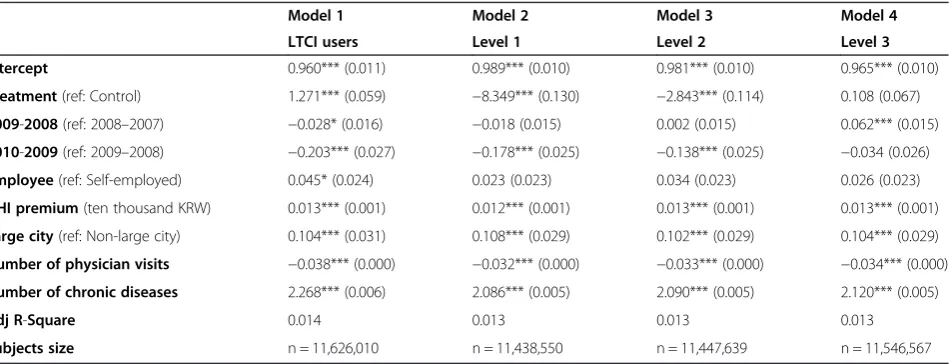
Table 2 shows the effects of the LTCI program on the LoS of LTCI users compared to non-LTCI users. Model (1) shows the effects of the LTCI program on all LTCI users, while models (2), (3), and (4) show the effects of the LTCI program on LTCI users from each level com-pared to non-LTCI users. The results suggest that the introduction of the LTCI program is accompanied by an increase of 1.27 days in the LoS of LTCI users when controlling for the classification of NHI, contributions of NHI, residence, the number of physician visits, and the number of chronic diseases. With respect to the levels of LTCI, the LTCI program causes the LoS of level 1 bene-ficiaries to decrease by 8.35 days and causes the LoS of level 2 beneficiaries to decrease by 2.84 days. For level 3 beneficiaries, the LTCI program may increase the LoS but the parameter is not statistically significant at the 5% level against a two-sided alternative. In model (1), the
first-differenced year dummies representing 2009–2008
and 2010–2009 present negative signs, and the absolute values increase from 0.03 to 0.20, which means that the LoS for the elderly shows a decreasing trend over time for both the treatment and the control groups. On the whole, the LoS is positively associated with NHI pre-mium, large city, and the number of chronic diseases. Conversely, a negative relationship between the LoS and the number of physician visits is apparent.
Discussion
This study reveals that the introduction of a LTCI pro-gram in Korea is not effective in reducing the LoS of LTCI users as was expected to decrease because the LoS
of LTCI users is 1.27 days greater than the LoS of non-LTCI users. There are two main reasons for this result. Firstly, the admission days of level 3 beneficiaries are not expected to be reduced because they are not permitted to use the institutional care services provided by the Korean LTCI program except in the case that they have no family support or live in an inadequate housing con-dition. With respect to the medical conditions of LTCI beneficiaries, the primary disease in each level is demen-tia. Level 1 beneficiaries account for 22%, level 2 ac-counts for 26.9%, and level 3 acac-counts for 22.6% [23]. Those beneficiaries whose main disease consist of a stroke accounted for 33.3% in level 1, 25.4% in level 2, and 23.2% in level 3 [23]. Concerning the need for long-term care, most notably nursing care, there is no differ-ence between the three levels [24]. Under the circum-stance in which the need for nursing care services among the LTCI beneficiaries is equal, level 3 beneficiaries should use services provided by long-term care hospitals because they are not permitted to use the institutional care services in the Korean LTCI policy.
Secondly, the number of beds per 1,000 elderly per-sons increased to 15.3 beds in 2010, the greatest increase rate among all OECD countries [1]. The average annual increase rate of the number of beds in the long-term care hospitals was 20.8% from 2007 to 2010 [25]. This rapid rate of increase led to a 14.1% rise in the average annual rate of the LoS for Korean senior citizens over the same period [3], and it could be related to an in-crease in the LoS of LTCI users.
[image:5.595.64.539.526.708.2]However, we can’t suggest that the introduction of the LTCI program does not have an effect on the LoS of LTCI users. We found that the LoS of level 1 and level 2 benefi-ciaries decreased by 8.35 and 2.84 days, respectively. This
Table 2 Effects of the LTCI program on the LoS (Difference-in-difference estimation)
Model 1 Model 2 Model 3 Model 4
LTCI users Level 1 Level 2 Level 3
Intercept 0.960*** (0.011) 0.989*** (0.010) 0.981*** (0.010) 0.965*** (0.010)
Treatment(ref: Control) 1.271*** (0.059) −8.349*** (0.130) −2.843*** (0.114) 0.108 (0.067)
2009-2008(ref: 2008–2007) −0.028* (0.016) −0.018 (0.015) 0.002 (0.015) 0.062*** (0.015)
2010-2009(ref: 2009–2008) −0.203*** (0.027) −0.178*** (0.025) −0.138*** (0.025) −0.034 (0.026)
Employee(ref: Self-employed) 0.045* (0.024) 0.023 (0.023) 0.034 (0.023) 0.026 (0.023)
NHI premium(ten thousand KRW) 0.013*** (0.001) 0.012*** (0.001) 0.013*** (0.001) 0.013*** (0.001)
Large city(ref: Non-large city) 0.104*** (0.031) 0.108*** (0.029) 0.102*** (0.029) 0.104*** (0.029)
Number of physician visits −0.038*** (0.000) −0.032*** (0.000) −0.033*** (0.000) −0.034*** (0.000)
Number of chronic diseases 2.268*** (0.006) 2.086*** (0.005) 2.090*** (0.005) 2.120*** (0.005)
Adj R-Square 0.014 0.013 0.013 0.013
Subjects size n = 11,626,010 n = 11,438,550 n = 11,447,639 n = 11,546,567
*significant at the 10% level, **significant at the 5% level, ***significant at the 1% level.
decrease among level 1 and level 2 beneficiaries may be because level 1 and level 2 beneficiaries could choose the institutional care services provided by the LTCI program under the guidelines of the Korean LTCI program, and be-cause the need for inpatient services of level 1 and level 2 beneficiaries was reduced.
In addition, the difference in out-of-pocket costs be-tween long-term care hospitals covered by the Korean NHI program and long-term care institutions covered by the Korean LTCI program may result in a decrease in the LoS of level 1 and level 2 beneficiaries. LTCI bene-ficiaries admitted to long-term care hospitals paid 840 thousand Korean won (KRW) per month in out-of-pocket costs, while those who used long-term care insti-tutions paid 485 thousand Korean won (KRW) per month in out-of-pocket costs [26]. This difference in out-of-pocket costs could cause level 1 and level 2 bene-ficiaries to select institutional care services instead of hospital services. The decrease in the LoS is consistent with the results of previous literature in which there is a substitution effect between long-term care institutional services and hospital services [15].
Conclusions
This is the first study to examine the effects of the Korean LTCI program on the utilization of health care services covered by the Korean NHI program for the elderly population. This study demonstrates that the LTCI program reduces the LoS for level 1 and level 2, even though it does not reduce the LoS of level 3. The reason why there is an effect on the LoS of level 1 and 2 beneficiaries is that they can choose the institutional care services provided by the LTCI, and out-of-pocket costs of institutions are lower than hospitals. However, the reason why there is no effect on the LoS of level 3 beneficiaries is that they are not permitted to use the in-stitutional care services under the Korean LTCI policy. Therefore, we recommend a modification in the LTCI system that facilitates the use of long-term care institu-tional services by level 3 beneficiaries without conflicting Korea’s LTCI principle to promote home-based care ser-vices instead of the institutional care serser-vices.
Abbreviations
NHI:National health insurance; LTCI: Long-term care insurance; LoS: Length of stay; DID: Difference-in-difference; NHIS: National health insurance service; RPRC: Research project review committee; IRB: Institutional review board; CPI: Consumer price index; KRW: Korean won.
Competing interests
The authors have no conflicts of interest or competing financial or non-financial interests to report.
Authors’contributions
All authors jointly developed the concept of the study. KRH led the development of this manuscript and contributed to the research design, methodology, and revised draft. SWK made significant contributions to the framework and the interpretation of the results and drafted the manuscript.
SML performed data programming, conducted statistical analysis and drafted the manuscript. All authors approved and read the final draft.
Acknowledgements
This study was supported by National Health Insurance Service (NHIS). The authors would like to thank the NHIS for cooperation.
Author details
1Health Insurance Policy Research Institute, National Health Insurance Service, Mapo-gu, Seoul, South Korea.2School of Public Health, Daegu Haany University, Gyeongsan-si, Gyeongsangbuk-Do, South Korea.
Received: 10 March 2014 Accepted: 2 December 2014
References
1. OECD Health Database. [http://stats.oecd.org/]
2. Statistics Korea:Population Projections for Korea: 2010 ~ 2060.Daejeon: Statistics Korea; 2011.
3. National Health Insurance Service (NHIS):2010 National Health Insurance Statistical Yearbook.Seoul: National Health Insurance Service (NHIS); 2011. 4. Jeong KS:A workplan for the management of long-term care insurance.
Seoul: Korea Institute for Health and Social Affairs (KIHASA).Health Welf Policy Forum2010,168:5–9.
5. Park MS, Kang SM:Demand prospect of professional workers in execution of the elderly’s long-term care insurance: nurse, social welfare, care probation professional workers.Korean Communications in Stat2010,17(3):423–440. 6. Moon CJ:Long-Term Care Insurance Current Status and Directions.Seoul:
International symposium celebrating the 3rd anniversary of Korea long-term care insurance. National Health Insurance Service (NHIS); 2011.
7. Han KH:Survey on Family Caregiver in Pilot Areas of Long-Term Care Insurance.
Seoul: Ministry of Health and Welfare; 2008.
8. Kim DB, Park SY, Kim SB:The influence of using of long-term care service on depression and life satisfaction among family care-givers: a comparison of leisure activity.J Fam Relat2010,15(3):117–135.
9. Park CJ:Determinants of long term care service use of family caregiver.
J Comm Welf2010,33:69–92.
10. Kwon HJ, Cho YU, Ko JY:The effects of long-term care insurance on the life satisfaction and satisfaction in family relationships: the DD method combined with propensity score matching.Korean J Soc Welf2011, 63(4):301–326.
11. Park CJ, Lee SJ:The family caregivers’stress pathways by types of long term care services for the elderly.J Korea Gerontol Soc2011,31(3):831–848. 12. Lee CJ:The impact of work stress and job satisfaction on turnover
intention: a study of long-term care workers.J Korea Gerontol Soc2011, 31(2):277–290.
13. Victor CR, Healy J, Thomas A, Seargeant J:Old patients and delayed discharge from hospital.Health Soc Care Community2000,8(6):443–452. 14. Fernandez JL, Forder J:Consequences of local variations in social care on
the performance of the acute health care sector.Appl Econ2008, 40(12):1503–1518.
15. Forder J:Long-term care and hospital utilization by older people: an analysis of substitution rates.Health Econ2009,18(11):1322–1338. 16. Deraas TS, Berntsen GR, Hasvold T, Førde OH:Does long-term care use
within primary health care reduce hospital use among older people in Norway? a national five-year population-based observational study.
BMC Health Serv Res2011,11:287–297.
17. Tomita N, Yoshimura K, Ikegami N:Impact of home and community-based services on hospitalization and institutionalization among individuals eligible for long-term care insurance in Japan.BMC Health Serv Res2010, 10:345–357.
18. Cornwell C, Trumbull WN:Estimating the economic model of crime with panel data.Rev Econ Stat1994,76(2):360–366.
19. Papke LE:Tax policy and urban development: evidence from the Indiana enterprise zone program.J Public Econ1994,54(1):37–49.
20. Wooldridge JM:Econometric Analysis of Cross Section and Panel Data.
Cambridge MA: The MIT Press; 2002.
22. Chou SY, Grossman M, Liu JT, Joyce T:Parental education and child health: evidence from a natural experiment in Taiwan.Am Econ J Appl Econ2010,2(1):33–61.
23. National Health Insurance Service (NHIS):2010 Long-Term Care Insurance Major Statistics.Seoul: National Health Insurance Service (NHIS); 2011. 24. National Health Insurance Service (NHIS):Long-Term Care Insurance Statistical
Monthly Bulletin.Seoul: National Health Insurance Service (NHIS); 2011. 25. Song HJ, Chae JM, Lee BR, Lee KM:The Effective Management of Long-Term
Care Hospitals.Seoul: Health Insurance Review & Assessment Service; 2010. 26. Kwon JH, Han EJ, Choi ID:Survey on the Benefit Coverage Rate of Long-Term Care Insurance in 2010.Seoul: National Health Insurance Service (NHIS); 2010.
Submit your next manuscript to BioMed Central and take full advantage of:
• Convenient online submission
• Thorough peer review
• No space constraints or color figure charges
• Immediate publication on acceptance
• Inclusion in PubMed, CAS, Scopus and Google Scholar
• Research which is freely available for redistribution