\
at twice the speed, one-fourth the cost.
Ampex punches more holes in current media conversion
methods. You can put your computer back to full time computing.
New Ampex
OFF-LINEpaper tape to magnetic tape conversion
system saves you more time and money than any other method on
high volume conversion requirements - and gives you error-free
output tapes. The economical PTS helps you obtain maximum
computer throughput while reducing your total processing costs.
PTS Speed:Reads 5 to 8 level punched paper tape at 1,000
cps, converts data to computer ready 7 or 9 track IBM/ASCII
compatible magnetic tape with density up to 800 cpi.
PTS added features:
Operates off-line as an inexpensive,
rugged work horse. Simple, unitized control panel requires
only one operator. Programmable memory for any code
to any code conversion. Manual or automatic block length
setting. Automatic editing of special characters.
PTS reliability:
Extensive automatic system crosschecks assure
that final data written on tape is error-free. Proven reliable paper
tape reader and "no pinch roller" Ampex Single Capstan tape drive.
PTS by Ampex:Direct sale for less than $25,000-or your
choice of lease plans. Write for information on the PTS. From
Ampex, a world leader in magnetic tape recording. Write
Ampex Corporation, Redwood City, California.
CIRCLE 1 ON READER CARD
The gap between the computer and you.
The first of these computer communi-cations systems is the UNIVAC DCT -2000. Prior to these flexible new data termi-nals, emphasis has been on either low or high speed terminal equipment. But for most business requirements low speed is too slow. High speed is too expensive.
Now you can get more out of your computer, whether it's a conventional batch processing system or one that oper-ates in real-time.
With conventional systems, the DCT-2000 sends accumulated data on a sched-uled basis.
In a real-time mode the UNIVAC DCT-2000 sends data to the computer at any time. Or a network of DCT's can send data simultaneously. All of it will be pro-cessed and returned almost immediately to the appropriate DCT.
with a new series of Data Communications Terminals.
-you can afford to catch up. The low cost UNIVAC DCT·2000 can be your efficient, economical entry into an existing system such as those provided by the network of UNIVAC Data- Processing Centers. And you can start at any level.
All you need is a standard telephone line. And because the DCT·2000 prints up to 300 characters per second, receives in· to punched . cards at up to 75 cards per minute, and sends data at up to 200 cards
per minute, the telephone line can be used to its fullest capacity.
Capabilities like these make the DCT· 2000 the answer for the businessman who wants total systems performance at low cost. Soon UNIVAC will provide additional answers. The DCT.IOOO, and a variety of other data communications devices.
UNIVAC has closed computer gap.
UNIVAC®
Berkeley Scientific Laboratories
Announces the Missing Link:
the Laboratory Data Coliector™
and General Purpose Interface
Any Digital Output Device
Input:
Analog to digital converters Spectrophotometers, ColorimetersCounters, pulse height analysers Direct computer output
Output:
Any Digital Recording or Output Device Punched paper tape
Magnetic tape
Printers, plotters, typew'riters Direct computer input
for experimental and clinical laboratory automation and digital data acquisition and recording systems.
Provides complete digital systems using standard input·output devices. Performs all required operations for input data acquisition and output device control at a fraction of the cost of a stored program computer. All essential features in one compact programmable unit for connectingand controlling digital devices of all types-eliminates the need for expensive special·purpose controllers and interfaces. General code conversion built·in. Accepts parallel or serial digital inputs of any size
at rates up to 500,000 samples or characters per second. Complete solid-state design. .
Front Panel Programming or Remote Control allows: Selection of input and output data formats
Selection of separation and control characters Data identification setup for automatic insertion in output data
Selection of data rate control by input device, output device or external clock
Other essential features include:
Separate parallel
i~put
channel for timing or indicative dataBuilt-in coding error, sequence checking and maintenance circuitry for front panel maintenance
Rack mounted or console units. AID converter options The LDC is provided with electrical interfacing to meet customer device requirements; or complete LABORATORY DATA COLLECTOR systems with specified input·output devices are assembled and delivered. Write for
Technical Bulletin 104. Specify your equipment or application and we will quote design, price and delivery.
BSI..
BERKELEY SCIENTIFIC LABORATORIES2229 Fourth Street, Berkeley, California 947~0 [415] 841~8812
CIRCLE 6 ON READER CARD 4
volume 12
Publisher Editor
June
1966
number 6GARDNER F. LANDON ROBERT B. FOREST
Managing Editor & Arl Director Associate Editors
CLEVE MARIE BOUTELL EDWARD K. Y ASAKI WILLIAM J. ROLPH HEIDE E. HESS ANGELINE PANTAGES CHARLES WHITE HOWARD BROMBERG ROBERT V. HEAD PHIL HIRSCH • ROBERT L. PATRICK DANIEL D. McCRACKEN LOWELL AMDAHL MARILEE PITMAN ALGENE TRAINA Assistant Editor
Eastern Editor European Editor Contributing Editors Washington Reporter Editorial Adviser Technical Consultants Production Manager Circulation Mgr.
Eastern Distrid Manager.
New England District Manager & Vice President
Midwest Distrid Manager
JAMES M. MORRIS WARREN A. TIBBETTS
, ... , E. 44th St., New York N.Y. 10017 [212] MUrray Hill 7·5180
WARREN A. TIBBETTS
112 West Haven Rd., Manche.ter, N.H., [603] NAtional 5·9498
JOHN BRENNAN
205 We.t Wacker Drive. Chicago, III. 60606 [312] Financial 6·1026 Western Distrid Manager HAMILTON S. STYRON & Vice President 1830 W. Olympic Blvd., Los Angeles. Cal.. 90006 [2131. 385-0474
EDITORIAL OFFICES 1830 WEST OLYMPIC BLVD. lOS ANGELES, CALIF.
90006-Member. Circulation audited by
Business Publications Audit American Business Press, Inc.
DATAMATION Is published monthly on or about the tenth day of every month by F. D. Thompson Publications, Inc., Frank D. Thompson, Chairm<ln; Gardner F. Landon, Pres-ident; Gilbert Thayer, Senior Vice President. Executive, Circulat~on and Adve~tisi.ng
offices 141 East 44th Street, New York, New York 10017 (Murray Hili 7-5180). Editorial offices; 1830 W. Olympic Blvd., Los Angeles, California 90006. Published at Chicago, III.
DATAMATION is circulated without charge by name and title to individuals who qualify by our standards and are employed by manufacturers or users of automatic information-handling equipment in all branches of business, industry, government and the military. Available to others by subscription at the rate of $15.00 annually; single issues (when available) $1.50. Reduced rate for qualified students. Foreig~ s~b
scriptions are on a paid basis only at a rate of $25.00 annually. No subSCription agency is authorized by us to solicit or take orders for subscriptions. Controlled circulation paid at Columbus, O. and Chicago, III. Form 3579 to be sent to F. D. Thompson Publications, Inc., 205 W. Wacker Dr., Chicago, III. 60606. Copyright 1966, F. D. Thompson Publications, Inc. Microfilm copies of DATAMATION may be obtained from University Microfilms, Inc.; 313 No. First St., Ann Arbor, Michigan. Printed by Beslow Associates, Inc.
This issue 62,618 copies
NASA's new Raytheon 520 Computer
and Hybrid Linl(age System
beats specs by 33%
test
0000515
proves it
So did all the other tests performed on this digital
computer and hybrid linkage system before it was
shipped on schedule to NASA's Marshall Space
Flight Center facility at Slidell, Louisiana for
simu-lation of space vehicle control systems, structure
and fluid thrust coupling, trajectory optimization
and lateral-load and wind-profile studies.
Procurement specs called for maximum analog
loop error of ±0.055%. But test after test showed
actual errors much lower, ranging from 0.000% to
a high of ±0.037%, 33% better than required.
Average error for 12 channels was ±0.008%.
This kind' of performance is gratifying; but not
entirely unexpected. The conversion sub-system
linking the Raytheon 520' with an existing 231 RV
analog computer was designed to be accurate,
providing 13 bits plus sign, parallel sample and
hold and buffered digital-to-analog converters to
eliminate skew in sampling and desampling.
NASA's system includes Raytheon's new
Multi-verter®, a single unit combining integrated circuit
multiplexing, a sample and hold amplifier with an
aperture time under 50 nanoseconds and 4
micro-seconds settling time to 0.01 % accuracy,and a
0~01
% analog-digital converter.
Other features of the 520 hybrid system include
readout of all points accessible to the 231 RV
addressing system, 520 control of servoset
poten-tiometers, and sensing and control of 231 RV
com-puter modes such as Static Check, Rate Test, Pot
.Set, Reset, Hold and Operate. Up to nine analog
computer consoles can be handled. A 1200-hole
supplemental logic patch panel is provided with a
complement of logic elements.
Raytheon's hybrid computing software includes
Real-Time FORTRAN IV, FLEXTRAN (a macro
assembler) and the BOSS monitor. Hybrid
pro-grams provide mode control, pot setting, readout,
conversion, sense and control line activation and
priority interrupt operation.
The Raytheon 520 is a 24-bit small/medium scale
computer for hybrid computing, real-time systems
and general purpose scientific and engineering
applications. It's now being specified for
installa-tions in the $100,000 to $300,000 range. New
capa-bilities include a 1 J.Lsec main memory, Keyboard
CRT, Disk Pack, Direct Memory Access and Drum.
All the facts are in Data File C-127.
RAYTHEON COMPUTER
2700 South Fai rvi ew Street Santa Ana, California,92704
Jllne
1966
volume 12 number 6
.
automatIc
information
processIng
for business
industry &science
June 1966
®
22 PROGRAM AI'JD FILE CONVERSION,
by
W.J.
Cartledge, Jr.
Emphasizing an early and thorough analysis of the iob, the aut.hor describes the maior problems and flexible solutions involved in systems changeovers.
27 TRAINII'-JG FOR CONVERSION,
by
Modo V.Farina.
A description of how GE handled the training problems involved in changing over from five assorted computers to one GE-625 at the Schenectady plant.30 ECONOMIC CONSIDERATIONS OF COI~VERSIOI'-J,
by
D.M.
Baker.
Some practical suggestions on how to predict and minimize conversion costs, . including those "that may be lurking in dark corners, ready to pop out and gobble up what remains of your already too small budget." .49 COMPUTER-ASSISTED WRITING,
by
Robert A. Magnuson.
In print-out form, writing and re-writing the edp way.61 NATURAL-LANGUAGE PROCESSING,
by
R. F. Simmons.
A summary of the present status of natural-language processing by computer in the context of researchers' goals, with illustrations from the author's Protosynthex and other systems.77 NOT-SO-RANDOM DISCS,
by
Robert
L.
Patrick.
With disc files now a part of many installations, the author notes some practical aspects of their use, suggests they should be called cyclic rather than random-access devices.78 INTERNATIONAL BIOMEDICAL CONFERENCE REPORT.
105 SJCC CONFERENCE REPORT.
datamation departments
10 Calendar 107 World Report
12 Letters to the Editor 113 Washington Report
17 Look Ahead 116 Books
21 The Editor's Readout 127 Datamart
85 News Briefs 131 People
93 New Products 137 Index to Advertisers
101 New Literature .140 The Forum
hO\Nto
avoid
\Naiting for
computer time
This designer practically has a computer at his fingertips to help him solve tough engineering problems. Actually, he uses a Teletype Model 33 ASR (automatic send-receive) set to communicate on-line directly to a com-puter-even though it may be in another building or another city. A computer with real-time capabilities could be working on other engineering problems, as well as on a variety of administrative data-all at the same time, and all because of data communications.
Teletype Models 33 and 35 equipment provide com-munications with computers and other business ma-chines, because they use the same permutation code (ASCII) approved by the American Standards Associa-tion for informaAssocia-tion interchange. And, the 4-row key-board of this equipment makes it easy for anyone to use since it is similar to that of an ordinary typewriter.
Solves Problems In Minutes A major auto manu-facturer uses Teletype machines to put engineers in touch with a real-time computer on a time-sharing basis. This not only simplifies the solution of complex engi-neering problems, but enables engineers to retrieve infor-mation stored in the computer's 2-million word memory within microseconds.
Their engineering vice president reports' this has helped
machines that make data move
CIRCLE 9 ON READER CARD
cut the time required to solve many difficult problems from weeks to minutes. Also, since Teletype sets are relatively inexpensive and the computer is preprogramed, . the engineers are able to use the real-time computer to speed up solutions to all their problems.
Data Communications Capabilities Many com-panies are taking advantage of the data communications capabilities of Teletype machines to put them in contact with data processing centers.
For instance, aNew England data processing center is sharing time on its computer with 22 companies ranging from a clothing manufacturer to a liquor distributor. A typical transaction consists of a company transmitting by Teletype set to the computer center its identification number, stock number of an ordered material, and the customer delivery date. The computer processes the information, and sends back by Teletype machine the invoice description, noting the current inventory, as well as the customer credit rating.
New Brochure Available These capabilities of Teletype Models 33 and 35 page printers and auto-matic send-receive sets are why they are made for the Bell System and others who require reliable communications at the lowest possible cost. Additional applications on how Teletype equipment helps solve other business in-formation problems are contained in our new brochure,
"WHAT DATA COMMUNICATIONS CAN DO FOR YOU."
. Write Teletype Corporation, Dept. 81F, 5555 Touhy Avenue, Skokie, Illinois 60076.
T E L E T Y P E
NOW . . . A 1 % LINE AND LOAD REGULATOR WITH MICROSECOND RESPONSE
and 47-63 CYCLE OPERATION
Economy
•
Small size
•
Light Weight
Power factor insensitive
•
Cwrrent overload protection
No phase shift • All solid state •
Optional 400 cycle operation
•
Efficiency-up 10% more in rated tests
PRODUCT COMPARISON CHART
R-3200/60 Typical 60 va 60 va Ferroresonant Unit Transformer Price $20.00· $2l.00 Line
Regulation ±l% ±l% Load
Regulation ±l%
-Frequency 47-63 cps 60 cps Power Factor Insensitive up l.0
to ±0.7
Phase Shift No Yes Response 50 /L-sec 25,000 /L·sec Weight 2.5Ibs. 8lbs. Size 3x33A x4 in. 3x4x5 in.U Units to be
mounted 1 2
·F.D.B. Santa Ana. Subject to change. '·Dimensions do not include separate capacitor.
Unretouched photo shows output waveform superimposed over input. Regulation is achieved by "peak clipping."
The new Wanlass R-3200 Series voltage regulators are designed specifically for a wide variety of electronic instruments and equip-ments. Compare cost, performance, economy of operation with other competitively priced units (see table); Wanlass R-3200 voltage reg-ulators are the ideal choice for all original equipment applications now using constant voltage ferroreson-ant transformers. Write today for complete technical data. Wanlass Electric Co., 2189 S. Grand Ave., Santa Ana, Calif. 92705.
(714) 546-8990.
R-320D has significant line noise suppression. Note 25-volt input change (upper) and 50 wsecond response in output (lower).
WANLASS ELECTRIC CO.
CIRCLE 10 ON READER CARD
10
~
'J
calendar
• National symposium of the Fed-eral Government Accountants Assn. featuring edp papers 'and exhibits will meet June 15-17, Radisson Hotel, Minneapolis, Minn.• Congress of the International Fed-eration of Automatic Control will be held in London June 20-25. Sponsors are U.K. Automation Council and Sec-retariat of the IF AC and National Member Organizations. Fees: dele-gates, $60; authors of papers, $50.,
• International conference of the Data Processing Management Assn. is scheduled for June 21-24, Hilton Hotel, Chicago, Ill.
• Symposium on mathematical and computational methods in the social sciences will be held at the Interna-tional Co~putation Center in Rome, July 4-8. Fee: $25.
• Institute in technical and indus-trial communications will be held July 5-9, Colorado State Univ., Fort Collins, Colo. National Center of Communication Arts and Sciences is a co-sponsor with the university.
• The users group for small IBM computers, COMMON, will meet July 6-8, Denver Hilton Hotel, Denver, Colo.
• Conference on data acquisition and processing in biology and medicine is scheduled for July 25-27, Univ. of Rochester Medical School, Rochester, N.Y.
• Colloquium on computers and language will be held July 28, The RA~m Corp., Santa Monica, Calif.
• "Time-Sharing" will be the theme of the Northwest Computing Assn. conference to be held August 11-13, Seattle, Wash.
• SHARE XXVII will meet August 15-19, Royal York Hotel, Toronto, Ontario, Canada.
COURSES:
June 27-July 1, Modern Methods in Analog Simulation, Illinois Institute
of Technology, Chicago. Sponsor: Electronic Associates Inc. $2S0. June 27-July 1, Computer Graphics, Ohio State Univ., School of Engineer-ing, Columbus, O. $IS0.
June 29, Data Link Seminar, lIT Re-search Institute, Chicago, Ill.
July II-IS, Dynamics and Control of Process Systems, Princeton (N.J.) Computation Center. Sponsor: Elec-tronic Associates Inc. $200.
July 11-22, Modern Theory of Com-munication, Ohio State Univ., School of Engineering, Columbus, O. $27S. July 11-22, Computerized Simulation of Market and Competitor Response, Sloan School of Management, MIT, Cambridge, Mass.
July 12-14, Information Retrieval: To-day and Tomorrow, Sheraton Eastland Motor Hotel, Portland, Me. Sponsor: Computer Usage Education Inc. $195. July 18-22 SIMSCRIPT, Modeling and Simulation, Southern Simulation Serv-ice, Tampa, Fla.
July 18-22, Analog Simulation and Computation, Princeton Computing Center, N.J. Sponsor: Electronic As-sociates Inc. $200.
July 18-29, Analysis and Design for Automatic Control, Hobart and Wil-liam Smith Colleges, Geneva, N.Y. Sponsor: Instrument Society of America. Application deadline is July 7. $38S.
July 18-29, Real-Time Information Systems, Univ. of California Extension,. Los Angeles. $300.
July 2S-29, 8800 Operation, Princeton Computing Center, N.}. Sponsor: Elec-tronic Associates Inc. $200.
July 2S-August S, Computer Control Systems Technology, Univ. of Califor-nia Extension? Los Angeles, Calif. July 26-28, The Reprogramming Prob-lem, Jack Tar Hotel, San Francisco, Calif. Sponsor: Computer Usage Edu-cation Inc. $19S.
August 8-12, Urban and Regional In-formation Systems, Univ. of California Extension, Los Angeles, Calif.
August 9-11, IBM System/360 Soft-ware, Sheraton Eastland Motor Hotel, Portland, Me. Sponsor: Computer Us-age Education Inc. $19S.
August 18-19, Introduction to / Sym-bolic Control, lIT Research Institute, Chicago, Ill.
August 23-2S, Time-Sharing, Jack Tar Hotel, San Francisco, Calif. Sponsor: Computer Usage Education Inc. $19S.
June 1966
Q R S T U V W X
Unretouched characters
Y Z 0
1
2
3
4
5
II
YOU want unlimited symbOl style
wrillen at UP to
4
psee speed ...
A Tasker 401 Symbol Writer is for you. Its unique, patented stroke-writing technique can 'produce virtually any kind of symbol or character at speeds as fast as 4 p.sec per character! It can also be remotely located (up to 50 feet) and can drive as many as 50 nonparallel displays.
Dynamic, automatic control allows precision
shapes and sizes to be freely intermixed, as your pro-grams or control circuits command. You can mingle capitals, lower case letters, subscripts, italics, symbols, foreign alphabets ... even specify them tall and narrow or short and wide. And constant writing rate gives uniform line intensity and brightness throughout all symbols.
The basic 401 series writes up to 64 symbols
(modularly expandable and alterable), including special symbols and gothic alpha-numerics conforming to MIL-C-18012A. Applicable to any CRT display system, models are available for 4 p.sec or slower speeds. A 2-p.sec model is under development.
For symbol writing far in advance of the conven-tional, get in touch with Tasker.
·Iook
10
lasker
Tasker Instruments Corp./7838 Orion Ave./ Van Nuys, Calif. 91409/ (213) 781-3150
CIRCLE 11 ON READER CARD
are you paying
more than
$600
a month
for computer
tape handling?
Investigate the lower-cost, super-dependable IBM interchangeables.Datamec 0 3029 Tape Unit (interchangeable with IBM 729-11 and 729-V)
$600
a
month
Purchase Price: $14,500
Make your own profit-saving move. Write Tom Tracy at Datamec, 345 Middlefield Road, Mountain View, California 94041. Better yet, phone Tom at (415) 968-7291.
@)~v~WJ§~
A DIVISION OF HEWLETT-PACKARD
leadership in low-cost/high reliability digital magnetic tape handling
CIRCLE 12 ON READER CARD
12
~Q
letters
standards & software
Sir:
The editorial, "The Missing Data Base," (Mar., p. 21), concerns two subjects which should be of vital concern to the entire industry-soft-ware costs and standards. Yet we find a large segment of the using public insensitive or unaware of these prob-lem areas. This irresponsibility is ap-parent in the user comment made at the recent SHARE meeting concerning PL/I, to the effect, "Let IBM go ahead with it. We want a PL/I compiler now." At this same meeting, Mr. Wat-son of IBM pointed out that 360 soft-ware costs ($60 million for '66) will exceed those for hardware. Do users believe they are getting software free of charge? It is distressing that such at-titudes persist.
The process of developing standards is agonizingly slow but can be con-siderably improved by increased indus-try awareness of the entire standards activity and by determined participa-tion on the part of users and equip-ment suppliers.
A. J. WHITMORE
Westinghouse Electric Corp. Pittsburgh, Pennsylvania
Sir:
World Report (April, p. 149), men-tions that the European Computer Manufacturers Assn. (ECMA) has formed a technical working committee on PL/I. This information is more in-teresting when it is realized that the formation of this TC 10 was decided in November '64, and the first meeting was held in January '65. The commit-tee-the first international group deal-ing with PL/I-has been extremely ac-tive since then, working hard on a hard subject. All available updated informa-tion has been provided for the mem-bers.
During this time, the U.S. edp com-munity tried "to achieve coherence in their own ranks" as General Sarnoff would say. In August '65, I attended a meeting of manufacturers and users in N ew York, and proposed the full cooperation of ECMA to an American PL/I committee, if formed·. Almost all attendees gave definite reasons against such a .committee. However, in the meantime, X3.4.2 has been born, trail-ing TC 10 by over a year. I am happy to re-state here our full readiness for
clos~ cooperation. National edp
stand-ards are of little value unless they are compatible with internationally ac-cepted and implemented standards, be-cause only these can ensure improve-ment of information interchange. D. HEKIMI
Secretary General
European Computers Manufacturers Assn.
Geneva, Switzerland
the pushbutton telephone
Sir:
Dr. Leon Davidson's article, "A Push-button Telephone for Alphanumeric Input" (April, p. 27), proposes that the special characters lambda and rho be suffixed to numeric digits in order to encode letters of the alphabet. I can think of at least one good reason for making them prefixes: the com-puter receiving the codes should be capable of immediately generating a voice equivalent and "speaking" it so that the button-pusher can verify that he has entered the right combination. The method suggested in the article requires the computer to wait for the next transmitted character before it can decide what the last character really meant.
Furthermore, if lambda and· rho are treated as binary zero and binary ohe, and if the digit zero is assumed to be a delimiter, then the user can enter any character using a six-bit or eight-bit code, or some special code. This facility makes immediate computer voice response imperative. The entry of lambda and rho twice could be taken to mean "change mode" and "stay in this mode." To the extent that successive letters belong to the same mode, this could reduce entry times appreciably.
ARTHUR L. DE M UNITIZ Los Angeles, California
Sir:
I suggest that Dr. Davidson has not given alphanumeric input serious con-sideration from the user's point of view. Is there a need to provide alpha input from telephones? I remain un-convinced.
The explanation of the mechanics of this input uses 12 keys. Why 12? Elsewhere the article mentions that capability has already been provided for 16. This reduction in key capacity certainly makes the author's answer more difficult and contrived.
When you ask
for Fairchild's
new
2.5D Planar Arrayed Coincident Expandable
memory stack, with cam lock connectors,
30% fewer connections,:and all-welded
terminations, including diode modules,
just ask for PACER
T .M
.
meniory stack.
It's faster.
FAIRCHIL..C
MEMORY PRODUCTS
Department of Fairchild Camera and Instrumentation Corporation, 2525 Charleston Road, Mountain View, California 94040. Telephone: 415-962-2917 TWX: 910-379-6945
letters
he divide the alphabet into thirds and arrange them accordingly so that the ordinary user could have some basis for remembering if a character needs just one or another or both of :two other character keys for proper en-coding?
Obviously alphabetic input, regard-less of machine capability, will not become feasible for humans without a full alphabet keyboard ( or with minor deletions in certain
languages-'~C" for example, is fully replaceable in English by either "K" or "S") with a minimum matrix size of 3 x 9 or 4 x 7 etc.
ELI NADEL Miami, Florida
The author replies: these letters illustrate the problem of introducing a new technology with-out an actual "hands-on" demonstration. Mr. de Munitiz would possibly recant his first paragraph if he could tryout, himself, the procedure he recommends, using a real sys-tem. For one thing, he would not be willing to wait for a speak-back of each character 'before hitting the next character (even if the system designer allowed loading down the system by giving each input character the full "input message/response message" treat-ment).Furthermore, using the 11th and 12th buttons as suffixes allpws the user to obtain visual clues from the position of the desired character on its digit button (left, middle, or
Switch to fast
right) before he as to select the function but-ton (11 to 12). This, by the way, also answers Mr. Nadel-since there is no need to
remem-ber the, layout or the' encoding, one can look at the buttons every time, if one wishes.
As for Mr. de Munitz's excellent suggestion that binary bit strings be allowed as input, this can be handled by the numeric-entry mode described in my article, without use of the "left" or "right" buttons. Merely use the regular "1" and "0", and use any other digit (say "9") as the delimiter. There is no need to sacrifice the flexibility of function of the "left" and "right" buttons for this purpose. To respond briefly to Mr. Nadel's remark: "Why 12 keys?" Because 12-button sets are in mass production, and 16-button sets are not. Mr. Nadel's opinions about full alphabetic keyboards, and his doubt as to the need for alpha input, are matters of opinion. This area is best left to market researchers for evalua-tion. IBM's press demonstration in April, of a 12-button phone input system for high-school students' homework, shows that the future of the system which I described can't be as dismal as Mr. Nadel believes.
Sir:
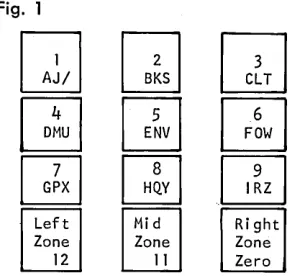
There might be several advantages to arranging the alphanumerics in ac-cordance with Hollerith (see Fig. 1), thus enabling more direct input to the computer or easy reading of unde-coded hard copy. Such inputs would be convenient for updating the data base and management information sys-tems, without the necessity for special devices at a few hotels or corporate
Ferris Wheel Rotary Files
without recopying records
Handling 81 card sizes up to 11" by 81
h",
Ferris gives instant access to your present records without the cost and error-risk of re-I typing cards. Motorized or manual Ferris Wheels range from desk-top models to big Master Units that place up to 200,000 cards at seated operator's finger tips in two sec-onds average tray delivery time. Riding in exclusive "Ferris Wheel" trays, cards are easily removed for posting or use. Even largest capacity units are light, mobile, roll out of way when not in use, or into vaults at night. Learn how Ferris Wheels speed reference jobs, cut fatigue, save money. For details or demonstration send coupon.
,·Wt"
VIS I B LEAcme Visible Records, Inc. Ferris Division
7506 West Allview Drive, Crozet, Va. Please show us how Ferris Wheel Rotaries can speed our record reference. cut oper-ator fatigue, save us money.
NAME _ _ _ _ _ _ _ _ TITlE _ _ _ _ COMPANY _ _ _ _ _ _ _ _ _ _ _ _ _ __ ADDRESS, _ _ _ _ _ _ _ _ _ _ _ _ _ _
CIRCLE 14 ON READER CARD
14
branches throughout the country. To one side of the telephone keyboard, a list of special characters could be printed. Since these would each be coded ·with more than two buttons, such characters could be designated preceding· the entry with a double slash. Although cumbersome, this would allow an enormous number of Fig. 1
CkJ
~
~
Left Zone 12~
QJ
rn
Mid Zone11
CkJ
QJ
rn
RightZone Zero
special symbols to be entered, thus suiting every user.
One human factor that is needed is single-character cancellation. Most of us discover a dialing error (if we dis-cover it at all) just after making it. A mark could be placed after the mis-take by pressing the three Zone but-tons. Thus, if the dialer hit the "9" button instead of the "8", cancellation could be indicated by adding the three zones, or in the case of the "R" (9
+
Middle), by adding the Left and Right buttons. The actual cancellation would be accomplished by the computer at the receiving end. For visibility checks lights behind the button could go on when the corresponding code was pressed-e.g., pressing button "I" would light the "1" on the button and addition of Zone 12 would shift on the light for "A" behind the button. A. K. EMRICHKensington, Maryland
The author replies: This letter typifies the many possible variations which can be developed on keyboard layouts. However, his arrangement would be of use chiefly to certain small groups such as programmers, and might therefore best be provided by use of an overlay, rather than by expecting that some telephone sets be manufactured to this special pattern. He also calls attention to the need for a "cancel", code. I found that alternate strokes of "left" and "right" buttons (four or more in total) served this purpose unambiguously.
Datamation welcomes your correspondenc.e concerning articles or items appearing in this magazine. Letters should be double spaced ... and the briefer the better. We reserve the right to edit letters sub-mitted to us.
[image:16.613.393.543.127.265.2]Automated
Payroll
for
LESS Money!
Now, you can electronically automate complex payroll applications (plus other processing jobs) for substantially less cost than any other type of automated EDP system.
11500" payroll applications can be TOTALLY automatic.
It
provides each employee with a fully protected check and an itemized statement of earnings and deductions. The payroll journal, check register and employee's earnings record are all produced automatically. So is a distribution detail for direct entry to subsidiary ledgers. Even details for de· ferred records like quarterly tax reports are accumulated and stored for subse· quent automatic reporting.The NCR 500 System reads and "speaks" in any of four EDP languages. Punched card. Punched tape. Magnetic ledger. OptiGal character recognition. You can use anyone - a combination, or all of the languages with equal ease.
Buy or lease only the units of the system you need. Expand it as your business grows. The price of the "500" System will remain modest.
What can the NCR 500 System do for you? What are the probable savings? You can find out by calling your local NCR office. Or, write NCR, Dayton, Ohio 45409.
THE NATIONAL CASH REGISTER COMPANY
CIRCLE 15 ON READER CARD
June 1966
® DAYTON, OHIO 45409
16
ASI Computer Di"ision-EMR, announces the
first in the ADVA/VCE 6100 Computer Series
the paper tiger with teeth ...
The
~ew6130 computer system from the ASI Computer Division
of Electro-Mechanical Research, Inc. is not available for immediate
delivery. Some win call it a "paper tiger." This computer,
however, is a formidable one, fully equipped for data
acquisition systems and other industrial applications. It's designed to
out-perform all competitive machines in the low-cost area . .
Check some of the features of the ADVANCE 6130 and you'll see
it's worth waiting
for-• 16-bit data word plus parity and memory protect bits.
• 0.9 microsecond
me~orycycle time.
• Monolithic integrated circuitry .
• Multiple bus system of organization which allows parallel
communication and control between central processors, I/O
channels, peripheral units, and/or various memory modules •
• Low price, $34,000.
For more information, contact any of our sales offices or
our Marketing Department in Minneapolis directly.
ASI COMPUTER DIVISION
p,,',"
8001 Bloomington Freeway, Minneapolis, Minn. 55420
and sufficiently
precise to enjoy
the esoteric
language of the
computer,
Id of man.
Jerating systems, utility systems or
ns systems.
lye openings in Sales, Field Systems
Product
PI~nningand
Engineering'-r. E. B. Schultz, Dept. SW -6, RCA
ita Processing, Bldg. 202-1, Cherry
New Jersey 08101.
A n Equal Opportunity Employer M & F
Most Trusted Name in Electronics
CRTRMRT.ION
look~ahead
A STANDARD SOLUTION
TO CONVERSION PROBLEMS?
Newest entry into the hectic computer sweepstakes is
Standard Computer Corp. of Phoenix.
Not to be confused
with Standard Computers, Inc. (Philly leasing _firm),
SCC will shortly announce a third generation computer
(Fairchild CTL monolithic integrated circuits) which
will handle second generation software (e.g., 7094
programs will run in machine
langu~ge).Several cpu's
will be available, featuring main storage of 196K
six-bit bytes or l31K eight-six-bit bytes.
Internal data
handling speeds will range from 350 nanoseconds to
3.5 usec.
Tape channels will be able to handle 30,
60, or 90 KC (800 bpi) tape units.
-The company, formed in March '65, says that
system rentals will range from $6,500 to -$18K/month.
The first two systems will be shipped next month; firm
orders for six more to be shipped this year are in
house.
The new gear might offer an interesting
solution to the conversion problem (see this month's
cover feature artIcles), and the cries of "I like
IBSYS now" heard at SHARE a few months back.
AIR FORCE RELEASES CAPTIVE
A report by an ad hoc Congressional committee
recommending that System Development Corp. be treated
by the Air Force Systems Command as an independent
contractor has won official AF approval.
Thus the company will henceforth bid on AF work:
there will be no more sole-source procurements.
Right now, about 82% of SDC's work comes from the Air
Force.
That figure may drop.
SDC says it will
continue to offer its service to "public-serving
organizations," which in the past has included a CPA
institute and a state hospital association, as well as
state and local governments, universities, etc.
SDC says it will continue to take about a 6%
"profit" margin, which is earmarked for research.
But
such research in the past has included loaning, for
free, technical people to, say, a local gov't agency.
The resulting expertise is used to pursue contracts
for similar work at other agencies.
Whether SDC can
continue such practices and still compete with lean,
hungry commercial software houses is the big question.
THE HARD LIFE OF SOFTWARE
Some uncertainty about the delivery date of the PL/I H
compiler is indicated by the April IBM OS/360
delivery schedule.
The H was to have been coded in
PL/I and compiled by the F (44K?) compiler, but now it
won't be: the F has run into some snags and slipped
to an August 31 delivery.
COBOL F storage requirement
has increased from 44K to 64K, meaning users will
need l28K of core storage to accommodate it.
Though IBM is trying to decrease this.
Big systems users feel hardest hit by the slip of
the control program for multiprogramming (variable
number of tasks) from Nov. '66 to second quarter of '67.
Too, model 67's delivered before then will have to
deal with pre-tested versions of this program and
of the time-sharing operating system which is promised
for June '67.
Don't read about, AUTOFLOW*
unless you need
documentation help
If you are that one·out·of 31,391 computer users without documentation problems-you don't need AUTOFLOW.
AUTOFLOW,is ADR's Computer Documentation System, designed to assist programmers produce accurate flowcharts, automatically, from assembly language input.
The only programmers who need (or recommend) AUTOFLOW are those who want an easy to use, easy to learn, no·extra·effort documentation system. With AUTO FLOW, the programmer doesn't worry about any graphic considera· tions. AUTO FLOW produces the flowchart, allocates symbols, edits, rearranges coding, allocates pages and columns, and draws connecting lines.
And because AUTOFLOW reduces documentation, maintenance, and reprogramming costs-management likes it too. (We'll supply 7 more reasons if you ask.)
Operational since early '65, AUTOFLOW has been acclaimed both as the significant tool for controlling documentation quality and accuracy, and a superior method of establishing program documentation standards and rules.
The AUTOFLOW-Computer Documentation System is available for IBM 1401, 1410, 1460 and System/360; RCA 501 and SPECTRA 70, and Honeywell 200.
Request detailed operational information and modest prices on leasing arrangement by completing the ,attached form. .
You can get out of the documentation doldrums-discover AUTOFLOW today!
~
APPLIED
DATA RESEARCH, INC.
~ 206 Center, Route 206 Princeton, New Jersey 609·921·8850 Offices in Princeton, Washington, New York and Los Angeles.
18
DYes.
I
DNo.
'
Prove that Don't help! I prefer AUTO FLOW tedious, expensive, can help me, inaccurate documentation I am also interested in:
D Management Sciences
D Software Development
D Applications Programming
o
ResearchD Equal Opportunity Employment at ADR
°Trademark Patent Pending
Name _ _ _ _ _ _ _ _ _ _ _ _ Title _ _ _ _ _ _ _ _ _ _ _
Co, _ _ _ _ _ _ _ _ _ _ _ _
Address _ _ _ _ _ _ _ _ _ _ _
City _ _ _ _ _ State _ _ _ Zip _ _
CIRCLE 17 ON READER CARD
DATAMATION
NCR operates in one of the most challenging and constructive of all business fields. Our chief ef-fort is directed toward helping business operate more effectively. This is accomplished through pro-viding better and complete data processing systems.
NCR's new product releases dur-ing the past year averaged more than one a month, and ranged from a major new computer fam-ily to a new line of cash registers. The development of NCR's "To-tal Systems" concept has contrib-uted substantially to the compa-nies growth.
As worldwide sales continue to in-crease, many different skills are , presently in demand at NCR for the installation of total data proc-essing systems. Current require-ments are in Dayton and other locations mentioned below.
*
look ahead
UCLA ALMOST
DROPS THE BALL
I. C.-COMMUNICATIONS
BREAKTHROUGH BATTLE LOOMS
THE NEW LOOK
AT . AEROFLEX
June 19.66
. In the communications area, latest availability
dates for the telecommunications (queued) control
programs and I/O support for the 2311 data cell drive
are supposed to be announced this· month.
In the
meantime, the interim measure -- the Communications
Coritr()l Application Program, which is independent of
OS 360 -- is just now in its firial test state, and
most users are finding they have to modify it.
Result: a new user's group of about 30 companies has
been formed;
onepurpo~e:to nudge IBM into giving
CCAP full support and possibly into developing an
improved version.
.
Other software delays since December: 44K
Assembler --
4
months to Sept. '66; 200K FORTRAN IV
6 months to Dec. '66.
On the bright side, a two-man
SHARE team allegedly reports F assembler offers 10-20
times the speed of the E, although· one 50 user says
it's more like 5 times.
Alumni and friends of UCLA are disturbed at the
computing situation there. A complex chain of·events
almost
l~dto the loss of a
$1.4~millioriARPAsponsored computer netw()rkstudy.
One UCLA spokesman
blames slow government funding, although dough from a
previous·ARPAcontract kept the project nominally
alive for awhile.
Then four
keyprogra~ersleft,
another six· were dropped
or·re~assigned.An order for
$400K-worth of· high-speed communicating gear was
cancelled, but the remaining megabuck will probably
be re-assigned to a modified, reduced network study,
headed by Clay Sprowls (he
gQe~on sabbatical July 1) ;
and to the School of Engineering, which will
instrumeht computers
i~an attempt to measure
hardware, system and user program performance.
One far-out hardware designer who labels himself a
conservative says that the latest integrated circuits
will make such a big cost breakthrough in the next
3-5 years that it could spell doom for time-sharing
and multiprocessing.
Says he, the new i.c.'s·, with an
entire register on a Single
chip~could bring about a
cheap, small computer ($lOO/month) to be attached to a
peripheral device. ·The ·combo would offer more'
capability than a 1401.
Another hardware expert doubts things will happen
that fast, points out that reductions in data
transmission rates could offset such effects of i.c.
'breakth<ruughs. ·It'sconceivable,· says the second man,
that with your own satellite, you might be able to
achieve coast-to-coast transmission
ra~esof 5¢/hr •
. A simple inexpensive photographic system that uses one
negative to store up to 400 high-resolution images
all the same size as the negative.
The equipment
andtechniqueS'f'Or such
a
system have been developed
by AeroflexLaboratories, Inc., Plainview, N.Y., and
manufacturers from allover the computer., crt .display,
document retrieval, camera and other industries have
bee~
sending their scouts there to find out if and
. how they can use·it. The method of the Multiplex
Recording Technique, developed last October, is not
disclosed, as nine
~atents a~epending.
.
MRP inventor Clayton Houghton notes that the
modular system, using a projector which can display
more than one image from a negative at a time, could
replace tape units and crt displays in some
(Continued on page 135)
You'd have to be crazy
to publish a firm -software
delivery schedule.
Here's one for· Sigma 7:
Fourth quarter 1966.
Stand-alone package, operating without a monitor in minimum storage. Includes SOS standard FORTRAN IV, a standard Assem-bler, a Library of Mathematical and Utility Routines, and a program debug package. This package permits you to operate one job at a time - either a real-time or a general-purpose job.First quarter 1967
Ii The first level of SOS monitors, called Basic ControlMonitor. All the stand-alone software is available under the monitor, and you can now do two things simultaneously - a real-tiine job in the foreground, and a general-purpose job in the background. .
Second quarter 1967.
You step up to Batch Processing Monitor, a much more comprehensive monitor, plus this additional software:SOS Extended FORTRAN IV, debug version, oriented toward program checkout.
High-Efficiency Extended FORTRAN IV, oriented toward efficient object programs.
Extended assembler (Meta-Symbol).
ADAPT, an application-oriented package for numerical control of machine tools.
Third quarter 1967.
Debug version of PLI I.r
Fourth quarter 1967.
Conversational versions of FORTRAN IV and PL/I~ standard version of the Universal Time-Sharing Monitor; High-Efficiency ver-sion of PLI I.Soon thereafter we will deliver the Extended version of the Universal Time-Sharing Monitor; MANAGE, a management information system which inCludes a Report Generator; a generalized Sort! Merge program, and other applications packages.
We're not promising to deliver. a great big musclebound
All Sigma 7 software is reentrant.
mass of all-purpose software all at once.
.
And we're not going to let you sit and wait for software
after your Sigma 7 is installed.
'
·.We're gOIng to deliver successive levels of software on
a firm schedule. Every level is compatible with the next
one, so that 90u'1l move up to greater capabiiity with each
new package.
Sigma
7
softWare gives you a choice of three
compila-..tion modes
~debug, high-efficiency, conversation.
Sigma 7 software is multi-use.
Itlooks the same
regard-less of the mode of use of the hardware.
All Sigma 7 software has very low overhead. The muscle
is where it counts.
All df the delivery dates are firm. We'll be glad. to put
them in writing. In an order.
Scientific Data Systems
1649 Seventeenth Street, Santa Monica, California Offices in principal cities throughout the world
CIRCLE 18 ON READER CARD
editor's read$ut
HIS MASTER'S VOICE
For those of you old enough, the title above immediately calls forth an image of a dog sitting, head cocked in thoughtful attention, before the horn of a gramophone.
But let's 'talk about user groups. In the beginning, a user group was four guys with a bottle sitting in a room saying, "They can't do this to us." The -fact that "they" did do that to "them" shouldn't obscure the -fact that user groups have been, at times, highly ~seful and productive organizations. User groups saved FORTRAN, shaped PL/I, sniped at COBOL. They've served as audi-ences to stirring- confessions about hardware and software slippages. (in time and performance). They've tended to keep manufacturers a bit more honest than they might otherwise have been.
But it's doubtful that user groups have accomplished as much as they should have. And it's increasingly doubtful that they'll be as effective in the future as they have been. For one thing" they're getting just too darned big. (COMMON is said to have 1000 members.) A subtle psychology of size makes it harder for a man to sound off in front of hundreds than it would be before a small group. And the bigger the crowd, the· easier it is for the manufacturer to gain acceptance of ideas which might be hacked to pieces by' a handful. Too, user groups are tending to broaden the scope' of their machine cov-erage. COMMON, formerly a 1620 user group, looks as if it will offer haven to 1620, 1130, and 1700 users, plus any 360 users who can't find a home in SHARE or GUIDE. Whether any user organization can effectively serve such a broad variety of interests is doubtful.
The fact that user groups (as now constituted) are tied to one computer manufacturer inhibits their devotion to problems which cross and rise above one company's line of equipment. The costly crimp placed on conversion by machine-dependent languages is one example.
So what about JUG (Joint User Group), which is supposed to pay attention to such lofty matters? Well, JUG is an organization of organizations. Which means that it's one level removed from the workers, the doers. Square the con-fusion and lethargy inherent in any group of part-time workers who meet occasionally, and you get the picture. We're not criticizing JUG; we're merely saying "that's human nature."
Standards, you want? JUG, the voice of the individual user (as distinguished from the user as a member of a trade association), has one vote on the American Standards Association information processing committee. BEMA, the voice of the manufacturer, has 12.
Still, JUG is trying. With a prod and an assist. from the DEC user group, they conducted an administrative workshop for user group executives just prior to the '66 SJCC. Termed by those who attended as useful, the meeting produced a committee to investigate- the possibility of a common program catalog, an idea introduced at JUG over a year ago. Another workshop is being planned for November.
Some folks argue that ACM could be the voice of the user. But why ACM should start now to do something it's avoided so far isn't clear. Besides ACM doesn't represent small, unsophisticated users. And, points out one man, the manufacturer supports user groups . . . might be more responsive to their wishes than to a profess'ional society.
Others have tried to introduce the idea of manufacturer-independent user groups, conforming to application interests, not particular machines. One such idea was shot down last year by SHARE.
We don't know the answer. But we do feel that it is'time for user groups to review and measure themselves against their goals: Are we really putting effective pressure on the. manufacturer? Are we working toward establishing common means of measuring system performance, for instance? Are we tackling the important problems which go beyond anyone manufacturer's equipment?
The need is clear. The talent and energy are available. All we have to do is stop listening to that> damn gramophone and get to work.
PROGRAM
AND FILE
CONVERSION
by W. J. CARTLEDGE, JR.
D
. The prospect of disturbing the status of hun-dreds of well-running programs and data files is not a welcome one for those who have never~__ experienced a computer conversion, and it is even more fearsome to those who have been through such an effort. Careful study of the conversion problem for' a given installation will usually lead to this conclusion-it's going to be even worse than you thoughtl
However, conversion can be tackled like any other large systems job: break it into pieces and deal with them one at a time. Perhaps the following suggestions for dealing with these "pieces" will be too idealistic in some cases, and may have to be compromised with real life. But if they at least provoke managers to serious thinking about the details of conversion, they will have served their purpose. organization' of resources
When does conversion begin and end? It may be said that conversion begins when people are assigned to' work specifically in this area. Conversion is completed when people are no longer working with old programs. This implies, then, that people must be organized to begin work on conversion problems. People are needed to define the conversion problems peculiar to the installation; to design the standards and policies of conversion; to perform the actual recoding and testing; and, of course, to supervise the general conversion effort.
The particular organization of manpower depends on the degree of conversion problems for the installation. If the installation is largely using COBOL and has data files that need little or no conversion, then it is quite possible that the existing staff within the current organization struc-ture may be all that is needed to perform the conversion.
On the other hand, an installation with more complex problems may require the manufacturer's assistance or out-side contract programming services, as well as reor-ganization of the programming staff.
In any case, a, specific organization should be set up: either the conversion will be accomplished by the pro-grammers currently responsible for each program, or by a conversion team; both approaches have their advantages. Conversion by qn assigned team provides better control over the conversion effort and certainly enables more uni-form conversion, testing, and documentation practices with the responsibility placed upon one group. Also, a team will usually be better motivated to keep the conversion effort on schedule, or even ahead of schedule if present documentation is up to date and complete. A side effect of the team approach is that the converted programs will be understood by persons other than the currently respon-sible programmers, thus providing an alternate source for future maintenance.
The team approach also allows the best utilization of conversion experience because these specialists will
be-22
plan
your
change
and change
your
plan
come quite familiar with the inevitable "unwritten" pro-cedures that' are pert'inent only to the conversion process. Many stop-gap measures will be worked out as conversion progresses, in order to keep pace with changes in policy, equipment configuration, and available software. A small group working ,closely together would recognize fre-quently recurring conversion problems that could be solved or minimized by a special aid or procedure. .
Conversion by the responsible programmers within the present organization has certain advantages as well. For one thing, a heavily patched program which needs to be cleaned up during conversion can best be handled by one· who knows . the program well. There would also be less confusion, since there would be no need for communicat-ing undocumented program functions bet~een program-mers. Thus fewer man-hours would probably be needed to convert each program, although this time might be spread over a longer period due to the many interruptions for current program maintenance, etc., that compete for the programmer's attention. A by-product of this type of or-ganization is the experience of coding and testing in the new language gained by the programmer so that he can handle maintenance more directly and with a better under-standing of the over-all effects of future changes within his programs.
conversion planning and control
Planning the conversion effort is essential to success. The main considerations include:
1. Knowledge of available conversion aids
2. Priority schedule of applications to be converted 3. Conversion policies and standards
Mr. Cartledge heads the Tech-nical Support section at Hughes Aircraft Co., fullerton, Calif. ,The treasurer of GUIDE
Inter-national, he has served as chairman of the 5/360 con-version committee and was a representative to the IBM/ GUIDE/SHARE ioint conversion committee.