Rochester Institute of Technology
RIT Scholar Works
Theses
Thesis/Dissertation Collections
8-1-1996
The Effect of cylindrical obstructions on the fluid
flow in narrow rectangular channels
Gary Compagna
Follow this and additional works at:
http://scholarworks.rit.edu/theses
Recommended Citation
The Effect of Cylindrical Obstructions on the Fluid Flow
in Narrow Rectangular Channels
by
Gary L. Compagna
A Thesis submitted in partial fulfillment
of the requirements for the degree of
Master of Science in Mechanical Engineering
Approved By:
Professor S. Kandlikar
Professor
A.
Nye
Professor
A.
Ogut
Professor C. Haines
DEPARTMENT OF MECHANICAL ENGINEERING
COLLEGE OF ENGINEERING
ROCHESTER INSTITUTE OF TECHNOLOGY
PERMISSION GRANTED
I, Gary
L.
Compagna, hereby grant pennission to the Wallace Memorial Library of the
Rochester Institute of Technology to reproduce my thesis entitled "The Effect of Cylindrical
Obstructions on the Fluid Flow in Narrow Rectangular Channels" in whole or in part. Any
reproduction will not be for commercial use or profit.
August 31, 1996
ACKNOWLEDGMENTS
This
work could nothave
been
completed withoutthe
assistance andunderstanding
ofseveral
outstanding individuals.
Kiran Kumar
andDr.
Sung-Eun
Kim
from
Creare,
Inc.
providedassistancethat
included
helping
withFLUENT
softwareissues
and also withunderstanding
ofthe
fluid
mechanicsinvolved
in
this
problem.A
specialthanks
goesto
Satish Kandlikar
without whose gentlepushing
andunderstanding
Table
ofContents
Page
LIST
OF
FIGURES
iii
LIST OF
TABLES
viLIST OF
SYMBOLS
viiABSTRACT
1
1.
INTRODUCTION
2
1.1
APPLICABILITY
OF HELE-SHAW FLOW
5
1.2
APPLICATIONS
9
1.2.1 POLYMERASE CHAIN REACTION DETECTION POUCH
9
1.2.2 OTHER
APPLICATIONS
10
1.3
PROBLEM DEFINITION
12
1.4
OBJECTIVES
OF THE PRESENT WORK
15
2. LITERATURE REVIEW
16
2.1
BASIC
GOVERNING EQUATIONS
26
2.1.1 FLUID FLOW
GOVERMNG EQUATIONS
26
2.1.2 POTENTIAL FLOW
28
3. THEORETICAL ANALYSIS
37
3.1
FLUID FLOW IN RECTANGULAR DUCTS
37
3.2
INVISCID IRROTATIONAL FLOW IN TWO
DIMENSIONAL
FLOW
41
3.2. 1 POTENTIAL FLOW FIELD FOR UNIFORM FLOW OVER A
CYLINDER....
42
3.2.2
POTENTIAL
FLOW RESULTS
USING METHOD OF IMAGES
44
4.
NUMERICAL
ANALYSIS METHOD
50
Page
4.1.2
2-D FLUID FLOW WITH CYLINDRICAL OBSTRUCTION
57
4.2
VERIFICATION
OF
NUMERICAL
ANALYSIS
81
4.2.1
2-D FLOW AROUND
CYLINDER
COMPARISON WITH FLUENT
81
4.2.2 FLUENT COMPARISONS
FOR VISCOUS FLOW OVER A CYLINDER
91
4.2.3 VISCOUS
FLOW
COMPARISON
FOR DIFFERENT GRID
FORMULATIONS
97
4.2.4 3-D
VISCOUS
FLOW COMPARISON TO FLUENT RESULTS IN
NARROW RECTANGULAR DUCTS
99
5. RESULTS FOR 3-D FLOW
104
5.1
BASELINE 3-D RESULT
104
5.2
FLOW UNIFORMITY AS PROBE HEIGHT CHANGES
120
5.3
SENSITIVITY TO CHANNEL WIDTH ON THE FLUID FLOW
128
6. CONCLUSIONS
136
7. RECOMMENDATIONS
FOR FUTURE WORK
140
LIST
OF FIGURES
Figure
Page
1-1
TYPICAL CHANNEL
GEOMETRY FOR PCR
DETECTION
CHAMBER
4
1-2
TYPICAL HELE-SHAW
GEOMETRY
7
1-3
FLUID
FLOW PATTERN
FOR HELE-SHAW CELL
8
1-4
PCR
DETECTION
POUCH
1 1
1-5
PCR DETECTION CHAMBER GAP CROSS SECTION
13
2-1
O-H GRID
STRUCTURE,
Kim
andChoudhury
(1990)
17
2-2
EXPERIMENTAL
FLOW PATTERN FOR LOW REYNOLDS NUMBER
19
2-3
EXPERIMENTAL FLOW PATTERNS AT Re
=19, 26,
and55
20
2-4
STREAMLINES
FOR STEADY FLOW PAST A CIRCULAR
CYLINDER FOR
Re
=5 AND 40
,
Dennis
andChang
(1970)
22
2-5
DIMENSIONLESS
PRESSURE COEFFICIENT ON THE CYLINDER
SURFACE,
Dennis
andChang
(1970)
23
2-6
UNIFORM FLOW AROUND A CYLINDER
31
2-7
DOUBLET REFLECTED USING METHOD OF IMAGES
36
3-1
VELOCITY PROFILE ACROSS GAP HEIGHT
38
3-2
FLUID VELOCITY
ACROSS GAP WIDTH
40
3-3
STREAMLINE PLOTS USING POTENTIAL FLOW THEORY
43
3-4
PRESSURE DISTRIBUTION USING
POTENTIAL FLOW THEORY
45
3-5
STREAMLINE
PLOTS USING THE METHOD OF IMAGES
46
3-6
VELOCITY
PROFILE
ON CYLINDER USING METHOD OF IMAGES
48
3-7
PRESSURE DISTRIBUTION USING THE METHOD
OF IMAGES
49
4-1
FLUENT VELOCITY IN NARROW RECTANGULAR
DUCT
53
4-2
FLUENT
3-D VELOCITY PROFILE
54
Figure
Page
4-6
POWER LAW SCHEME
USED BY FLUENT
61
4-7
PHYSICAL
GRID
PATTERN
FOR
2-D FLOW AROUND CYLINDER
63
4-8
FLUENT COMPUTATIONAL
GRID
64
4-9
CELL NOMENCLATURE
EMPLOYED IN HIGHER ORDER
INTERPOLATION SCHEMES
65
4-10
FLUENT POTENTIAL FLOW SOLUTION USING POWER LAW
INTERPOLATION
SCHEME
67
4-
1 1
FLUENT POTENTIAL FLOW SOLUTION USING QUICK
INTERPOLATION
SCHEME
68
4-12
VELOCITY PLOT FOR POTENTIAL FLOW AROUND CYLINDER
69
4-1 3
FLUENT STREAMLINES FOR VISCOUS FLOW WITH
Recy,
=40 AND "NO
SLIP"BOUNDARY ON THE CYLINDER
72
4-14
GEOMETRY AND GRID LAYOUT FOR SYMMETRIC FLOW AROUND
CYLINDER
73
4-15
VELOCITY FOR VISCOUS FLOW WITH
Recyi
=40 AND FREESTREAM
BOUNDARIES ON THE OUTER WALLS
74
4-
1 6
PRESSURE
DISTRIBUTION FOR VISCOUS FLOW AROUND A CYLINDER
WITHRecyi
=40
75
4-17
STREAMLINES FOR FLOW WITH
Recyi
=40
76
4-18
GEOMETRY AND GRID LAYOUT FOR FLOW
77
4-19
VELOCITY
PROFILE FOR FLOW WITH
Recyi
=40
78
4-20
PRESSURE
PROFILE FOR FLOW
WITH
Recyi
=40
79
4-2 1
COMPARISON
OF PRESSURE PROFILE WITH 1
80AND
360CYLINDER
..80
4-22
LOCATIONS FOR COMPARISON OF FLUENT
TO
THEORETICAL
RESULTS
83
4-23
VELOCITY
PROFILE
COMPARISON WITH METHOD OF
IMAGES
87
4-24
PRESSURE
COEFFICIENT
COMPARISON
89
Figure
Page
4-27
FLUENT STATIC PRESSURE
DROP IN
RECTANGULAR
CHANNEL
103
5-1
FLUENT
SYMMETRIC
GEOMETRY OUTLINE
105
5-2
3-D GEOMETRY FRONT
AND TOP VIEWS
106
5-3
CROSS SECTION
OF
COMPUTATIONAL
GRID FOR 3-D FLOW
107
5-4
FLUID VELOCITY ACROSS
WIDTH OF PCR DETECTION CHAMBER
109
5-5
PRESSURE DISTRIBUTION
ACROSS WIDTH OF PCR DETECTION
CHAMBER
110
5-6
FLUID VELOCITY
CLOSE-UP
NEAR DETECTION PROBES
1 1 1
5-7
PRESSURE DISTRIBUTION CLOSE-UP NEAR DETECTION PROBES
1 12
5-8
VELOCITY DISTRIBUTION ACROSS CHAMBER THICKNESS
1 13
5-9
PRESSURE DISTRIBUTION ACROSS CHAMBER THICKNESS
114
5-10
CLOSE-UP OF VELOCITY DISTRIBUTION THROUGH THE
THICKNESS 1 15
5-1 1
CLOSE-UP OF THE PRESSURE DISTRIBUTION THROUGH THE
THICKNESS
116
5-12
PRESSURE COEFFICIENTS ON DETECTION PROBES FOR 3-D FLOW
1
18
5-13
PRESSURE ACROSS THE TOP OF THE PCR DETECTION PROBE
1 19
5-14
GEOMETRY OUTLINES FOR DIFFERENT DETECTOR PROBE HEIGHTS
..121
5-15
FLUID VELOCITY FOR BASELINE HEIGHT DETECTOR PROBE
122
5-16
FLUID VELOCITY FOR INCREASED
DETECTOR PROBE HEIGHT
123
5-17
FLUID VELOCITY FOR FULL CHANNEL HEIGHT DETECTOR PROBE
124
5-1
8
PRESSURE
COEFFICIENT ON FIRST PROBE FOR DIFFERENT PROBE
HEIGHTS
125
5-19
PRESSURE
COEFFICIENT FOR DIFFERENT PROBE HEIGHTS
127
5-20
CONFIGURATIONS FOR VARYING CHANNEL
WIDTH
129
5-21
FLUID VELOCITY FOR NARROW CHANNEL WIDTH
130
LIST OF TABLES
Table
Page
4-
1
STREAM LINE COMPARISON
TO THEORY UPSTREAM FROM
CYLINDER
84
4-2
STREAM
LINE COMPARISON TO THEORY ABOVE CYLINDER
85
4-3
AXIAL VELOCITY COMPARISON TO THEORY ABOVE CYLINDER
86
4-4
PRESSURE COEFFICIENT COMPARISON ON CYLINDER
90
4-5
COMPARISON FOR SEPARATION ANGLE
95
4-6
COMPARISON
OF WAKE BUBBLE LENGTH
96
4-7
COMPARISON OF KEY PRESSURE POINTS FOR DIFFERENT SOLUTION
METHODS
98
4-8
COMPARISON WITH FLUENT ACROSS GAP WIDTH
100
4-9
COMPARISON WITH FLUENT ACROSS GAP THICKNESS
101
5-1
SUMMARY OF PRESSURE COEFFICIENTS AT
6
=0126
LIST OF SYMBOLS
SYMBOL
UNITS
a cylinder
diameter
mb
1/2
channel width mg
Gravity
m/sec2h
Elevation
mP
Pressure
N/m2
Pa
Pressure
on cylinder at radius=aN/m2
P-
Pressure
upstream atinlet
N/m2
r
Distance
in
radialdirection
mu
Velocity
in
axialdirection
m/secV
Velocity
in
verticaldirection
m/secX
Distance in
axialdirection
my
Distance
across chamber mz
Distance
acrossheight
ofchamber mAc
Cross
sectional aream2
Cp
Pressure
coefficient on cylinderDh
Hydraulic diameter
mH
Height
ofdetection
chamber mL
Length
ofDuct
mLc
Characteristic
length for duct
mP
Perimeter
mPe
Peclet
numberRe
Reynolds
numberRecyi
Reynolds
numberbased
on cylinderdiameter
um
Mean velocity in
duct
m/secGreek
Symbols
SYMBOL
P
Density
H
Viscosity
e
Angle
<D
Velocity
potential*F
Stream function
A
Doublet
strength4>
flux
of variableUNITS
kg/m3
kg/(m sec)
radians
m2/sec
m2/sec
The Effect
of
Cylindrical Obstructions
on
the
Fluid
Flow
in Narrow Rectangular Channels
ABSTRACT
This
thesis
presents a computationalfluid flow
analysisin
narrowrectangularchannels,
withregularspaced cylindrical
disks acting
as obstructionstofluid flow. The
problemgeometry
is based
on an approximation ofthe
configurationusedin
aPCR detection
chamber.Polymerase
chain reaction(PCR)
is
a method ofDNA
analysisthat
depends
onthe
flow
uniformity
withinthedetection
channel.The
nominal channelis
a narrowchannel with a maximumgap height
of0.13
mm and a maximum width of5.0
mm.The fluid flow
rate andchannelsizeresult
in
aReynolds
numberless
than5.
The
effect of oligonucleotidedetection
probes withinthe
detection
channel andthechannelgeometry
onthefluid
pressureis
determined. This is
accomplishedby
approximating
thedetection
probes asshortcylinders andusing
theCFD
codeFLUENT
tocalculatethe
flow
velocity
withinanidealized
rectangulardetection
chamber.The CFD
results arecomparedto theoreticalpotentialflow
solutions and other published1.
INTRODUCTION
Fluid
flow in
micro sized channels with cylindrical obstructionsis
ageometry
ofinterest in
many
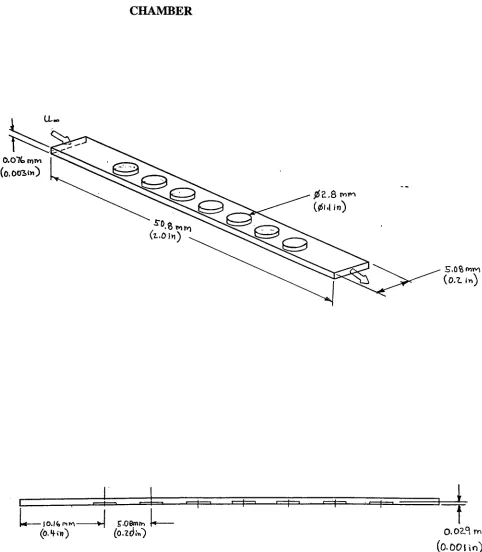
applications.Figure 1-1
shows atypical
channelfor
apolymerasechainreaction(PCR)
detection
chamber.PCR is
a method ofDNA
analysisthat
requiresfluid flow
overdetection
probesin
anenclosed space.
Figure 1-1 has dimensions
that
aremuchlarger in
the
width(W)
direction
than
in
the
height
(H)
direction. The
small size ofthe
channel resultsin Reynolds Numbers
that
arevery low (Re
<5). This low Reynolds's
numbermeansthatthe
flow
willbecome
fully
developed in
avery
shortlength
comparedtothe overall channellength.
The low Reynolds Number
andthe
geometry
ofW H
lead
to thisfluid flow
being
avariation oftwo
types
of commonfamilies
offlow
problems.Stokes Flow: Applicable
withvery
smallReynolds
number.When
thisoccursthe
viscousforces
overwhelmtheinertia
forces. This
allows the non-linearterms
in
the
Navier Stokes
equations
to
be
neglected.Hele-Shaw
Flow: Involves
slowflow
ofafluid between
parallelflat
plates which arefixed
at a smalldistance
(H)
apart.Hele-Shaw flow is
often createdin
experimentaltest
configurationsto
help
understandthe
basic flow
phenomena.Stokes flow is
often assumedbecause
thisallowsthe
full
Navier-Stokes
equationsto
be
simplifiedto the
point wherethey
canbe
solvedfor
specificconfigurationsand
boundary
conditions.These
flow
types
arevery
usefulfor
understanding
somefluid flow
configurations.However,
the
assumptions requiredlimit
their
usefulnessto
Using
computationalfluid dynamics
(CFD)
codesto
solvethese types
ofproblems allowsaperson
to
examine a wide range ofgeometries,
boundary
conditions,
andfluid
types
in
atime
effective manner withoutthe
expense of a good experimentaltest
set-up.Over
the
last
decade CFD
solutiontechniques
have
improved both in
computationalefficiency
and numerical accuracy.Also
computing
hardware has
advancedto thepoint whereindividual
engineers and scientisthave
attheirdisposable relatively low
costworkstationsthatare capableof
analyzing
complexfluid flow
problemsin
reasonabletimeperiods.
These
advanceshave led
to thedevelopment
ofnumerouscommercially
availableCFD
software codes.
FLUENT from
Creare,
Inc. is
one ofthesecommercialCFD
codes.The
software
includes both
pre-andpost-processing capability
thatallowtheflow geometry
to
be
created and modified as required.This
allows a wide rangeofvariablesto
be
modifiedto
Figure
1-1
TYPICAL
CHANNEL GEOMETRY
FOR
PCR
DETECTION
CHAMBER
O.OTt.mm
(o.
003>!>0jzte.8 tvi^
(01.1
in)
(O.Z ir>)
-lO.lfepiM--H S.06mtn
(O.ZtJi*')
0.02.^mrvi [image:16.557.33.515.85.637.2]1.1
APPLICABILITY
OF HELE-SHAW
FLOW
Hele-Shaw
(1898)
used an experimental setup
to
determine
the
streamlinesfor
the
flow
around
bodies
ofarbitrary
shape.He
showedthat
a three-dimensional viscousflow
between
two
closely
spacedflat
plates exhibitedtwo
dimensional
potentialflow
patterns.Figure
1-2,
from 'Viscous
Flows'by
Ockendon
andOckendon
(1995)
showsatypical
Hele-Shaw
cell.Figure
1-3,
from 'Visualized
Flow'compiled
by
Nakayama
(1988)
showsthe
flow
patternthatresults whenlooking
down
atthetop
oftheHele-Shaw
cell.There
aretwoaspects ofthis
study
thatfall
underthegeneralHele-Shaw flow
analogies.The first
aspect oftheHele-Shaw flow is
thatfor
themotion ofa viscousfluid,
between
two
fixed
parallel plates which aresufficiently
closetogether,
Saffman
andTaylor
(1958),
define
the
meanvelocity in
the
cell asfollows.
b2
(dp
u=-T27bi+pg|
(L1)
b2
dp
v =
The
second part ofthe
Hele-Shaw analogy
that
is
applicableto
narrowchannelflow is
whenone
fluid
of adifferent
density
is
acceleratedperpendicularto
theinterface
of anotherfluid.
This
is
thecase when onefluid is
at restin
thechannel andanotherfluid is
pushedinto
thechannel
to
"wash
out"theprevious
fluid. When
the
accelerating
fluid
has
the
higher
density
theinterface between
the two
willbe
stable.When
the
less
dense fluid
is
acceleratedinto
thehigher
density
fluid
the
interface
willbe
unstable,
Saffman
andTaylor
(1958).
The
typeoffluid
flow
that
willbe
studiedin
thiscase willbe
avariationoftheHele-Shaw
flow.
For Hele-Shaw flow
analysis,
any
obstructionin
the
channelis
assumedto
takeup
the
complete
height. This study
willlook
at cases wherethecylindricaldisk
obstructions areless
thanthe
height
ofthechannel.The
second extension ofHele-Shaw flow
thatwillbe investigated is
theinteraction
between
thecylindrical
disk
andthe sidewalledges.Pure Hele-Shaw
cells assumethat theflow
around
any
obstructions arenoteffectedby
side walls.The
abovetwoextensionsofHele-Shaw flow
canbe
thought
of astaking
theHele-Shaw
flow
whichis based
onthe
flow
being
analyzedin 2-dimensions
andextending
the analysisFigure 1-2
TYPICAL HELE-SHAW
GEOMETRY
Hele-Shaw
flow
Figure
1-3
FLUID
FLOW
PATTERN
FOR
HELE-SHAW
CELL
[image:20.557.69.488.203.512.2]1.2
APPLICATIONS
1.2.1 POLYMERASE CHAIN
REACTION DETECTION POUCH
This
study
was undertaken as an attemptto
understandtheperformanceofPCR detection
pouches.
The
polymerase chain reaction process(PCR)
is
a methodfor amplifying
andcapturing
specific samples ofDNA. PCR
amplificationmay
contain6
x1011
copies of a
particular
DNA
targetstrand.One PCR detection
methoddescribed
by Findlay
et al(1993)
combines
the
amplification anddetection
processin
a single closed vessel.The detection
process relies onthe specific
hybridization
tooligonucleotide probes and enzymatic signalgeneration.
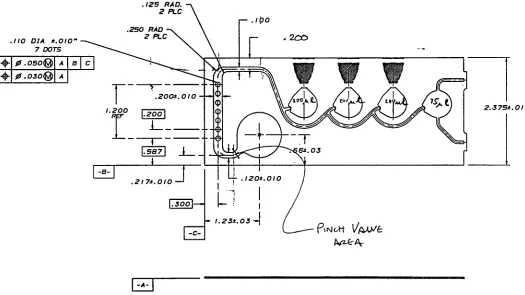
Figure 1-4
shows adrawing
ofthePCR
'pouch' usedfor
thisprocess.The PCR
pouch shownis
an expandable plasticdesign. To
analyzethe
flow in
thenarrowdetection
chamberthechannel
geometry
willbe
approximated as a rigid rectangularchannel.The detection
process works afterhybridization,
whenbiotinylated PCR
products arecapturedonthe
discrete detection
spotswhereverthey
encounterprobescomplimentary
totheirsequence.
After
subsequenttreatment
withdifferent fluids (streptavidin-horseradish
peroxidase
conjugate,
washsolution,
anddye
precursorsolution)
colorwilldevelop
onthedetection
probesOne
ofthegoalsin
thedesign
ofthisPCR
pouchwastominimizethe
amount offluids
requiredto
carry
outtheprocess.The
second goalwastobe
ableto
determine
a positive ornegative
test
resultby
visual comparison ofthe
detection
probes against a color chart orinstrumentally
by
reflectiondensitometry. The
combinationofthe
twopreviously
mentionedgoalsmeans
that the
fluid flow
acrossthedetection
probesis
criticalto the
performance ofThe 'color
response ofthe
detection
probeis
based
ondiffusion
from
the
fluid
to the
probeand
the
processis
sensitiveto
sample concentrationin
the
fluid
andthe
probe.The
processis
rate sensitive whichleads
to the
importance
ofwell understoodfluid
andthermalboundary
conditions.
1.2.2 OTHER
APPLICATIONS
Other
types
offluid flow
wherethis
analysisfor flow in
narrow channels withobstructionscould
be
applicable are asfollows.
1. Blood flow
withblockage;
the
flow
ofblood
in
the
body
throughnarrow arteries orveinswithsome
type
ofblockage
wouldfall into
thisgeneraltypeof application.The
geometry
ofthe
rectangular channel andcylindricaldisk
blocking
the
fluid flow
wouldbe
modifiedfor
this
analysis.2. Flow
offluid in Ink Jet
printer;
Inkjet
printers requiretheflow
offluid in
narrowchannels.
Also
theinsertion
ofcleaning
fluids
ordifferent
colorinks
couldfall into
Hele-Shaw
flow
depending
onthe
geometry
oftheflow
path.3.
Electronic cooling in
micro-channels;
small electronic systems such asmulti-chip
modulesoften require goodthermalcontroltomaintain accurate performance.
This
can requirefluid
flow
oversmallelectronic componentsto
removethe
powerbeing
Figure
1-4
PCR
Detection
Pouch
.110 DIA .OIO'
7 DOTS
?
0.050% A B C4- 0
.030% A
[image:23.557.15.540.225.520.2]!-3
PROBLEM
DEFINITIONThe
PCR detection
processis
based
ongetting
positive or negative readings on eachdetection
probe. Positive
readingsare obtainedwhenthe
fluid
passing
overthe
detection
probe
diffuses
sufficientamountsofthe
DNA
strands,
washfluid,
anddye fluid
into
the
probe.
The
diffusion
processdepends
onthe
sample concentrationin
the
detection
probe andin
the
fluid passing
throughthe
detection
chamber.The
ratethefluid
passes overthedetection
probe andthepressurethe
fluid
exerts onthe
probe are significantfactors in
obtaining satisfactory
machine performance.Experimentally
determining
the
flow
rateand pressureis
not aneasy
process giventhe
miniature
geometry
ofthe
PCR
detection
chamber.Using
CFD
toolsto
analytically
determine
the
flow
field
is
alower
cost approachin
termsoftime,
people,
and money.Figure 1-5
shows a cross section ofthedetection
chamberinside
thePCR instrument. This is
the
geometry
as thefluid is passing
throughthe
detection
chamber.The PCR
pouchis
nominally flat
and expands asfluid
passesthroughthedetection
chamber.The
analysis ofthistype
offluid
problem requiresthe
definition
of several variables.These
include
thefollowing.
1.
Geometry
Configuration
2.
Fluid
type
3.
Fluid
properties4.
Boundary
conditionsInlet flow
rate orvelocity
Outlet
conditionsWall
propertiesFigure 1-5
PCR DETECTION CHAMBER GAP
CROSS SECTION
Fixed
@
+/-.002"Detection)
Pfc.og,E
The
overallgeometry
size waspreviously
shownin Figure 1-1. This
showsthe
problemto
be
afull 3-dimensional
problem.This
work will approachtheproblemin 3-D because
diffusion
into
the
detection
probesdepends
onflow
onboth
the
top
and side walls.The length
ofthe
detection
chamber andthe
numberofdetection
probes willbe
reducedto
minimize
the
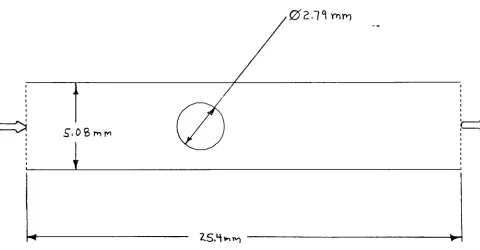
computationaltime.The 3-D
solution willbe
reducedto
25.4
mm andthe
number of
detection
probes willbe
reducedto
2. This
reductionin geometry
size willgreatly
reduce
the
problem runtime
and still allowthe
effect of probe andchambergeometry
onthe
flow field
tobe determined.
The
typeoffluid
willbe
assumedto
be
waterfor
all cases.The
actualPCR
processusesseveral
different
fluids
but
they
allarelargely
waterbased.
Using
wateralso meansthe
fluid
properties are
readily
availablein
standard publications.The
inlet
boundary
conditionsfor
thiswork will use a nominalinlet velocity
of0.01
m/secin
mostcases.
This velocity is based
ontheamount offluid in
thePCR
pouch andexperimentalresults
for
thetime
it
takes
thefluid
to transversethe
length
ofthedetection
chamber.The
outletboundary
conditionsfor
theactualPCR
pouchconsist of alarge
fluid
reservoir.The
outlet ofthedetection
chamber willbe
approximated as aninfinite
reservoir.The
walls andthe
detection
probeswillboth have
a'no
slip'
boundary
condition appliedduring
the solution ofthis
problem.In
actual practicethe
detection
probes are porous cells.Experimental
resultshave
shownthis to
be
asecondary
effect onthe
fluid flow
withinthe
This
problem willbe
solvedusing
the
CFD
software codeFLUENT.
The
problem willbe
solved as a
steady
state solution.Given
the
finite
amount offluid in
the
PCR
pouch, thissteady
state solution wouldonly be
validfor
avery
short amount oftime.However,
the
steady
state solution will provide excellentinsight into
theflow velocity
andpressuredistribution
withinthe
detection
chamber.1.4
OBJECTIVES
OF THE PRESENT WORK
The
objectives ofthis
work are givenbelow. These
objectives arebased
onthe
desire
to
have
uniformflow
overthe
maximumpossible surface areaofthedetection
probesin
thePCR
process.This
is because
thechemical reactionbetween
theDNA
strandsandthedetection
probesis
a ratedependent diffusion
processthat
depends
onthe
concentration ofspecies
in
thefluid
andthe
detection
probe.These
objectives arebased
onfirst verifying
that
FLUENT
is
a propertoolfor analyzing
this
type
offlow
problem andthenusing FLUENT
to analyzethefull 3-D flow field.
1
.Compare
the resultsfrom
potentialflow
theory
to
FLUENT
for flow
over cylinders.2.
Compare
the
FLUENT
resultsto other published resultsfor flow
over a cylinder.3.
Determine if FLUENT
willproperly
predictthe
effect of wallslocated in
closeproximity
toa cylinder.Use
thepotentialflow Method
ofImages
theory
for
verifying
the
FLUENT
results.4.
To
showthat
commercialCFD
codes such asFLUENT
canbe
usedto
analyze thethree
dimensional fluid flow in
narrowchannelsapproximately 0.04
mmthick.
5.
Determine
thepressuredistribution
onthe
detection
probesfor
atypical
geometry.2.
LITERATURE
REVIEW
There
is
noliterature
availableto
the author'sknowledge
on adetailed study for 3-D fluid
flow
around cylinders within a rectangularduct. There is however
alarge
body
ofworkfor
simplified versions of
this
problem.The
case oftwo
dimensional
fluid flow
aroundacylinder
is
avery
populartest
casefor verifying different CFD
codes.The American
Society
ofMechanical Engineers
published a compilation(FED-Vol.
160)
ofdifferent
papersfrom different CFD
vendors with solutionsto the
2-D
cylinderflow
problem.
All
ofthesepapers were presented attheFluids
Engineering
Conference
in 1993.
The
paperby
Kim
andChoudhury
(1993)
is
of particularinterest
asit
employsthesamesoftware,
FLUENT,
whichis
usedin
the
current study.Kim
andChoudhury
(1993)
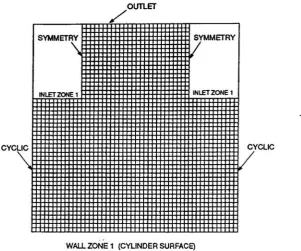
use a unique grid structurethatis
a combinationofO-type
gridsaroundthecylinder and
hexagon
gridsfar
upstream anddownstream from
the
cylinder.This
grid structure
is
shownin Figure 2-1. This
grid structureis
effectivefor getting
good resultsaroundthecylinder
using
the
O-grid
and alsofar
afieldfrom
thecylinderusing
the
hexagon
grid.
A
key
simplifying
assumption madein
this
paperis
the
assumptionthat
a'free
stream'boundary
conditionis
usedtosimulatethe
wallssurrounding
theflow. The free
streamboundary
conditionimplies
that thestreamfunction is
equalto zero and alsothe
vorticity is
equal
to
zero.Kim
andChoudhury
accomplishthis
by
setting
the
outer walls assymmetry
boundaries. The
assumptionoffree
streamboundary
conditions aredesigned
to
have
the
effect of
removing
the
wallfrom
the
solution.Depending
onthe
numerical approachused,
different
authors usedifferent
techniques to
approach afree
streamboundary
condition atthe
Figure
2-1
O-H Grid
Structure
usedby
Kim
andChoudhury (1990)
CYCLIC
SYMMETRY
INLET ZONE 1
/
OUTLET
/
SYMMETRY
INLETZONE 1
CYCLIC
WALL ZONE1 (CYLINDER
SURFACE)
Computational
Grid
SYMMETRY
OUTLET
[image:29.557.132.434.159.410.2]Kim
andChoudhury
(1993)
statethat
in
the
vicinity
ofRecyi
=5,
the
flow
startsto
separateto
form
a pair ofrecirculating
eddies attachedto
the
body.
They
also statethe
eddiesformed
behind
the
cylinder remainstationary
until anotherbifurcation
takesplace aroundRecyi
=40.
Beyond
Recyi
=40,
the
flow
becomes
asymmetric andunsteady,
being
accompaniedby
alternate vortex shedding.
Kim
andChoudhury
(1993)
present alloftheirresultsbased
onRecyi
=60.
For
the work presentedin
this
reporttheRecyi
willbe
equalto
42
orless. The
Recyi
approximately
equalto
40
was chosenbecause
it
representsthe
actualflow
ratefor
thePCR
process.
Unfortunately
this
is
the
Reynolds
numberthat
is
the
dividing
pointbetween steady
flow
andunsteady flow
causedby
vortex shedding.The
resultsdescribed
by
Kim
andChoudhury
(1993)
are consistentwithexperimental resultsavailable
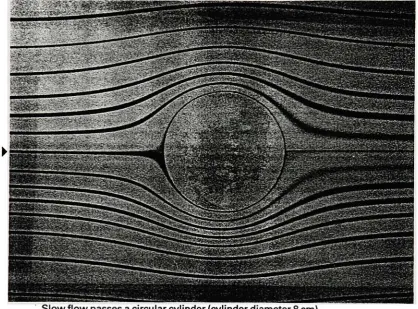
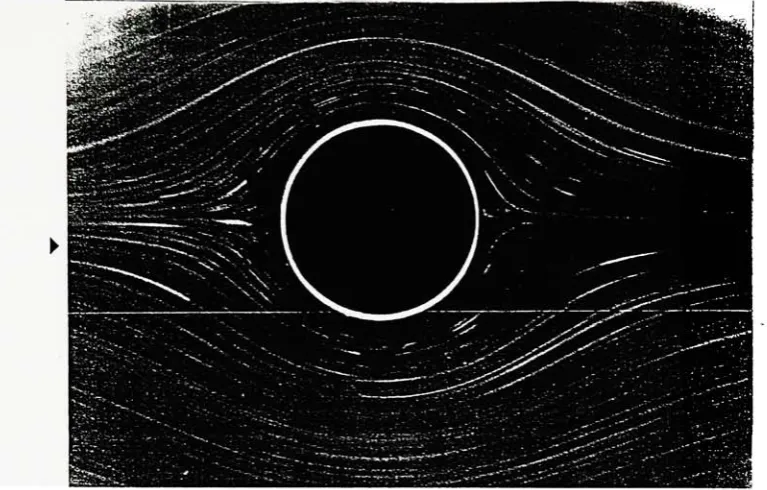
in literature. Shown in Figure 2-2
are someflow
experimentalflow
resultsfrom
Nakayama
(1988)
for very low Reynolds
numbers ofless
than
2. Notice
thatthere
are noeddies onthe
back
side ofthe
cylinder.As
the
Reynolds
numberis increased
theeddiesdo
begin
to
form. Figure 2-3
shows somemoreexperimental results
for Nakayama
(1988)
for Reynolds
numbers of16
and26. Once
theReynolds
numberis
increased higher
the eddiesbecome
unstable andbegin
to
shed.Figure
2-3
also shows anotherexperimental resultfor Nakayama
with aReynolds
number of55. At
thispointtheeddies arenotattachedtotheback
ofthe cylinder,
andtheflow is
nowFigure 2-2
Experimental Flow
Pattern
for
Low
Reynolds
Number
Flowaround a circularcylinderatRe=0.038
(glycerine,
flow velocity0.15cm/s,
cylinderdiameter 1.0 cm,tankwidth40cm,aluminium powder method).
Figure 2-3
Experimental
Flow Pattern
atReynolds Numbers
of19, 26,
and55
Flow
around acircular cylinderatRe
= 1
9
(water,
flow
velocity
0.20
cm/s,cylinderdiameter
1.0 cm, aluminium powdermethod and electrolytic precipitation
method).
Flow
around acircularcylinder atRe
Flow
around a circular cylinder atRe
=
26
(water,
flow velocity 0.25
cm/s,cylinder =55
(water,
flow velocity 0.55
cm/s,cylinderdiameter
1.0
cm, aluminium powderdiameter
1.0
cm, aluminium powderThe
numericalresultsfrom
this
analysis willbe
comparedto the
resultsofBraza
etal.(1986),
Dennis
andChang
(1970),
andFornberg
(1980). All
these
papersbecause
ofsimplifying
boundary
conditions onthe
wallsbase
the
Reynolds
number onthe
cylinderdiameter
ratherthan the
channel geometry.Dennis
andChang
(1970)
solvedthe
2-D flow
problemfor
5
<Recyi< 100 using
afinite
difference
solutiontechnique.
Dennis
andChang
(1970)
alsoapply
the
free
streamboundary
condition at
the
wall.They
do discuss
other possibleboundary
conditionsbut do
not giveany
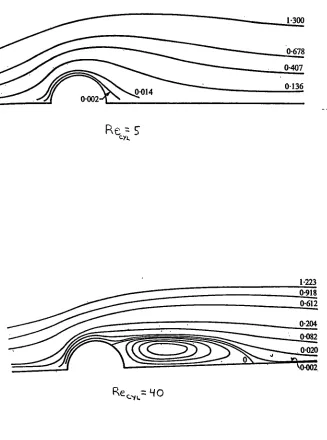
results.Figure 2-4
showsthestreamline
plotsfrom Dennis
andChang
(1970)
for
Recyi
equal
to
5
and40. Notice
the
difference
in
the
flow
patternbehind
the
cylinder.The
Recyi
=40
plotclearly
showsthecirculating eddy
that
werepreviously discussed. This
eddy
does
not occurfor
the
lower
Recyi
.The
other portionofthe
Dennis
andChang's
(1970)
resultthat
is
ofinterest is
the
resultsfrom
the
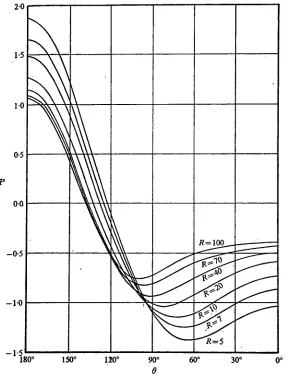
pressure coefficient onthecylinder surface.Dennis
andChang
(1970)
define
adimensionless
pressure coefficient givenin
equation2-1
.Figure 2-5
showsthe
result ofthis
pressure coefficient
for different Reynolds
numbers.Figure
2-4
STREAMLINES
FOR
STEADY
FLOW
PAST A CIRCULAR
CYLINDER
FOR
Re
=5 AND 40
,
Dennis
andChang (1970)
c-n.
1-223
[image:34.557.141.468.165.605.2]Figure
2-5
DIMENSIONLESS
PRESSURECOEFFICIENT ON THE CYLINDER
SURFACE,
Dennis
andChang (1970)
20
1-5
10
0-5
00
-0-5
-10
-1-5
180'
^
\
i
%
\|
.R=100___^
(^150 120 90
e
[image:35.557.140.429.178.552.2]Fornberg
(1980)
analyzedtheflow
overthe
cylinderin
a similarmethodto
Dennis
andChange
(1970). The
maindifference
is
Fornberg
(1980)
places much greater emphasis onthe
types
ofboundary
conditionsto
apply.He
points outthe
calculationsfor vorticity
aroundthe
cylinder canhave
an errorin
excess of20%
whenusing
afree
streamboundary
condition.This
is
true
evenif
the
boundary
conditionis
appliedfar away (23
times the
radius) from
the
cylinder
body.
Fornberg
considersfour different
boundary
conditions.1
.Free
stream2.
One
term
oftheOseen
approximation3.
Normal
derivative
of streamfunction
=0
4.
A
mixed condition of option1
and3
The
free
streamconditionimplies
that
thestreamfunction
equals0
atthe
wall.This
willneglecttheeffectofthe
boundary
layer
onthewall.Combining
thiswiththe
gradientbeing
zerodoes
notfully
take
into
accountthe wall effect.To
get thefull
walleffect one needsto
make the actualvelocity
equaltozeroand allowtheboundary
layer
atthewalltoform.
Fornberg
presents resultsvery
similarto
Dennis
andChang
(1970)
for
streamline
andvorticity.
The
paperpresentsresultsfor 2
<Recyi< 300.
A different
solutionmethodis
usedfor Reynolds
numbersless
than10,
but
nodetails
are given onthis solution method except thatit
is
based
onafast Poisson
solver.The
reportofBraza
et al.(1986)
comparesthe
numerical resultsto
experimental resultsfrom
different
authors.The
solution methodusedis
similartoFLUENT
in
that the
governing
equations arewritten
in
avelocity-pressureformulation
andin
conservativeform,
are solvedby
apredictor-correctorpressuremethod,
afinite
volume second order accurate scheme andBraza
(1980)
also uses afinite
volumetechnique
(the
sameasFLUENT)
instead
of a straightfinite
difference
technique
like Dennis
andChang
(1970). Braza
statesthatthe
governing
equationsintegrated
over anelementary
control volume enhancethe
local
massandmomentumconservation near
the
boundaries
better
thana simplefinite
difference
approximation scheme.
Braza
(1980)
also rewritesthe
governing
equations and solvesthem
in
alogarithmic-polar
coordinate system.This
makesthe
gridconfigurationconformcloserto the
cylinder geometry.The
results ofBraza
et al.(1980)
show a greater negative pressure coefficientthanthe
results of
Dennis
andChang
(1970). For
aReynolds
numberof40,
Braza
etal.(1980)
have
a minimum value of-1.19whereDennis
andChang
(1970)
have
a minimum value of-0.95.Braza
et al.(1980)
does
give adifferent definition for
the
pressure coefficientCp
than
Dennis
andChang
(1970). It is believed
by
this
authorthatBraza's
definition is
atypographic
mistakebecause
the
results presented agree well withother published results.Using
Braza's
definition
as published wouldresultin significantly different
results.One
ofthereasonsfor
thedifferent
resultsbetween Braza
et al. andDennis
andChang
is
because
they
each useslightly different
governing
equationsto
define
theflow field.
Braza
et al.have
writtenthegoverning Navier-Stokes
equationsin
terms
ofpressure andvelocity.
Dennis
andChang
have
simplifiedthegoverning flow
equations and writtenthe
equationsin
termsofstreamfunction
andvorticity.Extensive
use was also madethroughoutthisreportofthe
classicbooks
that
have been
2.1
BASIC
GOVERNING
EQUATIONS
The
following
section presents some ofthetop
level
governing
equations.These
equationscan
be found in
oneform
or anotherin
standardfluid
mechanicstext
books. The
following
discussion
willinclude
both
realfluids
withviscosity,
and noslip
atthe
solidsurface,
along
with
ideal flow
wheretheflow is
allowedto
slip
andthe
viscosity is
assumed zero orneglected.
Most
ofthe
theory
summarizedhere
wascontainedin books
by Schlichting
(1979),
Churchill
(1988)
andFox
andMcDonald
(1985).
2.1.1
FLUID FLOW GOVERNING EQUATIONS
Given in Figure 1-1 is
thegeometry for
the
PCR
detection
chamber.The
small size ofthechamber and
the
minimal amounts offluid
meanthatthe
Reynolds
numberwillalwaysbe
very low
.Re
=p_ULc
(2.2)
M-For
the
geometry
ofthePCR
detection
chamberthecharacteristiclength is
the
hydraulic
diameter.
Lc=Dh=4Ac
(2.3)
P
Most
ofthepublishedliterature
concentratesontheflow
aroundthe
cylinder andsimplifying
the
wallboundary
conditions.For
this reasonthe
characteristiclength
usedin
the
publisheddata
is
the
cylinderdiameter. In
thisreportthe
Reynolds
numberbased
onthe
cylinder willThe Navier Stokes
equations andthe
conservationof mass(or
continuity)
equationthat
define fluid flow in
the
detection
chamber areasfollows
continuity:
3p_
+V(pu)
=0
(2.4)
3t
pDu =
-Vp
+ |iV2u(2.5)
Dt
Where
D
d
d
d
d
= +u- +v+w
(2.6)
Dt
dt
dxdy
dz
V=i+J+k
(2.7)
dx
dy
dz
u = i +
vj
+ wk(2.8)
This form
oftheNavier-Stokes
equation assumesincompressible flow
and variationsin
the
fluid viscosity
canbe
neglected.Both
ofthese
assumptions are validfor
the
analysisin
the
PCR detection
chamberbecause
the
flow velocity is very low
andthe
chamberis
held
at aconstanttemperature.
In
the
case offrictionless
flow,
wherethe
viscosity
is low
and canbe
neglected
([J.
=0),
the
Navier-Stokes
equationcanbe
reducedto
Euler's Equation.
Du
_p =pg-V/>
Even
though
all realfluids have
viscosity, there
is
a significant amount ofpublishedwork onideal fluid flow.
Flow
with zeroviscosity
is defined
asinviscid fluid
flow. There
are noshear stresses present
in
inviscid
fluid
flow.
2.1.2 POTENTIAL FLOW
For
classical potentialflow
theory,
theflow
mustbe both inviscid (fi
=0)
andirrotational.
The
key
assumptionin
this type
offlow is
that
fluid friction
neartheboundary
canbe
neglected.
In
realfluids
this
is
nevertrue, but
potentialflow
can give acceptableunderstanding
ofthe
flow
phenomena provided youdo
notlook
too
closeto
theboundary
wall.
Potential flow
analysisis
avery
populartechniquebecause
thereare alarge
number ofanalytical solutions
representing different
types
offluid
flow. Potential flow
analysisis
currently
being
usedto
help
in
the
design
ofairplanes,
boats,
and automobiles.There is
alarge
body
of workthat
falls
undertheheading
ofPotential Flow. This
report willconcentrate on
only
twodimensional
potentialflow. In
two
dimensions,
with constantdensity,
the
conservation ofmass givenin
equation2.4
reducesto
thefollowing.
+
-0
(2.10,
dx
dy
The
streamfunction
is defined
suchthatit
also satisfiesthe
continuity
equation.u=
(2.11)
3y
v=
The
samecontinuity
equation and streamfunction
canbe
defined in
cylindricalcoordinates.This
willbe
very
usefulfor
looking
atflow
around acylinder.drV
dV
Conservation
of mass: + - =0
(2.
13)
dr
dd
Stream
function:
V=-^-(2.14)
r
dO
Ve=-d-l
dr
(2.15)
To be
a potentialflow
the
flow
mustbe both inviscid
andirrotational. For irrotational flow it
is
possibletodefine
avelocity
potential asfollows.
V
=-VO>(2.16)
The
abovedefinition
for
thevelocity
potentialis
notconsistent acrossdifferent fluid
textbooks.
Many
sourcesdefine V
=V<E>
.
This
report will use equation2.16
because it leads
to
thepositive
direction
offlow
being
in
the
direction
ofdecreasing
potential.In
cylindricalcoordinatesthe
velocity
potentials aredefine
asfollows.
d
Vr=~
(2.17)
dr
For irrotational flow
the
fluid
elementsin
the
flow field do
not undergoany
rotation.This
leads
to the
following
equationfor
anirrotational flow.
^-^
=0
(2.19)
dx
dy
Substituting
the
definition
for
the
streamfunction (eq. 2. 1 1
and2.12)
into
the
irrotational
flow
equation(2.19),
andsubstituting
the
velocity
potentialequation(2.16)
into
the
continuity
equation(2.10)
it is
possibletoobtaintwo
equationsthatareboth forms
ofLaplace's
equation.Also any function *P
orO
that
satisfiesLaplace's
equationrepresentsapossible
two-dimensional,
incompressible,
irrotational flow field.
t
+^-T
=(2-2)
3x2 3y2
<92<D (920
^+^=
<221)
Part
ofthereason potentialflow
analysisis
so oftenusedis
thatdifferent elementary flow
patterns can
be
addedto
one anothertocreate a complexflow
pattern.Both
<1>(velocity
potential)
and*F (stream
function)
satisfy Laplace's
equationfor flow
that
is
incompressible
and
irrotational. Since Laplace
equationis
linear
andhomogeneous
partialdifferential
equation solutions
may be
addedtogether.
Using
superpositionit
is
possibleto
simulatethe
flow
aroundthe
cylinderandthewallsfor inviscid
flow.
Superposition
canbe
usedbecause
each potential
(O3
=Oi
+O2)
is
a unique solution ofLaplace's
equation,
V2<P
=0. To
createflow
around acylinder,
superpositionis
usedfor
uniformflow
past adoublet. A doublet is
acombinationofa source and sink
ideal flow. Figure 2-6
showsthe
flow
configurationfor
aFigure
2-6
UNIFORM
FLOW
AROUND
A
CYLINDER
--LL
oOr-a
Uniform
Flow;
velocity
potentialstream
function
O
=-Ux =-U^rcosO(2.22)
(2.23)
Doublet;
velocity
potential <D=-Acos0
(2.24)
stream
function
*F
=-Asin0
(2.25)
Cylinder;
^cyl
=^uniform
+^doublet
(2.26)
= U rcosd
-Acosfl
(2.27)
Any
closed streamlinecanbe
takenasthe surface of a solidimmersed in
thefluid flow. This
means
the
cylinderwallis
representedby
the
streamline*F
=0. For
theinviscid flow
aroundacircular cylinderwithradius=
a,
andA=U^a2
,
Churchill
(1988)
givesthe
following
equations
for
thepotentialfunctions
and streamfunctions in
cylindrical and rectangularcoordinates.
0
=-u' a2^
r+
K
r J,2
A
cost?=
-ux\
1
+ 2 , 2x
+y
)
(2.28)
T
=-uM
(
a2^ r^
rJ
(
sin=-uy
,2
>
1
+2 . 2
The
velocity
componentsin
cylindrical coordinates are1
dy/
. aur
= -- =U,
rd6
'l-^lcosfl
(2.30)
V
6
dr
fi
2)
V rJ
sing
(2.31)
The velocity
atthe
surface r=ais
then"e,fl=-2LLsin0
(2-32)
u =
0
(2.33)
The velocity is
seento
be
zero attheforward (0
=7t)
andrear(0
=0),
whichare calledthepoints ofstagnation.
The
pressuredistribution is
given asPa=P+
^=- [1-4
sin2d]
(2.34)
The
previous equationshave
defined how
topredict anideal fluid flow for
uniformflow
around acylinder.
These
equationsdo
nottakeinto
accountany
effect walls outsidethe
cylinderwould
have
ontheflow. To
createthe
wallsthe
method ofimages
canbe
used."The
methodofimages
wasintroduced
by
Kelvin
for
usein electricity
andlater
usedby
Helmholtz
andStokes in fluid
dynamics."
Granger
(1975)
To
model uniformflow
over a cylinderbetween
two
walls requiresthat the
singularity inside
the walls,
which willbe
the
sameideal flow doublet
thatwaspreviously
discussed,
the
doublet
willhave
to
be
reflected outsidethe
walls.Note
that to
fully
accomplishthis
eachreflectionwill
have
to
be
reflecteditself,
whichmakesthe
final
solutiona series ofreflections.
Figure
2.7
shows arepresentation ofthe
reflecteddoublet. The
cylinderis
defined
the
same asin
the
previous sectionby letting
the
cylinder radiusbe
the
point wherethe
streamfunction
is
equalto
zero.Chung
(1978)
givesthe
streamfunction
andhorizontal
velocity using
themethod ofimages
asfollows.
=
/_
?-hr-H
lit
sinh'
(id>\
.
(2jty
sin
-\H)
V
H
H
,2i
nx)
i(xy
cosh cos '
H
(2.35)
The velocity is determined
by
taking
the
derivative
ofthe
streamfunction.
d*F
Vx
=^r-
=U.
xdy
1-sinh'
Kb^
(2iiy
cos -cosh'
^KX^
VH;
-cos^7ty^
+-2
{Hj
sm'27cy
cosh'TtXh".
cos 'icy"(2.36)
vy
=-dx
2
"
Ih,
sin
-sinh
I
H
J
I
H
J
cosh2
Ih
-cos2f
ny
H
A
nice aspect of potentialflow
is
that
afterdetermining
the streamfunction
andthen
taking
the
derivatives
to
getthe velocity, the
velocities canbe input
into
Bernoulli's
equationto
getthe
pressureprofile.Zj_
+ghi
+PL
=^L+gh2
+P^
(2.38)
2
P
2
p
The
flows
thatwillbe
discussed
in
this
report willhave
negligible changein
elevation(h)
and will also
have
constantdensity. Also
onthe
cylindrical surfacethe
radialvelocity is
zero.
Pcy,=P~+^(ui-Ue2)
(2.39)
The
above equationcanbe
rearrangedtoputit in
thesameform
as equation2. 1
whichdefines
thenon-dimensional pressure coefficient.Figure
2-7
DOUBLET
REFLECTED
USING
METHOD
OF
IMAGES
///'//
^-t
/
/
H
3.
THEORETICAL ANALYSIS
3.1 FLUID FLOW IN RECTANGULAR DUCTS
The
solutionfor
the
axialvelocity
(u)
for
fully
developed laminar
three
dimensional
flow in
a rectangular
duct is
asfollows.
u =
16Cia2
n~
:1-\ s n
2
n=l,3,5
cosh
1
2a
cosh nKb
2a
cos
(
nnz^V
2a
j(3.1)
For
the above equationC\
is
afunction
ofthepressuredrop
andtheviscosity.Shah
andLondon
(1978)
givethe
equationfor
the
meanvelocity
(Um)
relatedto
Q
asfollows.
Ci=
3
Ur
7t5
UJil..n5
I
2a
-1
2a
j(3-2)
The
results oftheabove equationshowthatflow in height direction
(H)
direction is very
much
like
the
flow between
two
parallel plates.Figure 3.1 is
a plot ofthe
velocity
profileFigure 3-1
VELOCITY
PROFILE
ACROSS GAP
HEIGHT
n =1,3..
19
C,:=l z:=0.0 a:=l b:=l0.5
ys
o
-0.5
\
\
\
\
\
\
1
J
/
\
-^
^"
0
0.05
0.1
0.15
0.2
0.25
0.3
Looking
at thetop
ofthe channel,
acrossthe width, the
flow
maintainsauniformvelocity
except nearthewalls.
This
result gives anunderstanding
ofwhy
the
Hele-Shaw
cellpreviously discussed
worksvery
wellfor simulating ideal flow in
twodimensions. Except
for
a smallboundary
layer
nearthe edge, the
flow velocity looks very
muchlike ideal flow.
Figure
3-2
shows a plotlooking
down
onthe
top
oftherectangularduct.
Figure 3-2
representstheflow
looking
atthetop
ofthe cell,
orthevelocity
gradientacrossthe
width.The flow looks exactly like inviscid irrotational flow in
two
dimensions (2-D slug
flow),
if
the
edge effectsnearthe
walls are neglected.This
means we can treatthe
flow
asideal flow
and use potential equationsto
modelflow
aroundany
objectslocated in
this
area.This
type
offlow has been
analyzedexperimentally
by
theuseofHele-Shaw
cells.The
flow
field for
aHele-Shaw
cell canbe
shownto
satisfy
the
Laplace
equation.When
a cylindricalobjectis
placedin
thegap
of aHele-Shaw
cell,
theequations showthatthemean
velocity is
thegradient of a potentialfunction. This
meanstheflow field
pasttheFigure 3-2
FLUID VELOCITY ACROSS
GAP WIDTH
n =1,3..199 y :=
0 a- 0.00254
m b:=3.8098 10
Um=0.01m/s
0.002
z.
l
0
0.002
______-_._____-__-___-.
0
0.005
0.01
0.015
0.02
3.2 INVISCID IRROTATIONAL FLOW IN TWO
DIMENSIONAL FLOW
This
section will presentthe
solutionfor
the two
dimensional flow
witha cylindricalobstruction.
The
two
dimensional
flow
field
willbe
solvedin
acoupleofdifferent
methods.1.
2-D
potentialflow
without walls2.
2-D
potentialflow using
the method ofimages
to
simulate wallsMethod
1,
2-D
potentialflow
without walls willsimulatethe
uniformflow
arounda cylinderthatwas
discussed in
section2.1.2. Method 2
willdetermine
theeffectofadding
thewalls.There
willbe
threeaspects oftheflow
solutionthat willbe important.
1.
flow velocity
2.
streamline pattern3.
pressuredistribution
The flow velocity is important because in
the
actualPCR
process onefluid
must pushouttheprevious
fluid. Experimental
resultshave
shownthecurrentPCR
pouchhas
sometroublecleaning
outthecornerareas ofthedetector
chamber wherethe
flow velocity
willbe
aminimum.
The
streamline pattern willbe
calculatedbecause
this
is
a visual representationthat
canbe
qualitatively
comparedto the
experimentalandnumericalresults shownin
section2.
FLUENT
also can providenumericalresultsfor
the
streamfunction
at particular points.This
The
third
aspect ofthe
fluid flow
that
willbe
investigated
willbe
the
pressuredistribution.
This is
important because
in
the
PCR
processthe
signalis
measuredusing
acolor reflectiondensitometry.
How
much coloris
ableto
diffuse into
the
detection
probe canbe
optimizedby
maximizing
thepressuredistribution
aroundthe
detector
probe.3.2.1 POTENTIAL FLOW
FIELD FOR UNIFORM FLOW
OVER A
CYLINDER
Figure 3-3
showstheplot ofthestreamline function for
a particular geometry.These flow
patterns are
based
onusing
equation2.29.
The
interesting
thing
to
noteis
thatFigure 3-3 does
not showany
ofthe
recirculating
eddiesthatshould occur
for
aReynolds Number
of40. This is because
this
plotis based
onthe2-D
potential
flow
theory
which neglectsthe
boundary
layer
aroundthe
body. This
meansthis
theory
is
reasonable ontheforward
sideofthe cylinder,
but does
notdo
a goodjob
onthe
aftside.
The
other aspectto
considerin
this
resultis
what possible effecttheaddition of walls wouldhave
onthe
flow
pattern.The
baseline geometry for
this
effort considersthe
outer wallto
be
approximately 1.8
times
thedetection
probe radiusaway from
the
origin.The
top
3
flows
would
be impacted
by
a walllocated in
this
position.This
is
part ofthe
reasonFornberg
Figure 3-3
STREAMLINE PLOTS
USING
POTENTIAL FLOW THEORY
^
"X
.
X
^
H)=4TJ
.
/
^- wall
locaii'on
*or
fcK
.
--~
""
~
*N
__
X x
\
\f--zo
=s--4 -2 0 2 4
-r-i
"n
(*^l)
Given in Figure 3-4 is
a plot of the pressuredistribution using
the
equation2-34
whichhas
been
non-dimensionahzedto
be in
the
sameform
asequation2. 1
.The
resultsshowthat themaximum positive pressure occurs at
the
twostagnationpoints of0and180. When
comparing
the
resultto
Dennis
andChang
(1970)
givenin Figure
2-5,
the
results are similarin
shape onthe
front
side ofthecylinderbut
thepressurefully
recovers onthe
backside
ofthe cylinder,
whichdoes
nothappen for Dennis
andChang
(1970)
because
they
take
into
account
the
boundary
layer
separation aroundthecylinder.3.2.2 POTENTIAL FLOW RESULTS USING METHOD OF IMAGES
In
section3.2.1,
potentialflow
aroundthecylinderwasdiscussed. It did
notinclude
the
effectofthewalls aroundthecylinder.
Using
themethodofimages,
Section 2. 1.2
discuss
how
themethod ofimages
can accountfor
thewallsby
reflecting
theflow
singularitiesoutsidethewall
boundary.
Given in Figure 3-5
is
a plot ofthe
streamlinesusing
equation2.35. Unlike
the
resultsin
Figure
3-3,
these resultsdo
takeinto
accountthe
effect ofthe
wall onthe
fluid flow. This
result shows
how
themethodofimages
canbe
usedtopredictflow
patternswithinachannel.
The
otheritem
to
noticein Figure 3-5 is
thatit
stilldoes
not predictthe recirculation zone onthe
back
end ofthe
cylinder.This
is because
thisresultis
stillbased
onthe
potentialflow
theory
that
allowsthe
flow
to
slip
onthecylinderwalls and also assumesthe
fluid has
zeroFigure
3-4
PRESSURE DISTRIBUTION
USING
POTENTIAL FLOW
THEORY
1
"\
/
^
0.2
a
P c
\
a. 1.*
\
~2.2~3
20 40 60 80 100 120 140 160 180
e
Figure 3-5
STREAMLINE
PLOTS USING
THE METHOD OF IMAGES
wal
_jL
_.
.
_-~~" ~~"
~-..
qj^is
/
--u)= :o
/
i
I
\
l|J=.3
/
X
set.
wru
When
comparedto thefluid
flow
overthecylinder withoutwalls, the
methodofimages does
show
how
the
wall would causethe
velocity
ofthe
fluid
overthe
cylinderto
increase. Figure
3-6
shows avelocity
plotcomparing
the two
cases.For
flow
over